Irving ISD Technology Plan“To realize the benefits of technology, schools must develop a plan for integrating technology into the curriculum.” (November & Staundt, 1998)Pam EndicottLamar UniversityEDLD 5362
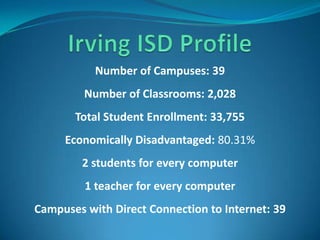
Irving ISD ProfileNumber of Campuses: 39Number of Classrooms: 2,028Total Student Enrollment: 33,755Economically Disadvantaged: 80.31%2 students for every computer1 teacher for every computerCampuses with Direct Connection to Internet: 39
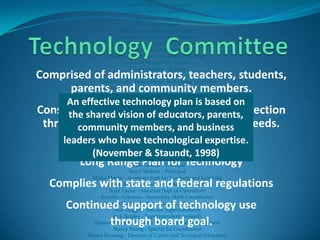
Jonathan Traughber ‐ studentTaelerDeHaes ‐ studentGina Bates ‐ parentKaren Faris ‐ parentHong Sae ‐ Community MemberMart Nelson ‐ Community MemberBill Morgan ‐ Community MemberToni Clark – Community MemberRosemary Robbins ‐ Community MemberGabrielle McCollum ‐ TeacherTiffany Holmes ‐ TeacherLisa Hill ‐ TeacherKeith Wyrick – Instructional Technology SpecialistSherri Marchant ‐ Instructional Technology SpecialistCarla Nutt ‐ Instructional Technology SpecialistChris Johnson ‐ Instructional Technology SpecialistRhonda Phillips ‐ Instructional Technology SpecialistLori Bierschwale ‐ LibrarianLea Bailey ‐ Director of LibrariesMargaret Malzer ‐ Campus TechnicianMiguel Elizondo ‐ Vice PrincipalEric Creeger ‐ Vice PrincipalRobert Abel ‐ PrincipalPatty Notgrass ‐ PrincipalRick Nolly ‐ PrincipalJackie Gorena ‐ PrincipalRocci Malone ‐ PrincipalMarie Morris ‐ Assistant Supt for Teaching and LearningRalph Diaz ‐ Assistant to the SuperintendentScott Layne ‐ Assistant Supt of OperationsJennifer Hylemon ‐ Secondary Math CoordinatorJennifer Jackson ‐ Secondary ELA CoordinatorNeil Dugger ‐ Interim SuperintendentJack Singley ‐ Superintendent (retired)Dianna Hopper ‐ Director of Professional DevelopmentNancy Young ‐ Special Ed CoordinatorShawn Blessing ‐ Director of Career and Technical EducationJudy Rudebusch ‐ Director of Special ProgramsRobyn Wolters ‐ Director of PersonnelCheryl Jennings ‐ Director of Elementary EducationWhit Johnstone ‐ Director of Research, Evaluation and AssessmentKelly Horn ‐ Director of FacilitiesTony Thetford ‐ Director of Public RelationsDarrell Vaughn ‐ Network AdministratorBob Harmon ‐ WebmasterJerramFroese ‐ Instructional Technology CoordinatorLorie Squalls ‐ Instructional Technology CoordinatorMikieKindsfather ‐ Instructional Technology CoordinatorSam Farsaii ‐ Director of Instructional TechnologyLee Watts ‐ Director of Networking / Data ProcessingKeith Larson ‐ Director of Technical ServicesAlice Owen ‐ Executive Director of TechnologyTechnology  CommitteeComprised of administrators, teachers, students, parents, and community members.Constructed a vision for the future and direction through an action plan detailing future needs.Aligned to components of the Texas Long Range Plan for TechnologyComplies with state and federal regulationsContinued support of technology use through board goal.An effective technology plan is based on the shared vision of educators, parents, community members, and business leaders who have technological expertise. (November & Staundt, 1998)
Board Goal Related to Technology “Require all professional staff to effectively facilitate teaching and learning by actively participating in high quality staff development and using a variety of technological resources to engage students so that all graduates can succeed in a 21st century environment.” (Irving ISD Board Goal#4, 2010)
Technology Plan PurposeArticulate a common vision for technology.Identify strategies to use technology.Promote student achievement of rigorous standards.Develop essential critical thinking skills. Prepare students to be productive citizens.
Technology Plan RationaleVital for the 21st century.Integrate, interesting, motivating, and relevant.Personal computing device for all students K-12.Tools for teaching and managing information.Students responsible for own learning.Accessible at all times.
Technology Plan GoalsInfuse higher level thinking.Support assessment and planning.Educate all students and teachers.Ensure ongoing professional development.Ensure 100% administrative participation.Provide leadership.Ensure a stable and robust infrastructure.
Technology Plan CoversFour Major AreasIntegration of Technology into Teaching and LearningProfessional DevelopmentAdministration and Support ServicesInfrastructure for Technology
Teaching and LearningIntegrate Technology Applications TEKS and higher order thinking into 100% of curriculum areasIncrease  technology integrations annuallyProvide adequate technologyEducate students on appropriate use of technology  Educate students on appropriate use of InternetImprove instructional practice, model lifelong learning, and exhibit leadership
Professional DevelopmentOrient teachers in appropriate use of technology Orient teachers in Internet SafetyProvide job-embedded technology trainingProvide technology integration training
Administration & Support ServicesIncrease administrator participationIncrease use of technologyEstablish, communicate, support, and monitor expectations for technology integrationModel ways to address students’ diverse learning styles, working strategies, and abilities
Infrastructure for TechnologyAchieve and maintain a 1:1 personal computing device.Provide adequate technology.Identify needs, procure and maintain technology resources.Increase reliability to ensure dependable and continuous operation.Develop a sustainable system.
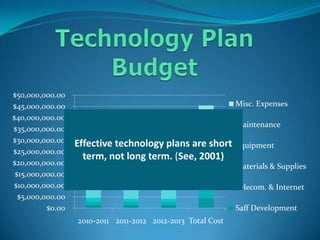
Technology Plan BudgetEffective technology plans are short term, not long term. (See, 2001)
Technology Plan Evaluation MethodsReview progress at least once a year.Reports to Superintendent and Irving ISD Board.Plan updated as needed.Review data each year to measure effectiveness.
Technology Plan Evaluation Methods (cont.)Review of staff development records.Review TAKS scores and district assessments.Review data from networking monitoring tools.Track parent phone calls and website hits receivedProject management tools.
Are we measuring up?National Technology Plan5 Goals  By 2014Fundamentally change the learning process.Use technology in second generation of assessments.Connect teachers with their peers.Infrastructure allows access in and out of school.Harness the power of technology
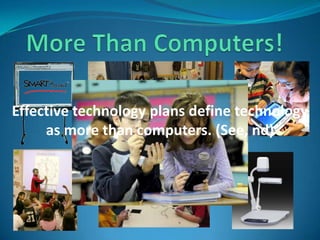
More Than Computers!Effective technology plans define technology as more than computers. (See, nd)
“The Irving ISD, in partnership with families and the community, shall meet the educational needs of students by producing engaged learners who are critical thinkers, leaders, and contributors in a technological, diverse, and competitive 21st century world.” (Irving ISD)
ResourcesIrving Independent School District Technology Plan. Retrieved from http://www.irvingisd.net/technology/documents/lrtp.pdfNoir, S. (producer).  Arne duncan talks about the 2010 national   ed tech plan:  Retrieved May 14, 2011, from    http://www.youtube.com/watch?v=Z0PctTd_plENovember, A., Staundt, C., (1998). Critical issue: developing a         school or district technology plan. Retrieved February 9,          2010, from North Central Regional Educational Library:        http://www.ncrel.org/sdrs/areas/issues/methods/technlgy/te30       0.htmSee, J., (nd). Developing effective technology plans. Retrieved  May          14, 2011 from http://www.nctp.com/html/john_see.cfm

EDLD 5362 Technology Plan Assignment

  • 1.
    Irving ISD TechnologyPlan“To realize the benefits of technology, schools must develop a plan for integrating technology into the curriculum.” (November & Staundt, 1998)Pam EndicottLamar UniversityEDLD 5362
  • 2.
    Irving ISD ProfileNumberof Campuses: 39Number of Classrooms: 2,028Total Student Enrollment: 33,755Economically Disadvantaged: 80.31%2 students for every computer1 teacher for every computerCampuses with Direct Connection to Internet: 39
  • 3.
    Jonathan Traughber ‐studentTaelerDeHaes ‐ studentGina Bates ‐ parentKaren Faris ‐ parentHong Sae ‐ Community MemberMart Nelson ‐ Community MemberBill Morgan ‐ Community MemberToni Clark – Community MemberRosemary Robbins ‐ Community MemberGabrielle McCollum ‐ TeacherTiffany Holmes ‐ TeacherLisa Hill ‐ TeacherKeith Wyrick – Instructional Technology SpecialistSherri Marchant ‐ Instructional Technology SpecialistCarla Nutt ‐ Instructional Technology SpecialistChris Johnson ‐ Instructional Technology SpecialistRhonda Phillips ‐ Instructional Technology SpecialistLori Bierschwale ‐ LibrarianLea Bailey ‐ Director of LibrariesMargaret Malzer ‐ Campus TechnicianMiguel Elizondo ‐ Vice PrincipalEric Creeger ‐ Vice PrincipalRobert Abel ‐ PrincipalPatty Notgrass ‐ PrincipalRick Nolly ‐ PrincipalJackie Gorena ‐ PrincipalRocci Malone ‐ PrincipalMarie Morris ‐ Assistant Supt for Teaching and LearningRalph Diaz ‐ Assistant to the SuperintendentScott Layne ‐ Assistant Supt of OperationsJennifer Hylemon ‐ Secondary Math CoordinatorJennifer Jackson ‐ Secondary ELA CoordinatorNeil Dugger ‐ Interim SuperintendentJack Singley ‐ Superintendent (retired)Dianna Hopper ‐ Director of Professional DevelopmentNancy Young ‐ Special Ed CoordinatorShawn Blessing ‐ Director of Career and Technical EducationJudy Rudebusch ‐ Director of Special ProgramsRobyn Wolters ‐ Director of PersonnelCheryl Jennings ‐ Director of Elementary EducationWhit Johnstone ‐ Director of Research, Evaluation and AssessmentKelly Horn ‐ Director of FacilitiesTony Thetford ‐ Director of Public RelationsDarrell Vaughn ‐ Network AdministratorBob Harmon ‐ WebmasterJerramFroese ‐ Instructional Technology CoordinatorLorie Squalls ‐ Instructional Technology CoordinatorMikieKindsfather ‐ Instructional Technology CoordinatorSam Farsaii ‐ Director of Instructional TechnologyLee Watts ‐ Director of Networking / Data ProcessingKeith Larson ‐ Director of Technical ServicesAlice Owen ‐ Executive Director of TechnologyTechnology CommitteeComprised of administrators, teachers, students, parents, and community members.Constructed a vision for the future and direction through an action plan detailing future needs.Aligned to components of the Texas Long Range Plan for TechnologyComplies with state and federal regulationsContinued support of technology use through board goal.An effective technology plan is based on the shared vision of educators, parents, community members, and business leaders who have technological expertise. (November & Staundt, 1998)
  • 4.
    Board Goal Relatedto Technology “Require all professional staff to effectively facilitate teaching and learning by actively participating in high quality staff development and using a variety of technological resources to engage students so that all graduates can succeed in a 21st century environment.” (Irving ISD Board Goal#4, 2010)
  • 5.
    Technology Plan PurposeArticulatea common vision for technology.Identify strategies to use technology.Promote student achievement of rigorous standards.Develop essential critical thinking skills. Prepare students to be productive citizens.
  • 6.
    Technology Plan RationaleVitalfor the 21st century.Integrate, interesting, motivating, and relevant.Personal computing device for all students K-12.Tools for teaching and managing information.Students responsible for own learning.Accessible at all times.
  • 7.
    Technology Plan GoalsInfusehigher level thinking.Support assessment and planning.Educate all students and teachers.Ensure ongoing professional development.Ensure 100% administrative participation.Provide leadership.Ensure a stable and robust infrastructure.
  • 8.
    Technology Plan CoversFourMajor AreasIntegration of Technology into Teaching and LearningProfessional DevelopmentAdministration and Support ServicesInfrastructure for Technology
  • 9.
    Teaching and LearningIntegrateTechnology Applications TEKS and higher order thinking into 100% of curriculum areasIncrease technology integrations annuallyProvide adequate technologyEducate students on appropriate use of technology Educate students on appropriate use of InternetImprove instructional practice, model lifelong learning, and exhibit leadership
  • 10.
    Professional DevelopmentOrient teachersin appropriate use of technology Orient teachers in Internet SafetyProvide job-embedded technology trainingProvide technology integration training
  • 11.
    Administration & SupportServicesIncrease administrator participationIncrease use of technologyEstablish, communicate, support, and monitor expectations for technology integrationModel ways to address students’ diverse learning styles, working strategies, and abilities
  • 12.
    Infrastructure for TechnologyAchieveand maintain a 1:1 personal computing device.Provide adequate technology.Identify needs, procure and maintain technology resources.Increase reliability to ensure dependable and continuous operation.Develop a sustainable system.
  • 13.
    Technology Plan BudgetEffectivetechnology plans are short term, not long term. (See, 2001)
  • 14.
    Technology Plan EvaluationMethodsReview progress at least once a year.Reports to Superintendent and Irving ISD Board.Plan updated as needed.Review data each year to measure effectiveness.
  • 15.
    Technology Plan EvaluationMethods (cont.)Review of staff development records.Review TAKS scores and district assessments.Review data from networking monitoring tools.Track parent phone calls and website hits receivedProject management tools.
  • 16.
    Are we measuringup?National Technology Plan5 Goals By 2014Fundamentally change the learning process.Use technology in second generation of assessments.Connect teachers with their peers.Infrastructure allows access in and out of school.Harness the power of technology
  • 17.
    More Than Computers!Effectivetechnology plans define technology as more than computers. (See, nd)
  • 18.
    “The Irving ISD,in partnership with families and the community, shall meet the educational needs of students by producing engaged learners who are critical thinkers, leaders, and contributors in a technological, diverse, and competitive 21st century world.” (Irving ISD)
  • 19.
    ResourcesIrving Independent SchoolDistrict Technology Plan. Retrieved from http://www.irvingisd.net/technology/documents/lrtp.pdfNoir, S. (producer). Arne duncan talks about the 2010 national ed tech plan: Retrieved May 14, 2011, from http://www.youtube.com/watch?v=Z0PctTd_plENovember, A., Staundt, C., (1998). Critical issue: developing a school or district technology plan. Retrieved February 9, 2010, from North Central Regional Educational Library: http://www.ncrel.org/sdrs/areas/issues/methods/technlgy/te30 0.htmSee, J., (nd). Developing effective technology plans. Retrieved May 14, 2011 from http://www.nctp.com/html/john_see.cfm

Editor's Notes

  • #2 This is a presentation of the Irving Independent School District’s Technology Plan. This plan was developed to keep up with the rapidly changing pace of technology in the district and provide a guide for future technology implementation. “To realize the benefits of technology, schools must develop a plan for integrating technology into the curriculum.” (November & Staundt, 1998)
  • #3 The Irving Independent School District consists of 39 campuses, 2,028 classrooms, and 33,755 students, of whom more than 80% are considered to be economically disadvantaged. We have a computer for every 2 students and a computer for every single teacher and administrator and all campuses and classrooms have wireless internet access.
  • #4 A committee comprised of administrators, teachers, students, parents and community members constructed a vision for the future and provided direction for the district. Ideas were compiled into workable action plans detailing the future needs over the next three years. The plan is aligned to components of the Texas Long Range Plan for Technology and complies with all state and federal regulations for technology planning. The Irving ISD Board of Trustees has pledged continuing support of technology use in the district through adopting a board goal related to technology use. An effective technology plan is based on the shared vision of educators, parents, community members, and business leaders who have technological expertise. (November & Staundt, 1998)
  • #5 Just as mentioned in the previous slide, the Irving ISD Board of Trustees has pledged continuing support of technology use in the district through adopting a board goal related to technology use. Board goal #4 states, “Require all professional staff to effectively facilitate teaching and learning by actively participating in high quality staff development and using a variety of technological resources to engage students so that all graduates can succeed in a 21st century environment”.
  • #6 Irving Independent School District prepared this Technology Plan to articulate a common vision for technology in the district and identify the strategies that will help us use technology to promote student achievement of rigorous curriculum standards and the development of critical thinking skills that are essential for academic and workplace success. The single most important factor in determining the success of technology in the classroom is a teacher who is able to use technology in instruction. By ensuring equitable and efficient use of existing and emerging technologies, the Irving Independent School District will prepare students to be productive citizens of an increasingly complex information society.
  • #7 We as a district believe that technology is vital to teaching and learning for the 21st century. In order for all to realize its importance it will need to be transparent in every classroom and integrated throughout the curriculum. All students in grades K – 12th will be supported with a personal computing device. Teachers and students will be equipped with current technologies that make learning interesting, motivating and relevant to the real world. Professional staff will use these tools for teaching and managing information. Students will be responsible for their own learning and teachers will serve as facilitators. Technology will be accessible and in working order at all times for teaching and learning.
  • #8 In reaching these goals listed students in school and beyond will be able to. • Evaluate & apply information • Think critically • Access and find relevant information • Problem solve • Write for an authentic audience • Demonstrate financial literacy • Become well rounded in academics, fine arts, and athletics • Develop active listening skills • Work, think, and produce collaboratively • Use available technology • Understand the legalities and ethics of technology • Be risk takers • Be flexible and open to new ideas • Be productive citizens • Develop a sense of responsibility rather than entitlement • Demonstrate social responsibility • and Develop life‐long learning skills
  • #9 This technology plan will take the district forward through 2013. This Plan for Technology covers four major areas. Integration of Technology into Teaching and Learning, Professional Development, Administration and Support Services, and Infrastructure for Technology. The plan was developed to keep up with the rapidly changing pace of technology in the district and provide a guide for future technology implementations. The following slides will address each of these four areas.
  • #10 To improve teaching and learning Technology Applications TEKS and higher order thinking skills will be integrated into all curriculum areas. Students, teachers, and administrators will increase technology integrations every year. Opportunities will be provided to educate students in appropriate use of technology and Internet safety including but not limited to identity theft, malware, social networking tools, and cyberbullying. All instructional staff will be required to apply professional learning to improve instructional practices, model lifelong learning, and exhibit leadership by promoting and demonstrating effective use of digital tools and resources.
  • #11 The district will provide opportunities to orient teachers in appropriate use of technology and internet safety including but not limited to identity theft, malware, social networking tools, and cyberbullying. They will also provide differentiated, informal and formal, job-embedded technology training based on campus needs. The district is also committed to providing professional development on integrating technology necessary for teacher success..
  • #12 The district is committed to increase administrator participation in training to use new and existing software programs. They will also increase the use of technology to improve and expand communication with staff. Administrators will also be required to establish, communicate, support and monitor expectations for teachers in regards to the integration of technology into the curriculum on a daily basis. Administrators will also be expected to model ways to address students’ diverse learning styles, working strategies, and abilities by increasing the use of technology where appropriate in all staff development.  
  • #13 The district will strive to achieve and maintain a personal computing device ratio of 1:1 for both students and professional educators. They will provide adequate technology to support all district planning and assessment systems. They will continuously identify needs, procure and maintain technology resources for the continued improvement of teaching and learning. They are also committed to increasing the reliability of the district instructional technology equipment, data processing services, network equipment/facilities, and telecommunications equipment to ensure dependable and continuous operations 24/7. And they will develop a system that is sustainable with available funds. 
  • #14 The total cost over a three year period will come to $45,424,774.00. That breaks down into $4,329,468.00 for Staff Development, $4,182,750.00 for Telecommunications & Internet access, $4, 247,042.00 for Materials & Supplies,$27,128,521.00 for Equipment, $5,434,220.00 for Maintenance, and $112,773.00 for Miscellaneous Expenses.Effective technology plans are short term, not long term. (See, 2001)
  • #15 To review the progress made the district Long Range Technology Planning Committee meets at least once a year. Each item of our plan includes local evaluation criteria and artifacts gathered in order to measure progress toward each objective and action item. The Executive Director of Technology facilitates this review process with the Long Range Planning Committee and other staff members. A report is then given to the superintendent. The plan is updated on an annual basis, if needed, to reflect the district’s current financial ability or the advent of new technologies.
  • #16 To increase the ability of teachers teaching technology throughout instruction we look at staff development records to show how many participants attended training, how many sessions offered, the variety of topics offered, and the session evaluations. To measure how students are mastering state academic standards we review TAKS scores, district interim assessments, and a district‐developed technology standards assessment. We use a variety of metrics to measure the effectiveness of our hardware and telecommunication networks. We look at data from networking monitoring tools, hardware and software inventories, repair data, and other technical support metrics. We keep track of the number and type of parent phone calls we send from our automated phone calling system. We also track the number of hits we receive on our website and how many parents have signed on to our parent portal. We manage all of our technology implementations through project management tools with assigned responsibilities, timelines and deadlines.
  • #17 Are we measuring up to the National Technology Plan? The National Technology Plan has 5 goals they want to reach by 2014. First goal is to realize that technology can fundamentally change the learning process. (Cantor video) The Irving ISD has forged ahead in this thinking for several years and is a recognized technology leader when it comes to integrating technology into the learning process. The second goal is to use technology in the second generation of assessments. (Cantor video) We are implementing assessments online. The third goal is to connect teachers with their peers. (Cantor video) Integrating blogs and wikis for teachers to use enables them to connect with teachers nationwide. The fourth goal is to build an infrastructure that allows us to support access in and out of school. (Cantor video) Our teachers and students have access to the school network even when at home. Finally, the fifth goal is to harness the power of technology to help schools to become more productive, to accelerate student achievement faster than ever before. (Cantor video) We are accomplishing this goal as well. Students are winning and receiving technology awards. So when you ask if we are measuring up my answer would have to be yes.
  • #18 In Irving ISD we implement many types of technologies from computers, laptops, white boards, smart boards, document cameras, projection systems, and student response systems. We hope to see more implementation of iPads, iPods, and Smart Phones in the near future. Effective technology plans define technology as more than computers. (See,nd)
  • #19 As a recognized district for its technology integration we can only strive to complete our mission. It states…“The Irving ISD, in partnership with families and the community, shall meet the educational needs of students by producing engaged learners who are critical thinkers, leaders, and contributors in a technological, diverse, and competitive 21st century world.” (Irving ISD)