Learning Technology
Interoperability Standards
Niall Sclater, n.sclater@strath.ac.uk
and
Lorna M. Campbell, lmc@strath.ac.uk
CETIS and the University of Strathclyde
LMC, IWM Presentation, June 2002
Briefing Session Timetable
 09.15 – 09.40 Learning technology
interoperability standards: introduction and
overview – L. Campbell.
 09.40 – 10.05 Group discussion.
 10.05 – 10.20 Implementation issues – N.
Sclater.
 10.20 – 10.30 Final discussion.
LMC, IWM Presentation, June 2002
What are learning technology standards and
specifications?
 Standards that are designed to facilitate
the description, packaging, sequencing
and delivery of educational content,
learning activities and learner
information.
LMC, IWM Presentation, June 2002
Why do we need learning technology
standards and specifications?
 To prevent content becoming “locked
in” to proprietary systems.
 To ensure educational content can be
reused.
 To enable educational content & learner
information to be shared.
 To facilitate interoperability.
LMC, IWM Presentation, June 2002
Who is developing LT interoperability
specifications?
IMS Global Learning
 http://www.imsproject.org/
 Learning Resource Meta-data
 Question and Test Interoperability
 Learner Information Packages
 Competencies
 Simple Sequencing
 Content Packaging
 Learning Design
 Accessibility
 Digital Repositories Interoperability.LMC, IWM Presentation, June 2002
Who is developing LT interoperability
“specifications”?
Advanced Distributed Learning (ADL).
 http://adlnet.org/
 US Department of Defence Initiative.
 Working with IMS.
 Primarily focused on the delivery of web based
content.
 Shared Content Object Reference Model
(SCORM).
 SCORM incorporates IMS Meta-data and
elements of IMS Content Packaging.
LMC, IWM Presentation, June 2002
Who is developing LT interoperability
specifications?
European Centre for Standards/Information
Society Standardisation System Learning
Technologies Workshop (CEN/ISSS WS-LT).
 http://www.cenorm.be/isss/Workshop/LT/Default.htm
 Project teams active in a variety of areas:
 Localisation and internationalisation of Learning Object
Metadata.
 Description of language capabilities.
 Quality assurance.
 Taxonomies and vocabularies.
 Educational modelling languages.
LMC, IWM Presentation, June 2002
Who is developing LT interoperability
specifications?
Open University of the Netherlands (OUNL)
 http://eml.ou.nl/introduction/index.htm
 Educational Modelling Language (EML)
 Describes and defines the process of learning itself.
 Capable of supporting a wide range of pedagogical
approaches.
 Supports single and multi users, behaviourist, constructivist
and mixed mode learning.
 Describes Units of Study in terms of roles, activities,
environments and objects.
 IMS Learning Design is based on the OUNL’s EML
specification.
LMC, IWM Presentation, June 2002
Who is developing LT interoperability
specifications?
Dublin Core Metadata Initiative.
 http://dublincore.org/
 Focused on developing interoperable online
metadata standards.
 Collaborating with IMS and IEEE LOM WG.
 “Ottawa Group”.
 “Metadata Principles and Practicalities” published
in DLib magazine. http://www.dlib.org/
LMC, IWM Presentation, June 2002
Who is developing formal LT interoperability
standards?
Institute of Electrical and Electronic
Engineers (IEEE) Learning Technology
Standards Committee (LTSC)
 http://ltsc.ieee.org/index.html
 Wide variety of working groups:
 Learner related
 Content related
 Data and metadata, including Learning Object Metadata
(LOM)
 Management systems and applications
LMC, IWM Presentation, June 2002
Who is developing formal LT interoperability
standards?
International Standards Organisation (ISO)
Sub Committee 36 (SC 36)
 http://www.iso.org
 Learning Technology.
 Standardization in the area of information
technologies that support automation for learners,
learning institutions, and learning resources.
 IEEE LTSC has a "formal" relationship with SC 36.
 Produce formal certified standards.
LMC, IWM Presentation, June 2002
What do LT interoperability standards do?
 Enable users to search for, locate and
retrieve appropriate content – Metadata,
Digital Repositories.
 Plan educational scenarios and formulate
instructional design – EML & Learning
Design.
 Deliver educational content tailored to
learners requirements – Learning Design,
EML, Simple Sequencing, SCORM.
LMC, IWM Presentation, June 2002
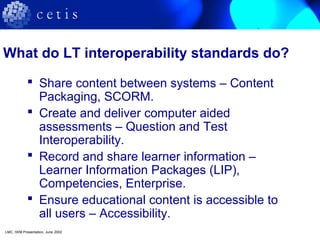
What do LT interoperability standards do?
 Share content between systems – Content
Packaging, SCORM.
 Create and deliver computer aided
assessments – Question and Test
Interoperability.
 Record and share learner information –
Learner Information Packages (LIP),
Competencies, Enterprise.
 Ensure educational content is accessible to
all users – Accessibility.
LMC, IWM Presentation, June 2002
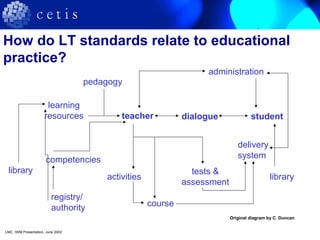
How do LT standards relate to educational
practice?
LMC, IWM Presentation, June 2002
administration
learning
resources
competencies
registry/
authority course
delivery
system
student
pedagogy
tests &
assessment
activities
dialogueteacher
library
library
Original diagram by C. Duncan
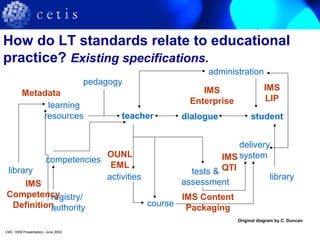
How do LT standards relate to educational
practice? Existing specifications.
LMC, IWM Presentation, June 2002
administration
learning
resources
competencies
registry/
authority course
delivery
system
student
pedagogy
tests &
assessment
activities
dialogueteacher
library
library
Metadata
IMS
Competency
Definition
OUNL
EML
IMS Content
Packaging
IMS
QTI
IMS
Enterprise
IMS
LIP
Original diagram by C. Duncan
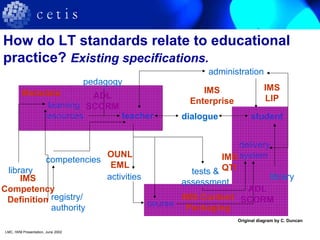
How do LT standards relate to educational
practice? Existing specifications.
LMC, IWM Presentation, June 2002
administration
learning
resources
competencies
registry/
authority course
delivery
system
student
pedagogy
tests &
assessment
activities
dialogueteacher
library
library
Metadata
IMS
Competency
Definition
OUNL
EML
IMS Content
Packaging
IMS
QTI
IMS
Enterprise
IMS
LIP
Original diagram by C. Duncan
ADL
SCORM
ADL
SCORM
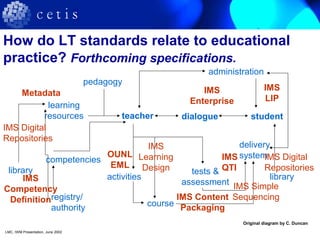
How do LT standards relate to educational
practice? Forthcoming specifications.
LMC, IWM Presentation, June 2002
administration
learning
resources
competencies
registry/
authority course
delivery
system
student
pedagogy
tests &
assessment
activities
dialogueteacher
library
library
Metadata
IMS
Competency
Definition
OUNL
EML
IMS Content
Packaging
IMS
QTI
IMS
Enterprise
IMS
LIP
IMS
Learning
Design
IMS Simple
Sequencing
IMS Digital
Repositories
IMS Digital
Repositories
Original diagram by C. Duncan
CETIS: Supporting the UK FE/HE community
 Centre for Educational Technology Interoperability
Standards.
 Funded by the Joint Information Systems Committee
(JISC).
 Support UK Higher and Further Education.
 Represents UK FE/HE on international educational
standards initiatives, e.g. IMS, CEN/ISSS.
 Advises Universities and Colleges on the strategic,
technical and pedagogic implications of educational
technology standards.
 Manages the Special Interest Groups (SIGs).
LMC, IWM Presentation, June 2002
The CETIS SIGs
 Established to support the UK FE/HE sector’s uptake
and implementation of interoperability specifications.
 Track the development of standards and
specifications.
 Advise the sector on the relevance of different
standards and specifications.
 Channel sector’s requirements back to CETIS and
international standards initiatives.
 Support communities of practice.
LMC, SURF Presentation, April 2002
The CETIS SIGs
 Accessibility SIG
 Assessment SIG
 Computer aided assessment and Question and Test
Interoperability.
 Educational Content SIG
 Content Packaging, Learning Design, Simple Sequencing,
SCORM, EML, etc.
 Learner Information and Enterprise SIG
 Metadata SIG
 Focused on learning resource metadata.
 FE Focus Group
 Supports the interests of FE colleges in the SIGs and other
organisations.
LMC, IWM Presentation, June 2002
Further information
The CETIS website:
 http://www.cetis.ac.uk/
 Hosts websites for all the SIGs.
 Regular updates of latest developments in the field of
LT standards.
 Described by The Technology Source as:
“Probably the most comprehensive and current site
devoted to educational technology interoperability
standards, the CETIS Web site is an essential
resource for anyone working in the fields of learning
objects or learning content management systems.”
LMC, IWM Presentation, June 2002
Discussion topic
 Have learning technology interoperability
standards and specifications impacted on
your current practice?
 How do you envisage learning technology
interoperability standards and specifications
will affect future practice?
LMC, IWM Presentation, June 2002

IWMW 2002: Interoperability and learning standards briefing, Introduction

  • 1.
    Learning Technology Interoperability Standards NiallSclater, n.sclater@strath.ac.uk and Lorna M. Campbell, lmc@strath.ac.uk CETIS and the University of Strathclyde LMC, IWM Presentation, June 2002
  • 2.
    Briefing Session Timetable 09.15 – 09.40 Learning technology interoperability standards: introduction and overview – L. Campbell.  09.40 – 10.05 Group discussion.  10.05 – 10.20 Implementation issues – N. Sclater.  10.20 – 10.30 Final discussion. LMC, IWM Presentation, June 2002
  • 3.
    What are learningtechnology standards and specifications?  Standards that are designed to facilitate the description, packaging, sequencing and delivery of educational content, learning activities and learner information. LMC, IWM Presentation, June 2002
  • 4.
    Why do weneed learning technology standards and specifications?  To prevent content becoming “locked in” to proprietary systems.  To ensure educational content can be reused.  To enable educational content & learner information to be shared.  To facilitate interoperability. LMC, IWM Presentation, June 2002
  • 5.
    Who is developingLT interoperability specifications? IMS Global Learning  http://www.imsproject.org/  Learning Resource Meta-data  Question and Test Interoperability  Learner Information Packages  Competencies  Simple Sequencing  Content Packaging  Learning Design  Accessibility  Digital Repositories Interoperability.LMC, IWM Presentation, June 2002
  • 6.
    Who is developingLT interoperability “specifications”? Advanced Distributed Learning (ADL).  http://adlnet.org/  US Department of Defence Initiative.  Working with IMS.  Primarily focused on the delivery of web based content.  Shared Content Object Reference Model (SCORM).  SCORM incorporates IMS Meta-data and elements of IMS Content Packaging. LMC, IWM Presentation, June 2002
  • 7.
    Who is developingLT interoperability specifications? European Centre for Standards/Information Society Standardisation System Learning Technologies Workshop (CEN/ISSS WS-LT).  http://www.cenorm.be/isss/Workshop/LT/Default.htm  Project teams active in a variety of areas:  Localisation and internationalisation of Learning Object Metadata.  Description of language capabilities.  Quality assurance.  Taxonomies and vocabularies.  Educational modelling languages. LMC, IWM Presentation, June 2002
  • 8.
    Who is developingLT interoperability specifications? Open University of the Netherlands (OUNL)  http://eml.ou.nl/introduction/index.htm  Educational Modelling Language (EML)  Describes and defines the process of learning itself.  Capable of supporting a wide range of pedagogical approaches.  Supports single and multi users, behaviourist, constructivist and mixed mode learning.  Describes Units of Study in terms of roles, activities, environments and objects.  IMS Learning Design is based on the OUNL’s EML specification. LMC, IWM Presentation, June 2002
  • 9.
    Who is developingLT interoperability specifications? Dublin Core Metadata Initiative.  http://dublincore.org/  Focused on developing interoperable online metadata standards.  Collaborating with IMS and IEEE LOM WG.  “Ottawa Group”.  “Metadata Principles and Practicalities” published in DLib magazine. http://www.dlib.org/ LMC, IWM Presentation, June 2002
  • 10.
    Who is developingformal LT interoperability standards? Institute of Electrical and Electronic Engineers (IEEE) Learning Technology Standards Committee (LTSC)  http://ltsc.ieee.org/index.html  Wide variety of working groups:  Learner related  Content related  Data and metadata, including Learning Object Metadata (LOM)  Management systems and applications LMC, IWM Presentation, June 2002
  • 11.
    Who is developingformal LT interoperability standards? International Standards Organisation (ISO) Sub Committee 36 (SC 36)  http://www.iso.org  Learning Technology.  Standardization in the area of information technologies that support automation for learners, learning institutions, and learning resources.  IEEE LTSC has a "formal" relationship with SC 36.  Produce formal certified standards. LMC, IWM Presentation, June 2002
  • 12.
    What do LTinteroperability standards do?  Enable users to search for, locate and retrieve appropriate content – Metadata, Digital Repositories.  Plan educational scenarios and formulate instructional design – EML & Learning Design.  Deliver educational content tailored to learners requirements – Learning Design, EML, Simple Sequencing, SCORM. LMC, IWM Presentation, June 2002
  • 13.
    What do LTinteroperability standards do?  Share content between systems – Content Packaging, SCORM.  Create and deliver computer aided assessments – Question and Test Interoperability.  Record and share learner information – Learner Information Packages (LIP), Competencies, Enterprise.  Ensure educational content is accessible to all users – Accessibility. LMC, IWM Presentation, June 2002
  • 14.
    How do LTstandards relate to educational practice? LMC, IWM Presentation, June 2002 administration learning resources competencies registry/ authority course delivery system student pedagogy tests & assessment activities dialogueteacher library library Original diagram by C. Duncan
  • 15.
    How do LTstandards relate to educational practice? Existing specifications. LMC, IWM Presentation, June 2002 administration learning resources competencies registry/ authority course delivery system student pedagogy tests & assessment activities dialogueteacher library library Metadata IMS Competency Definition OUNL EML IMS Content Packaging IMS QTI IMS Enterprise IMS LIP Original diagram by C. Duncan
  • 16.
    How do LTstandards relate to educational practice? Existing specifications. LMC, IWM Presentation, June 2002 administration learning resources competencies registry/ authority course delivery system student pedagogy tests & assessment activities dialogueteacher library library Metadata IMS Competency Definition OUNL EML IMS Content Packaging IMS QTI IMS Enterprise IMS LIP Original diagram by C. Duncan ADL SCORM ADL SCORM
  • 17.
    How do LTstandards relate to educational practice? Forthcoming specifications. LMC, IWM Presentation, June 2002 administration learning resources competencies registry/ authority course delivery system student pedagogy tests & assessment activities dialogueteacher library library Metadata IMS Competency Definition OUNL EML IMS Content Packaging IMS QTI IMS Enterprise IMS LIP IMS Learning Design IMS Simple Sequencing IMS Digital Repositories IMS Digital Repositories Original diagram by C. Duncan
  • 18.
    CETIS: Supporting theUK FE/HE community  Centre for Educational Technology Interoperability Standards.  Funded by the Joint Information Systems Committee (JISC).  Support UK Higher and Further Education.  Represents UK FE/HE on international educational standards initiatives, e.g. IMS, CEN/ISSS.  Advises Universities and Colleges on the strategic, technical and pedagogic implications of educational technology standards.  Manages the Special Interest Groups (SIGs). LMC, IWM Presentation, June 2002
  • 19.
    The CETIS SIGs Established to support the UK FE/HE sector’s uptake and implementation of interoperability specifications.  Track the development of standards and specifications.  Advise the sector on the relevance of different standards and specifications.  Channel sector’s requirements back to CETIS and international standards initiatives.  Support communities of practice. LMC, SURF Presentation, April 2002
  • 20.
    The CETIS SIGs Accessibility SIG  Assessment SIG  Computer aided assessment and Question and Test Interoperability.  Educational Content SIG  Content Packaging, Learning Design, Simple Sequencing, SCORM, EML, etc.  Learner Information and Enterprise SIG  Metadata SIG  Focused on learning resource metadata.  FE Focus Group  Supports the interests of FE colleges in the SIGs and other organisations. LMC, IWM Presentation, June 2002
  • 21.
    Further information The CETISwebsite:  http://www.cetis.ac.uk/  Hosts websites for all the SIGs.  Regular updates of latest developments in the field of LT standards.  Described by The Technology Source as: “Probably the most comprehensive and current site devoted to educational technology interoperability standards, the CETIS Web site is an essential resource for anyone working in the fields of learning objects or learning content management systems.” LMC, IWM Presentation, June 2002
  • 22.
    Discussion topic  Havelearning technology interoperability standards and specifications impacted on your current practice?  How do you envisage learning technology interoperability standards and specifications will affect future practice? LMC, IWM Presentation, June 2002