How Portable Are the
Metadata Standards for
Scientific Data?
Jian Qin Kai Li
School of Information Studies
Syracuse University
Syracuse, NY, USA
Why study metadata portability?
Complex, very large metadata
standards
•  are “…unwieldy to apply…”
•  are “difficult to understand
and enact in its entirety…”
•  require customization to
tailor to specific needs
•  costly in time and personnel
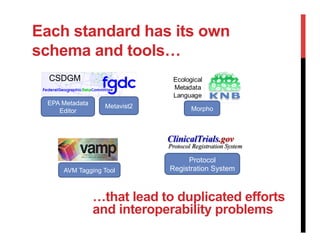
Each standard has its own
schema and tools…
EPA Metadata
Editor
Metavist2 Morpho
Protocol
Registration SystemAVM Tagging Tool
…that lead to duplicated efforts
and interoperability problems
Metadata for scientific data is
at the juncture of -
Data-Driven Science
RDF
RDFa
ORCID
XML
OWL
DOI
Technical Standards
Infrastructure
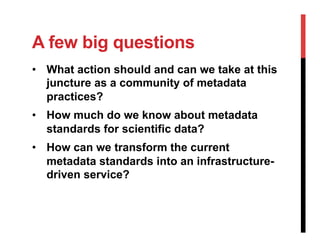
A few big questions
•  What action should and can we take at this
juncture as a community of metadata
practices?
•  How much do we know about metadata
standards for scientific data?
•  How can we transform the current
metadata standards into an infrastructure-
driven service?
•  Portable
•  Customizable
•  Extendable
•  Reusable
•  Easy to use
An infrastructure
perspective for
metadata
An attempt to define “metadata
infrastructure”
Semantically:
• metadata elements, vocabularies, entities, and
other metadata artifacts as the underlying
foundation to build tools, software and
applications
Technically:
• “a data model for describing the resources,
aspects of metadata encoding and storage
formats, metadata for web services, metadata
tools, usage, modification, transformation,
interoperability, and metadata crosswalk
” (CLARIN)
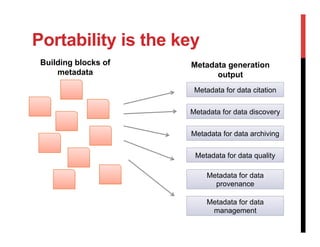
Portability is the key
Building blocks of
metadata
Metadata for data citation
Metadata for data discovery
Metadata for data archiving
Metadata for data quality
Metadata for data
provenance
Metadata for data
management
Metadata generation
output
How portable are metadata
standards for scientific data?
Two measures of metadata portability:
• Co-occurrence of semantic elements: the
times of semantically identical elements used
in multiple standards
• Degree of modularity: the degree of
independence and self-descriptiveness of a
sub-structure of concept/entity in metadata
standards
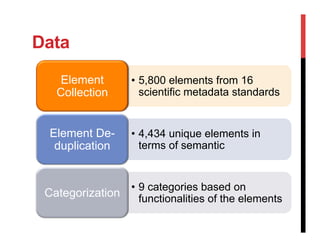
Data
•  5,800 elements from 16
scientific metadata standards
Element
Collection
•  4,434 unique elements in
terms of semantic
Element De-
duplication
•  9 categories based on
functionalities of the elements
Categorization
Element distribution by standard
NetCDF Climate and
Forecast Metadata
Convention (CF)
2427 elements
Ecological Metadata
Language
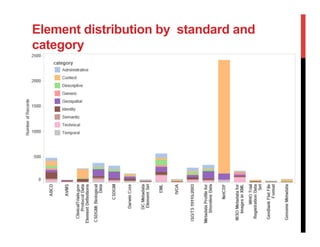
Element distribution by standard and
category
Frequency of occurrences by
category
Top occurring elements
Element
Element co-occurrences across
metadata standards
Of 4,434 unique elements,
539 (12.16%) elements
occurred in more than one
standard
Frequency of
co-occurrences
Numberofelements
Elements that most frequently
co-occurred
Modularity
Two levels of modularity:
• Level 1: having multiple XML schema files for
the whole standard;
• Level 2: having separate schemas for entities
such as person/organization, dataset, study,
instrument, and subject
Of the 6 standards with schema files, all of
them belong to Level 1 modularity.
Discussion
Portable metadata standards
• Possible?
• Feasible?
• Advantages over the one-covers-all
approach?
A metadata infrastructure for scientific data
• Bridge the gap between existing semantic and
entity resources and metadata generation
• Much to be researched…
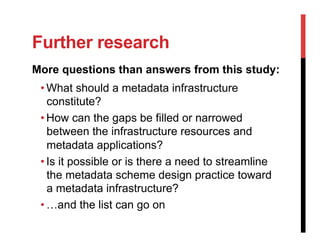
Further research
More questions than answers from this study:
• What should a metadata infrastructure
constitute?
• How can the gaps be filled or narrowed
between the infrastructure resources and
metadata applications?
• Is it possible or is there a need to streamline
the metadata scheme design practice toward
a metadata infrastructure?
• …and the list can go on
Questions and
comments?

How Portable Are the Metadata Standards for Scientific Data?

  • 1.
    How Portable Arethe Metadata Standards for Scientific Data? Jian Qin Kai Li School of Information Studies Syracuse University Syracuse, NY, USA
  • 2.
    Why study metadataportability? Complex, very large metadata standards •  are “…unwieldy to apply…” •  are “difficult to understand and enact in its entirety…” •  require customization to tailor to specific needs •  costly in time and personnel
  • 3.
    Each standard hasits own schema and tools… EPA Metadata Editor Metavist2 Morpho Protocol Registration SystemAVM Tagging Tool …that lead to duplicated efforts and interoperability problems
  • 4.
    Metadata for scientificdata is at the juncture of - Data-Driven Science RDF RDFa ORCID XML OWL DOI Technical Standards Infrastructure
  • 5.
    A few bigquestions •  What action should and can we take at this juncture as a community of metadata practices? •  How much do we know about metadata standards for scientific data? •  How can we transform the current metadata standards into an infrastructure- driven service?
  • 6.
    •  Portable •  Customizable • Extendable •  Reusable •  Easy to use An infrastructure perspective for metadata
  • 7.
    An attempt todefine “metadata infrastructure” Semantically: • metadata elements, vocabularies, entities, and other metadata artifacts as the underlying foundation to build tools, software and applications Technically: • “a data model for describing the resources, aspects of metadata encoding and storage formats, metadata for web services, metadata tools, usage, modification, transformation, interoperability, and metadata crosswalk ” (CLARIN)
  • 8.
    Portability is thekey Building blocks of metadata Metadata for data citation Metadata for data discovery Metadata for data archiving Metadata for data quality Metadata for data provenance Metadata for data management Metadata generation output
  • 9.
    How portable aremetadata standards for scientific data? Two measures of metadata portability: • Co-occurrence of semantic elements: the times of semantically identical elements used in multiple standards • Degree of modularity: the degree of independence and self-descriptiveness of a sub-structure of concept/entity in metadata standards
  • 10.
    Data •  5,800 elementsfrom 16 scientific metadata standards Element Collection •  4,434 unique elements in terms of semantic Element De- duplication •  9 categories based on functionalities of the elements Categorization
  • 11.
    Element distribution bystandard NetCDF Climate and Forecast Metadata Convention (CF) 2427 elements Ecological Metadata Language
  • 12.
    Element distribution bystandard and category
  • 13.
  • 14.
  • 15.
    Element co-occurrences across metadatastandards Of 4,434 unique elements, 539 (12.16%) elements occurred in more than one standard Frequency of co-occurrences Numberofelements
  • 16.
    Elements that mostfrequently co-occurred
  • 17.
    Modularity Two levels ofmodularity: • Level 1: having multiple XML schema files for the whole standard; • Level 2: having separate schemas for entities such as person/organization, dataset, study, instrument, and subject Of the 6 standards with schema files, all of them belong to Level 1 modularity.
  • 18.
    Discussion Portable metadata standards • Possible? • Feasible? • Advantagesover the one-covers-all approach? A metadata infrastructure for scientific data • Bridge the gap between existing semantic and entity resources and metadata generation • Much to be researched…
  • 19.
    Further research More questionsthan answers from this study: • What should a metadata infrastructure constitute? • How can the gaps be filled or narrowed between the infrastructure resources and metadata applications? • Is it possible or is there a need to streamline the metadata scheme design practice toward a metadata infrastructure? • …and the list can go on
  • 20.