Marketing
   in
Banking
 Sector
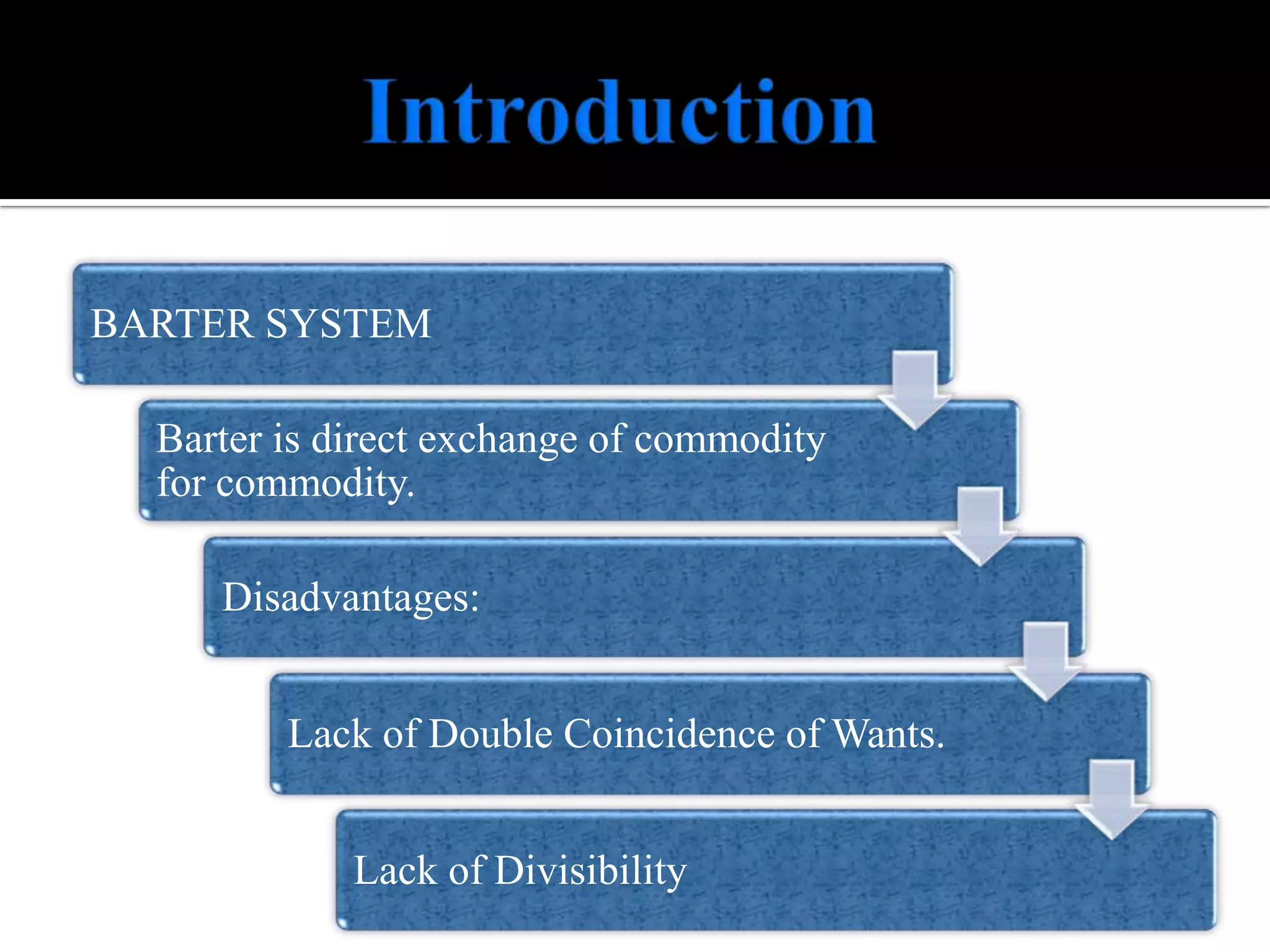
BARTER SYSTEM

  Barter is direct exchange of commodity
  for commodity.

     Disadvantages:


         Lack of Double Coincidence of Wants.


             Lack of Divisibility
   Money is anything that can serve as a medium
    of exchange and has general
    acceptability, measure of value and store of
    value.

 Commodity Money
 Metallic Money
 Paper Money
 Bank   or Credit Money
An institution
which receives
funds from the        Control the
  public and           supply of
gives loans and       Money and
  advances to           Credit.
   those who
    needs it.

The Banks can
                    With the Aim of
  create Credit
                     making Profit,
i.e., Creation of
                    it is regarded as
   Additional
                      a commercial
   Money for
                        institution.
     Lending.
    The First Bank in India, called „The General
    Bank of India (1786)‟.
   The East India Company established „The
    Bank of Bengal (1809)‟.
   The next bank was „Bank of Hindustan (1870)‟.
   Allahabad Bank (1865), was the first Bank,
    completely run by Indians.
   Punjab National Bank Ltd. set up in 1894.
   „Reserve Bank of India‟ in April 1, 1935.
Capital             Innovations
Formation

                      Finance for
                        Priority
                        Sectors.
 Provision for
 Medium and
  Long term      Monetization
   Finance
Private Sector


                                Regional Rural
                                                   State/Central
                                    Banks


               Commercial        Co-operative
                                                      Private
                 bank               Banks

               Non Banking
                  Finance                          Primary Credit
                                 Public Sector
                Companies                             Societies
                 (NBFCs)
Central Bank
   (RBI)                            Foreign


                                Indian Financial
                                  Institutions
               Term Financial
                 Institutions
                                 State Finance
                                 Corporations
                                    (SFCs)
RBI SEAL


           RBI HEADQUARTERS
           MUMBAI, MAHARASTRA
Headquarters        Mumbai, Maharashtra

    Established       1 April 1935

    Governor          Dr Duwuri Subbarao

     Currency         Indian rupee

      Code            INR

     Reserves         US$30,210 crore
                      (US$302.1 billion)
     Website          http://www.rbi.org.in

Base borrowing rate   8.00%
It is India's central banking institution


Controls the monetary policy of India


Bank of issue


Regulator and supervisor of the financial system


Issuer of currency


Banker of Banks


Detection Of Fake currency
“ Bank marketing is the aggregate of
functions, directed at providing
services to satisfy customers financial
(and other related) needs and wants,
more effectively and efficiently than
the competitors keeping in view the
organizational objectives of the bank.”
AIM- To create and win more and more customers
and to retain them through effective customer
service.

The existence of the bank has no value without the
existence of the customer.

Appropriate promise to a customer through a range
of services (products) and also to ensure effective
delivery through satisfaction is important.
Identifying the most profitable markets now and in future.


Assessing the present and future needs of customers.

Setting business development goals and making plans to meet
them.

Managing the various services and promoting them.


Adapting to a changing environment in Market.
Bank which are not
   Designed after          facing acute
taking into account    competition could      Design new product
 the STRENGTHS         think of “Market          range for their
        and            Development” by        customers of various
WEAKNESSES of         offering the existing        segments.
 the organization.       services to new
                          customers.
Traditional
               Internal   Interactive
 external
              marketing   marketing
marketing
   Consists of 4 P’s marketing mix


                           Promotion


                 Product
                              4        Price
                             P’s


                             Place
Includes interest , fees or commission charged by the bank. Also the interest
paid by the bank.

Typical for banking sector since RBI regulates rates of
interest, Organizations are supposed to sub-serve weaker sections and the
rural regions of the country.

Buyers look for satisfaction which differs from person to person.


Keeping in view the level of satisfaction of a particular segment, the banks
have to frame the pricing strategies.

The interest charged and the interest paid should have a co-relation between
them.
Make
Develop                   Estimate
            marketing                Calculate
marketing               the demand
              mix                      cost
 strategy                  curve.
            decisions
It refers to the establishment and functioning of a
network of branches and other offices through
which banking services are delivered.
Objective is to get the right product ,at right places
at right time at the least cost.

Extensive branch network- access to large section of
people

Proximity may play a determinant role in selecting
the bank.
   Advertising

   Publicity

   Sales Promotion

   Personal Selling

   Push and Pull Strategies
Quality Human
                  resource can be a
                       point of
                   differentiation


   Employees
 should also be
   treated as
     internal
customers, and
      sort of
marketing mix
   should be
    followed.
                            It involves the people(5th
                              P) of the bank i.e. the
                                    employees.
   The quality of service provided during the buyer-
    employee interaction.
   Efforts for previous strategies will turn futile if
    the interaction does not takes place satisfactorily.
     It involves :


*Process     P)    (6 th

*Physical evidence (7 th P)
Refers to the systems used to assist the organization in delivering the service.

Aids to the promotion of customer satisfaction

It involves:

1. Speeding delivery of services

2. Reducing the paper work

3. Standardization of procedures

4. Customization as per individual demand simplicity etc
Referral services


    Direct mailing


Offering items having
 your brand identity


   Using the media


 Getting celebrities to
endorse the product or
       service.


  Sponsoring events


Using permission-based
      Marketing
Full Form :-
Industrial Credit   Largest private
                                        Second largest    Largest issuer of
 and Investment     sector bank in
                                       overall in terms    credit cards in
 Corporation of         market
                                          of assets.           India.
   India Bank       capitalization .
     (ICICI)
Product
     Pricing
     Place
   Promotion
    Process
Physical Evidence
     People
Senior
                      citizen
                     services:
          Demand                  Fixed
          services               Deposits :


Mobile
                                               Loan
banking

                     Produ
                       ct
                                              Roaming
 Card
                                              current


          Investme               Recurrin
             nt                  g deposit
                      Saving
                     account:.
1.   Pricing Decisions related to interest, fee or
     commission.

2.   RBI and IBA

3.   Raising Number of Customers
Services are sold through branches

Making Promised Services available to the ultimate
users.

Branches OF ICICI:


1900 in India and 33 in Mumbai.
Advertising - Television, radio, movies, theatres


Print Media- Hoardings, newspaper, magazines


Publicity- Road shows, campus visits, Sponsorship


Sales Promotion- Gifts, discount and commission, incentives, etc.


Telemarketing- ICICI one source Call center (Mind Space)
Standardization- ICICI bank has got standardized
procedures to get typical transactions.

Customization- Specialty counters at each branch to
deal with customers of a particular scheme.

Simplicity-    Separate counters exist with clear
indication.

Customer      Involvement-   Money   matters   and
signature.
All people directly or indirectly involved in the
consumption of banking services.

Workers, Employees, Management and other
Consumers

Employees of a Bank represents the organization to
its customers.

Internal Marketing
Financial Reports- The Company’s financial reports are
issued to the customers to emphasis or credibility

Tangibles- Pens, Writing Pads to the internal customers.
Passbook and Cheque books to the customers.

Punch lines- “Hum Hai Naa”

Employee‟s Dress Code- ICICI bank follows a dress
code for their internal customers
   Various Banks and Financial Institutions are
    present today in the market squeezing the Market
    competition in Banking Sector.
   This is the biggest threat for Banks.
   Hence to survive in the market, Banks must have:-
     1. Strong Marketing Team Support
     2. Innovative Marketing Practices

    Hence, Bank Marketing has become the necessity
     in today‟s World.
Bhoomika Sahu
    Aditya Patel
     Shreya Shah
    Anurag Sinha
Surabhi Dashasahastra
   Robin Agrawal
    Prateek Aloni

Marketing in Banking Sector

  • 1.
    Marketing in Banking Sector
  • 2.
    BARTER SYSTEM Barter is direct exchange of commodity for commodity. Disadvantages: Lack of Double Coincidence of Wants. Lack of Divisibility
  • 3.
    Money is anything that can serve as a medium of exchange and has general acceptability, measure of value and store of value.  Commodity Money  Metallic Money  Paper Money  Bank or Credit Money
  • 4.
    An institution which receives fundsfrom the Control the public and supply of gives loans and Money and advances to Credit. those who needs it. The Banks can With the Aim of create Credit making Profit, i.e., Creation of it is regarded as Additional a commercial Money for institution. Lending.
  • 5.
    The First Bank in India, called „The General Bank of India (1786)‟.  The East India Company established „The Bank of Bengal (1809)‟.  The next bank was „Bank of Hindustan (1870)‟.  Allahabad Bank (1865), was the first Bank, completely run by Indians.  Punjab National Bank Ltd. set up in 1894.  „Reserve Bank of India‟ in April 1, 1935.
  • 6.
    Capital Innovations Formation Finance for Priority Sectors. Provision for Medium and Long term Monetization Finance
  • 8.
    Private Sector Regional Rural State/Central Banks Commercial Co-operative Private bank Banks Non Banking Finance Primary Credit Public Sector Companies Societies (NBFCs) Central Bank (RBI) Foreign Indian Financial Institutions Term Financial Institutions State Finance Corporations (SFCs)
  • 9.
    RBI SEAL RBI HEADQUARTERS MUMBAI, MAHARASTRA
  • 10.
    Headquarters Mumbai, Maharashtra Established 1 April 1935 Governor Dr Duwuri Subbarao Currency Indian rupee Code INR Reserves US$30,210 crore (US$302.1 billion) Website http://www.rbi.org.in Base borrowing rate 8.00%
  • 11.
    It is India'scentral banking institution Controls the monetary policy of India Bank of issue Regulator and supervisor of the financial system Issuer of currency Banker of Banks Detection Of Fake currency
  • 12.
    “ Bank marketingis the aggregate of functions, directed at providing services to satisfy customers financial (and other related) needs and wants, more effectively and efficiently than the competitors keeping in view the organizational objectives of the bank.”
  • 13.
    AIM- To createand win more and more customers and to retain them through effective customer service. The existence of the bank has no value without the existence of the customer. Appropriate promise to a customer through a range of services (products) and also to ensure effective delivery through satisfaction is important.
  • 14.
    Identifying the mostprofitable markets now and in future. Assessing the present and future needs of customers. Setting business development goals and making plans to meet them. Managing the various services and promoting them. Adapting to a changing environment in Market.
  • 15.
    Bank which arenot Designed after facing acute taking into account competition could Design new product the STRENGTHS think of “Market range for their and Development” by customers of various WEAKNESSES of offering the existing segments. the organization. services to new customers.
  • 16.
    Traditional Internal Interactive external marketing marketing marketing
  • 17.
    Consists of 4 P’s marketing mix Promotion Product 4 Price P’s Place
  • 18.
    Includes interest ,fees or commission charged by the bank. Also the interest paid by the bank. Typical for banking sector since RBI regulates rates of interest, Organizations are supposed to sub-serve weaker sections and the rural regions of the country. Buyers look for satisfaction which differs from person to person. Keeping in view the level of satisfaction of a particular segment, the banks have to frame the pricing strategies. The interest charged and the interest paid should have a co-relation between them.
  • 19.
    Make Develop Estimate marketing Calculate marketing the demand mix cost strategy curve. decisions
  • 20.
    It refers tothe establishment and functioning of a network of branches and other offices through which banking services are delivered. Objective is to get the right product ,at right places at right time at the least cost. Extensive branch network- access to large section of people Proximity may play a determinant role in selecting the bank.
  • 21.
    Advertising  Publicity  Sales Promotion  Personal Selling  Push and Pull Strategies
  • 22.
    Quality Human resource can be a point of differentiation Employees should also be treated as internal customers, and sort of marketing mix should be followed. It involves the people(5th P) of the bank i.e. the employees.
  • 23.
    The quality of service provided during the buyer- employee interaction.  Efforts for previous strategies will turn futile if the interaction does not takes place satisfactorily. It involves : *Process P) (6 th *Physical evidence (7 th P)
  • 24.
    Refers to thesystems used to assist the organization in delivering the service. Aids to the promotion of customer satisfaction It involves: 1. Speeding delivery of services 2. Reducing the paper work 3. Standardization of procedures 4. Customization as per individual demand simplicity etc
  • 25.
    Referral services Direct mailing Offering items having your brand identity Using the media Getting celebrities to endorse the product or service. Sponsoring events Using permission-based Marketing
  • 27.
    Full Form :- IndustrialCredit Largest private Second largest Largest issuer of and Investment sector bank in overall in terms credit cards in Corporation of market of assets. India. India Bank capitalization . (ICICI)
  • 28.
    Product Pricing Place Promotion Process Physical Evidence People
  • 29.
    Senior citizen services: Demand Fixed services Deposits : Mobile Loan banking Produ ct Roaming Card current Investme Recurrin nt g deposit Saving account:.
  • 30.
    1. Pricing Decisions related to interest, fee or commission. 2. RBI and IBA 3. Raising Number of Customers
  • 31.
    Services are soldthrough branches Making Promised Services available to the ultimate users. Branches OF ICICI: 1900 in India and 33 in Mumbai.
  • 32.
    Advertising - Television,radio, movies, theatres Print Media- Hoardings, newspaper, magazines Publicity- Road shows, campus visits, Sponsorship Sales Promotion- Gifts, discount and commission, incentives, etc. Telemarketing- ICICI one source Call center (Mind Space)
  • 33.
    Standardization- ICICI bankhas got standardized procedures to get typical transactions. Customization- Specialty counters at each branch to deal with customers of a particular scheme. Simplicity- Separate counters exist with clear indication. Customer Involvement- Money matters and signature.
  • 34.
    All people directlyor indirectly involved in the consumption of banking services. Workers, Employees, Management and other Consumers Employees of a Bank represents the organization to its customers. Internal Marketing
  • 35.
    Financial Reports- TheCompany’s financial reports are issued to the customers to emphasis or credibility Tangibles- Pens, Writing Pads to the internal customers. Passbook and Cheque books to the customers. Punch lines- “Hum Hai Naa” Employee‟s Dress Code- ICICI bank follows a dress code for their internal customers
  • 36.
    Various Banks and Financial Institutions are present today in the market squeezing the Market competition in Banking Sector.  This is the biggest threat for Banks.  Hence to survive in the market, Banks must have:- 1. Strong Marketing Team Support 2. Innovative Marketing Practices  Hence, Bank Marketing has become the necessity in today‟s World.
  • 37.
    Bhoomika Sahu Aditya Patel Shreya Shah Anurag Sinha Surabhi Dashasahastra Robin Agrawal Prateek Aloni