Introduction to Banking Products
Banking

 Basic Definition: A system of trading money
  which:
 provides a safe place to save excess cash,
  known as deposits.
 supplies liquidity to the economy by loaning
  this money out to help businesses grow and
  to allow consumers to purchase consumer
  products, homes, cars etc.
 Institutions which deal in money and credit.
 An intermediary, which handles other
  people’s money both for their advantage and
  to its own profits.
 A financial institution that links the flow of
  funds from savers to the users.
 Plays an important role in the economy of any
  country as they hold the saving of the public.
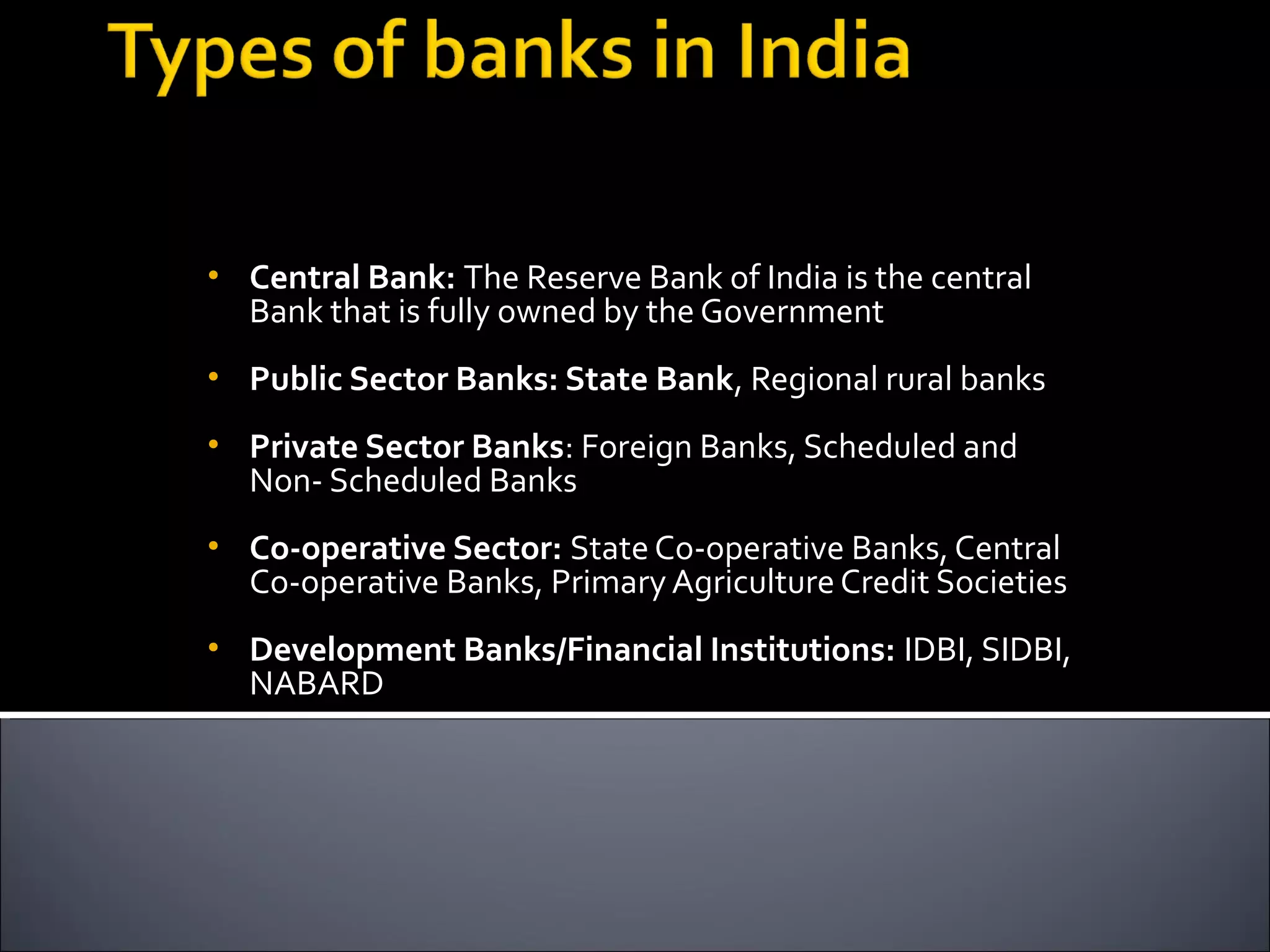
•   Central Bank: The Reserve Bank of India is the central
    Bank that is fully owned by the Government
•   Public Sector Banks: State Bank, Regional rural banks
•   Private Sector Banks: Foreign Banks, Scheduled and
    Non- Scheduled Banks
•   Co-operative Sector: State Co-operative Banks, Central
    Co-operative Banks, Primary Agriculture Credit Societies
•   Development Banks/Financial Institutions: IDBI, SIDBI,
    NABARD
 Issue of banknotes (promissory notes issued by a
  banker and payable to bearer on demand)
 Processing of payments by way of telegraphic
  transfer, internet banking or other means
 Issuing bank drafts and bank cheques
 Accepting money on term deposit
 Lending money by way of overdraft, installment
  loan or otherwise
   Providing documentary and standby letters of credit (trade
    finance), guarantees, performance bonds, securities
    underwriting commitments and other forms of off-balance
    sheet exposures
   Safekeeping of documents and other items in safe deposit
    boxes
   Currency exchange
   Acting as a 'financial supermarket' for the sale, distribution
    or brokerage, with or without advice, of insurance, unit trusts
    and similar financial products
 Issue of money, in the form of banknotes and
  current accounts subject to cheque or
  payment at the customer's order.
 Netting and settlement of payments.
 Credit intermediation
 Credit quality improvement
 Maturity transformation
“ Bank marketing is the aggregate of functions,
  directed at providing services to satisfy
  customers financial (and other related) needs
  and wants, more effectively and efficiently
  than the competitors keeping in view the
  organizational objectives of the bank.”
 The existence of the bank has little value
  without the existence of the customer.
 Aim is not only to create and win more and
  more customer but also to retain them
  through effective customer service.
 Appropriate promise to a customer through a
  range of services (products) and also to
  ensure effective delivery through satisfaction
  is important.
 Identifying the most profitable markets now
  and in future;
 Assessing the present and future needs of
  customers;
 Setting business development goals and
  making plans to meet them
 Managing the various services and
  promoting them to achieve the plans
 Adapting to a changing environment in the
  market place.
 Designed after taking into account the strengths
  and weaknesses of the organization.
 bank with clientele from various segments could
  think of “market penetration” by offering the
  existing range of services to existing customers.
 Bank which are not facing acute competition could
  think of “Market Development” by offering the
  existing services to new customers.
 design new product range for their customers of
  various segments
 Banks deal with individuals, group of persons
  and corporate
 More or less homogenous groups in terms of
  their needs and expectations.
 Market segments, targeting one or more
  segments, developing products and
  marketing programs tailor-made for these
  segments.
    Agricultural Sector
1.   Marginal
2.   2 to 5 acres
3.   5 to 10 acres
4.   10 acres and above

    Industrial Sector
1.   Tiny
2.   Co-operative
3.   Small-sized
4.   Large- sized
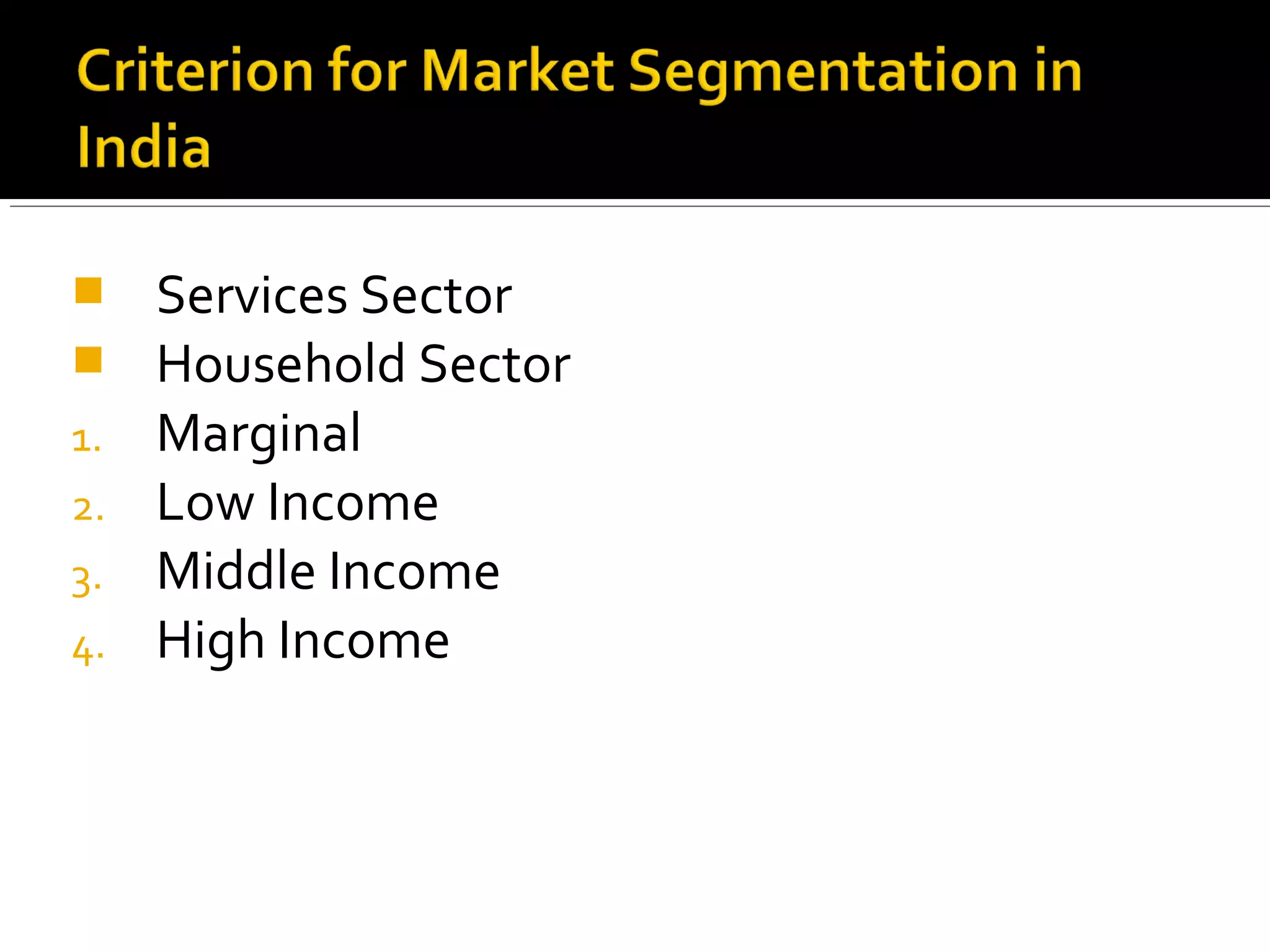
    Services Sector
    Household Sector
1.   Marginal
2.   Low Income
3.   Middle Income
4.   High Income
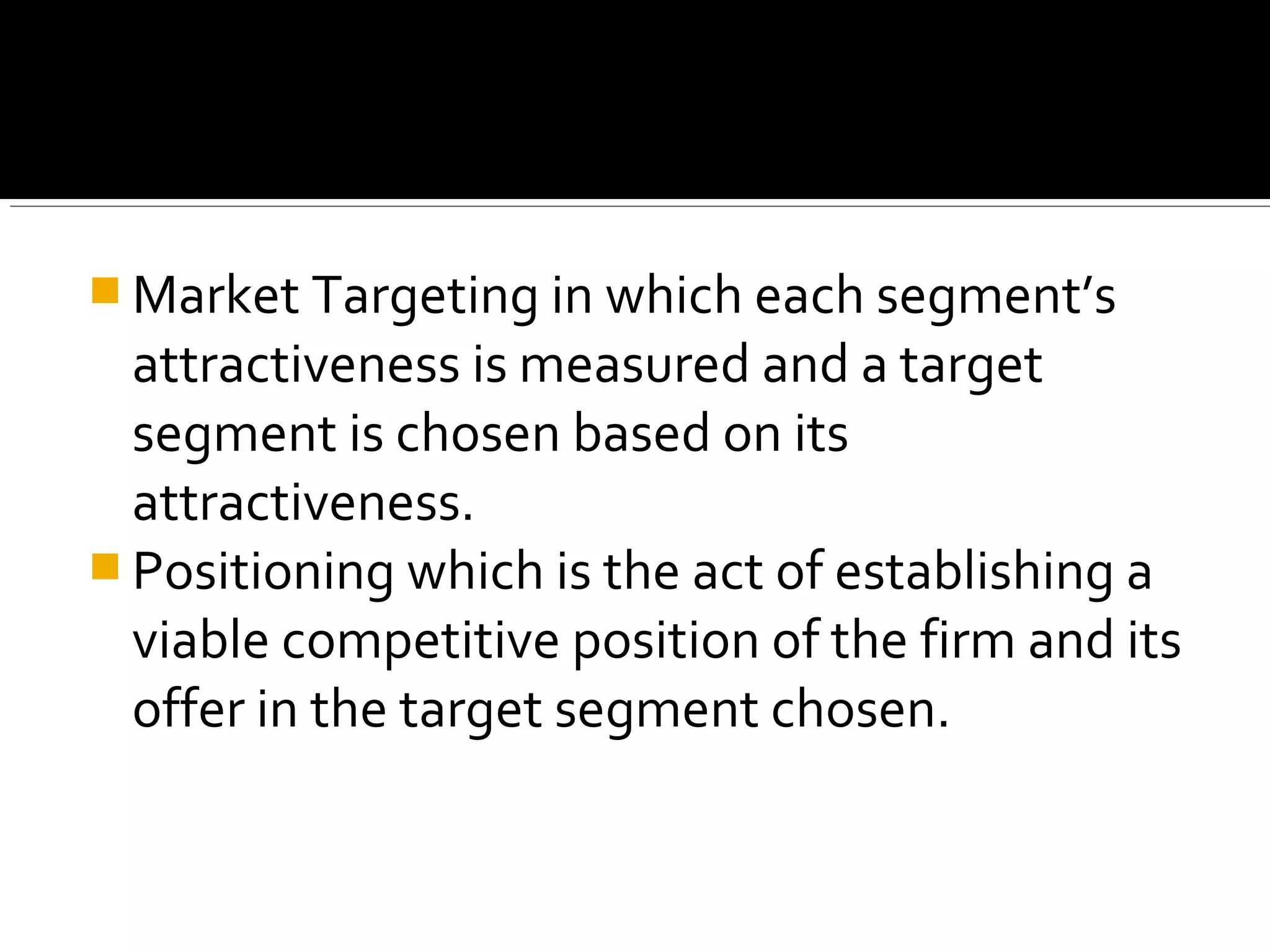
 Market Targeting in which each segment’s
  attractiveness is measured and a target
  segment is chosen based on its
  attractiveness.
 Positioning which is the act of establishing a
  viable competitive position of the firm and its
  offer in the target segment chosen.
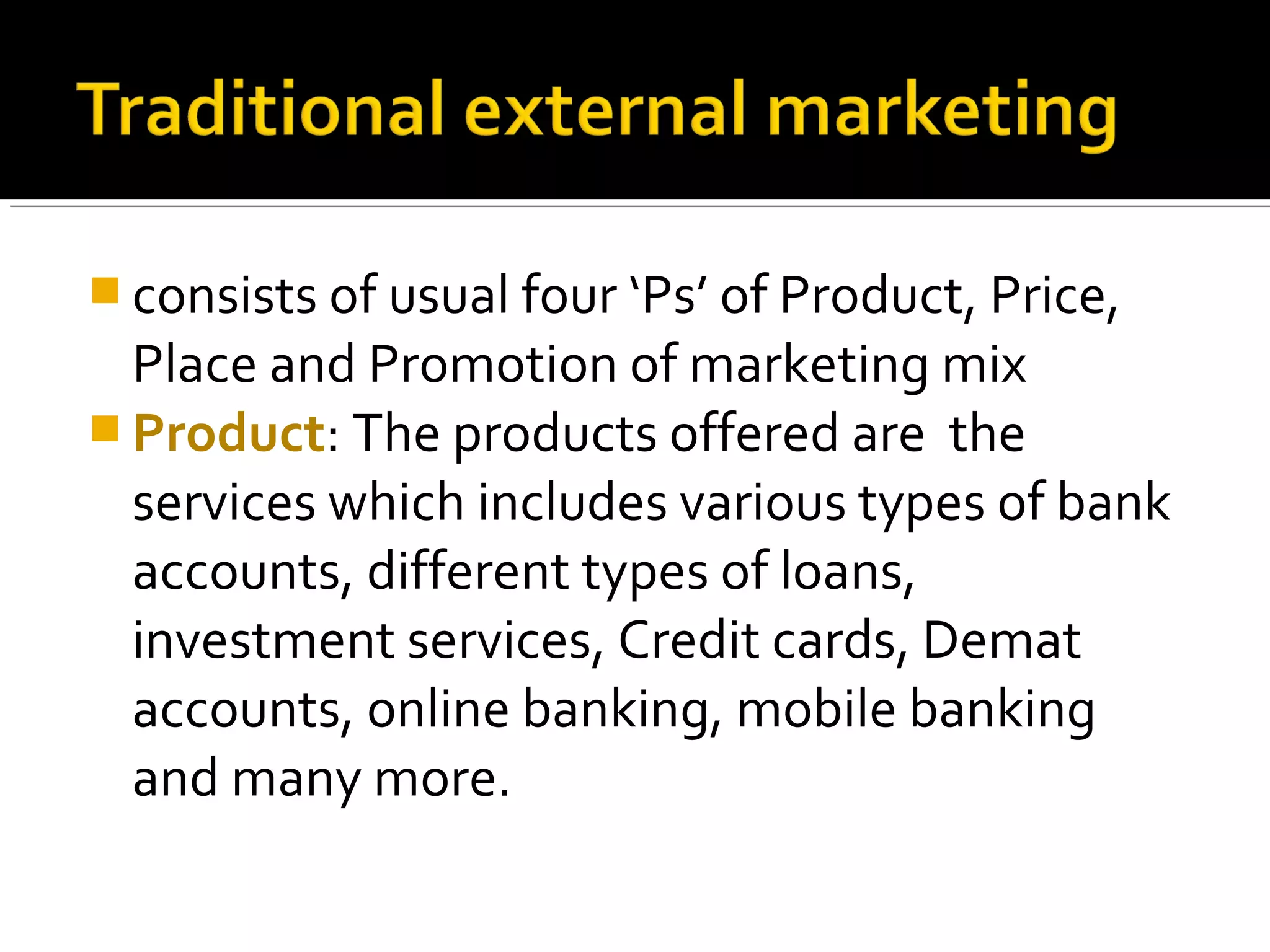
 consists of usual four ‘Ps’ of Product, Price,
  Place and Promotion of marketing mix
 Product: The products offered are the
  services which includes various types of bank
  accounts, different types of loans,
  investment services, Credit cards, Demat
  accounts, online banking, mobile banking
  and many more.
 Buyers look for satisfaction which differs
  from person to person.
 Keeping in view the level of satisfaction of a
  particular segment, the banks have to frame
  the pricing strategies.
 The interest charged and the interest paid
  should have a co-relation between them.
 It refers to the establishment and functioning of a
  network of branches and other offices through
  which banking services are delivered.
 Objective is to get the right product ,at right places
  at right time at the least cost.
 Extensive branch network- access to large section of
  people
 Proximity may play a determinant role in selecting
  the bank.
 Banks are coming up with extension counters,
  specialized branches, mobile branches, banks
  acquisition and amalgamation so as to have
  sufficient point of contacts with the customer.
 With the advent of technology other point of
  contacts have come up. Such as:
 ATM
 Telephone banking
 Online banking
 Mobile banking
 Video banking etc.
   Advertising

   Publicity

   Sales Promotion

   Personal Selling

   Push and Pull Strategies
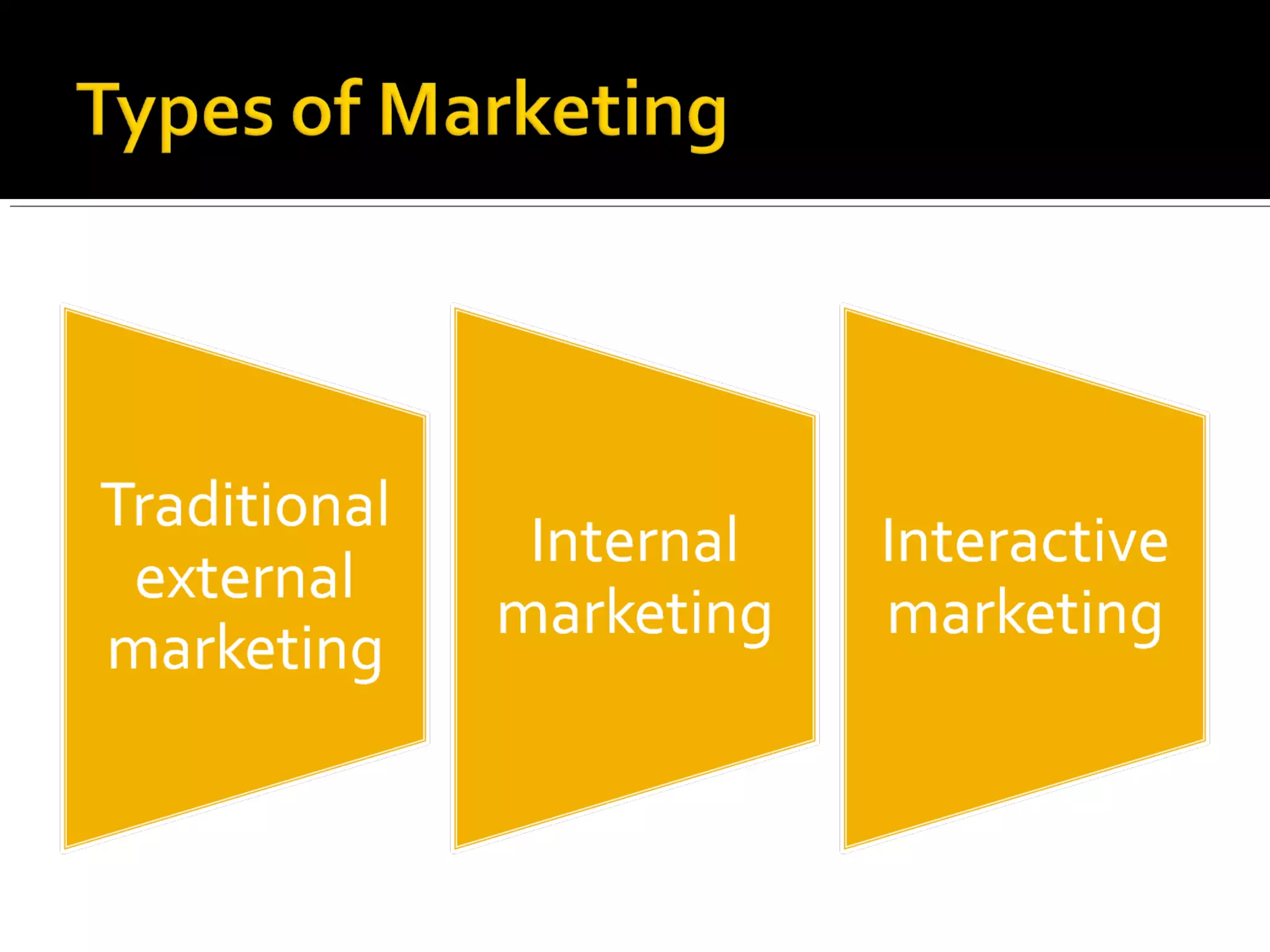
 It involves the people(5th P) of the bank i.e.
  the employees.
 Employees should also be treated as internal
  customers, and sort of marketing mix should
  be followed.
 Quality Human resource can be a point of
  differentiation
 The quality of service provided during the
  buyer-employee interaction.
 Efforts for previous strategies will turn futile
  if the interaction does not takes place
  satisfactorily.
  It involves :
 Process (6th P)
 Physical evidence (7th P)
 Refers to the systems used to assist the
  organization in delivering the service.
 Aids to the promotion of customer
  satisfaction
 It involves:
   speeding delivery of services
   reducing the paper work
   standardization of procedures
   customization as per individual demand
   simplicity etc.
   It includes signage, reports, punch lines, other tangibles,
    employee’s dress code etc.
   The company’s financial reports are issued to the
    customers to emphasis or credibility.
   Signage: Each and every bank has its logo by which a
    person can identify the company. It creates visualization
    and corporate identity for the banks.
   Tangibles: banks give pens, writing pads to the customers.
   Punch lines: Depicts the philosophy and attitude of the
    bank. Banks have influential punch lines to attract the
    customers.
   Referral services
   Direct mailing
   Cold calling
   Offering items having your brand identity
   Using the media
   Getting celebrities to endorse the product or service.
   Sponsoring events
   Using permission-based Marketing
 Recommendation of Talwar’s committee,1975:
 Establishment of customer service committee/staff
  committee in the every branch.
 Customer meets to be held at the branches at least
  once in a half year.
 15th of every month (next day if 15th is a holiday) to
  be observed as customer’s day at branches and
  administrative offices.
 Provision of complaint-cum-suggestion box in every
  branch.
 Provision of ‘May I help you’ counter in
  branches.
 Immediate credit of cheques up to Rs.2,500
  which has since been increased to Rs.15,000.
 Payment of penal interest in case of delay of
  collection of cheques.
 In the year 1995 ‘Banking Ombudsman’ was
  established by RBI with objective of resolving
  customer grievances in a quick and inexpensive
  manner.
 Bankers need to understand the rural
  psychology
 Employing local literate youth for confidence
  building
 Banker must be aware of agriculture aspects,
  cultural and communal aspects, institutional
  facilities etc.
 Process of change should be known to him
 Status of various development plans should be
  known
R:Retail Business for Rural Community As
             (Consumer & Producer)

U: Urban facilities, Investment, Infrastructure
R: Animal Husbandry & Allied Activities
A: Agri Production(Field Crops, Plantation)
L: Linkages & Synergy
 Horticulture, Plantation, Vegetable growing,
  Floriculture, aromatic and medicinal plants,
  Bio-diesel plants etc. for high investment
  Opportunities
 Post Harvest and Food Processing
 Seed Multiplication & Processing
 Dairy Farming, Sericulture, Aqua-Culture &
  Others.
 Irrigation Projects & Wasteland
  Developments.
 Rural Tourism & Other emerging areas.
 Industrial Credit and Investment
  corporation of India bank - largest private
  sector bank in market capitalization
 Second largest overall in terms of assets.
 largest issuer of credit cards in India
 Product :
 Saving account: offers a power packed
 Savings Account with a host of convenient
 features and banking channels to transact
 through.
 Senior citizen services: convenience with
 benefits
 Fixed Deposits : Safety, Flexibility, Liquidity
 and Returns
   Recurring Deposits: Affordability and higher earnings.
   Roaming Current: access your accounts at over 500
  networked branches across the country.
 Loans: Home Loans. Personal Loans. Car Loans, two
  Wheeler Loans, Commercial Vehicle Loans. Loans against
  Securities, educational loans etc
 Investments: ICICI Bank Tax Saving ,Foreign Exchange
  Services, Senior Citizens Savings Scheme, 2004.
 Cards: Credit card, ATM card, travelers card
   Demat services
   Online money transfer
   Mobile banking
    Pricing
1.   Pricing Decisions related to interest, fee or
     commission.

2.   RBI and IBA

3.   Raising Number of Customers
  Place
1. Services are sold through branches

2.   Making Promised Services available to the
     ultimate users.

3. Branches OF ICICI:
   1900 in India and 33 in Mumbai.
    Promotion
1.   Advertising - Television, radio, movies, theatres
2.   Print Media- Hoardings, newspaper, magazines
3.   Publicity- Road shows, campus visits, sandwich man,
     Sponsorship
4.   Sales Promotion- Gifts, discount and commission,
     incentives, etc.
5.   Personal Selling- Cross-sale (selling at competitors place),
     personalized service
6.   Telemarketing- ICICI one source Call center (mind space)
    Process
1.   Standardization- ICICI bank has got standardized
     procedures got typical transactions

2.   Customization- Specialty counters at each branch to deal
     with customers of a particular scheme

3.   Simplicity- Separate counters exist with clear indication

4. Customer Involvement- Money matters and signature
     Physical Evidence
1.    Signage
2.    Financial Reports- The Company’s financial reports are issued to
      the customers to emphasis or credibility
3.    Tangibles- Pens, Writing Pads to the internal customers.
      Passbook and Cheque books to the customers.
4.    Punch lines- “Hum Hai Naa”
5.   Employee’s Dress Code- ICICI bank follows a dress code for their
      internal customers
    People
1.   All people directly or indirectly involved in the
     consumption of banking services.
2.   Workers, Employees, Management and other
     Consumers
3.   Employees of a Bank represents the organization
     to its customers.
4. Internal Marketing
THANK YOU

Core banking

  • 1.
  • 2.
    Banking  Basic Definition:A system of trading money which:  provides a safe place to save excess cash, known as deposits.  supplies liquidity to the economy by loaning this money out to help businesses grow and to allow consumers to purchase consumer products, homes, cars etc.
  • 3.
     Institutions whichdeal in money and credit.  An intermediary, which handles other people’s money both for their advantage and to its own profits.  A financial institution that links the flow of funds from savers to the users.  Plays an important role in the economy of any country as they hold the saving of the public.
  • 4.
    Central Bank: The Reserve Bank of India is the central Bank that is fully owned by the Government • Public Sector Banks: State Bank, Regional rural banks • Private Sector Banks: Foreign Banks, Scheduled and Non- Scheduled Banks • Co-operative Sector: State Co-operative Banks, Central Co-operative Banks, Primary Agriculture Credit Societies • Development Banks/Financial Institutions: IDBI, SIDBI, NABARD
  • 5.
     Issue ofbanknotes (promissory notes issued by a banker and payable to bearer on demand)  Processing of payments by way of telegraphic transfer, internet banking or other means  Issuing bank drafts and bank cheques  Accepting money on term deposit  Lending money by way of overdraft, installment loan or otherwise
  • 6.
    Providing documentary and standby letters of credit (trade finance), guarantees, performance bonds, securities underwriting commitments and other forms of off-balance sheet exposures  Safekeeping of documents and other items in safe deposit boxes  Currency exchange  Acting as a 'financial supermarket' for the sale, distribution or brokerage, with or without advice, of insurance, unit trusts and similar financial products
  • 7.
     Issue ofmoney, in the form of banknotes and current accounts subject to cheque or payment at the customer's order.  Netting and settlement of payments.  Credit intermediation  Credit quality improvement  Maturity transformation
  • 8.
    “ Bank marketingis the aggregate of functions, directed at providing services to satisfy customers financial (and other related) needs and wants, more effectively and efficiently than the competitors keeping in view the organizational objectives of the bank.”
  • 9.
     The existenceof the bank has little value without the existence of the customer.  Aim is not only to create and win more and more customer but also to retain them through effective customer service.  Appropriate promise to a customer through a range of services (products) and also to ensure effective delivery through satisfaction is important.
  • 10.
     Identifying themost profitable markets now and in future;  Assessing the present and future needs of customers;  Setting business development goals and making plans to meet them  Managing the various services and promoting them to achieve the plans  Adapting to a changing environment in the market place.
  • 11.
     Designed aftertaking into account the strengths and weaknesses of the organization.  bank with clientele from various segments could think of “market penetration” by offering the existing range of services to existing customers.  Bank which are not facing acute competition could think of “Market Development” by offering the existing services to new customers.  design new product range for their customers of various segments
  • 12.
     Banks dealwith individuals, group of persons and corporate  More or less homogenous groups in terms of their needs and expectations.  Market segments, targeting one or more segments, developing products and marketing programs tailor-made for these segments.
  • 13.
    Agricultural Sector 1. Marginal 2. 2 to 5 acres 3. 5 to 10 acres 4. 10 acres and above  Industrial Sector 1. Tiny 2. Co-operative 3. Small-sized 4. Large- sized
  • 14.
    Services Sector  Household Sector 1. Marginal 2. Low Income 3. Middle Income 4. High Income
  • 15.
     Market Targetingin which each segment’s attractiveness is measured and a target segment is chosen based on its attractiveness.  Positioning which is the act of establishing a viable competitive position of the firm and its offer in the target segment chosen.
  • 17.
     consists ofusual four ‘Ps’ of Product, Price, Place and Promotion of marketing mix  Product: The products offered are the services which includes various types of bank accounts, different types of loans, investment services, Credit cards, Demat accounts, online banking, mobile banking and many more.
  • 19.
     Buyers lookfor satisfaction which differs from person to person.  Keeping in view the level of satisfaction of a particular segment, the banks have to frame the pricing strategies.  The interest charged and the interest paid should have a co-relation between them.
  • 21.
     It refersto the establishment and functioning of a network of branches and other offices through which banking services are delivered.  Objective is to get the right product ,at right places at right time at the least cost.  Extensive branch network- access to large section of people  Proximity may play a determinant role in selecting the bank.
  • 22.
     Banks arecoming up with extension counters, specialized branches, mobile branches, banks acquisition and amalgamation so as to have sufficient point of contacts with the customer.  With the advent of technology other point of contacts have come up. Such as:  ATM  Telephone banking  Online banking  Mobile banking  Video banking etc.
  • 23.
    Advertising  Publicity  Sales Promotion  Personal Selling  Push and Pull Strategies
  • 24.
     It involvesthe people(5th P) of the bank i.e. the employees.  Employees should also be treated as internal customers, and sort of marketing mix should be followed.  Quality Human resource can be a point of differentiation
  • 25.
     The qualityof service provided during the buyer-employee interaction.  Efforts for previous strategies will turn futile if the interaction does not takes place satisfactorily. It involves :  Process (6th P)  Physical evidence (7th P)
  • 26.
     Refers tothe systems used to assist the organization in delivering the service.  Aids to the promotion of customer satisfaction  It involves: speeding delivery of services reducing the paper work standardization of procedures customization as per individual demand simplicity etc.
  • 27.
    It includes signage, reports, punch lines, other tangibles, employee’s dress code etc.  The company’s financial reports are issued to the customers to emphasis or credibility.  Signage: Each and every bank has its logo by which a person can identify the company. It creates visualization and corporate identity for the banks.  Tangibles: banks give pens, writing pads to the customers.  Punch lines: Depicts the philosophy and attitude of the bank. Banks have influential punch lines to attract the customers.
  • 28.
    Referral services  Direct mailing  Cold calling  Offering items having your brand identity  Using the media  Getting celebrities to endorse the product or service.  Sponsoring events  Using permission-based Marketing
  • 29.
     Recommendation ofTalwar’s committee,1975:  Establishment of customer service committee/staff committee in the every branch.  Customer meets to be held at the branches at least once in a half year.  15th of every month (next day if 15th is a holiday) to be observed as customer’s day at branches and administrative offices.  Provision of complaint-cum-suggestion box in every branch.
  • 30.
     Provision of‘May I help you’ counter in branches.  Immediate credit of cheques up to Rs.2,500 which has since been increased to Rs.15,000.  Payment of penal interest in case of delay of collection of cheques.  In the year 1995 ‘Banking Ombudsman’ was established by RBI with objective of resolving customer grievances in a quick and inexpensive manner.
  • 31.
     Bankers needto understand the rural psychology  Employing local literate youth for confidence building  Banker must be aware of agriculture aspects, cultural and communal aspects, institutional facilities etc.  Process of change should be known to him  Status of various development plans should be known
  • 32.
    R:Retail Business forRural Community As (Consumer & Producer) U: Urban facilities, Investment, Infrastructure R: Animal Husbandry & Allied Activities A: Agri Production(Field Crops, Plantation) L: Linkages & Synergy
  • 33.
     Horticulture, Plantation,Vegetable growing, Floriculture, aromatic and medicinal plants, Bio-diesel plants etc. for high investment Opportunities  Post Harvest and Food Processing  Seed Multiplication & Processing  Dairy Farming, Sericulture, Aqua-Culture & Others.  Irrigation Projects & Wasteland Developments.  Rural Tourism & Other emerging areas.
  • 35.
     Industrial Creditand Investment corporation of India bank - largest private sector bank in market capitalization  Second largest overall in terms of assets.  largest issuer of credit cards in India
  • 36.
     Product : Saving account: offers a power packed Savings Account with a host of convenient features and banking channels to transact through. Senior citizen services: convenience with benefits Fixed Deposits : Safety, Flexibility, Liquidity and Returns
  • 37.
    Recurring Deposits: Affordability and higher earnings.  Roaming Current: access your accounts at over 500 networked branches across the country.  Loans: Home Loans. Personal Loans. Car Loans, two Wheeler Loans, Commercial Vehicle Loans. Loans against Securities, educational loans etc  Investments: ICICI Bank Tax Saving ,Foreign Exchange Services, Senior Citizens Savings Scheme, 2004.  Cards: Credit card, ATM card, travelers card  Demat services  Online money transfer  Mobile banking
  • 38.
    Pricing 1. Pricing Decisions related to interest, fee or commission. 2. RBI and IBA 3. Raising Number of Customers
  • 39.
     Place 1.Services are sold through branches 2. Making Promised Services available to the ultimate users. 3. Branches OF ICICI: 1900 in India and 33 in Mumbai.
  • 40.
    Promotion 1. Advertising - Television, radio, movies, theatres 2. Print Media- Hoardings, newspaper, magazines 3. Publicity- Road shows, campus visits, sandwich man, Sponsorship 4. Sales Promotion- Gifts, discount and commission, incentives, etc. 5. Personal Selling- Cross-sale (selling at competitors place), personalized service 6. Telemarketing- ICICI one source Call center (mind space)
  • 41.
    Process 1. Standardization- ICICI bank has got standardized procedures got typical transactions 2. Customization- Specialty counters at each branch to deal with customers of a particular scheme 3. Simplicity- Separate counters exist with clear indication 4. Customer Involvement- Money matters and signature
  • 42.
    Physical Evidence 1. Signage 2. Financial Reports- The Company’s financial reports are issued to the customers to emphasis or credibility 3. Tangibles- Pens, Writing Pads to the internal customers. Passbook and Cheque books to the customers. 4. Punch lines- “Hum Hai Naa” 5. Employee’s Dress Code- ICICI bank follows a dress code for their internal customers
  • 43.
    People 1. All people directly or indirectly involved in the consumption of banking services. 2. Workers, Employees, Management and other Consumers 3. Employees of a Bank represents the organization to its customers. 4. Internal Marketing
  • 44.