1
2
• Systemic supervision (examination and advise) of a
women during pregnancy.
• Should be : 1. regular
2. periodic
3. according to the need of individual.
• Comprises of : 1. careful history taking and
examination – general and
obstretical.
2. to carry out necessary investigation.
3. advise given to pregnant woman.
3
AIMS AND OJECTIVES
• High risk cases
• To prevent or detect and treat at earliest if any
complication.
• To educate the mother about physiology of pregnancy and
labour.
• Discuss the couple about place, time, mode of delivery and
care of new born.
• To motivate couple about need of family planning and
MTPs.
OBJECTIVES –
1. To ensure normal pregnancy
2. Healthy mother and healthy baby.
4
• Counseling a couple about a pregnancy, its course,
outcome well before the time of actual conception.
OBJECTIVES:
 to ensure that woman enters pregnancy with optimal
state of health, safe for both mother and foetus.
 Helps in identifying the risk factors so that proper care
can be provide to reduce or eliminate them
5
PRECONCEPTIONAL VISITS:
1.High risk factor identification- by detailed evaluation.
2.Base level health status recorded- B.P, Pulse.
3.Rubella and Hepatitis immunization is given in non immune
woman.
4.Folic acid supplementation- 4mg/day
4 weeks prior to conception upto 12 weeks of
pregnancy
5.Maternal health is optimized-weight, anaemia.
6. Fear of incoming pregnancy.
7.If any medical complication- educate the patient about
effect of disease on pregnancy and vice versa.
8. Drugs used are verified and changed if required.
9. smoking, alcohol, abusing drugs are avoided.
10. Inheritable genetic diseases are screened.
6
HISTORY TAKING-
First visit is called BOOKING VISIT.
VITAL STATISTICS: - Name
- Date of 1st visit
- Address
-Age
-Gravida and parity
-Duration of marriage
-Religion
-Occupation of her and of husband
-Period of gestation(in terms of completed
weeks)
7
COMPLAINTS: Genesis of complaints are to be noted.
If no complaints enquiry about sleep, appetite, bowel
habits, urination is made.
HISTORY OF PRESENT ILLNESS: Onset
Duration
Severity
Use of medication
Progress
8
HISTORY OF PRESENT PREGNANCY:
1.Complications of different trimesters of present
pregnancy are noted.
FIRST TRIMESTES- hyperemesis
-threatened abortion
SECOND TRIMESTER -pyelitis
THIRD TRIMESTER - anaemia
- pre- eclampsia
-antepartum haemorrhage
2. No. of previous antenatal visits.
3.Immunization status.
4. Any medication or radiation exposure in early pregnancy.
9
OBSTRETICAL HISTORY: Only in multigravidae
GPAL – Gravida*, Parity**, Abortions, Live issues.
*Gravida- pregnant state present and past irrespective of
period of gestation.
**Parity- a state of previous pregnancy beyond period of
viability.
MENSTRUAL HISTORY:
Cycle
Duration
Amount of blood flow
Last Normal Menstrual Period- calculated by Naegele’s
formula
NAEGELE’S FORMULA: 9 months+ 7 days added tp the first
day of last normal period. 10
PAST MEDICAL HISTORY- Any past medical illness are
recorded.
PAST SURGICAL HISTORY- General or Gynaecological.
FAMILY HISTORY- Hypertension, Diabetes, Tuberculosis,
Blood dyscrasia, Hereditary disorder if any.
PERSONAL HISTORY- Habits- smoking, alcohol
- Contraceptives used
- Any allergy- drugs used should be
verified
- Immunization- Tb, Tetanus, Anti-D
11
EXAMINATION-
GENERAL PHYSICAL EXAMINATION-
1. Build
2. Nutrition
3. Height
4. Weight
5. Pallor
6. Jaundice
7. Tongue, teeth, gums, tonsils
8. Neck- slight physiological enlargement of thyroid glands
occur in 50% cases.
9. Oedema of legs- mostly seen on medial malleolus and
anterior surface of lower one-third of Tibia.
12
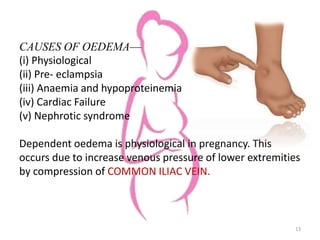
CAUSES OF OEDEMA—
(i) Physiological
(ii) Pre- eclampsia
(iii) Anaemia and hypoproteinemia
(iv) Cardiac Failure
(v) Nephrotic syndrome
Dependent oedema is physiological in pregnancy. This
occurs due to increase venous pressure of lower extremities
by compression of COMMON ILIAC VEIN.
13
OBSTETRICAL EXAMINATION-
Abdominal- Tone of muscles
Scar or herniation, if any
Vaginal- Done in antenatal clinic before 12 weeks
Done to: 1) diagnose pregnancy
2) to corroborate size of uterus with
period of amenorrhoea
3) to exclude any pelvic pathology
NOTE: Internal examination is not done in cases of
previous history of miscarriage, occasional vaginal
bleeding. Here ultrasound examination can be done.
14
Steps for vaginal examination-
-Done in antenatal clinic
-Patient must empty her bladder prior to examination
-Patient is placed in dorsal position with thighs flexed.
-Hands washed with soap and sterile glove is put by
examiner.
Inspection- character of vaginal discharge, if any,
cystocele, uterine prolapse or rectocele is noted.
Speculum examination- Bivalve speculum is used.
Cervical smear for exfoliative cytology or vaginal swab
may be taken.
Bimanual examination- should be gentle and
systematic. It is done to note changes in Cervix, Uterus.
15
ROUTINE INVESTIGATIONS-
1) BLOOD- Haemoglobin, Haematocrit, ABO and Rh
Grouping, Blood Glucose, VDRL.
2) URINE- Protein, Sugar, Pus cells
SPECIAL INVESTIGATIONS-
1) Serological Test- for Rubella, Hepatitis B, HIV
2) Ultrasound Examination- First trimester scan either
Transabdominal (TAS) or Transvaginal (TVS).
This helps to detect- early pregnancy
- accurate dating
- number of foetus
- gross foetal anomalies
- any uterine pathology
Booking scan is done at 18-20 weeks.
16
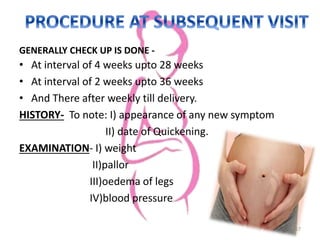
GENERALLY CHECK UP IS DONE -
• At interval of 4 weeks upto 28 weeks
• At interval of 2 weeks upto 36 weeks
• And There after weekly till delivery.
HISTORY- To note: I) appearance of any new symptom
II) date of Quickening.
EXAMINATION- I) weight
II)pallor
III)oedema of legs
IV)blood pressure
17
18
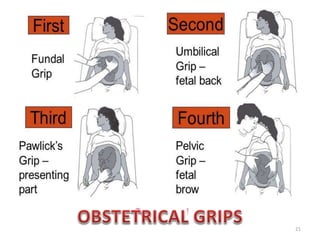
ABDOMINAL EXAMINATION-
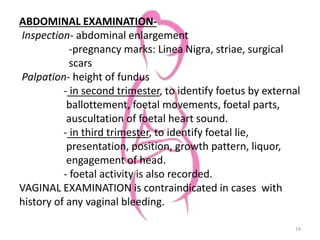
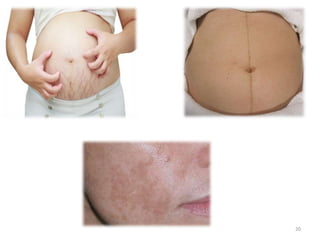
Inspection- abdominal enlargement
-pregnancy marks: Linea Nigra, striae, surgical
scars
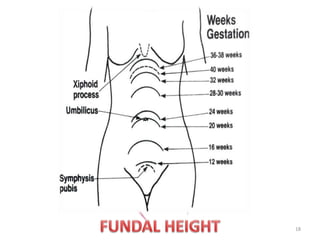
Palpation- height of fundus
- in second trimester, to identify foetus by external
ballottement, foetal movements, foetal parts,
auscultation of foetal heart sound.
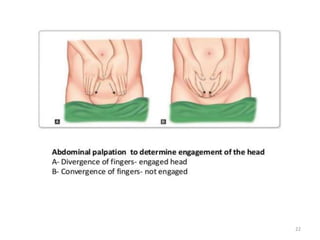
- in third trimester, to identify foetal lie,
presentation, position, growth pattern, liquor,
engagement of head.
- foetal activity is also recorded.
VAGINAL EXAMINATION is contraindicated in cases with
history of any vaginal bleeding.
19
20
21
22
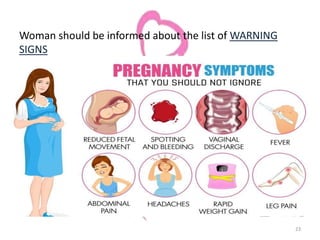
Woman should be informed about the list of WARNING
SIGNS
23
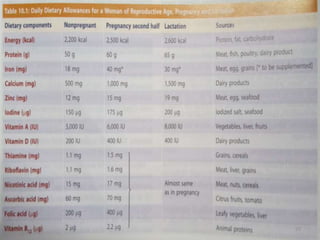
• DIET- should be adequate to provide-
1) Good maternal health
2) optimal foetal growth
3) strength and vitality required during labour
4) successful lactation
 Increased calorie requirement is to the extend of 300 over
the non pregnancy state during second half of pregnancy.
 Pregnancy diet should be light, nutritious, easily digestible
and rich in protein, minerals, vitamins.
 Diet should include 1 litre of milk, plenty of green
vegetables and fruits. Majority of fats should be animal
type containing vitamin A and D.
24
25
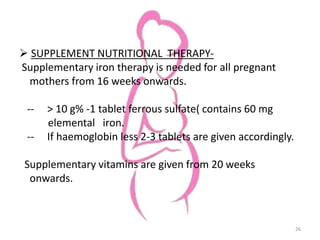
 SUPPLEMENT NUTRITIONAL THERAPY-
Supplementary iron therapy is needed for all pregnant
mothers from 16 weeks onwards.
-- > 10 g% -1 tablet ferrous sulfate( contains 60 mg
elemental iron.
-- If haemoglobin less 2-3 tablets are given accordingly.
Supplementary vitamins are given from 20 weeks
onwards.
26
•ANTENATAL HYGIENE-
 Rest and sleep- 10 hours sleep should be taken especially in
last 6 weeks.
 Bowel-Constipation is common, rectal bleeding, painful
fissures or haemorroids may be there.
 Clothing- Should wear loose but comfortable clothes. High
heels should be avoided in advanced pregnancy.
 Dental care- Good oral hygiene should be maintained.
 Coitus-Woman with increased risk of miscarriage or preterm
labour should avoid coition if uterine activity is increased.
 Travel-Travel by jerky vehicles should be avoided especially in
1 trimester and last 6 weeks.
Air travel is contraindicated in case of placenta previa, pre-
eclampsia , severe anaemia.
 Smoking and alcohol should be avoided.
27
•IMMUNISATION-
 Tetanus toxoid- safe and mandatory; 0.5 ml (IM)
1st dose- at booking visit and 2nd 6 weeks later
If already taken within last 3 years, booster at 36 weeks
 Typhoid , Cholera – if epidemic.
28
• Nausea and vomiting- especially in morning soon after getting
up is common in primigravidae , subside by the end of 1st
trimester.
MEASURES: 1) Dietary changes- dry toast, protein rich
meals
2) Behavior modifications
3) Medication
• Backache- due to weight gain, anterior tilt of pelvis, urinary
infection, constipation, incorrect posture.
• Constipation- Atonicity of gut occurs due to progesterone,
diminished physical activity, pressure of gravid uterus on
pelvic colon.
• Leg cramps-due to deficiency of diffusible serum calcium or
elevation of serum phosphorus.
Supplementary calcium therapy may be beneficial.
29
• Varicose veins- due to obstruction in venous return by
pregnant uterus. Specific therapies are avoided.
• Haemorroids- occurs due to hard stool and may get
complicated by bleeding or protruding. Laxatives can be used
but surgery is avoided.
• Carpal tunnel syndrome- pain, numbness in thumb, index and
middle finger due to compression of median nerve.
• Round ligament pain- due to stretching of round ligament
during movement.
• Syncope- after prolonged standing due to pooling of blood in
veins of lower extremities.
• Ankle oedema- physiological, pre-eclampsia or other cause
• Vaginal discharge-if any infection then should be treated with
vaginal application(Trichomonas ,Candida)
30
•ARSENICUM ALBUM-
-Painful distension of abdomen with violent burning in
epigastric region. Burning is associated with all complaints.

-Appetite is lost.
-Disturbance of stomach by taking ice-cold things and over
ripe fruits.
-Vomiting usually at night- green or black water. Vomits as
soon as food reaches stomach.
-All the troubles are marked in 1st trimester.
-Leucorrhoea in 1st trimester- profuse, yellow, corroding,
offensive.
-Palpitation with dyspnoea and disturbed sleep.
-Modalities-< :mid day, mid night, cold, smell of food.
->:heat, warm drinks. 31
•COCCULUS INDICUS-
- Continuous vomiting in large amount including undigested
food particles.
- Violent cramps in stomach with gripping pain.
- Nausea with faintness.
- Extreme aversion to food especially SOUR things. Feels
better by COLD things.
-Peculiar constrictive tension on right side of chest on
inspiration.
-Stiffness of all joints with trembling of extremities.
-Sad and thinks of bad part of matters.
-Cannot tolerate contradiction and is irritable.
Modalities- < : eating, going to bed, riding in carriage
> : Bending forward, cold drinks
32
•NATRUM SULPHURICUM-
-Mind: melancholic, history of repeated attacks of mania,
suicidal tendency.
- Dreams of running water.
-Complaints of duodenal catarrh with sharp stitching pain
and increased flatulency.
-Intense burning in abdomen increased even after taking
water.
-Yellow green leucorrhoea with hoarseness of voice.
-Asthma during pregnancy.
Modalities- < : lying in bed, damp wet weather, music
> :dry weather, change in position.
33
•PULSATILLA NIGRICANS-
-Marked changeability in every ailment.
-Timid, gentle, emotional.
-Shooting pain always changing its position and associated
with chills.
-Desire- fatty food and tonics; aversion- bread, milk.
-Bitter taste in mouth with waterbrash and offensive smell
from mouth.
-Drawing, tearing pain in limbs with deathly coldness.
- Dryness of mouth with no thirst.
Modalities- <: heat, pregnancy, warm room
> : cold, open air, movement, pressure.
34
•NATRUM MURIATICUM-
-Mind : awkward, hasty, consolation aggravates her
complaints.
-Pregnancy in anaemic woman
-Intense craving for salts, milk, fish and aversion to coffee.
- Extreme debility, feeling of prostration in morning while in
bed.
- Headache due to constipation only during day time.
- Instead of weight gain there may be cachexia and
prostration.
Modalities- < : seashore, daytime (10-11 a.m.), lying down.
> : open air, pushing back against firm support.
35
36

Antenatal care

  • 1.
  • 2.
  • 3.
    • Systemic supervision(examination and advise) of a women during pregnancy. • Should be : 1. regular 2. periodic 3. according to the need of individual. • Comprises of : 1. careful history taking and examination – general and obstretical. 2. to carry out necessary investigation. 3. advise given to pregnant woman. 3
  • 4.
    AIMS AND OJECTIVES •High risk cases • To prevent or detect and treat at earliest if any complication. • To educate the mother about physiology of pregnancy and labour. • Discuss the couple about place, time, mode of delivery and care of new born. • To motivate couple about need of family planning and MTPs. OBJECTIVES – 1. To ensure normal pregnancy 2. Healthy mother and healthy baby. 4
  • 5.
    • Counseling acouple about a pregnancy, its course, outcome well before the time of actual conception. OBJECTIVES:  to ensure that woman enters pregnancy with optimal state of health, safe for both mother and foetus.  Helps in identifying the risk factors so that proper care can be provide to reduce or eliminate them 5
  • 6.
    PRECONCEPTIONAL VISITS: 1.High riskfactor identification- by detailed evaluation. 2.Base level health status recorded- B.P, Pulse. 3.Rubella and Hepatitis immunization is given in non immune woman. 4.Folic acid supplementation- 4mg/day 4 weeks prior to conception upto 12 weeks of pregnancy 5.Maternal health is optimized-weight, anaemia. 6. Fear of incoming pregnancy. 7.If any medical complication- educate the patient about effect of disease on pregnancy and vice versa. 8. Drugs used are verified and changed if required. 9. smoking, alcohol, abusing drugs are avoided. 10. Inheritable genetic diseases are screened. 6
  • 7.
    HISTORY TAKING- First visitis called BOOKING VISIT. VITAL STATISTICS: - Name - Date of 1st visit - Address -Age -Gravida and parity -Duration of marriage -Religion -Occupation of her and of husband -Period of gestation(in terms of completed weeks) 7
  • 8.
    COMPLAINTS: Genesis ofcomplaints are to be noted. If no complaints enquiry about sleep, appetite, bowel habits, urination is made. HISTORY OF PRESENT ILLNESS: Onset Duration Severity Use of medication Progress 8
  • 9.
    HISTORY OF PRESENTPREGNANCY: 1.Complications of different trimesters of present pregnancy are noted. FIRST TRIMESTES- hyperemesis -threatened abortion SECOND TRIMESTER -pyelitis THIRD TRIMESTER - anaemia - pre- eclampsia -antepartum haemorrhage 2. No. of previous antenatal visits. 3.Immunization status. 4. Any medication or radiation exposure in early pregnancy. 9
  • 10.
    OBSTRETICAL HISTORY: Onlyin multigravidae GPAL – Gravida*, Parity**, Abortions, Live issues. *Gravida- pregnant state present and past irrespective of period of gestation. **Parity- a state of previous pregnancy beyond period of viability. MENSTRUAL HISTORY: Cycle Duration Amount of blood flow Last Normal Menstrual Period- calculated by Naegele’s formula NAEGELE’S FORMULA: 9 months+ 7 days added tp the first day of last normal period. 10
  • 11.
    PAST MEDICAL HISTORY-Any past medical illness are recorded. PAST SURGICAL HISTORY- General or Gynaecological. FAMILY HISTORY- Hypertension, Diabetes, Tuberculosis, Blood dyscrasia, Hereditary disorder if any. PERSONAL HISTORY- Habits- smoking, alcohol - Contraceptives used - Any allergy- drugs used should be verified - Immunization- Tb, Tetanus, Anti-D 11
  • 12.
    EXAMINATION- GENERAL PHYSICAL EXAMINATION- 1.Build 2. Nutrition 3. Height 4. Weight 5. Pallor 6. Jaundice 7. Tongue, teeth, gums, tonsils 8. Neck- slight physiological enlargement of thyroid glands occur in 50% cases. 9. Oedema of legs- mostly seen on medial malleolus and anterior surface of lower one-third of Tibia. 12
  • 13.
    CAUSES OF OEDEMA— (i)Physiological (ii) Pre- eclampsia (iii) Anaemia and hypoproteinemia (iv) Cardiac Failure (v) Nephrotic syndrome Dependent oedema is physiological in pregnancy. This occurs due to increase venous pressure of lower extremities by compression of COMMON ILIAC VEIN. 13
  • 14.
    OBSTETRICAL EXAMINATION- Abdominal- Toneof muscles Scar or herniation, if any Vaginal- Done in antenatal clinic before 12 weeks Done to: 1) diagnose pregnancy 2) to corroborate size of uterus with period of amenorrhoea 3) to exclude any pelvic pathology NOTE: Internal examination is not done in cases of previous history of miscarriage, occasional vaginal bleeding. Here ultrasound examination can be done. 14
  • 15.
    Steps for vaginalexamination- -Done in antenatal clinic -Patient must empty her bladder prior to examination -Patient is placed in dorsal position with thighs flexed. -Hands washed with soap and sterile glove is put by examiner. Inspection- character of vaginal discharge, if any, cystocele, uterine prolapse or rectocele is noted. Speculum examination- Bivalve speculum is used. Cervical smear for exfoliative cytology or vaginal swab may be taken. Bimanual examination- should be gentle and systematic. It is done to note changes in Cervix, Uterus. 15
  • 16.
    ROUTINE INVESTIGATIONS- 1) BLOOD-Haemoglobin, Haematocrit, ABO and Rh Grouping, Blood Glucose, VDRL. 2) URINE- Protein, Sugar, Pus cells SPECIAL INVESTIGATIONS- 1) Serological Test- for Rubella, Hepatitis B, HIV 2) Ultrasound Examination- First trimester scan either Transabdominal (TAS) or Transvaginal (TVS). This helps to detect- early pregnancy - accurate dating - number of foetus - gross foetal anomalies - any uterine pathology Booking scan is done at 18-20 weeks. 16
  • 17.
    GENERALLY CHECK UPIS DONE - • At interval of 4 weeks upto 28 weeks • At interval of 2 weeks upto 36 weeks • And There after weekly till delivery. HISTORY- To note: I) appearance of any new symptom II) date of Quickening. EXAMINATION- I) weight II)pallor III)oedema of legs IV)blood pressure 17
  • 18.
  • 19.
    ABDOMINAL EXAMINATION- Inspection- abdominalenlargement -pregnancy marks: Linea Nigra, striae, surgical scars Palpation- height of fundus - in second trimester, to identify foetus by external ballottement, foetal movements, foetal parts, auscultation of foetal heart sound. - in third trimester, to identify foetal lie, presentation, position, growth pattern, liquor, engagement of head. - foetal activity is also recorded. VAGINAL EXAMINATION is contraindicated in cases with history of any vaginal bleeding. 19
  • 20.
  • 21.
  • 22.
  • 23.
    Woman should beinformed about the list of WARNING SIGNS 23
  • 24.
    • DIET- shouldbe adequate to provide- 1) Good maternal health 2) optimal foetal growth 3) strength and vitality required during labour 4) successful lactation  Increased calorie requirement is to the extend of 300 over the non pregnancy state during second half of pregnancy.  Pregnancy diet should be light, nutritious, easily digestible and rich in protein, minerals, vitamins.  Diet should include 1 litre of milk, plenty of green vegetables and fruits. Majority of fats should be animal type containing vitamin A and D. 24
  • 25.
  • 26.
     SUPPLEMENT NUTRITIONALTHERAPY- Supplementary iron therapy is needed for all pregnant mothers from 16 weeks onwards. -- > 10 g% -1 tablet ferrous sulfate( contains 60 mg elemental iron. -- If haemoglobin less 2-3 tablets are given accordingly. Supplementary vitamins are given from 20 weeks onwards. 26
  • 27.
    •ANTENATAL HYGIENE-  Restand sleep- 10 hours sleep should be taken especially in last 6 weeks.  Bowel-Constipation is common, rectal bleeding, painful fissures or haemorroids may be there.  Clothing- Should wear loose but comfortable clothes. High heels should be avoided in advanced pregnancy.  Dental care- Good oral hygiene should be maintained.  Coitus-Woman with increased risk of miscarriage or preterm labour should avoid coition if uterine activity is increased.  Travel-Travel by jerky vehicles should be avoided especially in 1 trimester and last 6 weeks. Air travel is contraindicated in case of placenta previa, pre- eclampsia , severe anaemia.  Smoking and alcohol should be avoided. 27
  • 28.
    •IMMUNISATION-  Tetanus toxoid-safe and mandatory; 0.5 ml (IM) 1st dose- at booking visit and 2nd 6 weeks later If already taken within last 3 years, booster at 36 weeks  Typhoid , Cholera – if epidemic. 28
  • 29.
    • Nausea andvomiting- especially in morning soon after getting up is common in primigravidae , subside by the end of 1st trimester. MEASURES: 1) Dietary changes- dry toast, protein rich meals 2) Behavior modifications 3) Medication • Backache- due to weight gain, anterior tilt of pelvis, urinary infection, constipation, incorrect posture. • Constipation- Atonicity of gut occurs due to progesterone, diminished physical activity, pressure of gravid uterus on pelvic colon. • Leg cramps-due to deficiency of diffusible serum calcium or elevation of serum phosphorus. Supplementary calcium therapy may be beneficial. 29
  • 30.
    • Varicose veins-due to obstruction in venous return by pregnant uterus. Specific therapies are avoided. • Haemorroids- occurs due to hard stool and may get complicated by bleeding or protruding. Laxatives can be used but surgery is avoided. • Carpal tunnel syndrome- pain, numbness in thumb, index and middle finger due to compression of median nerve. • Round ligament pain- due to stretching of round ligament during movement. • Syncope- after prolonged standing due to pooling of blood in veins of lower extremities. • Ankle oedema- physiological, pre-eclampsia or other cause • Vaginal discharge-if any infection then should be treated with vaginal application(Trichomonas ,Candida) 30
  • 31.
    •ARSENICUM ALBUM- -Painful distensionof abdomen with violent burning in epigastric region. Burning is associated with all complaints. -Appetite is lost. -Disturbance of stomach by taking ice-cold things and over ripe fruits. -Vomiting usually at night- green or black water. Vomits as soon as food reaches stomach. -All the troubles are marked in 1st trimester. -Leucorrhoea in 1st trimester- profuse, yellow, corroding, offensive. -Palpitation with dyspnoea and disturbed sleep. -Modalities-< :mid day, mid night, cold, smell of food. ->:heat, warm drinks. 31
  • 32.
    •COCCULUS INDICUS- - Continuousvomiting in large amount including undigested food particles. - Violent cramps in stomach with gripping pain. - Nausea with faintness. - Extreme aversion to food especially SOUR things. Feels better by COLD things. -Peculiar constrictive tension on right side of chest on inspiration. -Stiffness of all joints with trembling of extremities. -Sad and thinks of bad part of matters. -Cannot tolerate contradiction and is irritable. Modalities- < : eating, going to bed, riding in carriage > : Bending forward, cold drinks 32
  • 33.
    •NATRUM SULPHURICUM- -Mind: melancholic,history of repeated attacks of mania, suicidal tendency. - Dreams of running water. -Complaints of duodenal catarrh with sharp stitching pain and increased flatulency. -Intense burning in abdomen increased even after taking water. -Yellow green leucorrhoea with hoarseness of voice. -Asthma during pregnancy. Modalities- < : lying in bed, damp wet weather, music > :dry weather, change in position. 33
  • 34.
    •PULSATILLA NIGRICANS- -Marked changeabilityin every ailment. -Timid, gentle, emotional. -Shooting pain always changing its position and associated with chills. -Desire- fatty food and tonics; aversion- bread, milk. -Bitter taste in mouth with waterbrash and offensive smell from mouth. -Drawing, tearing pain in limbs with deathly coldness. - Dryness of mouth with no thirst. Modalities- <: heat, pregnancy, warm room > : cold, open air, movement, pressure. 34
  • 35.
    •NATRUM MURIATICUM- -Mind :awkward, hasty, consolation aggravates her complaints. -Pregnancy in anaemic woman -Intense craving for salts, milk, fish and aversion to coffee. - Extreme debility, feeling of prostration in morning while in bed. - Headache due to constipation only during day time. - Instead of weight gain there may be cachexia and prostration. Modalities- < : seashore, daytime (10-11 a.m.), lying down. > : open air, pushing back against firm support. 35
  • 36.