Memory hierarchy
Main Memory: memory unit that communicates directly with the CPU
(RAM)
Auxiliary Memory: device that provide backup storage (Disk Drives)
Example of auxiliary memory: magnetic disks and tapes.
 They are used for storing system programs, large data files, and
other backup information
 Only program programs and data currently needed by the
processor reside in main memory.
 All other information is stored in auxiliary memory and transferred
to main memory when needed.
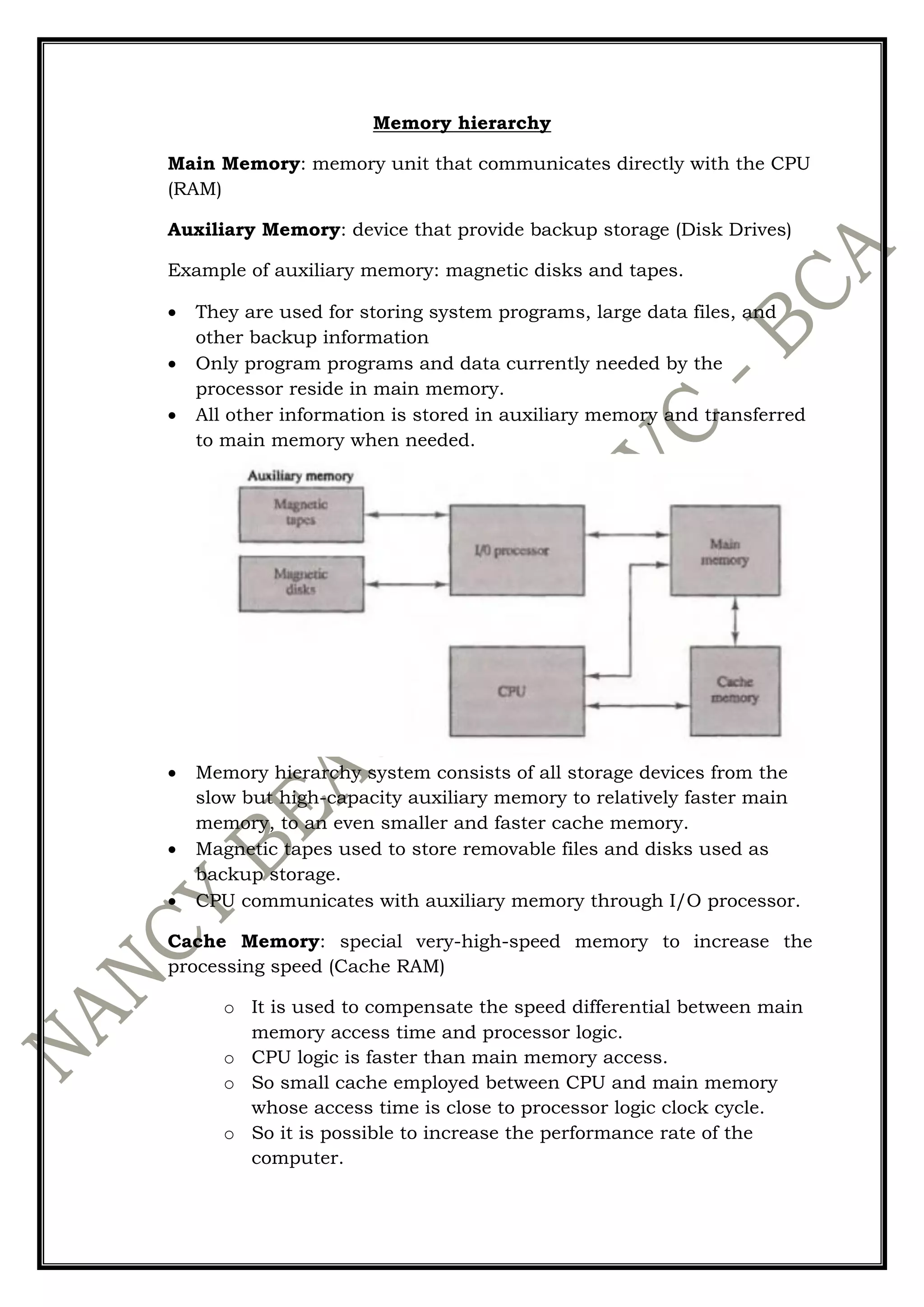
 Memory hierarchy system consists of all storage devices from the
slow but high-capacity auxiliary memory to relatively faster main
memory, to an even smaller and faster cache memory.
 Magnetic tapes used to store removable files and disks used as
backup storage.
 CPU communicates with auxiliary memory through I/O processor.
Cache Memory: special very-high-speed memory to increase the
processing speed (Cache RAM)
o It is used to compensate the speed differential between main
memory access time and processor logic.
o CPU logic is faster than main memory access.
o So small cache employed between CPU and main memory
whose access time is close to processor logic clock cycle.
o So it is possible to increase the performance rate of the
computer.
 As the storage capacity of the memory increases, the cost per bit
for storing binary information decreases and the access time of the
memory becomes longer.
Example
 Auxiliary memory has a large storage capacity, is relatively
inexpensive, but has low access speed compared to main memory.
 The cache memory is very small, relatively expensive, and has very
high access speed.
Goal of memory hierarchy
 To obtain the highest-possible average access speed while
minimizing the total cost.
Ratio
 Access time ratio between cache and main memory is about 1 to 7
For Example
 Cache memory may have an access time of 100ns, while main
memory access time may be 700ns.
 Auxiliary memory average access time is usually 1000 times that of
main memory.
Block Size
 Block size in auxiliary memory typically ranges from 256 to 2048
words, while cache block size is typically from 1 to 16 words.
Multiprogramming
 Multiprogramming refers to the existence of two or more programs
in different parts of the memory hierarchy at the same time.
 For example, when one program is waiting for input or output
transfer, there is another program ready to utilize the CPU.
Memory management
 A program with its data normally resides in auxiliary memory.
When the program or a segment of the program is to be executed, it
is transferred to main memory to be executed by the CPU.
 It is the task of the operating system to maintain in main memory
a portion of this information that is currently active.
 The part of the computer system that supervises the flow of
information between auxiliary memory and main memory is called
the memory management system.

Memory hierarchy

  • 1.
    Memory hierarchy Main Memory:memory unit that communicates directly with the CPU (RAM) Auxiliary Memory: device that provide backup storage (Disk Drives) Example of auxiliary memory: magnetic disks and tapes.  They are used for storing system programs, large data files, and other backup information  Only program programs and data currently needed by the processor reside in main memory.  All other information is stored in auxiliary memory and transferred to main memory when needed.  Memory hierarchy system consists of all storage devices from the slow but high-capacity auxiliary memory to relatively faster main memory, to an even smaller and faster cache memory.  Magnetic tapes used to store removable files and disks used as backup storage.  CPU communicates with auxiliary memory through I/O processor. Cache Memory: special very-high-speed memory to increase the processing speed (Cache RAM) o It is used to compensate the speed differential between main memory access time and processor logic. o CPU logic is faster than main memory access. o So small cache employed between CPU and main memory whose access time is close to processor logic clock cycle. o So it is possible to increase the performance rate of the computer.
  • 2.
     As thestorage capacity of the memory increases, the cost per bit for storing binary information decreases and the access time of the memory becomes longer. Example  Auxiliary memory has a large storage capacity, is relatively inexpensive, but has low access speed compared to main memory.  The cache memory is very small, relatively expensive, and has very high access speed. Goal of memory hierarchy  To obtain the highest-possible average access speed while minimizing the total cost. Ratio  Access time ratio between cache and main memory is about 1 to 7 For Example  Cache memory may have an access time of 100ns, while main memory access time may be 700ns.  Auxiliary memory average access time is usually 1000 times that of main memory. Block Size  Block size in auxiliary memory typically ranges from 256 to 2048 words, while cache block size is typically from 1 to 16 words. Multiprogramming  Multiprogramming refers to the existence of two or more programs in different parts of the memory hierarchy at the same time.  For example, when one program is waiting for input or output transfer, there is another program ready to utilize the CPU. Memory management  A program with its data normally resides in auxiliary memory. When the program or a segment of the program is to be executed, it is transferred to main memory to be executed by the CPU.  It is the task of the operating system to maintain in main memory a portion of this information that is currently active.
  • 3.
     The partof the computer system that supervises the flow of information between auxiliary memory and main memory is called the memory management system.