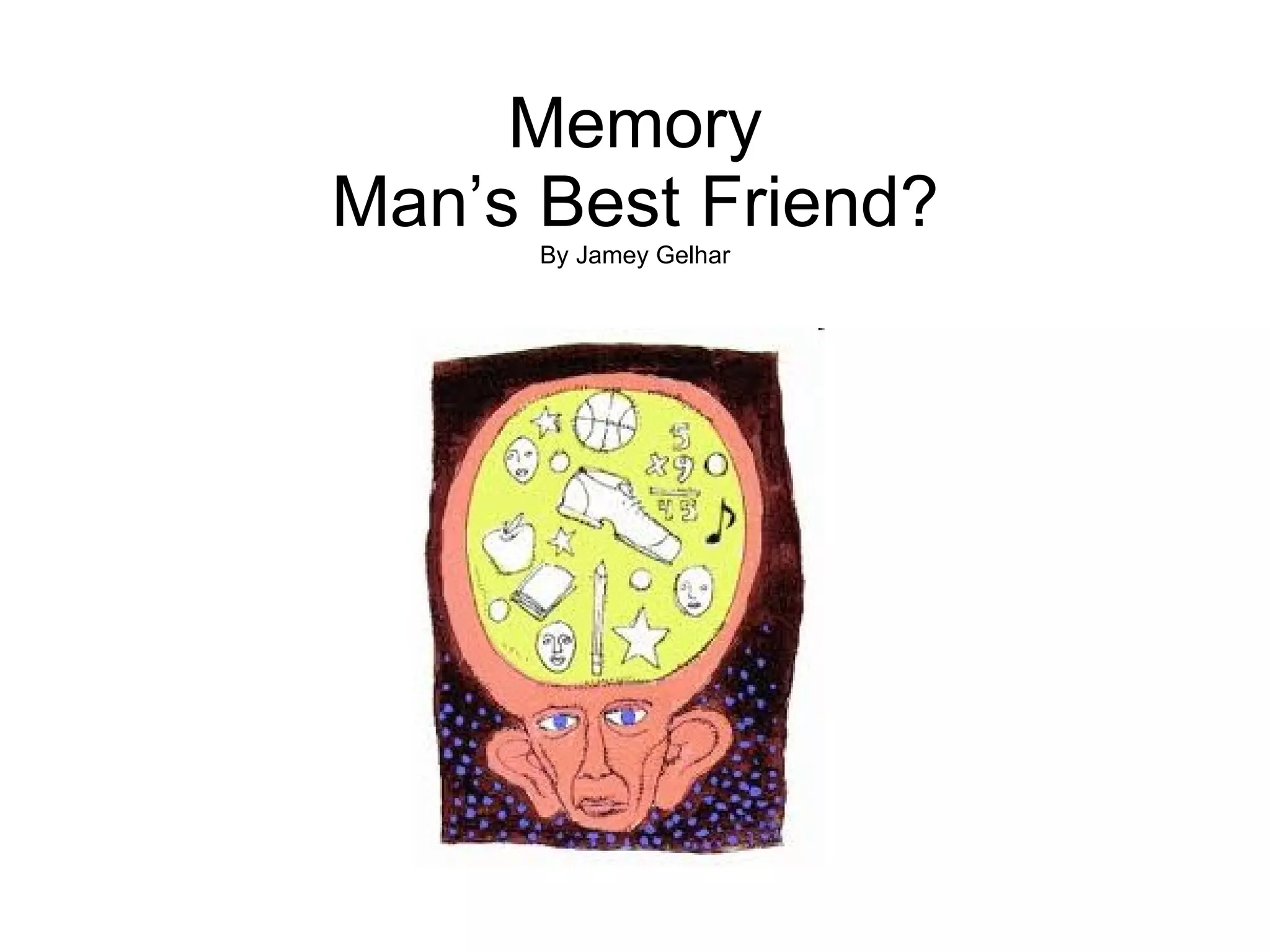
Memory Man’s Best Friend? By Jamey Gelhar
Memory The purpose of this presentation is to give a very brief description of memory, and for the main emphasis to be about how you can increase and improve memory. Start out by watching this YouTube clip http://www.youtube.com/watch?v=grZuwo_YlY0 ENJOY!
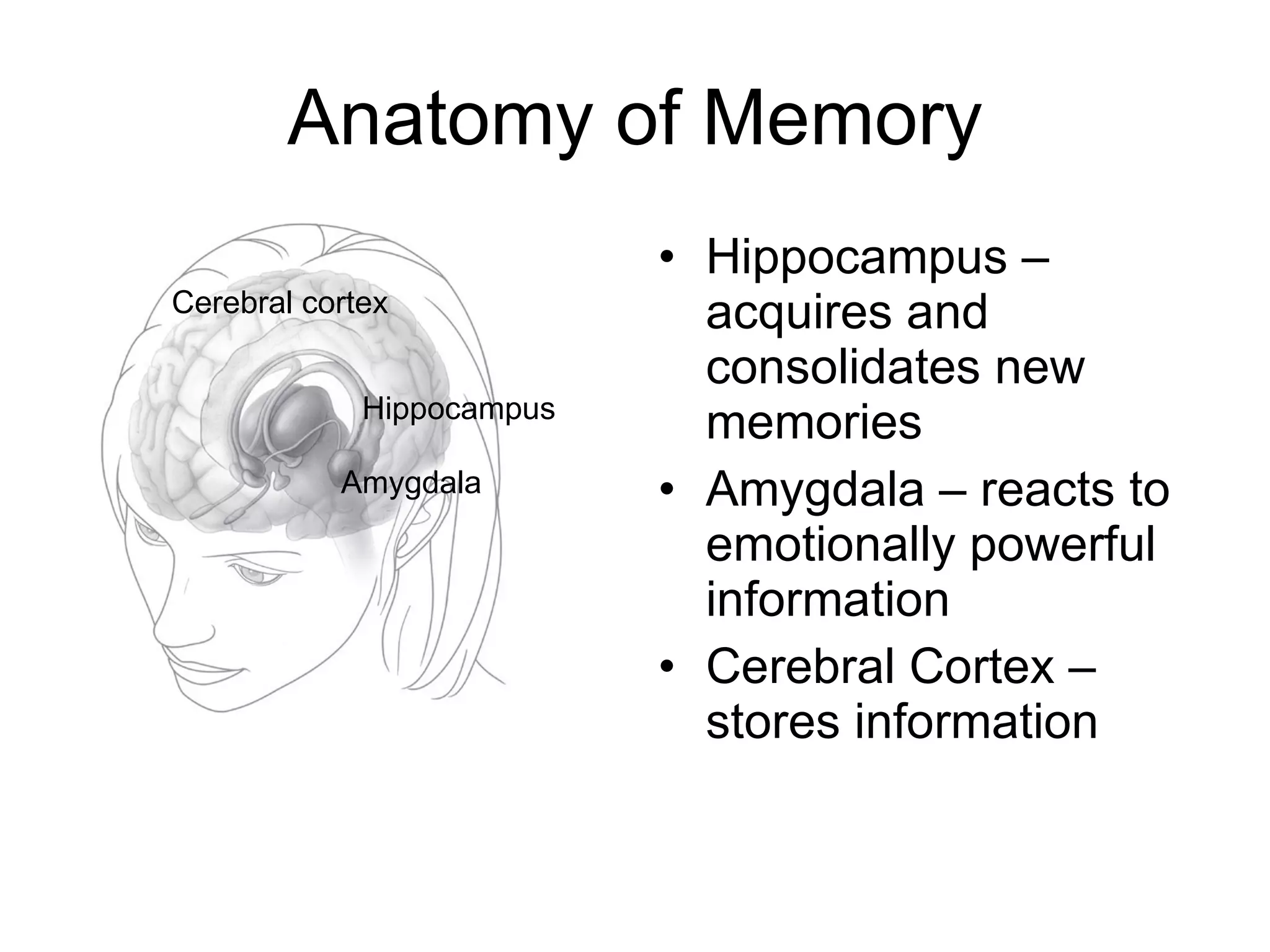
Anatomy of Memory Hippocampus – acquires and consolidates new memories Amygdala – reacts to emotionally powerful information Cerebral Cortex – stores information Cerebral cortex Hippocampus Amygdala
Memory Systems Memory has three parts: Encoding, Storage, and Retrieval.  Encoding  – the first memory process. This process involves the organization and transformation of incoming information so that it can be entered into memory Storage  – the second memory process. Storage involves entering and maintaining information in memory for a period of time. The human memory system that stores information for brief time periods are called  sensory   memory  and  short   term   memory , while the more permanent system is known as  long-term memory. Retrieval  – the third memory process. Retrieval involves recovering stored information from memory so that it can be used.
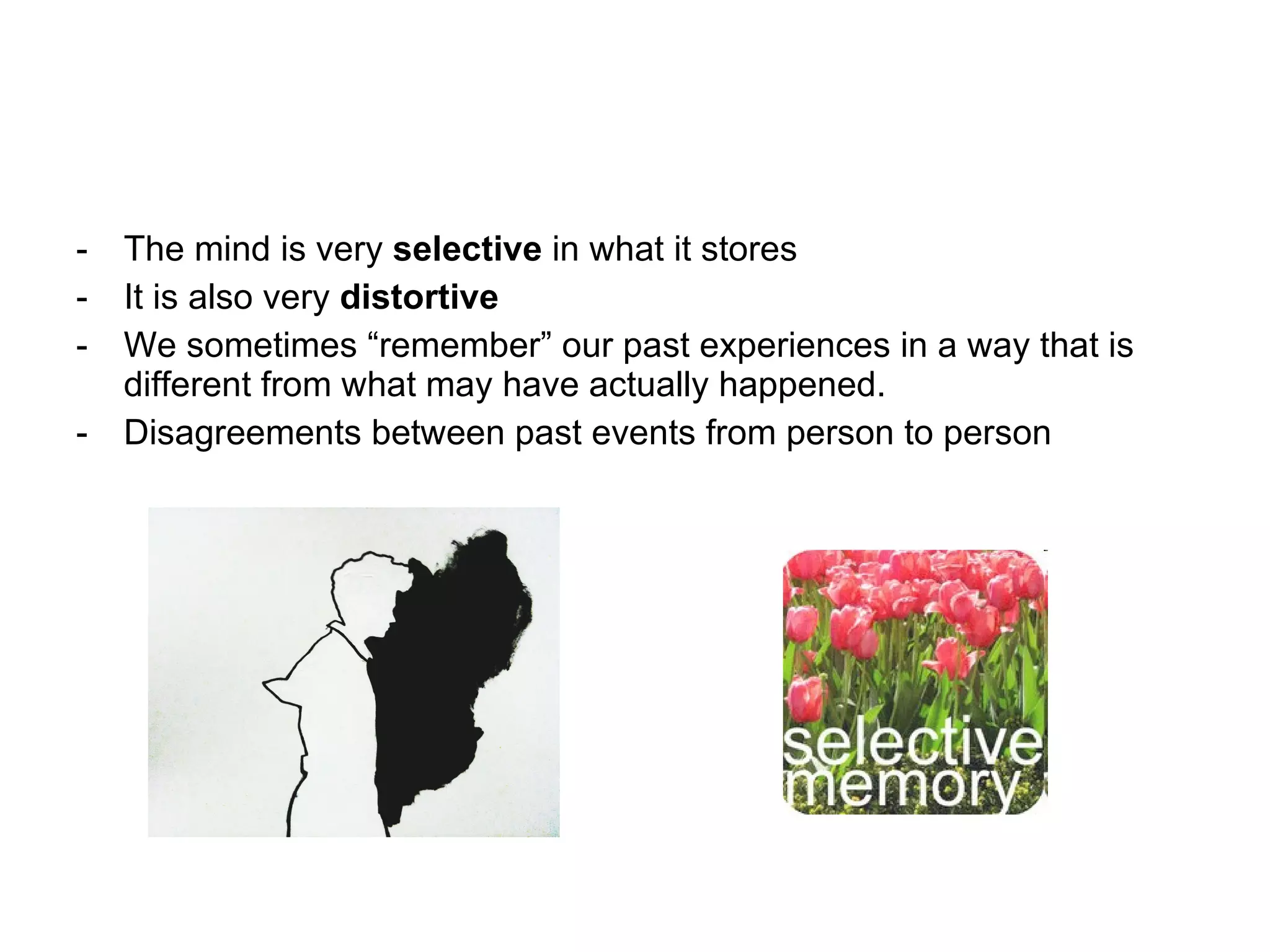
The mind is very  selective  in what it stores It is also very  distortive We sometimes “remember” our past experiences in a way that is different from what may have actually happened. Disagreements between past events from person to person
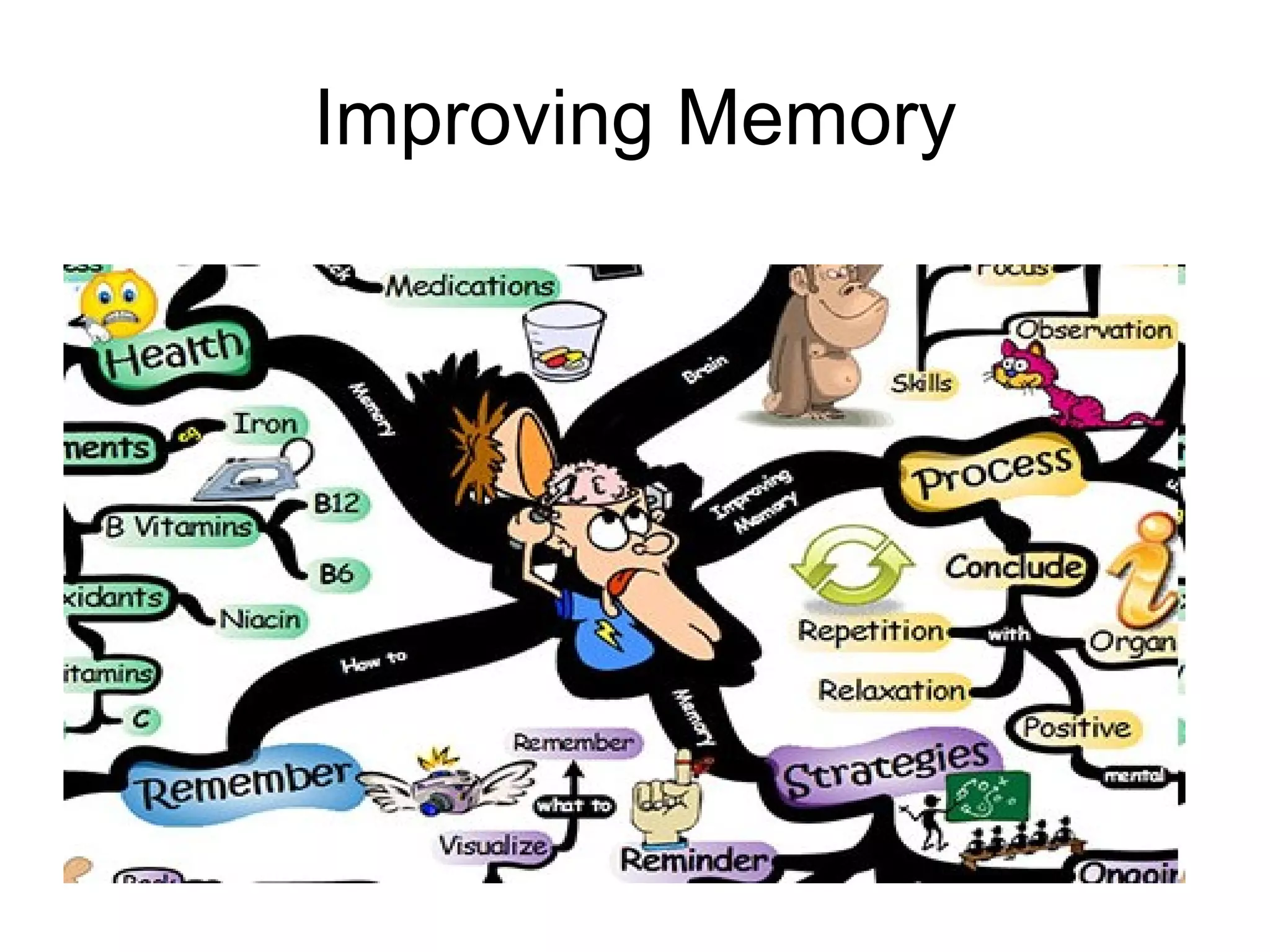
Improving Memory
Improving Memory Nobody can remember all the millions of things they hear, see, touch, taste, or smell. However, there are many things you can do to improve your ability to retain and recall memories. Keep Learning Use Your Senses Diet Repetition Mnemonics Exercise
Keep Learning Keeping your brain active is extremely important for retaining memory. Getting and staying in the habit of being mentally active. Challenge your brain with mental exercises. Brain activities are believed to activate processes to help maintain individual brain cells and stimulate communication
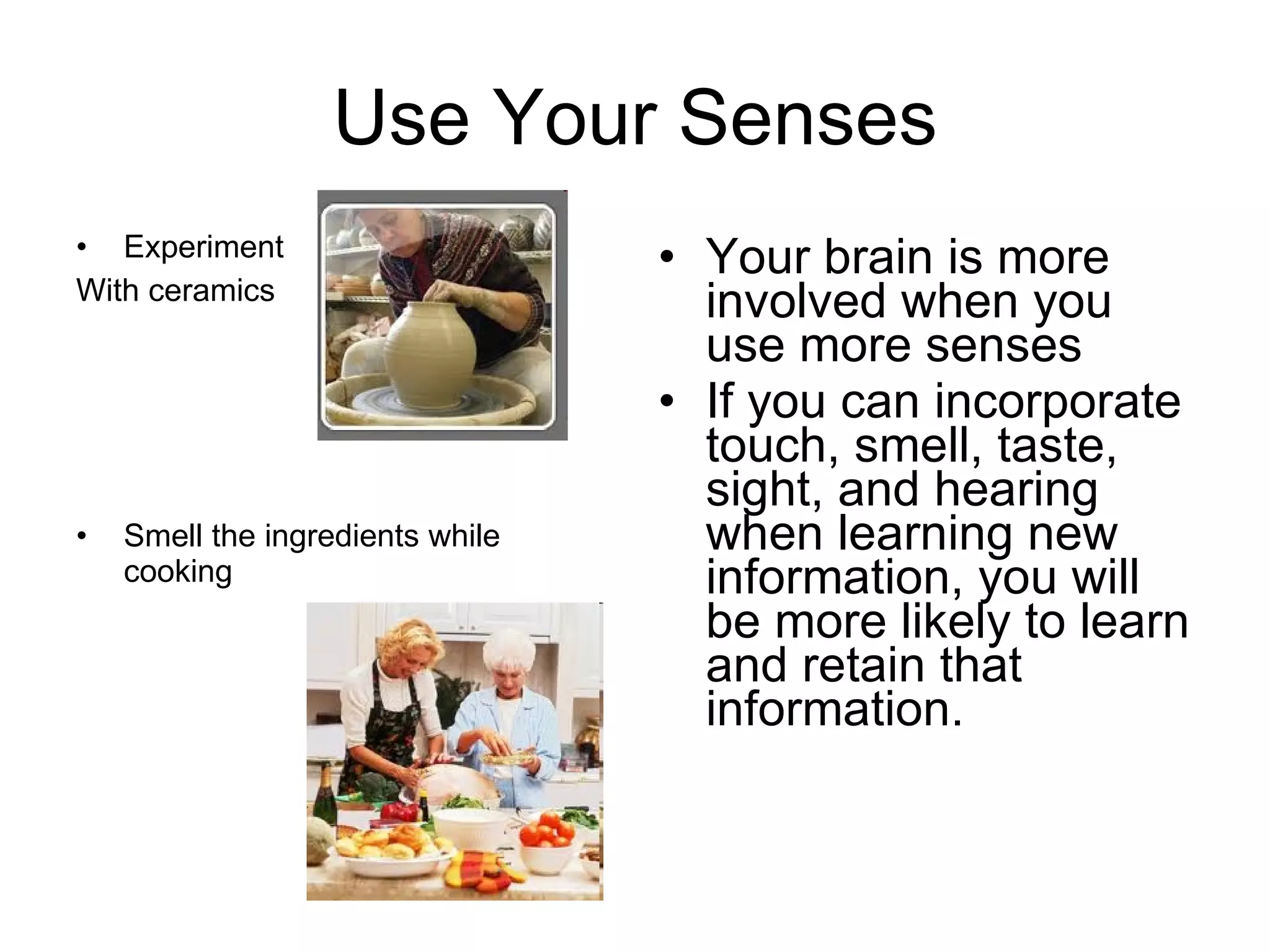
Use Your Senses Experiment  With ceramics Smell the ingredients while cooking Your brain is more involved when you use more senses If you can incorporate touch, smell, taste, sight, and hearing when learning new information, you will be more likely to learn and retain that information.
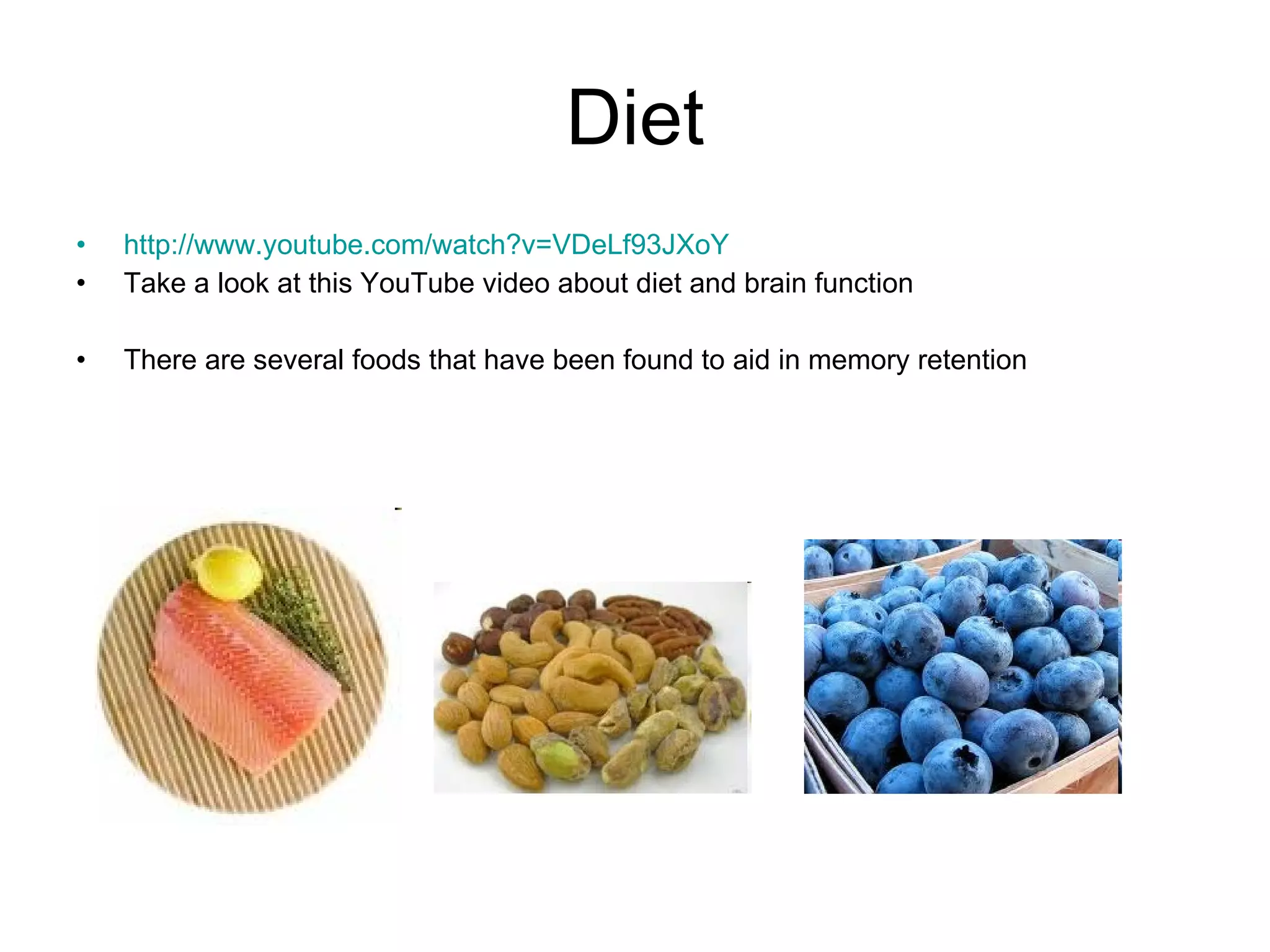
Diet http://www.youtube.com/watch?v=VDeLf93JXoY Take a look at this YouTube video about diet and brain function There are several foods that have been found to aid in memory retention
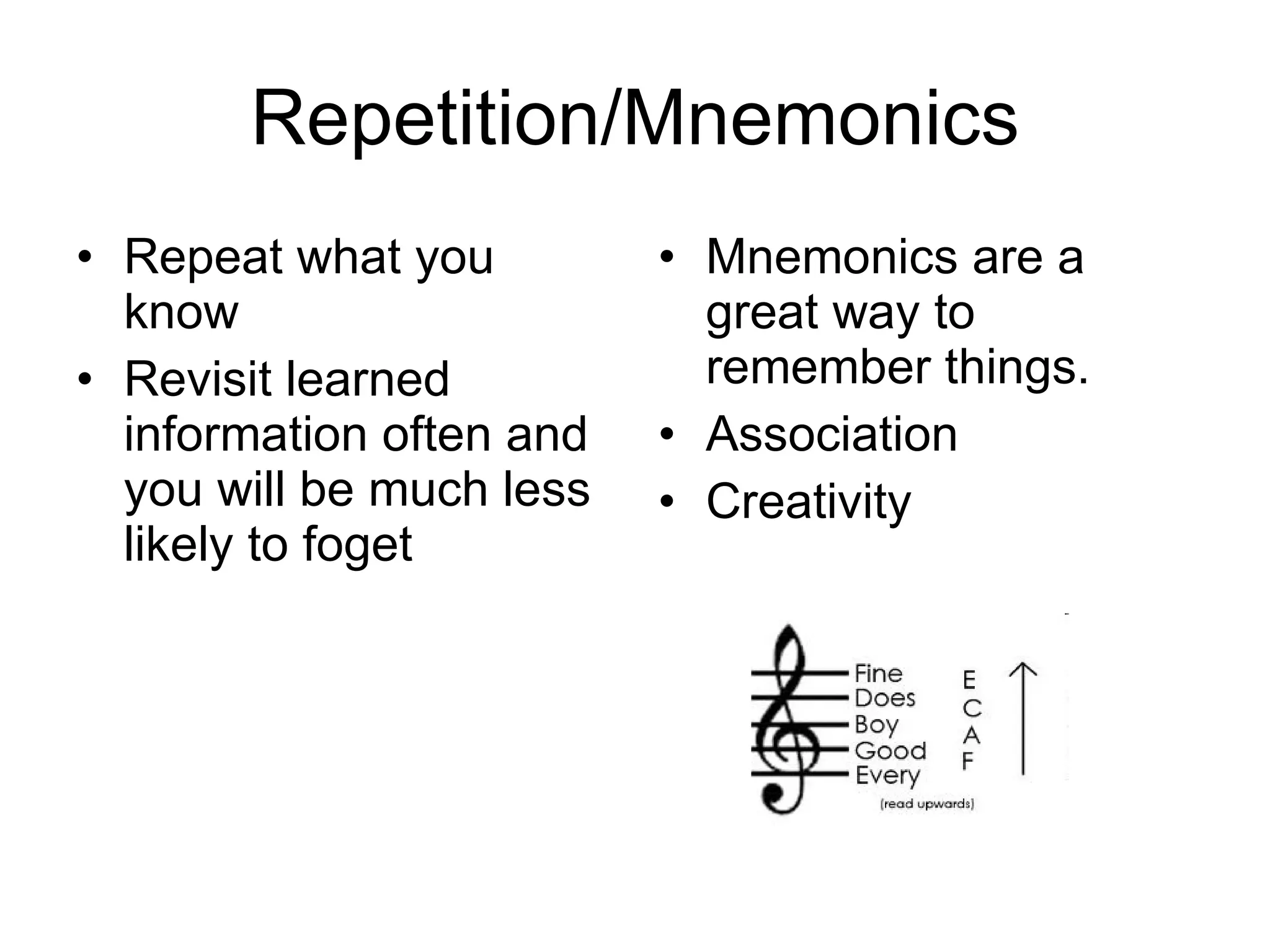
Repetition/Mnemonics Repeat what you know Revisit learned information often and you will be much less likely to foget Mnemonics are a great way to remember things. Association Creativity
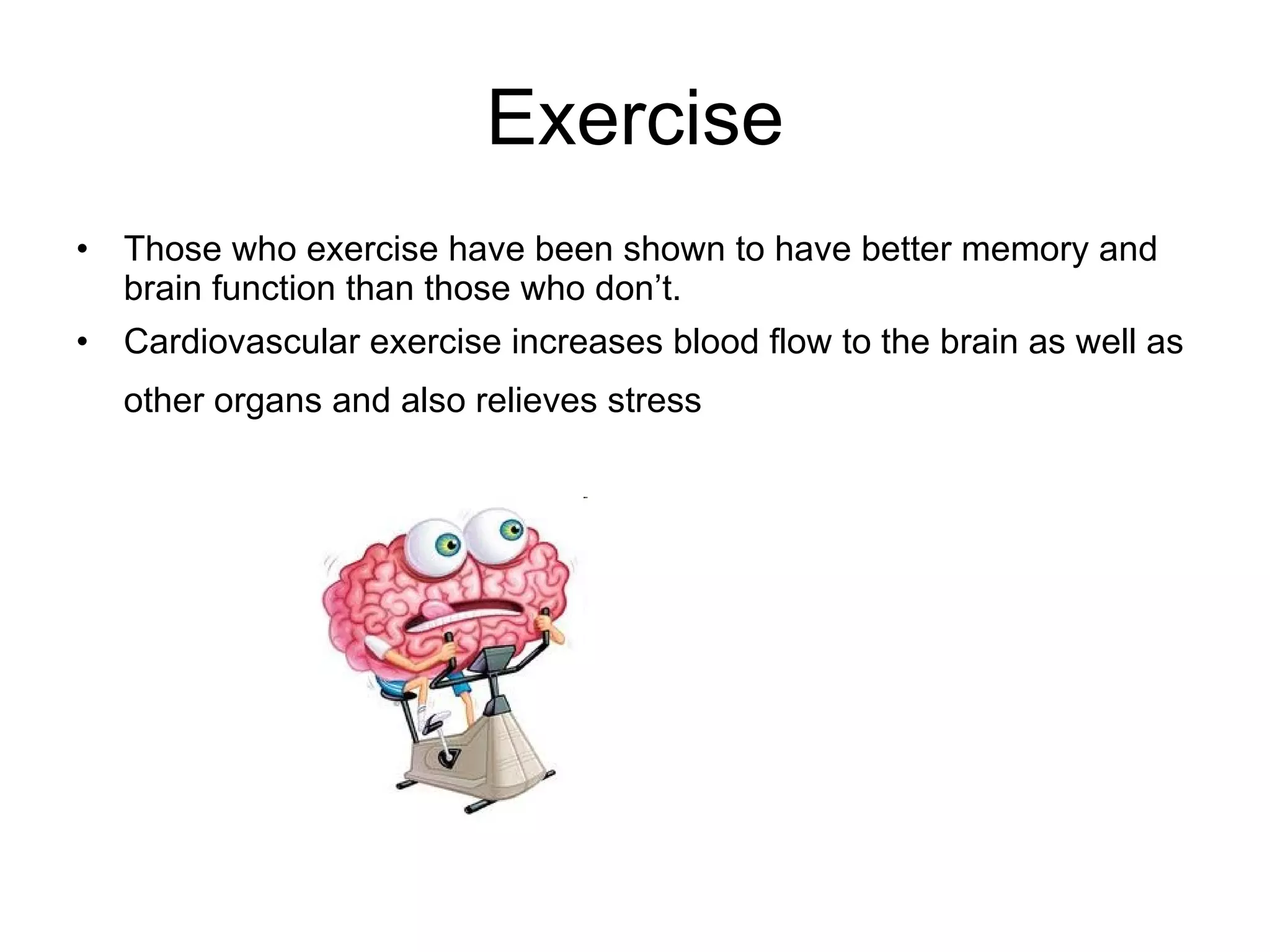
Exercise Those who exercise have been shown to have better memory and brain function than those who don’t. Cardiovascular exercise increases blood flow to the brain as well as other organs and also relieves stress
Conclusion As you can see, there are many different things you can do to improve memory and to benefit your learning abilities. A MIND IS A TERRIBLE THING TO WASTE!
Bibliography Association Between Mind-Body and Cardiovascular Exercises and Memory in Older Adults. Journal of the American Geriatrics Society; Oct2005, Vol. 53 Issue 10, p1754-1760, 7p, 3  http://web.ebscohost.com/ehost/pdfviewer/pdfviewer?hid=122&sid=2a86a63c-f7f1-4a55-abfd-69fb26002b02%40sessionmgr4&vid=14 This source was an article from EBSCO that described the ways that exercise benefits brain function and memory. It had studies on adults who exercised and showed the results they found. Franzoi, Stephen L. “Essentials of Psychology” Thompson, 2008. “Memory” Ch 7, pp 244 This Psychology textbook was a great reference for the topic, although I focused on things that weren’t really included. It had great technical explanations of short and long term memory. “ Preserving and improving memory as we age” Harvard Women's Health Watch; Feb2010, Vol. 17 Issue 6, p1-3, 3p  http://web.ebscohost.com/ehost/pdfviewer/pdfviewer?hid=7&sid=2a86a63c-f7f1-4a55-abfd-69fb26002b02%40sessionmgr4&vid=12 This is the source that I used the most, because it was the most relevant to what I wanted to focus on, in relation to ways to improve memory and brain activity. This source described things you can do such as keep learning, health, positive outlook, etc.

Memory

  • 1.
    Memory Man’s BestFriend? By Jamey Gelhar
  • 2.
    Memory The purposeof this presentation is to give a very brief description of memory, and for the main emphasis to be about how you can increase and improve memory. Start out by watching this YouTube clip http://www.youtube.com/watch?v=grZuwo_YlY0 ENJOY!
  • 3.
    Anatomy of MemoryHippocampus – acquires and consolidates new memories Amygdala – reacts to emotionally powerful information Cerebral Cortex – stores information Cerebral cortex Hippocampus Amygdala
  • 4.
    Memory Systems Memoryhas three parts: Encoding, Storage, and Retrieval. Encoding – the first memory process. This process involves the organization and transformation of incoming information so that it can be entered into memory Storage – the second memory process. Storage involves entering and maintaining information in memory for a period of time. The human memory system that stores information for brief time periods are called sensory memory and short term memory , while the more permanent system is known as long-term memory. Retrieval – the third memory process. Retrieval involves recovering stored information from memory so that it can be used.
  • 5.
    The mind isvery selective in what it stores It is also very distortive We sometimes “remember” our past experiences in a way that is different from what may have actually happened. Disagreements between past events from person to person
  • 6.
  • 7.
    Improving Memory Nobodycan remember all the millions of things they hear, see, touch, taste, or smell. However, there are many things you can do to improve your ability to retain and recall memories. Keep Learning Use Your Senses Diet Repetition Mnemonics Exercise
  • 8.
    Keep Learning Keepingyour brain active is extremely important for retaining memory. Getting and staying in the habit of being mentally active. Challenge your brain with mental exercises. Brain activities are believed to activate processes to help maintain individual brain cells and stimulate communication
  • 9.
    Use Your SensesExperiment With ceramics Smell the ingredients while cooking Your brain is more involved when you use more senses If you can incorporate touch, smell, taste, sight, and hearing when learning new information, you will be more likely to learn and retain that information.
  • 10.
    Diet http://www.youtube.com/watch?v=VDeLf93JXoY Takea look at this YouTube video about diet and brain function There are several foods that have been found to aid in memory retention
  • 11.
    Repetition/Mnemonics Repeat whatyou know Revisit learned information often and you will be much less likely to foget Mnemonics are a great way to remember things. Association Creativity
  • 12.
    Exercise Those whoexercise have been shown to have better memory and brain function than those who don’t. Cardiovascular exercise increases blood flow to the brain as well as other organs and also relieves stress
  • 13.
    Conclusion As youcan see, there are many different things you can do to improve memory and to benefit your learning abilities. A MIND IS A TERRIBLE THING TO WASTE!
  • 14.
    Bibliography Association BetweenMind-Body and Cardiovascular Exercises and Memory in Older Adults. Journal of the American Geriatrics Society; Oct2005, Vol. 53 Issue 10, p1754-1760, 7p, 3 http://web.ebscohost.com/ehost/pdfviewer/pdfviewer?hid=122&sid=2a86a63c-f7f1-4a55-abfd-69fb26002b02%40sessionmgr4&vid=14 This source was an article from EBSCO that described the ways that exercise benefits brain function and memory. It had studies on adults who exercised and showed the results they found. Franzoi, Stephen L. “Essentials of Psychology” Thompson, 2008. “Memory” Ch 7, pp 244 This Psychology textbook was a great reference for the topic, although I focused on things that weren’t really included. It had great technical explanations of short and long term memory. “ Preserving and improving memory as we age” Harvard Women's Health Watch; Feb2010, Vol. 17 Issue 6, p1-3, 3p http://web.ebscohost.com/ehost/pdfviewer/pdfviewer?hid=7&sid=2a86a63c-f7f1-4a55-abfd-69fb26002b02%40sessionmgr4&vid=12 This is the source that I used the most, because it was the most relevant to what I wanted to focus on, in relation to ways to improve memory and brain activity. This source described things you can do such as keep learning, health, positive outlook, etc.

Editor's Notes

  • #4 “ Preserving and improving memory as we age” Harvard Women's Health Watch; Feb2010, Vol. 17 Issue 6, p1-3, 3p http://web.ebscohost.com/ehost/pdfviewer/pdfviewer?hid=7&sid=2a86a63c-f7f1-4a55-abfd-69fb26002b02%40sessionmgr4&vid=12
  • #5 Franzoi, Stephen L. “Essentials of Psychology” Thompson, 2008. “Memory” Ch 7, pp 244
  • #6 Martinez, Michael E. . Phi Delta Kappan , Human Memory the Basics. May2010, Vol. 91 Issue 8, p62-65, 4p
  • #9 “ Preserving and improving memory as we age” Harvard Women's Health Watch; Feb2010, Vol. 17 Issue 6, p1-3, 3p http://web.ebscohost.com/ehost/pdfviewer/pdfviewer?hid=7&sid=2a86a63c-f7f1-4a55-abfd-69fb26002b02%40sessionmgr4&vid=12
  • #10 “ Preserving and improving memory as we age” Harvard Women's Health Watch; Feb2010, Vol. 17 Issue 6, p1-3, 3p http://web.ebscohost.com/ehost/pdfviewer/pdfviewer?hid=7&sid=2a86a63c-f7f1-4a55-abfd-69fb26002b02%40sessionmgr4&vid=12
  • #12 “ Preserving and improving memory as we age” Harvard Women's Health Watch; Feb2010, Vol. 17 Issue 6, p1-3, 3p http://web.ebscohost.com/ehost/pdfviewer/pdfviewer?hid=7&sid=2a86a63c-f7f1-4a55-abfd-69fb26002b02%40sessionmgr4&vid=12
  • #13 Association Between Mind-Body and Cardiovascular Exercises and Memory in Older Adults. Journal of the American Geriatrics Society; Oct2005, Vol. 53 Issue 10, p1754-1760, 7p, 3 http://web.ebscohost.com/ehost/pdfviewer/pdfviewer?hid=122&sid=2a86a63c-f7f1-4a55-abfd-69fb26002b02%40sessionmgr4&vid=14