Memory
Done By:
Tahani Almudarra
Najla AlRasheed
Amjaad Alsalamah
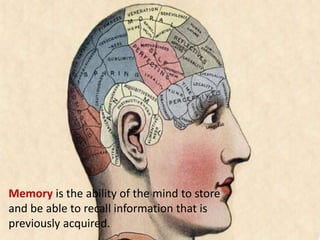
Memory is the ability of the mind to store
and be able to recall information that is
previously acquired.
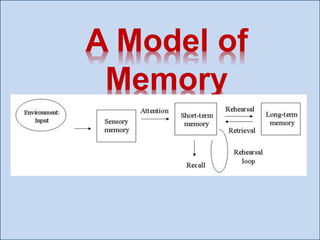
A Model of
Memory
Sensory Memory
During every moment of an organism's life,
sensory information is being taken in by sensory
receptors and processed by the nervous system.
The information people received which is stored
in sensory memory is just long enough to be
transferred to short-term memory. Humans have
five main senses: sight, hearing, taste, smell,
touch. Sensory memory (SM) allows individuals
to retain impressions of sensory information
after the original stimulus has ceased.
Short-term memory
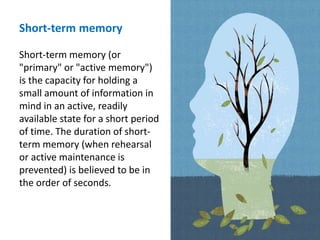
Short-term memory (or
"primary" or "active memory")
is the capacity for holding a
small amount of information in
mind in an active, readily
available state for a short period
of time. The duration of short-
term memory (when rehearsal
or active maintenance is
prevented) is believed to be in
the order of seconds.
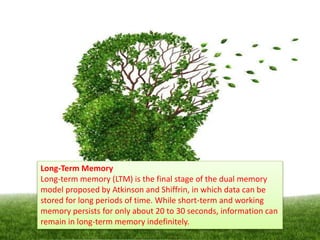
Long-Term Memory
Long-term memory (LTM) is the final stage of the dual memory
model proposed by Atkinson and Shiffrin, in which data can be
stored for long periods of time. While short-term and working
memory persists for only about 20 to 30 seconds, information can
remain in long-term memory indefinitely.
Retrieval of Memories
When you want to remember something, you retrieve the
information on an unconscious level, bringing it into your
conscious mind at will. While most people think they have
either a "bad" or a "good" memory, in fact, most people are
fairly good at remembering some types of things and not so
good at remembering others. If you do have trouble
remembering something -- assuming you don't have a physical
disease -- it's usually not the fault of your entire memory
system but an inefficient component of one part of your
memory system.
Forgetting
Forgetting refers to apparent loss or
modification of information already encoded
and stored in an individual's long term memory.
It is a spontaneous or gradual process in which
old memories are unable to be recalled from
memory storage. Forgetting also helps to
reconcile the storage of new information with
old knowledge. Problems with remembering,
learning and retaining new information are a
few of the most common complaints of older
adults. Memory performance is usually related
to the active functioning of three stages. These
three stages are encoding, storage and
retrieval.
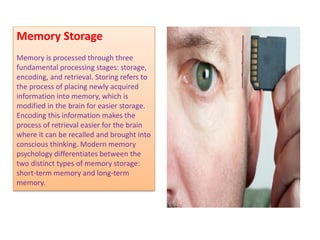
Memory Storage
Memory is processed through three
fundamental processing stages: storage,
encoding, and retrieval. Storing refers to
the process of placing newly acquired
information into memory, which is
modified in the brain for easier storage.
Encoding this information makes the
process of retrieval easier for the brain
where it can be recalled and brought into
conscious thinking. Modern memory
psychology differentiates between the
two distinct types of memory storage:
short-term memory and long-term
memory.
Left-handers
recall events more easily
MEMBERS of a family that is
dominated by left-handers tend to
be better at remembering events
than facts.
Dr Stephen Christman and Dr
Ruth Propper, of the
University of Toledo in Ohio,
they believe that the two
halves of the brain work
together in episodic memory
to help remember events
because left-handers and
those with left-handedness -
whose brains' halves work
together more actively - recall
events better than facts.
In two experiments, they found that people better remembered whether
they had seen a word before if they were either related to left-handers or
shown the word twice on different sides of the visual field, which stimulates
both halves of the brain. Because lefties and their relatives seem to have
larger corpus callosums, the bridges of neurons linking the brain's
hemispheres, these results suggest that interaction between the two halves
strengthens memory for events. "So left-handers probably do have a richer
ability to recall their lives," Christman, himself a southpaw, says.
Left-handers, who make up 15 percent of the population, don't have a monopoly on
memory, though. The experiments showed that semantic memory was stronger in those
individuals with all right-handed relatives, or when words were presented to just one side of
the visual field. Both groups also recognized words they had seen before with equal ease.
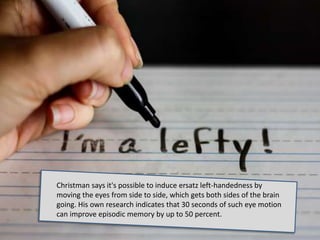
Christman says it's possible to induce ersatz left-handedness by
moving the eyes from side to side, which gets both sides of the brain
going. His own research indicates that 30 seconds of such eye motion
can improve episodic memory by up to 50 percent.
9 Things You Didn't Know
About Human Memory!
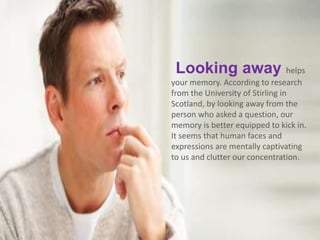
Looking away helps
your memory. According to research
from the University of Stirling in
Scotland, by looking away from the
person who asked a question, our
memory is better equipped to kick in.
It seems that human faces and
expressions are mentally captivating
to us and clutter our concentration.
Sevenis the
magic number. Ever wonder
why telephone numbers are
7 digits? Pioneer
psychologist George A
Miller theorized that our
short term memory can
hold around 7 items before
we begin to forget them.
Try it yourself. Have a friend
make a list of 10 words or
numbers. Read once and try
to recall as many as you
can. Most people top out at
around 7.
Bad memories can be erased using electroshock
therapy. Marijn Kroes, a neuroscientist at Radboud University
Nijmegen in the Netherlands found that by deliberately timing
electroconvulsive shocks, they could interrupt patient's memories
of a disturbing event.
Women's memoryis enhanced
by a deep voice. Researchers from the University of
Aberdeen King's College in Scotland and McMaster
University in Canada found that women were able
to recall more information when given by a man
with a deep baritone versus a man with a high-
pitched voice. Male memories did not appear to be
influenced by the pitch of a female's voice.
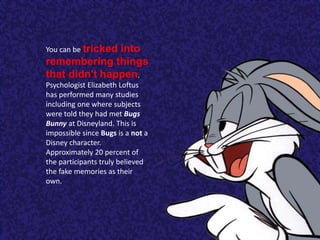
You can be tricked into
remembering things
that didn't happen.
Psychologist Elizabeth Loftus
has performed many studies
including one where subjects
were told they had met Bugs
Bunny at Disneyland. This is
impossible since Bugs is a not a
Disney character.
Approximately 20 percent of
the participants truly believed
the fake memories as their
own.
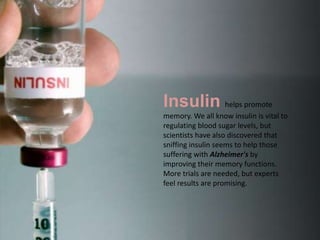
Insulin helps promote
memory. We all know insulin is vital to
regulating blood sugar levels, but
scientists have also discovered that
sniffing insulin seems to help those
suffering with Alzheimer's by
improving their memory functions.
More trials are needed, but experts
feel results are promising.
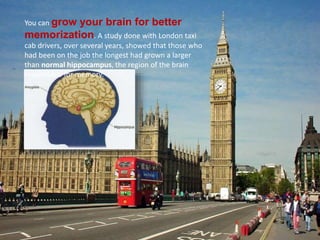
You can grow your brain for better
memorization. A study done with London taxi
cab drivers, over several years, showed that those who
had been on the job the longest had grown a larger
than normal hippocampus, the region of the brain
responsible for memory.
Anomi
a. This is the
technical word for
when you are
trying to
remember
something and
"it's on the tip of
your tongue".
We have more storage in our brain
than we need. Paul Reber, professor of
psychology at Northwestern University says "The
human brain consists of about one billion
neurons, amounting to more than a trillion
connections. If your brain worked like a DVR in a
television, you would have to leave the TV running
continuously for more than 300 years to use up all
that storage."
Memories can live on, even if we can't
access them
• Could forgotten songs
continue to live on inside
our heads, without us
knowing?
• In a 2013 report of a strange
case in the journal Frontiers
in Neurology, researchers
described a woman who
had musical hallucinations
of song that she didn't
recognize, but others did.
Brains may be programmed to forget
infancy
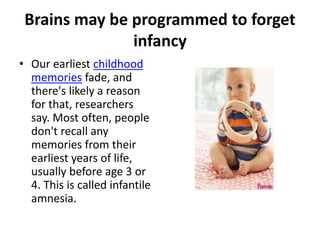
• Our earliest childhood
memories fade, and
there's likely a reason
for that, researchers
say. Most often, people
don't recall any
memories from their
earliest years of life,
usually before age 3 or
4. This is called infantile
amnesia.
Brains may be programmed to forget
infancy
Scientists
previously
thought that
early
memories
were there,
but children
just didn't
have the
language skills
to verbalize
them.
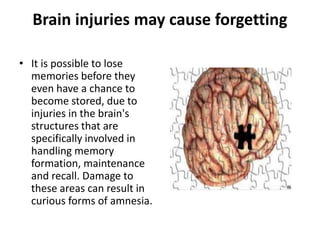
Brain injuries may cause forgetting
It is possible to lose
memories before they
even have a chance to
become stored, due to
injuries in the brain's
structures that are
specifically involved in
handling memory
formation, maintenance
and recall. Damage to
these areas can result in
curious forms of amnesia.
Brain injuries may cause forgetting
• In one of the most-studied cases of such
amnesia, Patient H.M. lost the ability to form
any new memories after a part of his brain,
the hippocampus, was removed during a
surgery to treat his epilepsy.
• Another famous case records the story of
Patient E.P., who had a similar fate after he
had inflammation of the brain caused by a
virus.
THE HUMAN
MEMORY
Since time immemorial,
humans have tried to
understand what memory
is, how it works and why it
goes wrong. It is an
important part of what
makes us truly human, and
yet it is one of the most
elusive and misunderstood
of human attributes.
References
Minkel, J. (2001, October 23). Lefties May Possess Superior Memory for
Events. Scientific American.
Highfield, R. (2001, October 22). Left-handers recall events more easily.The
Teleghraph. Retrieved August 2, 2015,
fromhttp://www.telegraph.co.uk/news/worldnews/northamerica/usa/13601
83/Left-handers-recall-events-more-easily.html
Mohs, P. (n.d.). Retrieved from
http://science.howstuffworks.com/life/inside-the-mind/human-
brain/human-memory3.htm
Why You Forget: 5 Strange Facts About Memory (LiveScience)
By: Gholipour, http://www.livescience.com/44940-strange-facts-about-
memory.html
Retrieved from https://en.wikipedia.org/wiki/Sensory_memory
Retrieved from https://en.wikipedia.org/wiki/Short-term_memory
Retrieved from https://en.wikipedia.org/wiki/Long-term_memory
Retrieved from https://en.wikipedia.org/wiki/Forgetting

Memory

  • 1.
    Memory Done By: Tahani Almudarra NajlaAlRasheed Amjaad Alsalamah
  • 2.
    Memory is theability of the mind to store and be able to recall information that is previously acquired.
  • 3.
  • 4.
    Sensory Memory During everymoment of an organism's life, sensory information is being taken in by sensory receptors and processed by the nervous system. The information people received which is stored in sensory memory is just long enough to be transferred to short-term memory. Humans have five main senses: sight, hearing, taste, smell, touch. Sensory memory (SM) allows individuals to retain impressions of sensory information after the original stimulus has ceased.
  • 5.
    Short-term memory Short-term memory(or "primary" or "active memory") is the capacity for holding a small amount of information in mind in an active, readily available state for a short period of time. The duration of short- term memory (when rehearsal or active maintenance is prevented) is believed to be in the order of seconds.
  • 6.
    Long-Term Memory Long-term memory(LTM) is the final stage of the dual memory model proposed by Atkinson and Shiffrin, in which data can be stored for long periods of time. While short-term and working memory persists for only about 20 to 30 seconds, information can remain in long-term memory indefinitely.
  • 7.
    Retrieval of Memories Whenyou want to remember something, you retrieve the information on an unconscious level, bringing it into your conscious mind at will. While most people think they have either a "bad" or a "good" memory, in fact, most people are fairly good at remembering some types of things and not so good at remembering others. If you do have trouble remembering something -- assuming you don't have a physical disease -- it's usually not the fault of your entire memory system but an inefficient component of one part of your memory system.
  • 8.
    Forgetting Forgetting refers toapparent loss or modification of information already encoded and stored in an individual's long term memory. It is a spontaneous or gradual process in which old memories are unable to be recalled from memory storage. Forgetting also helps to reconcile the storage of new information with old knowledge. Problems with remembering, learning and retaining new information are a few of the most common complaints of older adults. Memory performance is usually related to the active functioning of three stages. These three stages are encoding, storage and retrieval.
  • 9.
    Memory Storage Memory isprocessed through three fundamental processing stages: storage, encoding, and retrieval. Storing refers to the process of placing newly acquired information into memory, which is modified in the brain for easier storage. Encoding this information makes the process of retrieval easier for the brain where it can be recalled and brought into conscious thinking. Modern memory psychology differentiates between the two distinct types of memory storage: short-term memory and long-term memory.
  • 10.
  • 11.
    MEMBERS of afamily that is dominated by left-handers tend to be better at remembering events than facts. Dr Stephen Christman and Dr Ruth Propper, of the University of Toledo in Ohio, they believe that the two halves of the brain work together in episodic memory to help remember events because left-handers and those with left-handedness - whose brains' halves work together more actively - recall events better than facts.
  • 12.
    In two experiments,they found that people better remembered whether they had seen a word before if they were either related to left-handers or shown the word twice on different sides of the visual field, which stimulates both halves of the brain. Because lefties and their relatives seem to have larger corpus callosums, the bridges of neurons linking the brain's hemispheres, these results suggest that interaction between the two halves strengthens memory for events. "So left-handers probably do have a richer ability to recall their lives," Christman, himself a southpaw, says.
  • 13.
    Left-handers, who makeup 15 percent of the population, don't have a monopoly on memory, though. The experiments showed that semantic memory was stronger in those individuals with all right-handed relatives, or when words were presented to just one side of the visual field. Both groups also recognized words they had seen before with equal ease.
  • 14.
    Christman says it'spossible to induce ersatz left-handedness by moving the eyes from side to side, which gets both sides of the brain going. His own research indicates that 30 seconds of such eye motion can improve episodic memory by up to 50 percent.
  • 15.
    9 Things YouDidn't Know About Human Memory!
  • 16.
    Looking away helps yourmemory. According to research from the University of Stirling in Scotland, by looking away from the person who asked a question, our memory is better equipped to kick in. It seems that human faces and expressions are mentally captivating to us and clutter our concentration.
  • 17.
    Sevenis the magic number.Ever wonder why telephone numbers are 7 digits? Pioneer psychologist George A Miller theorized that our short term memory can hold around 7 items before we begin to forget them. Try it yourself. Have a friend make a list of 10 words or numbers. Read once and try to recall as many as you can. Most people top out at around 7.
  • 18.
    Bad memories canbe erased using electroshock therapy. Marijn Kroes, a neuroscientist at Radboud University Nijmegen in the Netherlands found that by deliberately timing electroconvulsive shocks, they could interrupt patient's memories of a disturbing event.
  • 19.
    Women's memoryis enhanced bya deep voice. Researchers from the University of Aberdeen King's College in Scotland and McMaster University in Canada found that women were able to recall more information when given by a man with a deep baritone versus a man with a high- pitched voice. Male memories did not appear to be influenced by the pitch of a female's voice.
  • 20.
    You can betricked into remembering things that didn't happen. Psychologist Elizabeth Loftus has performed many studies including one where subjects were told they had met Bugs Bunny at Disneyland. This is impossible since Bugs is a not a Disney character. Approximately 20 percent of the participants truly believed the fake memories as their own.
  • 21.
    Insulin helps promote memory.We all know insulin is vital to regulating blood sugar levels, but scientists have also discovered that sniffing insulin seems to help those suffering with Alzheimer's by improving their memory functions. More trials are needed, but experts feel results are promising.
  • 22.
    You can growyour brain for better memorization. A study done with London taxi cab drivers, over several years, showed that those who had been on the job the longest had grown a larger than normal hippocampus, the region of the brain responsible for memory.
  • 23.
    Anomi a. This isthe technical word for when you are trying to remember something and "it's on the tip of your tongue".
  • 24.
    We have morestorage in our brain than we need. Paul Reber, professor of psychology at Northwestern University says "The human brain consists of about one billion neurons, amounting to more than a trillion connections. If your brain worked like a DVR in a television, you would have to leave the TV running continuously for more than 300 years to use up all that storage."
  • 25.
    Memories can liveon, even if we can't access them • Could forgotten songs continue to live on inside our heads, without us knowing? • In a 2013 report of a strange case in the journal Frontiers in Neurology, researchers described a woman who had musical hallucinations of song that she didn't recognize, but others did.
  • 26.
    Brains may beprogrammed to forget infancy • Our earliest childhood memories fade, and there's likely a reason for that, researchers say. Most often, people don't recall any memories from their earliest years of life, usually before age 3 or 4. This is called infantile amnesia.
  • 27.
    Brains may beprogrammed to forget infancy Scientists previously thought that early memories were there, but children just didn't have the language skills to verbalize them.
  • 28.
    Brain injuries maycause forgetting It is possible to lose memories before they even have a chance to become stored, due to injuries in the brain's structures that are specifically involved in handling memory formation, maintenance and recall. Damage to these areas can result in curious forms of amnesia.
  • 29.
    Brain injuries maycause forgetting • In one of the most-studied cases of such amnesia, Patient H.M. lost the ability to form any new memories after a part of his brain, the hippocampus, was removed during a surgery to treat his epilepsy. • Another famous case records the story of Patient E.P., who had a similar fate after he had inflammation of the brain caused by a virus.
  • 30.
    THE HUMAN MEMORY Since timeimmemorial, humans have tried to understand what memory is, how it works and why it goes wrong. It is an important part of what makes us truly human, and yet it is one of the most elusive and misunderstood of human attributes.
  • 31.
    References Minkel, J. (2001,October 23). Lefties May Possess Superior Memory for Events. Scientific American. Highfield, R. (2001, October 22). Left-handers recall events more easily.The Teleghraph. Retrieved August 2, 2015, fromhttp://www.telegraph.co.uk/news/worldnews/northamerica/usa/13601 83/Left-handers-recall-events-more-easily.html Mohs, P. (n.d.). Retrieved from http://science.howstuffworks.com/life/inside-the-mind/human- brain/human-memory3.htm
  • 32.
    Why You Forget:5 Strange Facts About Memory (LiveScience) By: Gholipour, http://www.livescience.com/44940-strange-facts-about- memory.html Retrieved from https://en.wikipedia.org/wiki/Sensory_memory Retrieved from https://en.wikipedia.org/wiki/Short-term_memory Retrieved from https://en.wikipedia.org/wiki/Long-term_memory Retrieved from https://en.wikipedia.org/wiki/Forgetting