ENERGY NEEDS –ASSESSMENT &
REQUIREMENT
Dr.Sowmya M
DEFINING NUTRITIONAL STATUS
 Nutritional status is a current body status of a
person (or) A population group related to their
state of nourishment.
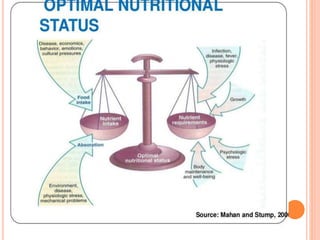
 Refers to the degree of balance between nutrient
intake & nutrient requirement.
 This balance is affected by many factors including
physiologic, psychical, developmental, cultural &
economic
 It determined by a complex interaction between
internal/ Constitutional factor & external
environment factors.
 Internal- age, sex, nutrition, behavior, physical
activity & diseases.
 External – food safety, cultural, social & economic
circumstances .
 Optimal nutritional :- Sufficient nutrients are
consumed to support day to day needs & any
increased metabolic demands( growth, illness,
pregnancy).
 Under nutrition :- Nutrient intake is inadequate to
meet day to day need or add metabolic demand.
 Vulnerable groups:- Infants, pregnant women, low
incomes, hospitalized people, aging adults—This
group are at risk for impaired growth & development,
lowered resistance to infection & disease, delay
wound healing, longer hospital stay & higher health
care cost.
 Over nutrition:- Consumption of nutrient in
excess of body need.
 A major nutritional problem today – can leads to
obesity & its risk for heart disease, type 2 DM,
HTN, stroke, GB disease, sleep apnea &
osteoarthritis.
DEVELOPMENTAL CARE
Infants & children- Birth -4month- most rapid
period of growth in the life cycle.
 The infant double birth weight by 4 month & triple
by 1 year.
 Breastfeeding is recommended for full term infants
for the 1st year of life because breast milk is ideally
formulated to promote normal infant growth &
development & natural immunity.
 infants increase their length by 50% during the first
year of life & double it by 4 years of age.
Adolescence : Characterized by rapid physical
growth & endocrine & hormonal change.
 Calorie & protein requirement increase to meet this
demand & to meet demand of bone growth &
increasing muscle mass & in the girls the onset of
menarche calcium & iron requirement increased.
 In generally boys grow & have less body fat than
girls.
 Adulthood:- Growth & nutrient needs stabilize
most adult are relatively good health.
 This time is important for health education because
life style factors such as smoking, stress, lack of
exercise, diet high in fat, sugar & low in fiber result
– risk of HTN< DM, obesity, cancer & osteoporosis.
 Old age : older adults have increased rik for under
nutrition or over nutrition.
 Risk factor: poor physical or mental health, social
isolation, limited functional ability, poverty &
diseases.
 Normal physiology changes:- affect the nutritional
status, poor dentition, decreased visual acuity,
decreased saliva production, slowed
gastrointestinal absorption, diminished olfactory &
taste sensitivity.
NUTRITIONAL ASSESSMENT
 A comprehensive analysis of a person’s nutrition
status that uses historical information, food intake,
anthropometric measurements, physical
examination & biochemical.
 Purposes & components of nutritional assessment
1. Identify individuals who are malnourished or are
at risk for developing malnutrition.
2. Provide data for designing a nutrition plan of care
to prevent or minimize development
malnutrition.
3. Establish baseline data for evaluating the efficacy
of nutritional care.
Nutrition screening
 The first step in assessing nutritional status, is
required for all patient in all health care setting
within 24 hours of admission.
 Parameters used for nutrition screening typically
include weight & height, history of condition
associated with increased nutritional risk, diet
information & laboratory.
 It need to assess risk of becoming malnourished &
over nourished.
 Assessment of nutritional in Two methods
1. Direct – A B C D Methods
2. Indirect – Economic factor, Ecological variables,
cultural & social habits.
 Nutritional assessment is the interpretation of
anthropometric, biochemical (laboratory), clinical and
dietary data to determine whether a person or groups of
people are well nourished or malnourished (over-
nourished or under-nourished).
 Nutritional assessment can be done using the ABCD
methods. These refer to the following:
 A-Anthropometry
 B-Biochemical/biophysical methods
 C-Clinical methods
 D-Dietary methods.
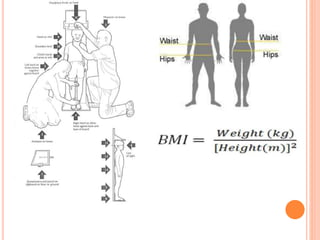
A-ANTHROPOMETRY
 Measurement of human dimensions
 Anthropos = human
 Metrikos = measuring
 Technique of measuring people
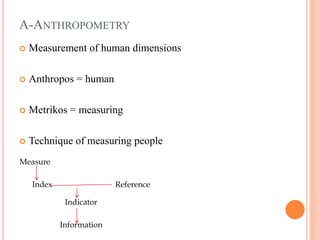
Measure
Index
Indicator
Reference
Information
 Measurement of body height, weight &
proportions.
 They indicate the nutritional status in general but
not used too identify specific nutritional
deficiencies.
 To evaluate both under & over nutrition.
 It indicates nutritional status – Body mass index
(BMI) this is associated with type 2 DM, CVS
disorder.
 B-Biochemical/biophysical methods- routine
laboratory test .
 C-Clinical methods
 D-Dietary methods – diet history
ENERGY REQUIREMENTS
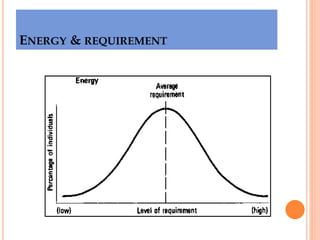
 Energy requirement is the amount of food energy
needed to balance energy expenditure-- in maintain
body size, body composition and a level of necessary
and desirable physical activity consistent with long-
term good health.
Energy requirement includes the energy needed for
 The optimal growth and development of children.
 The deposition of tissues during pregnancy, and
 The secretion of milk during lactation consistent with
the good health of mother and child.
ENERGY & REQUIREMENT
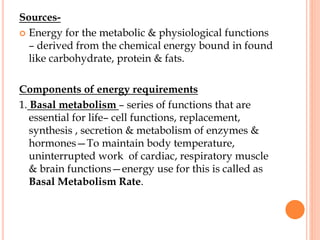
Sources-
 Energy for the metabolic & physiological functions
– derived from the chemical energy bound in found
like carbohydrate, protein & fats.
Components of energy requirements
1. Basal metabolism – series of functions that are
essential for life– cell functions, replacement,
synthesis , secretion & metabolism of enzymes &
hormones—To maintain body temperature,
uninterrupted work of cardiac, respiratory muscle
& brain functions—energy use for this is called as
Basal Metabolism Rate.
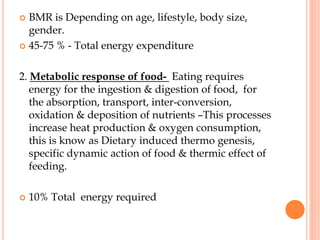
 BMR is Depending on age, lifestyle, body size,
gender.
 45-75 % - Total energy expenditure
2. Metabolic response of food- Eating requires
energy for the ingestion & digestion of food, for
the absorption, transport, inter-conversion,
oxidation & deposition of nutrients –This processes
increase heat production & oxygen consumption,
this is know as Dietary induced thermo genesis,
specific dynamic action of food & thermic effect of
feeding.
 10% Total energy required
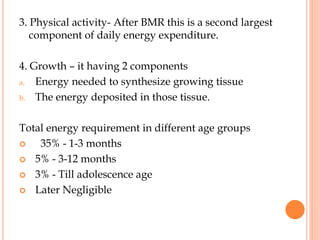
3. Physical activity- After BMR this is a second largest
component of daily energy expenditure.
4. Growth – it having 2 components
a. Energy needed to synthesize growing tissue
b. The energy deposited in those tissue.
Total energy requirement in different age groups
 35% - 1-3 months
 5% - 3-12 months
 3% - Till adolescence age
 Later Negligible
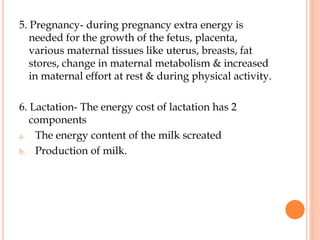
5. Pregnancy- during pregnancy extra energy is
needed for the growth of the fetus, placenta,
various maternal tissues like uterus, breasts, fat
stores, change in maternal metabolism & increased
in maternal effort at rest & during physical activity.
6. Lactation- The energy cost of lactation has 2
components
a. The energy content of the milk screated
b. Production of milk.
Energy needs –Assessment & Required.pptx

Energy needs –Assessment & Required.pptx

  • 1.
    ENERGY NEEDS –ASSESSMENT& REQUIREMENT Dr.Sowmya M
  • 2.
    DEFINING NUTRITIONAL STATUS Nutritional status is a current body status of a person (or) A population group related to their state of nourishment.  Refers to the degree of balance between nutrient intake & nutrient requirement.
  • 4.
     This balanceis affected by many factors including physiologic, psychical, developmental, cultural & economic  It determined by a complex interaction between internal/ Constitutional factor & external environment factors.  Internal- age, sex, nutrition, behavior, physical activity & diseases.  External – food safety, cultural, social & economic circumstances .
  • 5.
     Optimal nutritional:- Sufficient nutrients are consumed to support day to day needs & any increased metabolic demands( growth, illness, pregnancy).  Under nutrition :- Nutrient intake is inadequate to meet day to day need or add metabolic demand.  Vulnerable groups:- Infants, pregnant women, low incomes, hospitalized people, aging adults—This group are at risk for impaired growth & development, lowered resistance to infection & disease, delay wound healing, longer hospital stay & higher health care cost.
  • 6.
     Over nutrition:-Consumption of nutrient in excess of body need.  A major nutritional problem today – can leads to obesity & its risk for heart disease, type 2 DM, HTN, stroke, GB disease, sleep apnea & osteoarthritis.
  • 7.
    DEVELOPMENTAL CARE Infants &children- Birth -4month- most rapid period of growth in the life cycle.  The infant double birth weight by 4 month & triple by 1 year.  Breastfeeding is recommended for full term infants for the 1st year of life because breast milk is ideally formulated to promote normal infant growth & development & natural immunity.  infants increase their length by 50% during the first year of life & double it by 4 years of age.
  • 8.
    Adolescence : Characterizedby rapid physical growth & endocrine & hormonal change.  Calorie & protein requirement increase to meet this demand & to meet demand of bone growth & increasing muscle mass & in the girls the onset of menarche calcium & iron requirement increased.  In generally boys grow & have less body fat than girls.
  • 9.
     Adulthood:- Growth& nutrient needs stabilize most adult are relatively good health.  This time is important for health education because life style factors such as smoking, stress, lack of exercise, diet high in fat, sugar & low in fiber result – risk of HTN< DM, obesity, cancer & osteoporosis.
  • 10.
     Old age: older adults have increased rik for under nutrition or over nutrition.  Risk factor: poor physical or mental health, social isolation, limited functional ability, poverty & diseases.  Normal physiology changes:- affect the nutritional status, poor dentition, decreased visual acuity, decreased saliva production, slowed gastrointestinal absorption, diminished olfactory & taste sensitivity.
  • 11.
    NUTRITIONAL ASSESSMENT  Acomprehensive analysis of a person’s nutrition status that uses historical information, food intake, anthropometric measurements, physical examination & biochemical.  Purposes & components of nutritional assessment 1. Identify individuals who are malnourished or are at risk for developing malnutrition. 2. Provide data for designing a nutrition plan of care to prevent or minimize development malnutrition. 3. Establish baseline data for evaluating the efficacy of nutritional care.
  • 12.
    Nutrition screening  Thefirst step in assessing nutritional status, is required for all patient in all health care setting within 24 hours of admission.  Parameters used for nutrition screening typically include weight & height, history of condition associated with increased nutritional risk, diet information & laboratory.
  • 13.
     It needto assess risk of becoming malnourished & over nourished.  Assessment of nutritional in Two methods 1. Direct – A B C D Methods 2. Indirect – Economic factor, Ecological variables, cultural & social habits.
  • 14.
     Nutritional assessmentis the interpretation of anthropometric, biochemical (laboratory), clinical and dietary data to determine whether a person or groups of people are well nourished or malnourished (over- nourished or under-nourished).  Nutritional assessment can be done using the ABCD methods. These refer to the following:  A-Anthropometry  B-Biochemical/biophysical methods  C-Clinical methods  D-Dietary methods.
  • 15.
    A-ANTHROPOMETRY  Measurement ofhuman dimensions  Anthropos = human  Metrikos = measuring  Technique of measuring people Measure Index Indicator Reference Information
  • 16.
     Measurement ofbody height, weight & proportions.  They indicate the nutritional status in general but not used too identify specific nutritional deficiencies.  To evaluate both under & over nutrition.  It indicates nutritional status – Body mass index (BMI) this is associated with type 2 DM, CVS disorder.
  • 18.
     B-Biochemical/biophysical methods-routine laboratory test .  C-Clinical methods  D-Dietary methods – diet history
  • 19.
    ENERGY REQUIREMENTS  Energyrequirement is the amount of food energy needed to balance energy expenditure-- in maintain body size, body composition and a level of necessary and desirable physical activity consistent with long- term good health. Energy requirement includes the energy needed for  The optimal growth and development of children.  The deposition of tissues during pregnancy, and  The secretion of milk during lactation consistent with the good health of mother and child.
  • 20.
  • 21.
    Sources-  Energy forthe metabolic & physiological functions – derived from the chemical energy bound in found like carbohydrate, protein & fats. Components of energy requirements 1. Basal metabolism – series of functions that are essential for life– cell functions, replacement, synthesis , secretion & metabolism of enzymes & hormones—To maintain body temperature, uninterrupted work of cardiac, respiratory muscle & brain functions—energy use for this is called as Basal Metabolism Rate.
  • 22.
     BMR isDepending on age, lifestyle, body size, gender.  45-75 % - Total energy expenditure 2. Metabolic response of food- Eating requires energy for the ingestion & digestion of food, for the absorption, transport, inter-conversion, oxidation & deposition of nutrients –This processes increase heat production & oxygen consumption, this is know as Dietary induced thermo genesis, specific dynamic action of food & thermic effect of feeding.  10% Total energy required
  • 23.
    3. Physical activity-After BMR this is a second largest component of daily energy expenditure. 4. Growth – it having 2 components a. Energy needed to synthesize growing tissue b. The energy deposited in those tissue. Total energy requirement in different age groups  35% - 1-3 months  5% - 3-12 months  3% - Till adolescence age  Later Negligible
  • 24.
    5. Pregnancy- duringpregnancy extra energy is needed for the growth of the fetus, placenta, various maternal tissues like uterus, breasts, fat stores, change in maternal metabolism & increased in maternal effort at rest & during physical activity. 6. Lactation- The energy cost of lactation has 2 components a. The energy content of the milk screated b. Production of milk.