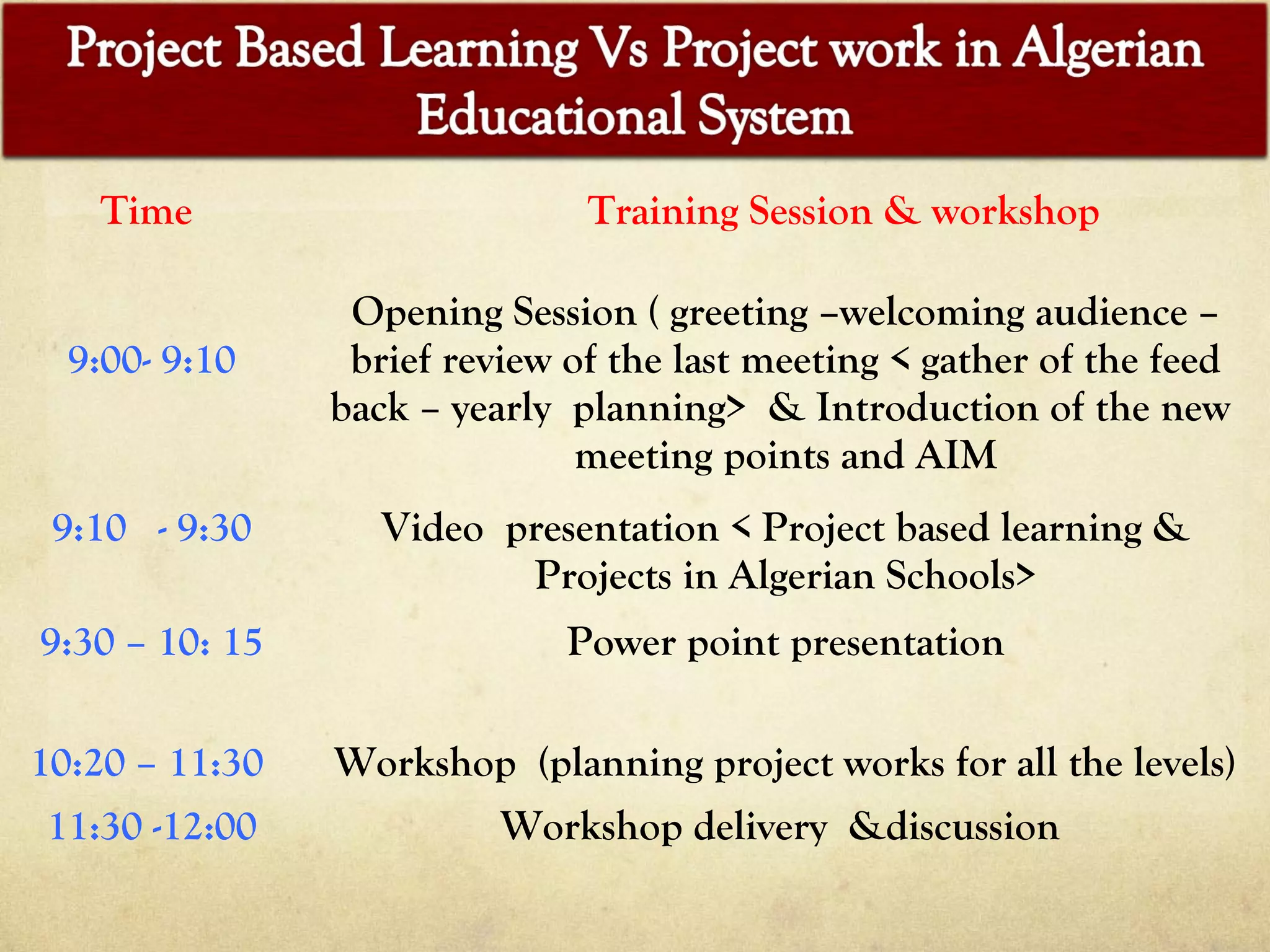
Time Training Session & workshop
9:00- 9:10
Opening Session ( greeting –welcoming audience –
brief review of the last meeting < gather of the feed
back – yearly planning> & Introduction of the new
meeting points and AIM
9:10 - 9:30 Video presentation < Project based learning &
Projects in Algerian Schools>
9:30 – 10: 15 Power point presentation
10:20 – 11:30 Workshop (planning project works for all the levels)
11:30 -12:00 Workshop delivery &discussion
Look at the Word Cloud and list as much words as you
can
The project work
One of the most distinctive features of the competency-Based Approach is
the integration of project work as part of learning strategy.
This approach seeks to make the attainment of objectives visible, i.e., concrete
through the realization of projects in selected domains of instruction.
In fact, fixing specific learning competencies will remain a far reaching dream (as
in the case of the traditional objective-based approaches) if the outcome is not
visible and measurable.
Project work makes learning more meaningful.
It also makes co-operative learning a concrete reality and opens up entirely new
avenues for action, interaction and the construction of new knowledge.
In short, it is only through carrying out project work that the basic
principles of the Competency-Based Approach can be made concrete.
The project is the final production of the file .
It facilitates language learning by setting tasks that require learners to work on
their own .
Learners collect information from a variety of sources that will result in
authentic output so that learners could produce a research report , a thesis or a
model in form of : recipe book , a brochure , posters that will serve authentic
communicative and learning purposes ..
What is project work?
 Project work involves multi-skill activities
which focus on a theme of interest .
 In project work ,students work together to
achieve a common purpose ,a concrete
outcome ,(for example, a brochure, a
bulletin board display , a video , an article )
.
 Typically it requires students to work
together over several days or weeks , both
inside and outside the classroom ,often in
collaboration with speakers of the target
language .
THE ADVANTAGES OF PROJECT WORK
It's an approach in which indirect teaching is
employed .Through this approach we aim to :
1-Students make their own choices about what
they do
2-Motivate learners abilities and skills .
3-Put in use the language acquisitions .
4-Give the learners the satisfaction of seeing a
concrete product that they have produced .
5-Be cooperative and sharing views and
problems , respecting each other's feelings ,
point of view and developing group work and
social skills .
2 Ways to plan a project work
Although recommendations as to the best way to develop projects vary,
most are consistent with eight (8) fundamental steps described below:
1-Define a theme
2-Determine the final outcome
3-Structure the project
4-Identify language skills and strategies
5- Gather information
6-Compile and analyze information
7-Present final product
8-Evaluate the project
Define a theme:
In collaboration with students, define a theme
that will amplify the students'
understanding of an aspect of their future
work and provide relevant language
practice.
Determine the final outcome:
Define the final outcome of the project (for
example, a written report, brochure,
debate, video) and its presentation
(collective or individual) . Agree on
• Structure the project:
Collectively identify the information that students will need
and the steps they must take to obtain it (library research,
letters, interviews, etc).Decide on each student's role and
put the students into working groups.
 Identify language skills and strategies :
Integrate lessons into the curriculum that prepare students
for Steps 5.6 and 7.Identify the language skills which
students will need to gather and compile information for
their project .For example , will they need to write letters ?
Will they interview native speakers? Determine the skills
and strategies that students will need to compile
information (Step6) .Plan activities to prepare them for
these tasks .Identify the skills and strategies that students
will need to present the final project(Step7) .As they
prepare their presentation, they may need to work on the
language (written or spoken) of formal reporting .
Gather information : After students design instruments for
data collection , have them gather information inside and
outside the classroom , individually, in pairs , and in groups .
Compile and analyze information: Students should compile
information they have gathered, compare their findings, and
decide how to organize them for efficient presentation.
Present final product: Students will present the outcome of
their project work as a culminating activity.
 Compile ,to collect information and arrange it in a book, report, or list
Evaluate the project:
In this final phase, students and teacher reflect
on the steps taken to accomplish their
objectives and the language, communicative
skills, and information they have acquired in
the process .
They can also discuss the value of their
experience and its relationship to future
vocational needs.
2nd
Way to PLAN A PROJECT
Every project involves various activities and should be planned as follow :
1. Preparation : It's a talk about the topic in which the teacher presents the project
and motivates the learners . The learners , by their turns may ask for further information .
2. Planning : At this stage , the learners have come to a decision confirmed by the
teacher .The planning goes through these aspects :
a) Identifying sources
b) Determining the mode for collecting and analysing information
c) Deciding on the presentation technique
d) Establishing evaluation procedures
e) Assigning individual tasks to team members in cases of collaborative efforts
.
3. Here the learners collect materials and information from books
,journals , libraries , maps , internet , magazines or resource persons and work individually
or in groups .The teacher himself is a source of information .
4. Timing : A certain amount of time is put aside for the project with a deadline , when
the project work will be ready .This depends on how much time is available .We don't
want a project going too long as much may lose interest and momentum .
5. Language : The language that is produced is not controlled , but the students should
have had input on the kind of language that the project needs
A SAMPLE PROJECT
• To illustrate how these generic steps
can be translated into practice, we
outline a project entitled
Purchasing a computer», designed
by two teachers of business English
in Italy.
1. Students agree to compile information about
four computers models in order to
recommend which system their school should
purchase.
2. Students decide on the final outcome:
subgroups will report on the information they
have gathered at a computer trade fair and
recommend a purchase .The whole class will
then decide which computer to buy .Together
they will write a formal recommendation and
submit it to the head administrator of their
school.
3.4.5.6 and 7 .Students will review advertisements promoting different
computer models and brands to discover the criteria used in comparing
computers .Students will survey school personnel to determine how the
new computer will be used .They will inquire about such criteria as
memory ,warranty, software compatibility , maintenance ,and cost.
Students will decide how to obtain information about four computers
on the market (trade magazine, promotional literature, computer trade
show) and summarize the materials they have accumulated .Students
will prepare an oral presentation that summarize their findings and
concludes with a recommendation to be submitted to the school
administration.
In the process of completing the project, students may need to practice
those language skills and strategies that they determined to be
important at different stages. Students will read a passage that compares
computer models. They will practice skimming and scanning for key
information from manufactures about their products .Students will
rehearse the formal oral presentation of a product comparison using a
8. In this final phase, students and teacher reflect on
the steps taken to accomplish their objectives and the
language, communicative skills, and information they
have acquired in the process .They can also discuss
the value of their experience and its relationship to
future vocational needs
CONCLUSION
ESP teachers can break with routine by spending a
week or more doing something besides grammar
drills and technical reading .The benefits of project
work also include improved student motivation and
enhanced awareness of their language needs ,
integrated skills practice , ands a more stimulating
and satisfying learning and teaching experience .
Project can be presented as:
Wall displays
Posters
Magazines
Newspapers
Books
Radio broadcast
Tv programmes
Film
Documentary
Teacher's role :
A successful project depends mostly on the teacher.
• Teachers should act as counselors and guide the learners to sources of
information.
• They should motivate and encourage the learners until the project
is achieved .
• This help can be linguistic like helping get the grammar right or
practical like supplying stationery ;
• To help the learner performing a successful project work , the
teacher guides the learner by ticking the following elements while
preparing his project .This guide (plan) is categorized as follow :
Common reasons why teachers might avoid
project work
• There isn’t enough time
Time is always an issue in the classroom .We never seem to have enough and there are so many other
things to do .But a lot of work on projects can be done outside classroom time. Homework is often
done quickly or badly if students are not motivated .If your students are interested in the project and
want the final presentation of their ideas to be good , they will spend more time outside the classroom
on it .Class time will not be wasted on projects as the work the children are doing is very valuable for
their language development they are using English to be creative and communicative and often stretch
themselves to try to produce an excellent end result .
• Children speak a lot in their mother tongue:
Of course they will use a certain amount of their own language especially if they are lower level, but
they are thinking about English and their final presentation of the project will be in English.
You can equip children with the classroom language they need for projects and encourage them to
use it by putting it up around the class so they can refer to it. E.g. «Where are the scissors?" Shall we put
this here?"
It can get very noisy:
Set rules before doing the project work and make it clear to the
students that excess noise is not allowed .Have good signals for getting
children to stop talking and pay attention to you .For example, stand
in the centre of the room with your hands in the air and wave .As the
children notice you they must do the same until everyone is standing
quietly waving looking at you .It's much better than shouting and once
the children get into the routine , it is a quick and effective way of
quietening down the room .We can easily tell what is good noise and
what is excess noise and we should encourage our students to tell the
difference too .
It’s hard to plan what children need to do a project successfully:
Try using a grid like this to analyse what you need before the project
.It can also be a good way of assessing the project for yourself after it is
done to help you be better prepared next time.
Teacher doesn't know what skills are being practised:
Try this grid to analyze the project, again, before and after .It can help
you see the value of the project and you can better explain it to the
parents and your colleagues, too.
Some problems facing teachers while dealing with project work:
 Crowded classes: It's hard to organize a successful group in such
classes.
 Too much written work to be corrected presented and discussed in the
classroom.
 Bad equipped classrooms for language teaching.
Some suggestions:
As we are facing problems while achieving our tasks, and in order to
get as good project work as possible; we suggest the following:
Split the class onto groups (4- 5)
Let the students decide which subjects they might choose
Each project is to be done by three or four groups each time to avoid
boredom and the other groups would take their turns after.
To encourage learners in performing good projects work, the teacher
may give a reward by additional points to their final mark and this
may differ from a work to another.
Organize a wall display in the class at the end of each term and the
best project work is selected for projects exhibition by the end of the
year to which parents can be invited.
Ways to present project works
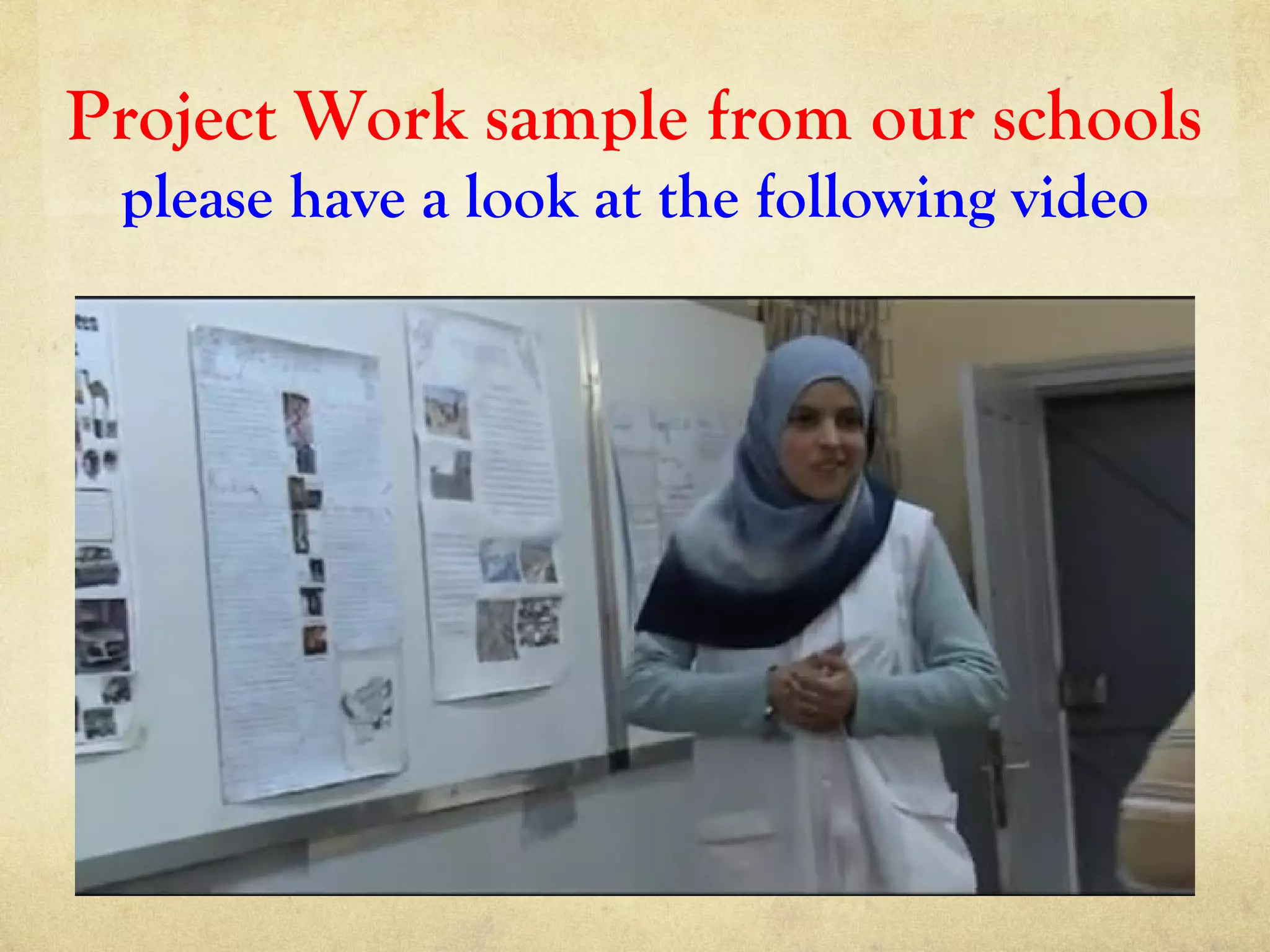
Project Work sample from our schools
please have a look at the following video
Thanks for ur attention
By
Mr.Samir Bounab

Meeting and workshop project based learning february 4th 2014 by mr.samir bounab

  • 2.
    Time Training Session& workshop 9:00- 9:10 Opening Session ( greeting –welcoming audience – brief review of the last meeting < gather of the feed back – yearly planning> & Introduction of the new meeting points and AIM 9:10 - 9:30 Video presentation < Project based learning & Projects in Algerian Schools> 9:30 – 10: 15 Power point presentation 10:20 – 11:30 Workshop (planning project works for all the levels) 11:30 -12:00 Workshop delivery &discussion
  • 3.
    Look at theWord Cloud and list as much words as you can
  • 6.
    The project work Oneof the most distinctive features of the competency-Based Approach is the integration of project work as part of learning strategy. This approach seeks to make the attainment of objectives visible, i.e., concrete through the realization of projects in selected domains of instruction. In fact, fixing specific learning competencies will remain a far reaching dream (as in the case of the traditional objective-based approaches) if the outcome is not visible and measurable. Project work makes learning more meaningful. It also makes co-operative learning a concrete reality and opens up entirely new avenues for action, interaction and the construction of new knowledge. In short, it is only through carrying out project work that the basic principles of the Competency-Based Approach can be made concrete. The project is the final production of the file . It facilitates language learning by setting tasks that require learners to work on their own . Learners collect information from a variety of sources that will result in authentic output so that learners could produce a research report , a thesis or a model in form of : recipe book , a brochure , posters that will serve authentic communicative and learning purposes ..
  • 7.
    What is projectwork?  Project work involves multi-skill activities which focus on a theme of interest .  In project work ,students work together to achieve a common purpose ,a concrete outcome ,(for example, a brochure, a bulletin board display , a video , an article ) .  Typically it requires students to work together over several days or weeks , both inside and outside the classroom ,often in collaboration with speakers of the target language .
  • 8.
    THE ADVANTAGES OFPROJECT WORK It's an approach in which indirect teaching is employed .Through this approach we aim to : 1-Students make their own choices about what they do 2-Motivate learners abilities and skills . 3-Put in use the language acquisitions . 4-Give the learners the satisfaction of seeing a concrete product that they have produced . 5-Be cooperative and sharing views and problems , respecting each other's feelings , point of view and developing group work and social skills .
  • 9.
    2 Ways toplan a project work Although recommendations as to the best way to develop projects vary, most are consistent with eight (8) fundamental steps described below: 1-Define a theme 2-Determine the final outcome 3-Structure the project 4-Identify language skills and strategies 5- Gather information 6-Compile and analyze information 7-Present final product 8-Evaluate the project
  • 10.
    Define a theme: Incollaboration with students, define a theme that will amplify the students' understanding of an aspect of their future work and provide relevant language practice. Determine the final outcome: Define the final outcome of the project (for example, a written report, brochure, debate, video) and its presentation (collective or individual) . Agree on
  • 11.
    • Structure theproject: Collectively identify the information that students will need and the steps they must take to obtain it (library research, letters, interviews, etc).Decide on each student's role and put the students into working groups.  Identify language skills and strategies : Integrate lessons into the curriculum that prepare students for Steps 5.6 and 7.Identify the language skills which students will need to gather and compile information for their project .For example , will they need to write letters ? Will they interview native speakers? Determine the skills and strategies that students will need to compile information (Step6) .Plan activities to prepare them for these tasks .Identify the skills and strategies that students will need to present the final project(Step7) .As they prepare their presentation, they may need to work on the language (written or spoken) of formal reporting .
  • 12.
    Gather information :After students design instruments for data collection , have them gather information inside and outside the classroom , individually, in pairs , and in groups . Compile and analyze information: Students should compile information they have gathered, compare their findings, and decide how to organize them for efficient presentation. Present final product: Students will present the outcome of their project work as a culminating activity.  Compile ,to collect information and arrange it in a book, report, or list
  • 13.
    Evaluate the project: Inthis final phase, students and teacher reflect on the steps taken to accomplish their objectives and the language, communicative skills, and information they have acquired in the process . They can also discuss the value of their experience and its relationship to future vocational needs.
  • 14.
    2nd Way to PLANA PROJECT Every project involves various activities and should be planned as follow : 1. Preparation : It's a talk about the topic in which the teacher presents the project and motivates the learners . The learners , by their turns may ask for further information . 2. Planning : At this stage , the learners have come to a decision confirmed by the teacher .The planning goes through these aspects : a) Identifying sources b) Determining the mode for collecting and analysing information c) Deciding on the presentation technique d) Establishing evaluation procedures e) Assigning individual tasks to team members in cases of collaborative efforts . 3. Here the learners collect materials and information from books ,journals , libraries , maps , internet , magazines or resource persons and work individually or in groups .The teacher himself is a source of information . 4. Timing : A certain amount of time is put aside for the project with a deadline , when the project work will be ready .This depends on how much time is available .We don't want a project going too long as much may lose interest and momentum . 5. Language : The language that is produced is not controlled , but the students should have had input on the kind of language that the project needs
  • 15.
    A SAMPLE PROJECT •To illustrate how these generic steps can be translated into practice, we outline a project entitled Purchasing a computer», designed by two teachers of business English in Italy.
  • 16.
    1. Students agreeto compile information about four computers models in order to recommend which system their school should purchase. 2. Students decide on the final outcome: subgroups will report on the information they have gathered at a computer trade fair and recommend a purchase .The whole class will then decide which computer to buy .Together they will write a formal recommendation and submit it to the head administrator of their school.
  • 17.
    3.4.5.6 and 7.Students will review advertisements promoting different computer models and brands to discover the criteria used in comparing computers .Students will survey school personnel to determine how the new computer will be used .They will inquire about such criteria as memory ,warranty, software compatibility , maintenance ,and cost. Students will decide how to obtain information about four computers on the market (trade magazine, promotional literature, computer trade show) and summarize the materials they have accumulated .Students will prepare an oral presentation that summarize their findings and concludes with a recommendation to be submitted to the school administration. In the process of completing the project, students may need to practice those language skills and strategies that they determined to be important at different stages. Students will read a passage that compares computer models. They will practice skimming and scanning for key information from manufactures about their products .Students will rehearse the formal oral presentation of a product comparison using a
  • 18.
    8. In thisfinal phase, students and teacher reflect on the steps taken to accomplish their objectives and the language, communicative skills, and information they have acquired in the process .They can also discuss the value of their experience and its relationship to future vocational needs CONCLUSION ESP teachers can break with routine by spending a week or more doing something besides grammar drills and technical reading .The benefits of project work also include improved student motivation and enhanced awareness of their language needs , integrated skills practice , ands a more stimulating and satisfying learning and teaching experience .
  • 20.
    Project can bepresented as: Wall displays Posters Magazines Newspapers Books Radio broadcast Tv programmes Film Documentary
  • 21.
    Teacher's role : Asuccessful project depends mostly on the teacher. • Teachers should act as counselors and guide the learners to sources of information. • They should motivate and encourage the learners until the project is achieved . • This help can be linguistic like helping get the grammar right or practical like supplying stationery ; • To help the learner performing a successful project work , the teacher guides the learner by ticking the following elements while preparing his project .This guide (plan) is categorized as follow :
  • 22.
    Common reasons whyteachers might avoid project work • There isn’t enough time Time is always an issue in the classroom .We never seem to have enough and there are so many other things to do .But a lot of work on projects can be done outside classroom time. Homework is often done quickly or badly if students are not motivated .If your students are interested in the project and want the final presentation of their ideas to be good , they will spend more time outside the classroom on it .Class time will not be wasted on projects as the work the children are doing is very valuable for their language development they are using English to be creative and communicative and often stretch themselves to try to produce an excellent end result . • Children speak a lot in their mother tongue: Of course they will use a certain amount of their own language especially if they are lower level, but they are thinking about English and their final presentation of the project will be in English. You can equip children with the classroom language they need for projects and encourage them to use it by putting it up around the class so they can refer to it. E.g. «Where are the scissors?" Shall we put this here?"
  • 23.
    It can getvery noisy: Set rules before doing the project work and make it clear to the students that excess noise is not allowed .Have good signals for getting children to stop talking and pay attention to you .For example, stand in the centre of the room with your hands in the air and wave .As the children notice you they must do the same until everyone is standing quietly waving looking at you .It's much better than shouting and once the children get into the routine , it is a quick and effective way of quietening down the room .We can easily tell what is good noise and what is excess noise and we should encourage our students to tell the difference too . It’s hard to plan what children need to do a project successfully: Try using a grid like this to analyse what you need before the project .It can also be a good way of assessing the project for yourself after it is done to help you be better prepared next time.
  • 24.
    Teacher doesn't knowwhat skills are being practised: Try this grid to analyze the project, again, before and after .It can help you see the value of the project and you can better explain it to the parents and your colleagues, too. Some problems facing teachers while dealing with project work:  Crowded classes: It's hard to organize a successful group in such classes.  Too much written work to be corrected presented and discussed in the classroom.  Bad equipped classrooms for language teaching. Some suggestions: As we are facing problems while achieving our tasks, and in order to get as good project work as possible; we suggest the following:
  • 25.
    Split the classonto groups (4- 5) Let the students decide which subjects they might choose Each project is to be done by three or four groups each time to avoid boredom and the other groups would take their turns after. To encourage learners in performing good projects work, the teacher may give a reward by additional points to their final mark and this may differ from a work to another. Organize a wall display in the class at the end of each term and the best project work is selected for projects exhibition by the end of the year to which parents can be invited.
  • 27.
    Ways to presentproject works
  • 28.
    Project Work samplefrom our schools please have a look at the following video
  • 29.
    Thanks for urattention By Mr.Samir Bounab