IncorporatingIncorporating
Project Work intoProject Work into
the Classroomthe Classroom
© Ed-Links-Morocco© Ed-Links-Morocco
The Project Work TraditionThe Project Work Tradition
English language educators have beenEnglish language educators have been
exploring and exploiting the tradition ofexploring and exploiting the tradition of
project workproject work since the mid-seventiessince the mid-seventies
when ELT married principles ofwhen ELT married principles of learner-learner-
centredness, learner autonomycentredness, learner autonomy andand task-task-
based learningbased learning..
© Ed-Links-Morocco© Ed-Links-Morocco
Defining Project WorkDefining Project Work
Project work is "an approach toProject work is "an approach to
learning which complementslearning which complements
mainstream methods and whichmainstream methods and which
can be used with almost all levels,can be used with almost all levels,
ages and abilities of students"ages and abilities of students"
(Haines 1989:1).(Haines 1989:1).
© Ed-Links-Morocco© Ed-Links-Morocco
(continued)(continued)
Project-based learning is as aProject-based learning is as a
variable tool to fully integratevariable tool to fully integrate
language and content learninglanguage and content learning
for teachers working in a varietyfor teachers working in a variety
of instructional settings.of instructional settings.
© Ed-Links-Morocco© Ed-Links-Morocco
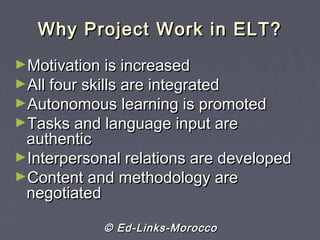
Why Project Work in ELT?Why Project Work in ELT?
►MMotivation is increasedotivation is increased
►All four skills are integratedAll four skills are integrated
►Autonomous learning is promotedAutonomous learning is promoted
►Tasks and language input areTasks and language input are
authenticauthentic
►Interpersonal relations are developedInterpersonal relations are developed
►Content and methodology areContent and methodology are
negotiatednegotiated
© Ed-Links-Morocco© Ed-Links-Morocco
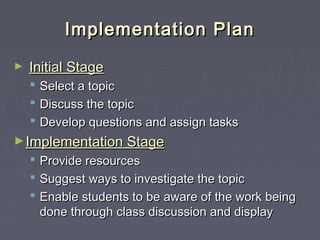
Implementation PlanImplementation Plan
► Initial StageInitial Stage
 Select a topicSelect a topic
 Discuss the topicDiscuss the topic
 Develop questions and assign tasksDevelop questions and assign tasks
►Implementation StageImplementation Stage
 Provide resourcesProvide resources
 Suggest ways to investigate the topicSuggest ways to investigate the topic
 Enable students to be aware of the work beingEnable students to be aware of the work being
done through class discussion and displaydone through class discussion and display
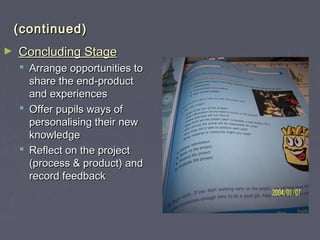
(continued)(continued)
► Concluding StageConcluding Stage
 Arrange opportunities toArrange opportunities to
share the end-productshare the end-product
and experiencesand experiences
 Offer pupils ways ofOffer pupils ways of
personalising their newpersonalising their new
knowledgeknowledge
 Reflect on the projectReflect on the project
(process & product) and(process & product) and
record feedbackrecord feedback
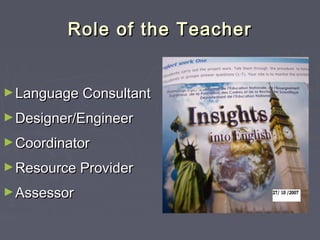
Role of the TeacherRole of the Teacher
►Language ConsultantLanguage Consultant
►Designer/EngineerDesigner/Engineer
►CoordinatorCoordinator
►Resource ProviderResource Provider
►AssessorAssessor
Characteristics of a SuccessfulCharacteristics of a Successful
ProjectProject
► Open-mindedness, respect for evidenceOpen-mindedness, respect for evidence
►Contribution and participation by each andContribution and participation by each and
every individual in the project teamevery individual in the project team
►Group work requiring co-operation andGroup work requiring co-operation and
development of interpersonal anddevelopment of interpersonal and
collaborative skillscollaborative skills
Assessing a ProjectAssessing a Project
► Why assess?Why assess?
 To improve the quality of the learning andTo improve the quality of the learning and
teaching processteaching process
►What to assess?What to assess?
 Not just the end productNot just the end product
 Pupils’ performance throughout the process e.g.Pupils’ performance throughout the process e.g.
their understanding of the topic, grasp of newtheir understanding of the topic, grasp of new
knowledge and skills, dedication to the project,knowledge and skills, dedication to the project,
cooperation with others, etc.cooperation with others, etc.
(continued)(continued)
► Who and whom to assess?Who and whom to assess?
 Teacher assessmentTeacher assessment
►Teacher assessing studentsTeacher assessing students
 Peer assessmentPeer assessment
►Students assessing each otherStudents assessing each other
 Self-assessmentSelf-assessment
►Students assessing themselvesStudents assessing themselves
►Teacher assessing himself/herselfTeacher assessing himself/herself
© Ed-Links-Morocco© Ed-Links-Morocco
Some Possible Drawbacks ofSome Possible Drawbacks of
Project WorkProject Work
► Learners using their own languageLearners using their own language .. If theIf the
class are monolingual they may use their L1 a lot.class are monolingual they may use their L1 a lot.
► Some learners doing nothingSome learners doing nothing .. By giving moreBy giving more
freedom to the learners you may also be givingfreedom to the learners you may also be giving
them the freedom to do nothing!them the freedom to do nothing!
► Groups working at different speeds.Groups working at different speeds.
One group may have 'finished' the project afterOne group may have 'finished' the project after
a couple of hours and say they have nothing to do.a couple of hours and say they have nothing to do.
References:References:
►Haines, SHaines, S 1989. Projects for the EFL1989. Projects for the EFL
classroom London: Nelsonclassroom London: Nelson
►Henry, J.Henry, J. 1994.1994. Teaching throughTeaching through
projects. London: Kogan Page Limited.projects. London: Kogan Page Limited.
►Papandreou, A.Papandreou, A. 1994. An application of1994. An application of
the projects approach to EFL. Englishthe projects approach to EFL. English
Teaching Forum, 32, 3, pp.41-42.Teaching Forum, 32, 3, pp.41-42.
© Ed-Links-Morocco© Ed-Links-Morocco
Incorporating project work (1)

Incorporating project work (1)

  • 1.
    IncorporatingIncorporating Project Work intoProjectWork into the Classroomthe Classroom © Ed-Links-Morocco© Ed-Links-Morocco
  • 2.
    The Project WorkTraditionThe Project Work Tradition English language educators have beenEnglish language educators have been exploring and exploiting the tradition ofexploring and exploiting the tradition of project workproject work since the mid-seventiessince the mid-seventies when ELT married principles ofwhen ELT married principles of learner-learner- centredness, learner autonomycentredness, learner autonomy andand task-task- based learningbased learning.. © Ed-Links-Morocco© Ed-Links-Morocco
  • 3.
    Defining Project WorkDefiningProject Work Project work is "an approach toProject work is "an approach to learning which complementslearning which complements mainstream methods and whichmainstream methods and which can be used with almost all levels,can be used with almost all levels, ages and abilities of students"ages and abilities of students" (Haines 1989:1).(Haines 1989:1). © Ed-Links-Morocco© Ed-Links-Morocco
  • 4.
    (continued)(continued) Project-based learning isas aProject-based learning is as a variable tool to fully integratevariable tool to fully integrate language and content learninglanguage and content learning for teachers working in a varietyfor teachers working in a variety of instructional settings.of instructional settings. © Ed-Links-Morocco© Ed-Links-Morocco
  • 5.
    Why Project Workin ELT?Why Project Work in ELT? ►MMotivation is increasedotivation is increased ►All four skills are integratedAll four skills are integrated ►Autonomous learning is promotedAutonomous learning is promoted ►Tasks and language input areTasks and language input are authenticauthentic ►Interpersonal relations are developedInterpersonal relations are developed ►Content and methodology areContent and methodology are negotiatednegotiated © Ed-Links-Morocco© Ed-Links-Morocco
  • 6.
    Implementation PlanImplementation Plan ►Initial StageInitial Stage  Select a topicSelect a topic  Discuss the topicDiscuss the topic  Develop questions and assign tasksDevelop questions and assign tasks ►Implementation StageImplementation Stage  Provide resourcesProvide resources  Suggest ways to investigate the topicSuggest ways to investigate the topic  Enable students to be aware of the work beingEnable students to be aware of the work being done through class discussion and displaydone through class discussion and display
  • 7.
    (continued)(continued) ► Concluding StageConcludingStage  Arrange opportunities toArrange opportunities to share the end-productshare the end-product and experiencesand experiences  Offer pupils ways ofOffer pupils ways of personalising their newpersonalising their new knowledgeknowledge  Reflect on the projectReflect on the project (process & product) and(process & product) and record feedbackrecord feedback
  • 8.
    Role of theTeacherRole of the Teacher ►Language ConsultantLanguage Consultant ►Designer/EngineerDesigner/Engineer ►CoordinatorCoordinator ►Resource ProviderResource Provider ►AssessorAssessor
  • 9.
    Characteristics of aSuccessfulCharacteristics of a Successful ProjectProject ► Open-mindedness, respect for evidenceOpen-mindedness, respect for evidence ►Contribution and participation by each andContribution and participation by each and every individual in the project teamevery individual in the project team ►Group work requiring co-operation andGroup work requiring co-operation and development of interpersonal anddevelopment of interpersonal and collaborative skillscollaborative skills
  • 10.
    Assessing a ProjectAssessinga Project ► Why assess?Why assess?  To improve the quality of the learning andTo improve the quality of the learning and teaching processteaching process ►What to assess?What to assess?  Not just the end productNot just the end product  Pupils’ performance throughout the process e.g.Pupils’ performance throughout the process e.g. their understanding of the topic, grasp of newtheir understanding of the topic, grasp of new knowledge and skills, dedication to the project,knowledge and skills, dedication to the project, cooperation with others, etc.cooperation with others, etc.
  • 11.
    (continued)(continued) ► Who andwhom to assess?Who and whom to assess?  Teacher assessmentTeacher assessment ►Teacher assessing studentsTeacher assessing students  Peer assessmentPeer assessment ►Students assessing each otherStudents assessing each other  Self-assessmentSelf-assessment ►Students assessing themselvesStudents assessing themselves ►Teacher assessing himself/herselfTeacher assessing himself/herself © Ed-Links-Morocco© Ed-Links-Morocco
  • 12.
    Some Possible DrawbacksofSome Possible Drawbacks of Project WorkProject Work ► Learners using their own languageLearners using their own language .. If theIf the class are monolingual they may use their L1 a lot.class are monolingual they may use their L1 a lot. ► Some learners doing nothingSome learners doing nothing .. By giving moreBy giving more freedom to the learners you may also be givingfreedom to the learners you may also be giving them the freedom to do nothing!them the freedom to do nothing! ► Groups working at different speeds.Groups working at different speeds. One group may have 'finished' the project afterOne group may have 'finished' the project after a couple of hours and say they have nothing to do.a couple of hours and say they have nothing to do.
  • 13.
    References:References: ►Haines, SHaines, S1989. Projects for the EFL1989. Projects for the EFL classroom London: Nelsonclassroom London: Nelson ►Henry, J.Henry, J. 1994.1994. Teaching throughTeaching through projects. London: Kogan Page Limited.projects. London: Kogan Page Limited. ►Papandreou, A.Papandreou, A. 1994. An application of1994. An application of the projects approach to EFL. Englishthe projects approach to EFL. English Teaching Forum, 32, 3, pp.41-42.Teaching Forum, 32, 3, pp.41-42. © Ed-Links-Morocco© Ed-Links-Morocco