I PROJECTS Neiva  2009
Project based  instruction is an authentic  instructional model  or strategy in which students plan, implement and evaluate  projects that  have real–world applications beyond the classroom Learning activities that are interdisciplinary, long-term and student-centered are emphasized What is  a project?
Project work have roots  in the constructivist approach  (Lev Vigostky, Brunner, Piaget, Dewey) Constructivism views learning as the result on mental construction. Children learn by constructing new ideas  or concepts based on their  current and previous knowledge
It provides motivation . Students choose the project which plays an active role  in the entire process. It provides meaningful content  for the students.  It deals with real-world  problems  It presents a  tangible product  that can be shared  with the audience  Why use project work?
It provides opportunities to  construct knowledge collaboratively  It increases  social and communication skills It increases  problem solving  skills It makes  connection between disciplines  It provides opportunities to  contribute to their school or community
It increases  self-esteem . Children take pride  in accomplishing something  that has value outside the classroom It provides a practical  real world way to  learn to use technology
Noise : However it could be  a good sign that children are enjoying the activity  Time : Work can be divided into class work and  home work  Using L1 : As long as the final product is presented in English, the usage of L1 does not matter  Different levels : The brighter students can work independently and the teacher can support the weaker ones .  Possible drawbacks
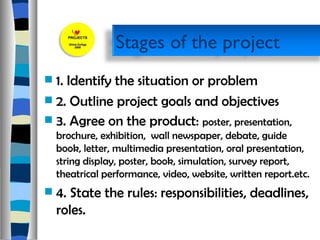
1. Identify the situation or problem 2. Outline project goals and objectives  3. Agree on the product:  poster, presentation, brochure, exhibition,  wall newspaper, debate, guide book, letter, multimedia presentation, oral presentation, string display, poster, book, simulation, survey report, theatrical performance, video, website, written report.etc. 4. State the rules: responsibilities, deadlines, roles. Stages of the project
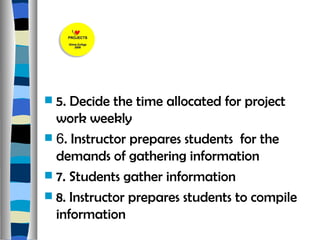
5. Decide the time allocated for project work weekly 6 . Instructor prepares students  for the demands of gathering information 7. Students gather information 8. Instructor prepares students to compile information
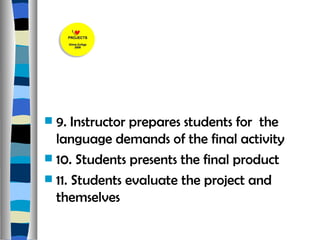
9. Instructor prepares students for  the language demands of the final activity  10. Students presents the final product  11. Students evaluate the project and themselves
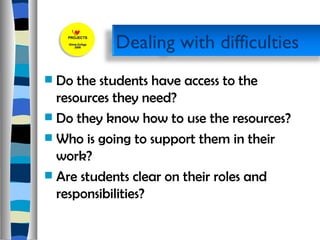
Do the students have access to the resources they need?  Do they know how to use the resources? Who is going to support them in their work? Are students clear on their roles and responsibilities? Dealing with difficulties
Schedule outcomes week after week Report periodical findings  Plan a project at the end of a unit  Time for a project
Collection projects : collect items (cars, postcards, coins, rocks,etc.)  Informational projects : reports about different areas, news, debates,  Orientation projects : city guides, brochures  Social welfare projects : homeless, animals in danger, global warming) Kinds of projects
Define the criteria for asessing the projects:  Process:  collecting, compiling and organizing information, contribution from all members, responsibilities, Product:  neat presentation, roles during the presentation stage.  Assessment of projects
Brochure to promote regional tourism, a debate on human rights, exhibition of dinosaurs, multimedia presentation of enadangered animals,  wall paper on healthy food, a book about world war II, a collection of coins from different countries, a poster on AIDS, a survey report about  teeangers and computer use, a video about pollution problems in your city, a written report about teen pregnancy in our city, an interview to a kidnapped person, a guide book to Huila, a theatrical  performance about family relationships, a  website of the school, an oral presentation about kidnapping in Colombia, a video about  homeless in your city .  Samples of projects

Project Work 1

  • 1.
  • 2.
    Project based instruction is an authentic instructional model or strategy in which students plan, implement and evaluate projects that have real–world applications beyond the classroom Learning activities that are interdisciplinary, long-term and student-centered are emphasized What is a project?
  • 3.
    Project work haveroots in the constructivist approach (Lev Vigostky, Brunner, Piaget, Dewey) Constructivism views learning as the result on mental construction. Children learn by constructing new ideas or concepts based on their current and previous knowledge
  • 4.
    It provides motivation. Students choose the project which plays an active role in the entire process. It provides meaningful content for the students. It deals with real-world problems It presents a tangible product that can be shared with the audience Why use project work?
  • 5.
    It provides opportunitiesto construct knowledge collaboratively It increases social and communication skills It increases problem solving skills It makes connection between disciplines It provides opportunities to contribute to their school or community
  • 6.
    It increases self-esteem . Children take pride in accomplishing something that has value outside the classroom It provides a practical real world way to learn to use technology
  • 7.
    Noise : Howeverit could be a good sign that children are enjoying the activity Time : Work can be divided into class work and home work Using L1 : As long as the final product is presented in English, the usage of L1 does not matter Different levels : The brighter students can work independently and the teacher can support the weaker ones . Possible drawbacks
  • 8.
    1. Identify thesituation or problem 2. Outline project goals and objectives 3. Agree on the product: poster, presentation, brochure, exhibition, wall newspaper, debate, guide book, letter, multimedia presentation, oral presentation, string display, poster, book, simulation, survey report, theatrical performance, video, website, written report.etc. 4. State the rules: responsibilities, deadlines, roles. Stages of the project
  • 9.
    5. Decide thetime allocated for project work weekly 6 . Instructor prepares students for the demands of gathering information 7. Students gather information 8. Instructor prepares students to compile information
  • 10.
    9. Instructor preparesstudents for the language demands of the final activity 10. Students presents the final product 11. Students evaluate the project and themselves
  • 11.
    Do the studentshave access to the resources they need? Do they know how to use the resources? Who is going to support them in their work? Are students clear on their roles and responsibilities? Dealing with difficulties
  • 12.
    Schedule outcomes weekafter week Report periodical findings Plan a project at the end of a unit Time for a project
  • 13.
    Collection projects :collect items (cars, postcards, coins, rocks,etc.) Informational projects : reports about different areas, news, debates, Orientation projects : city guides, brochures Social welfare projects : homeless, animals in danger, global warming) Kinds of projects
  • 14.
    Define the criteriafor asessing the projects: Process: collecting, compiling and organizing information, contribution from all members, responsibilities, Product: neat presentation, roles during the presentation stage. Assessment of projects
  • 15.
    Brochure to promoteregional tourism, a debate on human rights, exhibition of dinosaurs, multimedia presentation of enadangered animals, wall paper on healthy food, a book about world war II, a collection of coins from different countries, a poster on AIDS, a survey report about teeangers and computer use, a video about pollution problems in your city, a written report about teen pregnancy in our city, an interview to a kidnapped person, a guide book to Huila, a theatrical performance about family relationships, a website of the school, an oral presentation about kidnapping in Colombia, a video about homeless in your city . Samples of projects