

Andrea Sanchez
  Diana Arambulo
Fhernanda Cuesta
What is project-based
      learning?
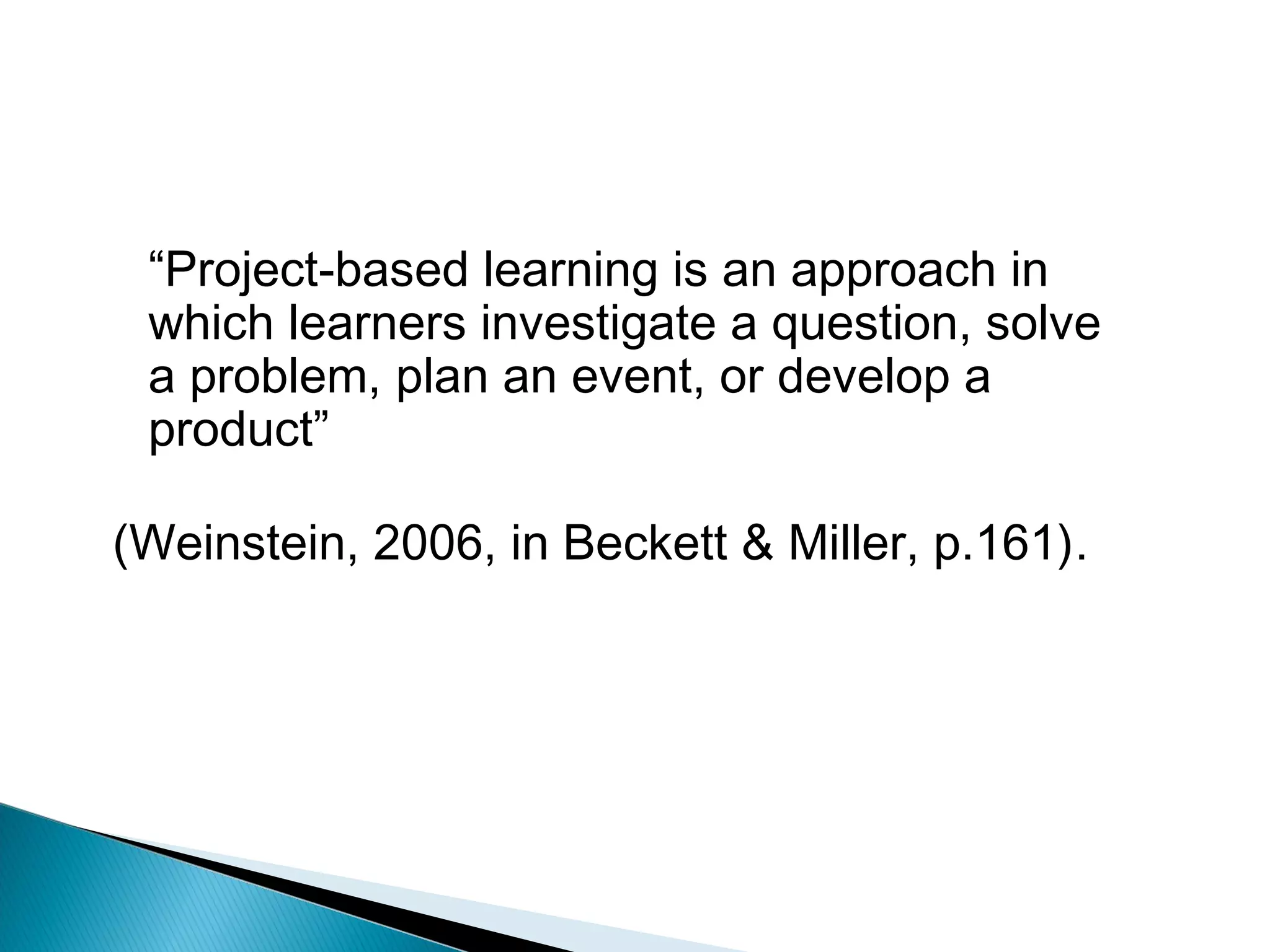
“Project-based learning is an approach in
 which learners investigate a question, solve
 a problem, plan an event, or develop a
 product”

(Weinstein, 2006, in Beckett & Miller, p.161).
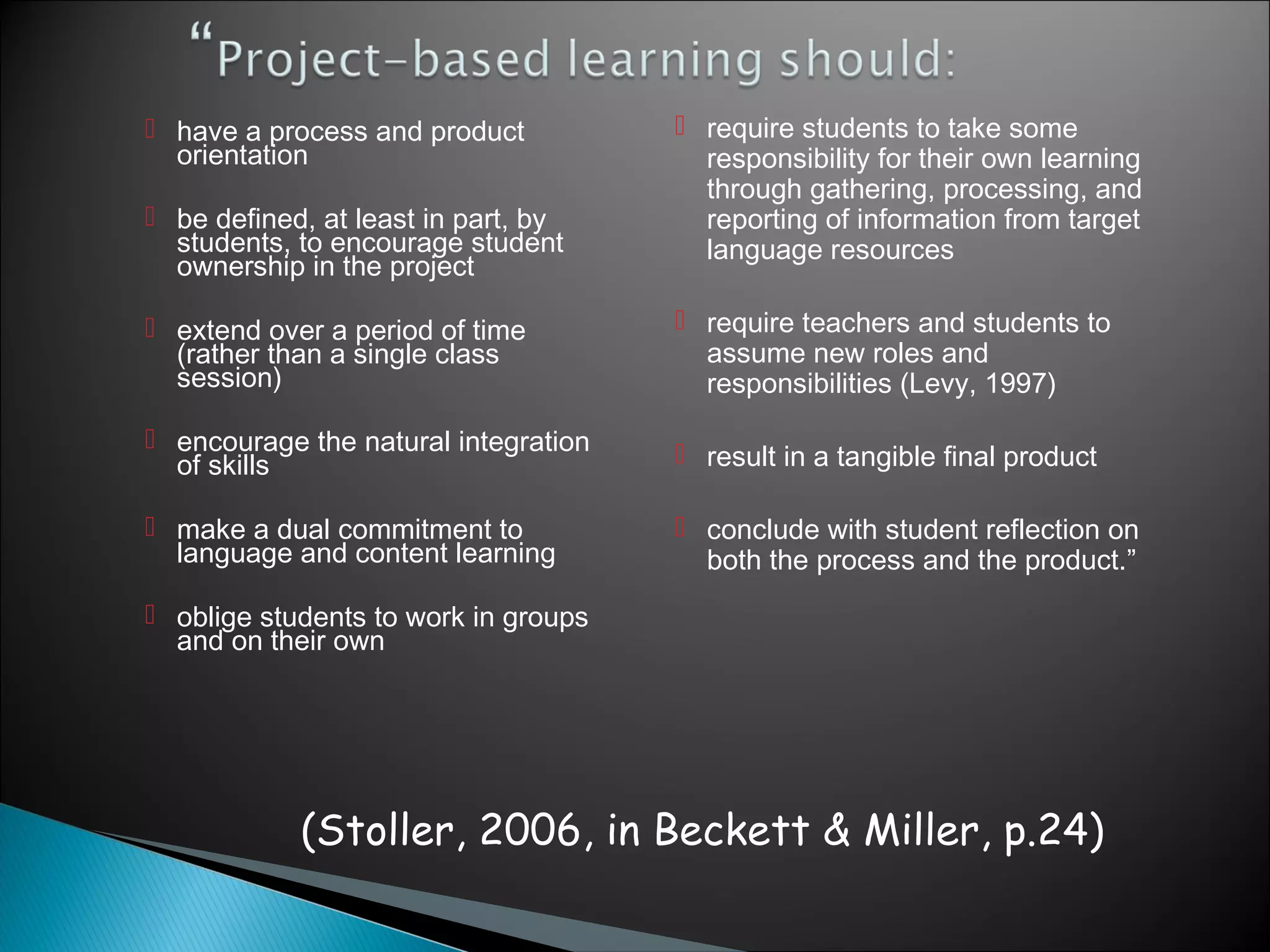
 have a process and product           require students to take some
  orientation                           responsibility for their own learning
                                        through gathering, processing, and
 be defined, at least in part, by      reporting of information from target
  students, to encourage student        language resources
  ownership in the project

 extend over a period of time         require teachers and students to
  (rather than a single class           assume new roles and
  session)                              responsibilities (Levy, 1997)
 encourage the natural integration
  of skills                            result in a tangible final product

 make a dual commitment to            conclude with student reflection on
  language and content learning         both the process and the product.”
 oblige students to work in groups
  and on their own


            (Stoller, 2006, in Beckett & Miller, p.24)
   Project work focuses on content learning rather than on
    specific language targets.
    Project work is student-centered.
   Project work is cooperative rather than competitive.
   Project work leads to the authentic integration of skills and
    processing of information from varied sources, mirroring real-
    life tasks.
   Project work culminates in an end product that can be shared
    with others, giving the project a real purpose.
   Project work is potentially motivating, stimulating, empowering
    and challenging.
 Learners using their own language
 Some learners doing nothing

 Groups working at different speeds

 Lack of enthusiasm in learners

 Learners fail to see the value in project-work

 A mismatch in expectations between learners

  and teachers
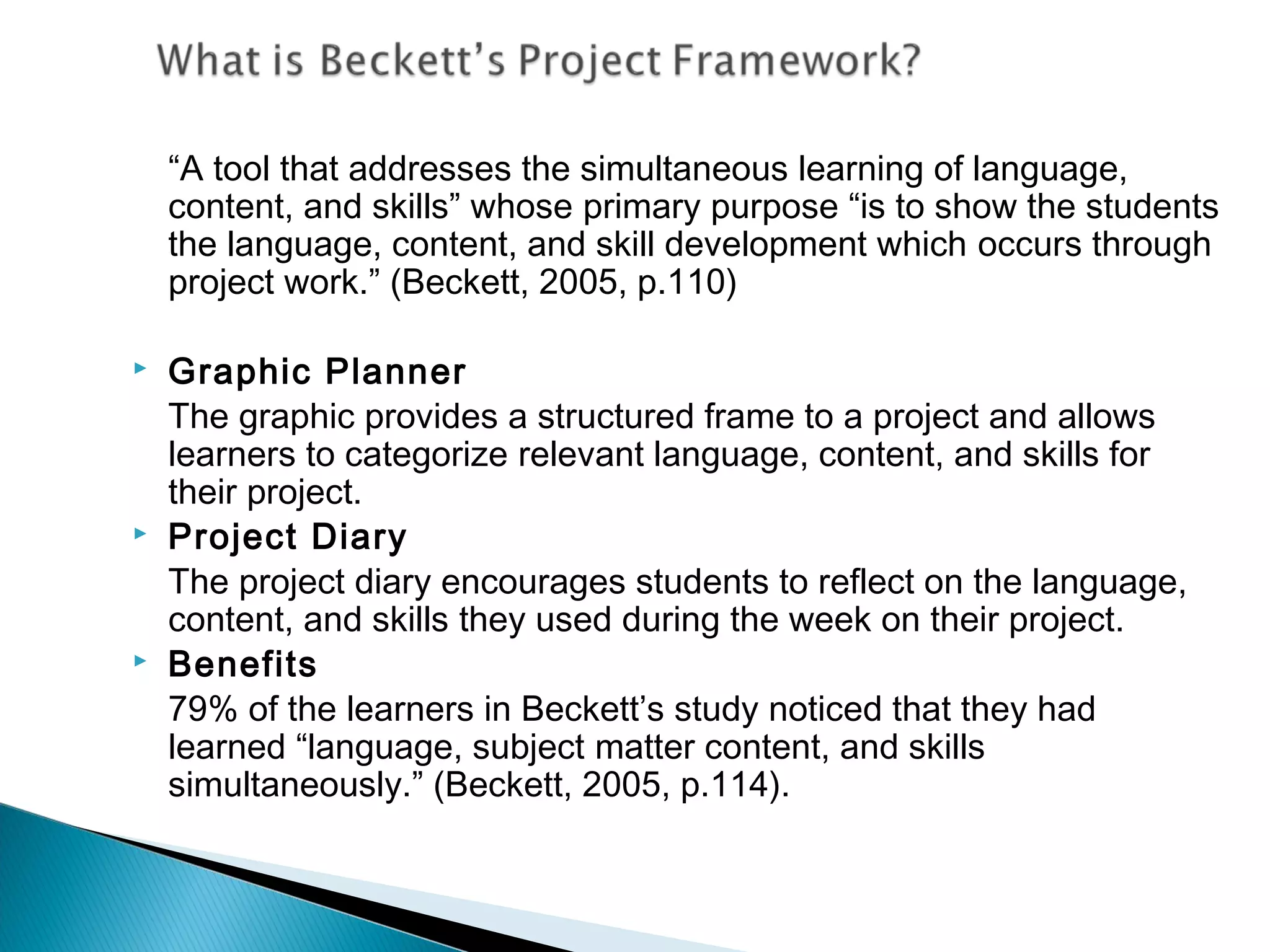
“A tool that addresses the simultaneous learning of language,
    content, and skills” whose primary purpose “is to show the students
    the language, content, and skill development which occurs through
    project work.” (Beckett, 2005, p.110)

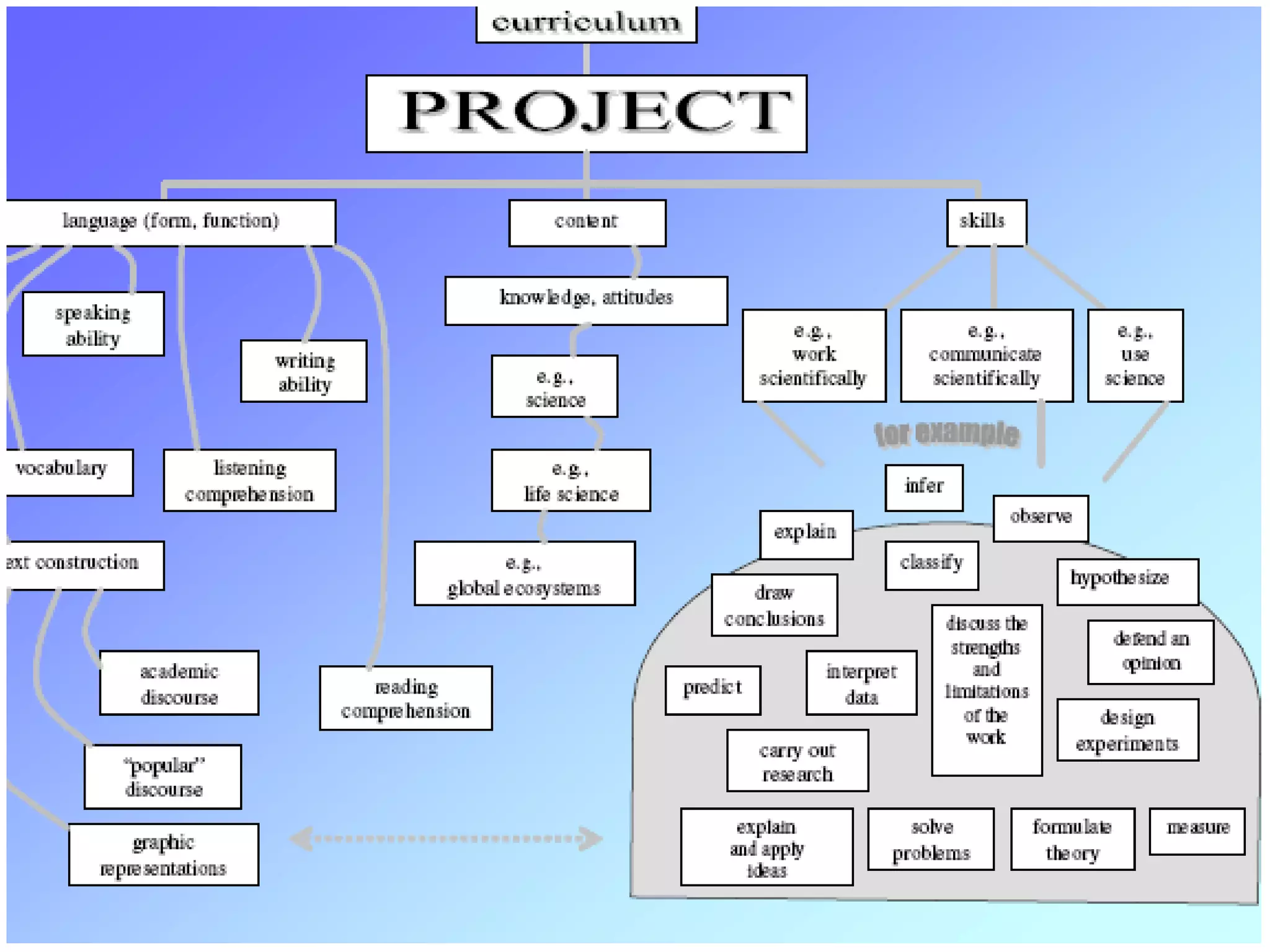
   Graphic Planner
    The graphic provides a structured frame to a project and allows
    learners to categorize relevant language, content, and skills for
    their project.
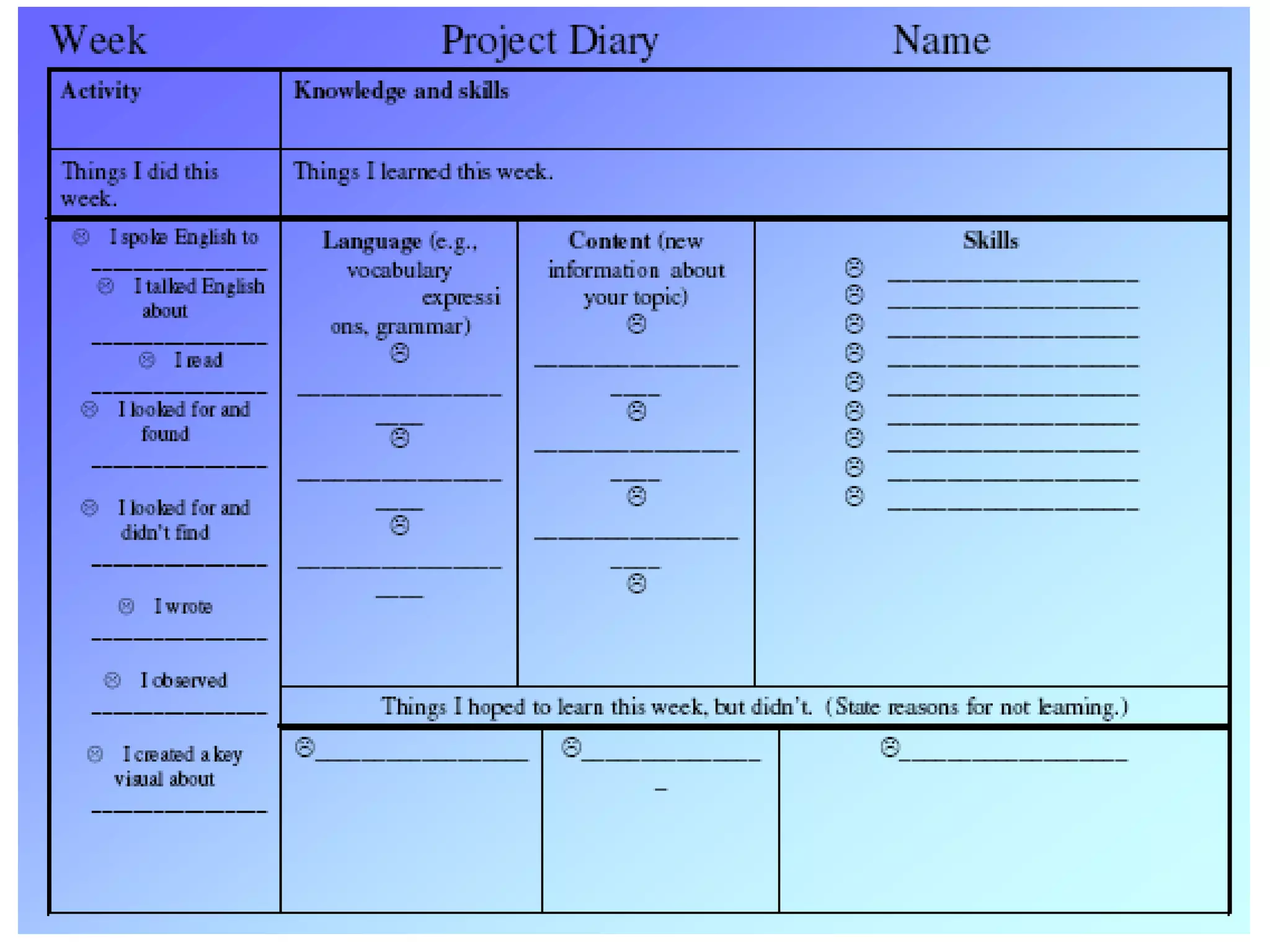
   Project Diary
    The project diary encourages students to reflect on the language,
    content, and skills they used during the week on their project.
   Benefits
    79% of the learners in Beckett’s study noticed that they had
    learned “language, subject matter content, and skills
    simultaneously.” (Beckett, 2005, p.114).
Beckett, G.H. (2006). Beyond second language acquisition: Secondary school ESL teacher goals and
actions for project‐based instruction. In G.H. Beckett & P.C. Miller (Eds.), Project‐based second and
foreign language education: Past, present, and future (pp.55‐70). Greenwich, CT: Information Age
Publishing Inc.

Beckett, G.H. (2002). Teacher and student evaluations of project‐based instruction. TESL Canada
journal, 19(2), 52‐66.

Beckett, G.H. & Slater, T. (2005). The Project Framework: a tool for language, content, and skills
integration. ELT Journal, 59(2), 108‐116.

Fried‐Booth, D.L. (2002). Project work (2nd ed.). Oxford: Oxford University Press.

Miller, P.C. (2006). Integrating second language standards into project‐based instruction. In G.H. Beckett
& P.C.

Stoller, F. (2006). Establishing a theoretical foundation for project‐based learning in second and foreign
language contexts. In G.H. Beckett & P.C. Miller (Eds.), Project‐based second and foreign language
education: Past, present, and future (pp.19‐40). Greenwich, CT: Information Age Publishing Inc.

Weinstein, G. (2001). Developing adult literacies. In M. Celce‐Murcia (Ed.), Teaching English as a second
or foreign language (3rd ed.) (pp.171‐186). Boston: Heinle & Heinle.

Weinstein, G. (2006). “Learners’ lives as curriculum:” An integrative project‐based model for language
learning. In G.H. Beckett & P.C. Miller (Eds.), Project‐based second and foreign language education:
Past, present, and future (pp.159‐165). Greenwich, CT: Information Age Publishing Inc.
Microteaching

Microteaching

  • 1.
    Andrea Sanchez Diana Arambulo Fhernanda Cuesta
  • 2.
  • 3.
    “Project-based learning isan approach in which learners investigate a question, solve a problem, plan an event, or develop a product” (Weinstein, 2006, in Beckett & Miller, p.161).
  • 4.
     have aprocess and product  require students to take some orientation responsibility for their own learning through gathering, processing, and  be defined, at least in part, by reporting of information from target students, to encourage student language resources ownership in the project  extend over a period of time  require teachers and students to (rather than a single class assume new roles and session) responsibilities (Levy, 1997)  encourage the natural integration of skills  result in a tangible final product  make a dual commitment to  conclude with student reflection on language and content learning both the process and the product.”  oblige students to work in groups and on their own (Stoller, 2006, in Beckett & Miller, p.24)
  • 6.
    Project work focuses on content learning rather than on specific language targets.  Project work is student-centered.  Project work is cooperative rather than competitive.  Project work leads to the authentic integration of skills and processing of information from varied sources, mirroring real- life tasks.  Project work culminates in an end product that can be shared with others, giving the project a real purpose.  Project work is potentially motivating, stimulating, empowering and challenging.
  • 7.
     Learners usingtheir own language  Some learners doing nothing  Groups working at different speeds  Lack of enthusiasm in learners  Learners fail to see the value in project-work  A mismatch in expectations between learners and teachers
  • 8.
    “A tool thataddresses the simultaneous learning of language, content, and skills” whose primary purpose “is to show the students the language, content, and skill development which occurs through project work.” (Beckett, 2005, p.110)  Graphic Planner The graphic provides a structured frame to a project and allows learners to categorize relevant language, content, and skills for their project.  Project Diary The project diary encourages students to reflect on the language, content, and skills they used during the week on their project.  Benefits 79% of the learners in Beckett’s study noticed that they had learned “language, subject matter content, and skills simultaneously.” (Beckett, 2005, p.114).
  • 11.
    Beckett, G.H. (2006).Beyond second language acquisition: Secondary school ESL teacher goals and actions for project‐based instruction. In G.H. Beckett & P.C. Miller (Eds.), Project‐based second and foreign language education: Past, present, and future (pp.55‐70). Greenwich, CT: Information Age Publishing Inc. Beckett, G.H. (2002). Teacher and student evaluations of project‐based instruction. TESL Canada journal, 19(2), 52‐66. Beckett, G.H. & Slater, T. (2005). The Project Framework: a tool for language, content, and skills integration. ELT Journal, 59(2), 108‐116. Fried‐Booth, D.L. (2002). Project work (2nd ed.). Oxford: Oxford University Press. Miller, P.C. (2006). Integrating second language standards into project‐based instruction. In G.H. Beckett & P.C. Stoller, F. (2006). Establishing a theoretical foundation for project‐based learning in second and foreign language contexts. In G.H. Beckett & P.C. Miller (Eds.), Project‐based second and foreign language education: Past, present, and future (pp.19‐40). Greenwich, CT: Information Age Publishing Inc. Weinstein, G. (2001). Developing adult literacies. In M. Celce‐Murcia (Ed.), Teaching English as a second or foreign language (3rd ed.) (pp.171‐186). Boston: Heinle & Heinle. Weinstein, G. (2006). “Learners’ lives as curriculum:” An integrative project‐based model for language learning. In G.H. Beckett & P.C. Miller (Eds.), Project‐based second and foreign language education: Past, present, and future (pp.159‐165). Greenwich, CT: Information Age Publishing Inc.