
Best practices in synchronizing IP-based packet broadcast networks
• June 13, 2022 | VidTrans22, Marina del Rey, California, USA
Luis E. Gonzalez, business development manager, Oscilloquartz
Need for timing in broadcasting
• Consistent time synchronization is absolutely critical in a media and broadcast facility. Without
equipment locked to the same timing source, multiple issues occur affecting media services
• In the baseband world, devices lock to a reference such as black/tri-level sync, DARS, timecode or
genlock
• With the adoption of IP, standards have been developed under the SMPTE-2110 umbrella, which
define a different mechanism of providing timing using IEEE-1588/PTP
• There are two PTP profiles utilized in the broadcasting industry: AES67 and SMPTE 2059-2
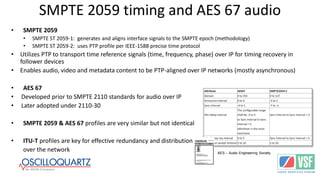
• SMPTE 2059
• SMPTE ST 2059-1: generates and aligns interface signals to the SMPTE epoch (methodology)
• SMPTE ST 2059-2: uses PTP profile per IEEE-1588 precise time protocol
• Utilizes PTP to transport time reference signals (time, frequency, phase) over IP for timing recovery in
follower devices
• Enables audio, video and metadata content to be PTP-aligned over IP networks (mostly asynchronous)
• AES 67
• Developed prior to SMPTE 2110 standards for audio over IP
• Later adopted under 2110-30
• SMPTE 2059 & AES 67 profiles are very similar but not identical
• ITU-T profiles are key for effective redundancy and distribution
over the network
SMPTE 2059 timing and AES 67 audio
AES – Audio Engineering Society
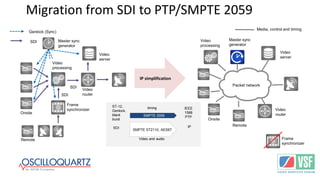
Migration from SDI to PTP/SMPTE 2059
Master sync
generator
SDI
Frame
synchronizer
Remote
Onsite
Video
router
SDI
Video
processing
Video
server
Genlock (Sync)
SDI
IP simplification
Master sync
generator
Frame
synchronizer
Remote
Onsite
Video
processing
Video
server
Video
router
Packet network
Media, control and timing
SDI
SMPTE ST2110, AES67
IP
SMPTE 2059
ST-12,
Genlock,
black
burst
IEEE
1588
PTP
Video and audio
timing
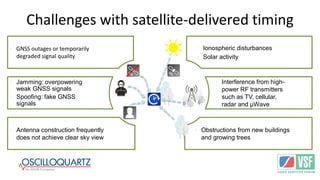
Challenges with satellite-delivered timing
• GNSS outages or temporarily
degraded signal quality
• Ionospheric disturbances
• Solar activity
• Jamming: overpowering
weak GNSS signals
• Spoofing: fake GNSS
signals
• Obstructions from new buildings
and growing trees
• Antenna construction frequently
does not achieve clear sky view
• Interference from high-
power RF transmitters
such as TV, cellular,
radar and µWave
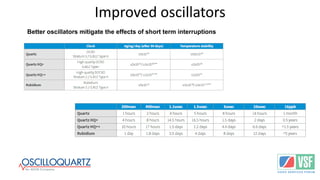
Improved oscillators
Better oscillators mitigate the effects of short term interruptions
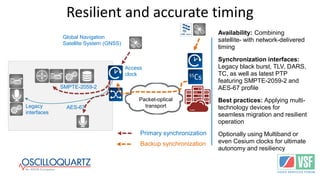
Resilient and accurate timing
AES-67
SMPTE-2059-2
Access
clock
Primary synchronization
Global Navigation
Satellite System (GNSS)
Packet-optical
transport
Availability: Combining
satellite- with network-delivered
timing
Synchronization interfaces:
Legacy black burst, TLV, DARS,
TC, as well as latest PTP
featuring SMPTE-2059-2 and
AES-67 profile
Best practices: Applying multi-
technology devices for
seamless migration and resilient
operation
Optionally using Multiband or
even Cesium clocks for ultimate
autonomy and resiliency
Backup synchronization
Legacy
interfaces
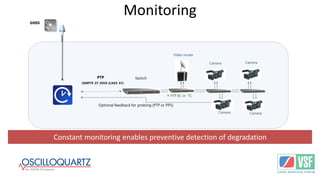
Constant monitoring enables preventive detection of degradation
Monitoring
9
9 © 2019 ADVA Optical Networking. All rights reserved. Confidential.
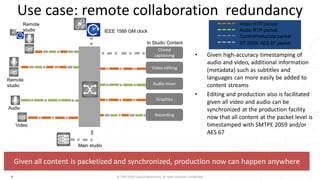
• Given high-accuracy timestamping of
audio and video, additional information
(metadata) such as subtitles and
languages can more easily be added to
content streams
• Editing and production also is facilitated
given all video and audio can be
synchronized at the production facility
now that all content at the packet level is
timestamped with SMTPE 2059 and/or
AES 67
Given all content is packetized and synchronized, production now can happen anywhere
Use case: remote collaboration redundancy
Closed
captioning
Video editing
Audio mixer
Graphics
Recording
Remote
studio
Main studio
Video RTP packet
Audio RTP packet
Control/metadata packet
ST 2059/ AES 67 packet
IEEE 1588 GM clock
Remote
studio
Audio
Video
In Studio Content
BC#1
BC1-A
BC &
SyncE
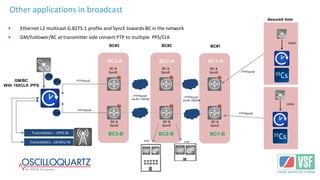
• Ethernet L2 multicast G.8275.1 profile and SyncE towards BC in the network
• GM/Follower/BC at transmitter side convert PTP to multiple PPS/CLK
Other applications in broadcast
Assured time
BC &
SyncE
BC1-B
PTP/SyncE
PTP/SyncE
PTP/SyncE
via BC DWDM
BC2-A
BC &
SyncE
BC &
SyncE
BC2-B
BC#2
BC3-A
BC &
SyncE
BC &
SyncE
BC3-B
PTP/SyncE
PTP/SyncE
Pr1
Pr2
BC#3
GM/BC
With 16XCLK /PPS
PTP/SyncE
via BC CWDM
Transmitters - 10 MHz IN
Transmitters – 1PPS IN
Pr3
PTP PTP
GNSS
GNSS
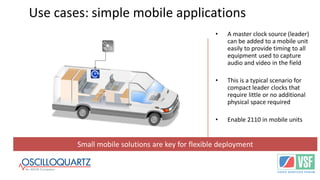
Small mobile solutions are key for flexible deployment
Use cases: simple mobile applications
• A master clock source (leader)
can be added to a mobile unit
easily to provide timing to all
equipment used to capture
audio and video in the field
• This is a typical scenario for
compact leader clocks that
require little or no additional
physical space required
• Enable 2110 in mobile units
• Next-generation broadcast applications are moving to IP to take advantage of lower cost and
flexibility offered by IP technology
• IP delivers higher flexibility for broadcast services, but timestamping and network engineering
are critical for meeting expected QoS
– Audio is also streamed with metadata and these streams must reliably align with video
when transmitted over asynchronous IP network connections
– Reliable time sources must be deployed so that all content created in IP, can be produced,
edited and transmitted with high-resolution content with expected QoS
• Risks from GNSS reliance must be considered and planned for in order to ensure service
availability. Better oscillators, newer technologies and redundancy are key
Takeaways
Thank you
IMPORTANT NOTICE
ADVA is the exclusive owner or licensee of the content, material, and information in this presentation. Any reproduction, publication or reprint, in whole or in part, is strictly prohibited.
The information in this presentation may not be accurate, complete or up to date, and is provided without warranties or representations of any kind, either express or implied. ADVA shall not be responsible for and disclaims any liability for any loss or damages, including without limitation, direct, indirect, incidental,
consequential and special damages, alleged to have been caused by or in connection with using and/or relying on the information contained in this presentation.
Copyright © for the entire content of this presentation: ADVA.
www.oscilloquartz.com | info@adva.com

Best practices in synchronizing IP-based packet broadcast networks

  • 1.
    Best practices insynchronizing IP-based packet broadcast networks • June 13, 2022 | VidTrans22, Marina del Rey, California, USA Luis E. Gonzalez, business development manager, Oscilloquartz
  • 2.
    Need for timingin broadcasting • Consistent time synchronization is absolutely critical in a media and broadcast facility. Without equipment locked to the same timing source, multiple issues occur affecting media services • In the baseband world, devices lock to a reference such as black/tri-level sync, DARS, timecode or genlock • With the adoption of IP, standards have been developed under the SMPTE-2110 umbrella, which define a different mechanism of providing timing using IEEE-1588/PTP • There are two PTP profiles utilized in the broadcasting industry: AES67 and SMPTE 2059-2
  • 3.
    • SMPTE 2059 •SMPTE ST 2059-1: generates and aligns interface signals to the SMPTE epoch (methodology) • SMPTE ST 2059-2: uses PTP profile per IEEE-1588 precise time protocol • Utilizes PTP to transport time reference signals (time, frequency, phase) over IP for timing recovery in follower devices • Enables audio, video and metadata content to be PTP-aligned over IP networks (mostly asynchronous) • AES 67 • Developed prior to SMPTE 2110 standards for audio over IP • Later adopted under 2110-30 • SMPTE 2059 & AES 67 profiles are very similar but not identical • ITU-T profiles are key for effective redundancy and distribution over the network SMPTE 2059 timing and AES 67 audio AES – Audio Engineering Society
  • 4.
    Migration from SDIto PTP/SMPTE 2059 Master sync generator SDI Frame synchronizer Remote Onsite Video router SDI Video processing Video server Genlock (Sync) SDI IP simplification Master sync generator Frame synchronizer Remote Onsite Video processing Video server Video router Packet network Media, control and timing SDI SMPTE ST2110, AES67 IP SMPTE 2059 ST-12, Genlock, black burst IEEE 1588 PTP Video and audio timing
  • 5.
    Challenges with satellite-deliveredtiming • GNSS outages or temporarily degraded signal quality • Ionospheric disturbances • Solar activity • Jamming: overpowering weak GNSS signals • Spoofing: fake GNSS signals • Obstructions from new buildings and growing trees • Antenna construction frequently does not achieve clear sky view • Interference from high- power RF transmitters such as TV, cellular, radar and µWave
  • 6.
    Improved oscillators Better oscillatorsmitigate the effects of short term interruptions
  • 7.
    Resilient and accuratetiming AES-67 SMPTE-2059-2 Access clock Primary synchronization Global Navigation Satellite System (GNSS) Packet-optical transport Availability: Combining satellite- with network-delivered timing Synchronization interfaces: Legacy black burst, TLV, DARS, TC, as well as latest PTP featuring SMPTE-2059-2 and AES-67 profile Best practices: Applying multi- technology devices for seamless migration and resilient operation Optionally using Multiband or even Cesium clocks for ultimate autonomy and resiliency Backup synchronization Legacy interfaces
  • 8.
    Constant monitoring enablespreventive detection of degradation Monitoring
  • 9.
    9 9 © 2019ADVA Optical Networking. All rights reserved. Confidential. • Given high-accuracy timestamping of audio and video, additional information (metadata) such as subtitles and languages can more easily be added to content streams • Editing and production also is facilitated given all video and audio can be synchronized at the production facility now that all content at the packet level is timestamped with SMTPE 2059 and/or AES 67 Given all content is packetized and synchronized, production now can happen anywhere Use case: remote collaboration redundancy Closed captioning Video editing Audio mixer Graphics Recording Remote studio Main studio Video RTP packet Audio RTP packet Control/metadata packet ST 2059/ AES 67 packet IEEE 1588 GM clock Remote studio Audio Video In Studio Content
  • 10.
    BC#1 BC1-A BC & SyncE • EthernetL2 multicast G.8275.1 profile and SyncE towards BC in the network • GM/Follower/BC at transmitter side convert PTP to multiple PPS/CLK Other applications in broadcast Assured time BC & SyncE BC1-B PTP/SyncE PTP/SyncE PTP/SyncE via BC DWDM BC2-A BC & SyncE BC & SyncE BC2-B BC#2 BC3-A BC & SyncE BC & SyncE BC3-B PTP/SyncE PTP/SyncE Pr1 Pr2 BC#3 GM/BC With 16XCLK /PPS PTP/SyncE via BC CWDM Transmitters - 10 MHz IN Transmitters – 1PPS IN Pr3 PTP PTP GNSS GNSS
  • 11.
    Small mobile solutionsare key for flexible deployment Use cases: simple mobile applications • A master clock source (leader) can be added to a mobile unit easily to provide timing to all equipment used to capture audio and video in the field • This is a typical scenario for compact leader clocks that require little or no additional physical space required • Enable 2110 in mobile units
  • 12.
    • Next-generation broadcastapplications are moving to IP to take advantage of lower cost and flexibility offered by IP technology • IP delivers higher flexibility for broadcast services, but timestamping and network engineering are critical for meeting expected QoS – Audio is also streamed with metadata and these streams must reliably align with video when transmitted over asynchronous IP network connections – Reliable time sources must be deployed so that all content created in IP, can be produced, edited and transmitted with high-resolution content with expected QoS • Risks from GNSS reliance must be considered and planned for in order to ensure service availability. Better oscillators, newer technologies and redundancy are key Takeaways
  • 13.
    Thank you IMPORTANT NOTICE ADVAis the exclusive owner or licensee of the content, material, and information in this presentation. Any reproduction, publication or reprint, in whole or in part, is strictly prohibited. The information in this presentation may not be accurate, complete or up to date, and is provided without warranties or representations of any kind, either express or implied. ADVA shall not be responsible for and disclaims any liability for any loss or damages, including without limitation, direct, indirect, incidental, consequential and special damages, alleged to have been caused by or in connection with using and/or relying on the information contained in this presentation. Copyright © for the entire content of this presentation: ADVA. www.oscilloquartz.com | info@adva.com