PRESEN BY:
AMIN KHALID MAKHDOOM
MEDICAL TERMINOLOGY
Twitter: ameen_km
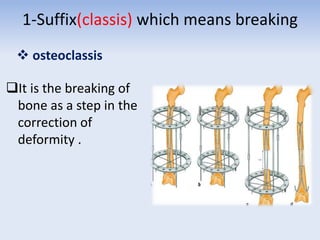
1-Suffix(classis) which means breaking
 osteoclassis
It is the breaking of
bone as a step in the
correction of
deformity .
Cont.
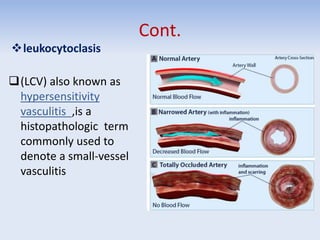
leukocytoclasis
(LCV) also known as
hypersensitivity
vasculitis ,is a
histopathologic term
commonly used to
denote a small-vessel
vasculitis
Cont.
autoclasis
A breaking up or
rupturing from
intrinsic or internal
causes
2- suffix (clast) which means something
that breaks or destroy
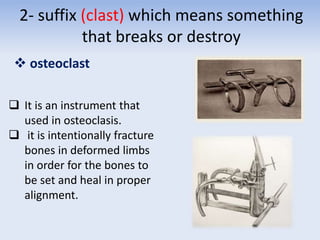
 osteoclast
 It is an instrument that
used in osteoclasis.
 it is intentionally fracture
bones in deformed limbs
in order for the bones to
be set and heal in proper
alignment.
cont.
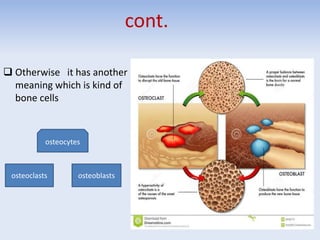
 Otherwise it has another
meaning which is kind of
bone cells
osteocytes
osteoblastsosteoclasts
Cont.
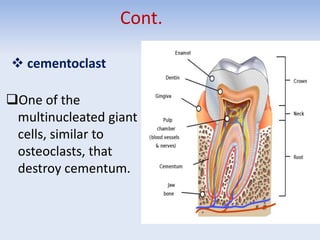
 cementoclast
One of the
multinucleated giant
cells, similar to
osteoclasts, that
destroy cementum.
Cont.
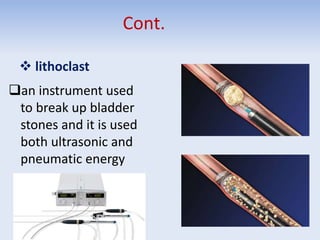
 lithoclast
an instrument used
to break up bladder
stones and it is used
both ultrasonic and
pneumatic energy
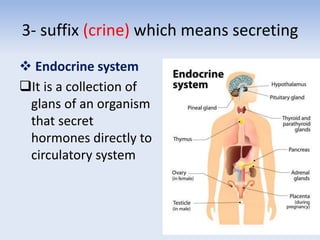
 Endocrine system
It is a collection of
glans of an organism
that secret
hormones directly to
circulatory system
3- suffix (crine) which means secreting
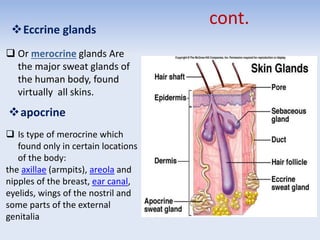
cont.Eccrine glands
 Or merocrine glands Are
the major sweat glands of
the human body, found
virtually all skins.
apocrine
 Is type of merocrine which
found only in certain locations
of the body:
the axillae (armpits), areola and
nipples of the breast, ear canal,
eyelids, wings of the nostril and
some parts of the external
genitalia
4-Suffix (crit) which means separate
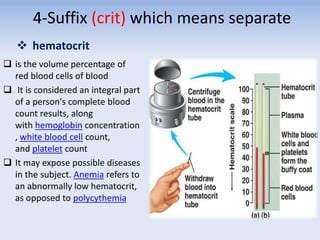
 hematocrit
 is the volume percentage of
red blood cells of blood
 It is considered an integral part
of a person's complete blood
count results, along
with hemoglobin concentration
, white blood cell count,
and platelet count
 It may expose possible diseases
in the subject. Anemia refers to
an abnormally low hematocrit,
as opposed to polycythemia
cont.
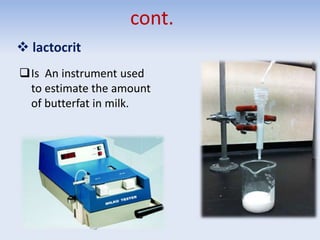
 lactocrit
Is An instrument used
to estimate the amount
of butterfat in milk.
Cont.
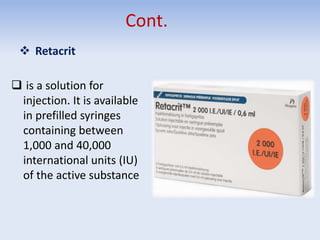
 Retacrit
 is a solution for
injection. It is available
in prefilled syringes
containing between
1,000 and 40,000
international units (IU)
of the active substance
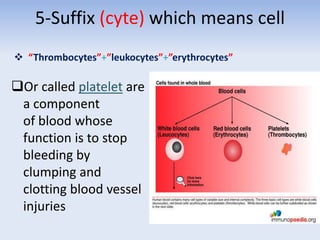
5-Suffix (cyte) which means cell
 “Thrombocytes”+”leukocytes”+”erythrocytes”
Or called platelet are
a component
of blood whose
function is to stop
bleeding by
clumping and
clotting blood vessel
injuries
6-Suffix( cytosis ) which means condition of cells
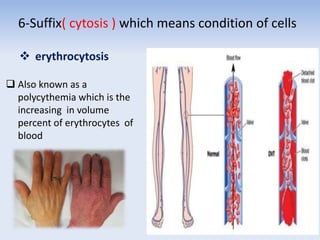
 erythrocytosis
 Also known as a
polycythemia which is the
increasing in volume
percent of erythrocytes of
blood
cont.
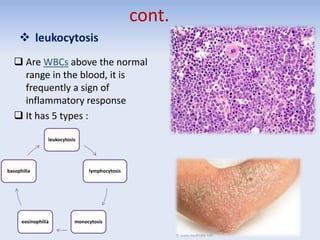
 leukocytosis
 Are WBCs above the normal
range in the blood, it is
frequently a sign of
inflammatory response
 It has 5 types :
leukocytosis
lymphocytosis
monocytosiseosinophilia
basophilia
cont.
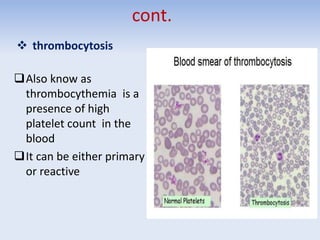
 thrombocytosis
Also know as
thrombocythemia is a
presence of high
platelet count in the
blood
It can be either primary
or reactive
7- suffix (derma) which refer to skin
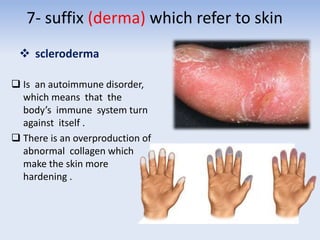
 scleroderma
 Is an autoimmune disorder,
which means that the
body’s immune system turn
against itself .
 There is an overproduction of
abnormal collagen which
make the skin more
hardening .
Cont.
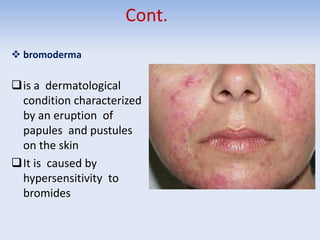
 bromoderma
is a dermatological
condition characterized
by an eruption of
papules and pustules
on the skin
It is caused by
hypersensitivity to
bromides
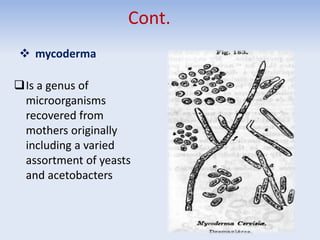
 mycoderma
Is a genus of
microorganisms
recovered from
mothers originally
including a varied
assortment of yeasts
and acetobacters
Cont.
8-Suffix( desis) which means binding
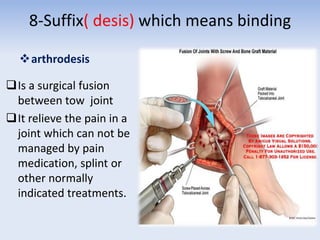
arthrodesis
Is a surgical fusion
between tow joint
It relieve the pain in a
joint which can not be
managed by pain
medication, splint or
other normally
indicated treatments.
Cont.
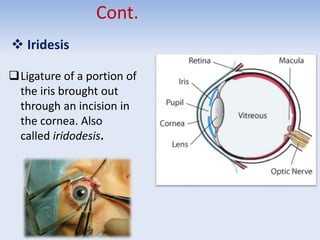
 Iridesis
Ligature of a portion of
the iris brought out
through an incision in
the cornea. Also
called iridodesis.
Cont.
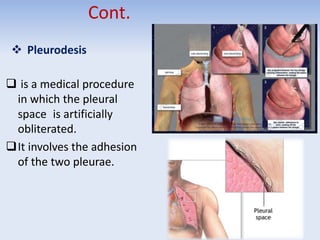
 Pleurodesis
 is a medical procedure
in which the pleural
space is artificially
obliterated.
It involves the adhesion
of the two pleurae.
9- suffix (dynia) which means pain
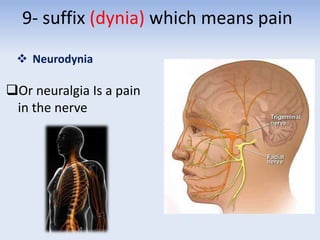
 Neurodynia
Or neuralgia Is a pain
in the nerve
Cont.
Allodynia
pain produced by a n
on-noxious stimulus
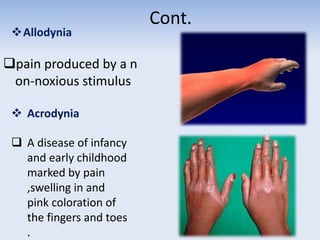
 Acrodynia
 A disease of infancy
and early childhood
marked by pain
,swelling in and
pink coloration of
the fingers and toes
.
10- suffix (ectasia) which means
dilation
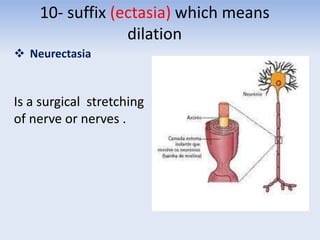
 Neurectasia
Is a surgical stretching
of nerve or nerves .
Cont.
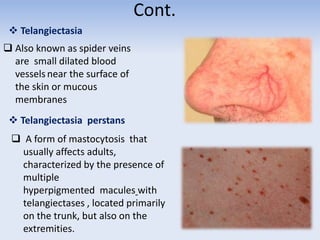
 Telangiectasia
 Also known as spider veins
are small dilated blood
vessels near the surface of
the skin or mucous
membranes
 Telangiectasia perstans
 A form of mastocytosis that
usually affects adults,
characterized by the presence of
multiple
hyperpigmented macules with
telangiectases , located primarily
on the trunk, but also on the
extremities.
11- suffix ( ectasis) which means
expanding
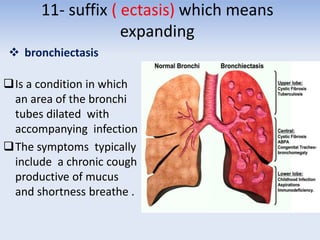
 bronchiectasis
Is a condition in which
an area of the bronchi
tubes dilated with
accompanying infection
The symptoms typically
include a chronic cough
productive of mucus
and shortness breathe .
Cont.
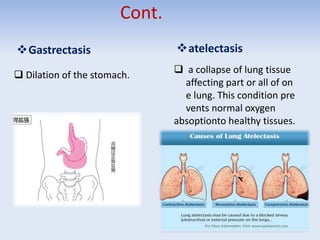
Gastrectasis
 Dilation of the stomach.
atelectasis
 a collapse of lung tissue
affecting part or all of on
e lung. This condition pre
vents normal oxygen
absoptionto healthy tissues.
12- suffix ( ectomy ) which means
removal
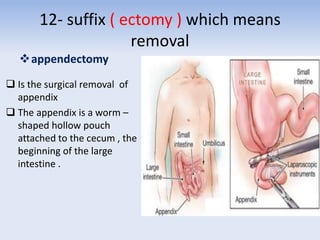
appendectomy
 Is the surgical removal of
appendix
 The appendix is a worm –
shaped hollow pouch
attached to the cecum , the
beginning of the large
intestine .
Cont.
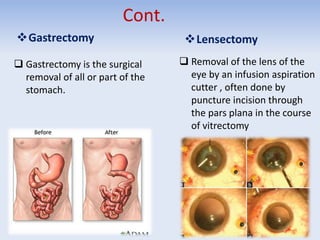
Gastrectomy
 Gastrectomy is the surgical
removal of all or part of the
stomach.
Lensectomy
 Removal of the lens of the
eye by an infusion aspiration
cutter , often done by
puncture incision through
the pars plana in the course
of vitrectomy
13- suffix (edema) which mean
swelling
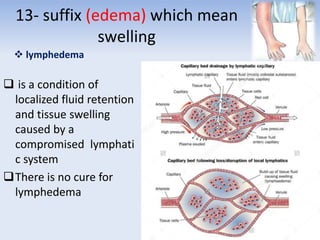
 lymphedema
 is a condition of
localized fluid retention
and tissue swelling
caused by a
compromised lymphati
c system
There is no cure for
lymphedema
Cont.
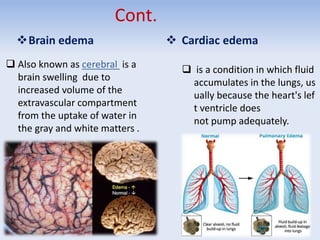
Brain edema
 Also known as cerebral is a
brain swelling due to
increased volume of the
extravascular compartment
from the uptake of water in
the gray and white matters .
 Cardiac edema
 is a condition in which fluid
accumulates in the lungs, us
ually because the heart's lef
t ventricle does
not pump adequately.
14- suffix (ema) which means condition
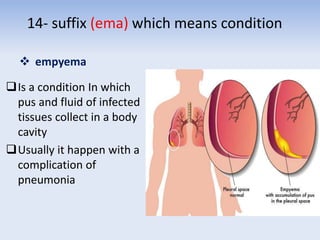
 empyema
Is a condition In which
pus and fluid of infected
tissues collect in a body
cavity
Usually it happen with a
complication of
pneumonia
Cont.
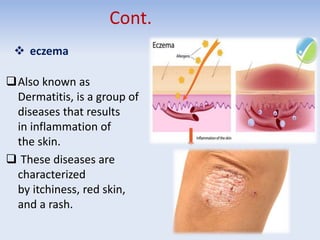
 eczema
Also known as
Dermatitis, is a group of
diseases that results
in inflammation of
the skin.
 These diseases are
characterized
by itchiness, red skin,
and a rash.
Cont.
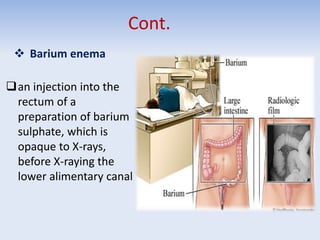
 Barium enema
an injection into the
rectum of a
preparation of barium
sulphate, which is
opaque to X-rays,
before X-raying the
lower alimentary canal
15- suffix (emesis) which means vomiting
hematemesis
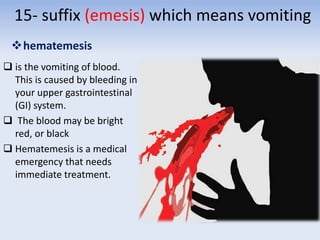
 is the vomiting of blood.
This is caused by bleeding in
your upper gastrointestinal
(GI) system.
 The blood may be bright
red, or black
 Hematemesis is a medical
emergency that needs
immediate treatment.
Cont.
 Pyemesis
 The vomiting of pus
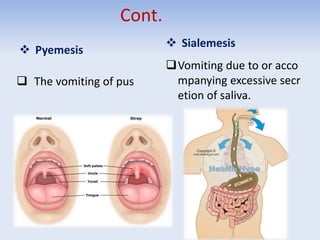
 Sialemesis
Vomiting due to or acco
mpanying excessive secr
etion of saliva.
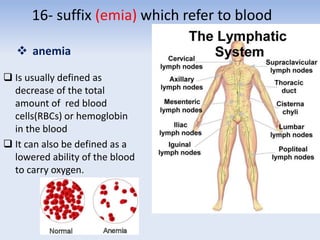
16- suffix (emia) which refer to blood
 anemia
 Is usually defined as
decrease of the total
amount of red blood
cells(RBCs) or hemoglobin
in the blood
 It can also be defined as a
lowered ability of the blood
to carry oxygen.
Cont.
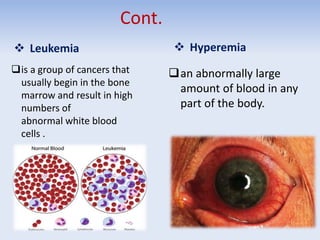
 Leukemia  Hyperemia
an abnormally large
amount of blood in any
part of the body.
is a group of cancers that
usually begin in the bone
marrow and result in high
numbers of
abnormal white blood
cells .
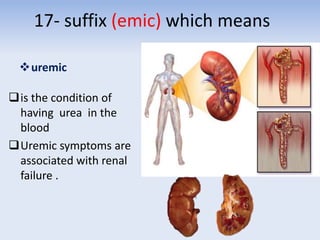
17- suffix (emic) which means
uremic
is the condition of
having urea in the
blood
Uremic symptoms are
associated with renal
failure .
Cont.
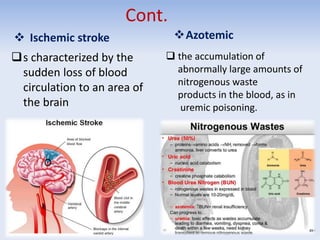
 Ischemic stroke
s characterized by the
sudden loss of blood
circulation to an area of
the brain
Azotemic
 the accumulation of
abnormally large amounts of
nitrogenous waste
products in the blood, as in
uremic poisoning.
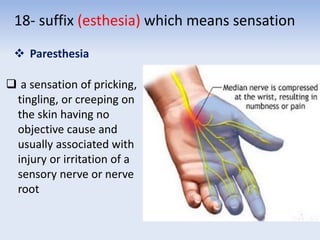
18- suffix (esthesia) which means sensation
 Paresthesia
 a sensation of pricking,
tingling, or creeping on
the skin having no
objective cause and
usually associated with
injury or irritation of a
sensory nerve or nerve
root
Cont.
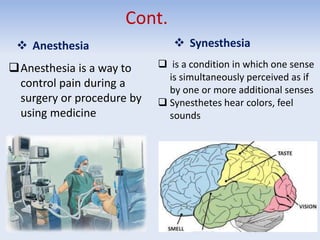
 Anesthesia
Anesthesia is a way to
control pain during a
surgery or procedure by
using medicine
 Synesthesia
 is a condition in which one sense
is simultaneously perceived as if
by one or more additional senses
 Synesthetes hear colors, feel
sounds
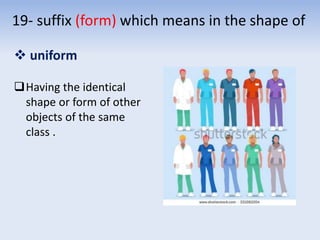
19- suffix (form) which means in the shape of
 uniform
Having the identical
shape or form of other
objects of the same
class .
Cont.
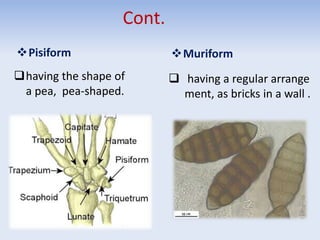
Pisiform
having the shape of
a pea, pea-shaped.
Muriform
 having a regular arrange
ment, as bricks in a wall .
20- suffix (gen) which means producing or
coming to be
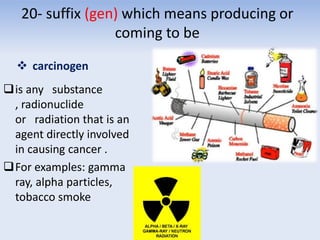
 carcinogen
is any substance
, radionuclide
or radiation that is an
agent directly involved
in causing cancer .
For examples: gamma
ray, alpha particles,
tobacco smoke
Cont.
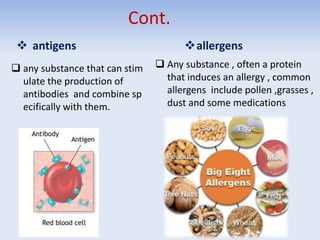
 antigens
 any substance that can stim
ulate the production of
antibodies and combine sp
ecifically with them.
allergens
 Any substance , often a protein
that induces an allergy , common
allergens include pollen ,grasses ,
dust and some medications
21- suffix (genesis) which means
production of
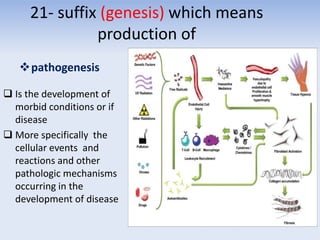
pathogenesis
 Is the development of
morbid conditions or if
disease
 More specifically the
cellular events and
reactions and other
pathologic mechanisms
occurring in the
development of disease
Cont.
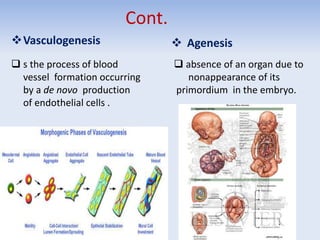
Vasculogenesis
 s the process of blood
vessel formation occurring
by a de novo production
of endothelial cells .
 Agenesis
 absence of an organ due to
nonappearance of its
primordium in the embryo.
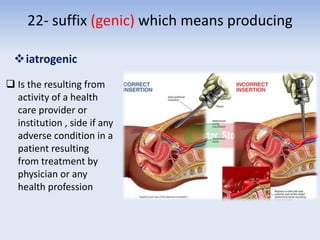
22- suffix (genic) which means producing
iatrogenic
 Is the resulting from
activity of a health
care provider or
institution , side if any
adverse condition in a
patient resulting
from treatment by
physician or any
health profession
Cont.
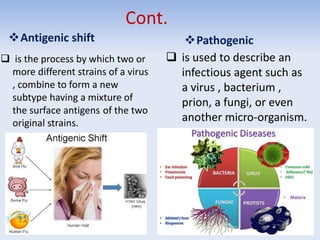
Antigenic shift
 is the process by which two or
more different strains of a virus
, combine to form a new
subtype having a mixture of
the surface antigens of the two
original strains.
Pathogenic
 is used to describe an
infectious agent such as
a virus , bacterium ,
prion, a fungi, or even
another micro-organism.
THANK YOU FOR YOUR ATTENTION

Medical terms

  • 1.
    PRESEN BY: AMIN KHALIDMAKHDOOM MEDICAL TERMINOLOGY Twitter: ameen_km
  • 2.
    1-Suffix(classis) which meansbreaking  osteoclassis It is the breaking of bone as a step in the correction of deformity .
  • 3.
    Cont. leukocytoclasis (LCV) also knownas hypersensitivity vasculitis ,is a histopathologic term commonly used to denote a small-vessel vasculitis
  • 4.
    Cont. autoclasis A breaking upor rupturing from intrinsic or internal causes
  • 5.
    2- suffix (clast)which means something that breaks or destroy  osteoclast  It is an instrument that used in osteoclasis.  it is intentionally fracture bones in deformed limbs in order for the bones to be set and heal in proper alignment.
  • 6.
    cont.  Otherwise ithas another meaning which is kind of bone cells osteocytes osteoblastsosteoclasts
  • 7.
    Cont.  cementoclast One ofthe multinucleated giant cells, similar to osteoclasts, that destroy cementum.
  • 8.
    Cont.  lithoclast an instrumentused to break up bladder stones and it is used both ultrasonic and pneumatic energy
  • 9.
     Endocrine system Itis a collection of glans of an organism that secret hormones directly to circulatory system 3- suffix (crine) which means secreting
  • 10.
    cont.Eccrine glands  Ormerocrine glands Are the major sweat glands of the human body, found virtually all skins. apocrine  Is type of merocrine which found only in certain locations of the body: the axillae (armpits), areola and nipples of the breast, ear canal, eyelids, wings of the nostril and some parts of the external genitalia
  • 11.
    4-Suffix (crit) whichmeans separate  hematocrit  is the volume percentage of red blood cells of blood  It is considered an integral part of a person's complete blood count results, along with hemoglobin concentration , white blood cell count, and platelet count  It may expose possible diseases in the subject. Anemia refers to an abnormally low hematocrit, as opposed to polycythemia
  • 12.
    cont.  lactocrit Is Aninstrument used to estimate the amount of butterfat in milk.
  • 13.
    Cont.  Retacrit  isa solution for injection. It is available in prefilled syringes containing between 1,000 and 40,000 international units (IU) of the active substance
  • 14.
    5-Suffix (cyte) whichmeans cell  “Thrombocytes”+”leukocytes”+”erythrocytes” Or called platelet are a component of blood whose function is to stop bleeding by clumping and clotting blood vessel injuries
  • 15.
    6-Suffix( cytosis )which means condition of cells  erythrocytosis  Also known as a polycythemia which is the increasing in volume percent of erythrocytes of blood
  • 16.
    cont.  leukocytosis  AreWBCs above the normal range in the blood, it is frequently a sign of inflammatory response  It has 5 types : leukocytosis lymphocytosis monocytosiseosinophilia basophilia
  • 17.
    cont.  thrombocytosis Also knowas thrombocythemia is a presence of high platelet count in the blood It can be either primary or reactive
  • 18.
    7- suffix (derma)which refer to skin  scleroderma  Is an autoimmune disorder, which means that the body’s immune system turn against itself .  There is an overproduction of abnormal collagen which make the skin more hardening .
  • 19.
    Cont.  bromoderma is adermatological condition characterized by an eruption of papules and pustules on the skin It is caused by hypersensitivity to bromides
  • 20.
     mycoderma Is agenus of microorganisms recovered from mothers originally including a varied assortment of yeasts and acetobacters Cont.
  • 21.
    8-Suffix( desis) whichmeans binding arthrodesis Is a surgical fusion between tow joint It relieve the pain in a joint which can not be managed by pain medication, splint or other normally indicated treatments.
  • 22.
    Cont.  Iridesis Ligature ofa portion of the iris brought out through an incision in the cornea. Also called iridodesis.
  • 23.
    Cont.  Pleurodesis  isa medical procedure in which the pleural space is artificially obliterated. It involves the adhesion of the two pleurae.
  • 24.
    9- suffix (dynia)which means pain  Neurodynia Or neuralgia Is a pain in the nerve
  • 25.
    Cont. Allodynia pain produced bya n on-noxious stimulus  Acrodynia  A disease of infancy and early childhood marked by pain ,swelling in and pink coloration of the fingers and toes .
  • 26.
    10- suffix (ectasia)which means dilation  Neurectasia Is a surgical stretching of nerve or nerves .
  • 27.
    Cont.  Telangiectasia  Alsoknown as spider veins are small dilated blood vessels near the surface of the skin or mucous membranes  Telangiectasia perstans  A form of mastocytosis that usually affects adults, characterized by the presence of multiple hyperpigmented macules with telangiectases , located primarily on the trunk, but also on the extremities.
  • 28.
    11- suffix (ectasis) which means expanding  bronchiectasis Is a condition in which an area of the bronchi tubes dilated with accompanying infection The symptoms typically include a chronic cough productive of mucus and shortness breathe .
  • 29.
    Cont. Gastrectasis  Dilation ofthe stomach. atelectasis  a collapse of lung tissue affecting part or all of on e lung. This condition pre vents normal oxygen absoptionto healthy tissues.
  • 30.
    12- suffix (ectomy ) which means removal appendectomy  Is the surgical removal of appendix  The appendix is a worm – shaped hollow pouch attached to the cecum , the beginning of the large intestine .
  • 31.
    Cont. Gastrectomy  Gastrectomy isthe surgical removal of all or part of the stomach. Lensectomy  Removal of the lens of the eye by an infusion aspiration cutter , often done by puncture incision through the pars plana in the course of vitrectomy
  • 32.
    13- suffix (edema)which mean swelling  lymphedema  is a condition of localized fluid retention and tissue swelling caused by a compromised lymphati c system There is no cure for lymphedema
  • 33.
    Cont. Brain edema  Alsoknown as cerebral is a brain swelling due to increased volume of the extravascular compartment from the uptake of water in the gray and white matters .  Cardiac edema  is a condition in which fluid accumulates in the lungs, us ually because the heart's lef t ventricle does not pump adequately.
  • 34.
    14- suffix (ema)which means condition  empyema Is a condition In which pus and fluid of infected tissues collect in a body cavity Usually it happen with a complication of pneumonia
  • 35.
    Cont.  eczema Also knownas Dermatitis, is a group of diseases that results in inflammation of the skin.  These diseases are characterized by itchiness, red skin, and a rash.
  • 36.
    Cont.  Barium enema aninjection into the rectum of a preparation of barium sulphate, which is opaque to X-rays, before X-raying the lower alimentary canal
  • 37.
    15- suffix (emesis)which means vomiting hematemesis  is the vomiting of blood. This is caused by bleeding in your upper gastrointestinal (GI) system.  The blood may be bright red, or black  Hematemesis is a medical emergency that needs immediate treatment.
  • 38.
    Cont.  Pyemesis  Thevomiting of pus  Sialemesis Vomiting due to or acco mpanying excessive secr etion of saliva.
  • 39.
    16- suffix (emia)which refer to blood  anemia  Is usually defined as decrease of the total amount of red blood cells(RBCs) or hemoglobin in the blood  It can also be defined as a lowered ability of the blood to carry oxygen.
  • 40.
    Cont.  Leukemia Hyperemia an abnormally large amount of blood in any part of the body. is a group of cancers that usually begin in the bone marrow and result in high numbers of abnormal white blood cells .
  • 41.
    17- suffix (emic)which means uremic is the condition of having urea in the blood Uremic symptoms are associated with renal failure .
  • 42.
    Cont.  Ischemic stroke scharacterized by the sudden loss of blood circulation to an area of the brain Azotemic  the accumulation of abnormally large amounts of nitrogenous waste products in the blood, as in uremic poisoning.
  • 43.
    18- suffix (esthesia)which means sensation  Paresthesia  a sensation of pricking, tingling, or creeping on the skin having no objective cause and usually associated with injury or irritation of a sensory nerve or nerve root
  • 44.
    Cont.  Anesthesia Anesthesia isa way to control pain during a surgery or procedure by using medicine  Synesthesia  is a condition in which one sense is simultaneously perceived as if by one or more additional senses  Synesthetes hear colors, feel sounds
  • 45.
    19- suffix (form)which means in the shape of  uniform Having the identical shape or form of other objects of the same class .
  • 46.
    Cont. Pisiform having the shapeof a pea, pea-shaped. Muriform  having a regular arrange ment, as bricks in a wall .
  • 47.
    20- suffix (gen)which means producing or coming to be  carcinogen is any substance , radionuclide or radiation that is an agent directly involved in causing cancer . For examples: gamma ray, alpha particles, tobacco smoke
  • 48.
    Cont.  antigens  anysubstance that can stim ulate the production of antibodies and combine sp ecifically with them. allergens  Any substance , often a protein that induces an allergy , common allergens include pollen ,grasses , dust and some medications
  • 49.
    21- suffix (genesis)which means production of pathogenesis  Is the development of morbid conditions or if disease  More specifically the cellular events and reactions and other pathologic mechanisms occurring in the development of disease
  • 50.
    Cont. Vasculogenesis  s theprocess of blood vessel formation occurring by a de novo production of endothelial cells .  Agenesis  absence of an organ due to nonappearance of its primordium in the embryo.
  • 51.
    22- suffix (genic)which means producing iatrogenic  Is the resulting from activity of a health care provider or institution , side if any adverse condition in a patient resulting from treatment by physician or any health profession
  • 52.
    Cont. Antigenic shift  isthe process by which two or more different strains of a virus , combine to form a new subtype having a mixture of the surface antigens of the two original strains. Pathogenic  is used to describe an infectious agent such as a virus , bacterium , prion, a fungi, or even another micro-organism.
  • 53.
    THANK YOU FORYOUR ATTENTION