1
Hospital Procedures
Medical Terminology
Part Two
2
Suffixes for Medical
Disciplines
-ology – the study of
Pathology
Cardiology
Hematology
Radiology
Oncology
Toxicology
3
Suffixes for Medical
Disciplines
-ologist – a person who
studies or practices a
specific discipline
Pathologist
Cardiologist
Hematologist
Radiologist
4
Suffixes for Medical
Disciplines
• -ist, -er – another form for referring to a
person who practices a specific discipline.
Internist
Anesthetist
(can be an RVT)
Dentist
Specialist
Practitioner
Coroner
5
Titles for the Medical
Disciplines
• Urologist
• Internist
• Dermatologist
• Theriogenologist
• Oncologist
• Microbiologist
• Opthalmologist
• Endocrinologist
• Pathologist
• Neurologist
• Cardiologist
• Radiologist
• Gastroenterologist
• Anesthesiologist
• Toxicologist
• Generalist
6
Important Medical Prefixes
• Ankyl/o-sis
• Crypt-orchid
• Lith–iasis
• Mega–colon
• Necr/o-sis
• Phag/o–cytosis
• Scler/o–sis
• Therm/o-regulation
• Thromb/o–cytopenia
• Trauma–tic
7
Important Medical Suffixes
• Uro-lith
• Osteo-lysis
• Spleno-megaly
• Hemi-paresis
• Hemi-plegia
• Dys-phagia
• Hyper-plasia
• Baso-philia
8
Important Medical Suffixes
• Dys-pnea
• Hemo-rrhage
• Hypo-thermia
• Hyper-trophy
• Broncho-spasm
• Hemo-stasis
• Nephro-toxin
9
Terms for Direction
• Anterior
• Posterior
• Cranial
• Caudal
• Cephalic
• Rostral
• Dorsal
• Ventral
10
11
Terms for Direction
• Medial
• Lateral
• Superior
• Inferior
• Deep
• Superficial
12
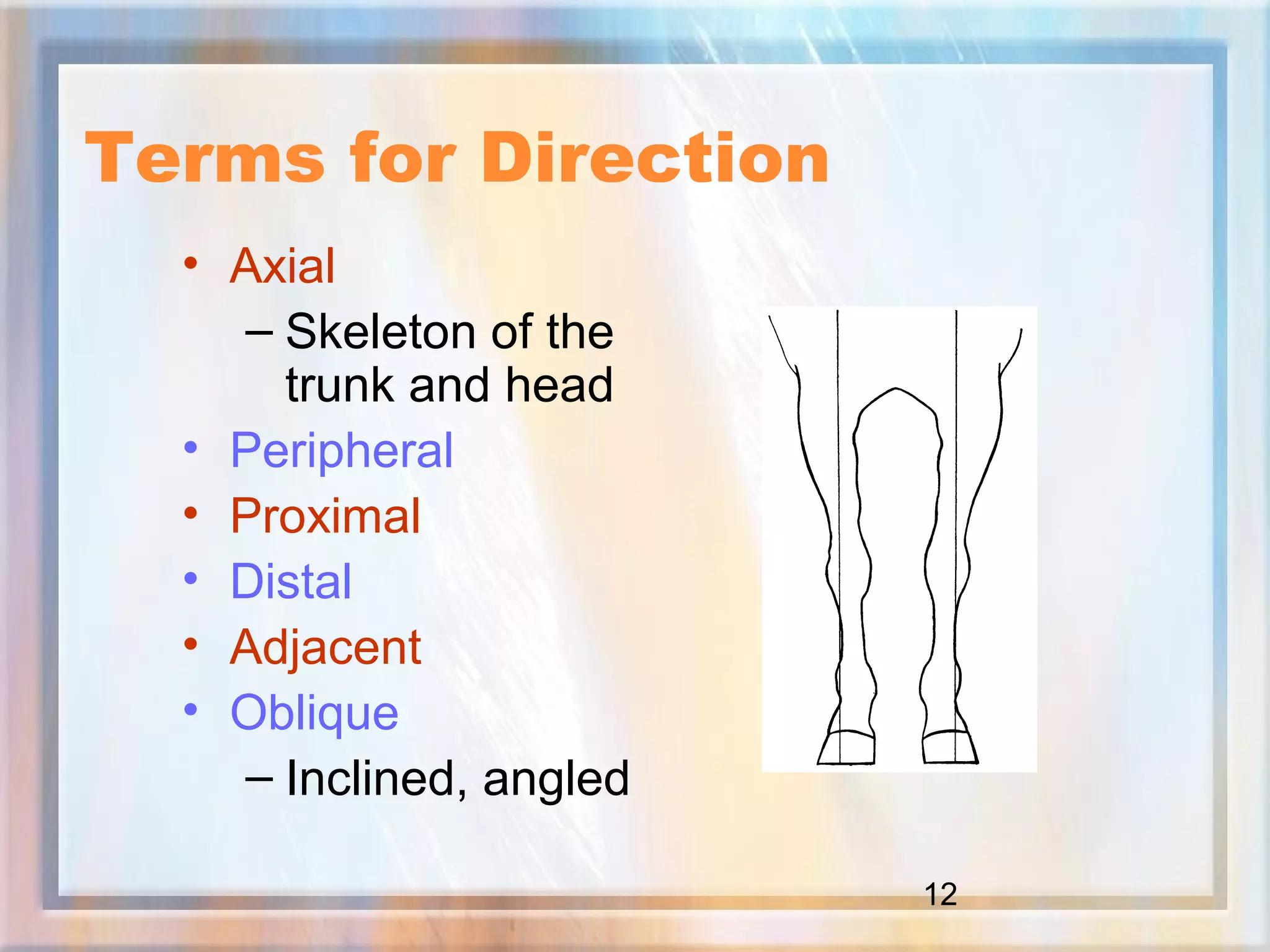
Terms for Direction
• Axial
– Skeleton of the
trunk and head
• Peripheral
• Proximal
• Distal
• Adjacent
• Oblique
– Inclined, angled
13
Terms for Position
Plane: a flat surface where no part is
higher or lower than the other.
• http://www.madsci.org/~lynn/VH/planes.html
• Median Plane
– Sagittal Plane: continuation of the
Median Plane on the right and left
sides
• Dorsal Plane
– Coronal or Frontal Plane for brain
and skull
• Transverse Plane
– Perpendicular to the median and
dorsal planes
• Quadrants (4)
14
15
Terms for Position
• Recumbent
• Supine
– (dorsal recumbency)
• Prone
– (sternal recumbency)
• Caudad
• Dorsum
16
Positional Terms Relating to
the Feet
• Palmar
• Plantar
• Dorsal
17
Positional Terms Relating to
the Teeth
• Occlusal
• Buccal
• Lingual
• Palatal
• Contact
18
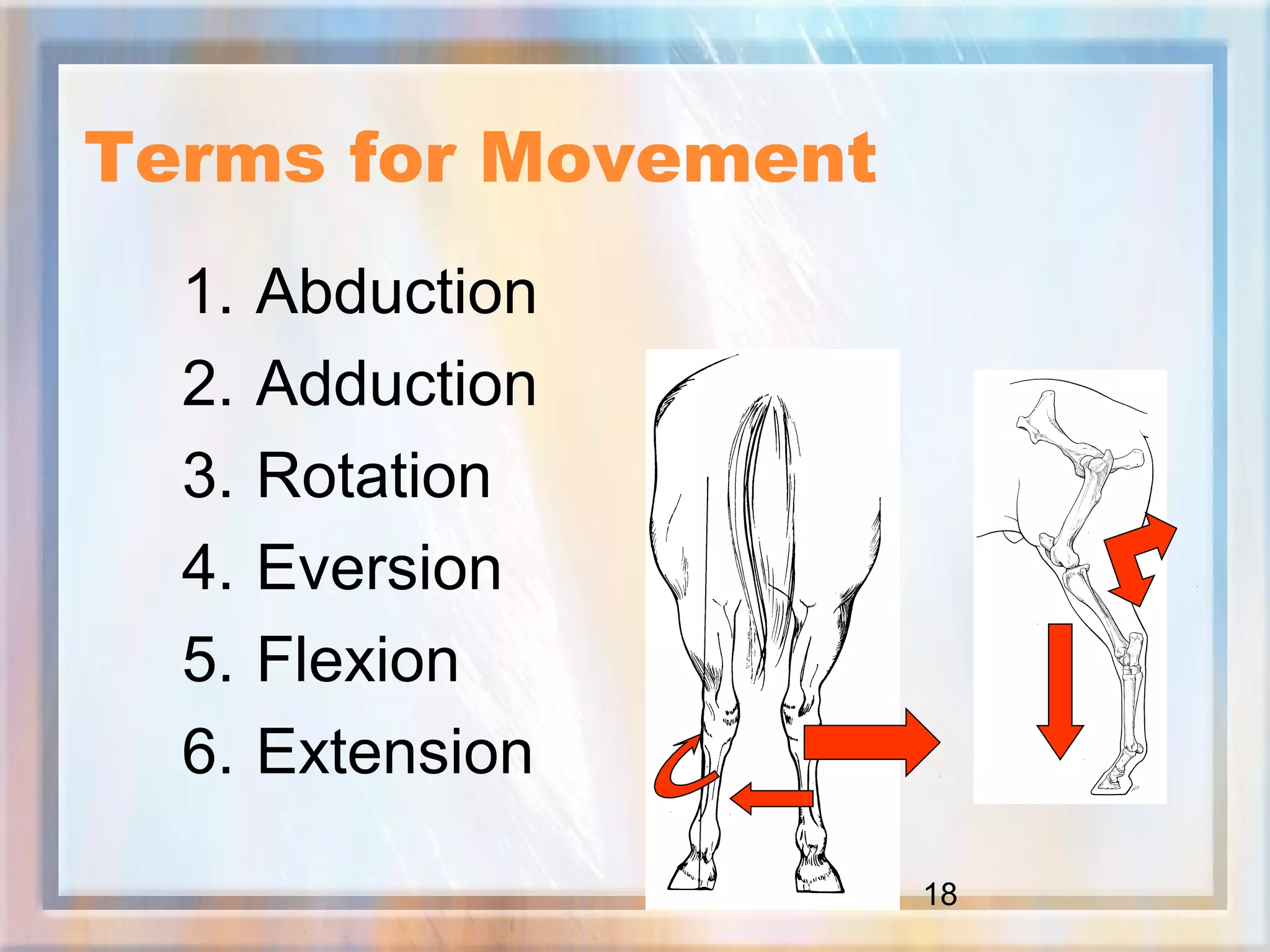
Terms for Movement
1. Abduction
2. Adduction
3. Rotation
4. Eversion
5. Flexion
6. Extension
19
Prefixes for Direction, Position,
and Movement
• Ab-duction (away). Abnormal
• Ad-duction (toward). Addition
• Circum-vent (around). Circumference
• Contra-indicated (against). Contraception
• Ipsi-lateral (self, same)
20
Prefixes for Direction, Position,
and Movement
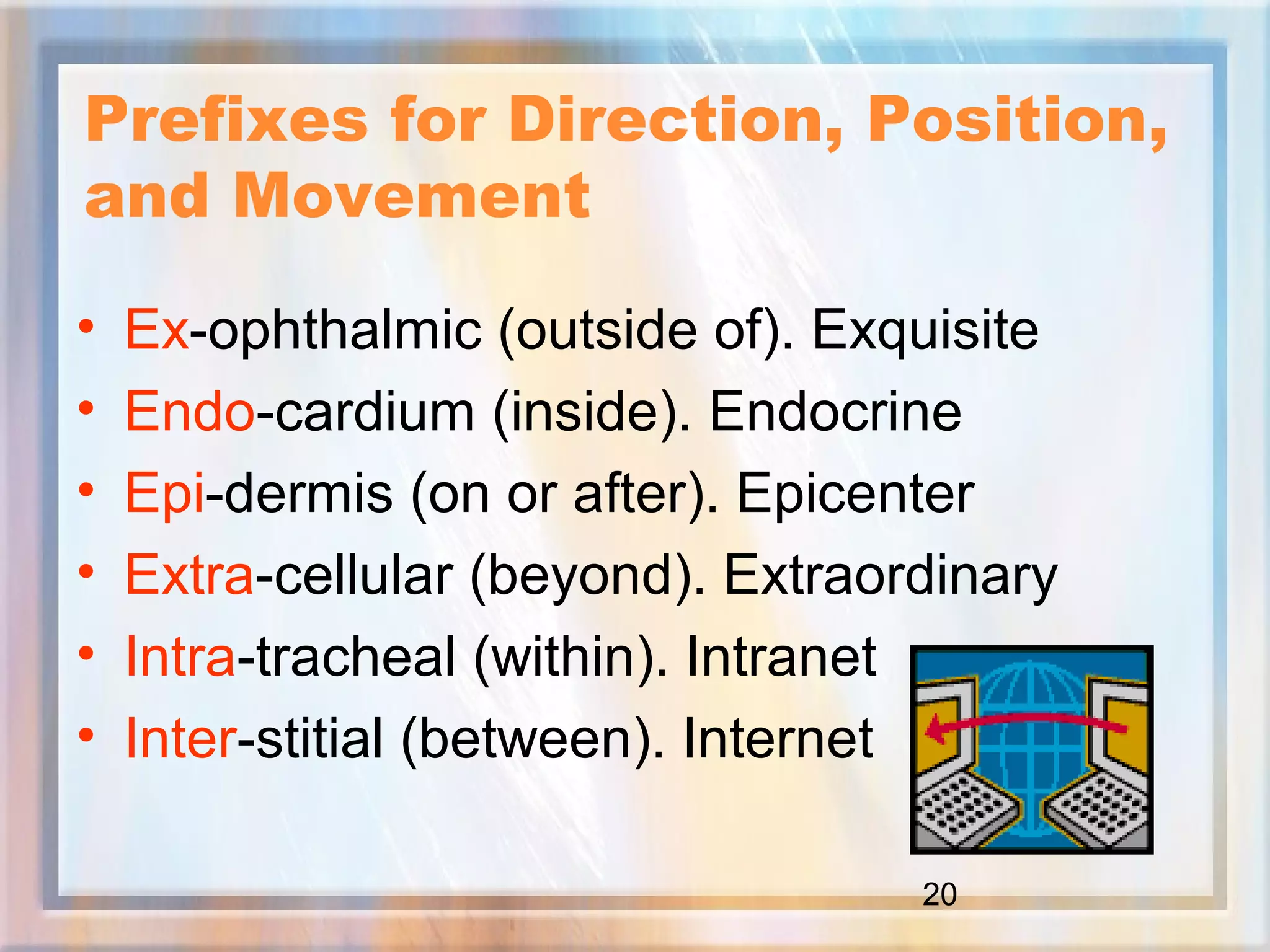
• Ex-ophthalmic (outside of). Exquisite
• Endo-cardium (inside). Endocrine
• Epi-dermis (on or after). Epicenter
• Extra-cellular (beyond). Extraordinary
• Intra-tracheal (within). Intranet
• Inter-stitial (between). Internet
21
Prefixes for Direction, Position,
and Movement
• Meso-metrium (middle). Mesolithic
• Meta-carpal (behind or transform). Metamorphic
• Para-median (next to). Paramedic
• Peri-anal (around). Periscope
• Retro-peritoneal (back). Retroactive
22
Prefixes for Direction, Position,
and Movement
• Sub-cutaneous (below). Subnormal
• Supra-nasal (above). Supraorbital
• Trans-endemic (through or beyond). Transfer
23
Prefixes Pertaining to Numeric
Terms
• Uni-cellular
• Primi-parous
• Mono-nuclear
• Diplo-id
• Bi-lateral
• Hemi-paresis
• Tri-mester
• Quadru-ped
• Multi-cellular
• Semi-coma
24
Prefixes Pertaining to Numeric
Terms
• Milli-liter (1000th)
• Centi-meter (100th)
• Kilo-gram (1000)
• Micro-gram (10,000)
• Nano-gram
(1/1,000,000,000)
2.2 Pounds = 1 Kilogram
25
Terms Relating to Microbiology
• Microorganism
• Pathogen/Pathogenic
• Bacteriology
• Virology
• Mycology/Fungi
26
Nomenclature of Bacteria
Naming Bacteria By Shape
Coccus/cocci – bacteria that are spherical
Streptococcus
Staphylococcus
Diplococcus
Bacillus/bacilli – bacteria that are rod-shaped
Lactobacillus
27
Nomenclature of Bacteria
Naming Bacteria by Group Arrangement
• Strepto- twisted (chains)
– Streptococcus
• Staphylo- bunch or cluster
– Staphylococcus
• Diplo- pairs
– Diplococci
28
Nomenclature of Bacteria
Bacteria named after a person
• Pasteurella
• Escherichia
Bacterial species can named for
type of animal:
Streptococcus equi
Disease it causes:
Bacillus anthracis
Or area of the body:
Staphylococcus epidermidis
29
Nomenclature of Viruses
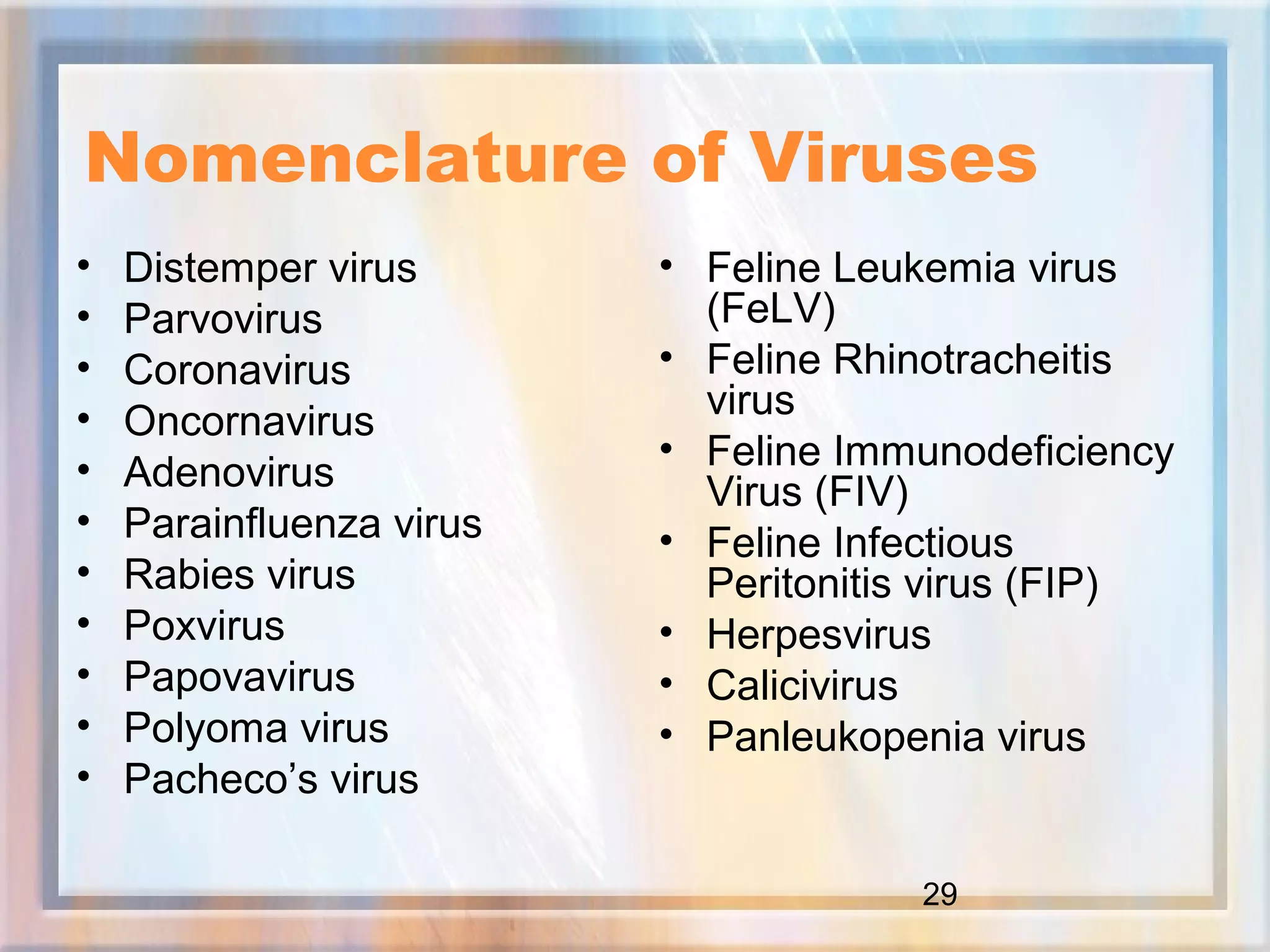
• Distemper virus
• Parvovirus
• Coronavirus
• Oncornavirus
• Adenovirus
• Parainfluenza virus
• Rabies virus
• Poxvirus
• Papovavirus
• Polyoma virus
• Pacheco’s virus
• Feline Leukemia virus
(FeLV)
• Feline Rhinotracheitis
virus
• Feline Immunodeficiency
Virus (FIV)
• Feline Infectious
Peritonitis virus (FIP)
• Herpesvirus
• Calicivirus
• Panleukopenia virus
30
Prefixes Related to Color
• Chrom-atin
• Chloro-phyl
• Cirrh-osis
• Cyano-sis
• Erythro-cyte
• Leuko-cyte
• Melano-cyte
• Xanth-oma
31
Terms Related to Blood
• Prefixes
–Cyto-penia
–Hemo-rrage
–Hema-cytometer
–Hemato-crit
• Suffixes
–Leuko-cyte
–Lympho-cytosis
–Ur-emia
–Lympho-penia
32
Terms Related to Urine
• Prefixes
–Uro-lith
–Urin-alysis
• Suffixes
–Hemat-uria
–Dys-uria
33
Terms Relating to
Pharmacology
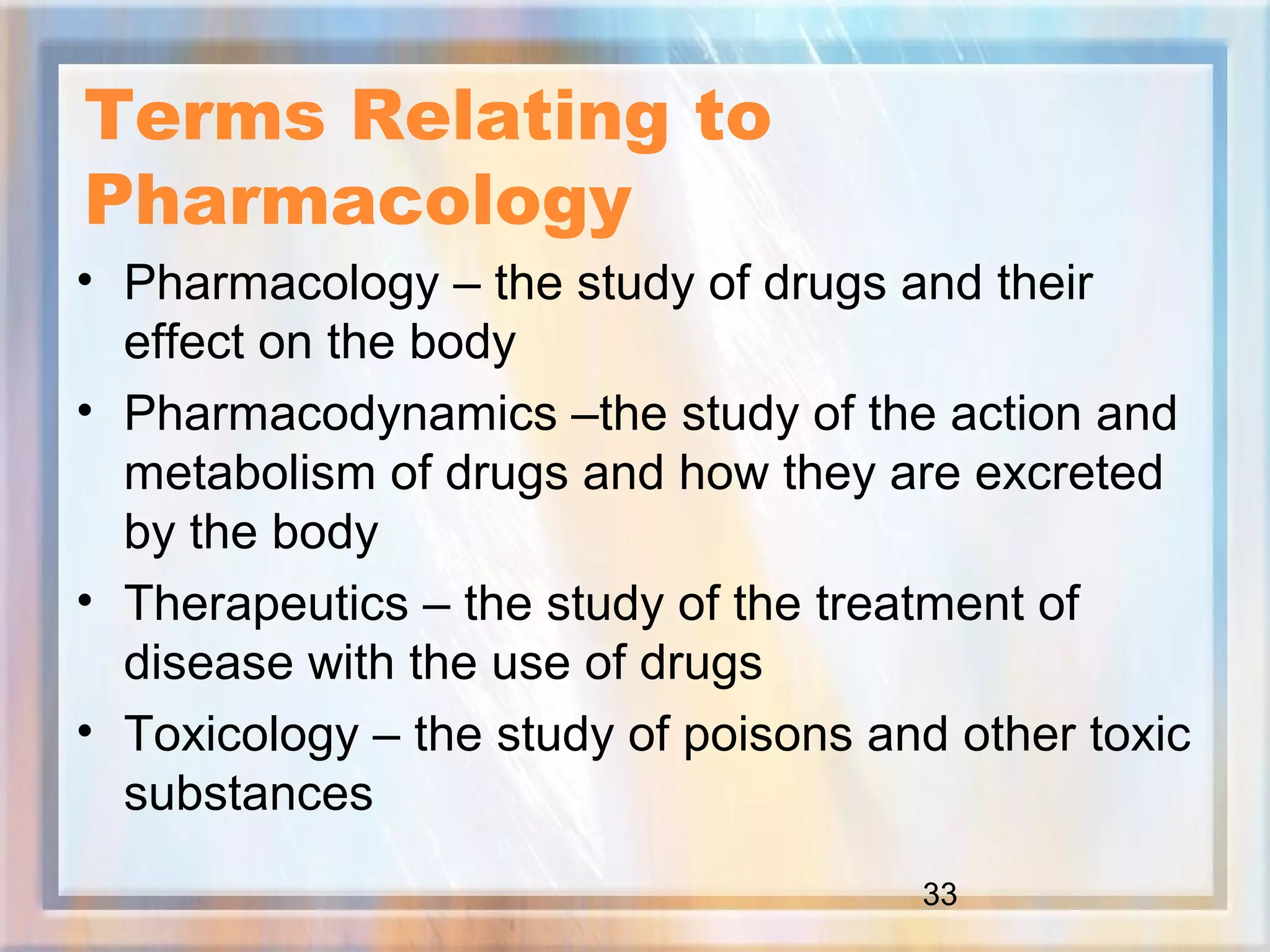
• Pharmacology – the study of drugs and their
effect on the body
• Pharmacodynamics –the study of the action and
metabolism of drugs and how they are excreted
by the body
• Therapeutics – the study of the treatment of
disease with the use of drugs
• Toxicology – the study of poisons and other toxic
substances
34
Drug Names
Trade Name
The brand name or proprietary
name – usually has a trademark
Generic Name
A chemically descriptive drug
name that is not protected by a
trademark
Chemical Name
Describes the constituents and
their chemical configuration within
the drug molecule
35
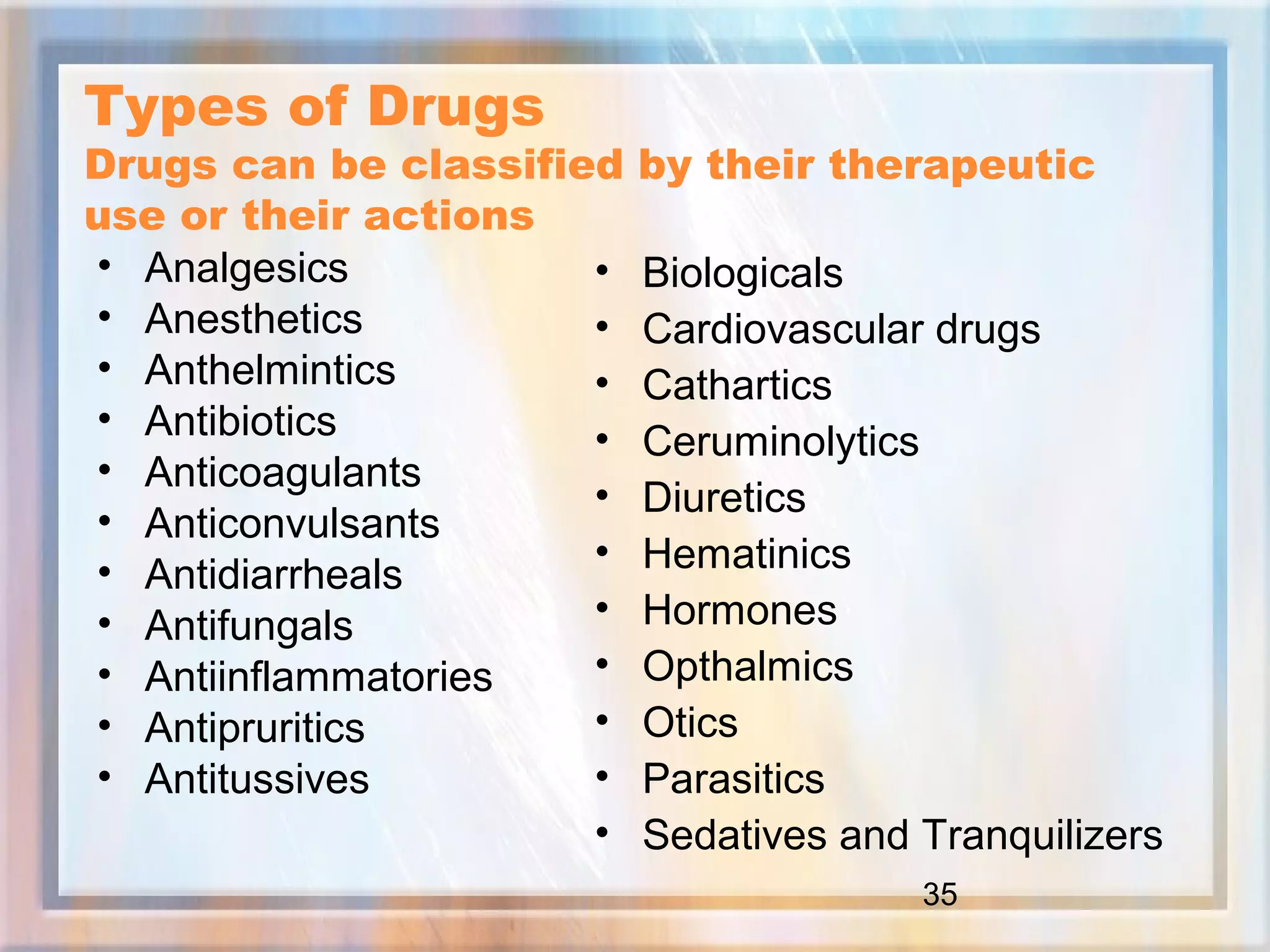
Types of Drugs
Drugs can be classified by their therapeutic
use or their actions
• Analgesics
• Anesthetics
• Anthelmintics
• Antibiotics
• Anticoagulants
• Anticonvulsants
• Antidiarrheals
• Antifungals
• Antiinflammatories
• Antipruritics
• Antitussives
• Biologicals
• Cardiovascular drugs
• Cathartics
• Ceruminolytics
• Diuretics
• Hematinics
• Hormones
• Opthalmics
• Otics
• Parasitics
• Sedatives and Tranquilizers
36
Other Important Prefixes
• Acro-megaly
• Aero-phagia
• Aniso-coria
• Ante-mortem
• Auto-lysis
• Cryo-surgery
• Hetero-chromia
• Hydro-philic
• Iatro-genic
• Inter-costal
• Intra-venous
• Iso-tonic
• Pan-osteitis
• Phon-ation
• Pre-operative
• Pro-estrus
• Post-prandial
• Re-hydrate
• Syn-ergistic
37
Other Important Suffixes
• Hyper-capnia
• Syn-drome
• An-esthesia
• Dia-gnosis
• Neo-natal
• Muc-oid
• My-opia
• Hyp-oxia
• Primi-parous
• Hyper-tension
• Cryo-therapy
• Hyper-tonic
38
Common Medical Terminology
• These are words you will be
expected to know and remember!
39
Common Medical Terminology
• Abscess – cavity containing pus
• Alopecia – abnormal hair loss
• Ambulate – to walk
• Analgesic – relieves pain
• Anemia – low red blood cells
• Anorexia – lack of appetite
• Antibody – protein produced in the body that destroys
specific invaders
• Arrhythmia – abnormal heart rhythm
• Artery – blood vessel leading from the heart
• Aseptic – without infection or contamination
• Bilateral – two sides
40
• Bile – produced by the liver for fat digestion
• Bloat – gas in the stomach
• Calculus – tartar
• Centimeter – one-hundredth of one meter
• Conjunctiva – inner membrane of the eyelids
• Cyanotic – Blue color of the gums due lack of oxygen
• Cystitis – inflammation of the urinary bladder
• Debride – remove dead tissue
• Declaw – amputation of a cat’s claws
• Defecation – passing feces
• ECG – (EKG) electrical impulses of the heart
Common Medical Terminology
41
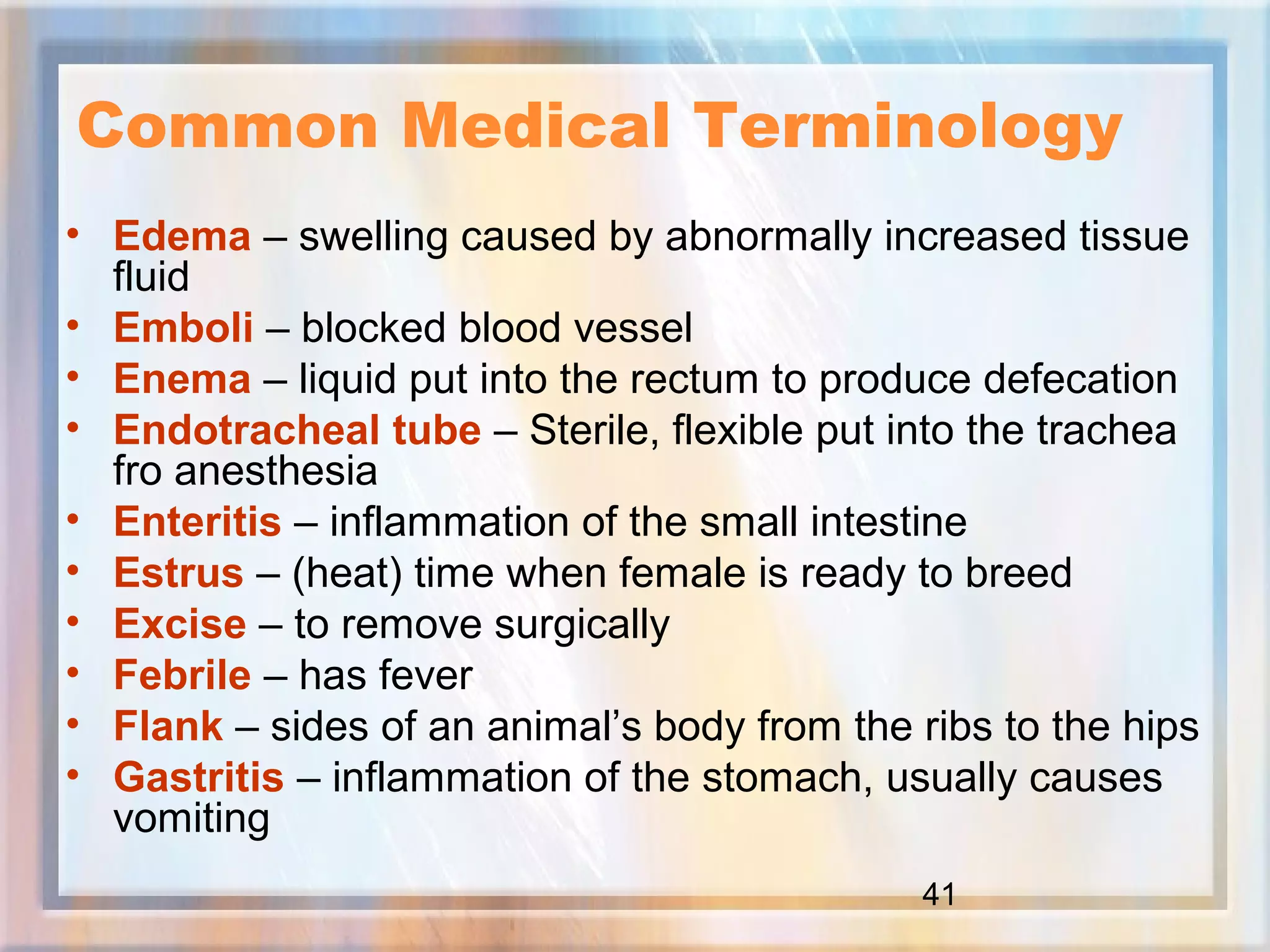
Common Medical Terminology
• Edema – swelling caused by abnormally increased tissue
fluid
• Emboli – blocked blood vessel
• Enema – liquid put into the rectum to produce defecation
• Endotracheal tube – Sterile, flexible put into the trachea
fro anesthesia
• Enteritis – inflammation of the small intestine
• Estrus – (heat) time when female is ready to breed
• Excise – to remove surgically
• Febrile – has fever
• Flank – sides of an animal’s body from the ribs to the hips
• Gastritis – inflammation of the stomach, usually causes
vomiting
42
Common Medical Terminology
• Gingiva – gum
• Hematocrit (HCT) – packed cell volume (PCV)
measures the number of red blood cells
• Hematoma – an area of swelling that contains blood
• Hemostat – clamp for blood vessels
• Hyper = high Hypo = low
• Icterus – yellow skin (jaundice)
• Incise – to cut
• Inflammation – tissue reaction to injury
• -itis – suffix meaning inflammation of
• Lateral recumbency – lying on its side
• Leukocyte – white blood cell
43
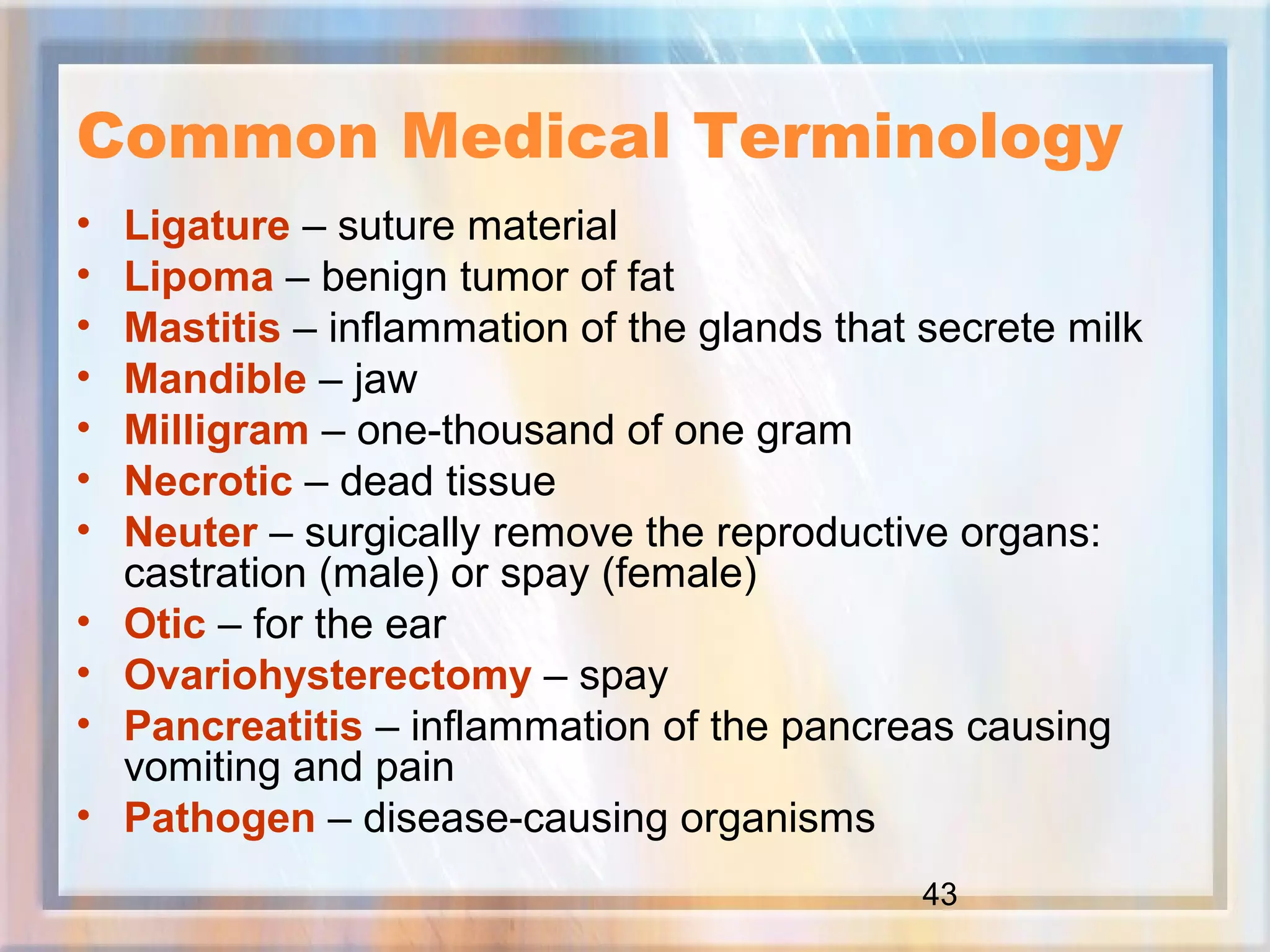
Common Medical Terminology
• Ligature – suture material
• Lipoma – benign tumor of fat
• Mastitis – inflammation of the glands that secrete milk
• Mandible – jaw
• Milligram – one-thousand of one gram
• Necrotic – dead tissue
• Neuter – surgically remove the reproductive organs:
castration (male) or spay (female)
• Otic – for the ear
• Ovariohysterectomy – spay
• Pancreatitis – inflammation of the pancreas causing
vomiting and pain
• Pathogen – disease-causing organisms
44
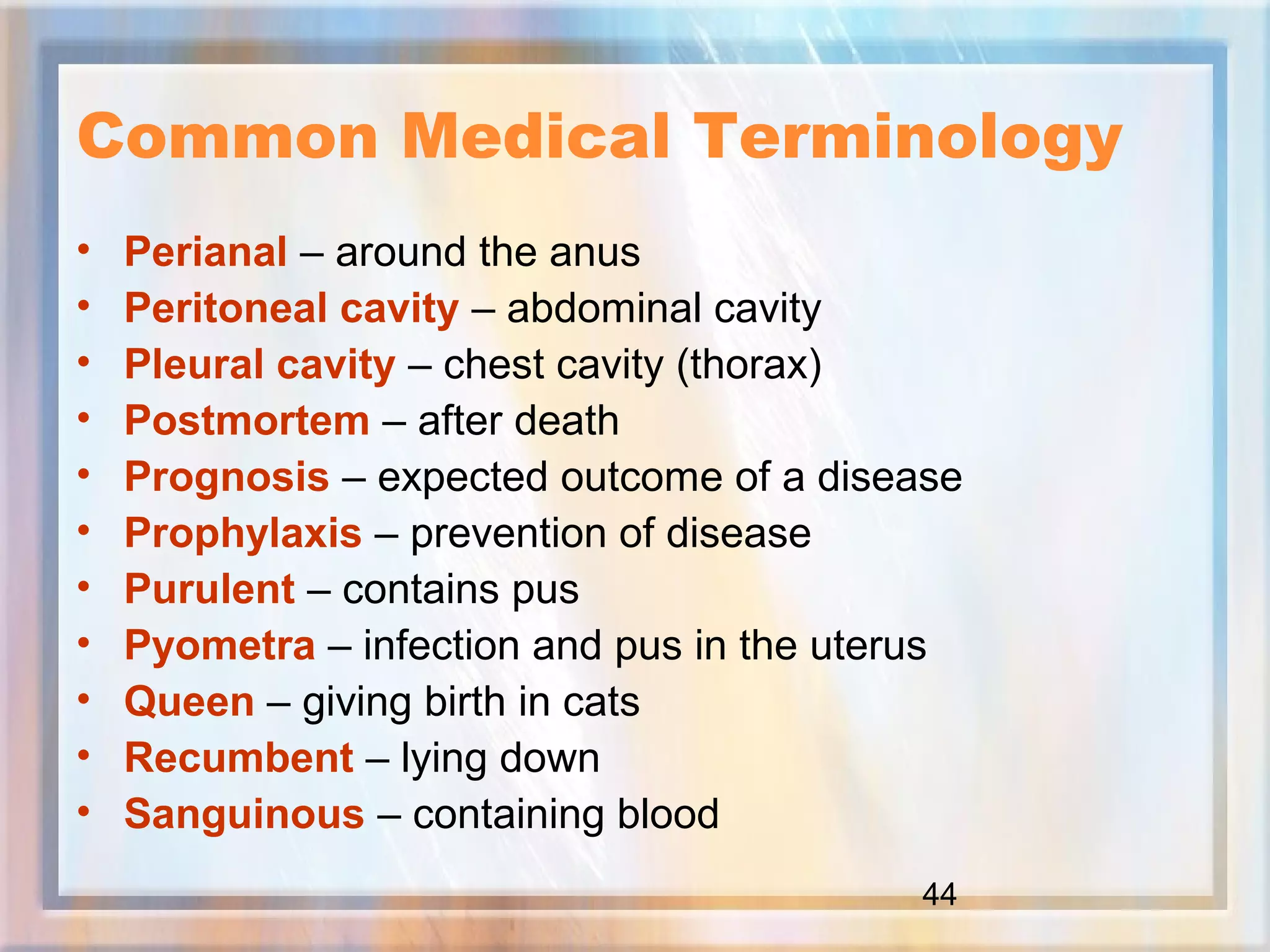
Common Medical Terminology
• Perianal – around the anus
• Peritoneal cavity – abdominal cavity
• Pleural cavity – chest cavity (thorax)
• Postmortem – after death
• Prognosis – expected outcome of a disease
• Prophylaxis – prevention of disease
• Purulent – contains pus
• Pyometra – infection and pus in the uterus
• Queen – giving birth in cats
• Recumbent – lying down
• Sanguinous – containing blood
45
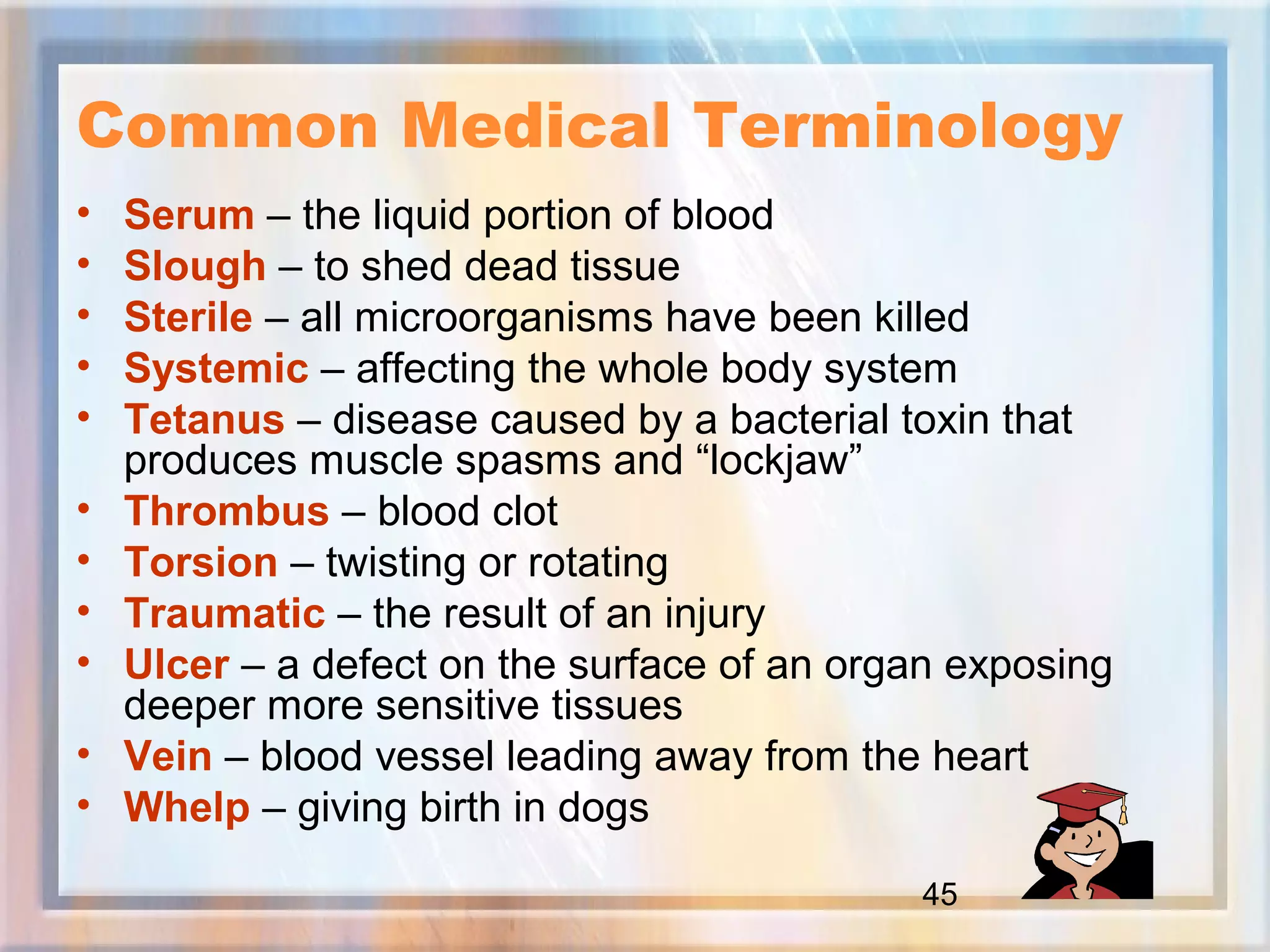
Common Medical Terminology
• Serum – the liquid portion of blood
• Slough – to shed dead tissue
• Sterile – all microorganisms have been killed
• Systemic – affecting the whole body system
• Tetanus – disease caused by a bacterial toxin that
produces muscle spasms and “lockjaw”
• Thrombus – blood clot
• Torsion – twisting or rotating
• Traumatic – the result of an injury
• Ulcer – a defect on the surface of an organ exposing
deeper more sensitive tissues
• Vein – blood vessel leading away from the heart
• Whelp – giving birth in dogs

HPMEDTERMOCVAS

  • 1.
  • 2.
    2 Suffixes for Medical Disciplines -ology– the study of Pathology Cardiology Hematology Radiology Oncology Toxicology
  • 3.
    3 Suffixes for Medical Disciplines -ologist– a person who studies or practices a specific discipline Pathologist Cardiologist Hematologist Radiologist
  • 4.
    4 Suffixes for Medical Disciplines •-ist, -er – another form for referring to a person who practices a specific discipline. Internist Anesthetist (can be an RVT) Dentist Specialist Practitioner Coroner
  • 5.
    5 Titles for theMedical Disciplines • Urologist • Internist • Dermatologist • Theriogenologist • Oncologist • Microbiologist • Opthalmologist • Endocrinologist • Pathologist • Neurologist • Cardiologist • Radiologist • Gastroenterologist • Anesthesiologist • Toxicologist • Generalist
  • 6.
    6 Important Medical Prefixes •Ankyl/o-sis • Crypt-orchid • Lith–iasis • Mega–colon • Necr/o-sis • Phag/o–cytosis • Scler/o–sis • Therm/o-regulation • Thromb/o–cytopenia • Trauma–tic
  • 7.
    7 Important Medical Suffixes •Uro-lith • Osteo-lysis • Spleno-megaly • Hemi-paresis • Hemi-plegia • Dys-phagia • Hyper-plasia • Baso-philia
  • 8.
    8 Important Medical Suffixes •Dys-pnea • Hemo-rrhage • Hypo-thermia • Hyper-trophy • Broncho-spasm • Hemo-stasis • Nephro-toxin
  • 9.
    9 Terms for Direction •Anterior • Posterior • Cranial • Caudal • Cephalic • Rostral • Dorsal • Ventral
  • 10.
  • 11.
    11 Terms for Direction •Medial • Lateral • Superior • Inferior • Deep • Superficial
  • 12.
    12 Terms for Direction •Axial – Skeleton of the trunk and head • Peripheral • Proximal • Distal • Adjacent • Oblique – Inclined, angled
  • 13.
    13 Terms for Position Plane:a flat surface where no part is higher or lower than the other. • http://www.madsci.org/~lynn/VH/planes.html • Median Plane – Sagittal Plane: continuation of the Median Plane on the right and left sides • Dorsal Plane – Coronal or Frontal Plane for brain and skull • Transverse Plane – Perpendicular to the median and dorsal planes • Quadrants (4)
  • 14.
  • 15.
    15 Terms for Position •Recumbent • Supine – (dorsal recumbency) • Prone – (sternal recumbency) • Caudad • Dorsum
  • 16.
    16 Positional Terms Relatingto the Feet • Palmar • Plantar • Dorsal
  • 17.
    17 Positional Terms Relatingto the Teeth • Occlusal • Buccal • Lingual • Palatal • Contact
  • 18.
    18 Terms for Movement 1.Abduction 2. Adduction 3. Rotation 4. Eversion 5. Flexion 6. Extension
  • 19.
    19 Prefixes for Direction,Position, and Movement • Ab-duction (away). Abnormal • Ad-duction (toward). Addition • Circum-vent (around). Circumference • Contra-indicated (against). Contraception • Ipsi-lateral (self, same)
  • 20.
    20 Prefixes for Direction,Position, and Movement • Ex-ophthalmic (outside of). Exquisite • Endo-cardium (inside). Endocrine • Epi-dermis (on or after). Epicenter • Extra-cellular (beyond). Extraordinary • Intra-tracheal (within). Intranet • Inter-stitial (between). Internet
  • 21.
    21 Prefixes for Direction,Position, and Movement • Meso-metrium (middle). Mesolithic • Meta-carpal (behind or transform). Metamorphic • Para-median (next to). Paramedic • Peri-anal (around). Periscope • Retro-peritoneal (back). Retroactive
  • 22.
    22 Prefixes for Direction,Position, and Movement • Sub-cutaneous (below). Subnormal • Supra-nasal (above). Supraorbital • Trans-endemic (through or beyond). Transfer
  • 23.
    23 Prefixes Pertaining toNumeric Terms • Uni-cellular • Primi-parous • Mono-nuclear • Diplo-id • Bi-lateral • Hemi-paresis • Tri-mester • Quadru-ped • Multi-cellular • Semi-coma
  • 24.
    24 Prefixes Pertaining toNumeric Terms • Milli-liter (1000th) • Centi-meter (100th) • Kilo-gram (1000) • Micro-gram (10,000) • Nano-gram (1/1,000,000,000) 2.2 Pounds = 1 Kilogram
  • 25.
    25 Terms Relating toMicrobiology • Microorganism • Pathogen/Pathogenic • Bacteriology • Virology • Mycology/Fungi
  • 26.
    26 Nomenclature of Bacteria NamingBacteria By Shape Coccus/cocci – bacteria that are spherical Streptococcus Staphylococcus Diplococcus Bacillus/bacilli – bacteria that are rod-shaped Lactobacillus
  • 27.
    27 Nomenclature of Bacteria NamingBacteria by Group Arrangement • Strepto- twisted (chains) – Streptococcus • Staphylo- bunch or cluster – Staphylococcus • Diplo- pairs – Diplococci
  • 28.
    28 Nomenclature of Bacteria Bacterianamed after a person • Pasteurella • Escherichia Bacterial species can named for type of animal: Streptococcus equi Disease it causes: Bacillus anthracis Or area of the body: Staphylococcus epidermidis
  • 29.
    29 Nomenclature of Viruses •Distemper virus • Parvovirus • Coronavirus • Oncornavirus • Adenovirus • Parainfluenza virus • Rabies virus • Poxvirus • Papovavirus • Polyoma virus • Pacheco’s virus • Feline Leukemia virus (FeLV) • Feline Rhinotracheitis virus • Feline Immunodeficiency Virus (FIV) • Feline Infectious Peritonitis virus (FIP) • Herpesvirus • Calicivirus • Panleukopenia virus
  • 30.
    30 Prefixes Related toColor • Chrom-atin • Chloro-phyl • Cirrh-osis • Cyano-sis • Erythro-cyte • Leuko-cyte • Melano-cyte • Xanth-oma
  • 31.
    31 Terms Related toBlood • Prefixes –Cyto-penia –Hemo-rrage –Hema-cytometer –Hemato-crit • Suffixes –Leuko-cyte –Lympho-cytosis –Ur-emia –Lympho-penia
  • 32.
    32 Terms Related toUrine • Prefixes –Uro-lith –Urin-alysis • Suffixes –Hemat-uria –Dys-uria
  • 33.
    33 Terms Relating to Pharmacology •Pharmacology – the study of drugs and their effect on the body • Pharmacodynamics –the study of the action and metabolism of drugs and how they are excreted by the body • Therapeutics – the study of the treatment of disease with the use of drugs • Toxicology – the study of poisons and other toxic substances
  • 34.
    34 Drug Names Trade Name Thebrand name or proprietary name – usually has a trademark Generic Name A chemically descriptive drug name that is not protected by a trademark Chemical Name Describes the constituents and their chemical configuration within the drug molecule
  • 35.
    35 Types of Drugs Drugscan be classified by their therapeutic use or their actions • Analgesics • Anesthetics • Anthelmintics • Antibiotics • Anticoagulants • Anticonvulsants • Antidiarrheals • Antifungals • Antiinflammatories • Antipruritics • Antitussives • Biologicals • Cardiovascular drugs • Cathartics • Ceruminolytics • Diuretics • Hematinics • Hormones • Opthalmics • Otics • Parasitics • Sedatives and Tranquilizers
  • 36.
    36 Other Important Prefixes •Acro-megaly • Aero-phagia • Aniso-coria • Ante-mortem • Auto-lysis • Cryo-surgery • Hetero-chromia • Hydro-philic • Iatro-genic • Inter-costal • Intra-venous • Iso-tonic • Pan-osteitis • Phon-ation • Pre-operative • Pro-estrus • Post-prandial • Re-hydrate • Syn-ergistic
  • 37.
    37 Other Important Suffixes •Hyper-capnia • Syn-drome • An-esthesia • Dia-gnosis • Neo-natal • Muc-oid • My-opia • Hyp-oxia • Primi-parous • Hyper-tension • Cryo-therapy • Hyper-tonic
  • 38.
    38 Common Medical Terminology •These are words you will be expected to know and remember!
  • 39.
    39 Common Medical Terminology •Abscess – cavity containing pus • Alopecia – abnormal hair loss • Ambulate – to walk • Analgesic – relieves pain • Anemia – low red blood cells • Anorexia – lack of appetite • Antibody – protein produced in the body that destroys specific invaders • Arrhythmia – abnormal heart rhythm • Artery – blood vessel leading from the heart • Aseptic – without infection or contamination • Bilateral – two sides
  • 40.
    40 • Bile –produced by the liver for fat digestion • Bloat – gas in the stomach • Calculus – tartar • Centimeter – one-hundredth of one meter • Conjunctiva – inner membrane of the eyelids • Cyanotic – Blue color of the gums due lack of oxygen • Cystitis – inflammation of the urinary bladder • Debride – remove dead tissue • Declaw – amputation of a cat’s claws • Defecation – passing feces • ECG – (EKG) electrical impulses of the heart Common Medical Terminology
  • 41.
    41 Common Medical Terminology •Edema – swelling caused by abnormally increased tissue fluid • Emboli – blocked blood vessel • Enema – liquid put into the rectum to produce defecation • Endotracheal tube – Sterile, flexible put into the trachea fro anesthesia • Enteritis – inflammation of the small intestine • Estrus – (heat) time when female is ready to breed • Excise – to remove surgically • Febrile – has fever • Flank – sides of an animal’s body from the ribs to the hips • Gastritis – inflammation of the stomach, usually causes vomiting
  • 42.
    42 Common Medical Terminology •Gingiva – gum • Hematocrit (HCT) – packed cell volume (PCV) measures the number of red blood cells • Hematoma – an area of swelling that contains blood • Hemostat – clamp for blood vessels • Hyper = high Hypo = low • Icterus – yellow skin (jaundice) • Incise – to cut • Inflammation – tissue reaction to injury • -itis – suffix meaning inflammation of • Lateral recumbency – lying on its side • Leukocyte – white blood cell
  • 43.
    43 Common Medical Terminology •Ligature – suture material • Lipoma – benign tumor of fat • Mastitis – inflammation of the glands that secrete milk • Mandible – jaw • Milligram – one-thousand of one gram • Necrotic – dead tissue • Neuter – surgically remove the reproductive organs: castration (male) or spay (female) • Otic – for the ear • Ovariohysterectomy – spay • Pancreatitis – inflammation of the pancreas causing vomiting and pain • Pathogen – disease-causing organisms
  • 44.
    44 Common Medical Terminology •Perianal – around the anus • Peritoneal cavity – abdominal cavity • Pleural cavity – chest cavity (thorax) • Postmortem – after death • Prognosis – expected outcome of a disease • Prophylaxis – prevention of disease • Purulent – contains pus • Pyometra – infection and pus in the uterus • Queen – giving birth in cats • Recumbent – lying down • Sanguinous – containing blood
  • 45.
    45 Common Medical Terminology •Serum – the liquid portion of blood • Slough – to shed dead tissue • Sterile – all microorganisms have been killed • Systemic – affecting the whole body system • Tetanus – disease caused by a bacterial toxin that produces muscle spasms and “lockjaw” • Thrombus – blood clot • Torsion – twisting or rotating • Traumatic – the result of an injury • Ulcer – a defect on the surface of an organ exposing deeper more sensitive tissues • Vein – blood vessel leading away from the heart • Whelp – giving birth in dogs