Introduction
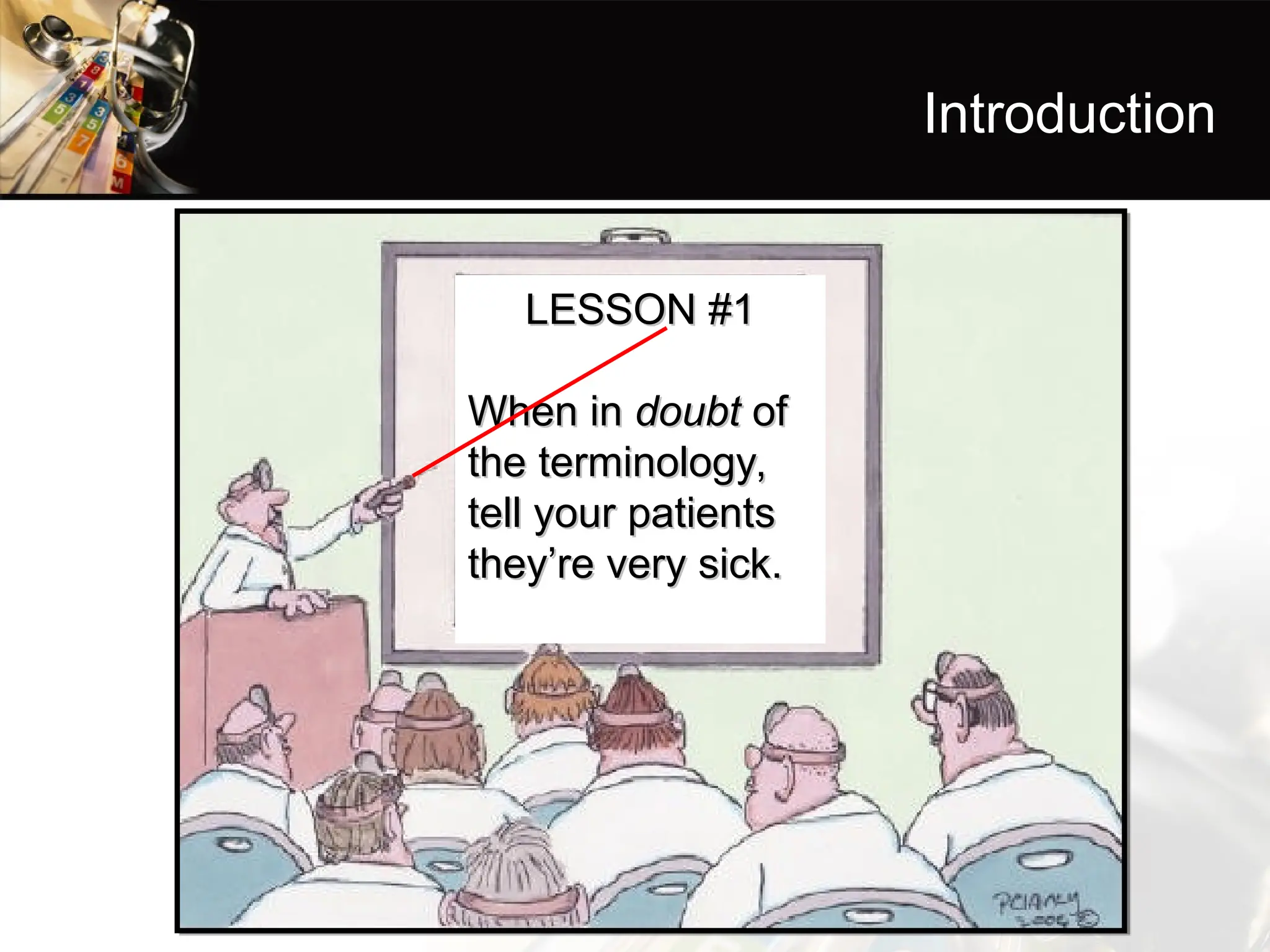
LESSON #1
LESSON #1
When in
When in doubt
doubt of
of
the terminology,
the terminology,
tell your patients
tell your patients
they’re very sick.
they’re very sick.
MEDICAL TERMINOLOGY
• The words – or terms – which make up the language
of medicine are referred to as the terminology of the
medical field…known as medical terminology.
• Like every other language, medical terminology has
changed over time and will continue to change.
• Most medical terms come from the Greek and Latin
languages.
3
3
How It Works
Most medical terms can be broken down into parts like a
sentence.
Common word parts/components:
 Prefixes / Roots or Words / Suffixes
Prefixes / Roots or Words / Suffixes
Linking or combining vowel usually “o”, but occasionally
“e” or “i”.
The medical terms will contain one or more of these
components.
4
4
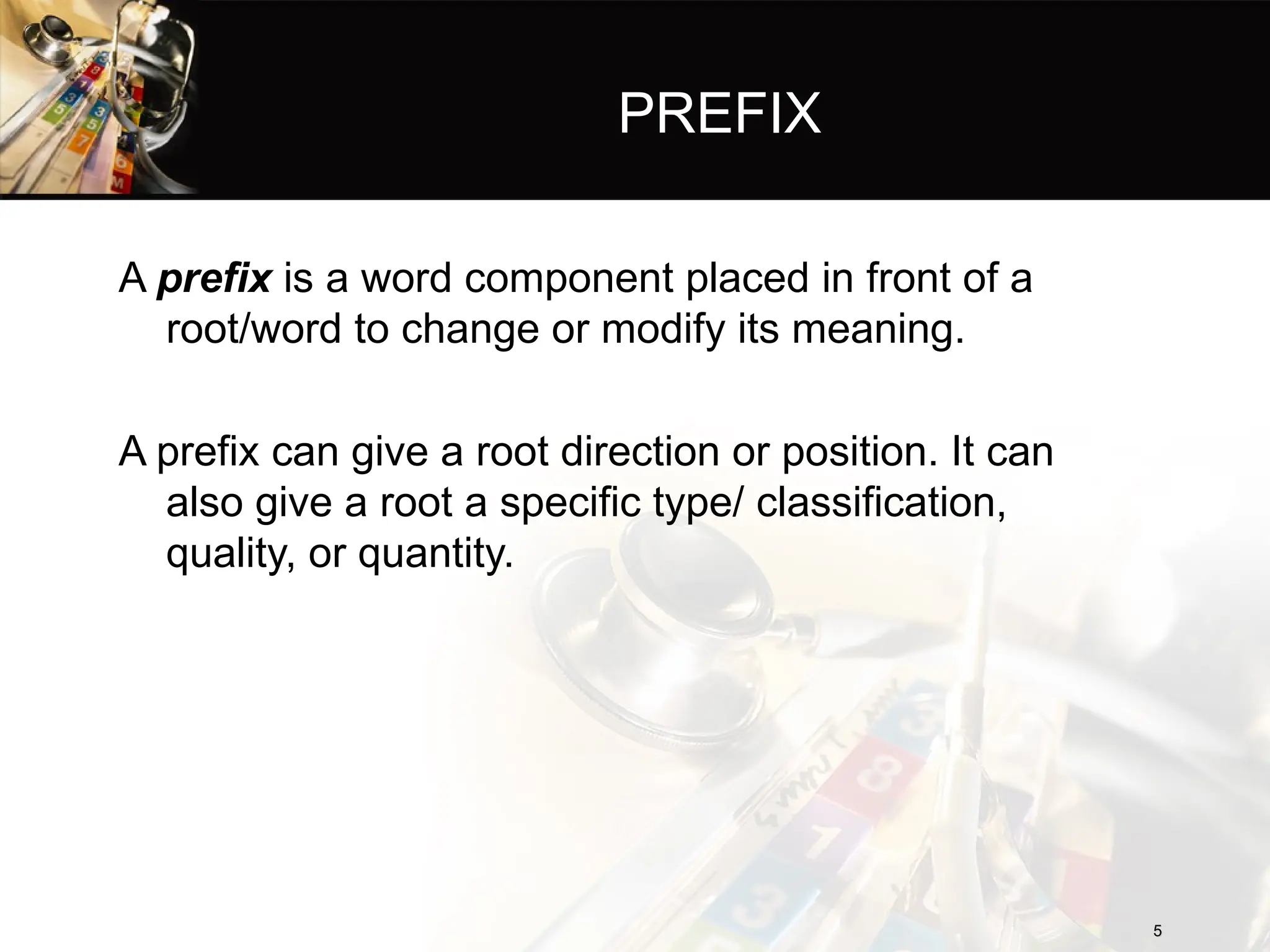
PREFIX
A prefix is a word component placed in front of a
root/word to change or modify its meaning.
A prefix can give a root direction or position. It can
also give a root a specific type/ classification,
quality, or quantity.
5
5
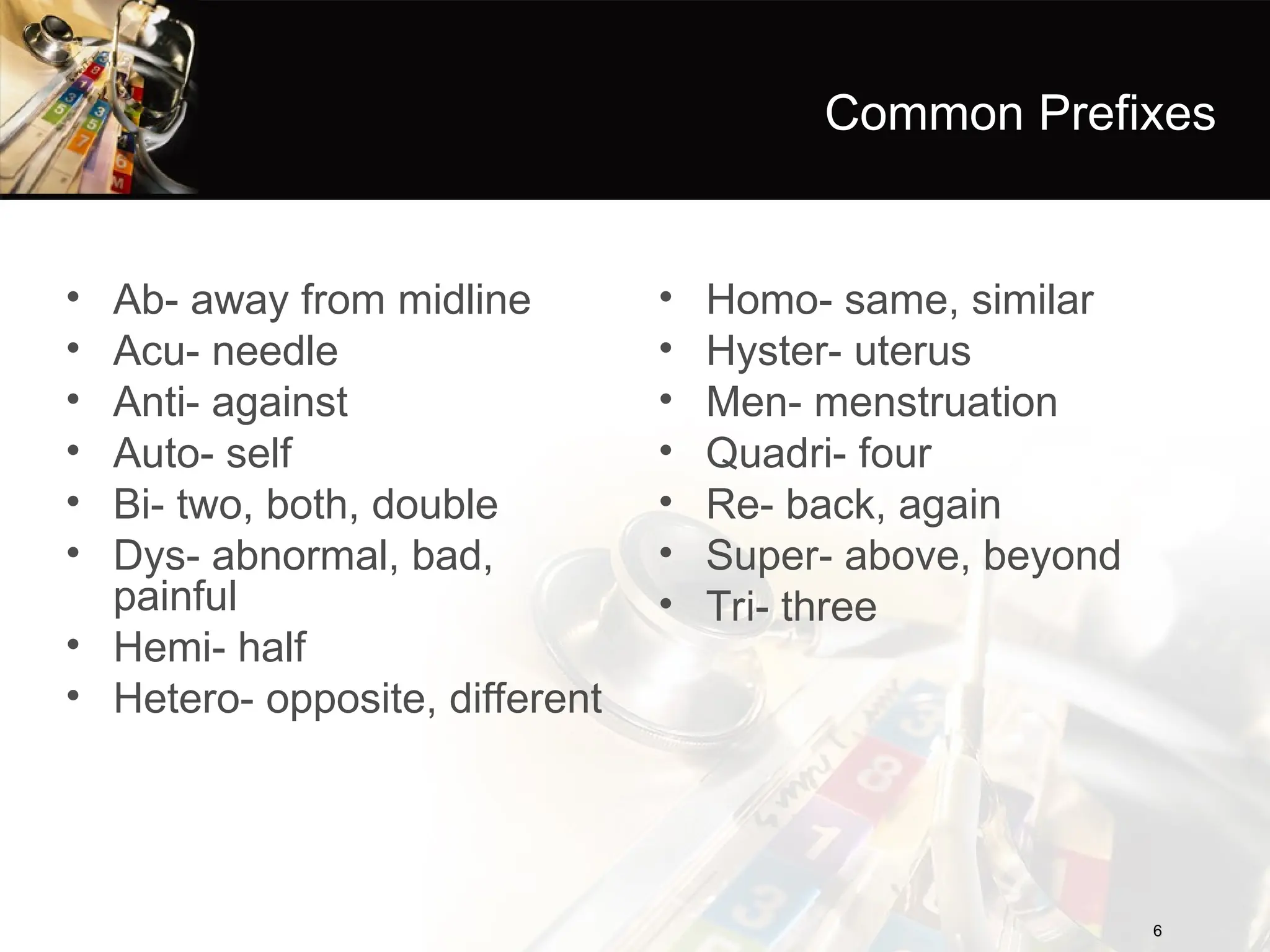
Common Prefixes
• Ab- away from midline
• Acu- needle
• Anti- against
• Auto- self
• Bi- two, both, double
• Dys- abnormal, bad,
painful
• Hemi- half
• Hetero- opposite, different
6
6
• Homo- same, similar
• Hyster- uterus
• Men- menstruation
• Quadri- four
• Re- back, again
• Super- above, beyond
• Tri- three
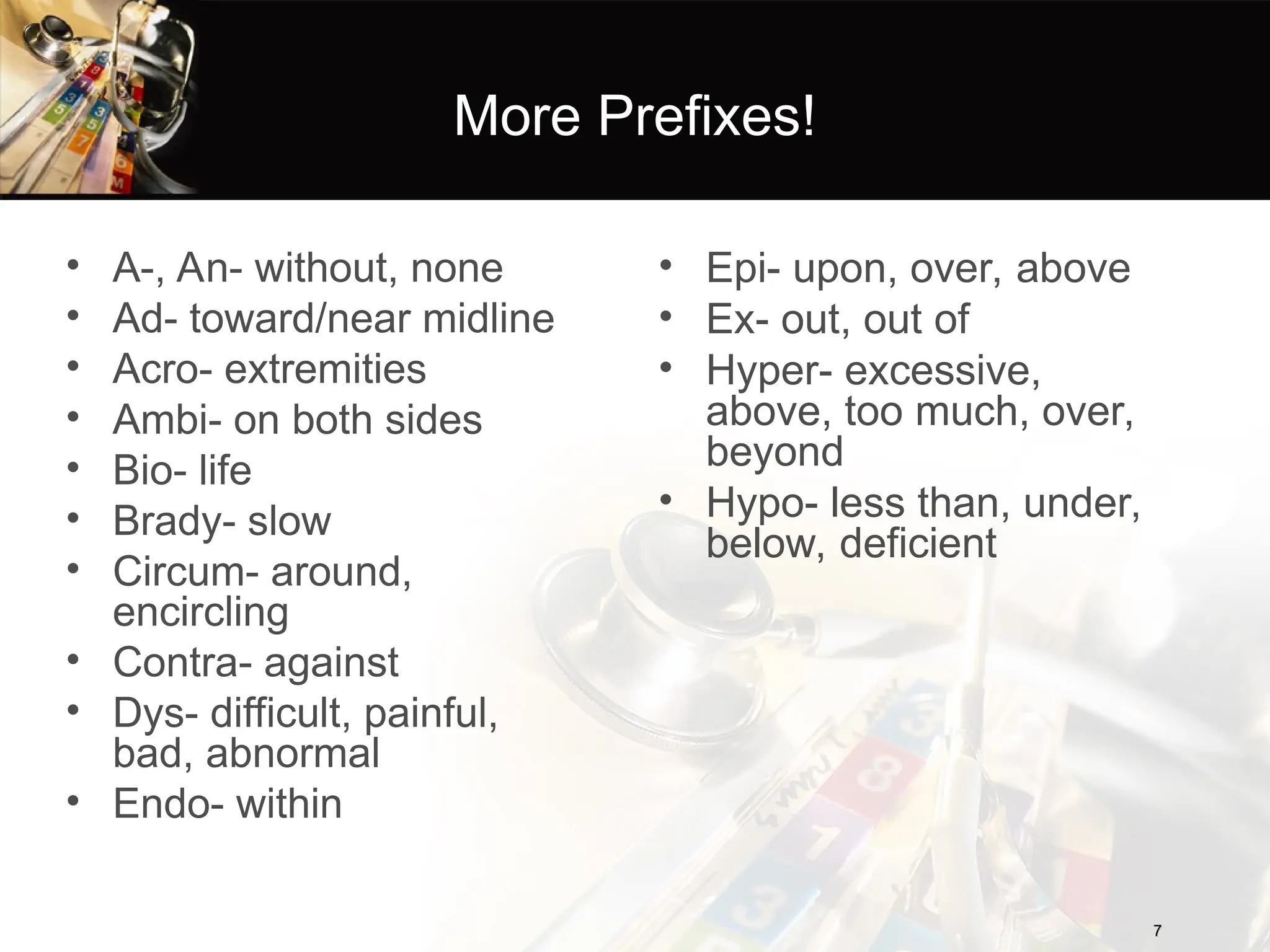
More Prefixes!
• A-, An- without, none
• Ad- toward/near midline
• Acro- extremities
• Ambi- on both sides
• Bio- life
• Brady- slow
• Circum- around,
encircling
• Contra- against
• Dys- difficult, painful,
bad, abnormal
• Endo- within
7
7
• Epi- upon, over, above
• Ex- out, out of
• Hyper- excessive,
above, too much, over,
beyond
• Hypo- less than, under,
below, deficient
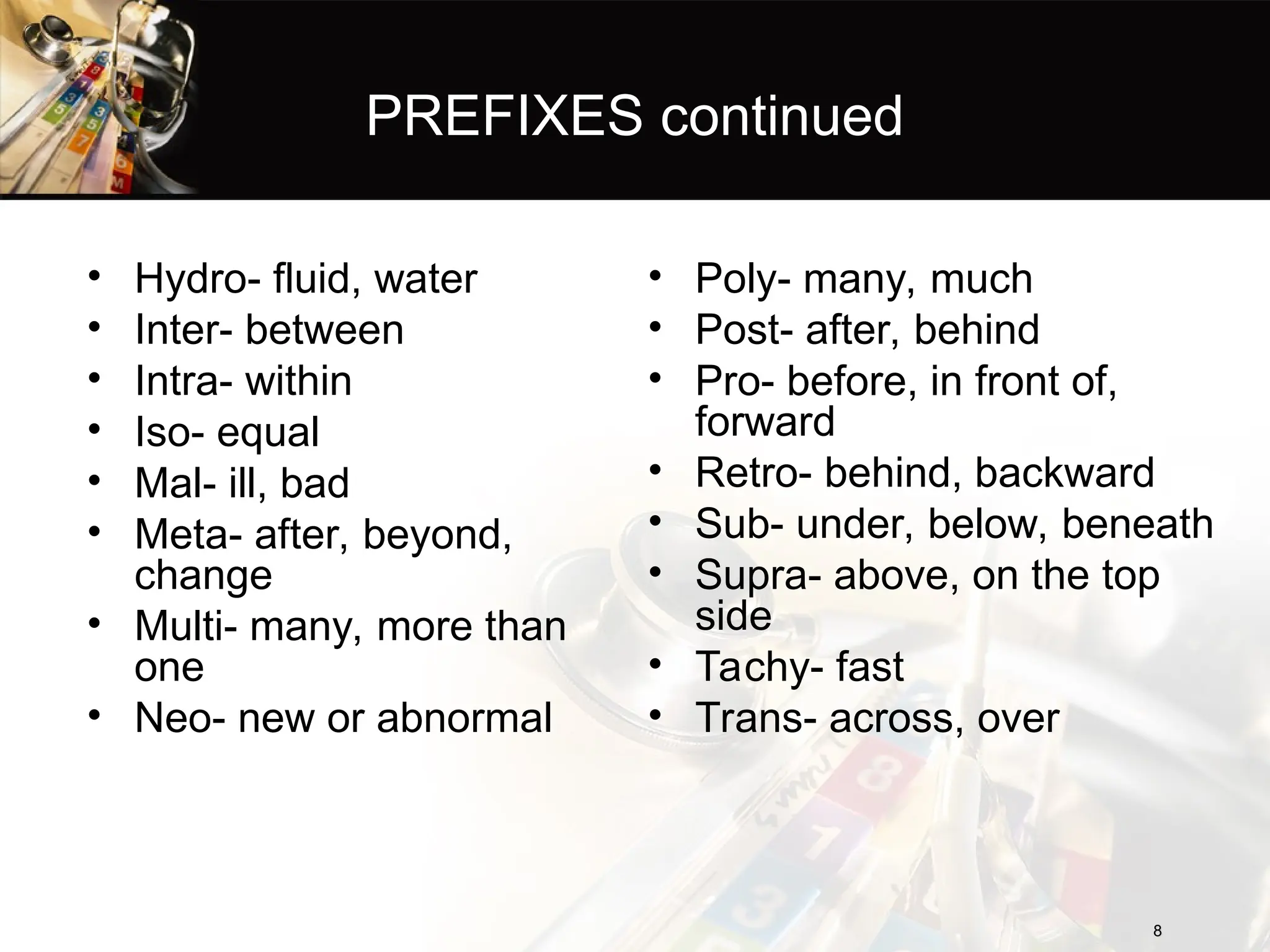
PREFIXES continued
• Hydro- fluid, water
• Inter- between
• Intra- within
• Iso- equal
• Mal- ill, bad
• Meta- after, beyond,
change
• Multi- many, more than
one
• Neo- new or abnormal
8
8
• Poly- many, much
• Post- after, behind
• Pro- before, in front of,
forward
• Retro- behind, backward
• Sub- under, below, beneath
• Supra- above, on the top
side
• Tachy- fast
• Trans- across, over
SUFFIX
A suffix is a word component added to the end of
a root/word that changes or modifies its usage,
function, or meaning.
9
9
SUFFIXES: Surgical Procedures
-centesis – to puncture/tap to draw fluid from
-desis – surgical fixation, fusion
-ectomy – excision, removal, cut out
-pexy - fixation
-plasty – surgical repair, correction
-rrhaphy – suture
-sect – to cut
-stomy – forming a new opening
-tome – instrument for cutting
-tomy – incision into, cut into
-tripsy – to crush, break down
-puncture – to pierce a surface
10
10
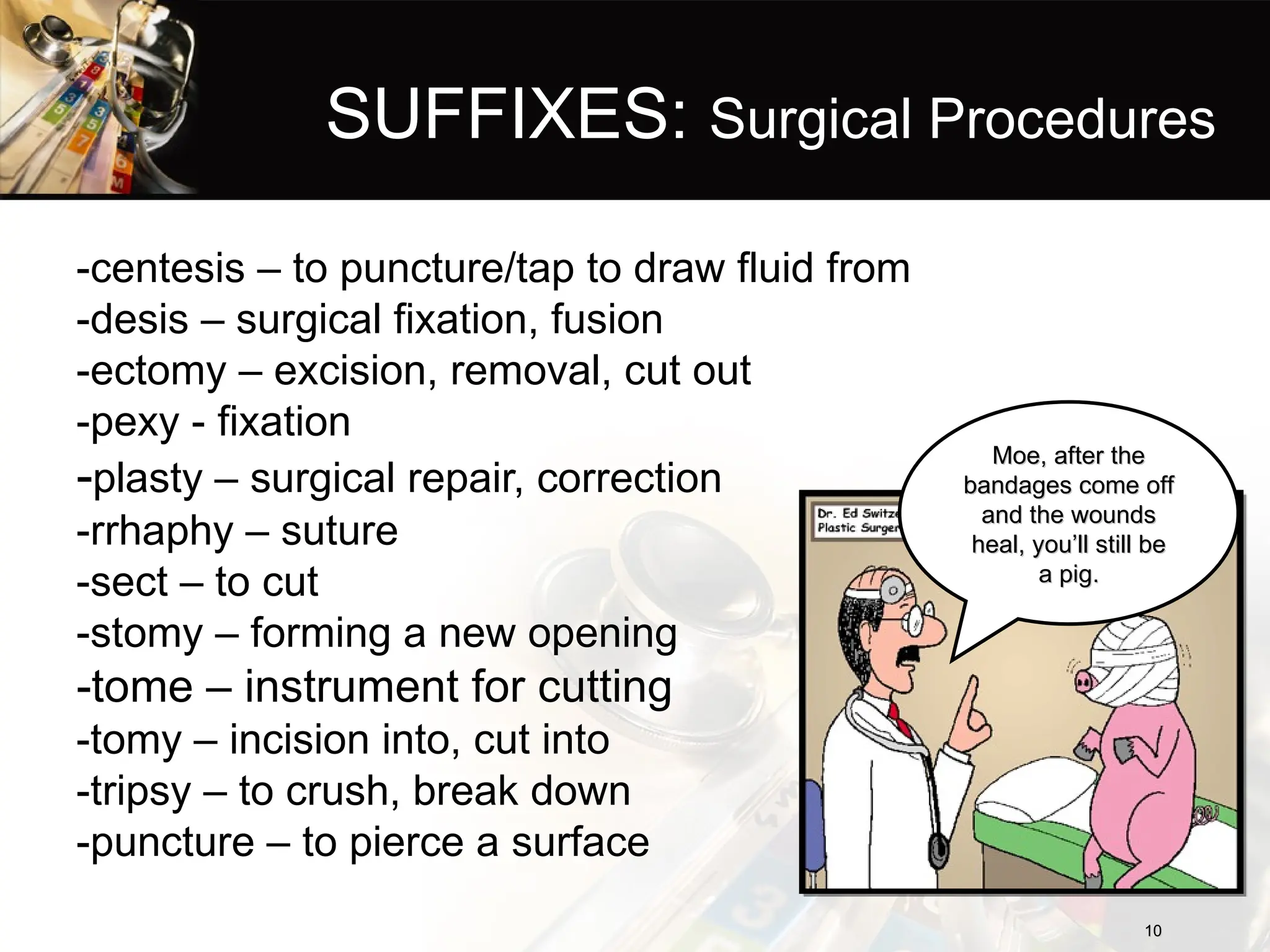
Moe, after the
Moe, after the
bandages come off
bandages come off
and the wounds
and the wounds
heal, you’ll still be
a pig.
a pig.
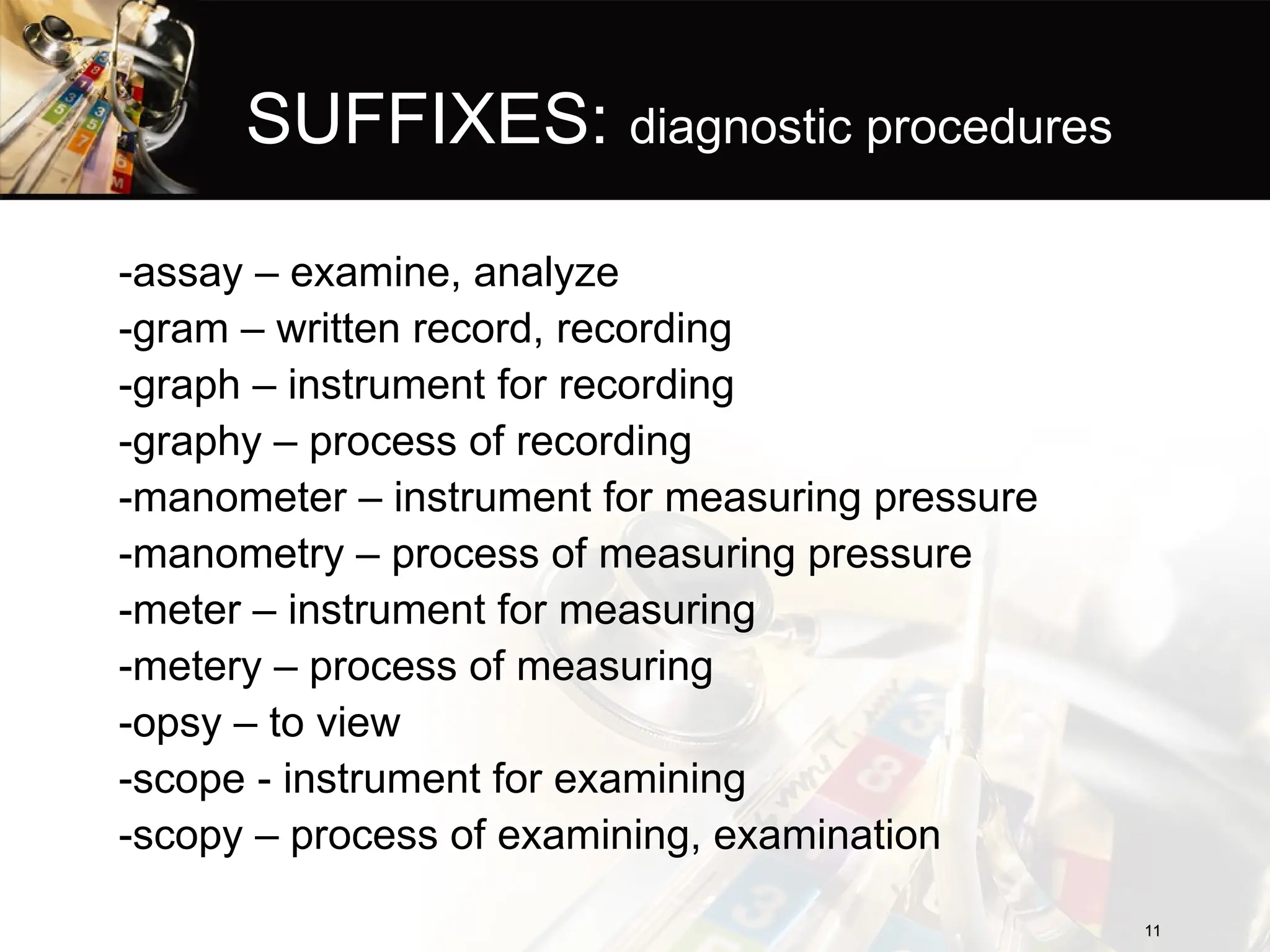
SUFFIXES: diagnostic procedures
-assay – examine, analyze
-gram – written record, recording
-graph – instrument for recording
-graphy – process of recording
-manometer – instrument for measuring pressure
-manometry – process of measuring pressure
-meter – instrument for measuring
-metery – process of measuring
-opsy – to view
-scope - instrument for examining
-scopy – process of examining, examination
11
11
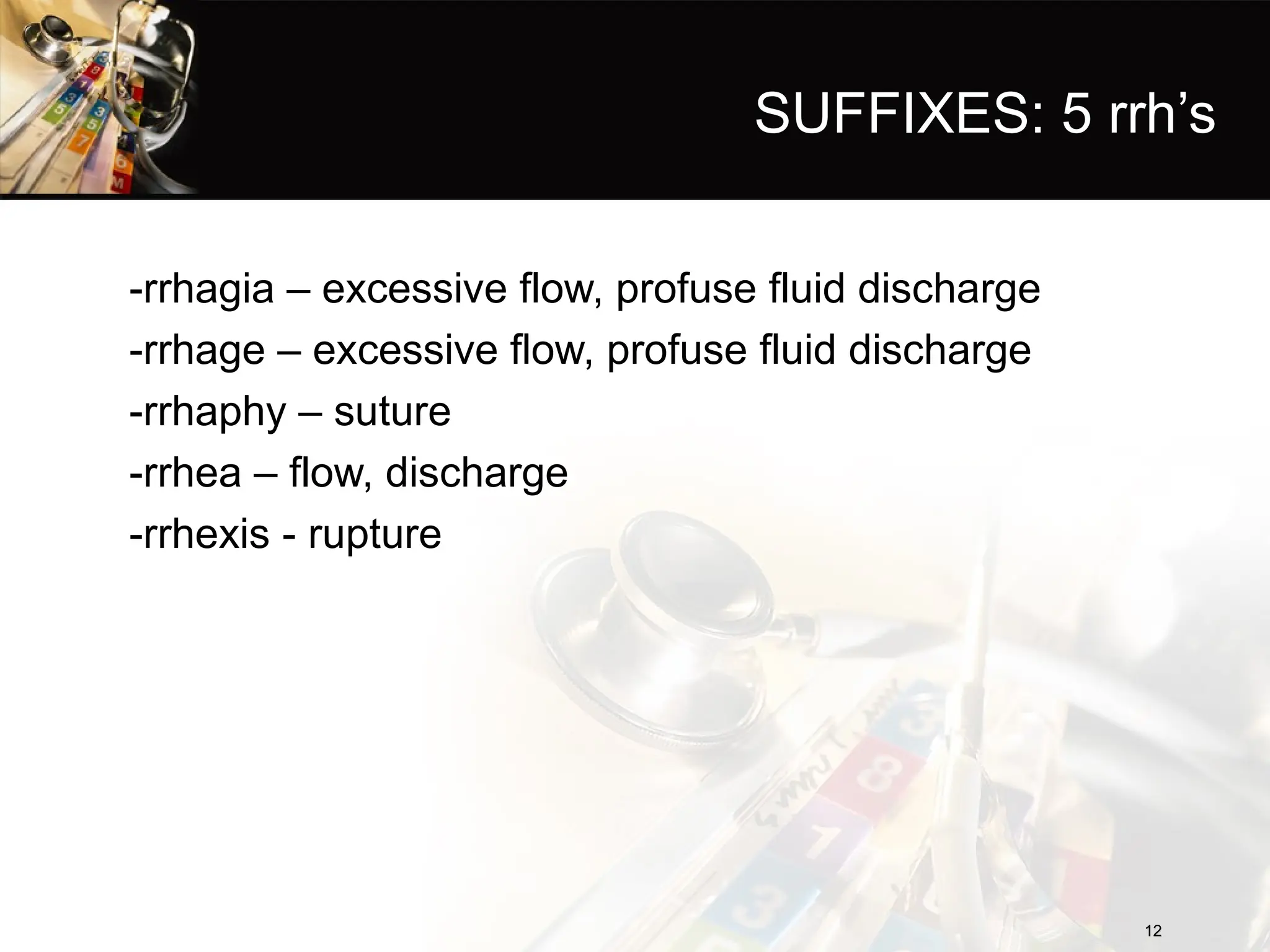
SUFFIXES: 5 rrh’s
-rrhagia – excessive flow, profuse fluid discharge
-rrhage – excessive flow, profuse fluid discharge
-rrhaphy – suture
-rrhea – flow, discharge
-rrhexis - rupture
12
12
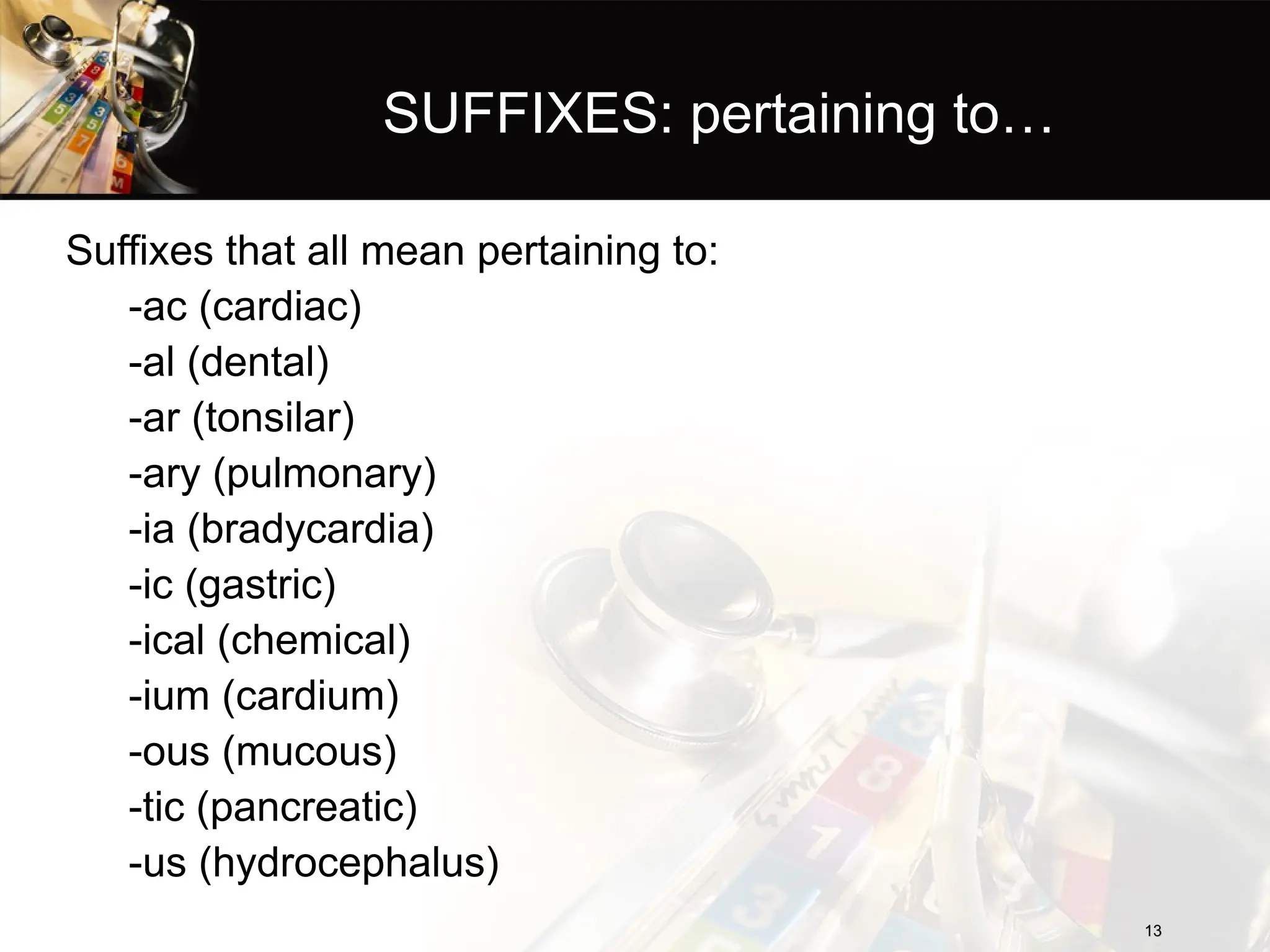
SUFFIXES: pertaining to…
Suffixes that all mean pertaining to:
-ac (cardiac)
-al (dental)
-ar (tonsilar)
-ary (pulmonary)
-ia (bradycardia)
-ic (gastric)
-ical (chemical)
-ium (cardium)
-ous (mucous)
-tic (pancreatic)
-us (hydrocephalus)
13
13
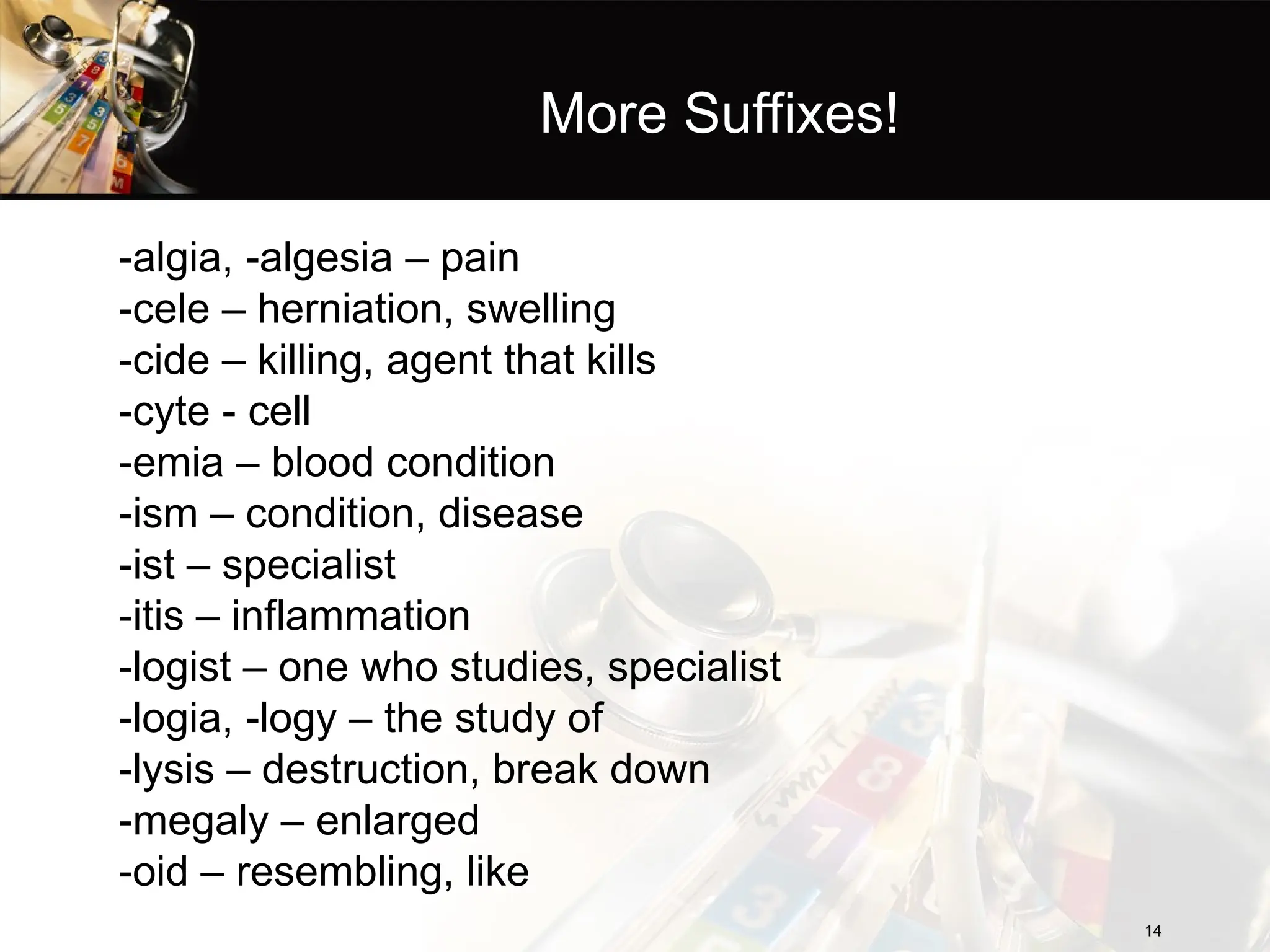
More Suffixes!
-algia, -algesia – pain
-cele – herniation, swelling
-cide – killing, agent that kills
-cyte - cell
-emia – blood condition
-ism – condition, disease
-ist – specialist
-itis – inflammation
-logist – one who studies, specialist
-logia, -logy – the study of
-lysis – destruction, break down
-megaly – enlarged
-oid – resembling, like
14
14
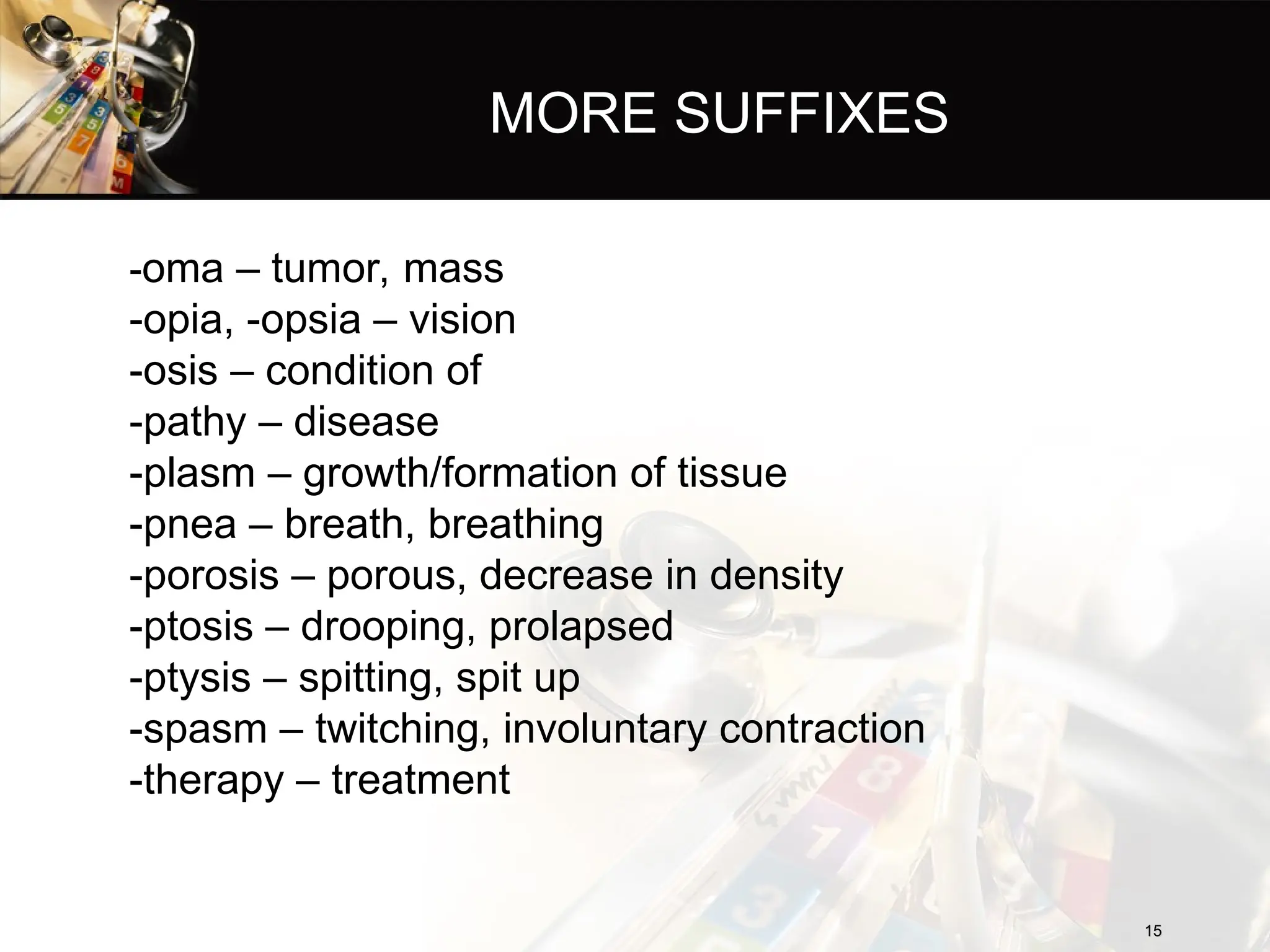
MORE SUFFIXES
-oma – tumor, mass
-opia, -opsia – vision
-osis – condition of
-pathy – disease
-plasm – growth/formation of tissue
-pnea – breath, breathing
-porosis – porous, decrease in density
-ptosis – drooping, prolapsed
-ptysis – spitting, spit up
-spasm – twitching, involuntary contraction
-therapy – treatment
15
15
ROOT
A root is the basic element of a word, and it is the
foundation on which the meaning of a word is built.
Many roots are real words in their own right and
term. Although these roots can have other elements,
they don't need other elements to be complete.
A root can be a whole word or a part of a word. Roots
come from many different languages, mainly Greek and
Latin, and find their way into English.
16
16
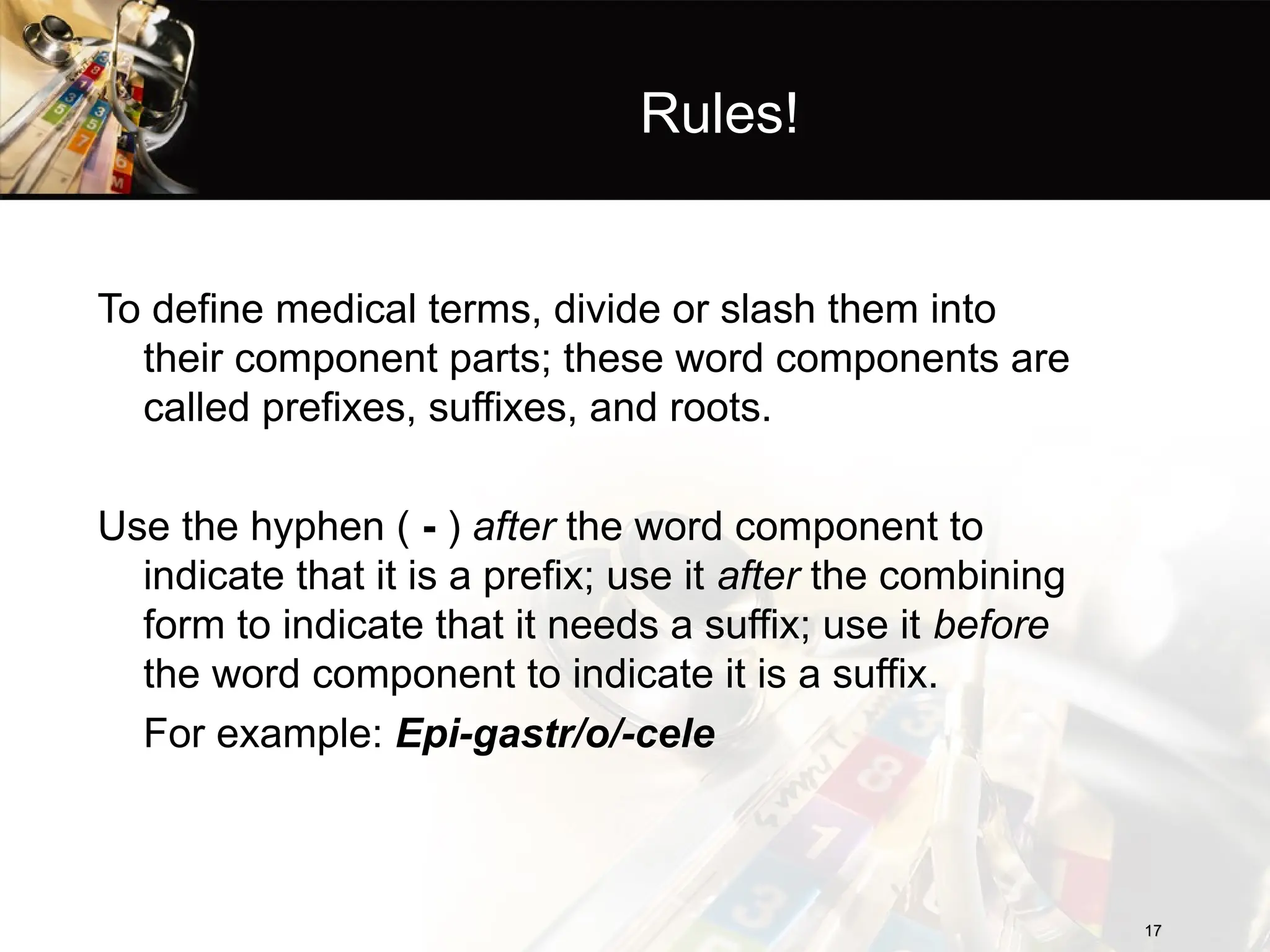
Rules!
To define medical terms, divide or slash them into
their component parts; these word components are
called prefixes, suffixes, and roots.
Use the hyphen ( - ) after the word component to
indicate that it is a prefix; use it after the combining
form to indicate that it needs a suffix; use it before
the word component to indicate it is a suffix.
For example: Epi-gastr/o/-cele
17
17
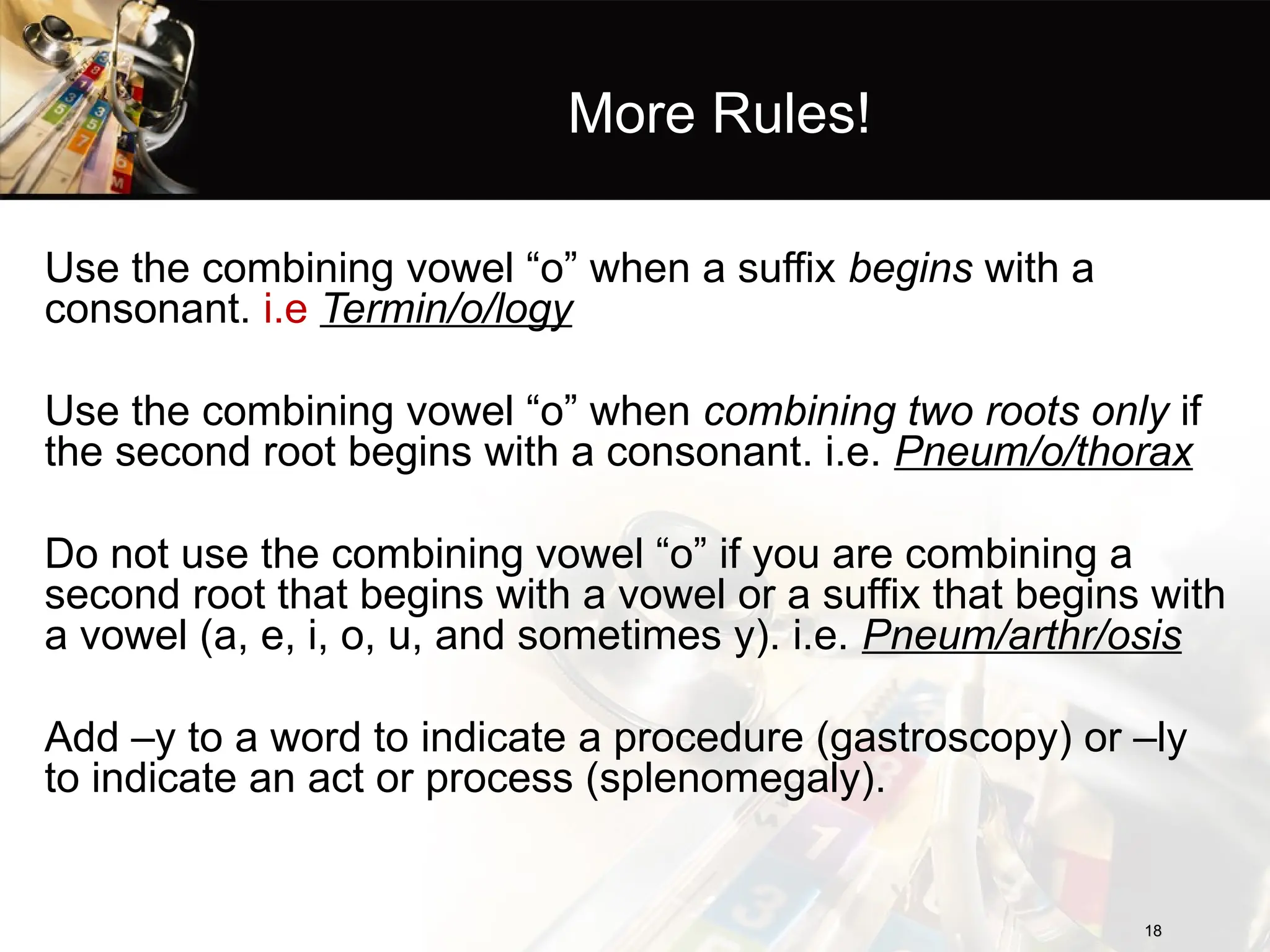
More Rules!
Use the combining vowel “o” when a suffix begins with a
consonant. i.e Termin/o/logy
Use the combining vowel “o” when combining two roots only if
the second root begins with a consonant. i.e. Pneum/o/thorax
Do not use the combining vowel “o” if you are combining a
second root that begins with a vowel or a suffix that begins with
a vowel (a, e, i, o, u, and sometimes y). i.e. Pneum/arthr/osis
Add –y to a word to indicate a procedure (gastroscopy) or –ly
to indicate an act or process (splenomegaly).
18
18
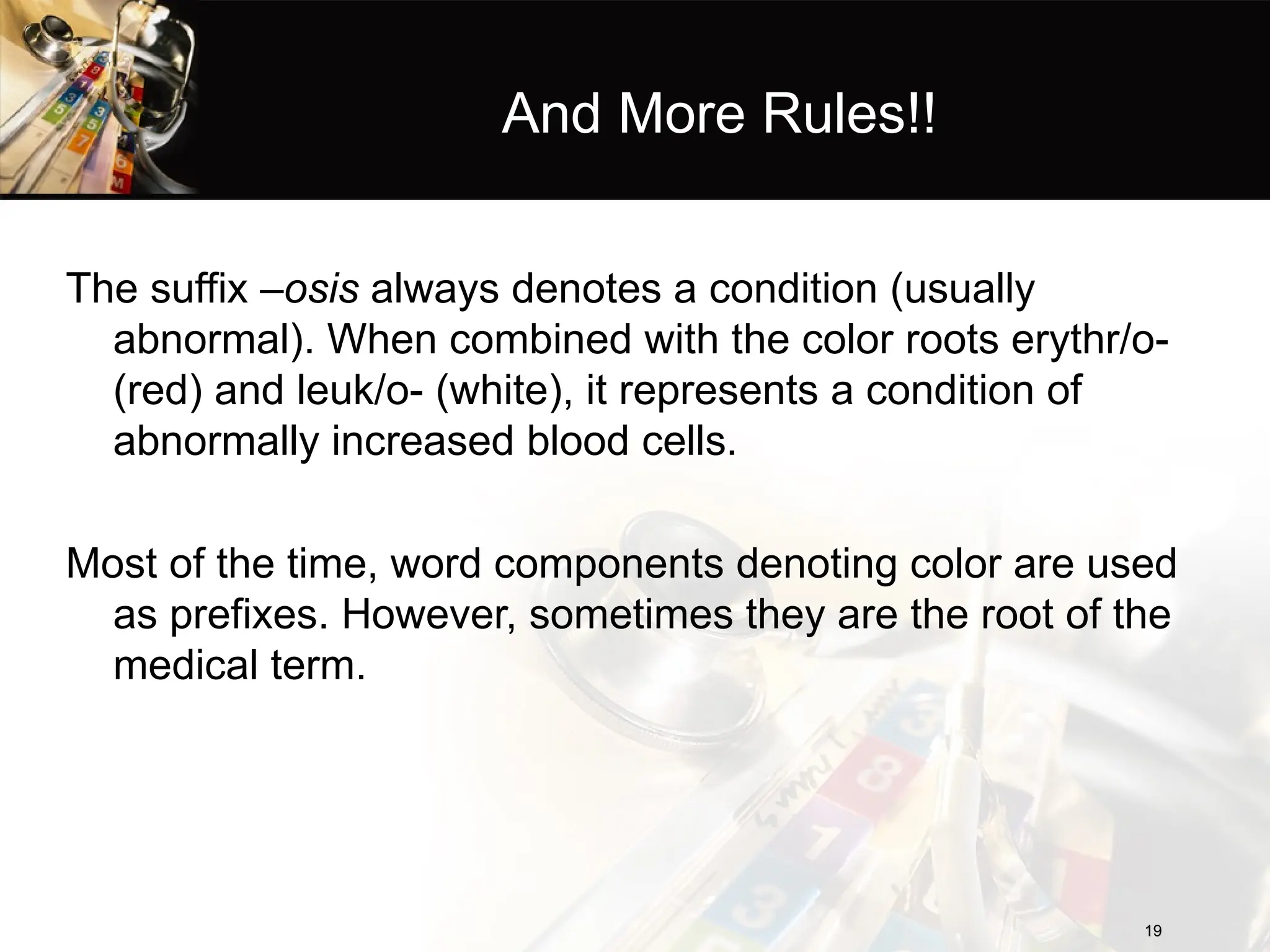
And More Rules!!
The suffix –osis always denotes a condition (usually
abnormal). When combined with the color roots erythr/o-
(red) and leuk/o- (white), it represents a condition of
abnormally increased blood cells.
Most of the time, word components denoting color are used
as prefixes. However, sometimes they are the root of the
medical term.
19
19
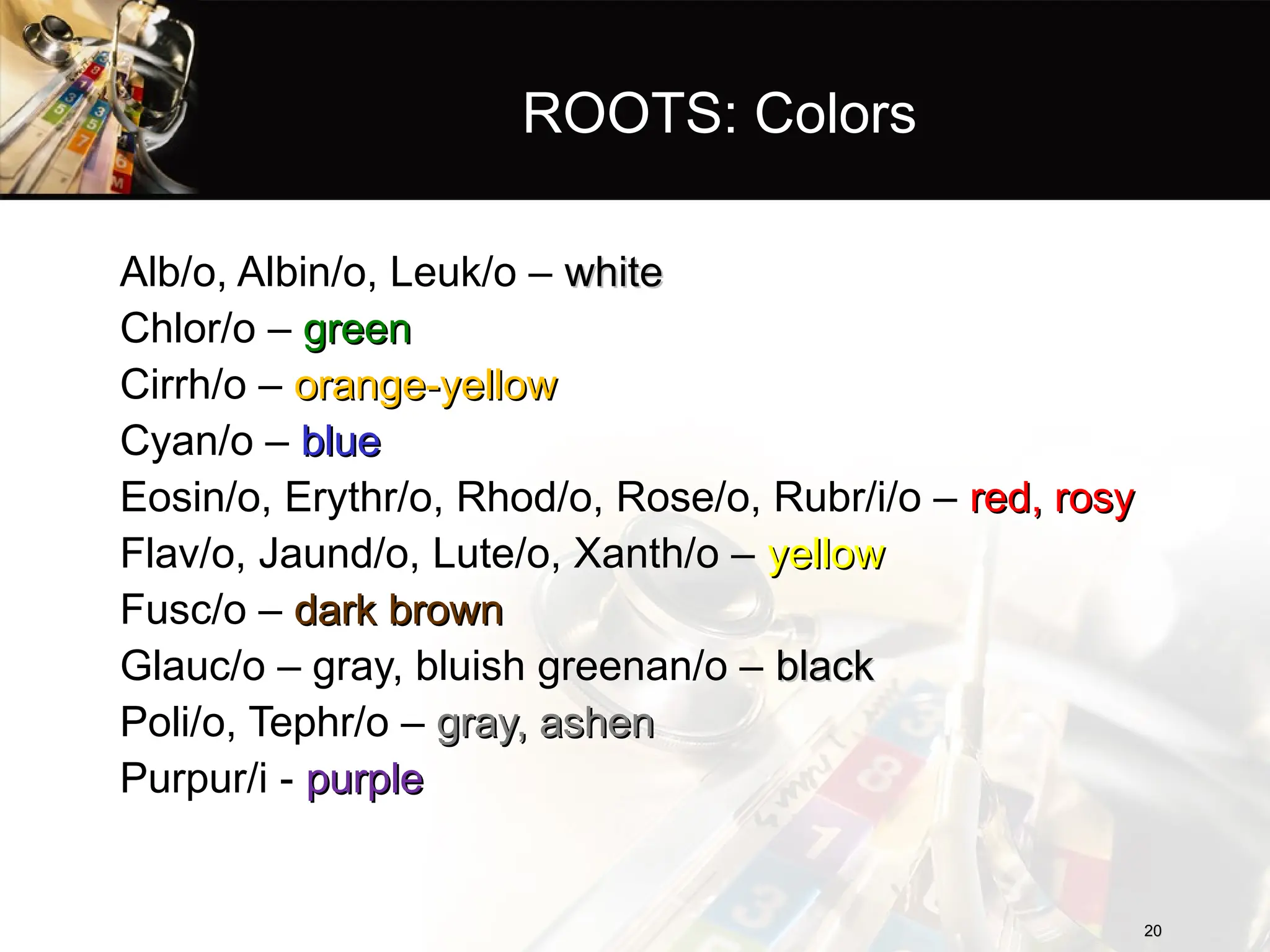
ROOTS: Colors
Alb/o, Albin/o, Leuk/o – white
white
Chlor/o – green
green
Cirrh/o – orange-yellow
orange-yellow
Cyan/o – blue
blue
Eosin/o, Erythr/o, Rhod/o, Rose/o, Rubr/i/o – red, rosy
red, rosy
Flav/o, Jaund/o, Lute/o, Xanth/o – yellow
yellow
Fusc/o – dark brown
dark brown
Glauc/o – gray, bluish greenan/o – black
black
Poli/o, Tephr/o – gray, ashen
gray, ashen
Purpur/i - purple
purple
20
20
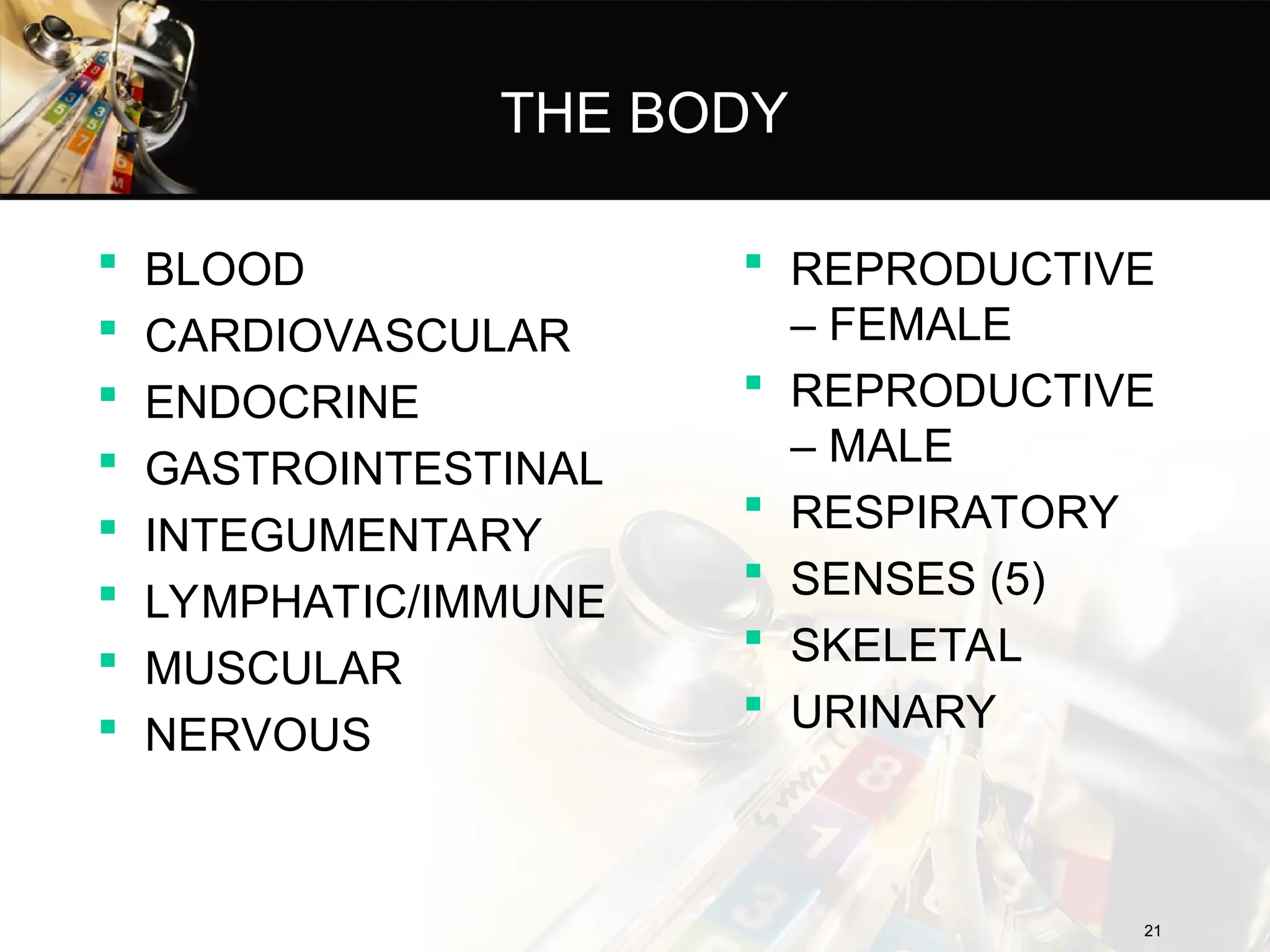
THE BODY
 BLOOD
 CARDIOVASCULAR
 ENDOCRINE
 GASTROINTESTINAL
 INTEGUMENTARY
 LYMPHATIC/IMMUNE
 MUSCULAR
 NERVOUS
 REPRODUCTIVE
– FEMALE
 REPRODUCTIVE
– MALE
 RESPIRATORY
 SENSES (5)
 SKELETAL
 URINARY
21
21
22
22
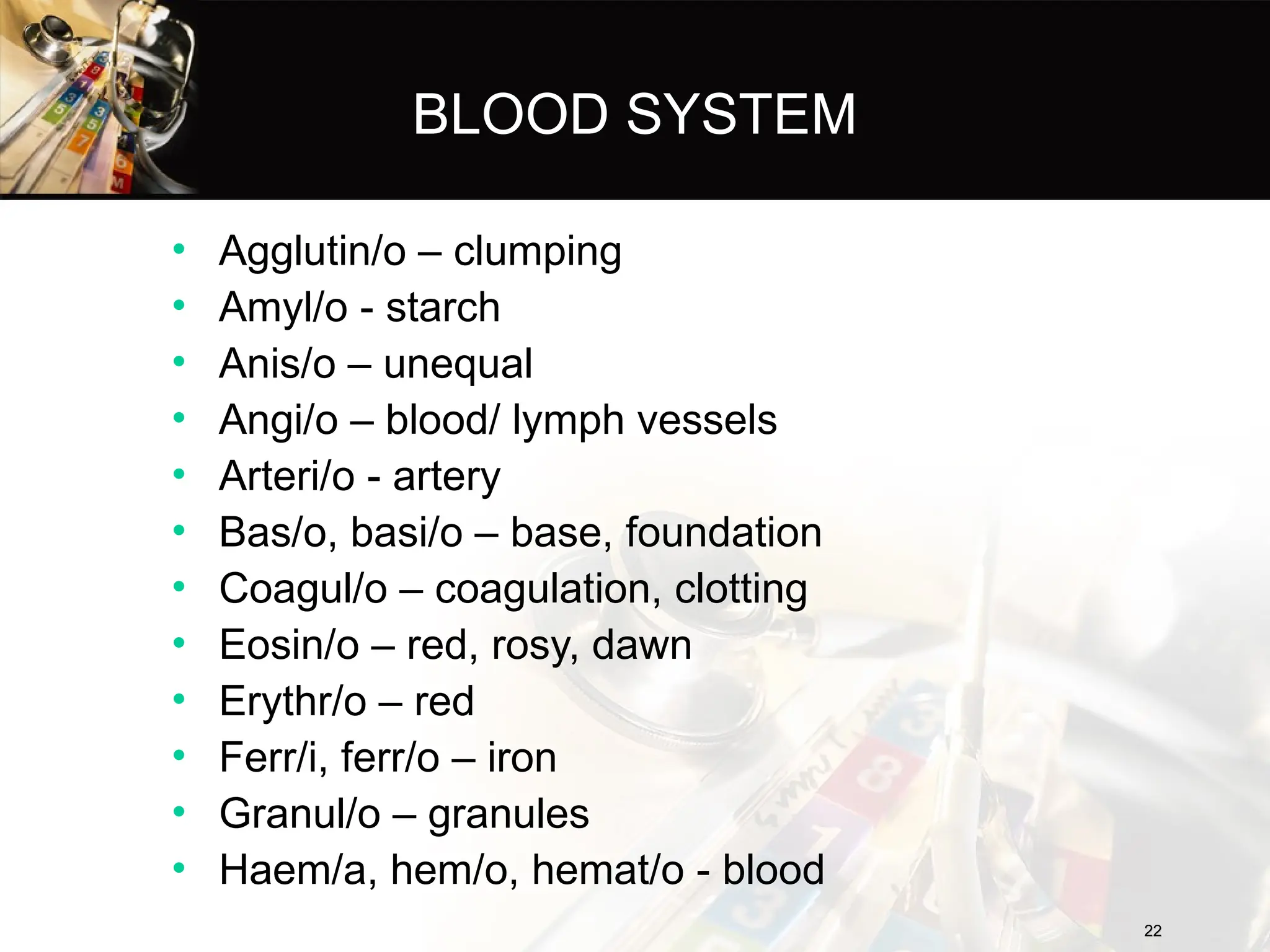
BLOOD SYSTEM
• Agglutin/o – clumping
• Amyl/o - starch
• Anis/o – unequal
• Angi/o – blood/ lymph vessels
• Arteri/o - artery
• Bas/o, basi/o – base, foundation
• Coagul/o – coagulation, clotting
• Eosin/o – red, rosy, dawn
• Erythr/o – red
• Ferr/i, ferr/o – iron
• Granul/o – granules
• Haem/a, hem/o, hemat/o - blood
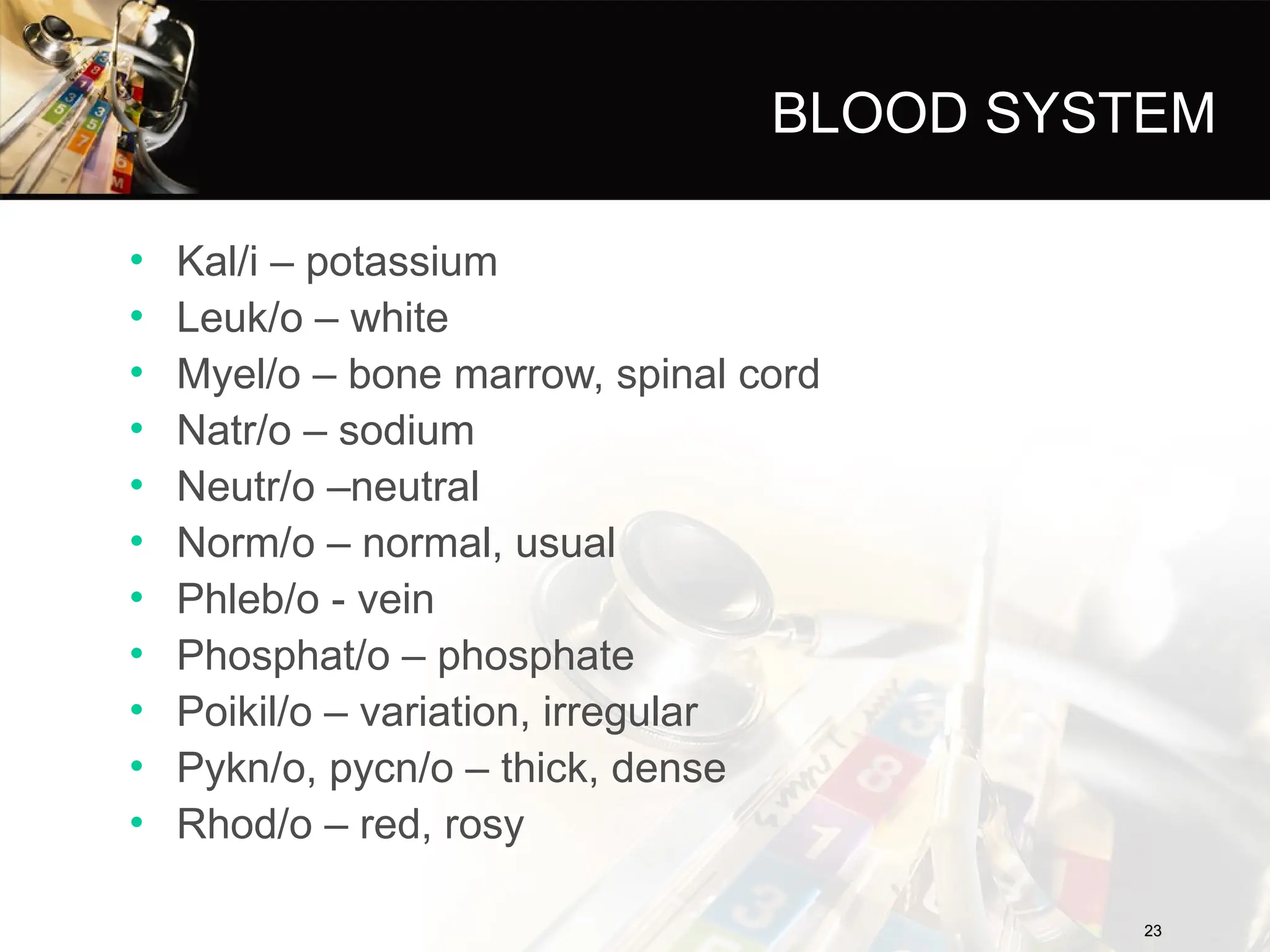
BLOOD SYSTEM
• Kal/i – potassium
• Leuk/o – white
• Myel/o – bone marrow, spinal cord
• Natr/o – sodium
• Neutr/o –neutral
• Norm/o – normal, usual
• Phleb/o - vein
• Phosphat/o – phosphate
• Poikil/o – variation, irregular
• Pykn/o, pycn/o – thick, dense
• Rhod/o – red, rosy
23
23
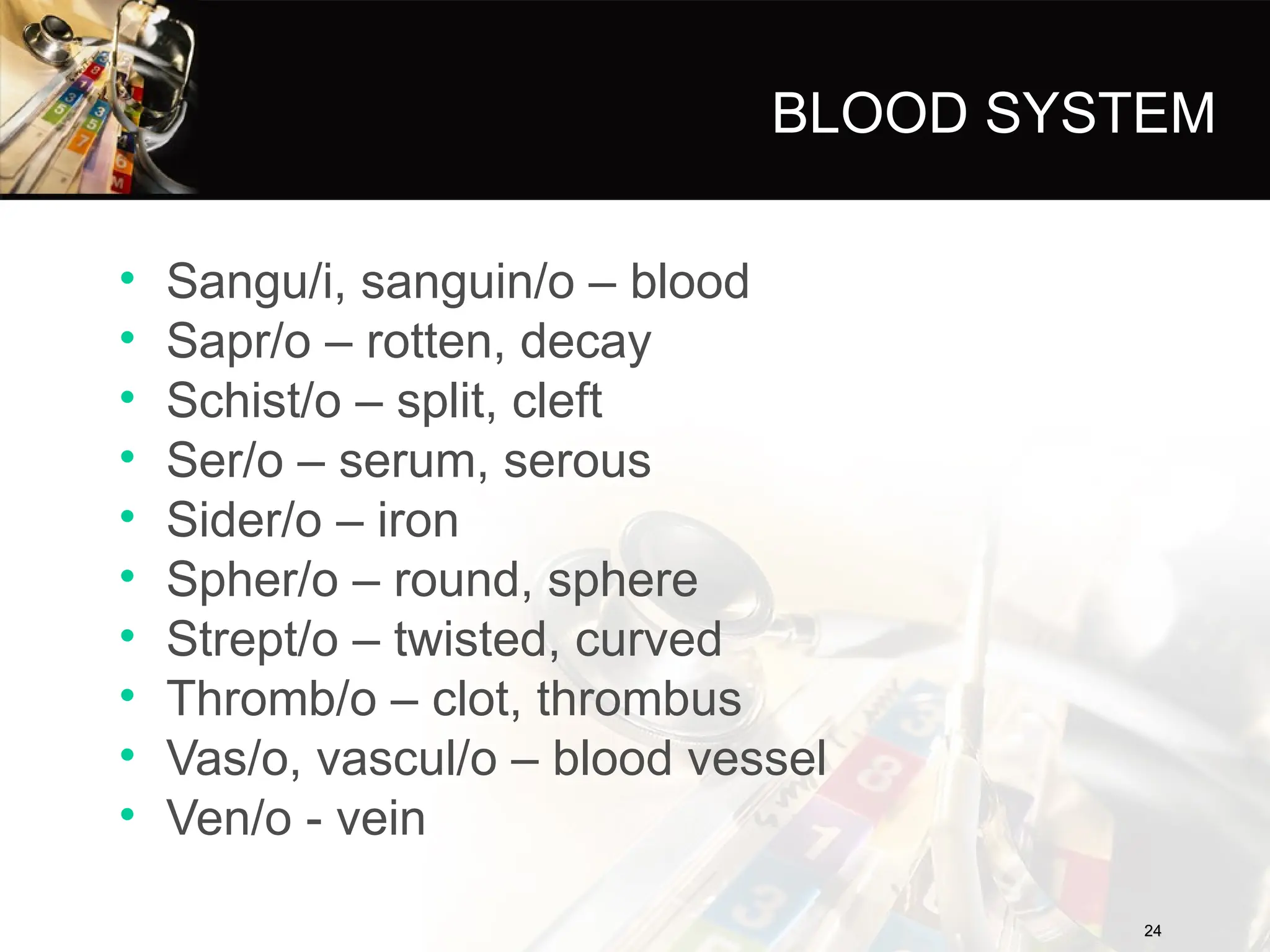
BLOOD SYSTEM
• Sangu/i, sanguin/o – blood
• Sapr/o – rotten, decay
• Schist/o – split, cleft
• Ser/o – serum, serous
• Sider/o – iron
• Spher/o – round, sphere
• Strept/o – twisted, curved
• Thromb/o – clot, thrombus
• Vas/o, vascul/o – blood vessel
• Ven/o - vein
24
24
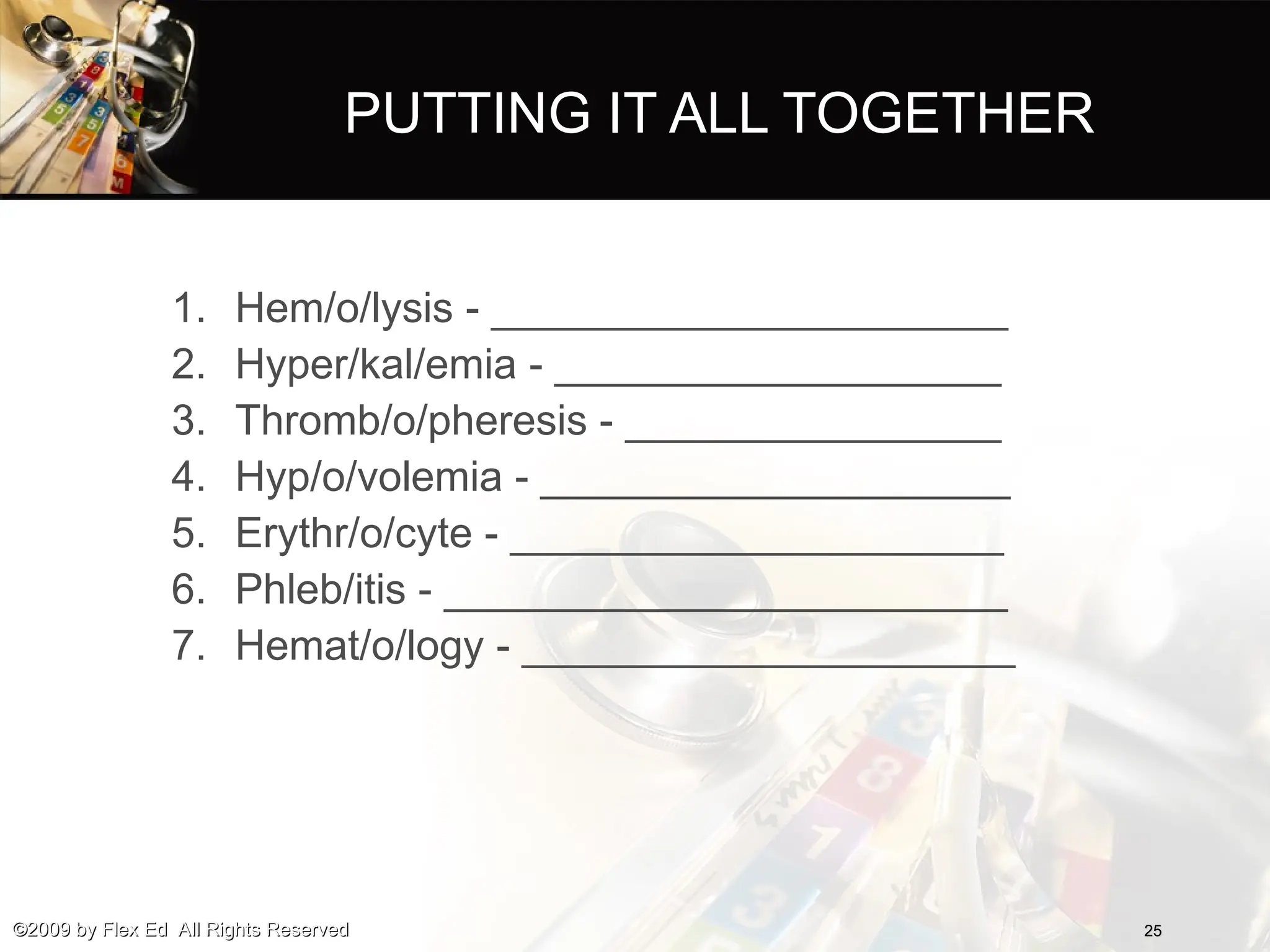
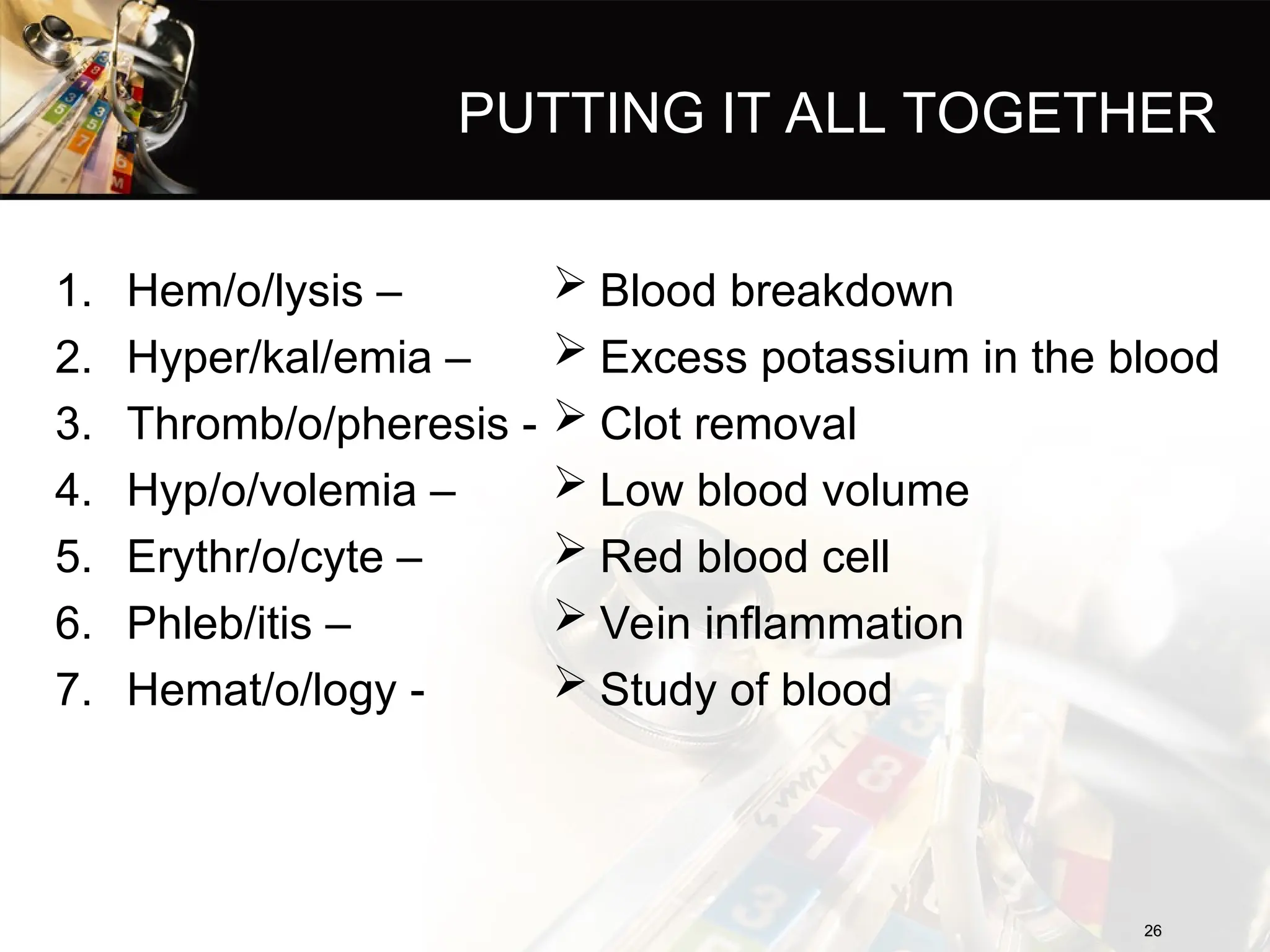
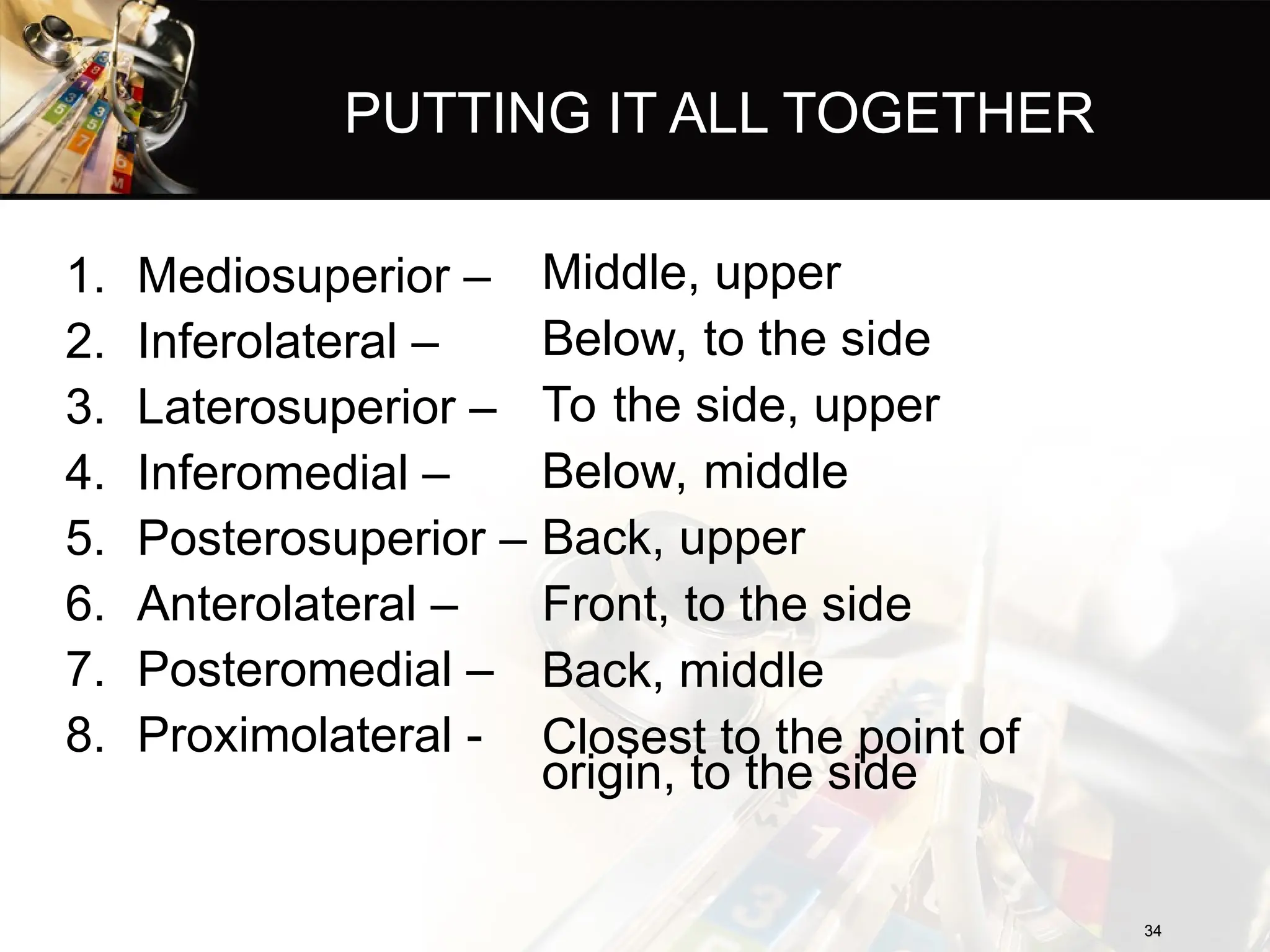
PUTTING IT ALL TOGETHER
1. Hem/o/lysis - ______________________
2. Hyper/kal/emia - ___________________
3. Thromb/o/pheresis - ________________
4. Hyp/o/volemia - ____________________
5. Erythr/o/cyte - _____________________
6. Phleb/itis - ________________________
7. Hemat/o/logy - _____________________
25
25
©2009 by Flex Ed All Rights Reserved
PUTTING IT ALL TOGETHER
1. Hem/o/lysis –
2. Hyper/kal/emia –
3. Thromb/o/pheresis -
4. Hyp/o/volemia –
5. Erythr/o/cyte –
6. Phleb/itis –
7. Hemat/o/logy -
 Blood breakdown
 Excess potassium in the blood
 Clot removal
 Low blood volume
 Red blood cell
 Vein inflammation
 Study of blood
26
26
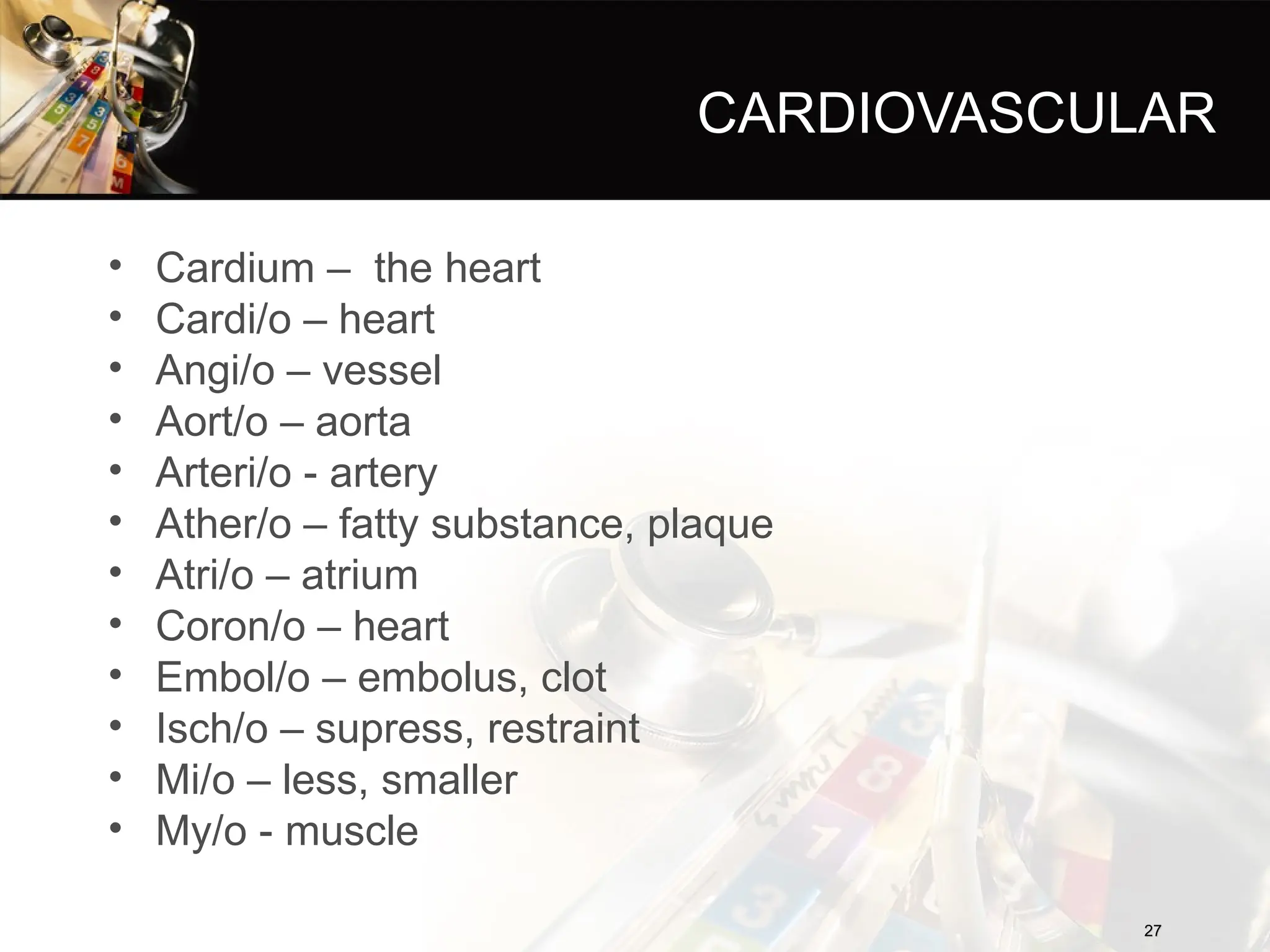
CARDIOVASCULAR
• Cardium – the heart
• Cardi/o – heart
• Angi/o – vessel
• Aort/o – aorta
• Arteri/o - artery
• Ather/o – fatty substance, plaque
• Atri/o – atrium
• Coron/o – heart
• Embol/o – embolus, clot
• Isch/o – supress, restraint
• Mi/o – less, smaller
• My/o - muscle
27
27
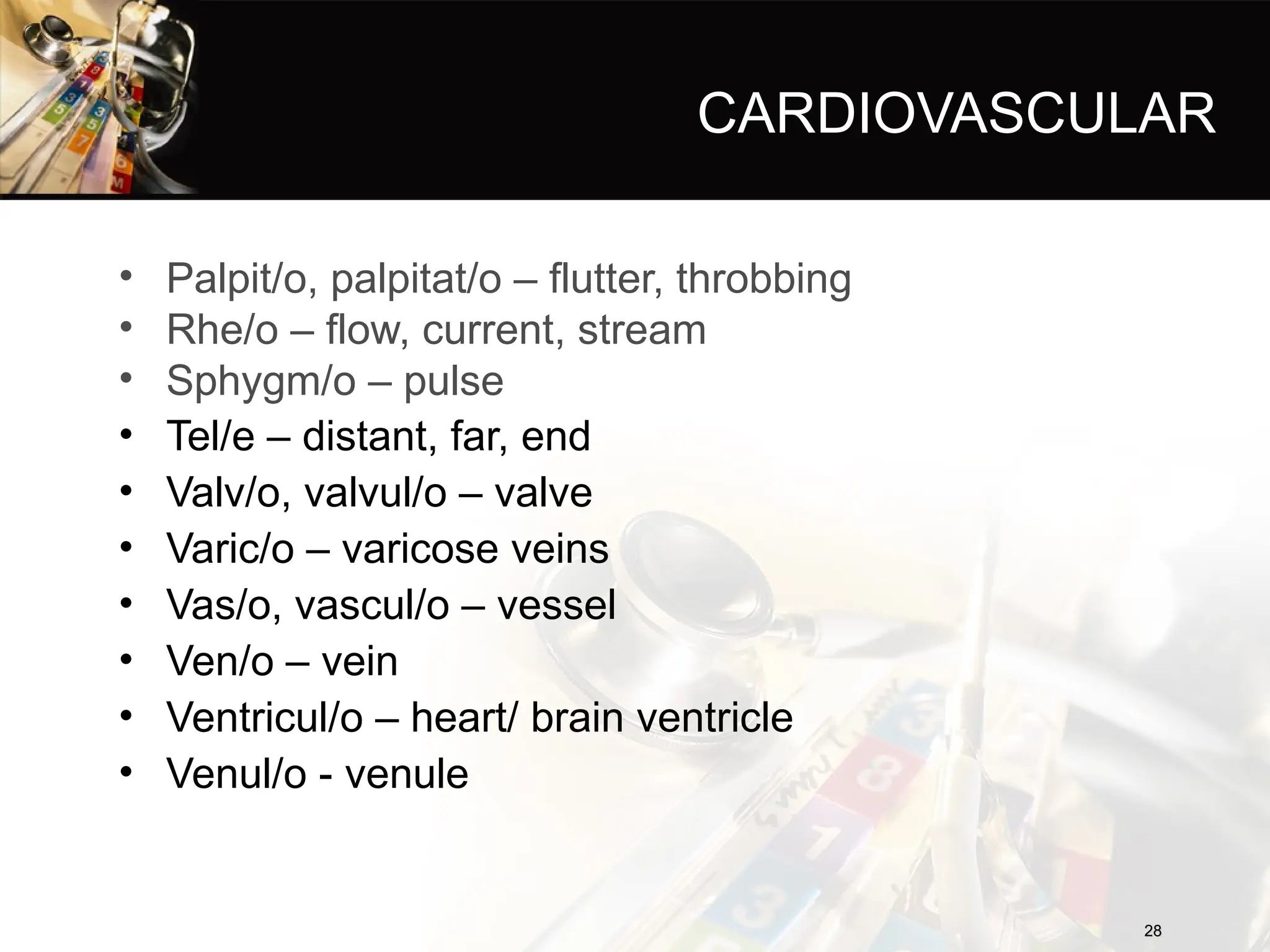
CARDIOVASCULAR
• Palpit/o, palpitat/o – flutter, throbbing
• Rhe/o – flow, current, stream
• Sphygm/o – pulse
• Tel/e – distant, far, end
• Valv/o, valvul/o – valve
• Varic/o – varicose veins
• Vas/o, vascul/o – vessel
• Ven/o – vein
• Ventricul/o – heart/ brain ventricle
• Venul/o - venule
28
28
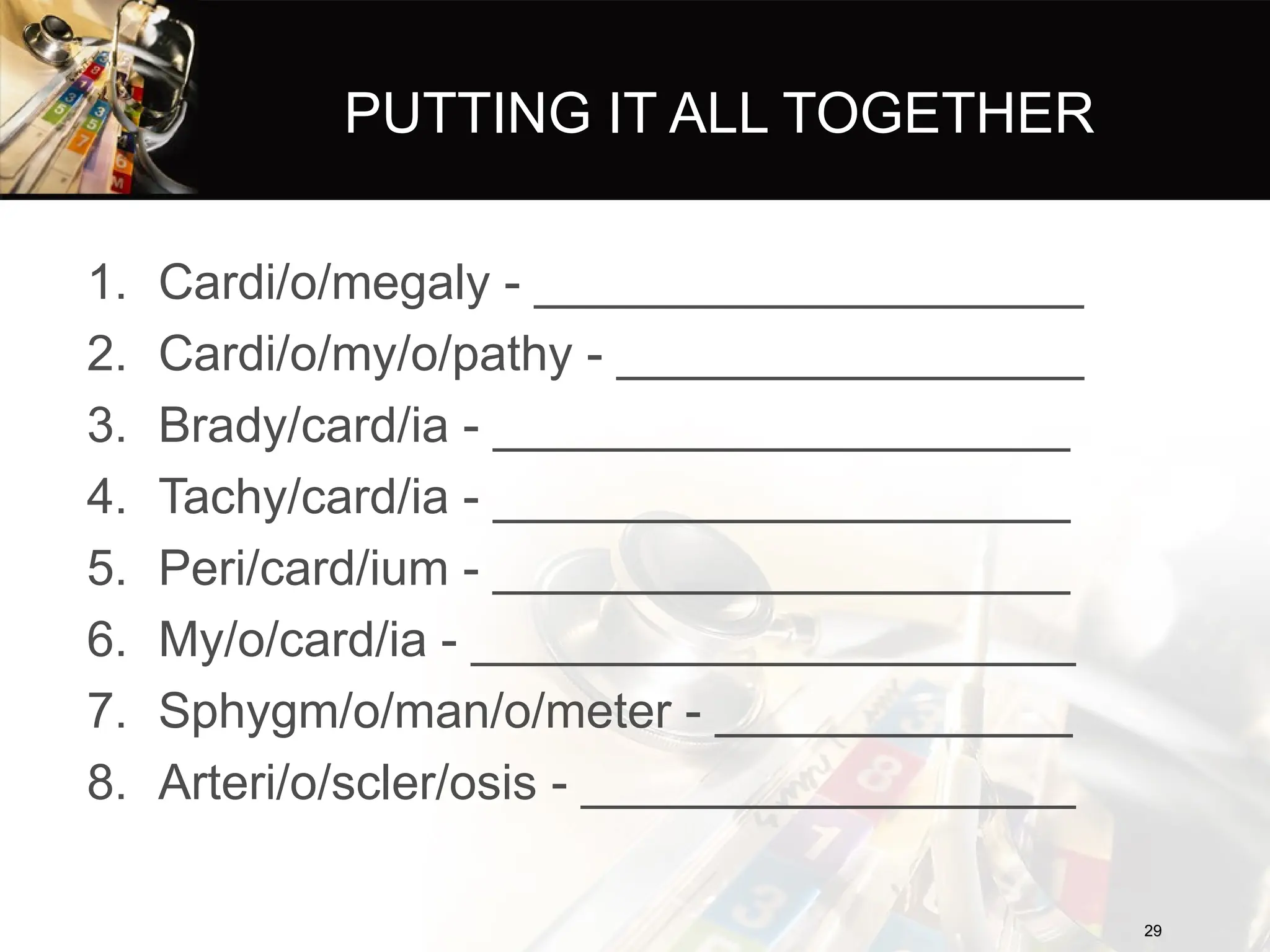
PUTTING IT ALL TOGETHER
1. Cardi/o/megaly - ____________________
2. Cardi/o/my/o/pathy - _________________
3. Brady/card/ia - _____________________
4. Tachy/card/ia - _____________________
5. Peri/card/ium - _____________________
6. My/o/card/ia - ______________________
7. Sphygm/o/man/o/meter - _____________
8. Arteri/o/scler/osis - __________________
29
29
PUTTING IT ALL TOGETHER
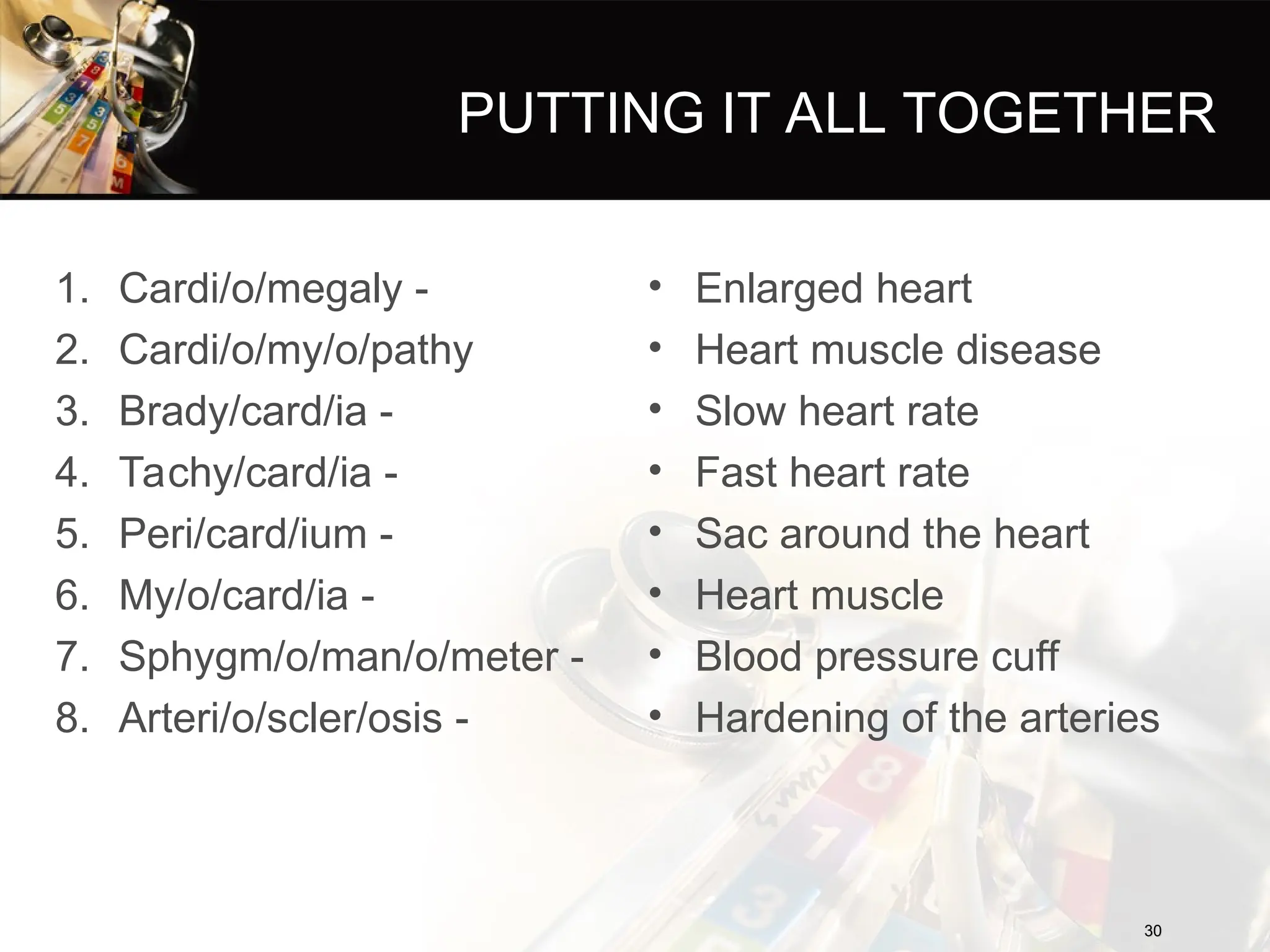
1. Cardi/o/megaly -
2. Cardi/o/my/o/pathy
3. Brady/card/ia -
4. Tachy/card/ia -
5. Peri/card/ium -
6. My/o/card/ia -
7. Sphygm/o/man/o/meter -
8. Arteri/o/scler/osis -
• Enlarged heart
• Heart muscle disease
• Slow heart rate
• Fast heart rate
• Sac around the heart
• Heart muscle
• Blood pressure cuff
• Hardening of the arteries
30
30
DIRECTIONAL TERMS
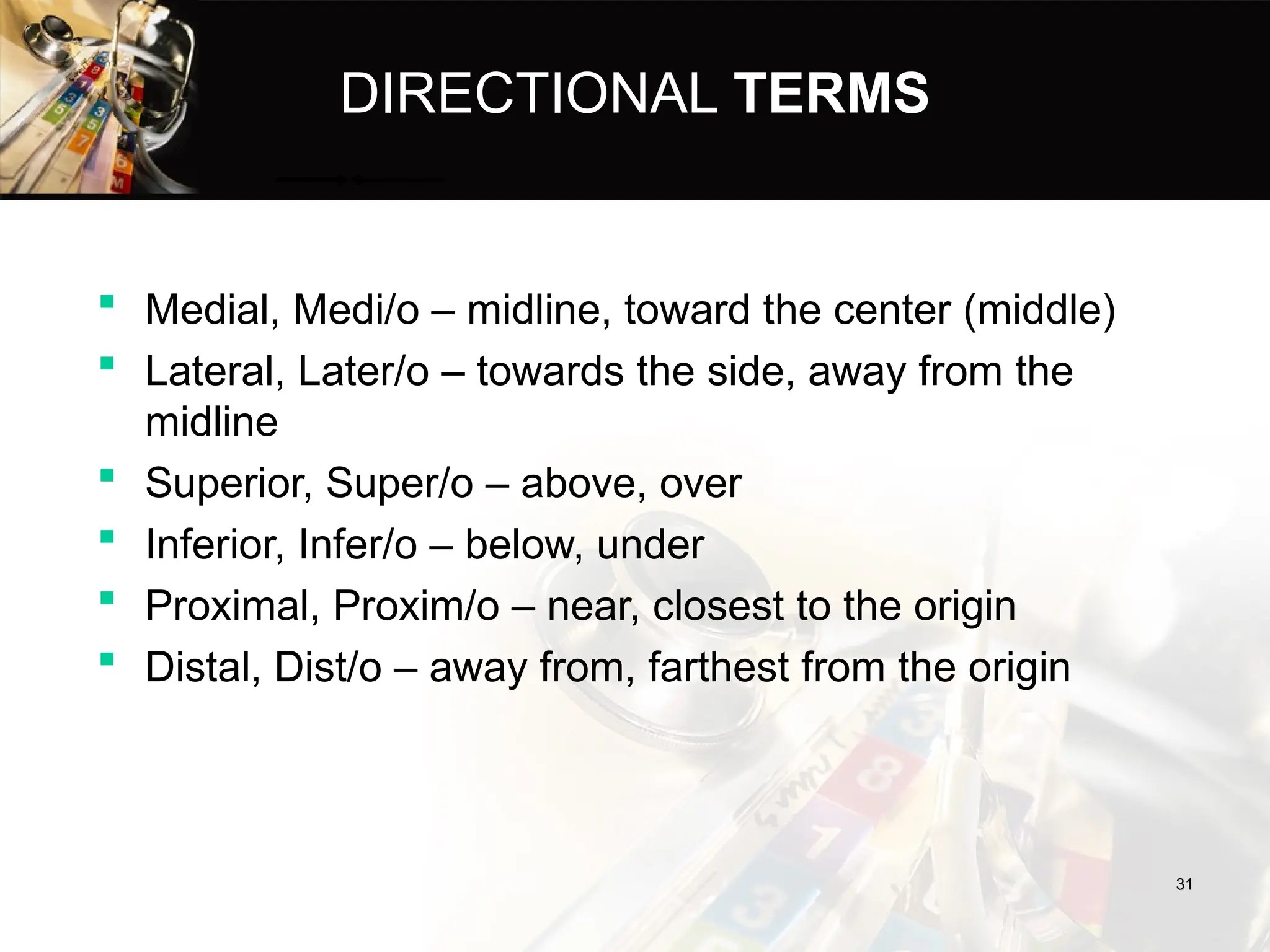
 Medial, Medi/o – midline, toward the center (middle)
 Lateral, Later/o – towards the side, away from the
midline
 Superior, Super/o – above, over
 Inferior, Infer/o – below, under
 Proximal, Proxim/o – near, closest to the origin
 Distal, Dist/o – away from, farthest from the origin
31
31
DIRECTIONAL TERMS
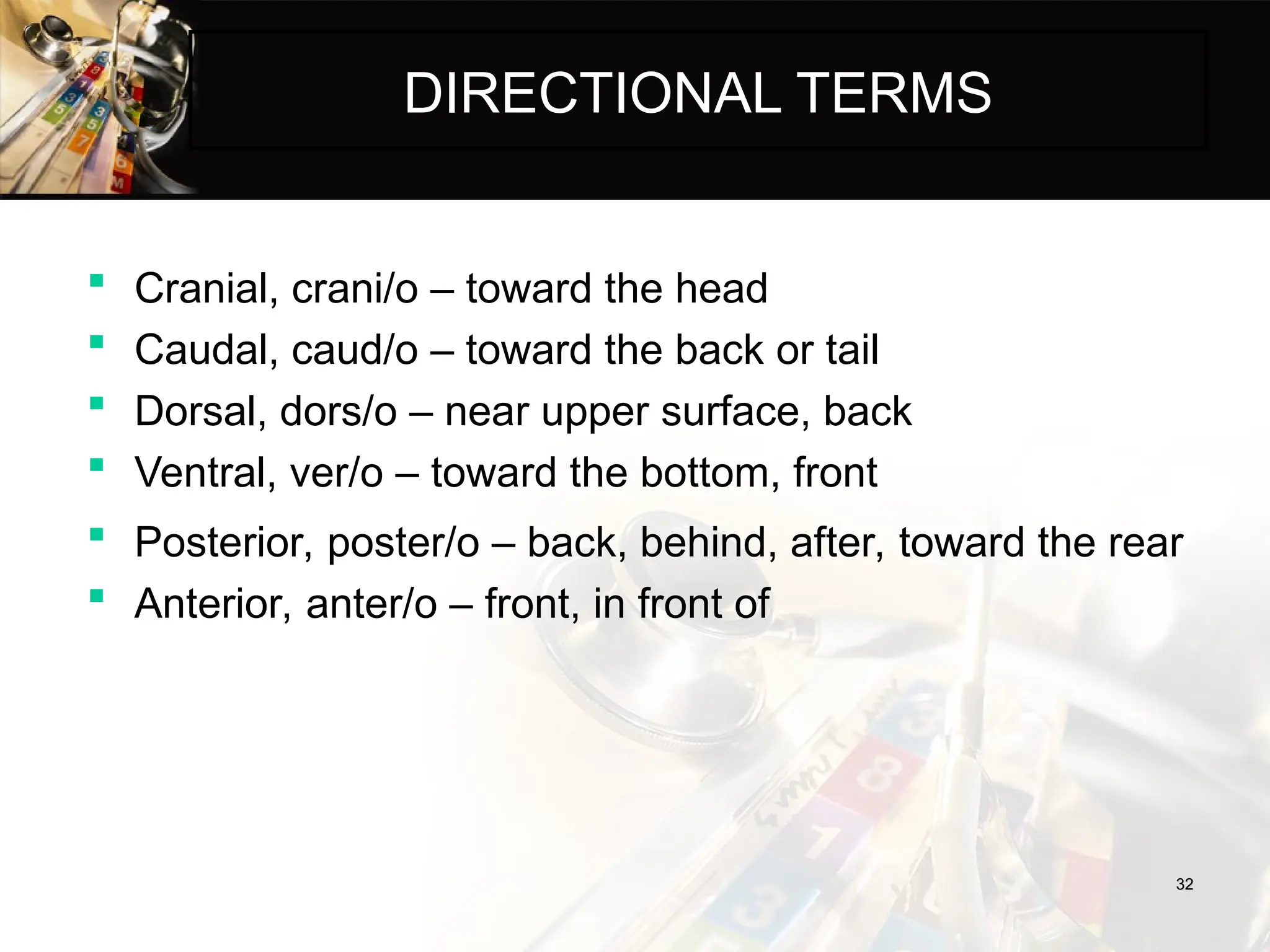
 Cranial, crani/o – toward the head
 Caudal, caud/o – toward the back or tail
 Dorsal, dors/o – near upper surface, back
 Ventral, ver/o – toward the bottom, front
32
32
 Posterior, poster/o – back, behind, after, toward the rear
 Anterior, anter/o – front, in front of
PUTTING IT ALL TOGETHER
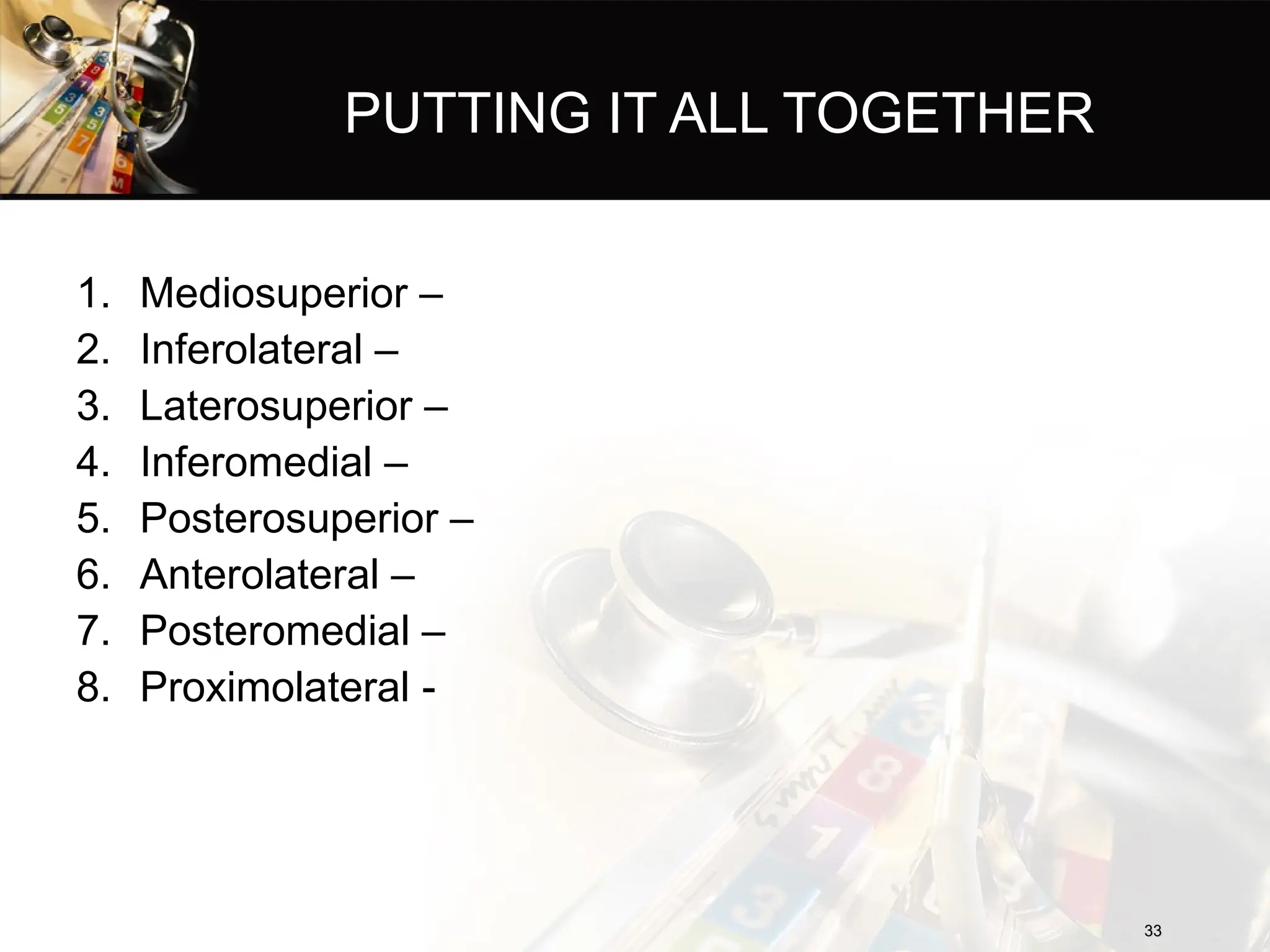
1. Mediosuperior –
2. Inferolateral –
3. Laterosuperior –
4. Inferomedial –
5. Posterosuperior –
6. Anterolateral –
7. Posteromedial –
8. Proximolateral -
33
33
PUTTING IT ALL TOGETHER
34
34
1. Mediosuperior –
2. Inferolateral –
3. Laterosuperior –
4. Inferomedial –
5. Posterosuperior –
6. Anterolateral –
7. Posteromedial –
8. Proximolateral -
Middle, upper
Below, to the side
To the side, upper
Below, middle
Back, upper
Front, to the side
Back, middle
Closest to the point of
origin, to the side
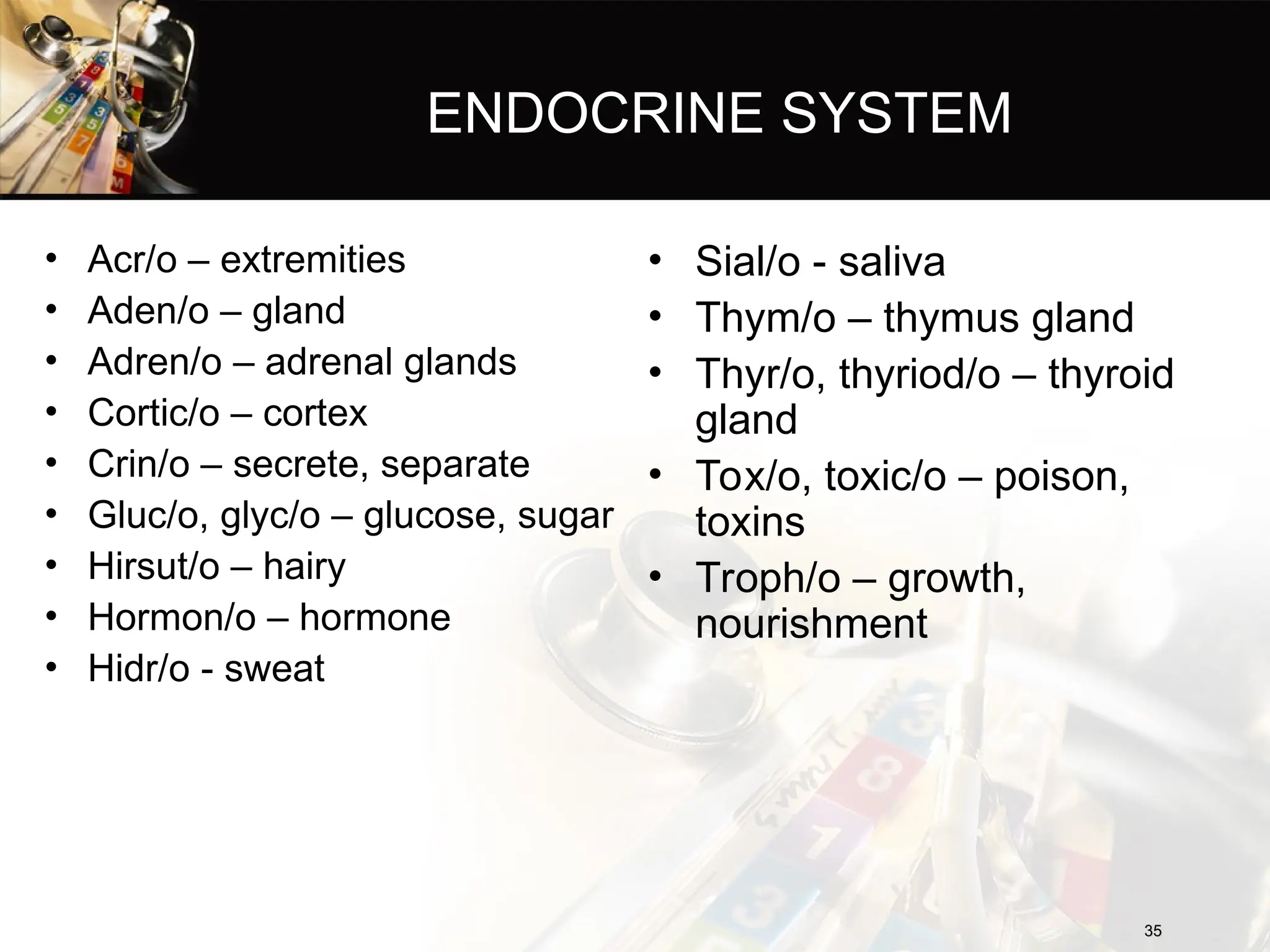
ENDOCRINE SYSTEM
• Acr/o – extremities
• Aden/o – gland
• Adren/o – adrenal glands
• Cortic/o – cortex
• Crin/o – secrete, separate
• Gluc/o, glyc/o – glucose, sugar
• Hirsut/o – hairy
• Hormon/o – hormone
• Hidr/o - sweat
35
35
• Sial/o - saliva
• Thym/o – thymus gland
• Thyr/o, thyriod/o – thyroid
gland
• Tox/o, toxic/o – poison,
toxins
• Troph/o – growth,
nourishment
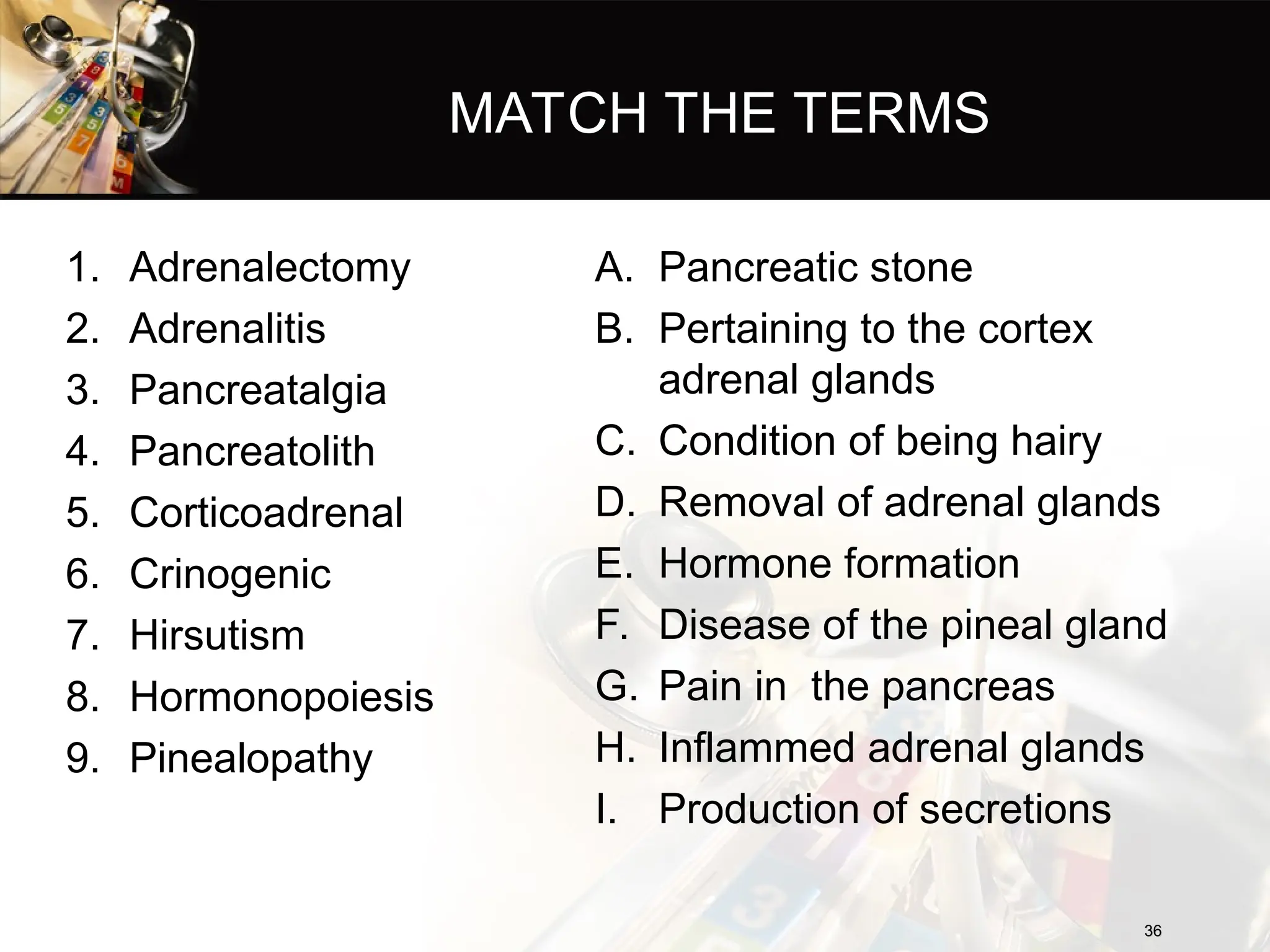
MATCH THE TERMS
1. Adrenalectomy
2. Adrenalitis
3. Pancreatalgia
4. Pancreatolith
5. Corticoadrenal
6. Crinogenic
7. Hirsutism
8. Hormonopoiesis
9. Pinealopathy
A. Pancreatic stone
B. Pertaining to the cortex
adrenal glands
C. Condition of being hairy
D. Removal of adrenal glands
E. Hormone formation
F. Disease of the pineal gland
G. Pain in the pancreas
H. Inflammed adrenal glands
I. Production of secretions
36
36
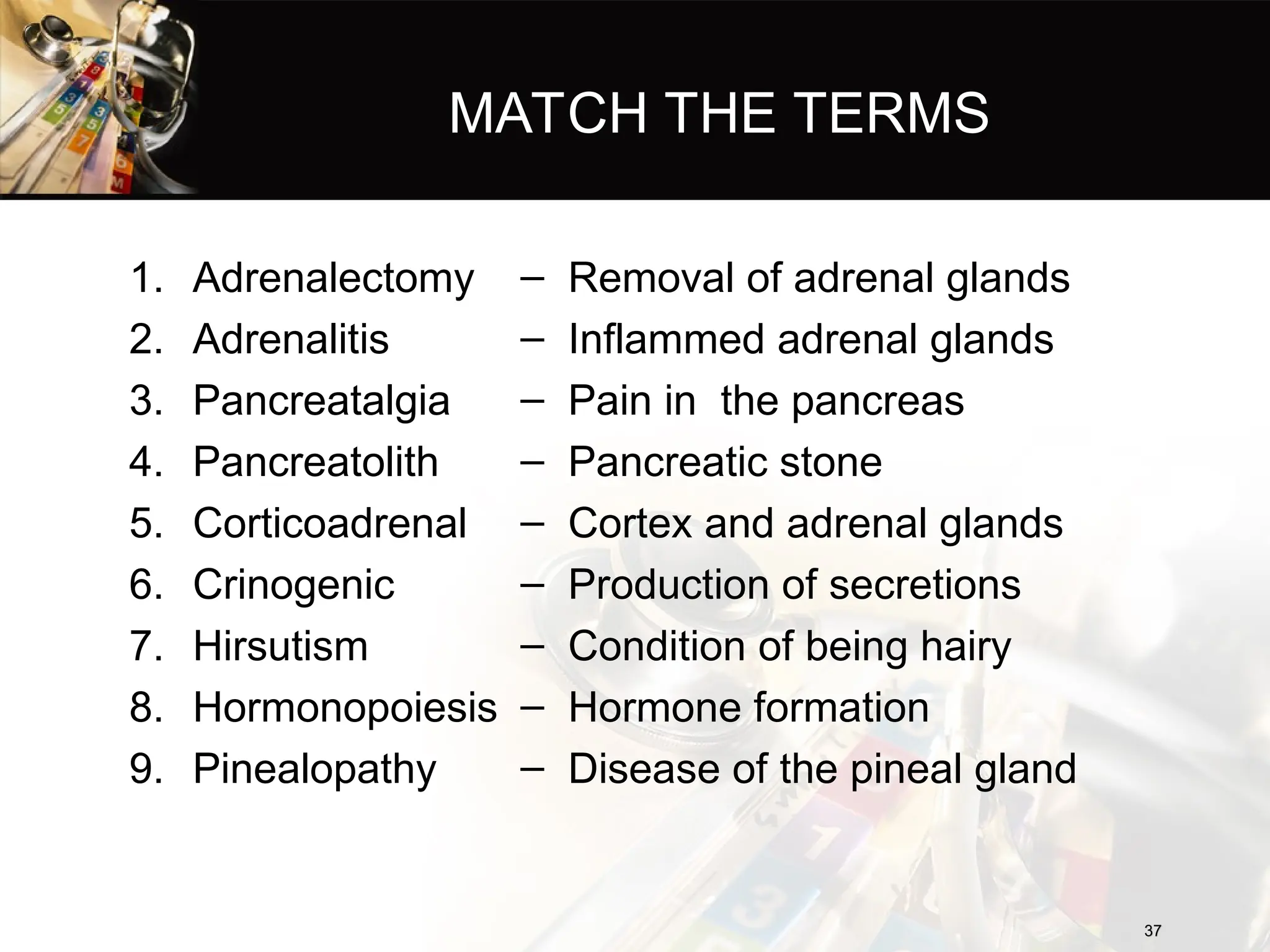
MATCH THE TERMS
1. Adrenalectomy
2. Adrenalitis
3. Pancreatalgia
4. Pancreatolith
5. Corticoadrenal
6. Crinogenic
7. Hirsutism
8. Hormonopoiesis
9. Pinealopathy
– Removal of adrenal glands
– Inflammed adrenal glands
– Pain in the pancreas
– Pancreatic stone
– Cortex and adrenal glands
– Production of secretions
– Condition of being hairy
– Hormone formation
– Disease of the pineal gland
37
37
GASTROINTESTINAL SYSTEM
• Abdomin/o – abdomen
• Amyl/o – starch
• An/o – anus
• Bil/i – bile
• Bucc/o – cheek
• Cec/o – cecum
• Celi/o – abdomen
• Chol/e – gall, bile
• Cholecyst/o - gallbladder
• Col/o – colon
• Dent/i - tooth
38
38
GASTROINTESTINAL SYSTEM
• Dips/o – thirst
• Duoden/o – doudenum
• Enter/o – intestines
• Esophag/o – esophogus
• Gastr/o – stomach
• Gingiv/o – gums
• Gloss/o – tongue
• Hepat/o – liver
• Ile/o – ileum
• Jejun/o - jejunum
39
39
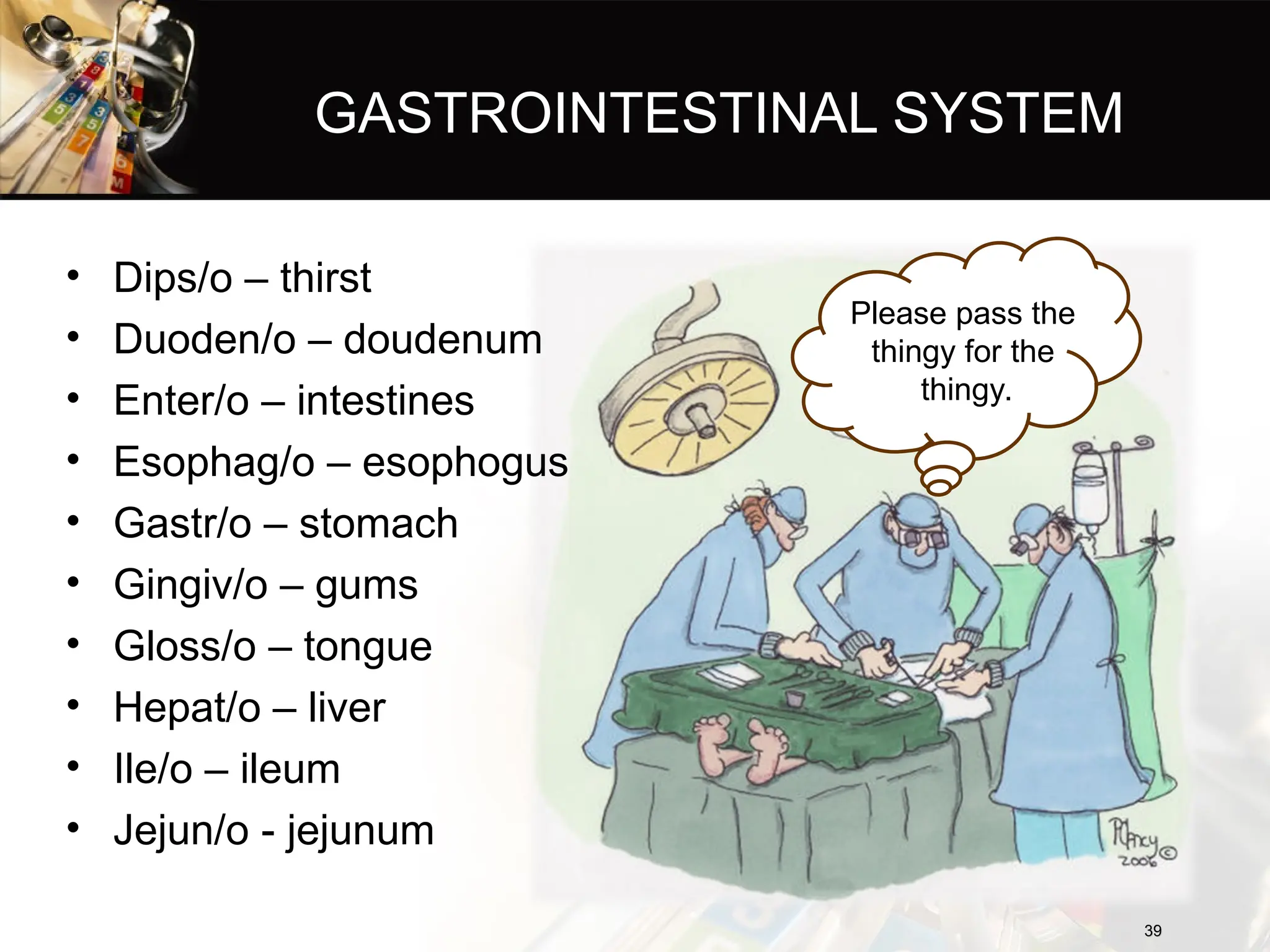
Please pass the
thingy for the
thingy.
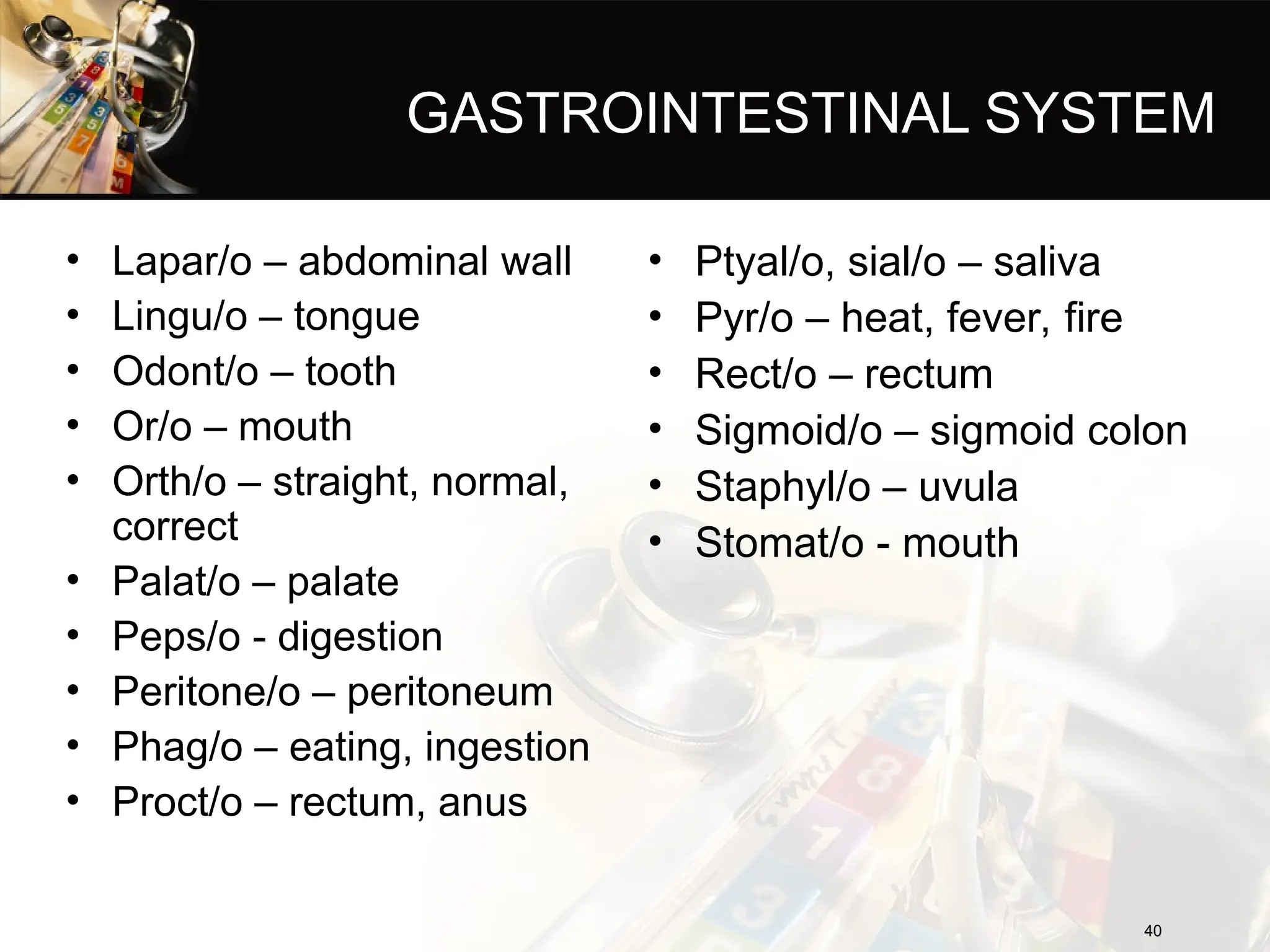
GASTROINTESTINAL SYSTEM
• Lapar/o – abdominal wall
• Lingu/o – tongue
• Odont/o – tooth
• Or/o – mouth
• Orth/o – straight, normal,
correct
• Palat/o – palate
• Peps/o - digestion
• Peritone/o – peritoneum
• Phag/o – eating, ingestion
• Proct/o – rectum, anus
40
40
• Ptyal/o, sial/o – saliva
• Pyr/o – heat, fever, fire
• Rect/o – rectum
• Sigmoid/o – sigmoid colon
• Staphyl/o – uvula
• Stomat/o - mouth
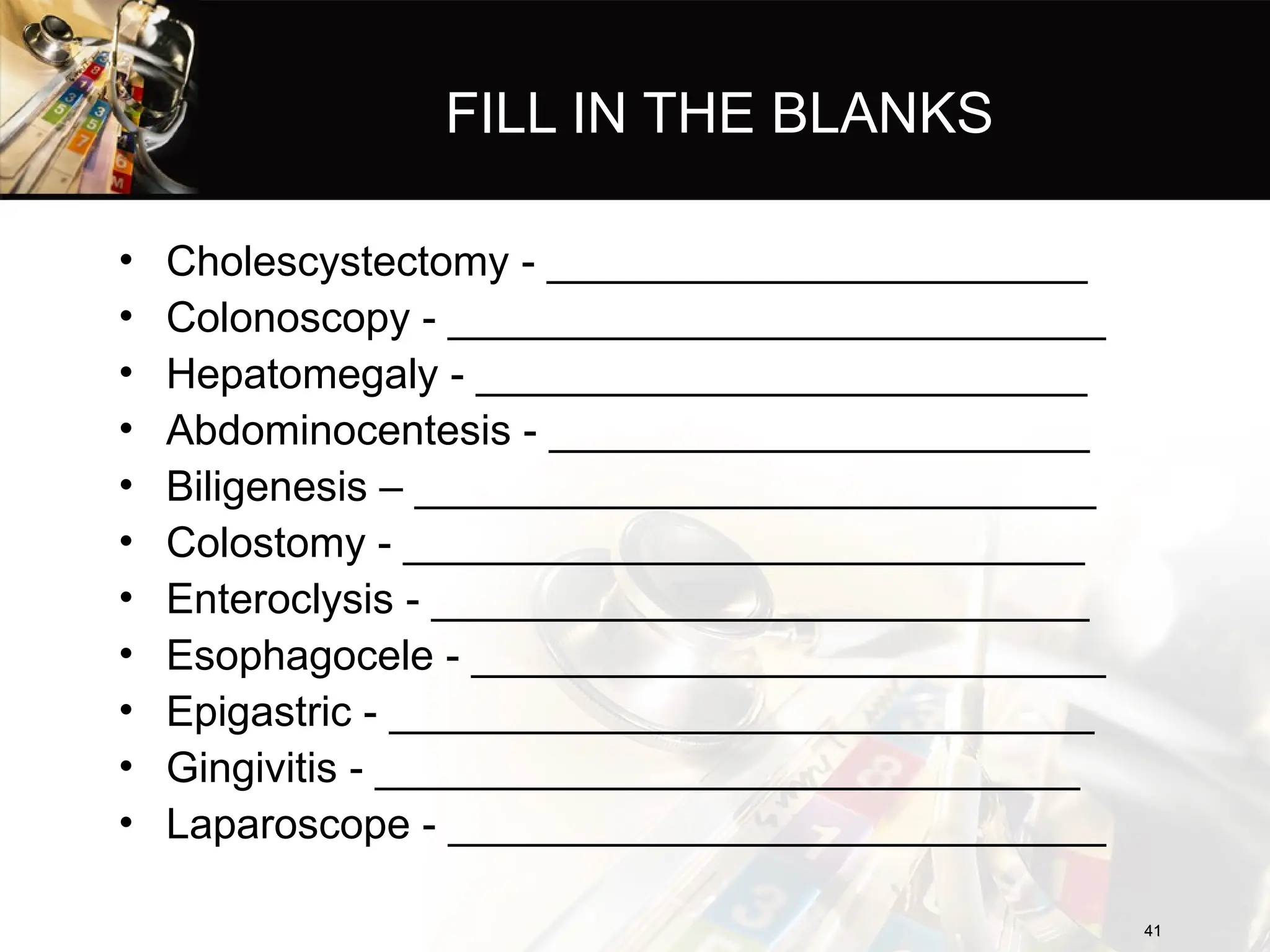
FILL IN THE BLANKS
• Cholescystectomy - _______________________
• Colonoscopy - ____________________________
• Hepatomegaly - __________________________
• Abdominocentesis - _______________________
• Biligenesis – _____________________________
• Colostomy - _____________________________
• Enteroclysis - ____________________________
• Esophagocele - ___________________________
• Epigastric - ______________________________
• Gingivitis - ______________________________
• Laparoscope - ____________________________
41
41
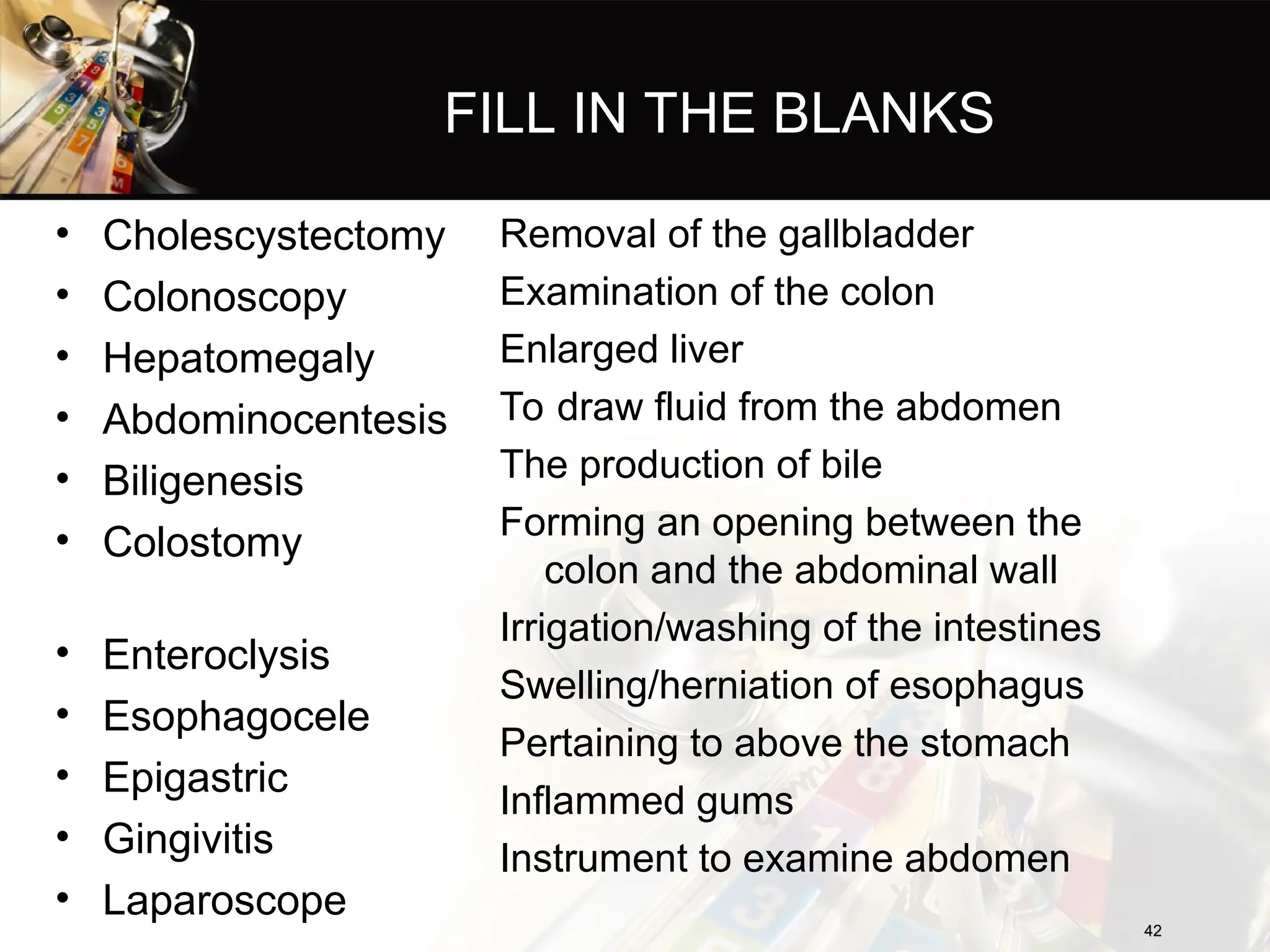
FILL IN THE BLANKS
• Cholescystectomy
• Colonoscopy
• Hepatomegaly
• Abdominocentesis
• Biligenesis
• Colostomy
• Enteroclysis
• Esophagocele
• Epigastric
• Gingivitis
• Laparoscope
Removal of the gallbladder
Examination of the colon
Enlarged liver
To draw fluid from the abdomen
The production of bile
Forming an opening between the
colon and the abdominal wall
Irrigation/washing of the intestines
Swelling/herniation of esophagus
Pertaining to above the stomach
Inflammed gums
Instrument to examine abdomen
42
42
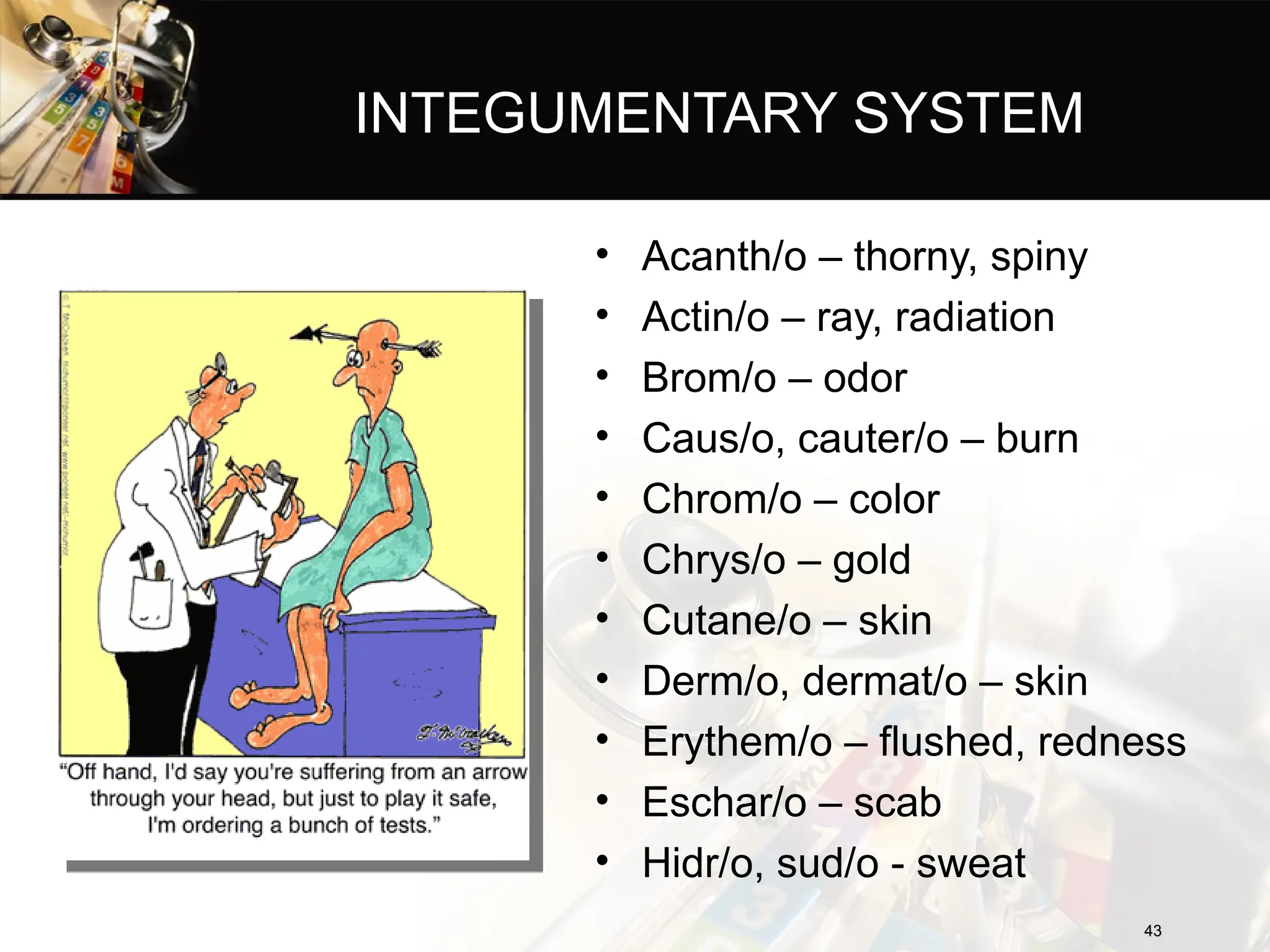
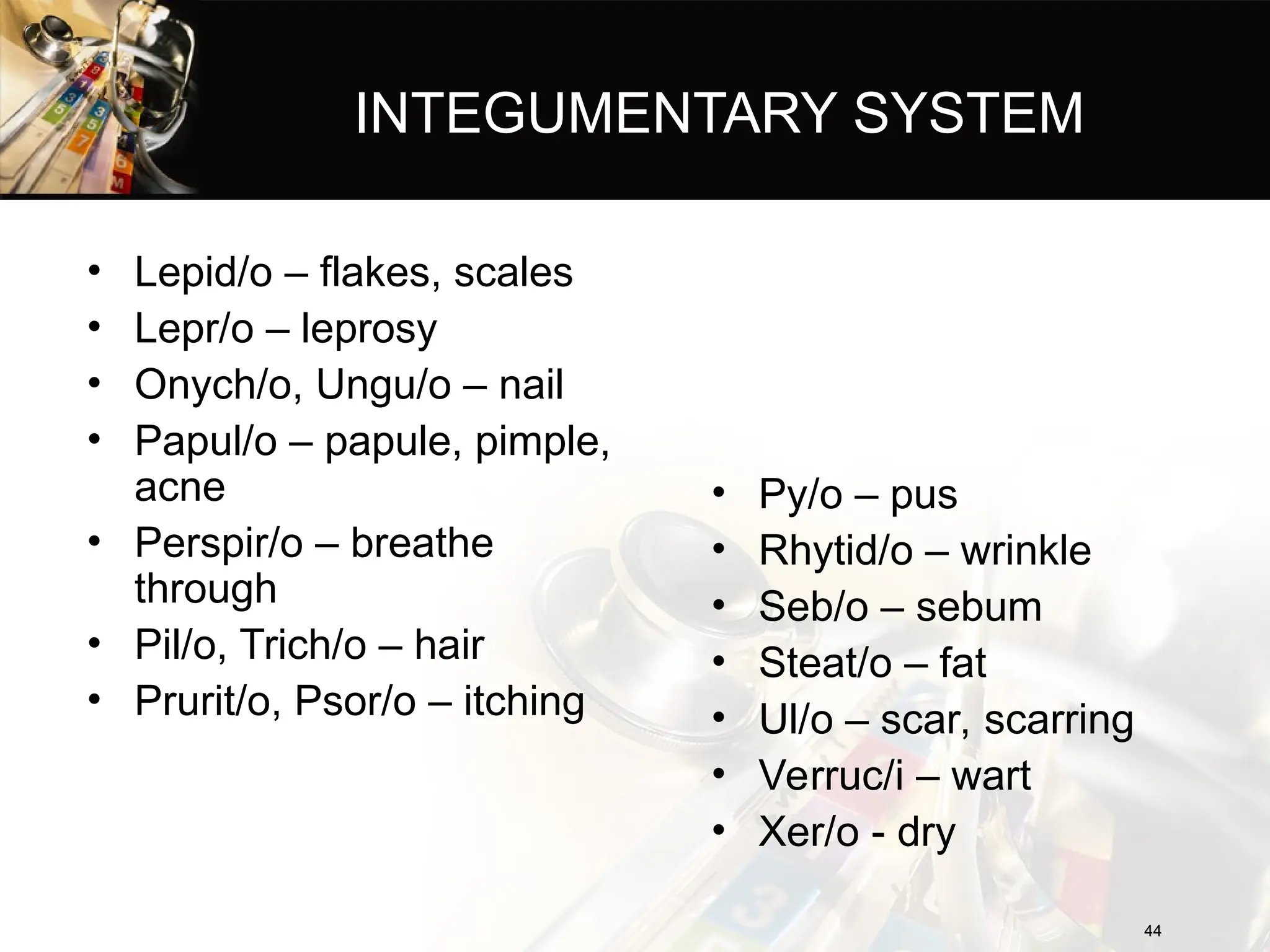
INTEGUMENTARY SYSTEM
• Acanth/o – thorny, spiny
• Actin/o – ray, radiation
• Brom/o – odor
• Caus/o, cauter/o – burn
• Chrom/o – color
• Chrys/o – gold
• Cutane/o – skin
• Derm/o, dermat/o – skin
• Erythem/o – flushed, redness
• Eschar/o – scab
• Hidr/o, sud/o - sweat
43
43
INTEGUMENTARY SYSTEM
• Lepid/o – flakes, scales
• Lepr/o – leprosy
• Onych/o, Ungu/o – nail
• Papul/o – papule, pimple,
acne
• Perspir/o – breathe
through
• Pil/o, Trich/o – hair
• Prurit/o, Psor/o – itching
44
44
• Py/o – pus
• Rhytid/o – wrinkle
• Seb/o – sebum
• Steat/o – fat
• Ul/o – scar, scarring
• Verruc/i – wart
• Xer/o - dry
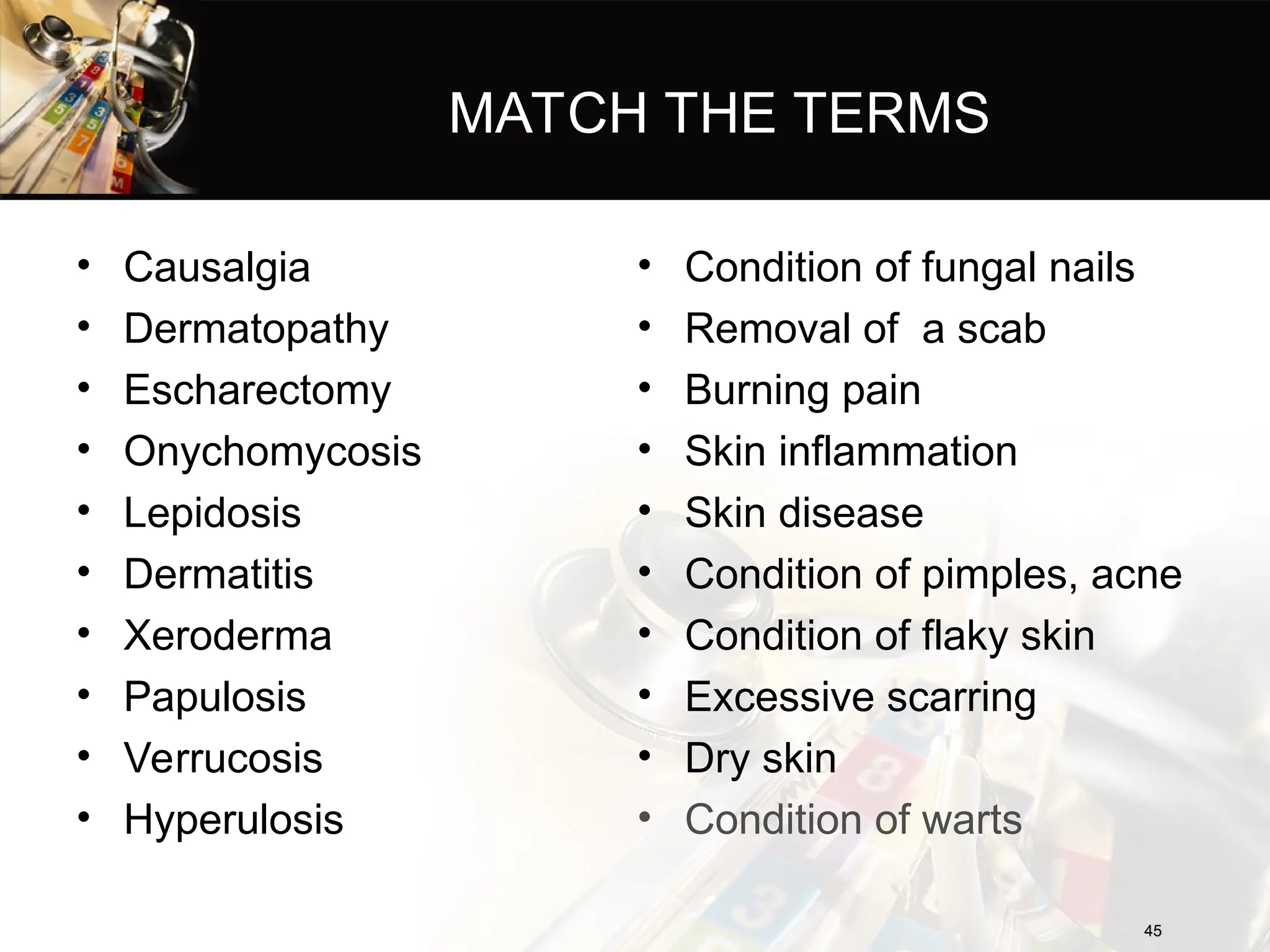
MATCH THE TERMS
• Causalgia
• Dermatopathy
• Escharectomy
• Onychomycosis
• Lepidosis
• Dermatitis
• Xeroderma
• Papulosis
• Verrucosis
• Hyperulosis
• Condition of fungal nails
• Removal of a scab
• Burning pain
• Skin inflammation
• Skin disease
• Condition of pimples, acne
• Condition of flaky skin
• Excessive scarring
• Dry skin
• Condition of warts
45
45
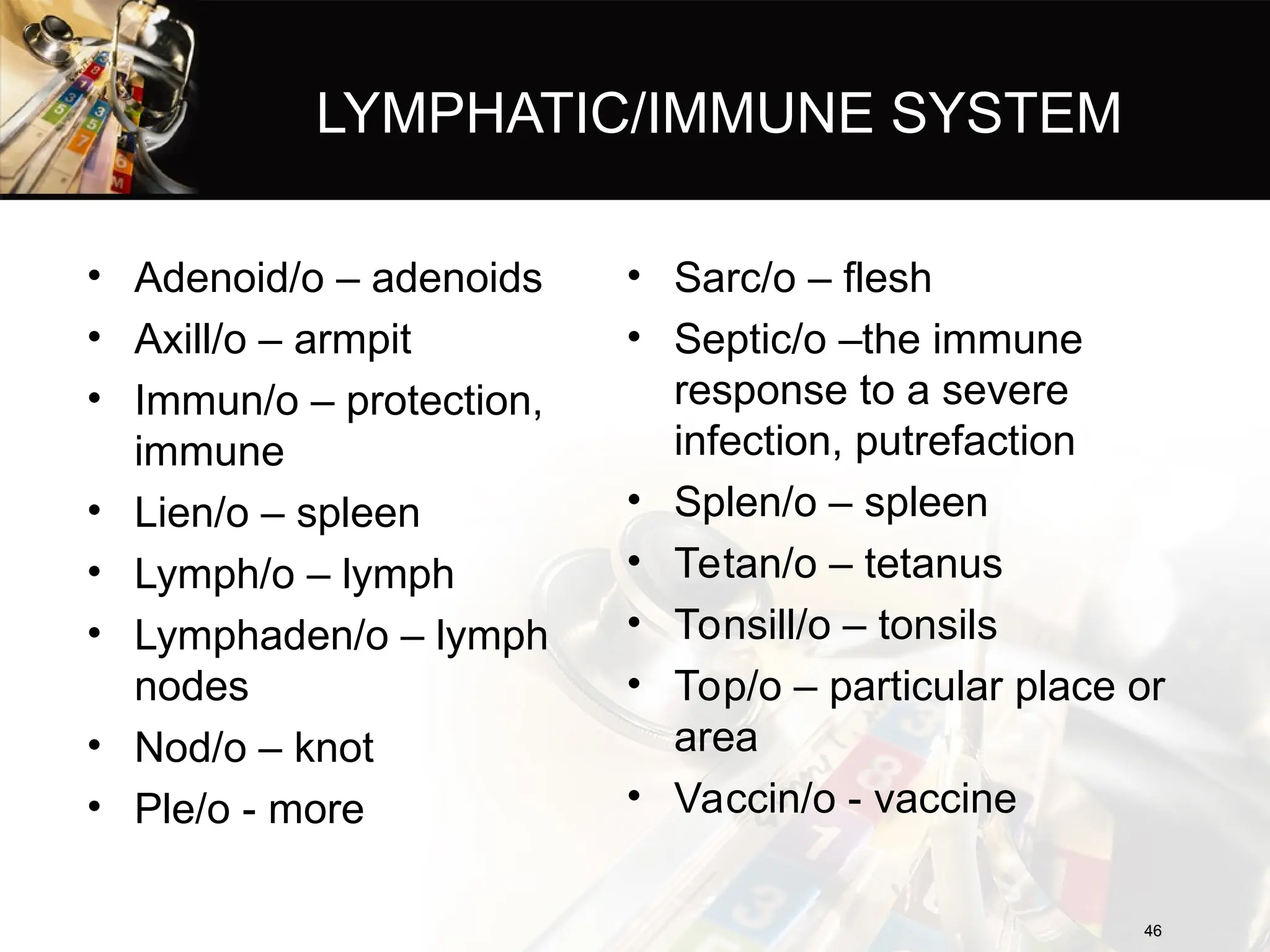
LYMPHATIC/IMMUNE SYSTEM
• Adenoid/o – adenoids
• Axill/o – armpit
• Immun/o – protection,
immune
• Lien/o – spleen
• Lymph/o – lymph
• Lymphaden/o – lymph
nodes
• Nod/o – knot
• Ple/o - more
46
46
• Sarc/o – flesh
• Septic/o –the immune
response to a severe
infection, putrefaction
• Splen/o – spleen
• Tetan/o – tetanus
• Tonsill/o – tonsils
• Top/o – particular place or
area
• Vaccin/o - vaccine
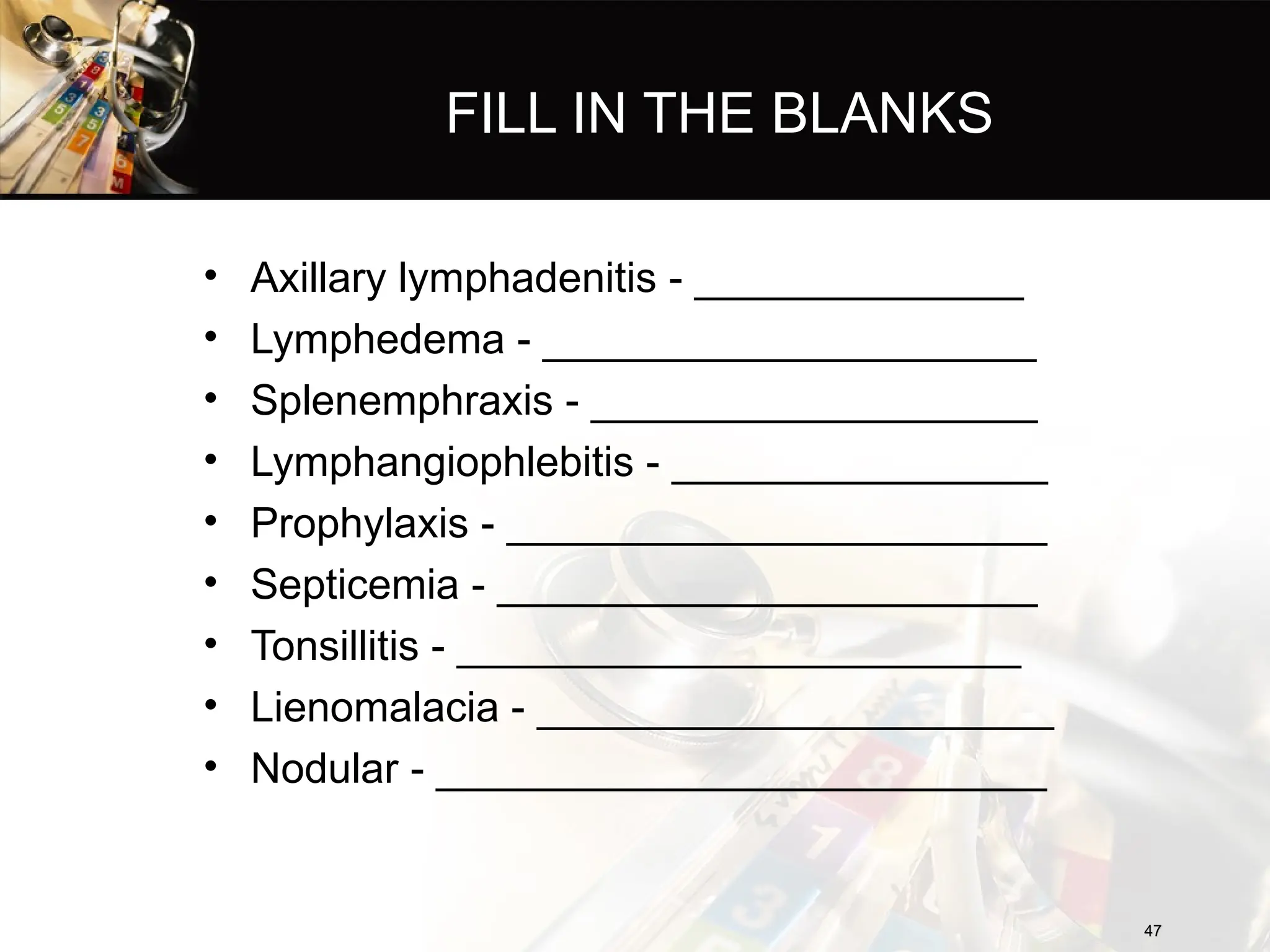
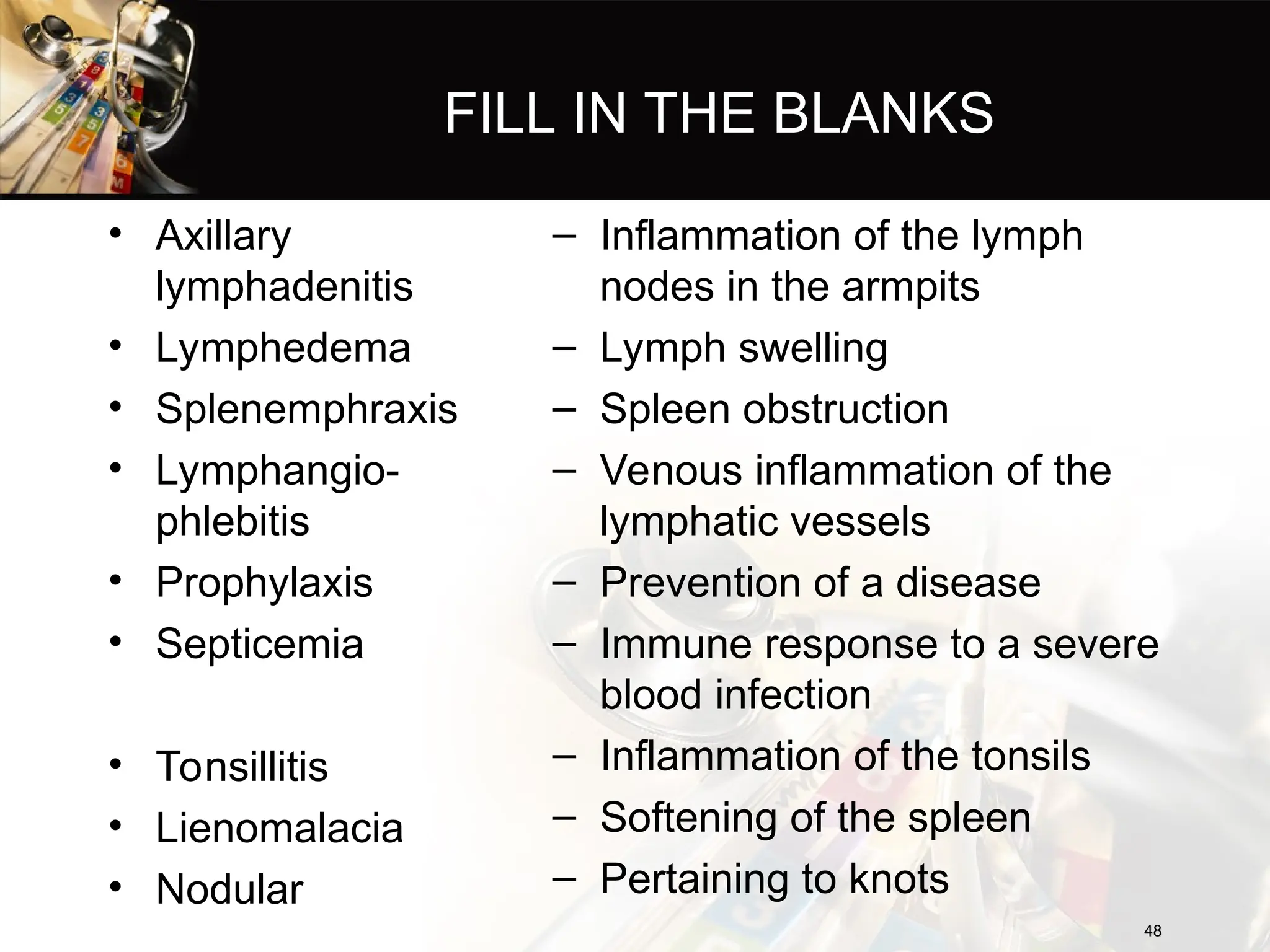
FILL IN THE BLANKS
• Axillary lymphadenitis - ______________
• Lymphedema - _____________________
• Splenemphraxis - ___________________
• Lymphangiophlebitis - ________________
• Prophylaxis - _______________________
• Septicemia - _______________________
• Tonsillitis - ________________________
• Lienomalacia - ______________________
• Nodular - __________________________
47
47
FILL IN THE BLANKS
• Axillary
lymphadenitis
• Lymphedema
• Splenemphraxis
• Lymphangio-
phlebitis
• Prophylaxis
• Septicemia
• Tonsillitis
• Lienomalacia
• Nodular
– Inflammation of the lymph
nodes in the armpits
– Lymph swelling
– Spleen obstruction
– Venous inflammation of the
lymphatic vessels
– Prevention of a disease
– Immune response to a severe
blood infection
– Inflammation of the tonsils
– Softening of the spleen
– Pertaining to knots
48
48
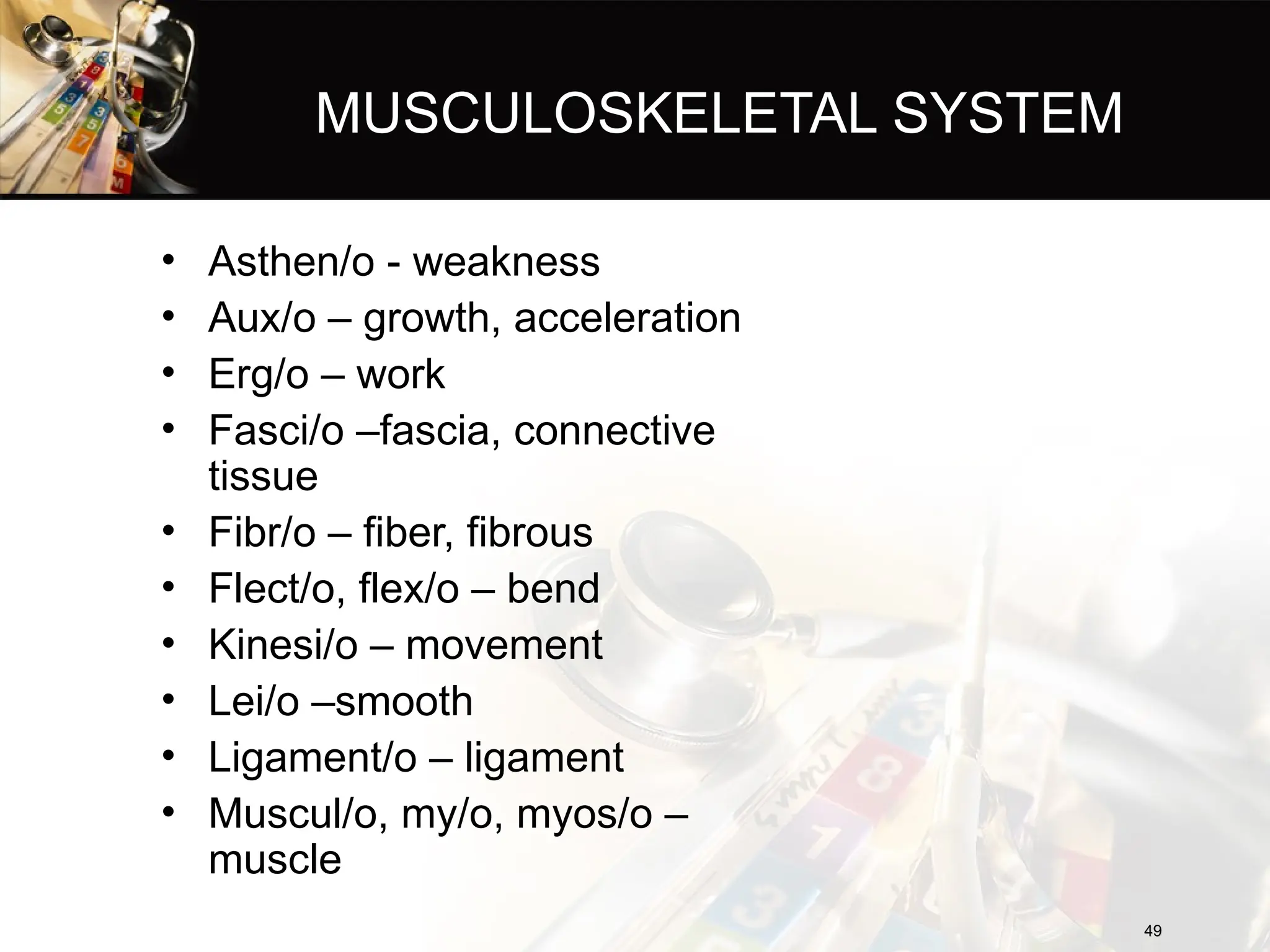
MUSCULOSKELETAL SYSTEM
• Asthen/o - weakness
• Aux/o – growth, acceleration
• Erg/o – work
• Fasci/o –fascia, connective
tissue
• Fibr/o – fiber, fibrous
• Flect/o, flex/o – bend
• Kinesi/o – movement
• Lei/o –smooth
• Ligament/o – ligament
• Muscul/o, my/o, myos/o –
muscle
49
49
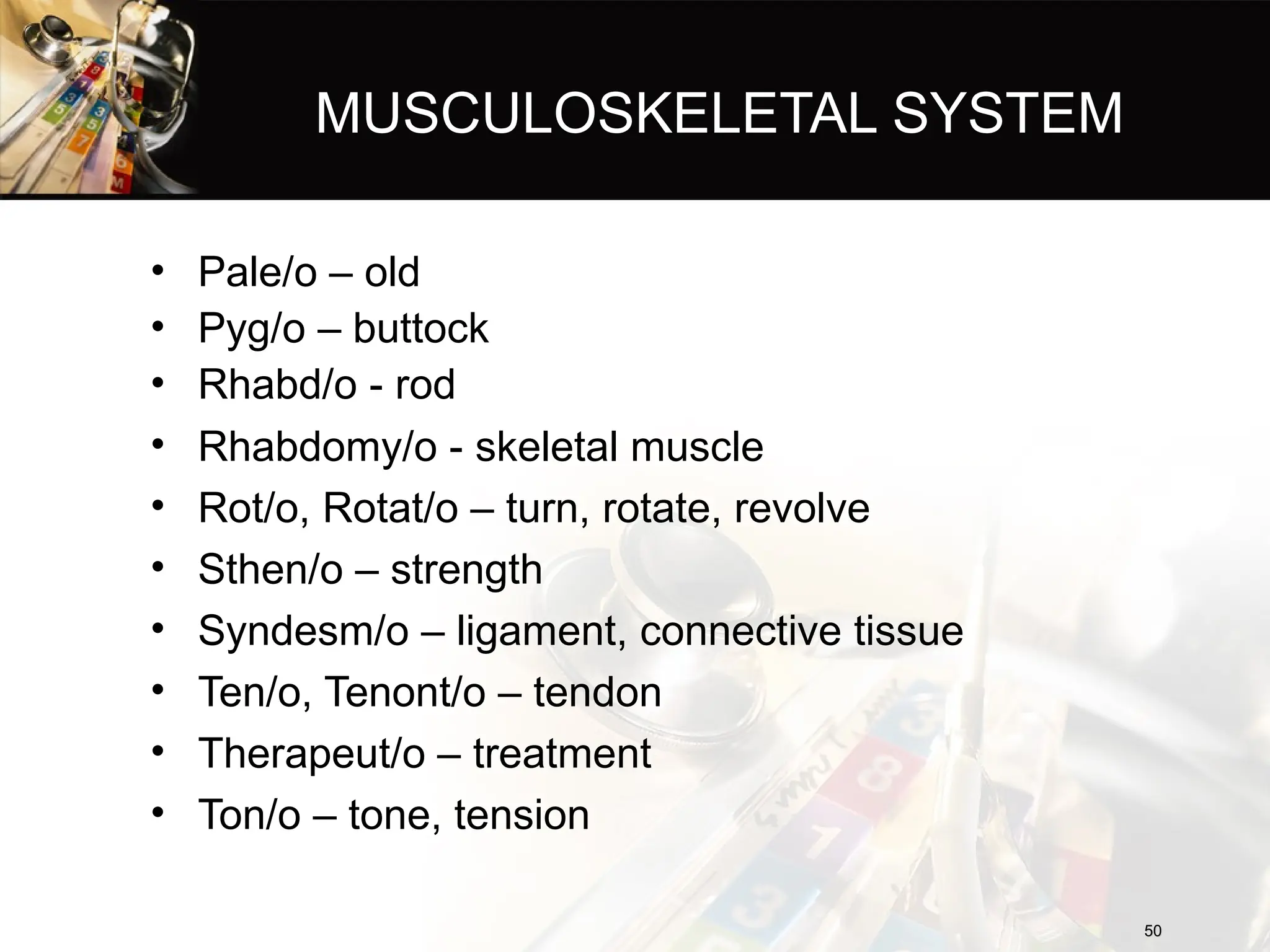
MUSCULOSKELETAL SYSTEM
• Pale/o – old
• Pyg/o – buttock
• Rhabd/o - rod
• Rhabdomy/o - skeletal muscle
• Rot/o, Rotat/o – turn, rotate, revolve
• Sthen/o – strength
• Syndesm/o – ligament, connective tissue
• Ten/o, Tenont/o – tendon
• Therapeut/o – treatment
• Ton/o – tone, tension
50
50
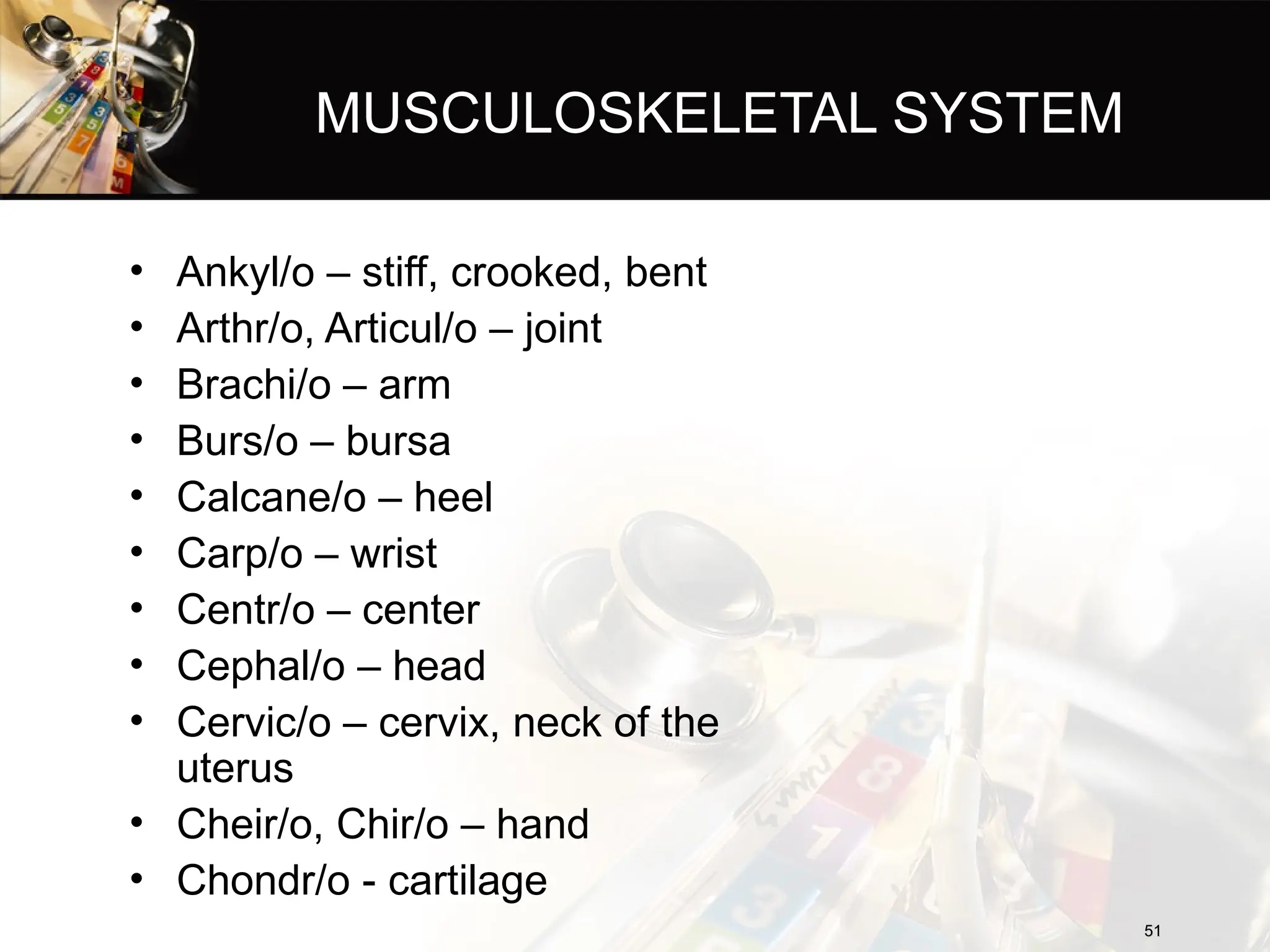
MUSCULOSKELETAL SYSTEM
• Ankyl/o – stiff, crooked, bent
• Arthr/o, Articul/o – joint
• Brachi/o – arm
• Burs/o – bursa
• Calcane/o – heel
• Carp/o – wrist
• Centr/o – center
• Cephal/o – head
• Cervic/o – cervix, neck of the
uterus
• Cheir/o, Chir/o – hand
• Chondr/o - cartilage
51
51
MUSCULOSKELETAL SYSTEM
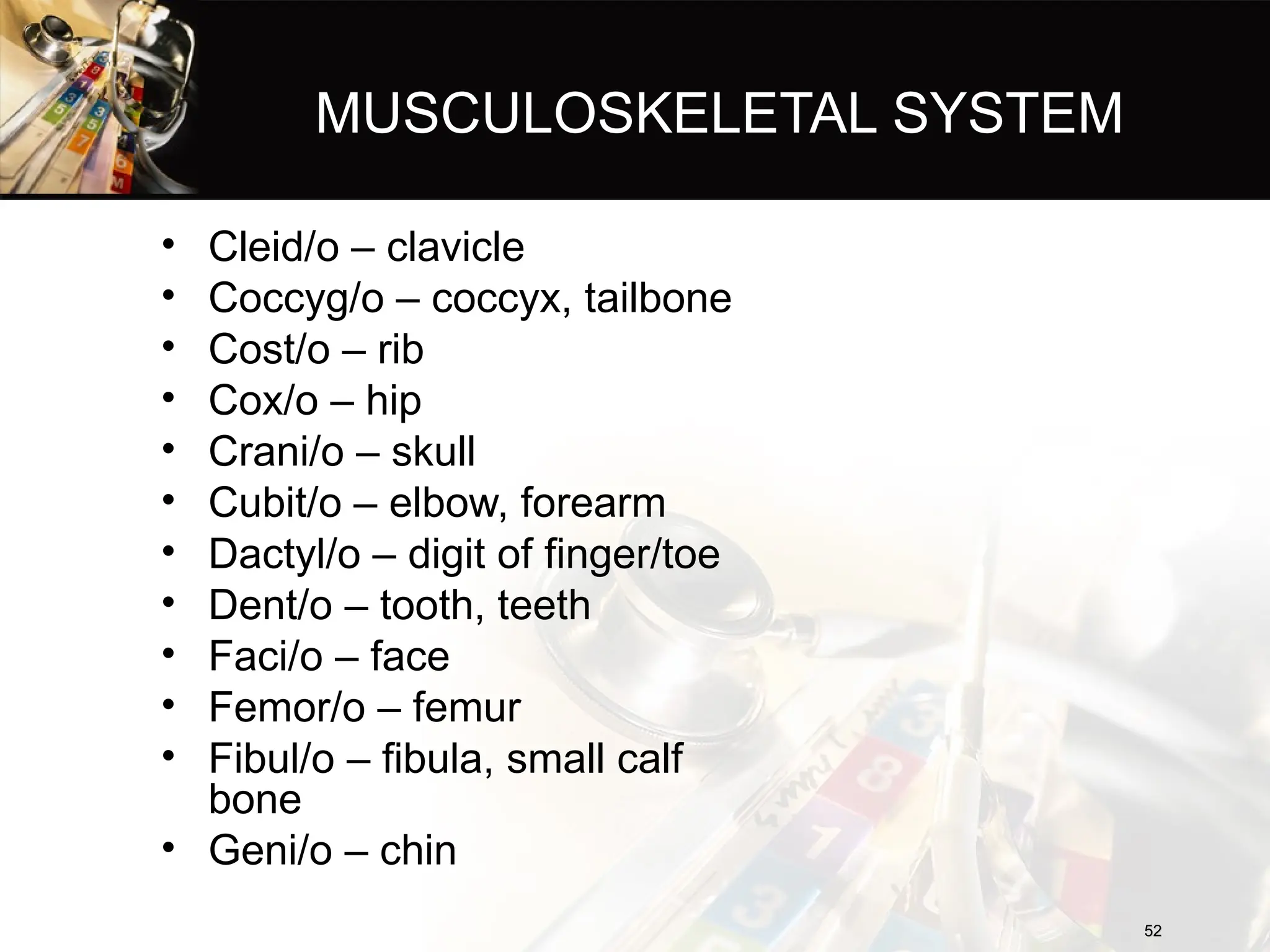
• Cleid/o – clavicle
• Coccyg/o – coccyx, tailbone
• Cost/o – rib
• Cox/o – hip
• Crani/o – skull
• Cubit/o – elbow, forearm
• Dactyl/o – digit of finger/toe
• Dent/o – tooth, teeth
• Faci/o – face
• Femor/o – femur
• Fibul/o – fibula, small calf
bone
• Geni/o – chin
52
52
MUSCULOSKELETAL SYSTEM
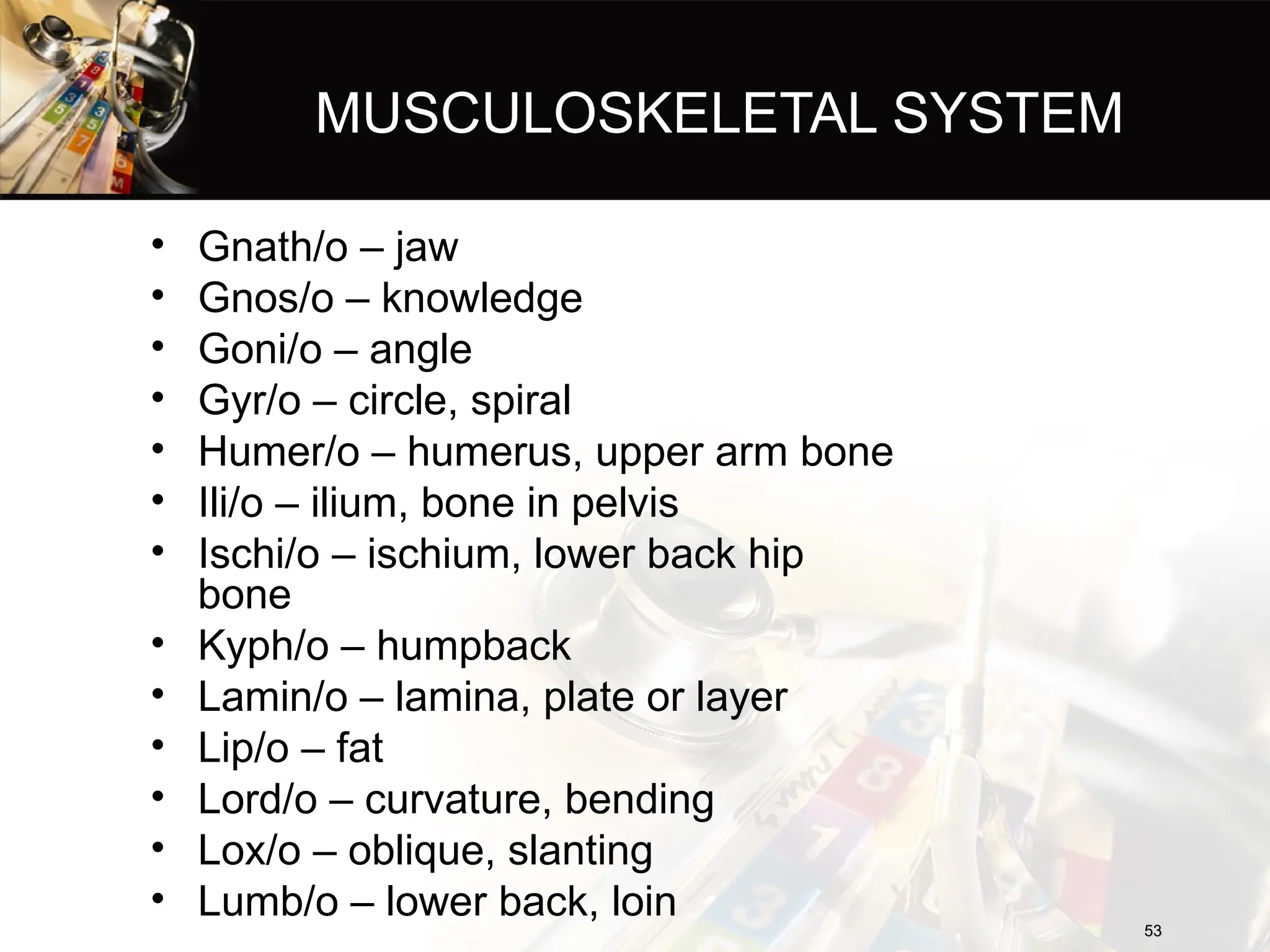
• Gnath/o – jaw
• Gnos/o – knowledge
• Goni/o – angle
• Gyr/o – circle, spiral
• Humer/o – humerus, upper arm bone
• Ili/o – ilium, bone in pelvis
• Ischi/o – ischium, lower back hip
bone
• Kyph/o – humpback
• Lamin/o – lamina, plate or layer
• Lip/o – fat
• Lord/o – curvature, bending
• Lox/o – oblique, slanting
• Lumb/o – lower back, loin
53
53
MUSCULOSKELETAL SYSTEM
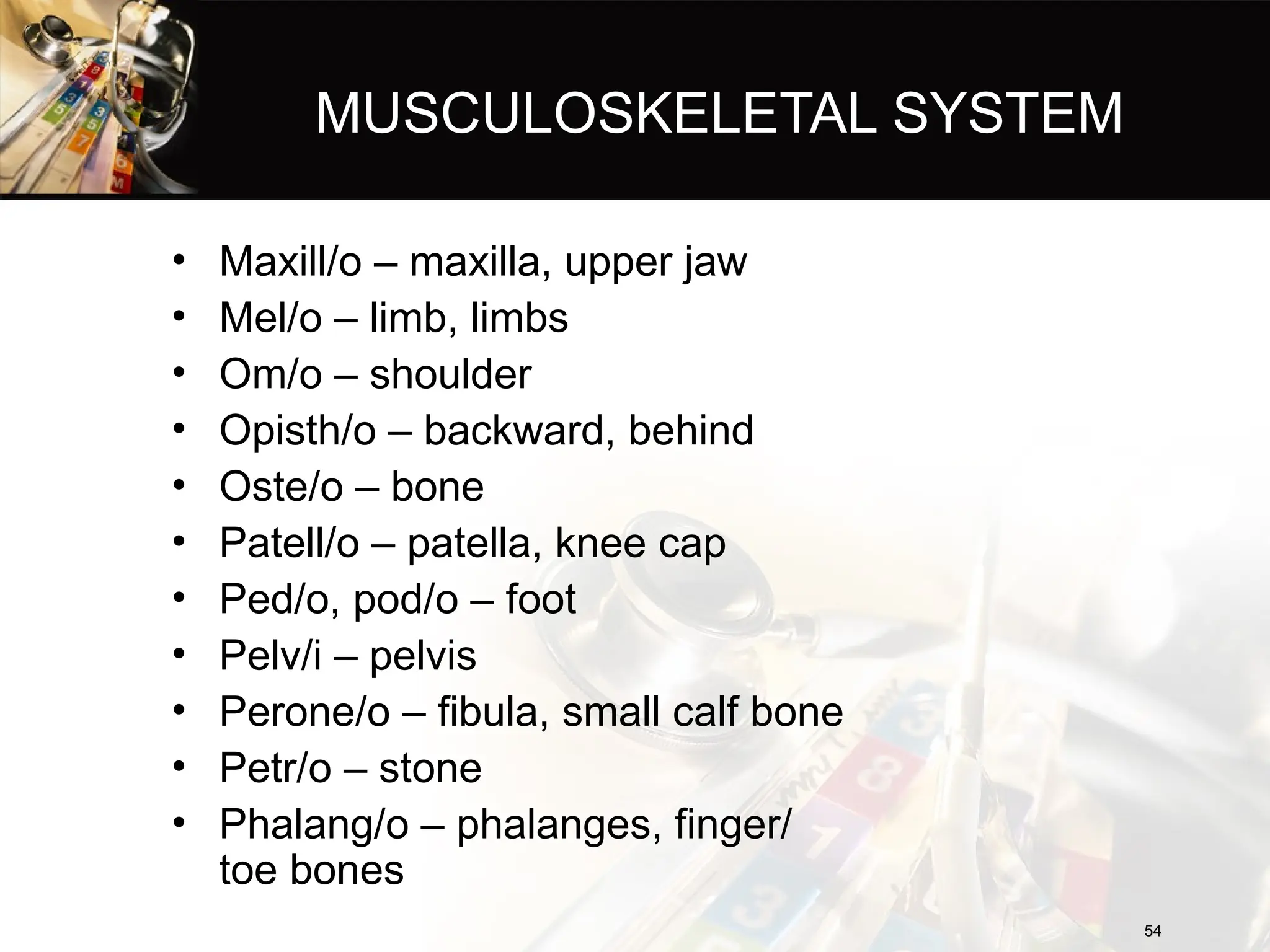
• Maxill/o – maxilla, upper jaw
• Mel/o – limb, limbs
• Om/o – shoulder
• Opisth/o – backward, behind
• Oste/o – bone
• Patell/o – patella, knee cap
• Ped/o, pod/o – foot
• Pelv/i – pelvis
• Perone/o – fibula, small calf bone
• Petr/o – stone
• Phalang/o – phalanges, finger/
toe bones
54
54
MUSCULOSKELETAL SYSTEM
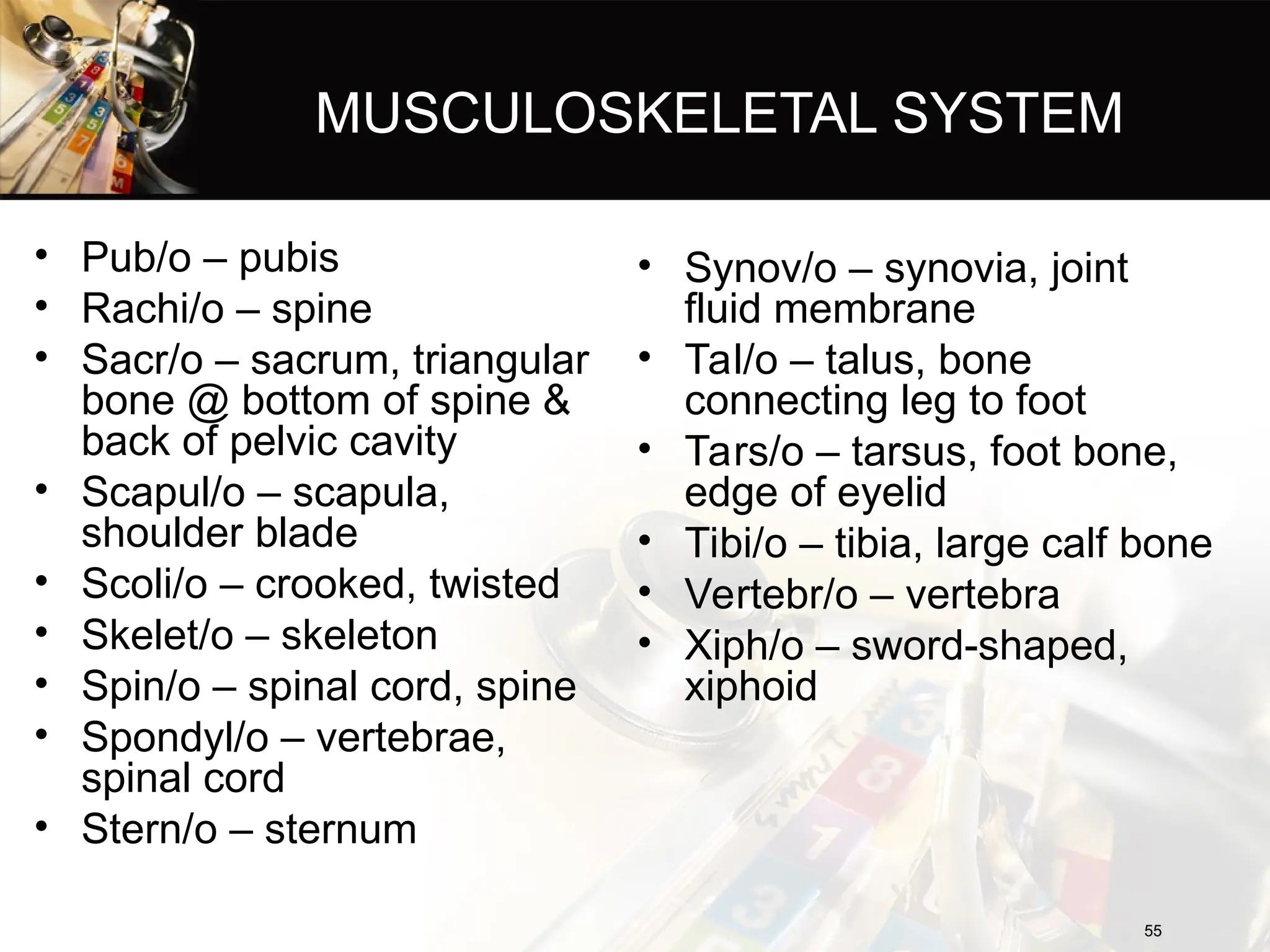
• Pub/o – pubis
• Rachi/o – spine
• Sacr/o – sacrum, triangular
bone @ bottom of spine &
back of pelvic cavity
• Scapul/o – scapula,
shoulder blade
• Scoli/o – crooked, twisted
• Skelet/o – skeleton
• Spin/o – spinal cord, spine
• Spondyl/o – vertebrae,
spinal cord
• Stern/o – sternum
55
55
• Synov/o – synovia, joint
fluid membrane
• Tal/o – talus, bone
connecting leg to foot
• Tars/o – tarsus, foot bone,
edge of eyelid
• Tibi/o – tibia, large calf bone
• Vertebr/o – vertebra
• Xiph/o – sword-shaped,
xiphoid
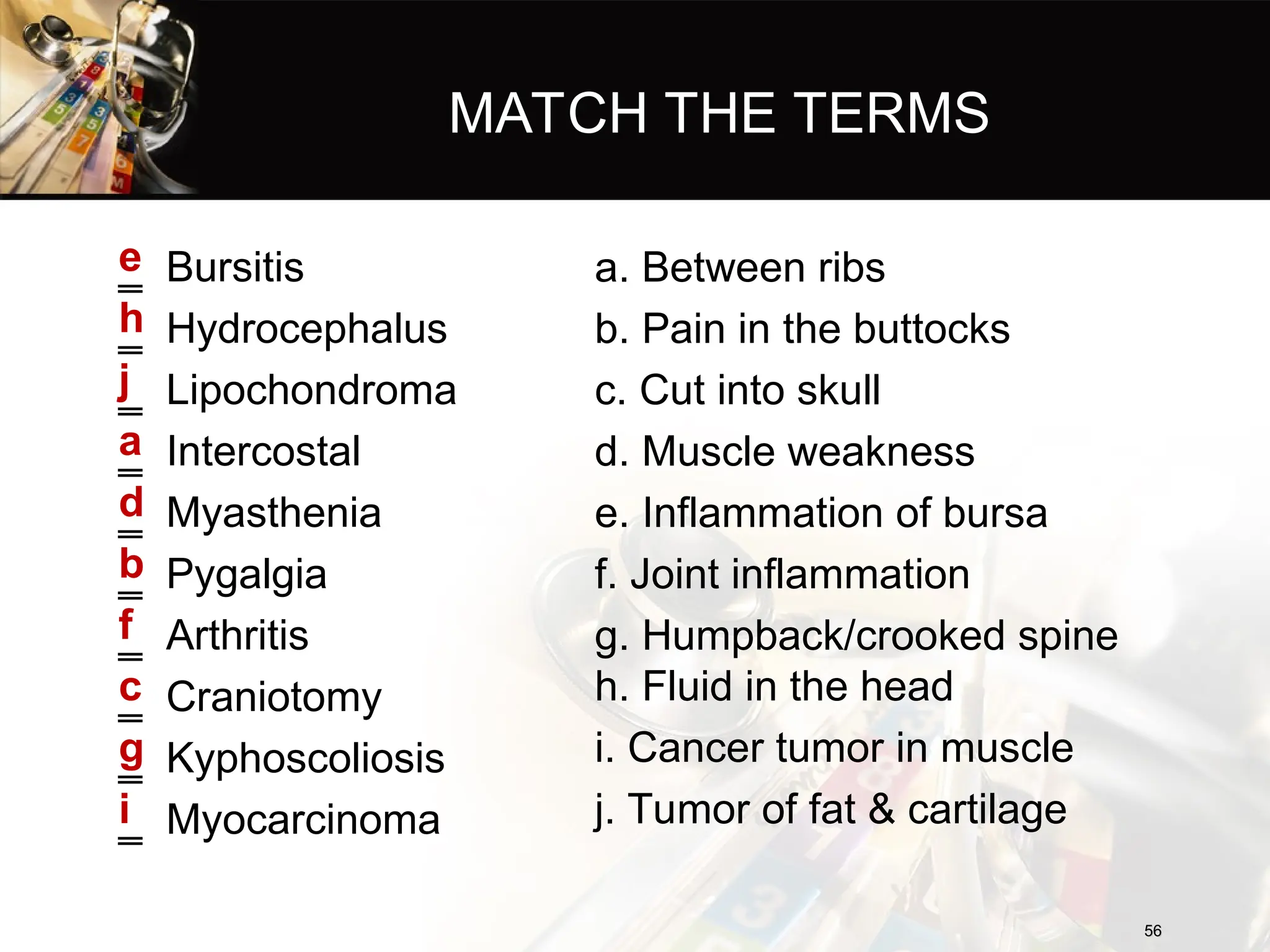
MATCH THE TERMS
‗ Bursitis
‗ Hydrocephalus
‗ Lipochondroma
‗ Intercostal
‗ Myasthenia
‗ Pygalgia
‗ Arthritis
‗ Craniotomy
‗ Kyphoscoliosis
‗ Myocarcinoma
e
h
j
a
d
b
f
c
g
i
56
56
a. Between ribs
b. Pain in the buttocks
c. Cut into skull
d. Muscle weakness
e. Inflammation of bursa
f. Joint inflammation
g. Humpback/crooked spine
h. Fluid in the head
i. Cancer tumor in muscle
j. Tumor of fat & cartilage
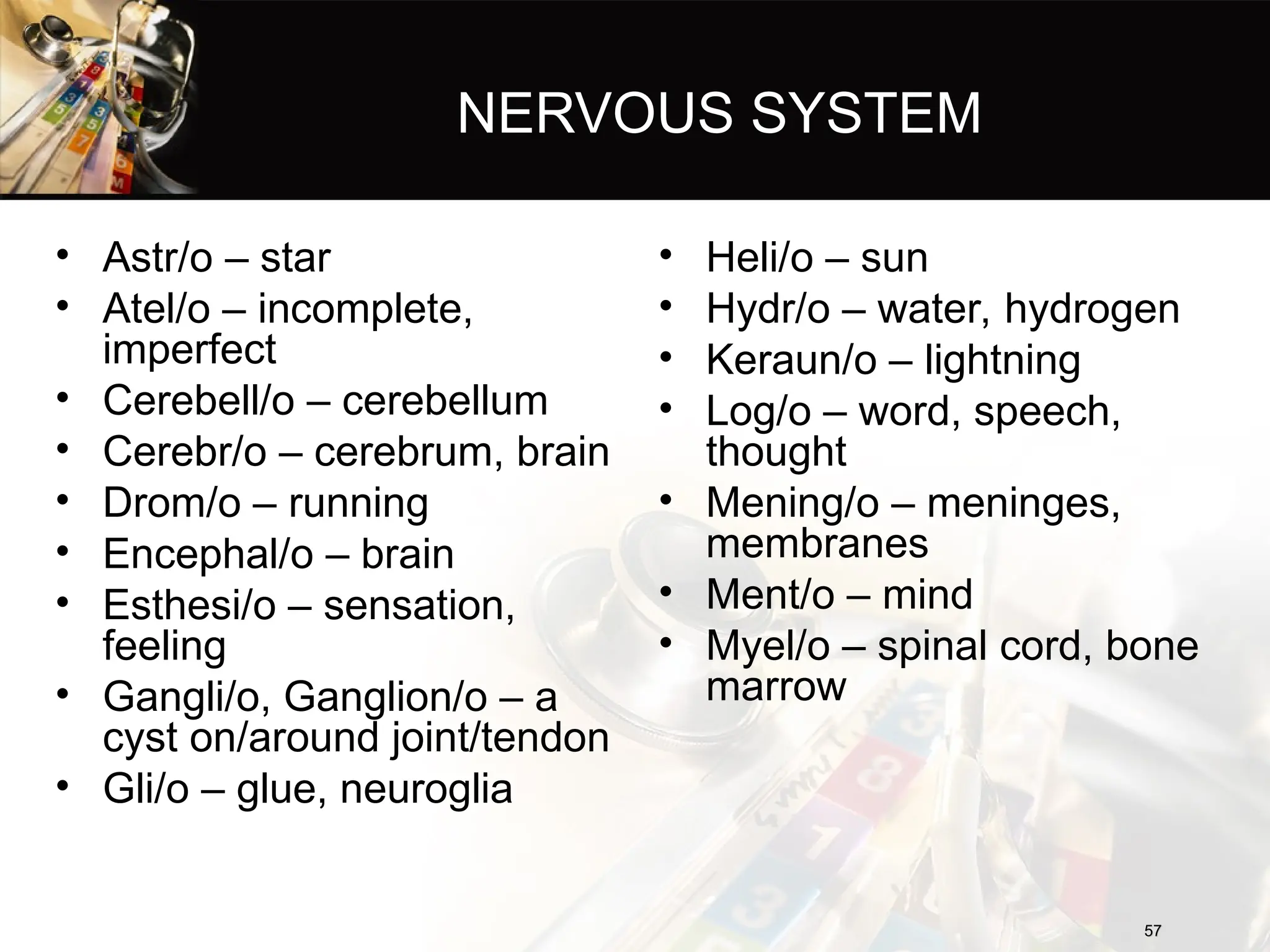
NERVOUS SYSTEM
• Astr/o – star
• Atel/o – incomplete,
imperfect
• Cerebell/o – cerebellum
• Cerebr/o – cerebrum, brain
• Drom/o – running
• Encephal/o – brain
• Esthesi/o – sensation,
feeling
• Gangli/o, Ganglion/o – a
cyst on/around joint/tendon
• Gli/o – glue, neuroglia
57
57
• Heli/o – sun
• Hydr/o – water, hydrogen
• Keraun/o – lightning
• Log/o – word, speech,
thought
• Mening/o – meninges,
membranes
• Ment/o – mind
• Myel/o – spinal cord, bone
marrow
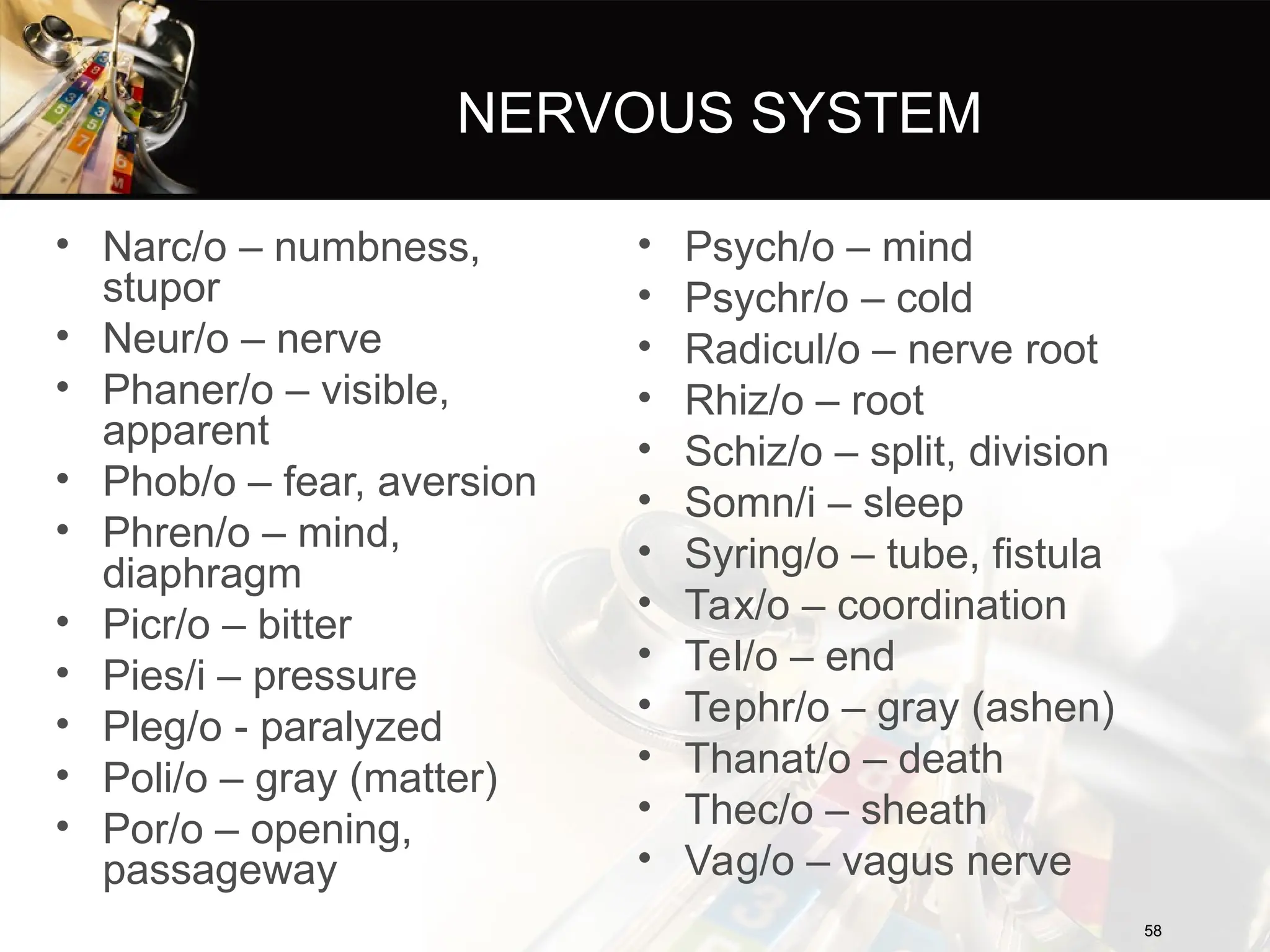
NERVOUS SYSTEM
• Narc/o – numbness,
stupor
• Neur/o – nerve
• Phaner/o – visible,
apparent
• Phob/o – fear, aversion
• Phren/o – mind,
diaphragm
• Picr/o – bitter
• Pies/i – pressure
• Pleg/o - paralyzed
• Poli/o – gray (matter)
• Por/o – opening,
passageway
58
58
• Psych/o – mind
• Psychr/o – cold
• Radicul/o – nerve root
• Rhiz/o – root
• Schiz/o – split, division
• Somn/i – sleep
• Syring/o – tube, fistula
• Tax/o – coordination
• Tel/o – end
• Tephr/o – gray (ashen)
• Thanat/o – death
• Thec/o – sheath
• Vag/o – vagus nerve
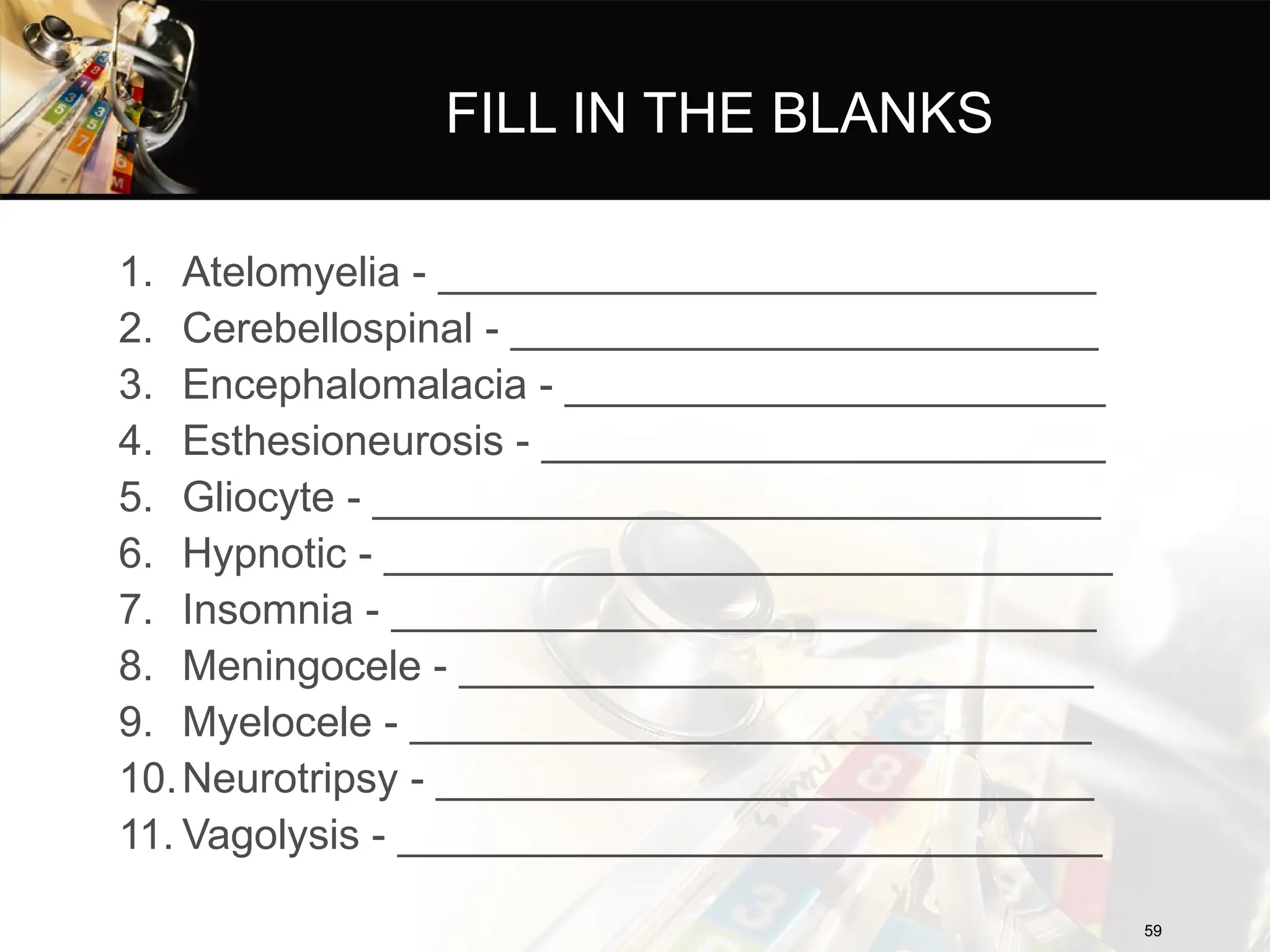
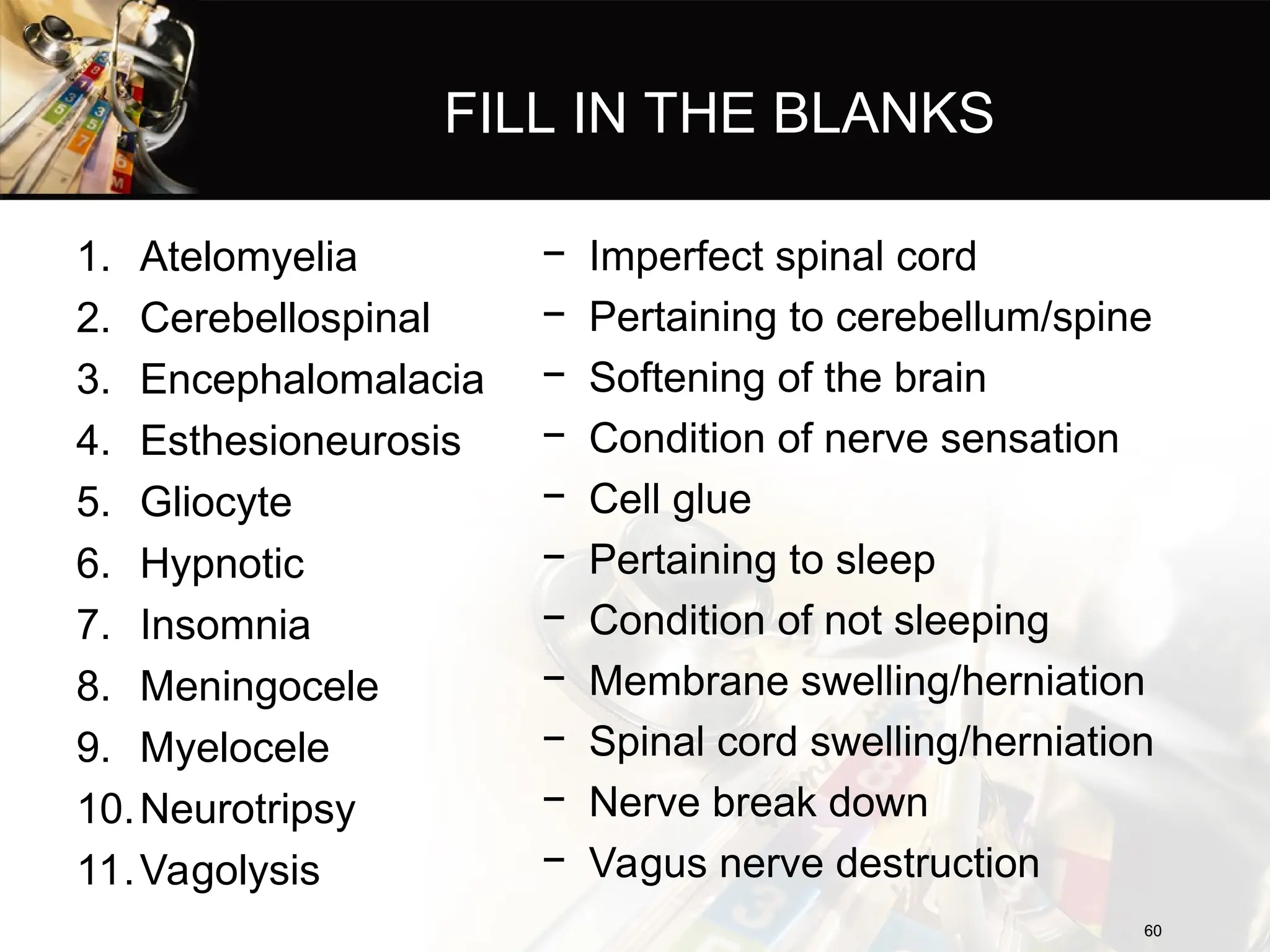
FILL IN THE BLANKS
1. Atelomyelia - ____________________________
2. Cerebellospinal - _________________________
3. Encephalomalacia - _______________________
4. Esthesioneurosis - ________________________
5. Gliocyte - _______________________________
6. Hypnotic - _______________________________
7. Insomnia - ______________________________
8. Meningocele - ___________________________
9. Myelocele - _____________________________
10.Neurotripsy - ____________________________
11. Vagolysis - ______________________________
59
59
FILL IN THE BLANKS
1. Atelomyelia
2. Cerebellospinal
3. Encephalomalacia
4. Esthesioneurosis
5. Gliocyte
6. Hypnotic
7. Insomnia
8. Meningocele
9. Myelocele
10.Neurotripsy
11.Vagolysis
− Imperfect spinal cord
− Pertaining to cerebellum/spine
− Softening of the brain
− Condition of nerve sensation
− Cell glue
− Pertaining to sleep
− Condition of not sleeping
− Membrane swelling/herniation
− Spinal cord swelling/herniation
− Nerve break down
− Vagus nerve destruction
60
60
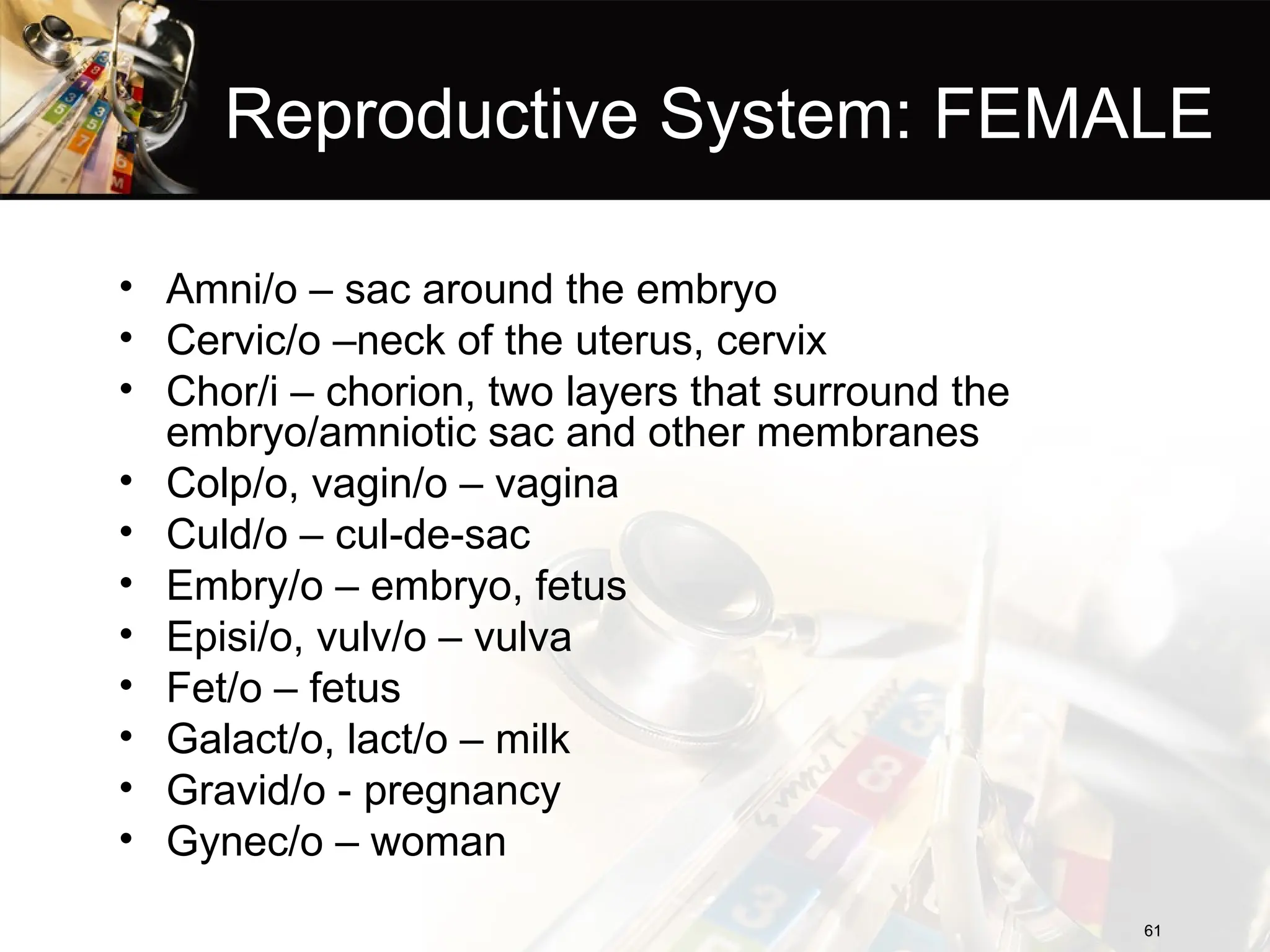
Reproductive System: FEMALE
• Amni/o – sac around the embryo
• Cervic/o –neck of the uterus, cervix
• Chor/i – chorion, two layers that surround the
embryo/amniotic sac and other membranes
• Colp/o, vagin/o – vagina
• Culd/o – cul-de-sac
• Embry/o – embryo, fetus
• Episi/o, vulv/o – vulva
• Fet/o – fetus
• Galact/o, lact/o – milk
• Gravid/o - pregnancy
• Gynec/o – woman
61
61
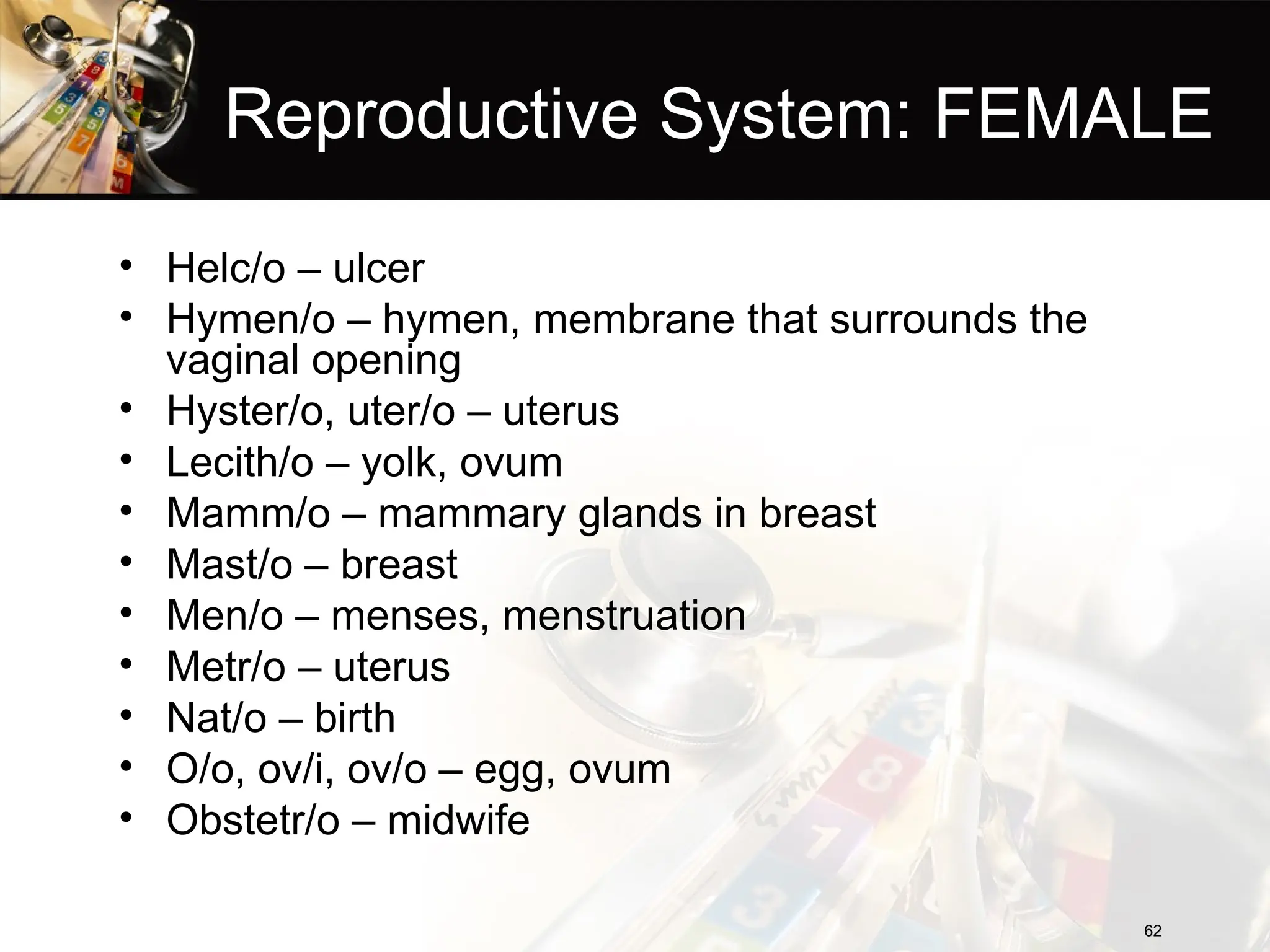
Reproductive System: FEMALE
• Helc/o – ulcer
• Hymen/o – hymen, membrane that surrounds the
vaginal opening
• Hyster/o, uter/o – uterus
• Lecith/o – yolk, ovum
• Mamm/o – mammary glands in breast
• Mast/o – breast
• Men/o – menses, menstruation
• Metr/o – uterus
• Nat/o – birth
• O/o, ov/i, ov/o – egg, ovum
• Obstetr/o – midwife
62
62
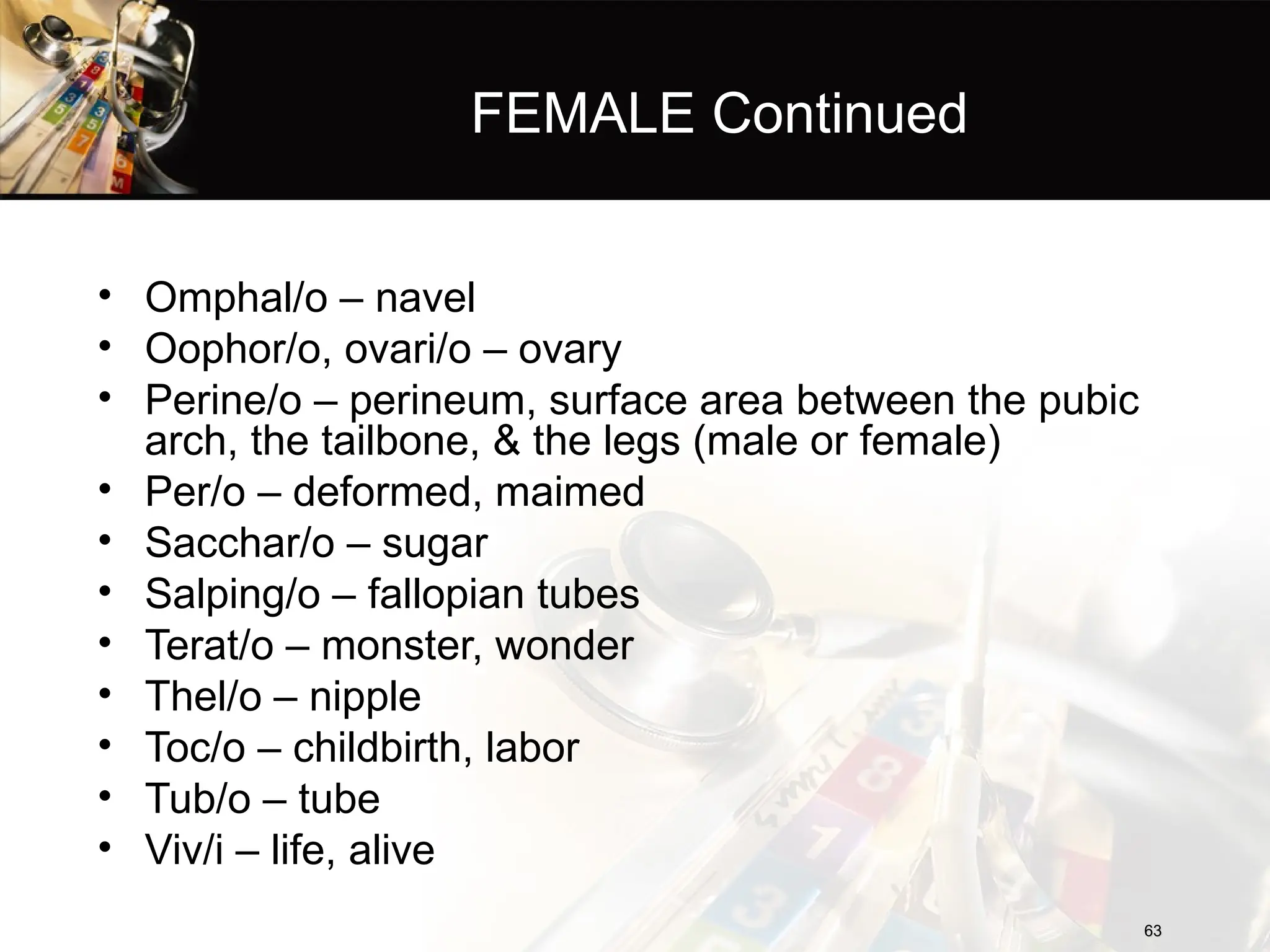
FEMALE Continued
• Omphal/o – navel
• Oophor/o, ovari/o – ovary
• Perine/o – perineum, surface area between the pubic
arch, the tailbone, & the legs (male or female)
• Per/o – deformed, maimed
• Sacchar/o – sugar
• Salping/o – fallopian tubes
• Terat/o – monster, wonder
• Thel/o – nipple
• Toc/o – childbirth, labor
• Tub/o – tube
• Viv/i – life, alive
63
63
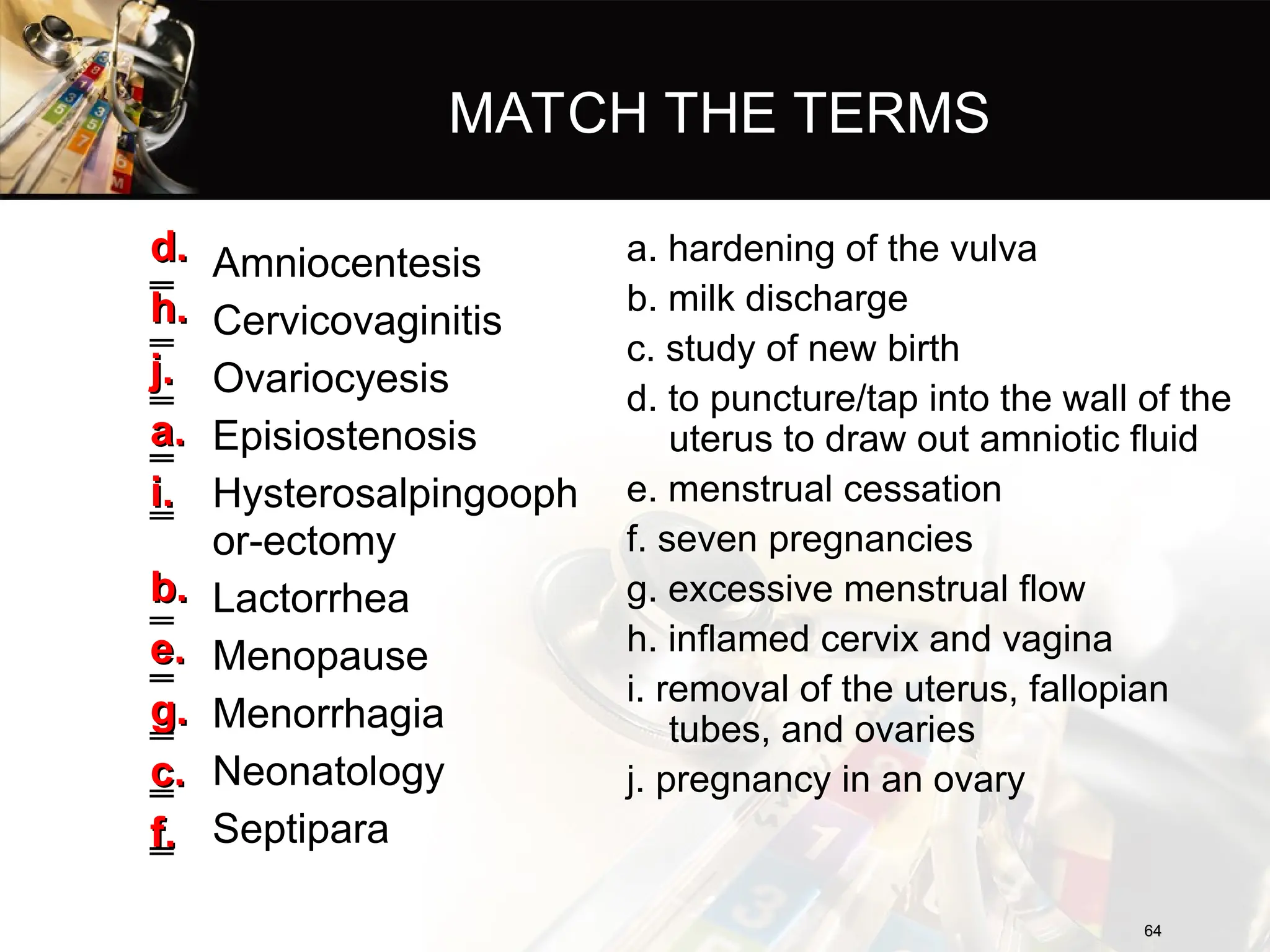
MATCH THE TERMS
‗ Amniocentesis
‗ Cervicovaginitis
‗ Ovariocyesis
‗ Episiostenosis
‗ Hysterosalpingooph
or-ectomy
‗ Lactorrhea
‗ Menopause
‗ Menorrhagia
‗ Neonatology
‗ Septipara
a. hardening of the vulva
b. milk discharge
c. study of new birth
d. to puncture/tap into the wall of the
uterus to draw out amniotic fluid
e. menstrual cessation
f. seven pregnancies
g. excessive menstrual flow
h. inflamed cervix and vagina
i. removal of the uterus, fallopian
tubes, and ovaries
j. pregnancy in an ovary
64
64
d.
d.
h.
h.
j.
j.
a.
a.
i.
i.
b.
b.
e.
e.
g.
g.
c.
c.
f.
f.
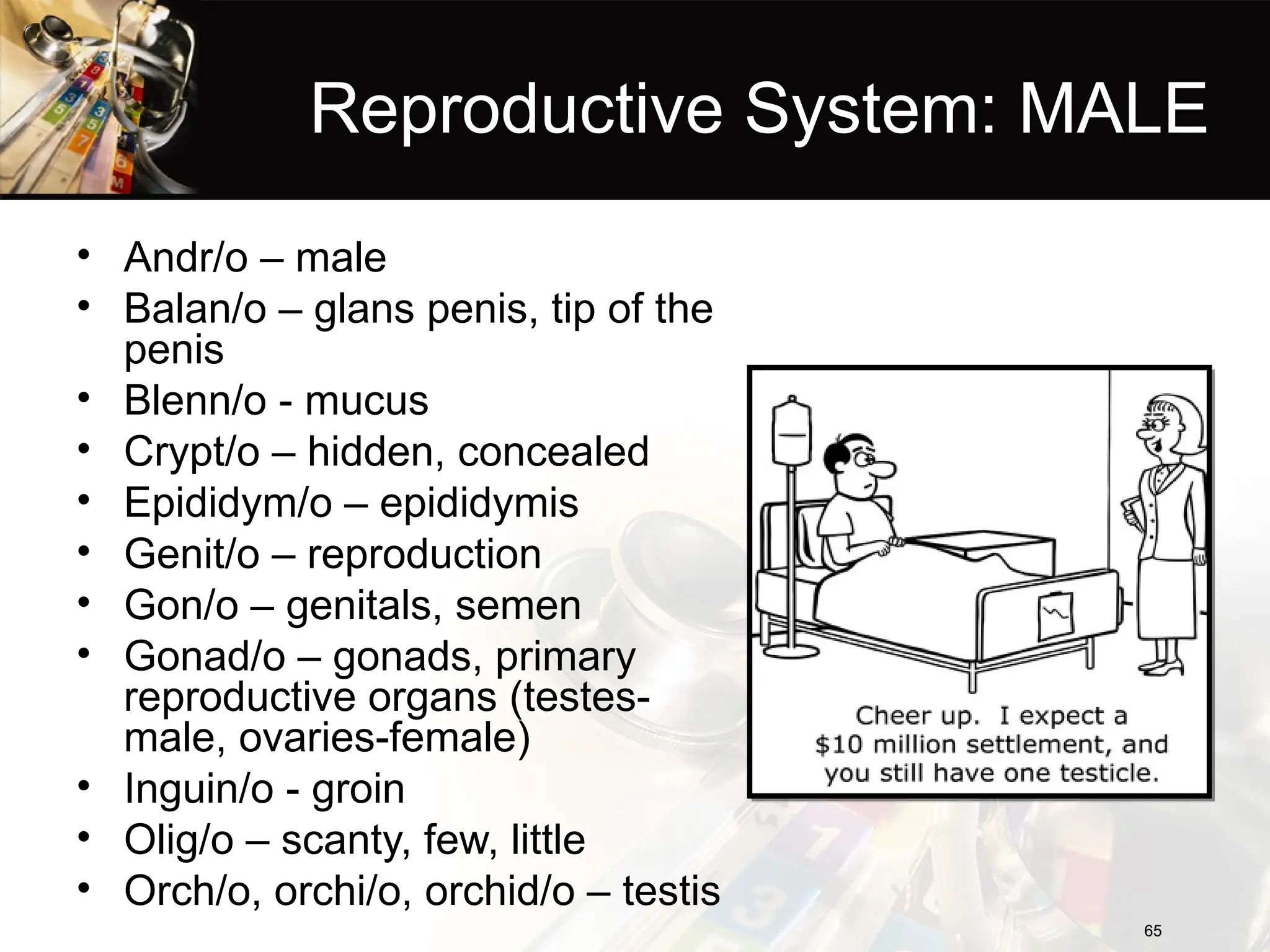
Reproductive System: MALE
• Andr/o – male
• Balan/o – glans penis, tip of the
penis
• Blenn/o - mucus
• Crypt/o – hidden, concealed
• Epididym/o – epididymis
• Genit/o – reproduction
• Gon/o – genitals, semen
• Gonad/o – gonads, primary
reproductive organs (testes-
male, ovaries-female)
• Inguin/o - groin
• Olig/o – scanty, few, little
• Orch/o, orchi/o, orchid/o – testis
65
65
Reproductive System: MALE
• Osche/o – scrotum
• Phall/o – penis
• Phim/o – muzzle
• Prostat/o – prostate glands
• Semen/i - semen
• Sperm/o, spermat/o – sperm, spermatozoa
• Test/o, testicul/o – testis
• Vas/o – vas deferens, vessel
• Venere/o – sexual intercourse
• Vesicul/o – seminal vesicle, gland that produces
70% of the fluid that becomes semen
66
66
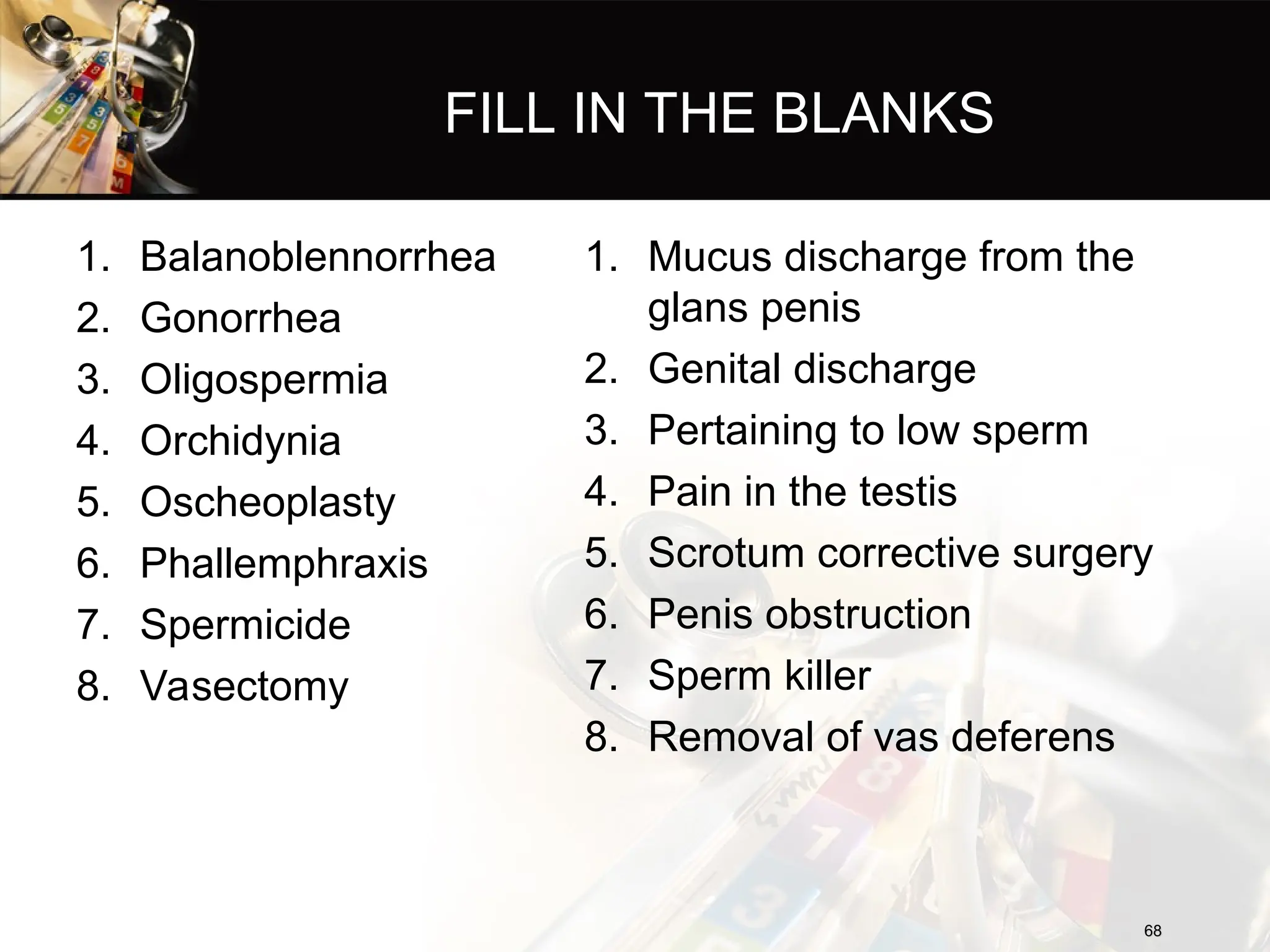
FILL IN THE BLANKS
• Balanoblennorrhea - _________________
• Gonorrhea - _______________________
• Oligospermia - _____________________
• Orchidynia - _______________________
• Oscheoplasty - _____________________
• Phallemphraxis - ____________________
• Spermicide - _______________________
• Vasectomy - _______________________
67
67
FILL IN THE BLANKS
1. Balanoblennorrhea
2. Gonorrhea
3. Oligospermia
4. Orchidynia
5. Oscheoplasty
6. Phallemphraxis
7. Spermicide
8. Vasectomy
1. Mucus discharge from the
glans penis
2. Genital discharge
3. Pertaining to low sperm
4. Pain in the testis
5. Scrotum corrective surgery
6. Penis obstruction
7. Sperm killer
8. Removal of vas deferens
68
68
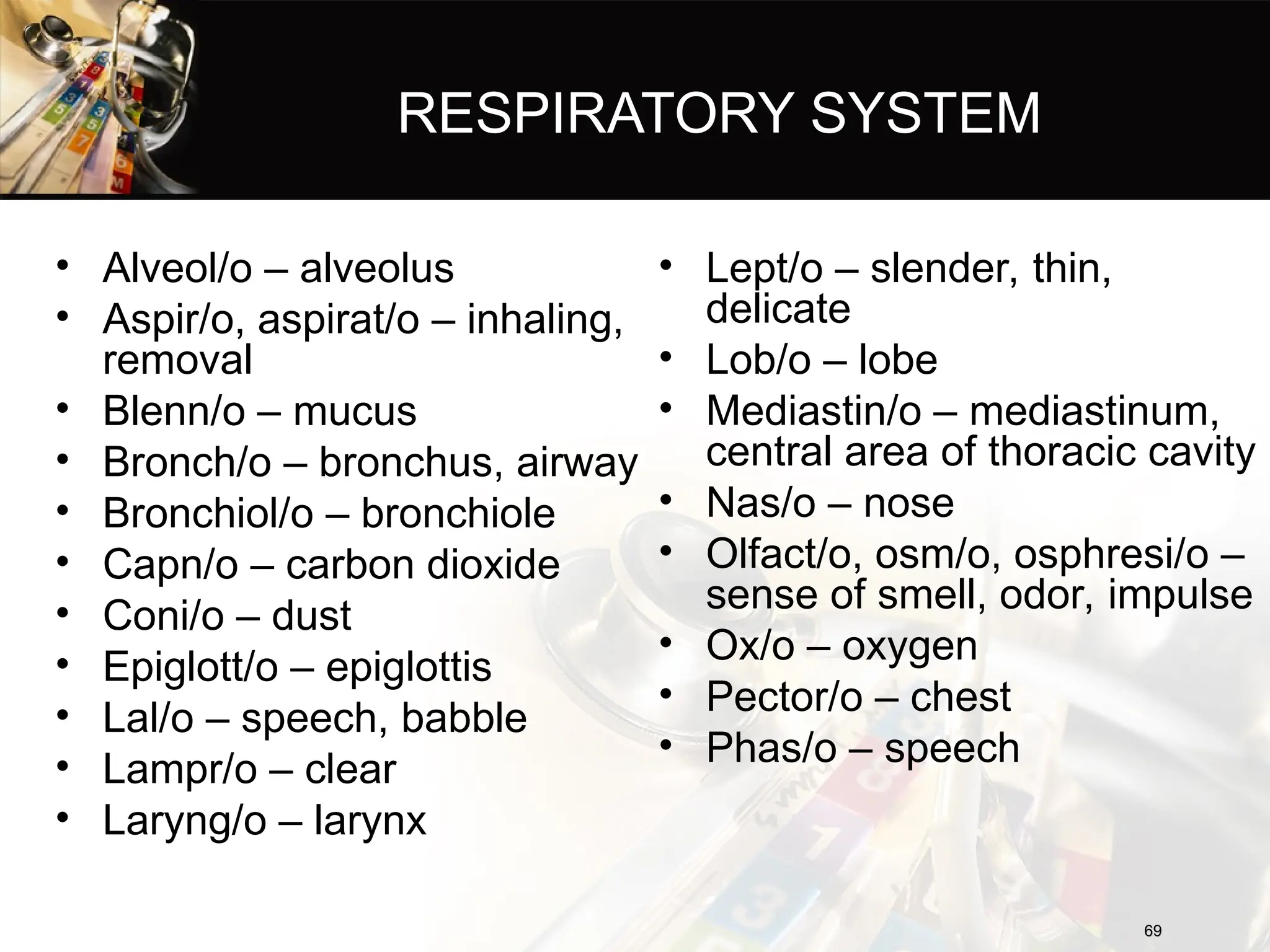
RESPIRATORY SYSTEM
• Alveol/o – alveolus
• Aspir/o, aspirat/o – inhaling,
removal
• Blenn/o – mucus
• Bronch/o – bronchus, airway
• Bronchiol/o – bronchiole
• Capn/o – carbon dioxide
• Coni/o – dust
• Epiglott/o – epiglottis
• Lal/o – speech, babble
• Lampr/o – clear
• Laryng/o – larynx
69
69
• Lept/o – slender, thin,
delicate
• Lob/o – lobe
• Mediastin/o – mediastinum,
central area of thoracic cavity
• Nas/o – nose
• Olfact/o, osm/o, osphresi/o –
sense of smell, odor, impulse
• Ox/o – oxygen
• Pector/o – chest
• Phas/o – speech
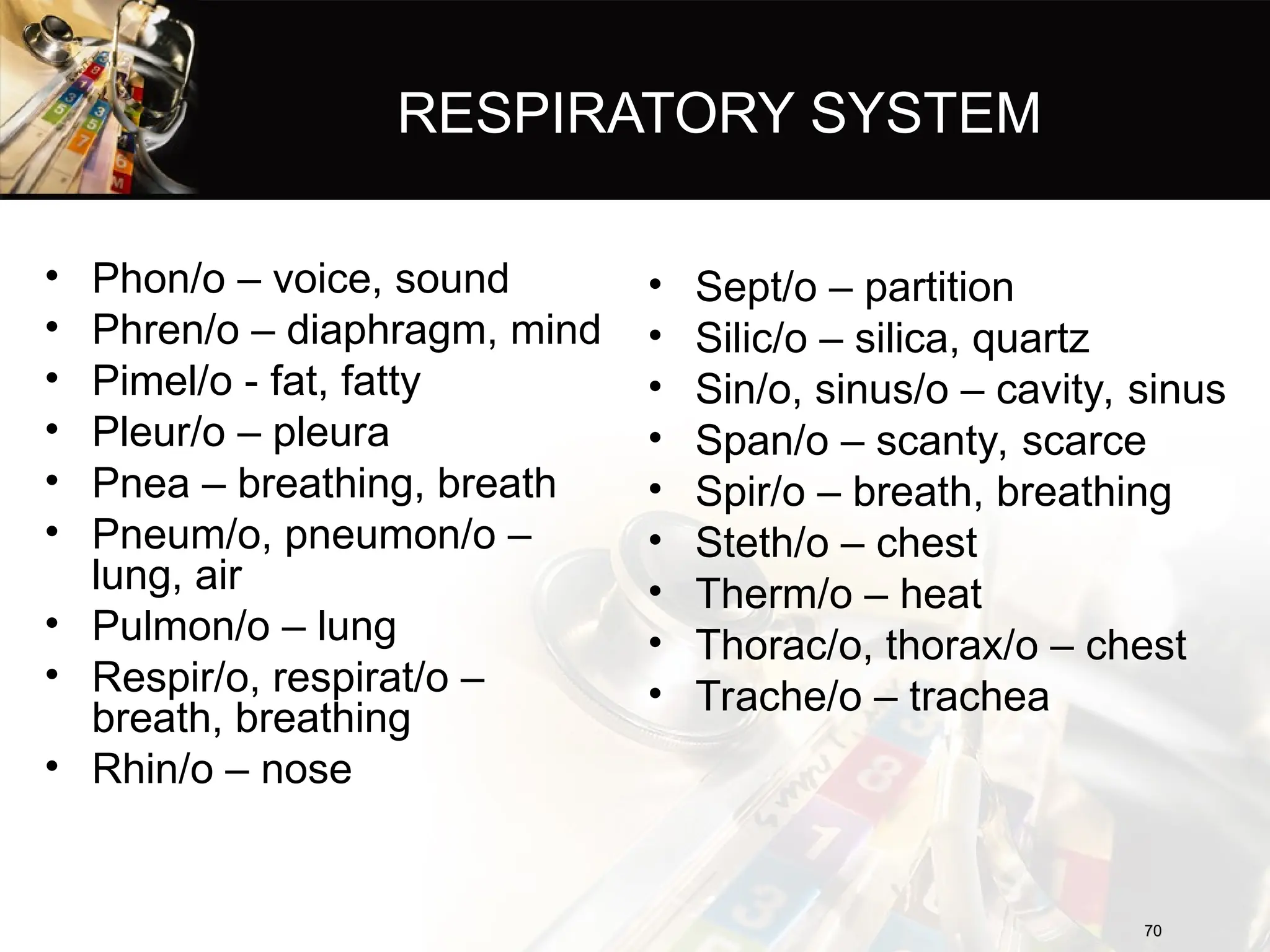
RESPIRATORY SYSTEM
• Phon/o – voice, sound
• Phren/o – diaphragm, mind
• Pimel/o - fat, fatty
• Pleur/o – pleura
• Pnea – breathing, breath
• Pneum/o, pneumon/o –
lung, air
• Pulmon/o – lung
• Respir/o, respirat/o –
breath, breathing
• Rhin/o – nose
70
70
• Sept/o – partition
• Silic/o – silica, quartz
• Sin/o, sinus/o – cavity, sinus
• Span/o – scanty, scarce
• Spir/o – breath, breathing
• Steth/o – chest
• Therm/o – heat
• Thorac/o, thorax/o – chest
• Trache/o – trachea
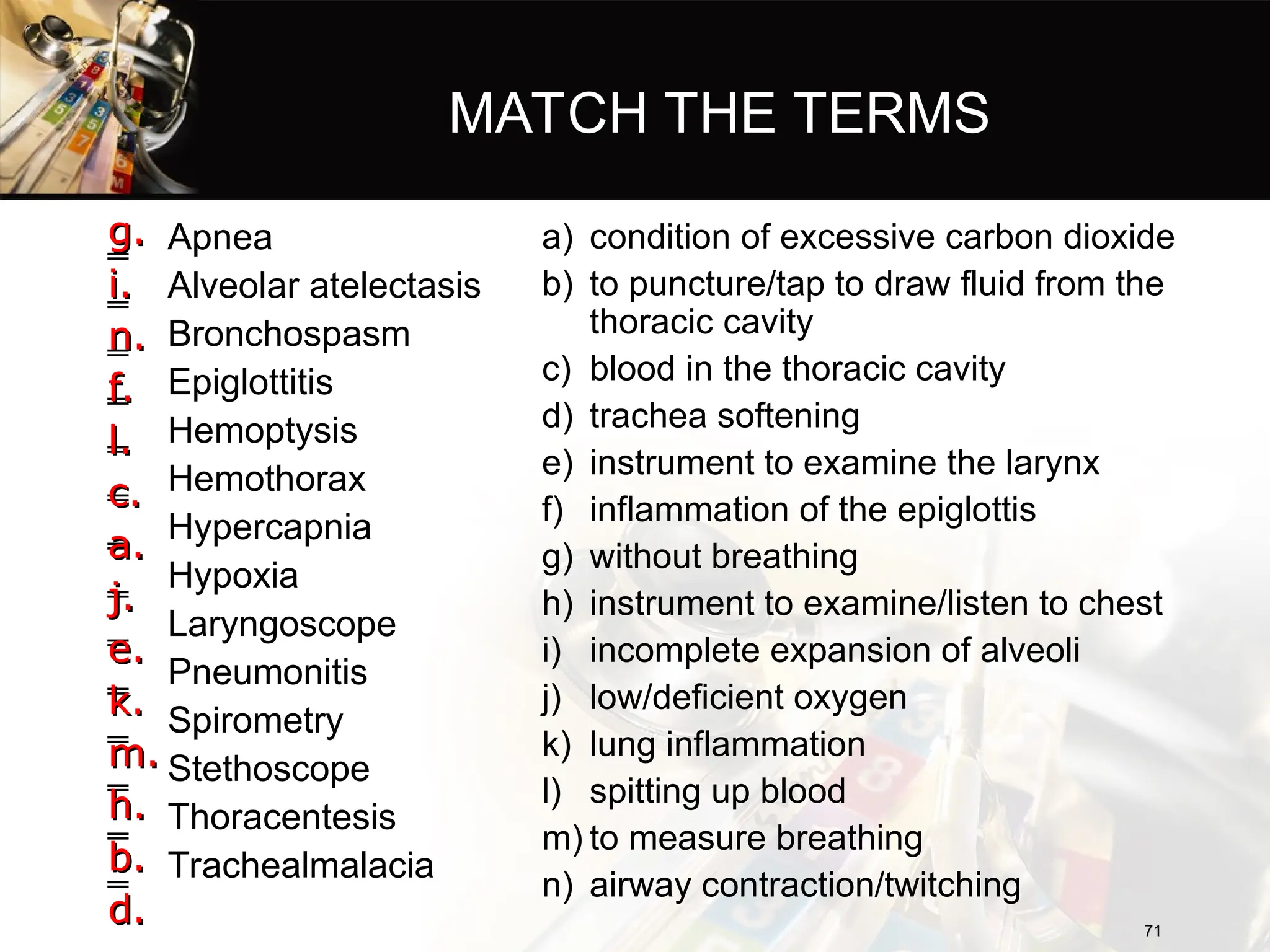
MATCH THE TERMS
‗ Apnea
‗ Alveolar atelectasis
‗ Bronchospasm
‗ Epiglottitis
‗ Hemoptysis
‗ Hemothorax
‗ Hypercapnia
‗ Hypoxia
‗ Laryngoscope
‗ Pneumonitis
‗ Spirometry
‗ Stethoscope
‗ Thoracentesis
‗ Trachealmalacia
a) condition of excessive carbon dioxide
b) to puncture/tap to draw fluid from the
thoracic cavity
c) blood in the thoracic cavity
d) trachea softening
e) instrument to examine the larynx
f) inflammation of the epiglottis
g) without breathing
h) instrument to examine/listen to chest
i) incomplete expansion of alveoli
j) low/deficient oxygen
k) lung inflammation
l) spitting up blood
m) to measure breathing
n) airway contraction/twitching
71
71
g.
g.
i.
i.
n.
n.
f.
f.
l.
l.
c.
c.
a.
a.
j.
j.
e.
e.
k.
k.
m.
m.
h.
h.
b.
b.
d.
d.
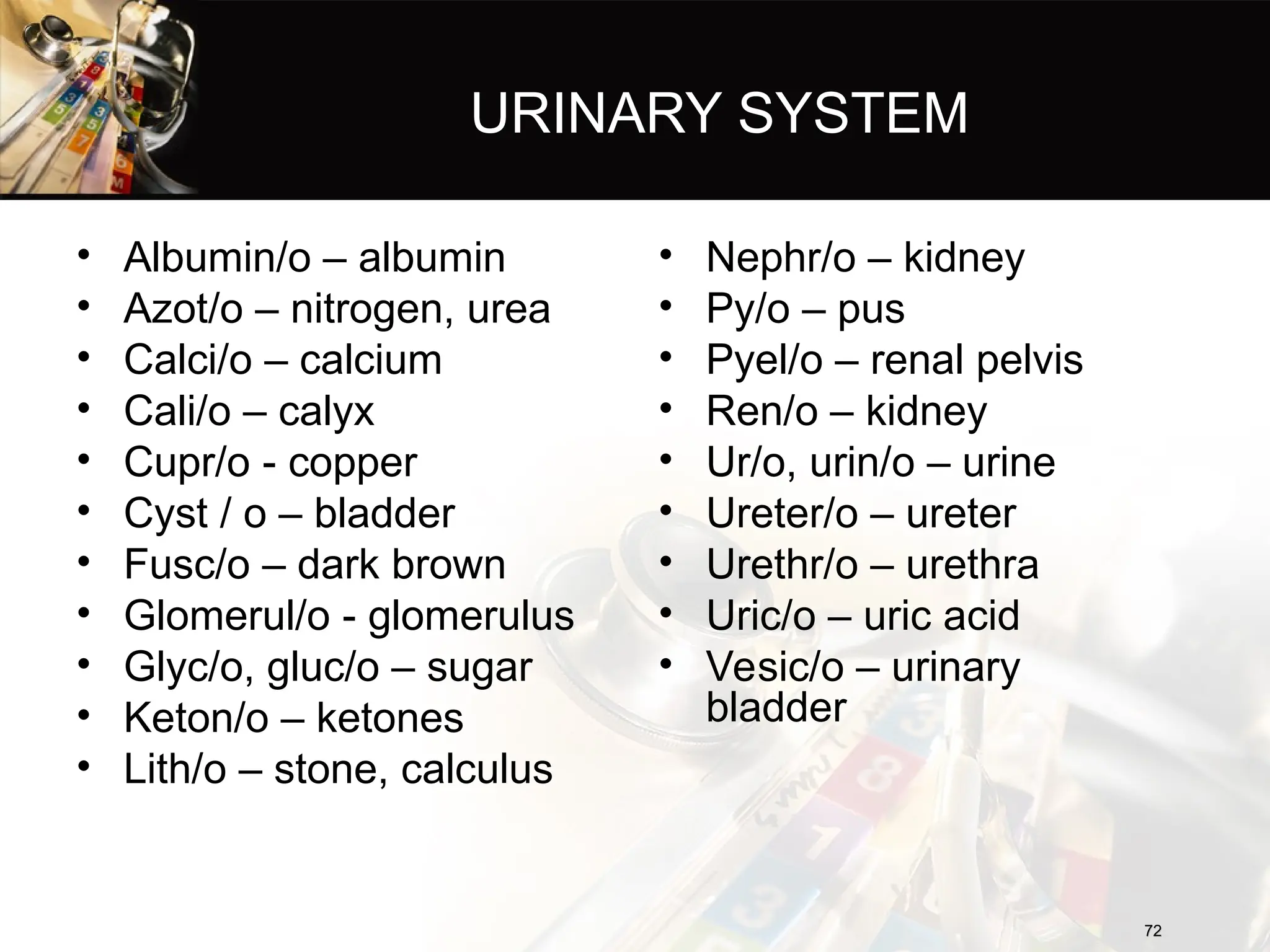
URINARY SYSTEM
• Albumin/o – albumin
• Azot/o – nitrogen, urea
• Calci/o – calcium
• Cali/o – calyx
• Cupr/o - copper
• Cyst / o – bladder
• Fusc/o – dark brown
• Glomerul/o - glomerulus
• Glyc/o, gluc/o – sugar
• Keton/o – ketones
• Lith/o – stone, calculus
72
72
• Nephr/o – kidney
• Py/o – pus
• Pyel/o – renal pelvis
• Ren/o – kidney
• Ur/o, urin/o – urine
• Ureter/o – ureter
• Urethr/o – urethra
• Uric/o – uric acid
• Vesic/o – urinary
bladder
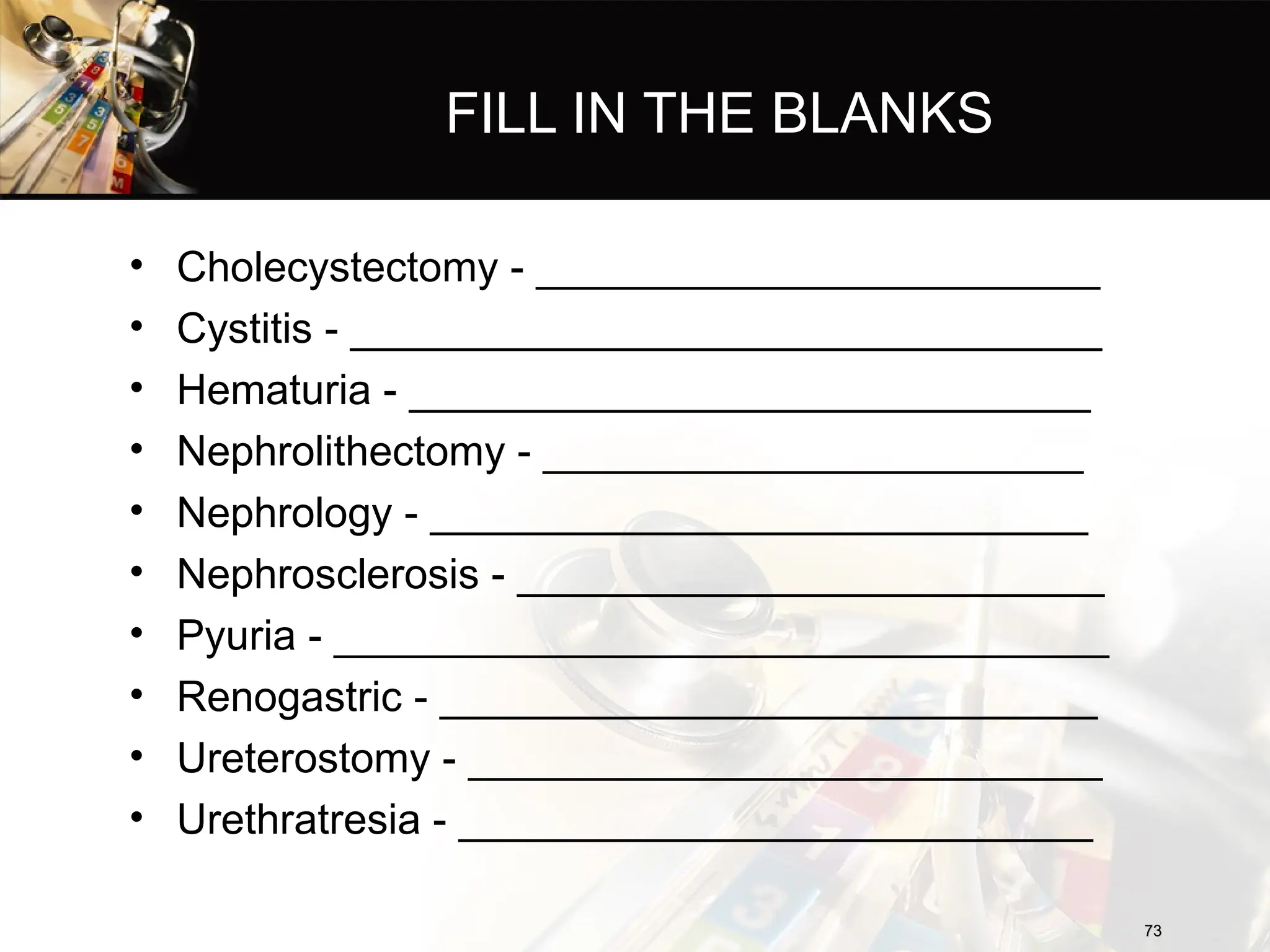
FILL IN THE BLANKS
• Cholecystectomy - ________________________
• Cystitis - ________________________________
• Hematuria - _____________________________
• Nephrolithectomy - _______________________
• Nephrology - ____________________________
• Nephrosclerosis - _________________________
• Pyuria - _________________________________
• Renogastric - ____________________________
• Ureterostomy - ___________________________
• Urethratresia - ___________________________
73
73
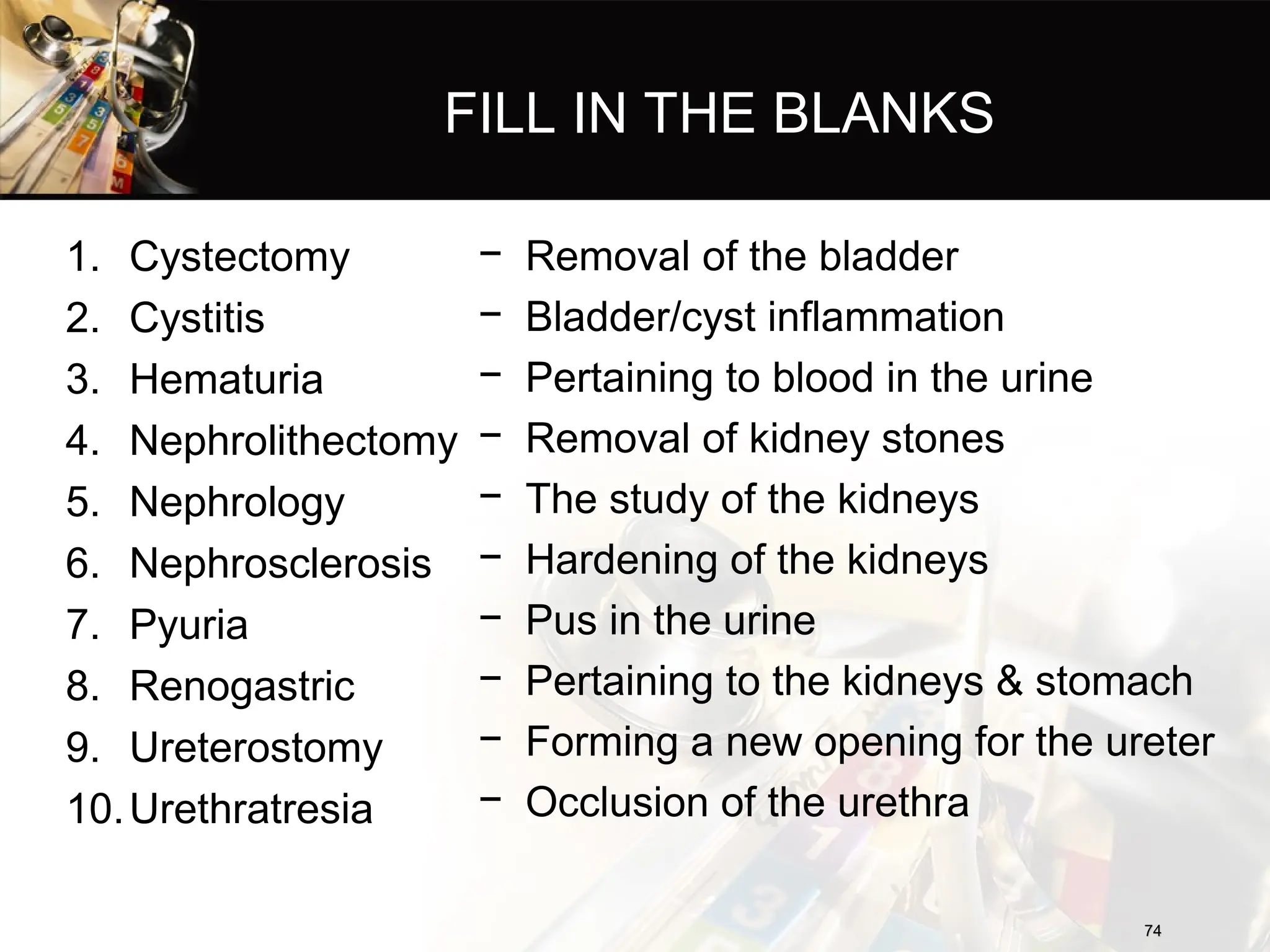
FILL IN THE BLANKS
1. Cystectomy
2. Cystitis
3. Hematuria
4. Nephrolithectomy
5. Nephrology
6. Nephrosclerosis
7. Pyuria
8. Renogastric
9. Ureterostomy
10.Urethratresia
− Removal of the bladder
− Bladder/cyst inflammation
− Pertaining to blood in the urine
− Removal of kidney stones
− The study of the kidneys
− Hardening of the kidneys
− Pus in the urine
− Pertaining to the kidneys & stomach
− Forming a new opening for the ureter
− Occlusion of the urethra
74
74
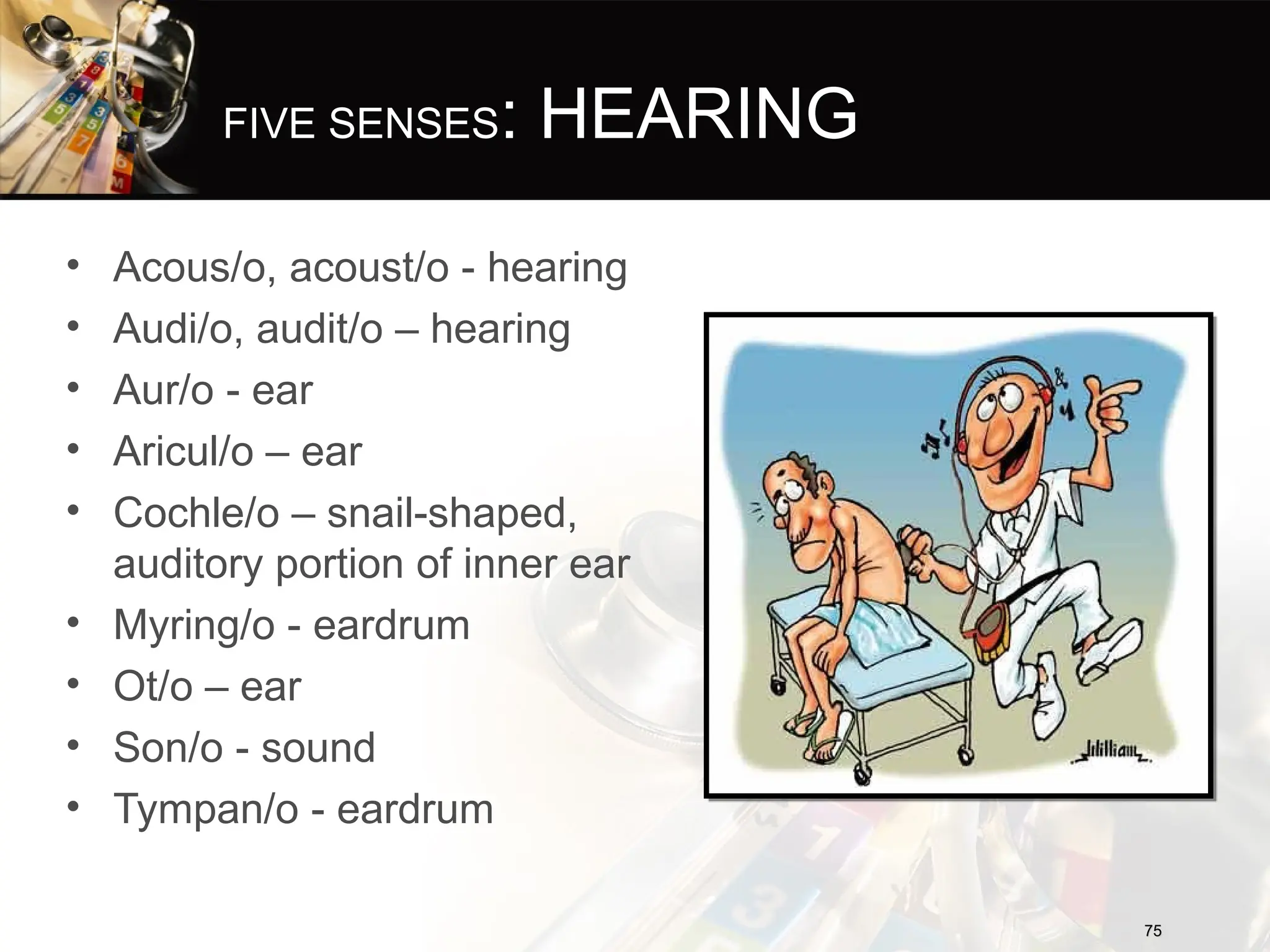
FIVE SENSES: HEARING
• Acous/o, acoust/o - hearing
• Audi/o, audit/o – hearing
• Aur/o - ear
• Aricul/o – ear
• Cochle/o – snail-shaped,
auditory portion of inner ear
• Myring/o - eardrum
• Ot/o – ear
• Son/o - sound
• Tympan/o - eardrum
75
75
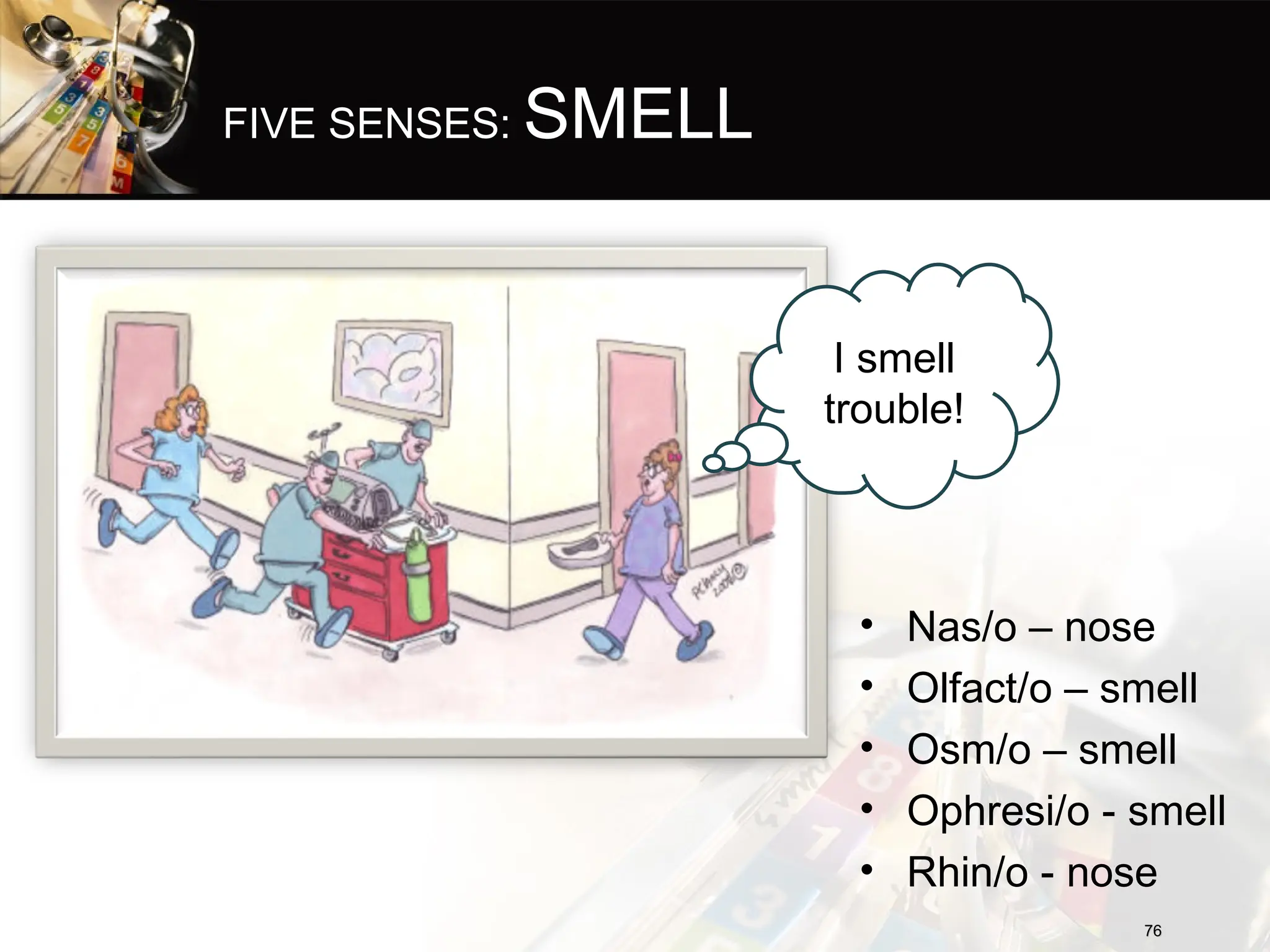
FIVE SENSES: SMELL
• Nas/o – nose
• Olfact/o – smell
• Osm/o – smell
• Ophresi/o - smell
• Rhin/o - nose
76
76
I smell
trouble!
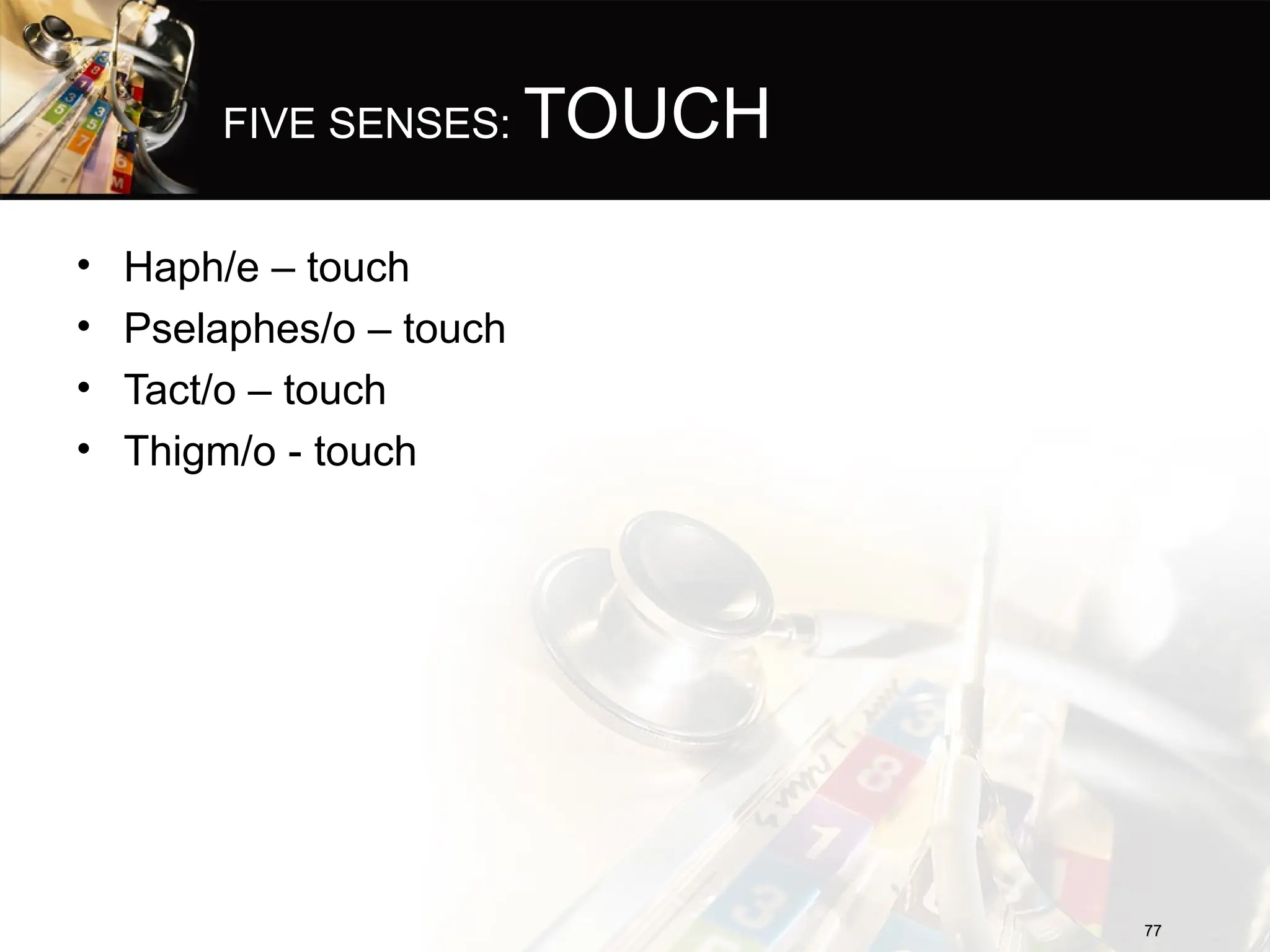
FIVE SENSES: TOUCH
• Haph/e – touch
• Pselaphes/o – touch
• Tact/o – touch
• Thigm/o - touch
77
77
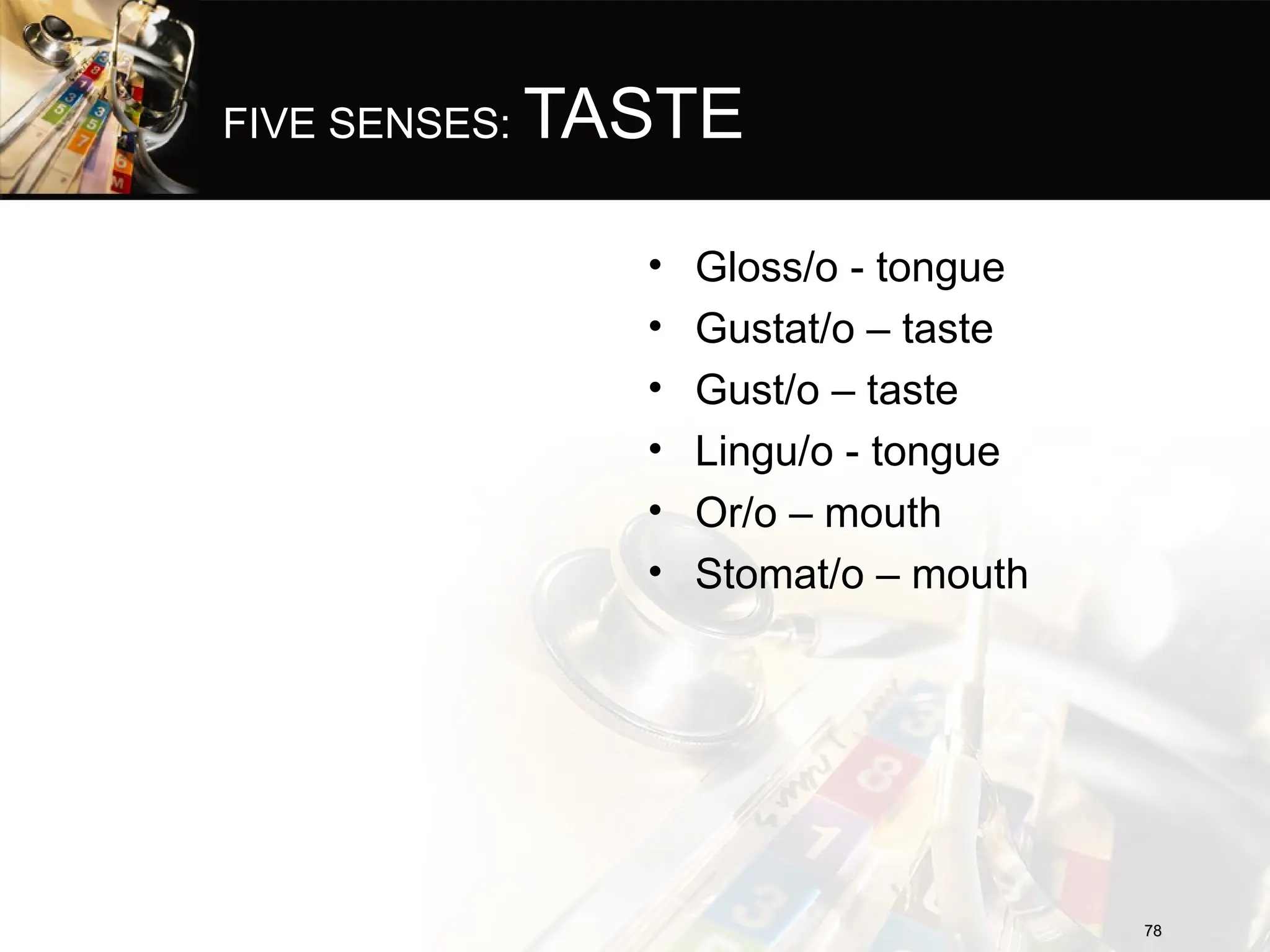
FIVE SENSES: TASTE
• Gloss/o - tongue
• Gustat/o – taste
• Gust/o – taste
• Lingu/o - tongue
• Or/o – mouth
• Stomat/o – mouth
78
78
FIVE SENSES: VISION
• Blephar/o, palpebr/o –
eyelid
• Conjunctiv/o –
conjunctiva, thin
membrane that covers
the inside of the eyelid &
outside of eyeball
• Cor/o, pupill/o – pupil
• Corne/o – cornea
• Dacry/o – tear
• Dipl/o – double
• Hygr/o – moisture
• Ir/o, irid/o – iris
• Kerat/o – cornea
79
79
• Lacrim/o – tear/lacrimal
duct
• Logad/o – whites of the
eyes
• Ocul/o – eye
• Ophry/o – eyebrow
• Ophthalm/o – eye
• Opt/o – vision
• Phac/o, phak/o – lens
• Retin/o – retina
• Scler/o – sclera
• Stigmat/o – point
• Uve/o – uvea
• Vitre/o - glassy
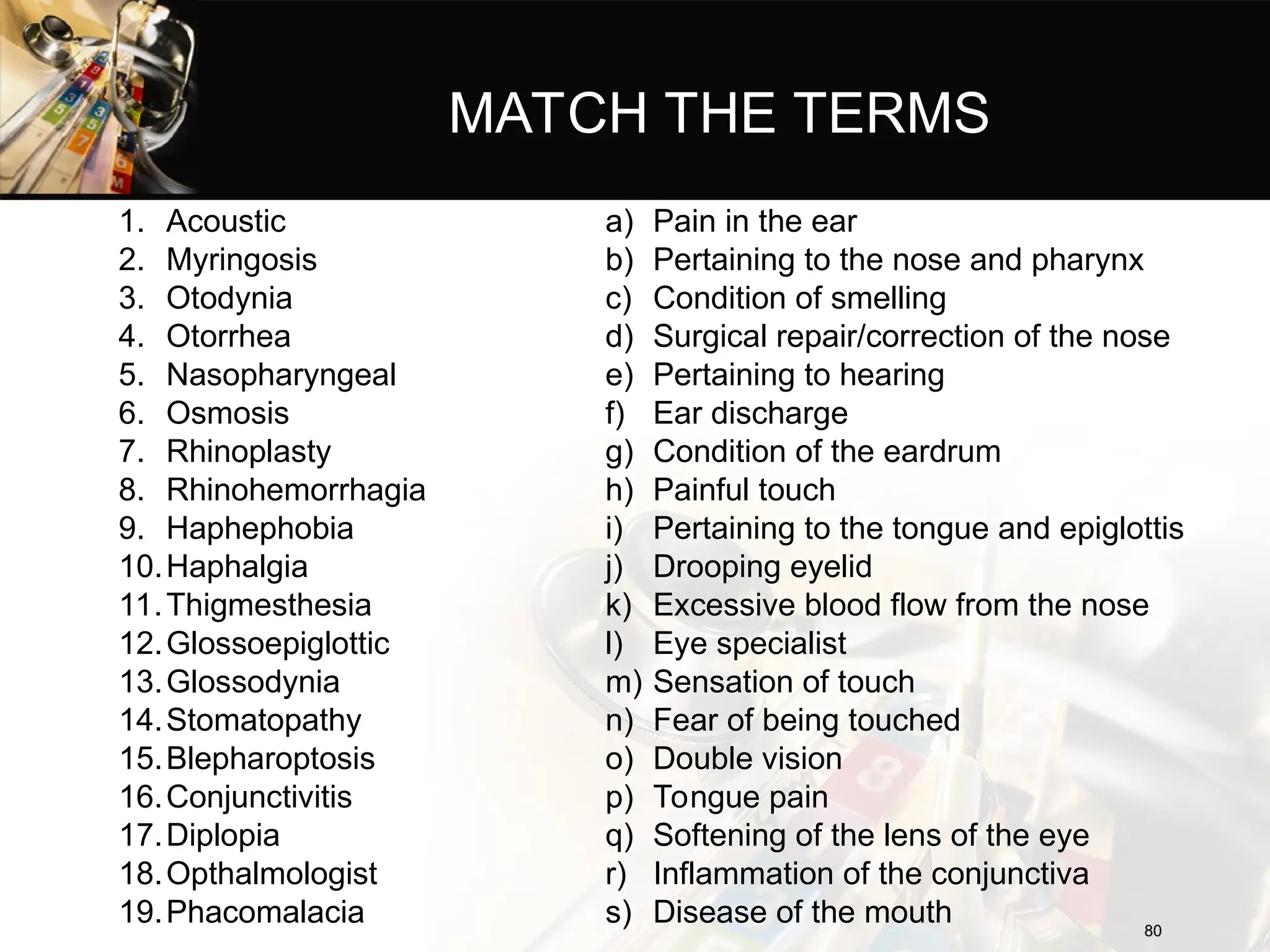
MATCH THE TERMS
1. Acoustic
2. Myringosis
3. Otodynia
4. Otorrhea
5. Nasopharyngeal
6. Osmosis
7. Rhinoplasty
8. Rhinohemorrhagia
9. Haphephobia
10.Haphalgia
11.Thigmesthesia
12.Glossoepiglottic
13.Glossodynia
14.Stomatopathy
15.Blepharoptosis
16.Conjunctivitis
17.Diplopia
18.Opthalmologist
19.Phacomalacia
a) Pain in the ear
b) Pertaining to the nose and pharynx
c) Condition of smelling
d) Surgical repair/correction of the nose
e) Pertaining to hearing
f) Ear discharge
g) Condition of the eardrum
h) Painful touch
i) Pertaining to the tongue and epiglottis
j) Drooping eyelid
k) Excessive blood flow from the nose
l) Eye specialist
m) Sensation of touch
n) Fear of being touched
o) Double vision
p) Tongue pain
q) Softening of the lens of the eye
r) Inflammation of the conjunctiva
s) Disease of the mouth 80
80
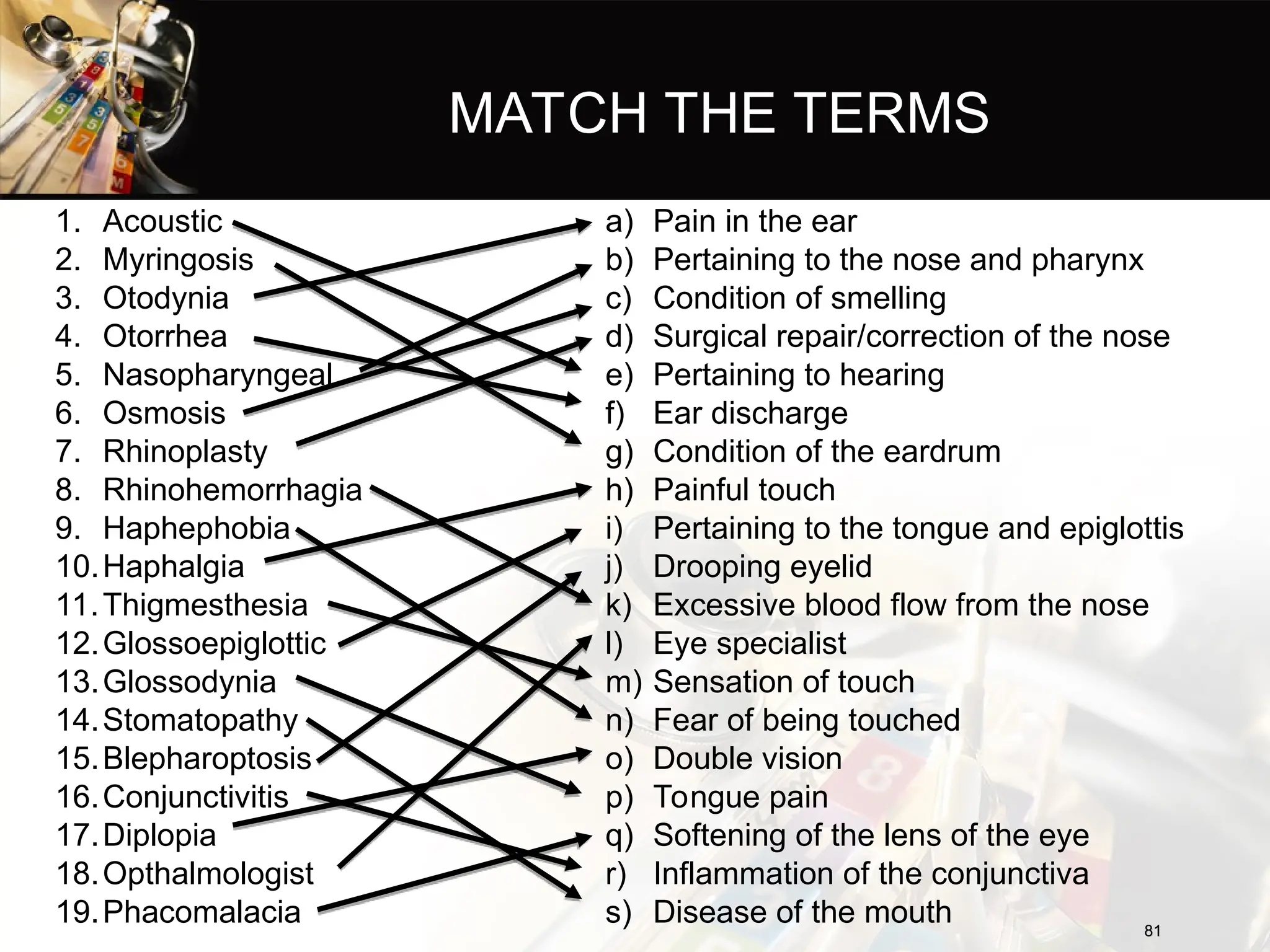
MATCH THE TERMS
1. Acoustic
2. Myringosis
3. Otodynia
4. Otorrhea
5. Nasopharyngeal
6. Osmosis
7. Rhinoplasty
8. Rhinohemorrhagia
9. Haphephobia
10.Haphalgia
11.Thigmesthesia
12.Glossoepiglottic
13.Glossodynia
14.Stomatopathy
15.Blepharoptosis
16.Conjunctivitis
17.Diplopia
18.Opthalmologist
19.Phacomalacia
a) Pain in the ear
b) Pertaining to the nose and pharynx
c) Condition of smelling
d) Surgical repair/correction of the nose
e) Pertaining to hearing
f) Ear discharge
g) Condition of the eardrum
h) Painful touch
i) Pertaining to the tongue and epiglottis
j) Drooping eyelid
k) Excessive blood flow from the nose
l) Eye specialist
m) Sensation of touch
n) Fear of being touched
o) Double vision
p) Tongue pain
q) Softening of the lens of the eye
r) Inflammation of the conjunctiva
s) Disease of the mouth 81
81
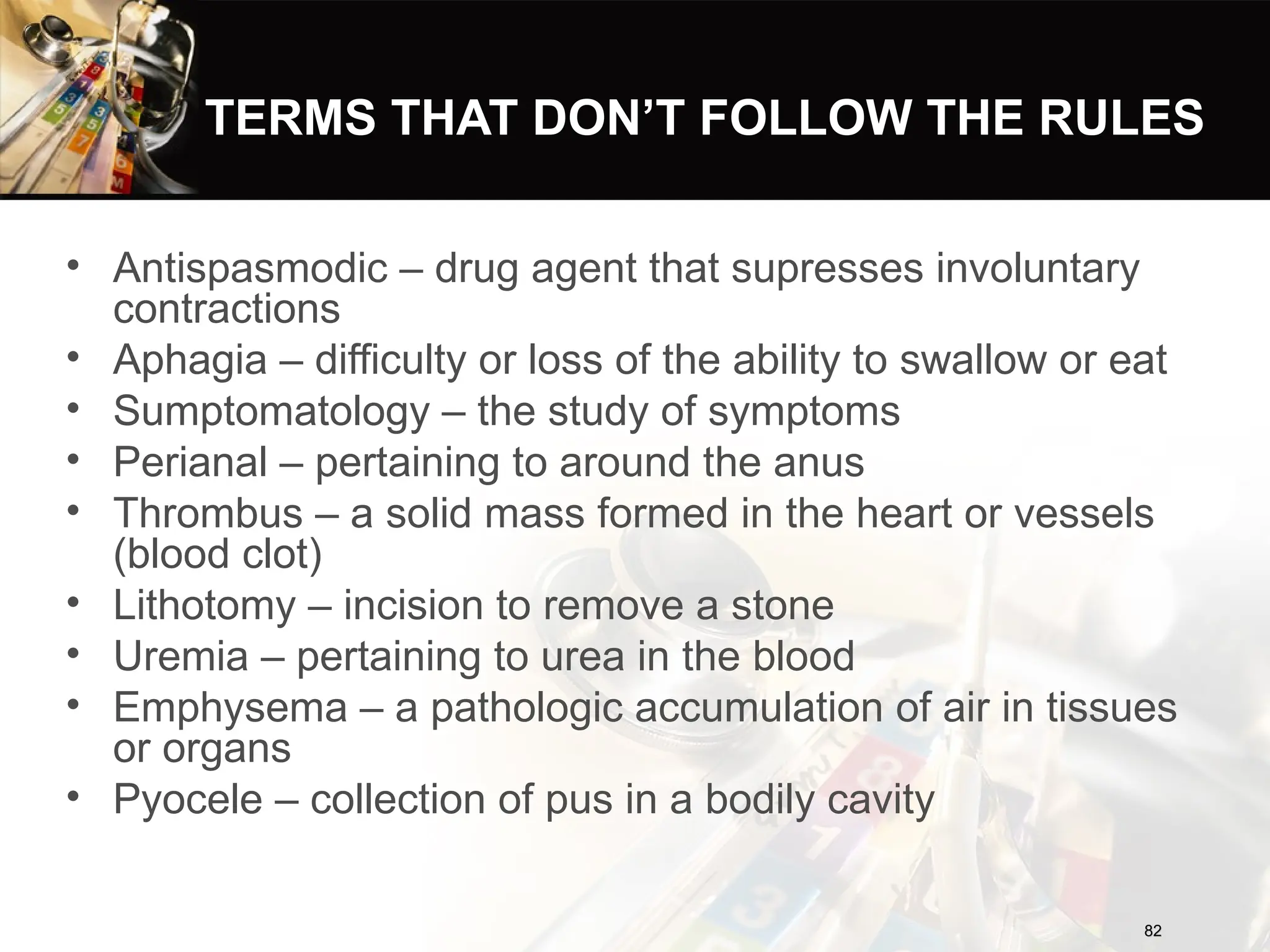
TERMS THAT DON’T FOLLOW THE RULES
• Antispasmodic – drug agent that supresses involuntary
contractions
• Aphagia – difficulty or loss of the ability to swallow or eat
• Sumptomatology – the study of symptoms
• Perianal – pertaining to around the anus
• Thrombus – a solid mass formed in the heart or vessels
(blood clot)
• Lithotomy – incision to remove a stone
• Uremia – pertaining to urea in the blood
• Emphysema – a pathologic accumulation of air in tissues
or organs
• Pyocele – collection of pus in a bodily cavity
82
82
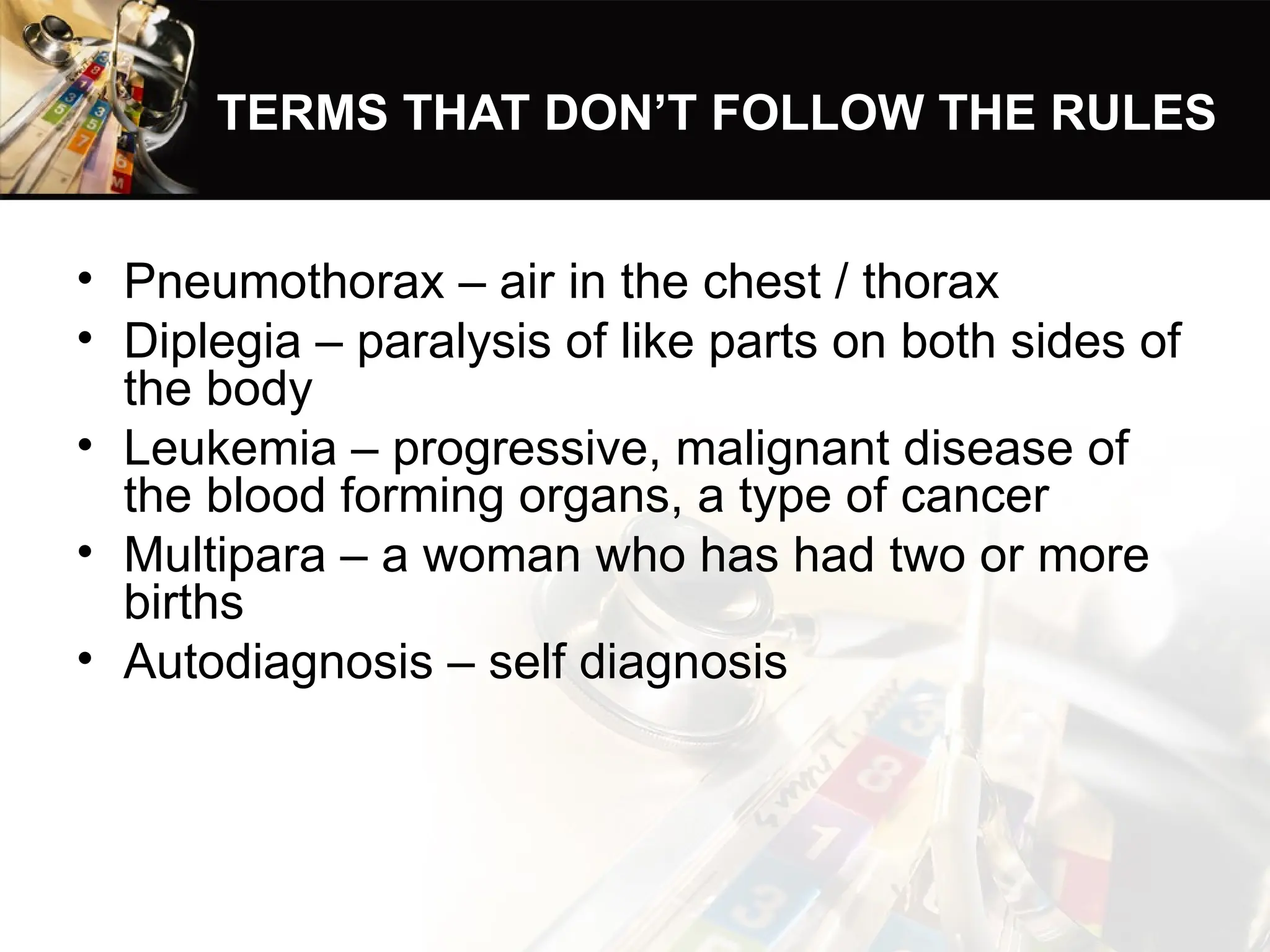
TERMS THAT DON’T FOLLOW THE RULES
• Pneumothorax – air in the chest / thorax
• Diplegia – paralysis of like parts on both sides of
the body
• Leukemia – progressive, malignant disease of
the blood forming organs, a type of cancer
• Multipara – a woman who has had two or more
births
• Autodiagnosis – self diagnosis
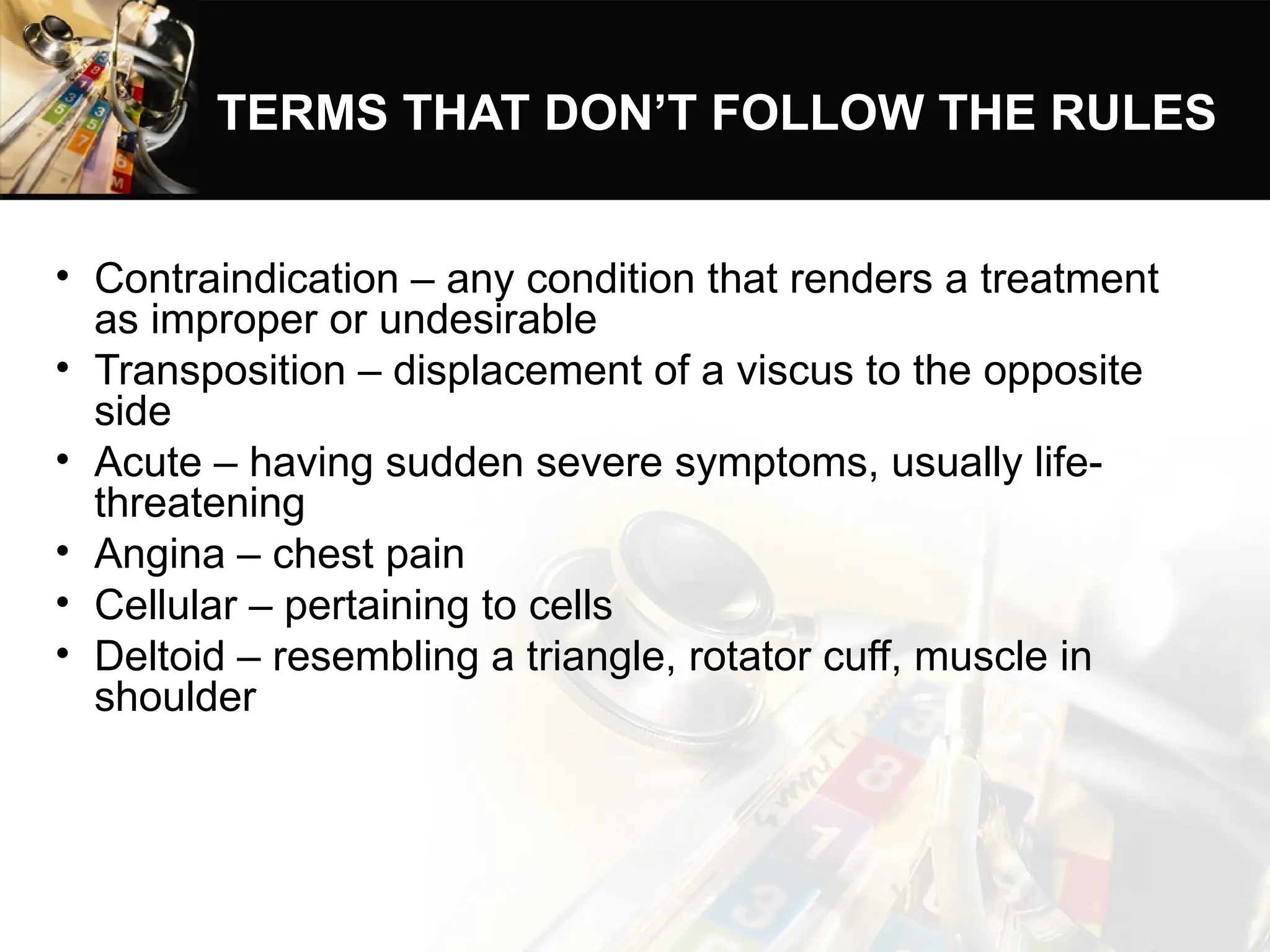
TERMS THAT DON’T FOLLOW THE RULES
• Contraindication – any condition that renders a treatment
as improper or undesirable
• Transposition – displacement of a viscus to the opposite
side
• Acute – having sudden severe symptoms, usually life-
threatening
• Angina – chest pain
• Cellular – pertaining to cells
• Deltoid – resembling a triangle, rotator cuff, muscle in
shoulder
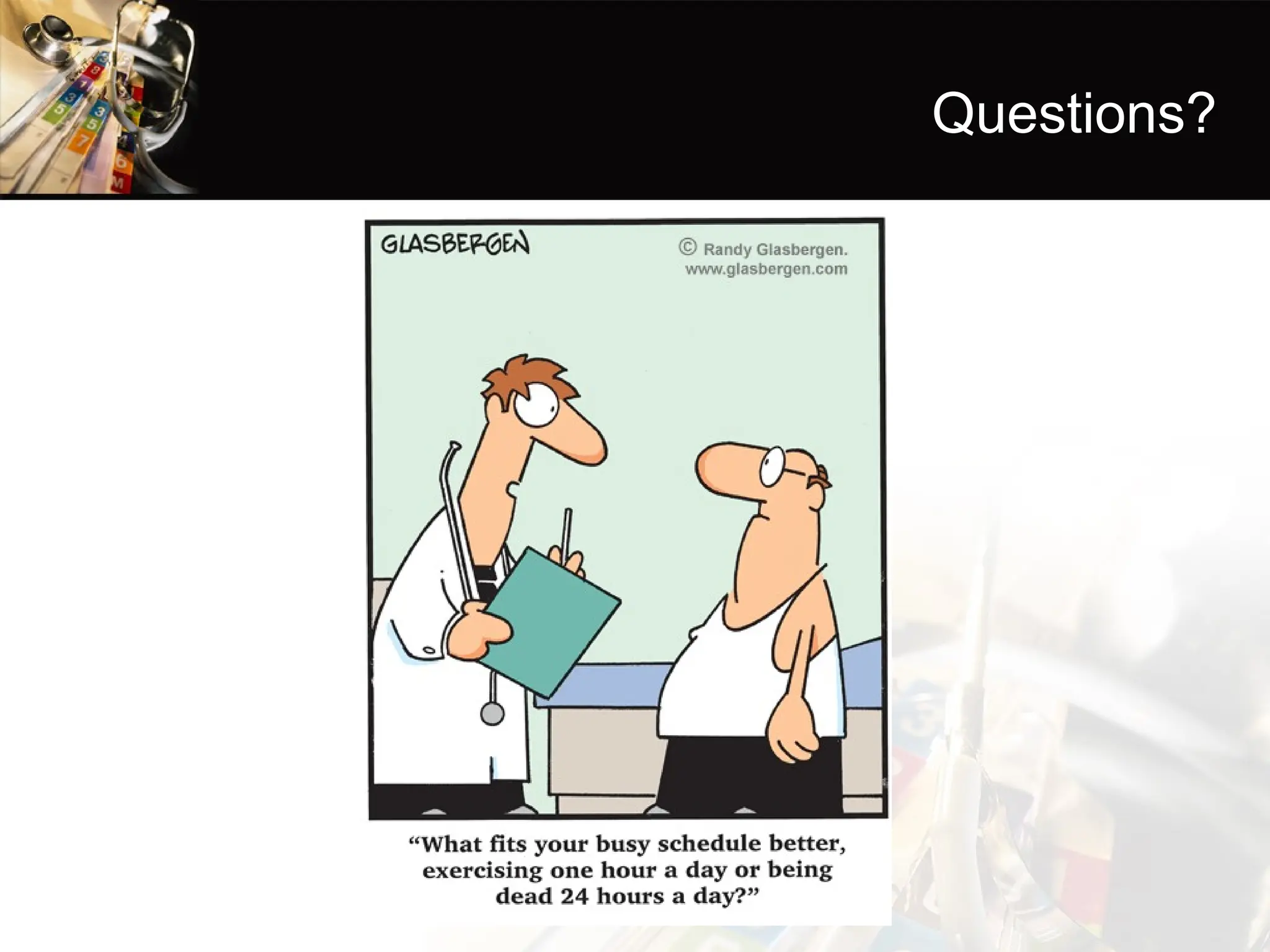
Questions?

introductiontomedicalterminology-hssedition11-2009-111102154411-phpapp02 (1).ppt

  • 2.
    Introduction LESSON #1 LESSON #1 Whenin When in doubt doubt of of the terminology, the terminology, tell your patients tell your patients they’re very sick. they’re very sick.
  • 3.
    MEDICAL TERMINOLOGY • Thewords – or terms – which make up the language of medicine are referred to as the terminology of the medical field…known as medical terminology. • Like every other language, medical terminology has changed over time and will continue to change. • Most medical terms come from the Greek and Latin languages. 3 3
  • 4.
    How It Works Mostmedical terms can be broken down into parts like a sentence. Common word parts/components:  Prefixes / Roots or Words / Suffixes Prefixes / Roots or Words / Suffixes Linking or combining vowel usually “o”, but occasionally “e” or “i”. The medical terms will contain one or more of these components. 4 4
  • 5.
    PREFIX A prefix isa word component placed in front of a root/word to change or modify its meaning. A prefix can give a root direction or position. It can also give a root a specific type/ classification, quality, or quantity. 5 5
  • 6.
    Common Prefixes • Ab-away from midline • Acu- needle • Anti- against • Auto- self • Bi- two, both, double • Dys- abnormal, bad, painful • Hemi- half • Hetero- opposite, different 6 6 • Homo- same, similar • Hyster- uterus • Men- menstruation • Quadri- four • Re- back, again • Super- above, beyond • Tri- three
  • 7.
    More Prefixes! • A-,An- without, none • Ad- toward/near midline • Acro- extremities • Ambi- on both sides • Bio- life • Brady- slow • Circum- around, encircling • Contra- against • Dys- difficult, painful, bad, abnormal • Endo- within 7 7 • Epi- upon, over, above • Ex- out, out of • Hyper- excessive, above, too much, over, beyond • Hypo- less than, under, below, deficient
  • 8.
    PREFIXES continued • Hydro-fluid, water • Inter- between • Intra- within • Iso- equal • Mal- ill, bad • Meta- after, beyond, change • Multi- many, more than one • Neo- new or abnormal 8 8 • Poly- many, much • Post- after, behind • Pro- before, in front of, forward • Retro- behind, backward • Sub- under, below, beneath • Supra- above, on the top side • Tachy- fast • Trans- across, over
  • 9.
    SUFFIX A suffix isa word component added to the end of a root/word that changes or modifies its usage, function, or meaning. 9 9
  • 10.
    SUFFIXES: Surgical Procedures -centesis– to puncture/tap to draw fluid from -desis – surgical fixation, fusion -ectomy – excision, removal, cut out -pexy - fixation -plasty – surgical repair, correction -rrhaphy – suture -sect – to cut -stomy – forming a new opening -tome – instrument for cutting -tomy – incision into, cut into -tripsy – to crush, break down -puncture – to pierce a surface 10 10 Moe, after the Moe, after the bandages come off bandages come off and the wounds and the wounds heal, you’ll still be heal, you’ll still be a pig. a pig.
  • 11.
    SUFFIXES: diagnostic procedures -assay– examine, analyze -gram – written record, recording -graph – instrument for recording -graphy – process of recording -manometer – instrument for measuring pressure -manometry – process of measuring pressure -meter – instrument for measuring -metery – process of measuring -opsy – to view -scope - instrument for examining -scopy – process of examining, examination 11 11
  • 12.
    SUFFIXES: 5 rrh’s -rrhagia– excessive flow, profuse fluid discharge -rrhage – excessive flow, profuse fluid discharge -rrhaphy – suture -rrhea – flow, discharge -rrhexis - rupture 12 12
  • 13.
    SUFFIXES: pertaining to… Suffixesthat all mean pertaining to: -ac (cardiac) -al (dental) -ar (tonsilar) -ary (pulmonary) -ia (bradycardia) -ic (gastric) -ical (chemical) -ium (cardium) -ous (mucous) -tic (pancreatic) -us (hydrocephalus) 13 13
  • 14.
    More Suffixes! -algia, -algesia– pain -cele – herniation, swelling -cide – killing, agent that kills -cyte - cell -emia – blood condition -ism – condition, disease -ist – specialist -itis – inflammation -logist – one who studies, specialist -logia, -logy – the study of -lysis – destruction, break down -megaly – enlarged -oid – resembling, like 14 14
  • 15.
    MORE SUFFIXES -oma –tumor, mass -opia, -opsia – vision -osis – condition of -pathy – disease -plasm – growth/formation of tissue -pnea – breath, breathing -porosis – porous, decrease in density -ptosis – drooping, prolapsed -ptysis – spitting, spit up -spasm – twitching, involuntary contraction -therapy – treatment 15 15
  • 16.
    ROOT A root isthe basic element of a word, and it is the foundation on which the meaning of a word is built. Many roots are real words in their own right and term. Although these roots can have other elements, they don't need other elements to be complete. A root can be a whole word or a part of a word. Roots come from many different languages, mainly Greek and Latin, and find their way into English. 16 16
  • 17.
    Rules! To define medicalterms, divide or slash them into their component parts; these word components are called prefixes, suffixes, and roots. Use the hyphen ( - ) after the word component to indicate that it is a prefix; use it after the combining form to indicate that it needs a suffix; use it before the word component to indicate it is a suffix. For example: Epi-gastr/o/-cele 17 17
  • 18.
    More Rules! Use thecombining vowel “o” when a suffix begins with a consonant. i.e Termin/o/logy Use the combining vowel “o” when combining two roots only if the second root begins with a consonant. i.e. Pneum/o/thorax Do not use the combining vowel “o” if you are combining a second root that begins with a vowel or a suffix that begins with a vowel (a, e, i, o, u, and sometimes y). i.e. Pneum/arthr/osis Add –y to a word to indicate a procedure (gastroscopy) or –ly to indicate an act or process (splenomegaly). 18 18
  • 19.
    And More Rules!! Thesuffix –osis always denotes a condition (usually abnormal). When combined with the color roots erythr/o- (red) and leuk/o- (white), it represents a condition of abnormally increased blood cells. Most of the time, word components denoting color are used as prefixes. However, sometimes they are the root of the medical term. 19 19
  • 20.
    ROOTS: Colors Alb/o, Albin/o,Leuk/o – white white Chlor/o – green green Cirrh/o – orange-yellow orange-yellow Cyan/o – blue blue Eosin/o, Erythr/o, Rhod/o, Rose/o, Rubr/i/o – red, rosy red, rosy Flav/o, Jaund/o, Lute/o, Xanth/o – yellow yellow Fusc/o – dark brown dark brown Glauc/o – gray, bluish greenan/o – black black Poli/o, Tephr/o – gray, ashen gray, ashen Purpur/i - purple purple 20 20
  • 21.
    THE BODY  BLOOD CARDIOVASCULAR  ENDOCRINE  GASTROINTESTINAL  INTEGUMENTARY  LYMPHATIC/IMMUNE  MUSCULAR  NERVOUS  REPRODUCTIVE – FEMALE  REPRODUCTIVE – MALE  RESPIRATORY  SENSES (5)  SKELETAL  URINARY 21 21
  • 22.
    22 22 BLOOD SYSTEM • Agglutin/o– clumping • Amyl/o - starch • Anis/o – unequal • Angi/o – blood/ lymph vessels • Arteri/o - artery • Bas/o, basi/o – base, foundation • Coagul/o – coagulation, clotting • Eosin/o – red, rosy, dawn • Erythr/o – red • Ferr/i, ferr/o – iron • Granul/o – granules • Haem/a, hem/o, hemat/o - blood
  • 23.
    BLOOD SYSTEM • Kal/i– potassium • Leuk/o – white • Myel/o – bone marrow, spinal cord • Natr/o – sodium • Neutr/o –neutral • Norm/o – normal, usual • Phleb/o - vein • Phosphat/o – phosphate • Poikil/o – variation, irregular • Pykn/o, pycn/o – thick, dense • Rhod/o – red, rosy 23 23
  • 24.
    BLOOD SYSTEM • Sangu/i,sanguin/o – blood • Sapr/o – rotten, decay • Schist/o – split, cleft • Ser/o – serum, serous • Sider/o – iron • Spher/o – round, sphere • Strept/o – twisted, curved • Thromb/o – clot, thrombus • Vas/o, vascul/o – blood vessel • Ven/o - vein 24 24
  • 25.
    PUTTING IT ALLTOGETHER 1. Hem/o/lysis - ______________________ 2. Hyper/kal/emia - ___________________ 3. Thromb/o/pheresis - ________________ 4. Hyp/o/volemia - ____________________ 5. Erythr/o/cyte - _____________________ 6. Phleb/itis - ________________________ 7. Hemat/o/logy - _____________________ 25 25 ©2009 by Flex Ed All Rights Reserved ©2009 by Flex Ed All Rights Reserved
  • 26.
    PUTTING IT ALLTOGETHER 1. Hem/o/lysis – 2. Hyper/kal/emia – 3. Thromb/o/pheresis - 4. Hyp/o/volemia – 5. Erythr/o/cyte – 6. Phleb/itis – 7. Hemat/o/logy -  Blood breakdown  Excess potassium in the blood  Clot removal  Low blood volume  Red blood cell  Vein inflammation  Study of blood 26 26
  • 27.
    CARDIOVASCULAR • Cardium –the heart • Cardi/o – heart • Angi/o – vessel • Aort/o – aorta • Arteri/o - artery • Ather/o – fatty substance, plaque • Atri/o – atrium • Coron/o – heart • Embol/o – embolus, clot • Isch/o – supress, restraint • Mi/o – less, smaller • My/o - muscle 27 27
  • 28.
    CARDIOVASCULAR • Palpit/o, palpitat/o– flutter, throbbing • Rhe/o – flow, current, stream • Sphygm/o – pulse • Tel/e – distant, far, end • Valv/o, valvul/o – valve • Varic/o – varicose veins • Vas/o, vascul/o – vessel • Ven/o – vein • Ventricul/o – heart/ brain ventricle • Venul/o - venule 28 28
  • 29.
    PUTTING IT ALLTOGETHER 1. Cardi/o/megaly - ____________________ 2. Cardi/o/my/o/pathy - _________________ 3. Brady/card/ia - _____________________ 4. Tachy/card/ia - _____________________ 5. Peri/card/ium - _____________________ 6. My/o/card/ia - ______________________ 7. Sphygm/o/man/o/meter - _____________ 8. Arteri/o/scler/osis - __________________ 29 29
  • 30.
    PUTTING IT ALLTOGETHER 1. Cardi/o/megaly - 2. Cardi/o/my/o/pathy 3. Brady/card/ia - 4. Tachy/card/ia - 5. Peri/card/ium - 6. My/o/card/ia - 7. Sphygm/o/man/o/meter - 8. Arteri/o/scler/osis - • Enlarged heart • Heart muscle disease • Slow heart rate • Fast heart rate • Sac around the heart • Heart muscle • Blood pressure cuff • Hardening of the arteries 30 30
  • 31.
    DIRECTIONAL TERMS  Medial,Medi/o – midline, toward the center (middle)  Lateral, Later/o – towards the side, away from the midline  Superior, Super/o – above, over  Inferior, Infer/o – below, under  Proximal, Proxim/o – near, closest to the origin  Distal, Dist/o – away from, farthest from the origin 31 31
  • 32.
    DIRECTIONAL TERMS  Cranial,crani/o – toward the head  Caudal, caud/o – toward the back or tail  Dorsal, dors/o – near upper surface, back  Ventral, ver/o – toward the bottom, front 32 32  Posterior, poster/o – back, behind, after, toward the rear  Anterior, anter/o – front, in front of
  • 33.
    PUTTING IT ALLTOGETHER 1. Mediosuperior – 2. Inferolateral – 3. Laterosuperior – 4. Inferomedial – 5. Posterosuperior – 6. Anterolateral – 7. Posteromedial – 8. Proximolateral - 33 33
  • 34.
    PUTTING IT ALLTOGETHER 34 34 1. Mediosuperior – 2. Inferolateral – 3. Laterosuperior – 4. Inferomedial – 5. Posterosuperior – 6. Anterolateral – 7. Posteromedial – 8. Proximolateral - Middle, upper Below, to the side To the side, upper Below, middle Back, upper Front, to the side Back, middle Closest to the point of origin, to the side
  • 35.
    ENDOCRINE SYSTEM • Acr/o– extremities • Aden/o – gland • Adren/o – adrenal glands • Cortic/o – cortex • Crin/o – secrete, separate • Gluc/o, glyc/o – glucose, sugar • Hirsut/o – hairy • Hormon/o – hormone • Hidr/o - sweat 35 35 • Sial/o - saliva • Thym/o – thymus gland • Thyr/o, thyriod/o – thyroid gland • Tox/o, toxic/o – poison, toxins • Troph/o – growth, nourishment
  • 36.
    MATCH THE TERMS 1.Adrenalectomy 2. Adrenalitis 3. Pancreatalgia 4. Pancreatolith 5. Corticoadrenal 6. Crinogenic 7. Hirsutism 8. Hormonopoiesis 9. Pinealopathy A. Pancreatic stone B. Pertaining to the cortex adrenal glands C. Condition of being hairy D. Removal of adrenal glands E. Hormone formation F. Disease of the pineal gland G. Pain in the pancreas H. Inflammed adrenal glands I. Production of secretions 36 36
  • 37.
    MATCH THE TERMS 1.Adrenalectomy 2. Adrenalitis 3. Pancreatalgia 4. Pancreatolith 5. Corticoadrenal 6. Crinogenic 7. Hirsutism 8. Hormonopoiesis 9. Pinealopathy – Removal of adrenal glands – Inflammed adrenal glands – Pain in the pancreas – Pancreatic stone – Cortex and adrenal glands – Production of secretions – Condition of being hairy – Hormone formation – Disease of the pineal gland 37 37
  • 38.
    GASTROINTESTINAL SYSTEM • Abdomin/o– abdomen • Amyl/o – starch • An/o – anus • Bil/i – bile • Bucc/o – cheek • Cec/o – cecum • Celi/o – abdomen • Chol/e – gall, bile • Cholecyst/o - gallbladder • Col/o – colon • Dent/i - tooth 38 38
  • 39.
    GASTROINTESTINAL SYSTEM • Dips/o– thirst • Duoden/o – doudenum • Enter/o – intestines • Esophag/o – esophogus • Gastr/o – stomach • Gingiv/o – gums • Gloss/o – tongue • Hepat/o – liver • Ile/o – ileum • Jejun/o - jejunum 39 39 Please pass the thingy for the thingy.
  • 40.
    GASTROINTESTINAL SYSTEM • Lapar/o– abdominal wall • Lingu/o – tongue • Odont/o – tooth • Or/o – mouth • Orth/o – straight, normal, correct • Palat/o – palate • Peps/o - digestion • Peritone/o – peritoneum • Phag/o – eating, ingestion • Proct/o – rectum, anus 40 40 • Ptyal/o, sial/o – saliva • Pyr/o – heat, fever, fire • Rect/o – rectum • Sigmoid/o – sigmoid colon • Staphyl/o – uvula • Stomat/o - mouth
  • 41.
    FILL IN THEBLANKS • Cholescystectomy - _______________________ • Colonoscopy - ____________________________ • Hepatomegaly - __________________________ • Abdominocentesis - _______________________ • Biligenesis – _____________________________ • Colostomy - _____________________________ • Enteroclysis - ____________________________ • Esophagocele - ___________________________ • Epigastric - ______________________________ • Gingivitis - ______________________________ • Laparoscope - ____________________________ 41 41
  • 42.
    FILL IN THEBLANKS • Cholescystectomy • Colonoscopy • Hepatomegaly • Abdominocentesis • Biligenesis • Colostomy • Enteroclysis • Esophagocele • Epigastric • Gingivitis • Laparoscope Removal of the gallbladder Examination of the colon Enlarged liver To draw fluid from the abdomen The production of bile Forming an opening between the colon and the abdominal wall Irrigation/washing of the intestines Swelling/herniation of esophagus Pertaining to above the stomach Inflammed gums Instrument to examine abdomen 42 42
  • 43.
    INTEGUMENTARY SYSTEM • Acanth/o– thorny, spiny • Actin/o – ray, radiation • Brom/o – odor • Caus/o, cauter/o – burn • Chrom/o – color • Chrys/o – gold • Cutane/o – skin • Derm/o, dermat/o – skin • Erythem/o – flushed, redness • Eschar/o – scab • Hidr/o, sud/o - sweat 43 43
  • 44.
    INTEGUMENTARY SYSTEM • Lepid/o– flakes, scales • Lepr/o – leprosy • Onych/o, Ungu/o – nail • Papul/o – papule, pimple, acne • Perspir/o – breathe through • Pil/o, Trich/o – hair • Prurit/o, Psor/o – itching 44 44 • Py/o – pus • Rhytid/o – wrinkle • Seb/o – sebum • Steat/o – fat • Ul/o – scar, scarring • Verruc/i – wart • Xer/o - dry
  • 45.
    MATCH THE TERMS •Causalgia • Dermatopathy • Escharectomy • Onychomycosis • Lepidosis • Dermatitis • Xeroderma • Papulosis • Verrucosis • Hyperulosis • Condition of fungal nails • Removal of a scab • Burning pain • Skin inflammation • Skin disease • Condition of pimples, acne • Condition of flaky skin • Excessive scarring • Dry skin • Condition of warts 45 45
  • 46.
    LYMPHATIC/IMMUNE SYSTEM • Adenoid/o– adenoids • Axill/o – armpit • Immun/o – protection, immune • Lien/o – spleen • Lymph/o – lymph • Lymphaden/o – lymph nodes • Nod/o – knot • Ple/o - more 46 46 • Sarc/o – flesh • Septic/o –the immune response to a severe infection, putrefaction • Splen/o – spleen • Tetan/o – tetanus • Tonsill/o – tonsils • Top/o – particular place or area • Vaccin/o - vaccine
  • 47.
    FILL IN THEBLANKS • Axillary lymphadenitis - ______________ • Lymphedema - _____________________ • Splenemphraxis - ___________________ • Lymphangiophlebitis - ________________ • Prophylaxis - _______________________ • Septicemia - _______________________ • Tonsillitis - ________________________ • Lienomalacia - ______________________ • Nodular - __________________________ 47 47
  • 48.
    FILL IN THEBLANKS • Axillary lymphadenitis • Lymphedema • Splenemphraxis • Lymphangio- phlebitis • Prophylaxis • Septicemia • Tonsillitis • Lienomalacia • Nodular – Inflammation of the lymph nodes in the armpits – Lymph swelling – Spleen obstruction – Venous inflammation of the lymphatic vessels – Prevention of a disease – Immune response to a severe blood infection – Inflammation of the tonsils – Softening of the spleen – Pertaining to knots 48 48
  • 49.
    MUSCULOSKELETAL SYSTEM • Asthen/o- weakness • Aux/o – growth, acceleration • Erg/o – work • Fasci/o –fascia, connective tissue • Fibr/o – fiber, fibrous • Flect/o, flex/o – bend • Kinesi/o – movement • Lei/o –smooth • Ligament/o – ligament • Muscul/o, my/o, myos/o – muscle 49 49
  • 50.
    MUSCULOSKELETAL SYSTEM • Pale/o– old • Pyg/o – buttock • Rhabd/o - rod • Rhabdomy/o - skeletal muscle • Rot/o, Rotat/o – turn, rotate, revolve • Sthen/o – strength • Syndesm/o – ligament, connective tissue • Ten/o, Tenont/o – tendon • Therapeut/o – treatment • Ton/o – tone, tension 50 50
  • 51.
    MUSCULOSKELETAL SYSTEM • Ankyl/o– stiff, crooked, bent • Arthr/o, Articul/o – joint • Brachi/o – arm • Burs/o – bursa • Calcane/o – heel • Carp/o – wrist • Centr/o – center • Cephal/o – head • Cervic/o – cervix, neck of the uterus • Cheir/o, Chir/o – hand • Chondr/o - cartilage 51 51
  • 52.
    MUSCULOSKELETAL SYSTEM • Cleid/o– clavicle • Coccyg/o – coccyx, tailbone • Cost/o – rib • Cox/o – hip • Crani/o – skull • Cubit/o – elbow, forearm • Dactyl/o – digit of finger/toe • Dent/o – tooth, teeth • Faci/o – face • Femor/o – femur • Fibul/o – fibula, small calf bone • Geni/o – chin 52 52
  • 53.
    MUSCULOSKELETAL SYSTEM • Gnath/o– jaw • Gnos/o – knowledge • Goni/o – angle • Gyr/o – circle, spiral • Humer/o – humerus, upper arm bone • Ili/o – ilium, bone in pelvis • Ischi/o – ischium, lower back hip bone • Kyph/o – humpback • Lamin/o – lamina, plate or layer • Lip/o – fat • Lord/o – curvature, bending • Lox/o – oblique, slanting • Lumb/o – lower back, loin 53 53
  • 54.
    MUSCULOSKELETAL SYSTEM • Maxill/o– maxilla, upper jaw • Mel/o – limb, limbs • Om/o – shoulder • Opisth/o – backward, behind • Oste/o – bone • Patell/o – patella, knee cap • Ped/o, pod/o – foot • Pelv/i – pelvis • Perone/o – fibula, small calf bone • Petr/o – stone • Phalang/o – phalanges, finger/ toe bones 54 54
  • 55.
    MUSCULOSKELETAL SYSTEM • Pub/o– pubis • Rachi/o – spine • Sacr/o – sacrum, triangular bone @ bottom of spine & back of pelvic cavity • Scapul/o – scapula, shoulder blade • Scoli/o – crooked, twisted • Skelet/o – skeleton • Spin/o – spinal cord, spine • Spondyl/o – vertebrae, spinal cord • Stern/o – sternum 55 55 • Synov/o – synovia, joint fluid membrane • Tal/o – talus, bone connecting leg to foot • Tars/o – tarsus, foot bone, edge of eyelid • Tibi/o – tibia, large calf bone • Vertebr/o – vertebra • Xiph/o – sword-shaped, xiphoid
  • 56.
    MATCH THE TERMS ‗Bursitis ‗ Hydrocephalus ‗ Lipochondroma ‗ Intercostal ‗ Myasthenia ‗ Pygalgia ‗ Arthritis ‗ Craniotomy ‗ Kyphoscoliosis ‗ Myocarcinoma e h j a d b f c g i 56 56 a. Between ribs b. Pain in the buttocks c. Cut into skull d. Muscle weakness e. Inflammation of bursa f. Joint inflammation g. Humpback/crooked spine h. Fluid in the head i. Cancer tumor in muscle j. Tumor of fat & cartilage
  • 57.
    NERVOUS SYSTEM • Astr/o– star • Atel/o – incomplete, imperfect • Cerebell/o – cerebellum • Cerebr/o – cerebrum, brain • Drom/o – running • Encephal/o – brain • Esthesi/o – sensation, feeling • Gangli/o, Ganglion/o – a cyst on/around joint/tendon • Gli/o – glue, neuroglia 57 57 • Heli/o – sun • Hydr/o – water, hydrogen • Keraun/o – lightning • Log/o – word, speech, thought • Mening/o – meninges, membranes • Ment/o – mind • Myel/o – spinal cord, bone marrow
  • 58.
    NERVOUS SYSTEM • Narc/o– numbness, stupor • Neur/o – nerve • Phaner/o – visible, apparent • Phob/o – fear, aversion • Phren/o – mind, diaphragm • Picr/o – bitter • Pies/i – pressure • Pleg/o - paralyzed • Poli/o – gray (matter) • Por/o – opening, passageway 58 58 • Psych/o – mind • Psychr/o – cold • Radicul/o – nerve root • Rhiz/o – root • Schiz/o – split, division • Somn/i – sleep • Syring/o – tube, fistula • Tax/o – coordination • Tel/o – end • Tephr/o – gray (ashen) • Thanat/o – death • Thec/o – sheath • Vag/o – vagus nerve
  • 59.
    FILL IN THEBLANKS 1. Atelomyelia - ____________________________ 2. Cerebellospinal - _________________________ 3. Encephalomalacia - _______________________ 4. Esthesioneurosis - ________________________ 5. Gliocyte - _______________________________ 6. Hypnotic - _______________________________ 7. Insomnia - ______________________________ 8. Meningocele - ___________________________ 9. Myelocele - _____________________________ 10.Neurotripsy - ____________________________ 11. Vagolysis - ______________________________ 59 59
  • 60.
    FILL IN THEBLANKS 1. Atelomyelia 2. Cerebellospinal 3. Encephalomalacia 4. Esthesioneurosis 5. Gliocyte 6. Hypnotic 7. Insomnia 8. Meningocele 9. Myelocele 10.Neurotripsy 11.Vagolysis − Imperfect spinal cord − Pertaining to cerebellum/spine − Softening of the brain − Condition of nerve sensation − Cell glue − Pertaining to sleep − Condition of not sleeping − Membrane swelling/herniation − Spinal cord swelling/herniation − Nerve break down − Vagus nerve destruction 60 60
  • 61.
    Reproductive System: FEMALE •Amni/o – sac around the embryo • Cervic/o –neck of the uterus, cervix • Chor/i – chorion, two layers that surround the embryo/amniotic sac and other membranes • Colp/o, vagin/o – vagina • Culd/o – cul-de-sac • Embry/o – embryo, fetus • Episi/o, vulv/o – vulva • Fet/o – fetus • Galact/o, lact/o – milk • Gravid/o - pregnancy • Gynec/o – woman 61 61
  • 62.
    Reproductive System: FEMALE •Helc/o – ulcer • Hymen/o – hymen, membrane that surrounds the vaginal opening • Hyster/o, uter/o – uterus • Lecith/o – yolk, ovum • Mamm/o – mammary glands in breast • Mast/o – breast • Men/o – menses, menstruation • Metr/o – uterus • Nat/o – birth • O/o, ov/i, ov/o – egg, ovum • Obstetr/o – midwife 62 62
  • 63.
    FEMALE Continued • Omphal/o– navel • Oophor/o, ovari/o – ovary • Perine/o – perineum, surface area between the pubic arch, the tailbone, & the legs (male or female) • Per/o – deformed, maimed • Sacchar/o – sugar • Salping/o – fallopian tubes • Terat/o – monster, wonder • Thel/o – nipple • Toc/o – childbirth, labor • Tub/o – tube • Viv/i – life, alive 63 63
  • 64.
    MATCH THE TERMS ‗Amniocentesis ‗ Cervicovaginitis ‗ Ovariocyesis ‗ Episiostenosis ‗ Hysterosalpingooph or-ectomy ‗ Lactorrhea ‗ Menopause ‗ Menorrhagia ‗ Neonatology ‗ Septipara a. hardening of the vulva b. milk discharge c. study of new birth d. to puncture/tap into the wall of the uterus to draw out amniotic fluid e. menstrual cessation f. seven pregnancies g. excessive menstrual flow h. inflamed cervix and vagina i. removal of the uterus, fallopian tubes, and ovaries j. pregnancy in an ovary 64 64 d. d. h. h. j. j. a. a. i. i. b. b. e. e. g. g. c. c. f. f.
  • 65.
    Reproductive System: MALE •Andr/o – male • Balan/o – glans penis, tip of the penis • Blenn/o - mucus • Crypt/o – hidden, concealed • Epididym/o – epididymis • Genit/o – reproduction • Gon/o – genitals, semen • Gonad/o – gonads, primary reproductive organs (testes- male, ovaries-female) • Inguin/o - groin • Olig/o – scanty, few, little • Orch/o, orchi/o, orchid/o – testis 65 65
  • 66.
    Reproductive System: MALE •Osche/o – scrotum • Phall/o – penis • Phim/o – muzzle • Prostat/o – prostate glands • Semen/i - semen • Sperm/o, spermat/o – sperm, spermatozoa • Test/o, testicul/o – testis • Vas/o – vas deferens, vessel • Venere/o – sexual intercourse • Vesicul/o – seminal vesicle, gland that produces 70% of the fluid that becomes semen 66 66
  • 67.
    FILL IN THEBLANKS • Balanoblennorrhea - _________________ • Gonorrhea - _______________________ • Oligospermia - _____________________ • Orchidynia - _______________________ • Oscheoplasty - _____________________ • Phallemphraxis - ____________________ • Spermicide - _______________________ • Vasectomy - _______________________ 67 67
  • 68.
    FILL IN THEBLANKS 1. Balanoblennorrhea 2. Gonorrhea 3. Oligospermia 4. Orchidynia 5. Oscheoplasty 6. Phallemphraxis 7. Spermicide 8. Vasectomy 1. Mucus discharge from the glans penis 2. Genital discharge 3. Pertaining to low sperm 4. Pain in the testis 5. Scrotum corrective surgery 6. Penis obstruction 7. Sperm killer 8. Removal of vas deferens 68 68
  • 69.
    RESPIRATORY SYSTEM • Alveol/o– alveolus • Aspir/o, aspirat/o – inhaling, removal • Blenn/o – mucus • Bronch/o – bronchus, airway • Bronchiol/o – bronchiole • Capn/o – carbon dioxide • Coni/o – dust • Epiglott/o – epiglottis • Lal/o – speech, babble • Lampr/o – clear • Laryng/o – larynx 69 69 • Lept/o – slender, thin, delicate • Lob/o – lobe • Mediastin/o – mediastinum, central area of thoracic cavity • Nas/o – nose • Olfact/o, osm/o, osphresi/o – sense of smell, odor, impulse • Ox/o – oxygen • Pector/o – chest • Phas/o – speech
  • 70.
    RESPIRATORY SYSTEM • Phon/o– voice, sound • Phren/o – diaphragm, mind • Pimel/o - fat, fatty • Pleur/o – pleura • Pnea – breathing, breath • Pneum/o, pneumon/o – lung, air • Pulmon/o – lung • Respir/o, respirat/o – breath, breathing • Rhin/o – nose 70 70 • Sept/o – partition • Silic/o – silica, quartz • Sin/o, sinus/o – cavity, sinus • Span/o – scanty, scarce • Spir/o – breath, breathing • Steth/o – chest • Therm/o – heat • Thorac/o, thorax/o – chest • Trache/o – trachea
  • 71.
    MATCH THE TERMS ‗Apnea ‗ Alveolar atelectasis ‗ Bronchospasm ‗ Epiglottitis ‗ Hemoptysis ‗ Hemothorax ‗ Hypercapnia ‗ Hypoxia ‗ Laryngoscope ‗ Pneumonitis ‗ Spirometry ‗ Stethoscope ‗ Thoracentesis ‗ Trachealmalacia a) condition of excessive carbon dioxide b) to puncture/tap to draw fluid from the thoracic cavity c) blood in the thoracic cavity d) trachea softening e) instrument to examine the larynx f) inflammation of the epiglottis g) without breathing h) instrument to examine/listen to chest i) incomplete expansion of alveoli j) low/deficient oxygen k) lung inflammation l) spitting up blood m) to measure breathing n) airway contraction/twitching 71 71 g. g. i. i. n. n. f. f. l. l. c. c. a. a. j. j. e. e. k. k. m. m. h. h. b. b. d. d.
  • 72.
    URINARY SYSTEM • Albumin/o– albumin • Azot/o – nitrogen, urea • Calci/o – calcium • Cali/o – calyx • Cupr/o - copper • Cyst / o – bladder • Fusc/o – dark brown • Glomerul/o - glomerulus • Glyc/o, gluc/o – sugar • Keton/o – ketones • Lith/o – stone, calculus 72 72 • Nephr/o – kidney • Py/o – pus • Pyel/o – renal pelvis • Ren/o – kidney • Ur/o, urin/o – urine • Ureter/o – ureter • Urethr/o – urethra • Uric/o – uric acid • Vesic/o – urinary bladder
  • 73.
    FILL IN THEBLANKS • Cholecystectomy - ________________________ • Cystitis - ________________________________ • Hematuria - _____________________________ • Nephrolithectomy - _______________________ • Nephrology - ____________________________ • Nephrosclerosis - _________________________ • Pyuria - _________________________________ • Renogastric - ____________________________ • Ureterostomy - ___________________________ • Urethratresia - ___________________________ 73 73
  • 74.
    FILL IN THEBLANKS 1. Cystectomy 2. Cystitis 3. Hematuria 4. Nephrolithectomy 5. Nephrology 6. Nephrosclerosis 7. Pyuria 8. Renogastric 9. Ureterostomy 10.Urethratresia − Removal of the bladder − Bladder/cyst inflammation − Pertaining to blood in the urine − Removal of kidney stones − The study of the kidneys − Hardening of the kidneys − Pus in the urine − Pertaining to the kidneys & stomach − Forming a new opening for the ureter − Occlusion of the urethra 74 74
  • 75.
    FIVE SENSES: HEARING •Acous/o, acoust/o - hearing • Audi/o, audit/o – hearing • Aur/o - ear • Aricul/o – ear • Cochle/o – snail-shaped, auditory portion of inner ear • Myring/o - eardrum • Ot/o – ear • Son/o - sound • Tympan/o - eardrum 75 75
  • 76.
    FIVE SENSES: SMELL •Nas/o – nose • Olfact/o – smell • Osm/o – smell • Ophresi/o - smell • Rhin/o - nose 76 76 I smell trouble!
  • 77.
    FIVE SENSES: TOUCH •Haph/e – touch • Pselaphes/o – touch • Tact/o – touch • Thigm/o - touch 77 77
  • 78.
    FIVE SENSES: TASTE •Gloss/o - tongue • Gustat/o – taste • Gust/o – taste • Lingu/o - tongue • Or/o – mouth • Stomat/o – mouth 78 78
  • 79.
    FIVE SENSES: VISION •Blephar/o, palpebr/o – eyelid • Conjunctiv/o – conjunctiva, thin membrane that covers the inside of the eyelid & outside of eyeball • Cor/o, pupill/o – pupil • Corne/o – cornea • Dacry/o – tear • Dipl/o – double • Hygr/o – moisture • Ir/o, irid/o – iris • Kerat/o – cornea 79 79 • Lacrim/o – tear/lacrimal duct • Logad/o – whites of the eyes • Ocul/o – eye • Ophry/o – eyebrow • Ophthalm/o – eye • Opt/o – vision • Phac/o, phak/o – lens • Retin/o – retina • Scler/o – sclera • Stigmat/o – point • Uve/o – uvea • Vitre/o - glassy
  • 80.
    MATCH THE TERMS 1.Acoustic 2. Myringosis 3. Otodynia 4. Otorrhea 5. Nasopharyngeal 6. Osmosis 7. Rhinoplasty 8. Rhinohemorrhagia 9. Haphephobia 10.Haphalgia 11.Thigmesthesia 12.Glossoepiglottic 13.Glossodynia 14.Stomatopathy 15.Blepharoptosis 16.Conjunctivitis 17.Diplopia 18.Opthalmologist 19.Phacomalacia a) Pain in the ear b) Pertaining to the nose and pharynx c) Condition of smelling d) Surgical repair/correction of the nose e) Pertaining to hearing f) Ear discharge g) Condition of the eardrum h) Painful touch i) Pertaining to the tongue and epiglottis j) Drooping eyelid k) Excessive blood flow from the nose l) Eye specialist m) Sensation of touch n) Fear of being touched o) Double vision p) Tongue pain q) Softening of the lens of the eye r) Inflammation of the conjunctiva s) Disease of the mouth 80 80
  • 81.
    MATCH THE TERMS 1.Acoustic 2. Myringosis 3. Otodynia 4. Otorrhea 5. Nasopharyngeal 6. Osmosis 7. Rhinoplasty 8. Rhinohemorrhagia 9. Haphephobia 10.Haphalgia 11.Thigmesthesia 12.Glossoepiglottic 13.Glossodynia 14.Stomatopathy 15.Blepharoptosis 16.Conjunctivitis 17.Diplopia 18.Opthalmologist 19.Phacomalacia a) Pain in the ear b) Pertaining to the nose and pharynx c) Condition of smelling d) Surgical repair/correction of the nose e) Pertaining to hearing f) Ear discharge g) Condition of the eardrum h) Painful touch i) Pertaining to the tongue and epiglottis j) Drooping eyelid k) Excessive blood flow from the nose l) Eye specialist m) Sensation of touch n) Fear of being touched o) Double vision p) Tongue pain q) Softening of the lens of the eye r) Inflammation of the conjunctiva s) Disease of the mouth 81 81
  • 82.
    TERMS THAT DON’TFOLLOW THE RULES • Antispasmodic – drug agent that supresses involuntary contractions • Aphagia – difficulty or loss of the ability to swallow or eat • Sumptomatology – the study of symptoms • Perianal – pertaining to around the anus • Thrombus – a solid mass formed in the heart or vessels (blood clot) • Lithotomy – incision to remove a stone • Uremia – pertaining to urea in the blood • Emphysema – a pathologic accumulation of air in tissues or organs • Pyocele – collection of pus in a bodily cavity 82 82
  • 83.
    TERMS THAT DON’TFOLLOW THE RULES • Pneumothorax – air in the chest / thorax • Diplegia – paralysis of like parts on both sides of the body • Leukemia – progressive, malignant disease of the blood forming organs, a type of cancer • Multipara – a woman who has had two or more births • Autodiagnosis – self diagnosis
  • 84.
    TERMS THAT DON’TFOLLOW THE RULES • Contraindication – any condition that renders a treatment as improper or undesirable • Transposition – displacement of a viscus to the opposite side • Acute – having sudden severe symptoms, usually life- threatening • Angina – chest pain • Cellular – pertaining to cells • Deltoid – resembling a triangle, rotator cuff, muscle in shoulder
  • 85.

Editor's Notes