THE
CATEGORICAL
SYLLOGISM
MichaelJhonM.Tamayao,M.A.Phil.
LOGIC
CollegeofMedicalTechnology
Cagayan State University
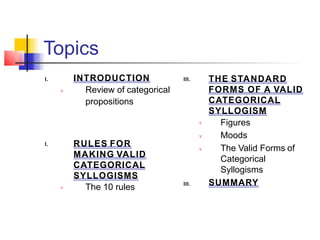
Topics
I.

INTRODUCTION
Review of categorical
propositions
III. THE STANDARD
FORMS OF A VALID
CATEGORICAL
SYLLOGISM
I.

RULES FOR
MAKING VALID
CATEGORICAL
SYLLOGISMS
The 10 rules III.



Figures
Moods
The Valid Forms of
Categorical
Syllogisms
SUMMARY
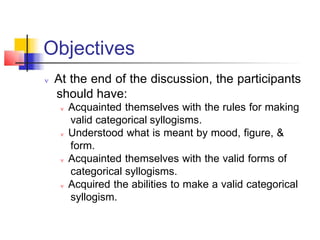
Objectives
 At the end of the discussion, the participants
should have:
 Acquainted themselves with the rules for making
valid categorical syllogisms.
 Understood what is meant by mood, figure, &
form.
 Acquainted themselves with the valid forms of
categorical syllogisms.
 Acquired the abilities to make a valid categorical
syllogism.
I. INTRODUCTION
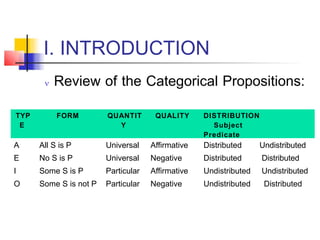
 Review of the Categorical Propositions:
TYP
E
FORM QUANTIT
Y
QUALITY DISTRIBUTION
Subject
Predicate
A All S is P Universal Affirmative Distributed Undistributed
E No S is P Universal Negative Distributed Distributed
I Some S is P Particular Affirmative Undistributed Undistributed
O Some S is not P Particular Negative Undistributed Distributed
I. INTRODUCTION
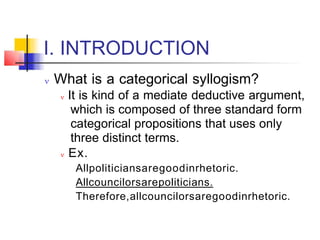
 What is a categorical syllogism?
 It is kind of a mediate deductive argument,
which is composed of three standard form
categorical propositions that uses only
three distinct terms.
 Ex.
Allpoliticiansaregoodinrhetoric.
Allcouncilorsarepoliticians.
Therefore,allcouncilorsaregoodinrhetoric.
II. RULES FOR MAKING
VALID CATEGORICAL
SYLLOGISMS

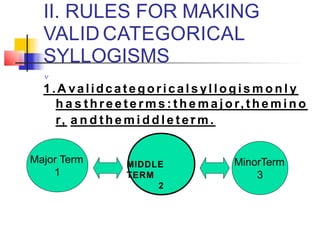
1.A validcategorical s yllogis m o n l y
h a s t hr e e t e r m s : t h e m a j o r, t h e m i n o
r, a n d t he m i d d l e t e r m.
Major Term
1
MIDDLE
TERM
2
MinorTerm
3
II. RULES FOR MAKING
VALID CATEGORICAL
SYLLOGISMS
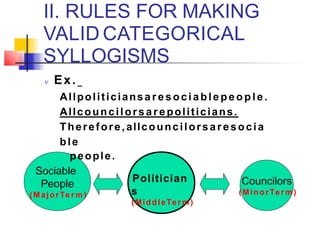
 Ex.
Allpoliticiansa r e sociable peopl e.
Allcouncilorsare politicians.
Therefore,allcouncilorsare socia
ble
people.
Sociable
People
(MajorTer m )
Politician
s
(MiddleTer m )
Councilors
(MinorTer m )
II. RULES FOR MAKING
VALID CATEGORICAL
SYLLOGISMS
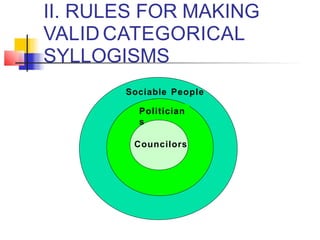
Sociable People
Politician
s
Councilors
II. RULES FOR MAKING
VALID CATEGORICAL
SYLLOGISMS
 The major term is predicate of the
conclusion. It appears in the Major Premise
(which is usually the first premise).
 The minor term is the subject of the
conclusion. It appears in the Minor Premise
(which is usually the second premise).
 The middle term is the term that
connects
or separates other terms completely or
partially.
II. RULES FOR MAKING
VALID CATEGORICAL
SYLLOGISMS
 2 . E a c h t e r m of a v a lid c a t e g o r i c a l
syllogism m u s t o c c u r int w o
propositionsoftheargum ent.
E x . Allpoliticiansa r e sociable p eo ple.
Allcouncilors ar e politicians.
Therefore,allcouncilorsaresociablepeople.
Politicians– occurs in the first and second premise.
SociablePeople– occurs in the first premise and
conclusion.
Councilors– occurs in the second premise and conclusion.
II. RULES FOR MAKING
VALID CATEGORICAL
SYLLOGISMS
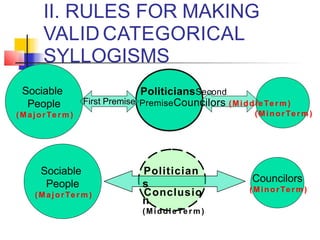
Sociable
People
(MajorTer m )
First Premise
PoliticiansSecond
PremiseCouncilors (MiddleTer m)
(MinorTer m )
Sociable
People
(MajorTer m )
Politician
s
Conclusio
n
(MiddleTer m )
Councilors
(MinorTer m )
II. RULES FOR MAKING
VALID CATEGORICAL
SYLLOGISMS

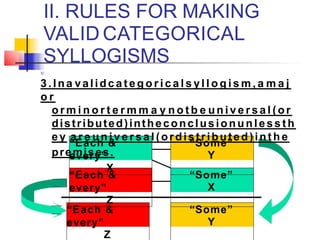
3 .Ina validc a t e g o r i c a l s y l l o g i s m , a m a j
o r
o r m i n o r t e r m m a y n o t b e u n i v e r s a l (or
distributed)intheconclusion unless th
ey a r e universal (ordistributed) int h e
premises.
“Each &
every”
X
“Some”
Y
“Each &
every”
Z
“Some”
X
“Each &
every”
Z
“Some”
Y
II. RULES FOR MAKING
VALID CATEGORICAL
SYLLOGISMS
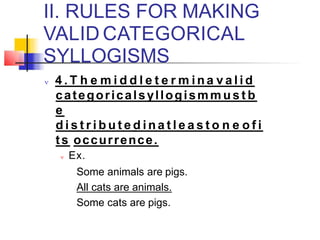
 4 . T h e m i d d l e t e r m i n a v a l i d
categoricalsyllogismm u s t b
e
d i s t r i b u t e d i n a t l e a s t o n e o f i
ts occurrence.
 Ex.
Some animals are pigs.
All cats are animals.
Some cats are pigs.
II. RULES FOR MAKING
VALID CATEGORICAL
SYLLOGISMS
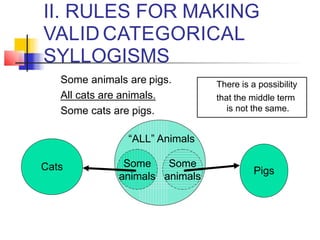
Some animals are pigs.
All cats are animals.
Some cats are pigs.
There is a possibility
that the middle term
is not the same.
“ALL” Animals
Cats Some
animals
Some
animals
Pigs
II. RULES FOR MAKING
VALID CATEGORICAL
SYLLOGISMS
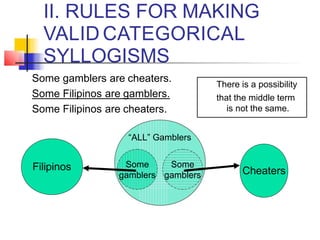
Some gamblers are cheaters.
Some Filipinos are gamblers.
Some Filipinos are cheaters.
“ALL” Gamblers
There is a possibility
that the middle term
is not the same.
Filipinos Some
gamblers
Some
gamblers Cheaters
II. RULES FOR MAKING
VALID CATEGORICAL
SYLLOGISMS
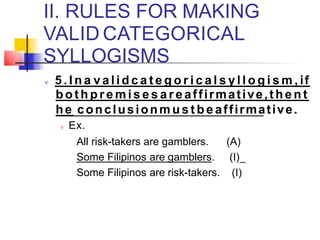
 5 . I n a v a lid c a t e g o r i c a l s y l l o g i s m , if
bot h p r e m i s e s a r e affirmative,t he n t
he conclusionm u s t b e affirmative.
 Ex.
All risk-takers are gamblers. (A)
Some Filipinos are gamblers. (I)
Some Filipinos are risk-takers. (I)
II. RULES FOR MAKING
VALID CATEGORICAL
SYLLOGISMS
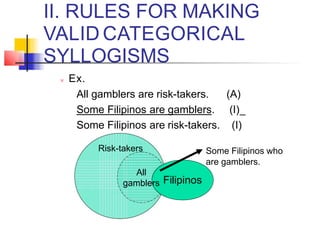
 Ex.
All gamblers are risk-takers. (A)
Some Filipinos are gamblers. (I)
Some Filipinos are risk-takers. (I)
Risk-takers
All
gamblers Filipinos
Some Filipinos who
are gamblers.
II. RULES FOR MAKING
VALID CATEGORICAL
SYLLOGISMS
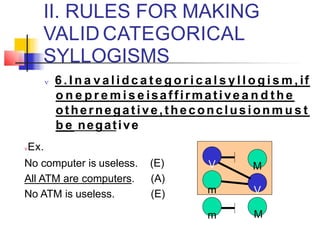
 6 . I n a v a lid c a t e g o r i c a l s y l l o g i s m , if
o n e p r e m i s e isaffirmative a n d t he
othernegative, theconclusion m u s t
b e negative
Ex.
No computer is useless.
All ATM are computers.
No ATM is useless.
(E)
(A)
(E)
V
m
m
M
V
M
II. RULES FOR MAKING
VALID CATEGORICAL
SYLLOGISMS

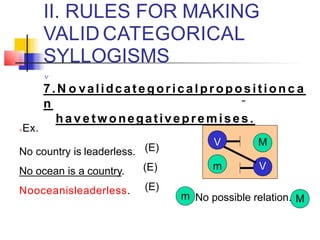
7.N o validcategoricalproposition c a
n
ha v e twonegativepremises.
Ex.
No country is leaderless.
No ocean is a country.
Nooceanisleaderless.
(E)
(E)
(E)
m
V M
m V
No possible relation. M
II. RULES FOR MAKING
VALID CATEGORICAL
SYLLOGISMS

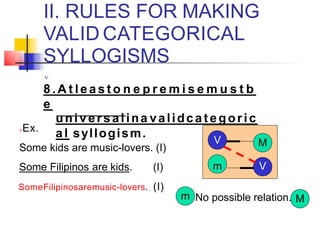
8 . A t l e a s t o n e p r e m i s e m u s t b
e
universal ina validcategoric
al syllogism.
Ex.
Some kids are music-lovers. (I)
V M
Some Filipinos are kids. (I)
SomeFilipinosaremusic-lovers. (I)
m
m V
No possible relation. M
II. RULES FOR MAKING
VALID CATEGORICAL
SYLLOGISMS

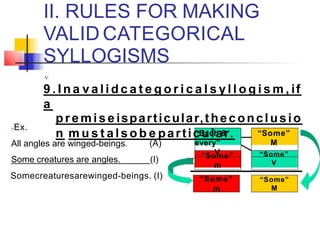
9 . I n a v a l i d c a t e g o r i c a l s y l l o g i s m , if
a
pre mis e isparticular,theconcl usio
n m u s t a ls o b e particular.
Ex.
All angles are winged-beings. (A)
Some creatures are angles. (I)
Somecreaturesarewinged-beings. (I) “Some”
m
“Some”
M
“Each &
every”
V
“Some”
M
“Some”
m
“Some”
V
II. RULES FOR MAKING
VALID CATEGORICAL
SYLLOGISMS

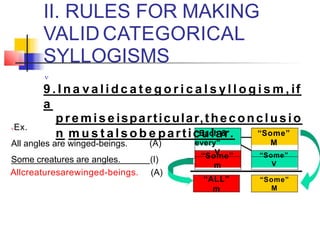
9 . I n a v a l i d c a t e g o r i c a l s y l l o g i s m , if
a
pre mis e isparticular,theconcl usio
n m u s t a ls o b e particular.
Ex.
All angles are winged-beings. (A)
Some creatures are angles. (I)
Allcreaturesarewinged-beings. (A)
“ALL”
m
“Some”
M
“Each &
every”
V
“Some”
M
“Some”
m
“Some”
V
II. RULES FOR MAKING
VALID CATEGORICAL
SYLLOGISMS
 1 0 . Ina valid c a t e g o r i c a l s yl l o g i s m , t h e
a c tu a l reale x i s t e n c e ofa s u b j e c t m a y n
o t
b e a s s e r t e d int h e c o n c l u s i o n u n l e s s it
h a s b e e n a sse rt ed inthep re m i s e s .
 E x .
Thisw o o d floats. T h a t w o o d floats.
Therefore,allw o o d floats.
III. THE STANDARD FORMS OF A
VALID CATEGORICAL
SYLLOGISM
 The logical form is the structure of
the
categorical syllogism as indicated by its
“figure” and “mood.”
 “Figure” is the arrangement of the
terms (major, minor, and middle) of the
argument.
 “Mood” is the arrangement of the
propositions by quantity and quality.
III. THE STANDARD FORMS OF A
VALID CATEGORICAL
SYLLOGISM
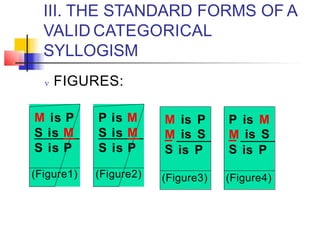
 FIGURES:
M is P
S is M
S is P
(Figure1)
P is M
S is M
S is P
(Figure2)
M
M
S
is P
is S
is P
(Figure3)
P
M
S
is M
is S
is P
(Figure4)
III. THE STANDARD FORMS OF A
VALID CATEGORICAL
SYLLOGISM
 MOODS:
4 types of categorical propositions (A, E, I, O)
Each type can be used thrice in an argument.
There are possible four figures.
Calculation: There can be 256 possible forms of a
categorical syllogism.
 But only 16 forms are valid.
III. THE STANDARD FORMS OF A
VALID CATEGORICAL
SYLLOGISM
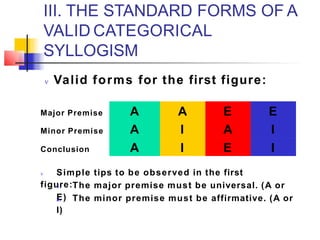
 Valid forms for the first figure:
Major Premise A A E E
Minor Premise A I A I
Conclusion A I E I
 Simple tips to be observed in the first
figure:
1. The major premise must be universal. (A or
E)
2. The minor premise must be affirmative. (A or
I)
III. THE STANDARD FORMS OF A
VALID CATEGORICAL
SYLLOGISM
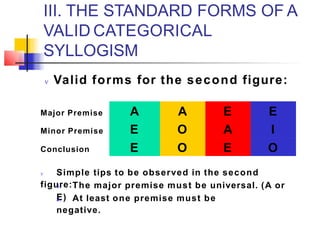
 Valid forms for the second figure:
Major Premise A A E E
Minor Premise E O A I
Conclusion E O E O
 Simple tips to be observed in the second
figure:
1. The major premise must be universal. (A or
E)
2. At least one premise must be
negative.
III. THE STANDARD FORMS OF A
VALID CATEGORICAL
SYLLOGISM
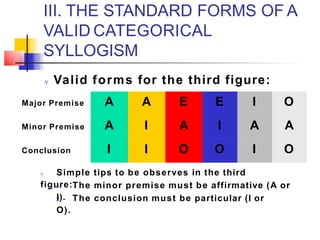
 Valid forms for the third figure:
Major Premise A A E E I O
Minor Premise A I A I A A
Conclusion I I O O I O
 Simple tips to be observes in the third
figure:
1. The minor premise must be affirmative (A or
I).
2. The conclusion must be particular (I or
O).
III. THE STANDARD FORMS OF A
VALID CATEGORICAL
SYLLOGISM
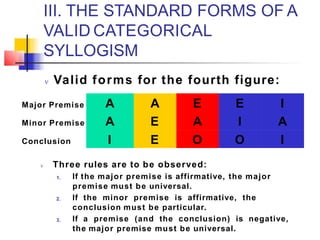
 Valid forms for the fourth figure:
Major Premise A A E E I
Minor Premise A E A I A
Conclusion I E O O I
 Three rules are to be observed:
1. If the major premise is affirmative, the major
premise must be universal.
2. If the minor premise is affirmative, the
conclusion must be particular.
3. If a premise (and the conclusion) is negative,
the major premise must be universal.
SUMMARY
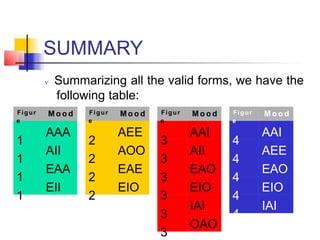
 Summarizing all the valid forms, we have the
following table:
Figur
e
1
1
1
1
M o o d
AAA
AII
EAA
EII
Figur
e
2
2
2
2
M o o d
AEE
AOO
EAE
EIO
Figur
e
3
3
3
3
3
3
M o o d
AAI
AII
EAO
EIO
IAI
OAO
Figur
e
4
4
4
4
4
M o o d
AAI
AEE
EAO
EIO
IAI

GenMath-Q2-W9-categorical-syllogism.pptx

  • 1.
  • 2.
    Topics I.  INTRODUCTION Review of categorical propositions III.THE STANDARD FORMS OF A VALID CATEGORICAL SYLLOGISM I.  RULES FOR MAKING VALID CATEGORICAL SYLLOGISMS The 10 rules III.    Figures Moods The Valid Forms of Categorical Syllogisms SUMMARY
  • 3.
    Objectives  At theend of the discussion, the participants should have:  Acquainted themselves with the rules for making valid categorical syllogisms.  Understood what is meant by mood, figure, & form.  Acquainted themselves with the valid forms of categorical syllogisms.  Acquired the abilities to make a valid categorical syllogism.
  • 4.
    I. INTRODUCTION  Reviewof the Categorical Propositions: TYP E FORM QUANTIT Y QUALITY DISTRIBUTION Subject Predicate A All S is P Universal Affirmative Distributed Undistributed E No S is P Universal Negative Distributed Distributed I Some S is P Particular Affirmative Undistributed Undistributed O Some S is not P Particular Negative Undistributed Distributed
  • 5.
    I. INTRODUCTION  Whatis a categorical syllogism?  It is kind of a mediate deductive argument, which is composed of three standard form categorical propositions that uses only three distinct terms.  Ex. Allpoliticiansaregoodinrhetoric. Allcouncilorsarepoliticians. Therefore,allcouncilorsaregoodinrhetoric.
  • 6.
    II. RULES FORMAKING VALID CATEGORICAL SYLLOGISMS  1.A validcategorical s yllogis m o n l y h a s t hr e e t e r m s : t h e m a j o r, t h e m i n o r, a n d t he m i d d l e t e r m. Major Term 1 MIDDLE TERM 2 MinorTerm 3
  • 7.
    II. RULES FORMAKING VALID CATEGORICAL SYLLOGISMS  Ex. Allpoliticiansa r e sociable peopl e. Allcouncilorsare politicians. Therefore,allcouncilorsare socia ble people. Sociable People (MajorTer m ) Politician s (MiddleTer m ) Councilors (MinorTer m )
  • 8.
    II. RULES FORMAKING VALID CATEGORICAL SYLLOGISMS Sociable People Politician s Councilors
  • 9.
    II. RULES FORMAKING VALID CATEGORICAL SYLLOGISMS  The major term is predicate of the conclusion. It appears in the Major Premise (which is usually the first premise).  The minor term is the subject of the conclusion. It appears in the Minor Premise (which is usually the second premise).  The middle term is the term that connects or separates other terms completely or partially.
  • 10.
    II. RULES FORMAKING VALID CATEGORICAL SYLLOGISMS  2 . E a c h t e r m of a v a lid c a t e g o r i c a l syllogism m u s t o c c u r int w o propositionsoftheargum ent. E x . Allpoliticiansa r e sociable p eo ple. Allcouncilors ar e politicians. Therefore,allcouncilorsaresociablepeople. Politicians– occurs in the first and second premise. SociablePeople– occurs in the first premise and conclusion. Councilors– occurs in the second premise and conclusion.
  • 11.
    II. RULES FORMAKING VALID CATEGORICAL SYLLOGISMS Sociable People (MajorTer m ) First Premise PoliticiansSecond PremiseCouncilors (MiddleTer m) (MinorTer m ) Sociable People (MajorTer m ) Politician s Conclusio n (MiddleTer m ) Councilors (MinorTer m )
  • 12.
    II. RULES FORMAKING VALID CATEGORICAL SYLLOGISMS  3 .Ina validc a t e g o r i c a l s y l l o g i s m , a m a j o r o r m i n o r t e r m m a y n o t b e u n i v e r s a l (or distributed)intheconclusion unless th ey a r e universal (ordistributed) int h e premises. “Each & every” X “Some” Y “Each & every” Z “Some” X “Each & every” Z “Some” Y
  • 13.
    II. RULES FORMAKING VALID CATEGORICAL SYLLOGISMS  4 . T h e m i d d l e t e r m i n a v a l i d categoricalsyllogismm u s t b e d i s t r i b u t e d i n a t l e a s t o n e o f i ts occurrence.  Ex. Some animals are pigs. All cats are animals. Some cats are pigs.
  • 14.
    II. RULES FORMAKING VALID CATEGORICAL SYLLOGISMS Some animals are pigs. All cats are animals. Some cats are pigs. There is a possibility that the middle term is not the same. “ALL” Animals Cats Some animals Some animals Pigs
  • 15.
    II. RULES FORMAKING VALID CATEGORICAL SYLLOGISMS Some gamblers are cheaters. Some Filipinos are gamblers. Some Filipinos are cheaters. “ALL” Gamblers There is a possibility that the middle term is not the same. Filipinos Some gamblers Some gamblers Cheaters
  • 16.
    II. RULES FORMAKING VALID CATEGORICAL SYLLOGISMS  5 . I n a v a lid c a t e g o r i c a l s y l l o g i s m , if bot h p r e m i s e s a r e affirmative,t he n t he conclusionm u s t b e affirmative.  Ex. All risk-takers are gamblers. (A) Some Filipinos are gamblers. (I) Some Filipinos are risk-takers. (I)
  • 17.
    II. RULES FORMAKING VALID CATEGORICAL SYLLOGISMS  Ex. All gamblers are risk-takers. (A) Some Filipinos are gamblers. (I) Some Filipinos are risk-takers. (I) Risk-takers All gamblers Filipinos Some Filipinos who are gamblers.
  • 18.
    II. RULES FORMAKING VALID CATEGORICAL SYLLOGISMS  6 . I n a v a lid c a t e g o r i c a l s y l l o g i s m , if o n e p r e m i s e isaffirmative a n d t he othernegative, theconclusion m u s t b e negative Ex. No computer is useless. All ATM are computers. No ATM is useless. (E) (A) (E) V m m M V M
  • 19.
    II. RULES FORMAKING VALID CATEGORICAL SYLLOGISMS  7.N o validcategoricalproposition c a n ha v e twonegativepremises. Ex. No country is leaderless. No ocean is a country. Nooceanisleaderless. (E) (E) (E) m V M m V No possible relation. M
  • 20.
    II. RULES FORMAKING VALID CATEGORICAL SYLLOGISMS  8 . A t l e a s t o n e p r e m i s e m u s t b e universal ina validcategoric al syllogism. Ex. Some kids are music-lovers. (I) V M Some Filipinos are kids. (I) SomeFilipinosaremusic-lovers. (I) m m V No possible relation. M
  • 21.
    II. RULES FORMAKING VALID CATEGORICAL SYLLOGISMS  9 . I n a v a l i d c a t e g o r i c a l s y l l o g i s m , if a pre mis e isparticular,theconcl usio n m u s t a ls o b e particular. Ex. All angles are winged-beings. (A) Some creatures are angles. (I) Somecreaturesarewinged-beings. (I) “Some” m “Some” M “Each & every” V “Some” M “Some” m “Some” V
  • 22.
    II. RULES FORMAKING VALID CATEGORICAL SYLLOGISMS  9 . I n a v a l i d c a t e g o r i c a l s y l l o g i s m , if a pre mis e isparticular,theconcl usio n m u s t a ls o b e particular. Ex. All angles are winged-beings. (A) Some creatures are angles. (I) Allcreaturesarewinged-beings. (A) “ALL” m “Some” M “Each & every” V “Some” M “Some” m “Some” V
  • 23.
    II. RULES FORMAKING VALID CATEGORICAL SYLLOGISMS  1 0 . Ina valid c a t e g o r i c a l s yl l o g i s m , t h e a c tu a l reale x i s t e n c e ofa s u b j e c t m a y n o t b e a s s e r t e d int h e c o n c l u s i o n u n l e s s it h a s b e e n a sse rt ed inthep re m i s e s .  E x . Thisw o o d floats. T h a t w o o d floats. Therefore,allw o o d floats.
  • 24.
    III. THE STANDARDFORMS OF A VALID CATEGORICAL SYLLOGISM  The logical form is the structure of the categorical syllogism as indicated by its “figure” and “mood.”  “Figure” is the arrangement of the terms (major, minor, and middle) of the argument.  “Mood” is the arrangement of the propositions by quantity and quality.
  • 25.
    III. THE STANDARDFORMS OF A VALID CATEGORICAL SYLLOGISM  FIGURES: M is P S is M S is P (Figure1) P is M S is M S is P (Figure2) M M S is P is S is P (Figure3) P M S is M is S is P (Figure4)
  • 26.
    III. THE STANDARDFORMS OF A VALID CATEGORICAL SYLLOGISM  MOODS: 4 types of categorical propositions (A, E, I, O) Each type can be used thrice in an argument. There are possible four figures. Calculation: There can be 256 possible forms of a categorical syllogism.  But only 16 forms are valid.
  • 27.
    III. THE STANDARDFORMS OF A VALID CATEGORICAL SYLLOGISM  Valid forms for the first figure: Major Premise A A E E Minor Premise A I A I Conclusion A I E I  Simple tips to be observed in the first figure: 1. The major premise must be universal. (A or E) 2. The minor premise must be affirmative. (A or I)
  • 28.
    III. THE STANDARDFORMS OF A VALID CATEGORICAL SYLLOGISM  Valid forms for the second figure: Major Premise A A E E Minor Premise E O A I Conclusion E O E O  Simple tips to be observed in the second figure: 1. The major premise must be universal. (A or E) 2. At least one premise must be negative.
  • 29.
    III. THE STANDARDFORMS OF A VALID CATEGORICAL SYLLOGISM  Valid forms for the third figure: Major Premise A A E E I O Minor Premise A I A I A A Conclusion I I O O I O  Simple tips to be observes in the third figure: 1. The minor premise must be affirmative (A or I). 2. The conclusion must be particular (I or O).
  • 30.
    III. THE STANDARDFORMS OF A VALID CATEGORICAL SYLLOGISM  Valid forms for the fourth figure: Major Premise A A E E I Minor Premise A E A I A Conclusion I E O O I  Three rules are to be observed: 1. If the major premise is affirmative, the major premise must be universal. 2. If the minor premise is affirmative, the conclusion must be particular. 3. If a premise (and the conclusion) is negative, the major premise must be universal.
  • 31.
    SUMMARY  Summarizing allthe valid forms, we have the following table: Figur e 1 1 1 1 M o o d AAA AII EAA EII Figur e 2 2 2 2 M o o d AEE AOO EAE EIO Figur e 3 3 3 3 3 3 M o o d AAI AII EAO EIO IAI OAO Figur e 4 4 4 4 4 M o o d AAI AEE EAO EIO IAI