NATURE OF THE IDEA
Ideas are the building blocks of knowledge. They
are the elements that constitute judgments and
judgments express either truth or error.

Ideas must be thoroughly understood because
no building can be solid unless its foundation is
solid.
FORMATION OF IDEAS
   All knowledge starts with the senses. Generally
    speaking, nothing is in the mind unless it passes thru
    the senses. Are there exceptions?
   Examples: sugar as an object of perception to
          the various senses. The image of sugar
                is retained even after the object itself
                is removed because I can recall the
                sugar’s image in my senses.
    Based on the above example I have an idea of sugar.
    This image of the imagination is the first step in the
    formation of an idea.

    Cite other examples.
   Man does not stop at the mere reproduction of the
    image. He begins to think. It does this by the
    process of abstraction.

   Through sense experience we encounter many
    beings whom we designate by the name “man”. But
    we found out from sense experience that are great
    differences among men.

   Comparing these differences some of them change
    while others disappear. The intellect also perceives
    that there are characters that remain intact thru all
    the changes.
1. Man must have a body.
2. Man must be alive.
3. Man must be sentient.
4. Man must be a substance.
5. Man must be rational.

Man must be a rational, sentient, living, bodily
substance in order to be a man. The absence of
any of these - man ceases to be a man. They are
therefore the essential elements that make a man a
man and not something else. Other characteristics
of man are non-essentials.
   The intellect strips the individual of all the non-
    essential qualities and retains only the essential
    attributes and forms them into one intellectual
    image - man is a rational, sentient, living, bodily
    substance – and since a sentient, living, bodily
    substance is called an animal , man is therefore a
    rational animal. This intellectual image of man is
    our idea of man.
COMPREHENSION AND EXTENSION IDEAS
   Comprehension and Extension are the logical
    qualities of an idea.

   Comprehension – is the sum total of all the
    attributes that constitute an idea in its
    representation of a thing.

   Extension – expresses the application of these
    attributes to individuals and groups to which they
    are found.
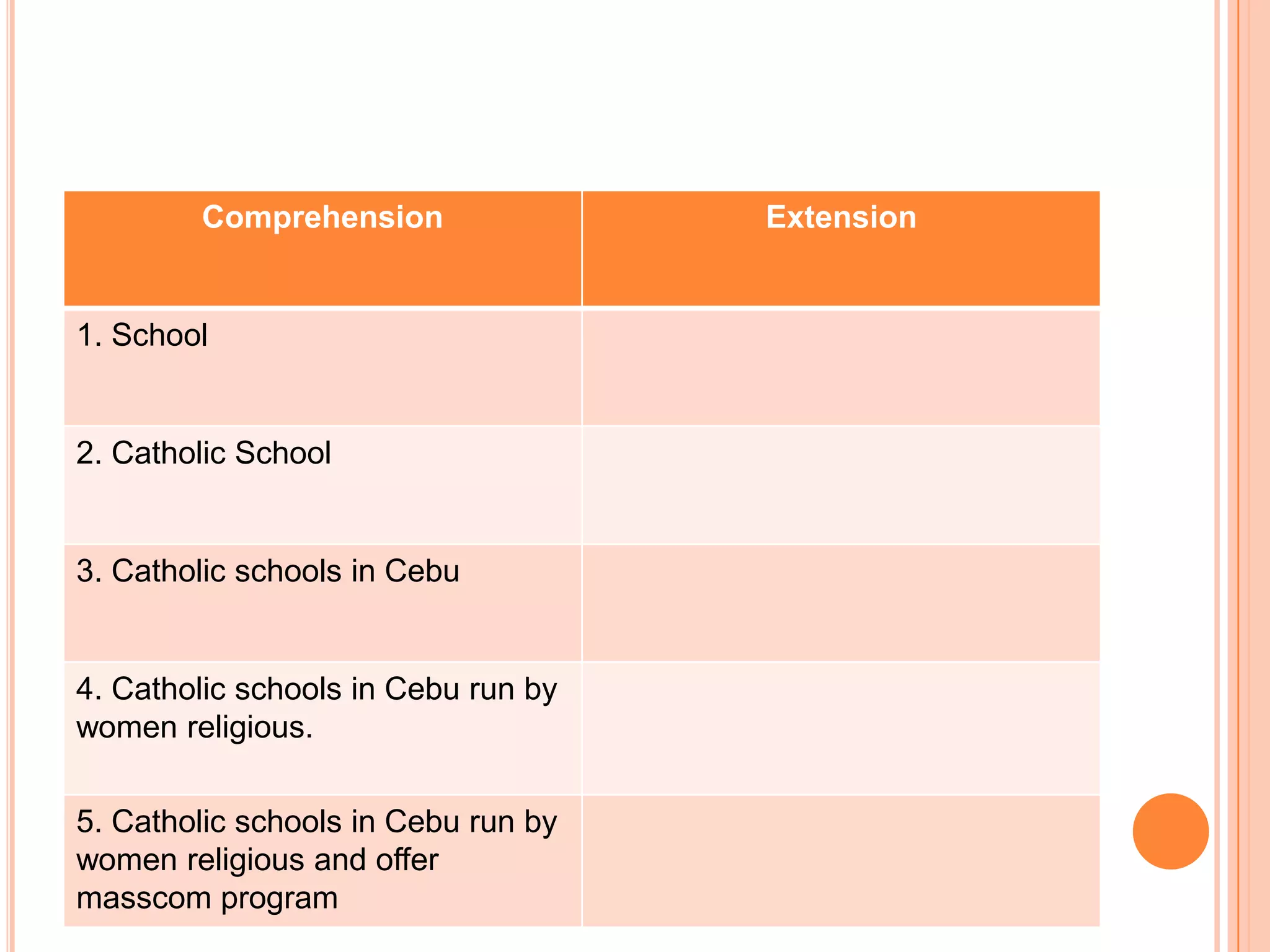
Comprehension                Extension


1. School


2. Catholic School


3. Catholic schools in Cebu


4. Catholic schools in Cebu run by
women religious.

5. Catholic schools in Cebu run by
women religious and offer
masscom program
STAGES OF LIFE

TEENS
You have all the time and energy but no money.

WORKERS
You have the money and energy but no time.

OLDIES
You have all the time and money but no more
energy.
Maestra: uy, Jose nganong na late man ka?
Jose: Kuan man gud ma’am … (nangalot sa ulo)
M: unsay kuan? Nganong na late lagi ka?
Jose: Kuan man gud ma’am. Gibunalan man gud ma’am
ni tatay ang akong manghod kay nagpabadlong man
siya.
M: aber, unsa may labot ana sa imong pagka late beh?
Jose: kuan man gud ma’am ang ako mang sapatos and
gigamit ni tatay sa pagbunal sa akong manghod.

Toink!
KINDS OF IDEAS

             Ideas According to Origin

Intuitive (or immediate) ideas are those which are
 formed as the result of the direct perception of
 things.

Abstractive (or mediate) ideas are formed by some
 means other than their immediate perception.
All ideas of persons, events and things which I
acquire not from personal experience but thru
books, newspapers, TV, radio, etc. are of this type.
     Ideas arrived at by deduction are of this type.
From the effects of heat, light , power I can
conclude there is electricity. If the electric fan and
the computer suddenly shuts down, you can
conclude that . . . ?
     In logic we have induction and deduction as
tools arriving at an inferential judgment.
KINDS OF IDEAS

         Ideas According to their Relation

Ideas from the standpoint of mutual relation are
  either connex or disparate. They are connex
  when one idea necessarily either includes or
  excludes the other.
  Examples: father – child, husband – wife, teacher –
  student, man – rational, light – darkness
Ideas are disparate when one idea neither
necessarily includes nor necessarily excludes the
other.
Examples: man – black, wise – good, iron –
wheel, wise – good

Ideas are either identical or diverse. They are
identical when their comprehension is the same
such as man – rational animal, water –
H2O, sodium chloride – salt
Ideas are diverse when their comprehension is
different such as man – brute, tree – dog, house –
car.

What about the ideas house – home. Are they
identical or diverse? Based upon your intuitive idea
is your house a home? Or is it merely a house and
not a home? Or are both ideas identical?
A HOUSE IS NOT A HOME
ORIGINAL VERSION BY   DIONNE WARWICK


  “A chair is still a chair even when there’s no one
  sitting there. But a chair is not a house and a house
  is not a home when there’s no on there to hold you
  tight, and no one there you can kiss good night”.

  “A room is still a room even when there’s nothing
  there but gloom. But a room is not a house and a
  house is not a home when the two of us are far
  apart and one of us has a broken heart”.
Diverse ideas are either compatible or
incompatible. They are compatible when the
attributes of the comprehension of both can be
united and give birth into another (third) idea.
Example: man – white, mind – sound

Incompatible when the attributes of the
comprehension of one idea excludes the
comprehension of the other idea.
Example: vice – virtue, wisdom – folly, light –
darkness
THE REPUGNANCE OF IDEAS
Forms the basis of their incompatibility. This gives
rise to contradictory, privative, contrary and relative
ideas.

Contradictory ideas are two ideas in which one
expresses the simple denial of the other.
Examples: thing – nothing, good – not good, equal
– unequal

Privative ideas are two ideas of which one signifies
a perfection while the other denies the perfection in
a subject which ought to possess it.
Examples: sight – blindness, sanity – insanity, living
– dead

Contrary ideas represent two extremes among
objects belonging to the same class.
Examples: good – bad , kind – cruel, pleasant –
painful

Relative ideas are two incompatible ideas united in
such a way that one cannot be understood with out
the other.
Examples: master – servant , left – right , cause –
effect
Lisod mo sultig “sori”.
Lisod mo sultig “gimahal ko ikaw”.
Lisod mo sultig “gikinahanglan ko ikaw.
Pero nahibaloan ko and pinakalisod isulti mao man
“RURAL RULER ROYAL”
10 x i – try bi

Nature of the idea

  • 1.
    NATURE OF THEIDEA Ideas are the building blocks of knowledge. They are the elements that constitute judgments and judgments express either truth or error. Ideas must be thoroughly understood because no building can be solid unless its foundation is solid.
  • 2.
    FORMATION OF IDEAS  All knowledge starts with the senses. Generally speaking, nothing is in the mind unless it passes thru the senses. Are there exceptions?  Examples: sugar as an object of perception to the various senses. The image of sugar is retained even after the object itself is removed because I can recall the sugar’s image in my senses. Based on the above example I have an idea of sugar. This image of the imagination is the first step in the formation of an idea. Cite other examples.
  • 3.
    Man does not stop at the mere reproduction of the image. He begins to think. It does this by the process of abstraction.  Through sense experience we encounter many beings whom we designate by the name “man”. But we found out from sense experience that are great differences among men.  Comparing these differences some of them change while others disappear. The intellect also perceives that there are characters that remain intact thru all the changes.
  • 4.
    1. Man musthave a body. 2. Man must be alive. 3. Man must be sentient. 4. Man must be a substance. 5. Man must be rational. Man must be a rational, sentient, living, bodily substance in order to be a man. The absence of any of these - man ceases to be a man. They are therefore the essential elements that make a man a man and not something else. Other characteristics of man are non-essentials.
  • 5.
    The intellect strips the individual of all the non- essential qualities and retains only the essential attributes and forms them into one intellectual image - man is a rational, sentient, living, bodily substance – and since a sentient, living, bodily substance is called an animal , man is therefore a rational animal. This intellectual image of man is our idea of man.
  • 6.
    COMPREHENSION AND EXTENSIONIDEAS  Comprehension and Extension are the logical qualities of an idea.  Comprehension – is the sum total of all the attributes that constitute an idea in its representation of a thing.  Extension – expresses the application of these attributes to individuals and groups to which they are found.
  • 7.
    Comprehension Extension 1. School 2. Catholic School 3. Catholic schools in Cebu 4. Catholic schools in Cebu run by women religious. 5. Catholic schools in Cebu run by women religious and offer masscom program
  • 8.
    STAGES OF LIFE TEENS Youhave all the time and energy but no money. WORKERS You have the money and energy but no time. OLDIES You have all the time and money but no more energy.
  • 9.
    Maestra: uy, Josenganong na late man ka? Jose: Kuan man gud ma’am … (nangalot sa ulo) M: unsay kuan? Nganong na late lagi ka? Jose: Kuan man gud ma’am. Gibunalan man gud ma’am ni tatay ang akong manghod kay nagpabadlong man siya. M: aber, unsa may labot ana sa imong pagka late beh? Jose: kuan man gud ma’am ang ako mang sapatos and gigamit ni tatay sa pagbunal sa akong manghod. Toink!
  • 10.
    KINDS OF IDEAS Ideas According to Origin Intuitive (or immediate) ideas are those which are formed as the result of the direct perception of things. Abstractive (or mediate) ideas are formed by some means other than their immediate perception.
  • 11.
    All ideas ofpersons, events and things which I acquire not from personal experience but thru books, newspapers, TV, radio, etc. are of this type. Ideas arrived at by deduction are of this type. From the effects of heat, light , power I can conclude there is electricity. If the electric fan and the computer suddenly shuts down, you can conclude that . . . ? In logic we have induction and deduction as tools arriving at an inferential judgment.
  • 12.
    KINDS OF IDEAS Ideas According to their Relation Ideas from the standpoint of mutual relation are either connex or disparate. They are connex when one idea necessarily either includes or excludes the other. Examples: father – child, husband – wife, teacher – student, man – rational, light – darkness
  • 13.
    Ideas are disparatewhen one idea neither necessarily includes nor necessarily excludes the other. Examples: man – black, wise – good, iron – wheel, wise – good Ideas are either identical or diverse. They are identical when their comprehension is the same such as man – rational animal, water – H2O, sodium chloride – salt
  • 14.
    Ideas are diversewhen their comprehension is different such as man – brute, tree – dog, house – car. What about the ideas house – home. Are they identical or diverse? Based upon your intuitive idea is your house a home? Or is it merely a house and not a home? Or are both ideas identical?
  • 15.
    A HOUSE ISNOT A HOME ORIGINAL VERSION BY DIONNE WARWICK “A chair is still a chair even when there’s no one sitting there. But a chair is not a house and a house is not a home when there’s no on there to hold you tight, and no one there you can kiss good night”. “A room is still a room even when there’s nothing there but gloom. But a room is not a house and a house is not a home when the two of us are far apart and one of us has a broken heart”.
  • 16.
    Diverse ideas areeither compatible or incompatible. They are compatible when the attributes of the comprehension of both can be united and give birth into another (third) idea. Example: man – white, mind – sound Incompatible when the attributes of the comprehension of one idea excludes the comprehension of the other idea. Example: vice – virtue, wisdom – folly, light – darkness
  • 17.
    THE REPUGNANCE OFIDEAS Forms the basis of their incompatibility. This gives rise to contradictory, privative, contrary and relative ideas. Contradictory ideas are two ideas in which one expresses the simple denial of the other. Examples: thing – nothing, good – not good, equal – unequal Privative ideas are two ideas of which one signifies a perfection while the other denies the perfection in a subject which ought to possess it.
  • 18.
    Examples: sight –blindness, sanity – insanity, living – dead Contrary ideas represent two extremes among objects belonging to the same class. Examples: good – bad , kind – cruel, pleasant – painful Relative ideas are two incompatible ideas united in such a way that one cannot be understood with out the other. Examples: master – servant , left – right , cause – effect
  • 19.
    Lisod mo sultig“sori”. Lisod mo sultig “gimahal ko ikaw”. Lisod mo sultig “gikinahanglan ko ikaw. Pero nahibaloan ko and pinakalisod isulti mao man “RURAL RULER ROYAL” 10 x i – try bi