Logic  HUM 200 Categorical Syllogisms1
Objectives2When you complete this lesson, you will be able to:Describe a standard-form categorical syllogismRecognize the terms of the syllogismIdentify the mood and figure of a syllogismUse the Venn diagram technique for testing syllogismsList and describe the syllogistic rules and syllogistic fallaciesList the fifteen valid forms of the categorical syllogism
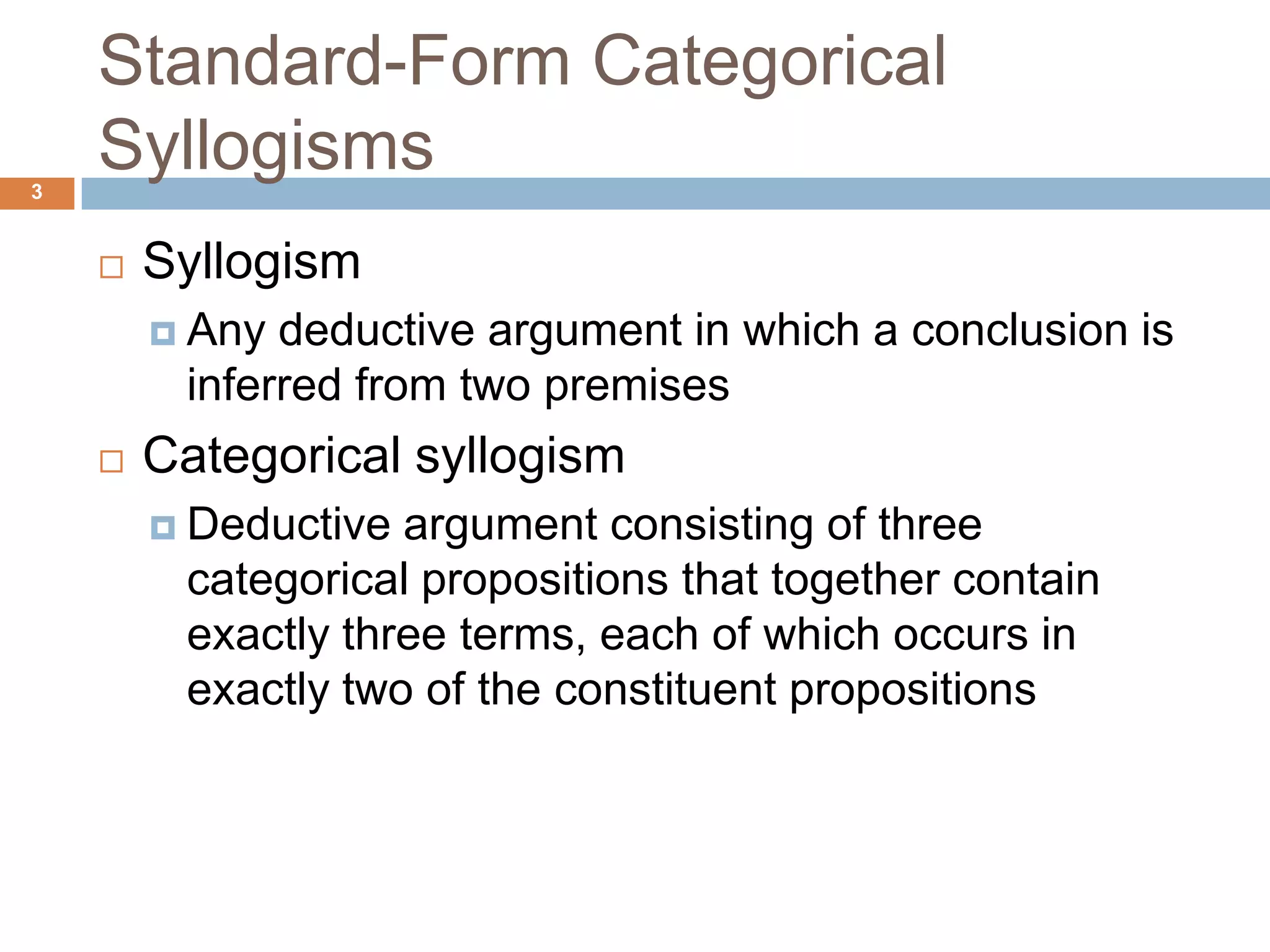
Standard-Form Categorical Syllogisms 3SyllogismAny deductive argument in which a conclusion is inferred from two premisesCategorical syllogismDeductive argument consisting of three categorical propositions that together contain exactly three terms, each of which occurs in exactly two of the constituent propositions
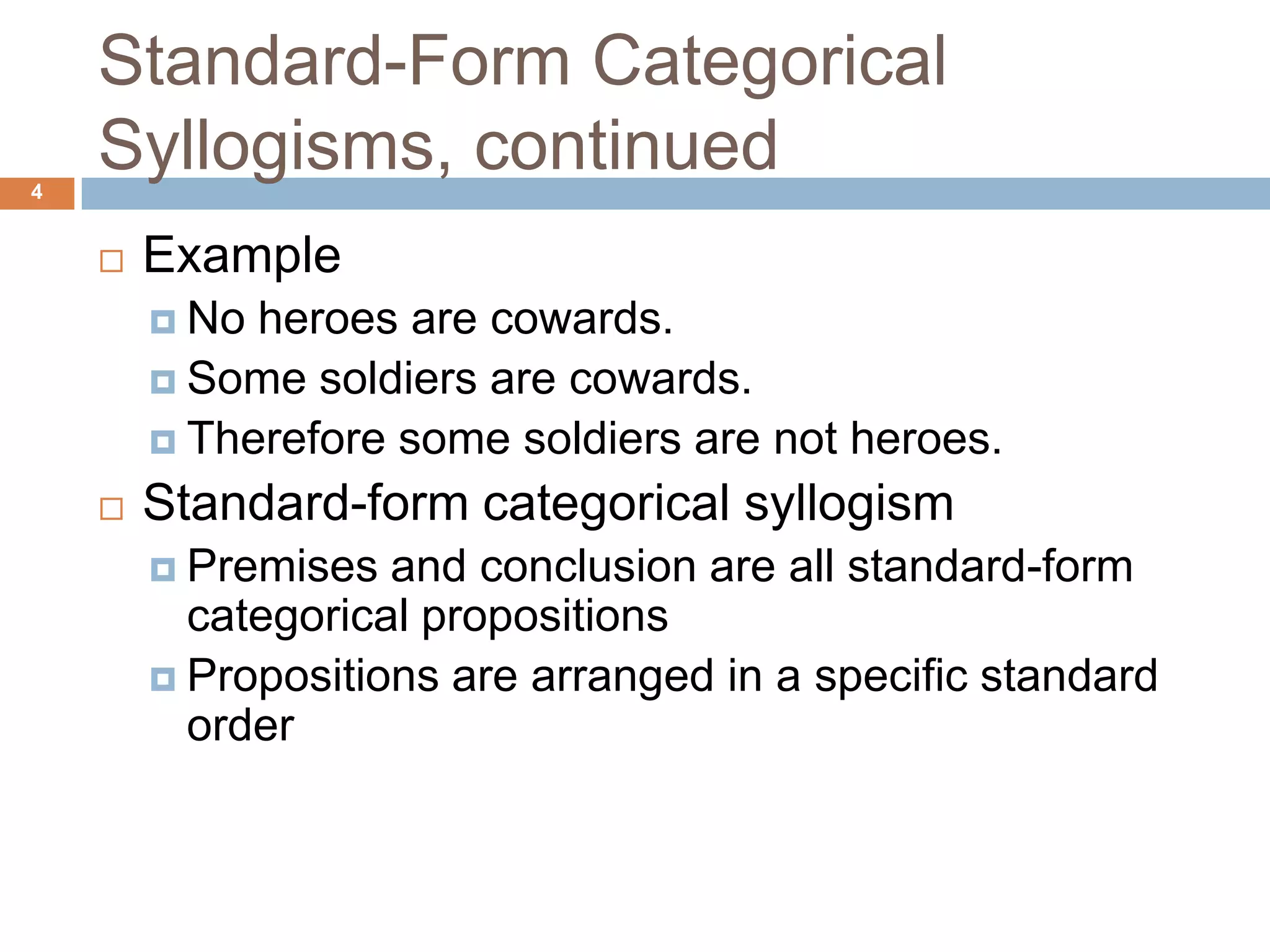
Standard-Form Categorical Syllogisms, continued 4ExampleNo heroes are cowards.Some soldiers are cowards.Therefore some soldiers are not heroes. Standard-form categorical syllogismPremises and conclusion are all standard-form categorical propositions Propositions are arranged in a specific standard order
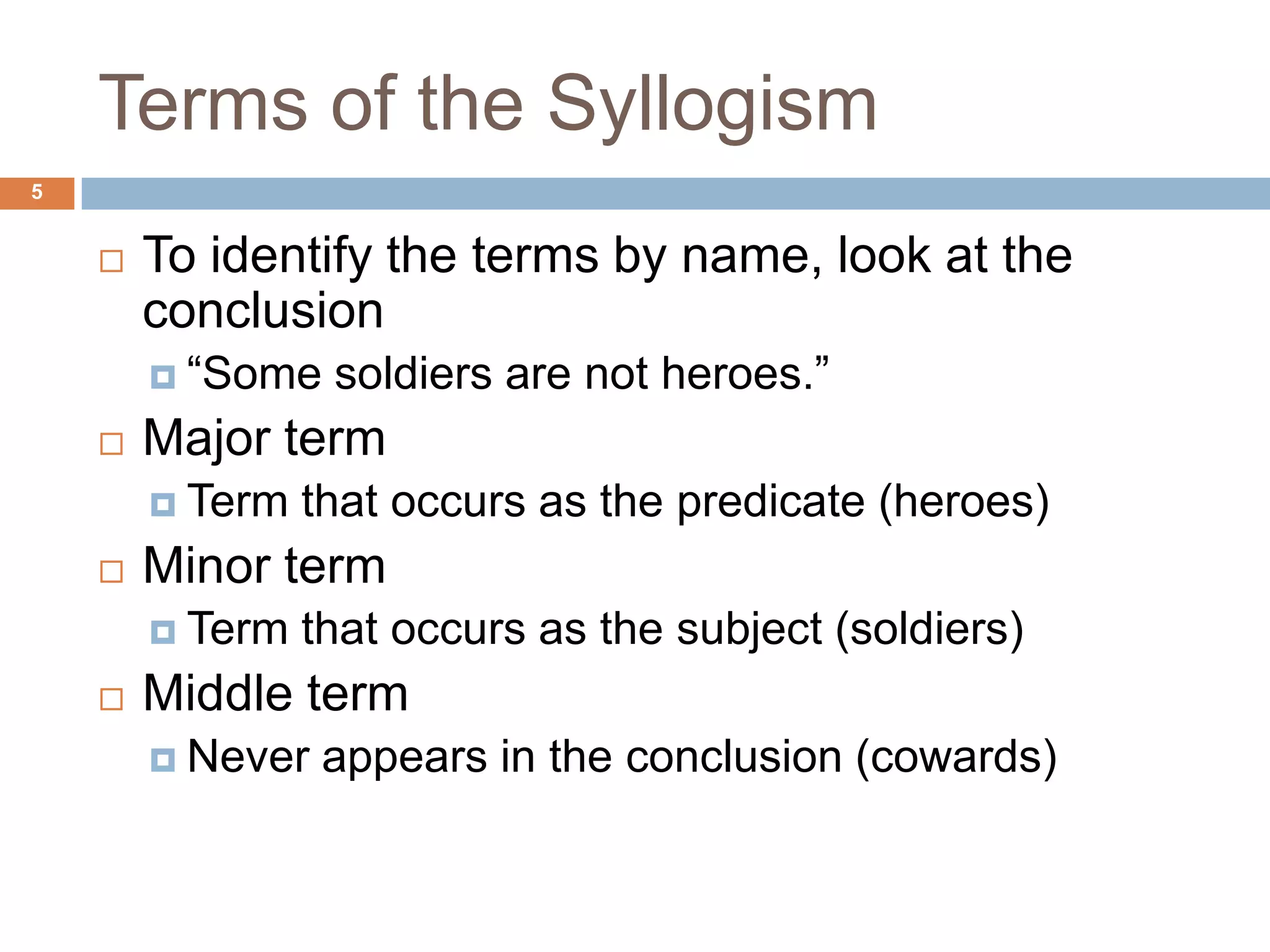
Terms of the Syllogism 5To identify the terms by name, look at the conclusion “Some soldiers are not heroes.”Major termTerm that occurs as the predicate (heroes)Minor termTerm that occurs as the subject (soldiers)Middle termNever appears in the conclusion (cowards)
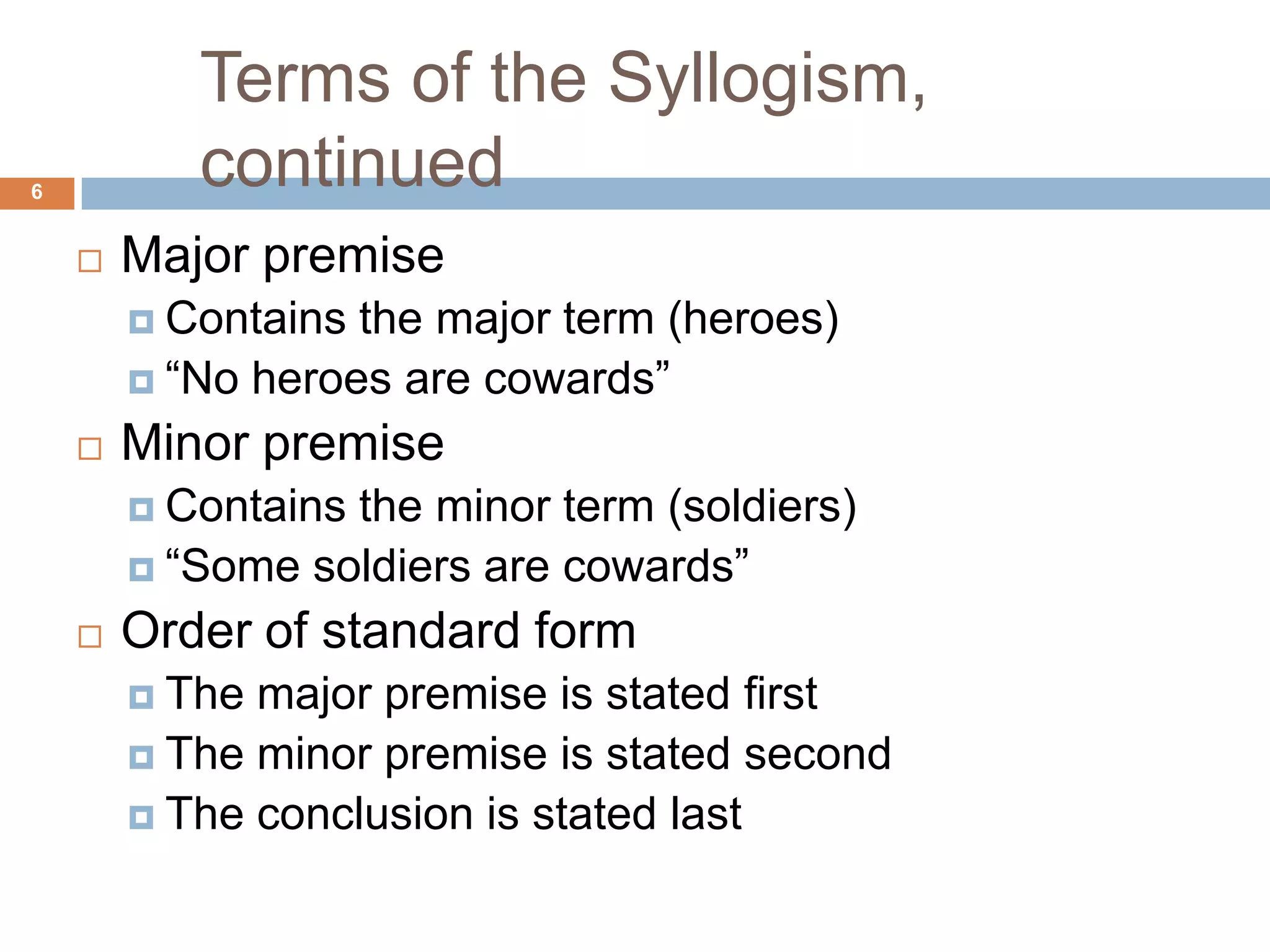
Terms of the Syllogism, continued 6Major premiseContains the major term (heroes)“No heroes are cowards” Minor premiseContains the minor term (soldiers)“Some soldiers are cowards” Order of standard formThe major premise is stated firstThe minor premise is stated secondThe conclusion is stated last
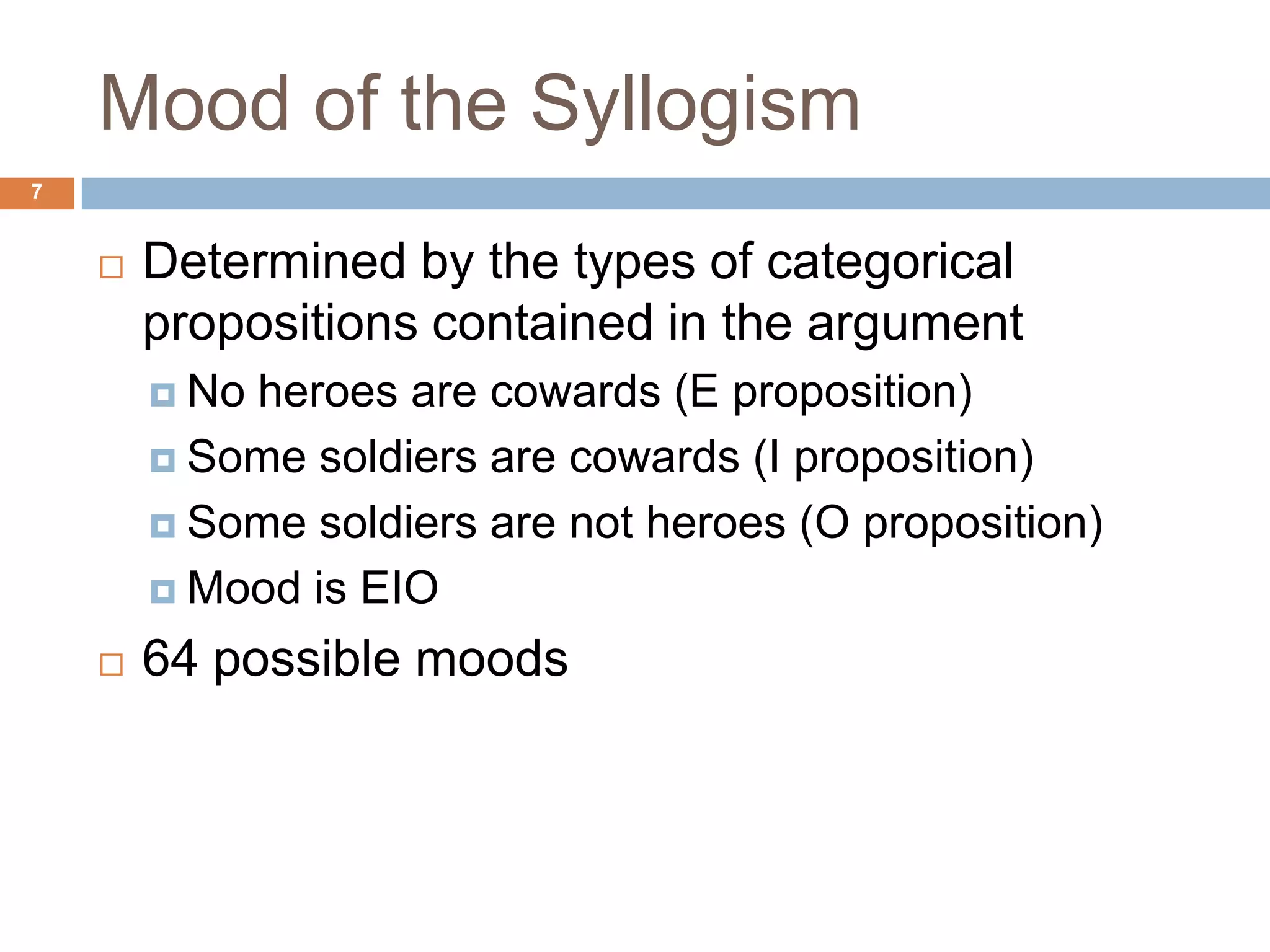
Mood of the Syllogism 7Determined by the types of categorical propositions contained in the argument No heroes are cowards (E proposition)Some soldiers are cowards (I proposition)Some soldiers are not heroes (O proposition)Mood is EIO64 possible moods
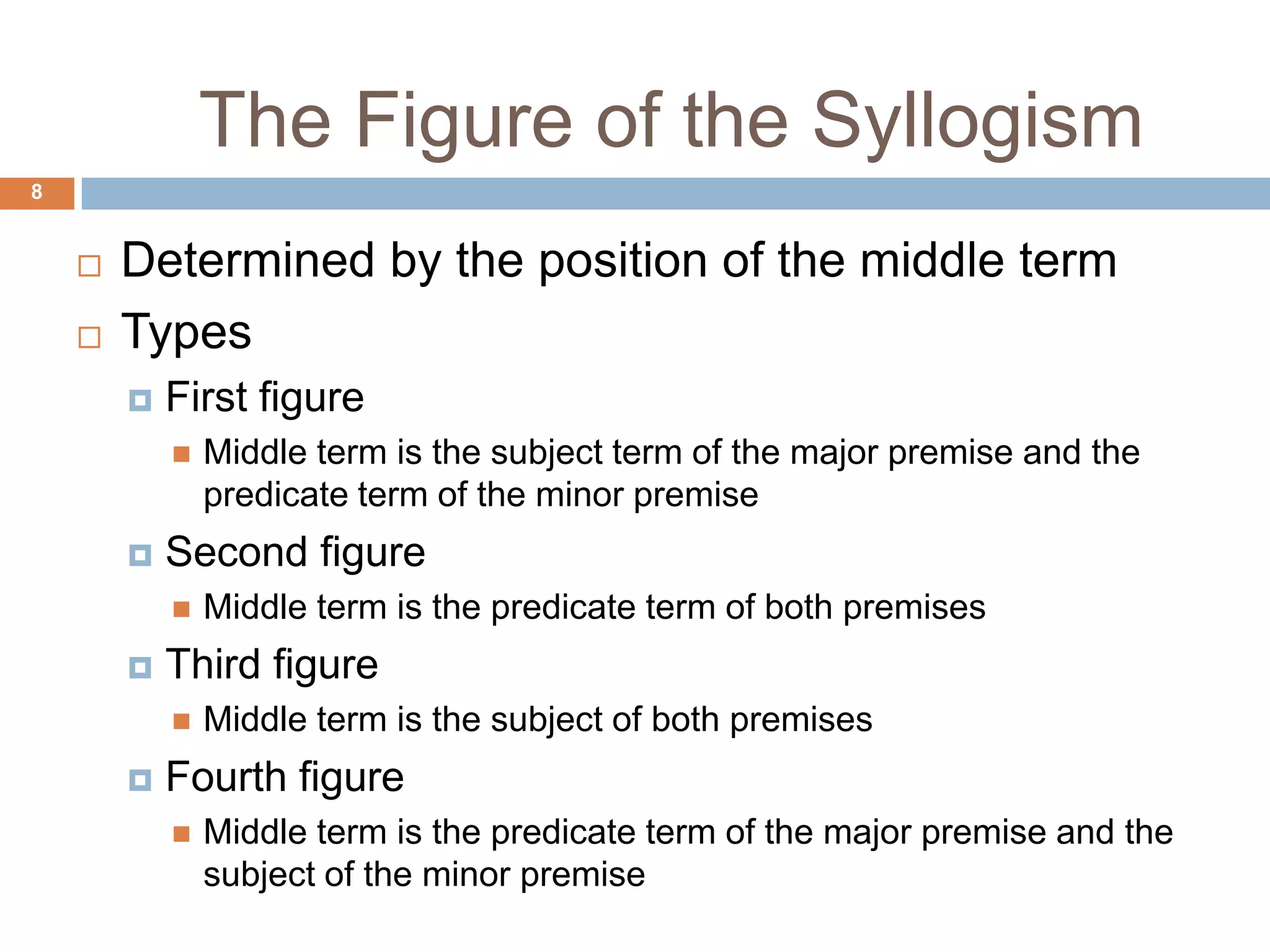
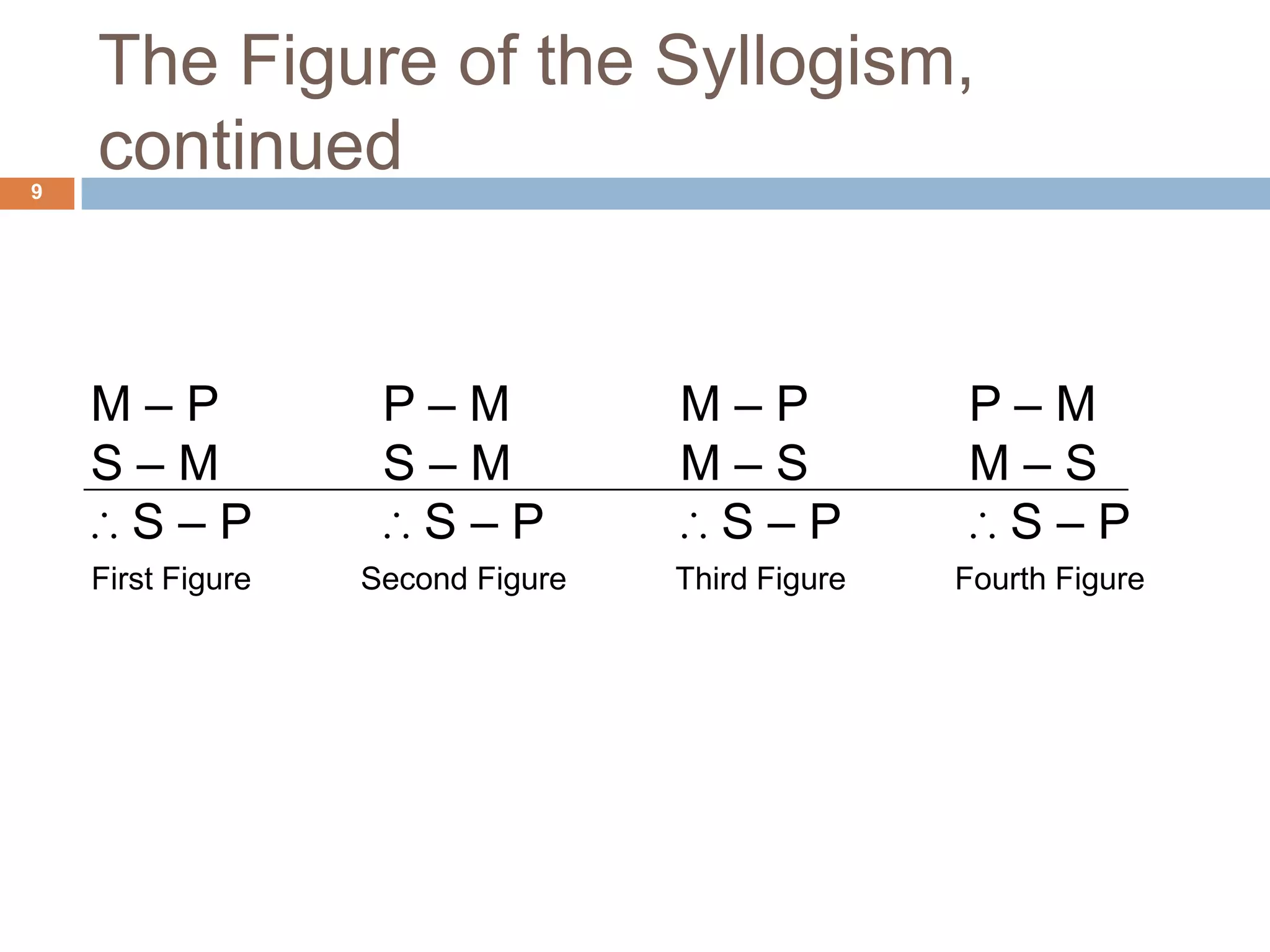
The Figure of the Syllogism 8Determined by the position of the middle term TypesFirst figureMiddle term is the subject term of the major premise and the predicate term of the minor premise Second figureMiddle term is the predicate term of both premises Third figureMiddle term is the subject of both premises Fourth figureMiddle term is the predicate term of the major premise and the subject of the minor premise
The Figure of the Syllogism, continued 9M – PS – M ∴ S – PP – MS – M ∴ S – PM – PM – S ∴ S – PP – MM – S ∴ S – PFirst FigureSecond FigureThird FigureFourth Figure
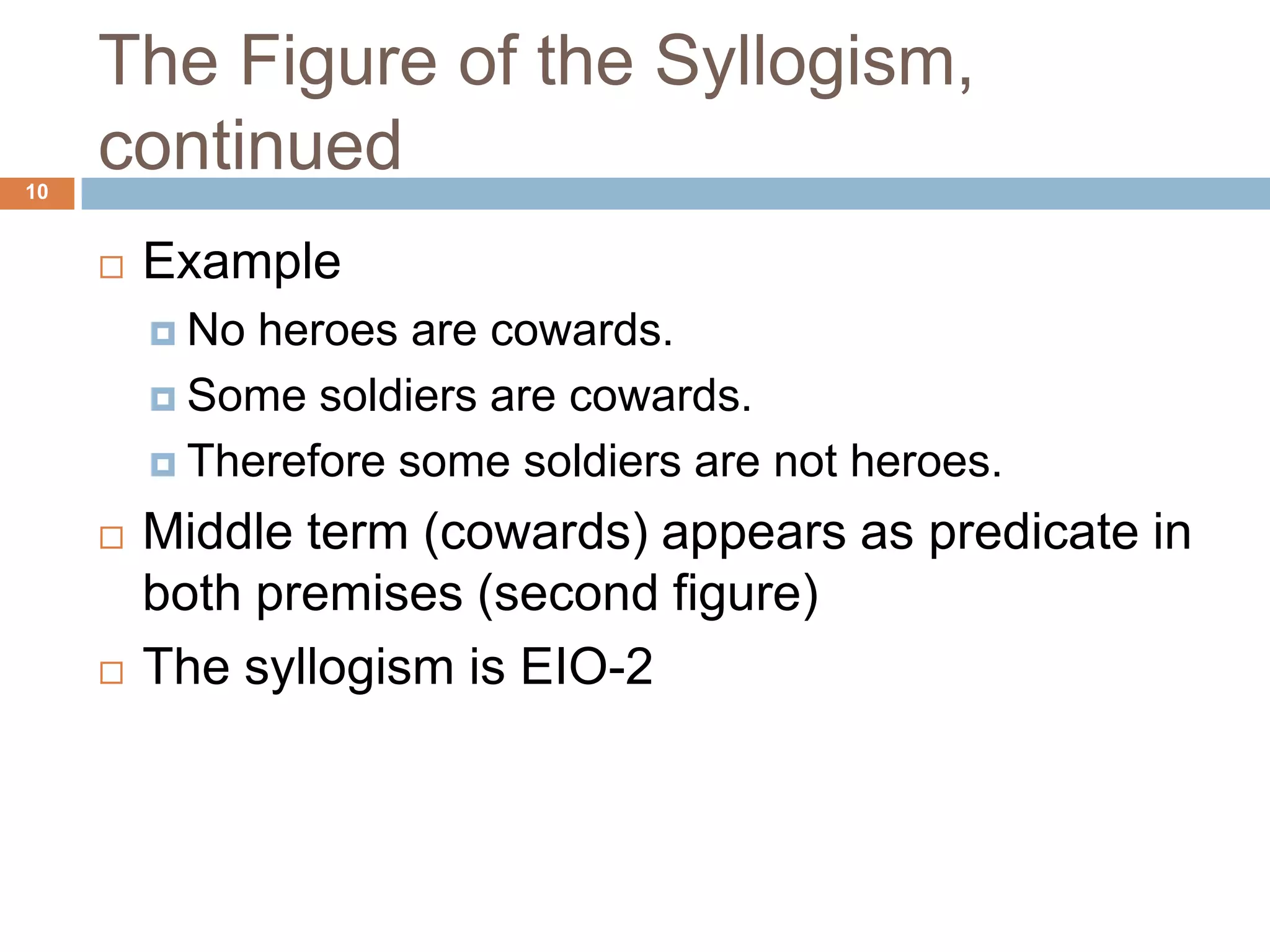
The Figure of the Syllogism, continued 10ExampleNo heroes are cowards.Some soldiers are cowards.Therefore some soldiers are not heroes.Middle term (cowards) appears as predicate in both premises (second figure)The syllogism is EIO-2
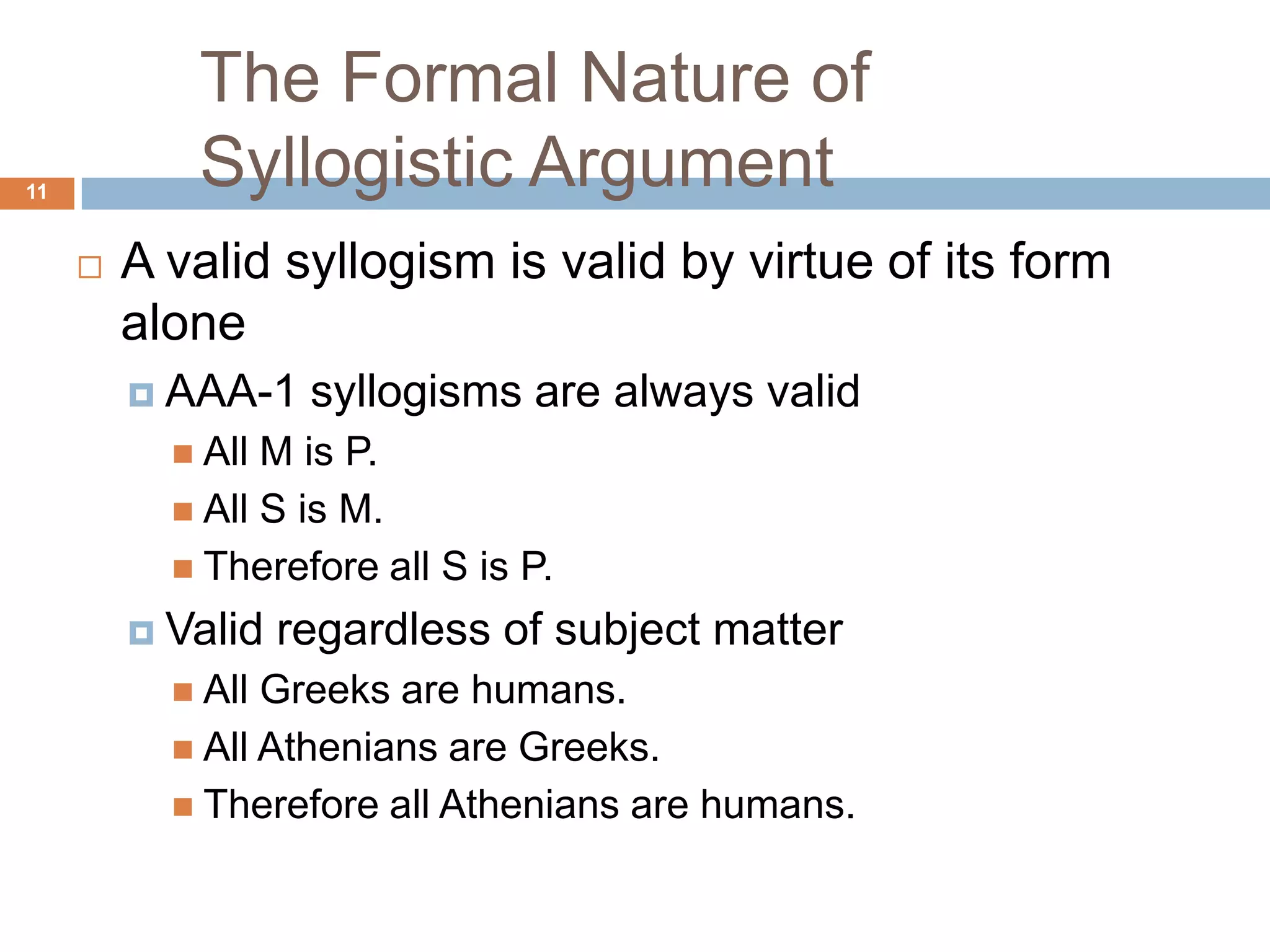
The Formal Nature of Syllogistic Argument 11A valid syllogism is valid by virtue of its form alone AAA-1 syllogisms are always validAll M is P.All S is M.Therefore all S is P. Valid regardless of subject matterAll Greeks are humans.All Athenians are Greeks.Therefore all Athenians are humans.
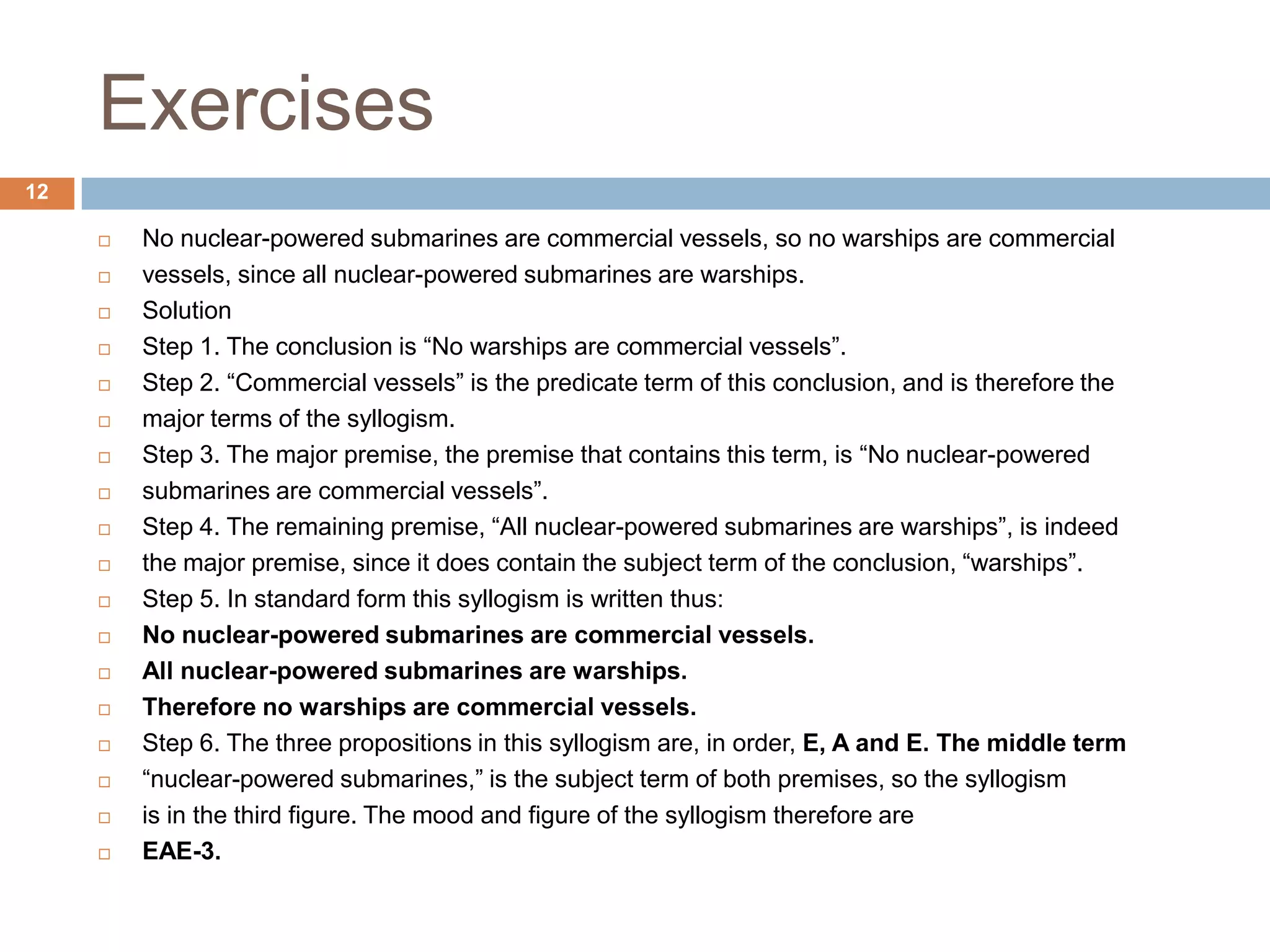
Exercises12No nuclear-powered submarines are commercial vessels, so no warships are commercialvessels, since all nuclear-powered submarines are warships.SolutionStep 1. The conclusion is “No warships are commercial vessels”.Step 2. “Commercial vessels” is the predicate term of this conclusion, and is therefore themajor terms of the syllogism.Step 3. The major premise, the premise that contains this term, is “No nuclear-poweredsubmarines are commercial vessels”.Step 4. The remaining premise, “All nuclear-powered submarines are warships”, is indeedthe major premise, since it does contain the subject term of the conclusion, “warships”.Step 5. In standard form this syllogism is written thus:No nuclear-powered submarines are commercial vessels.All nuclear-powered submarines are warships.Therefore no warships are commercial vessels.Step 6. The three propositions in this syllogism are, in order, E, A and E. The middle term“nuclear-powered submarines,” is the subject term of both premises, so the syllogismis in the third figure. The mood and figure of the syllogism therefore areEAE-3.
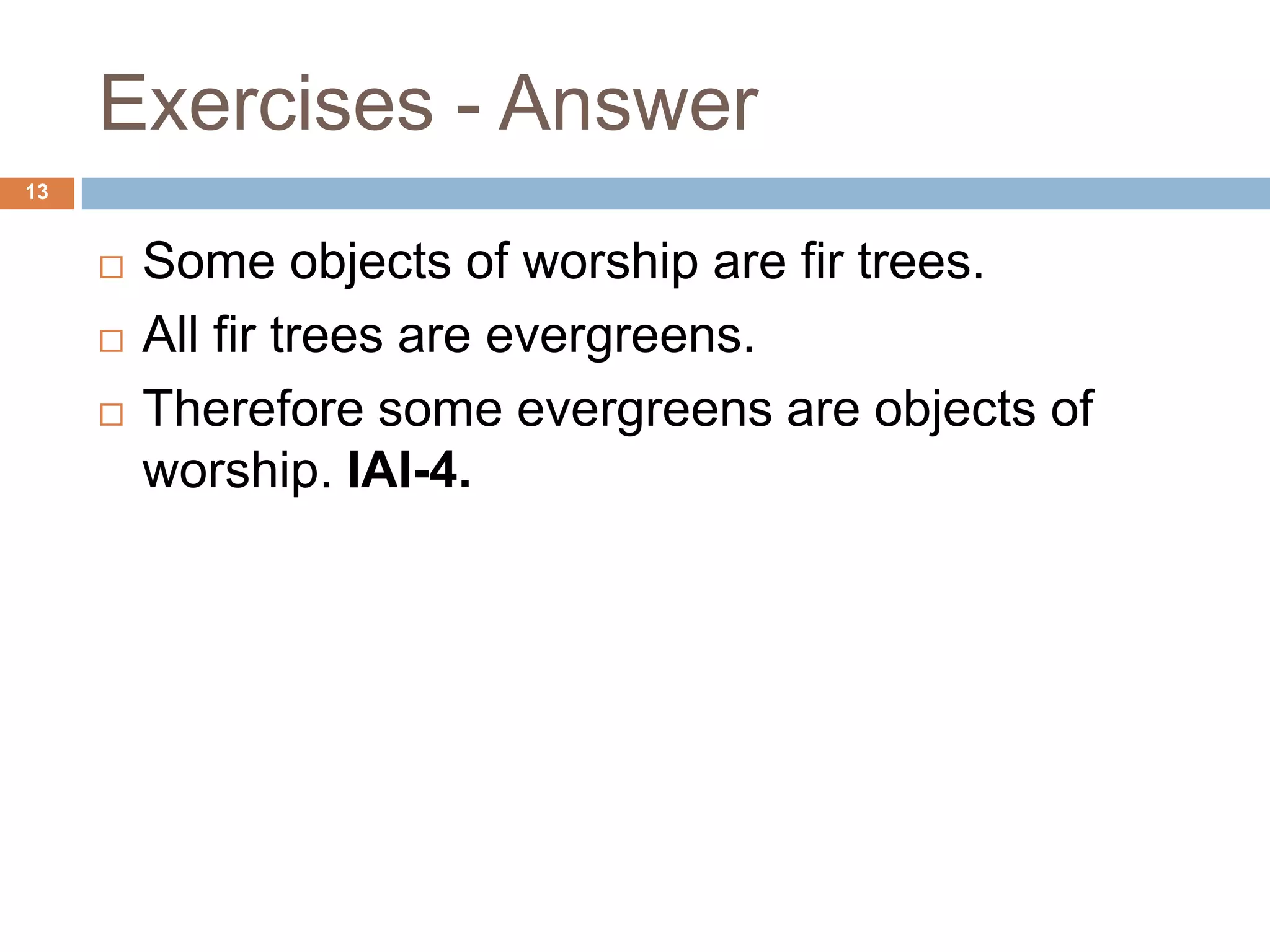
Exercises - Answer13Some objects of worship are fir trees. All fir trees are evergreens.Therefore some evergreens are objects of worship. IAI-4.
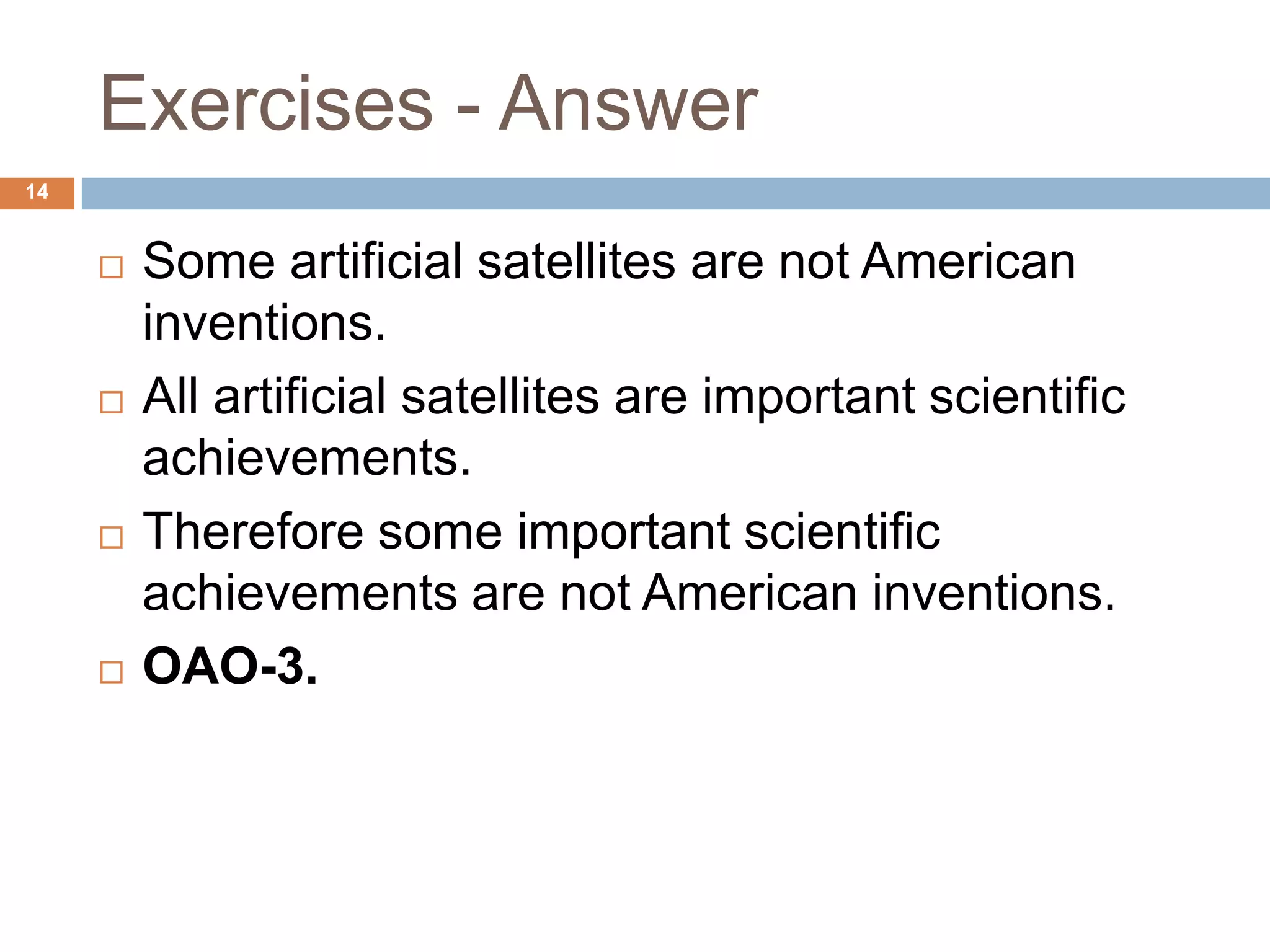
Exercises - Answer14Some artificial satellites are not American inventions.All artificial satellites are important scientific achievements.Therefore some important scientific achievements are not American inventions.OAO-3.
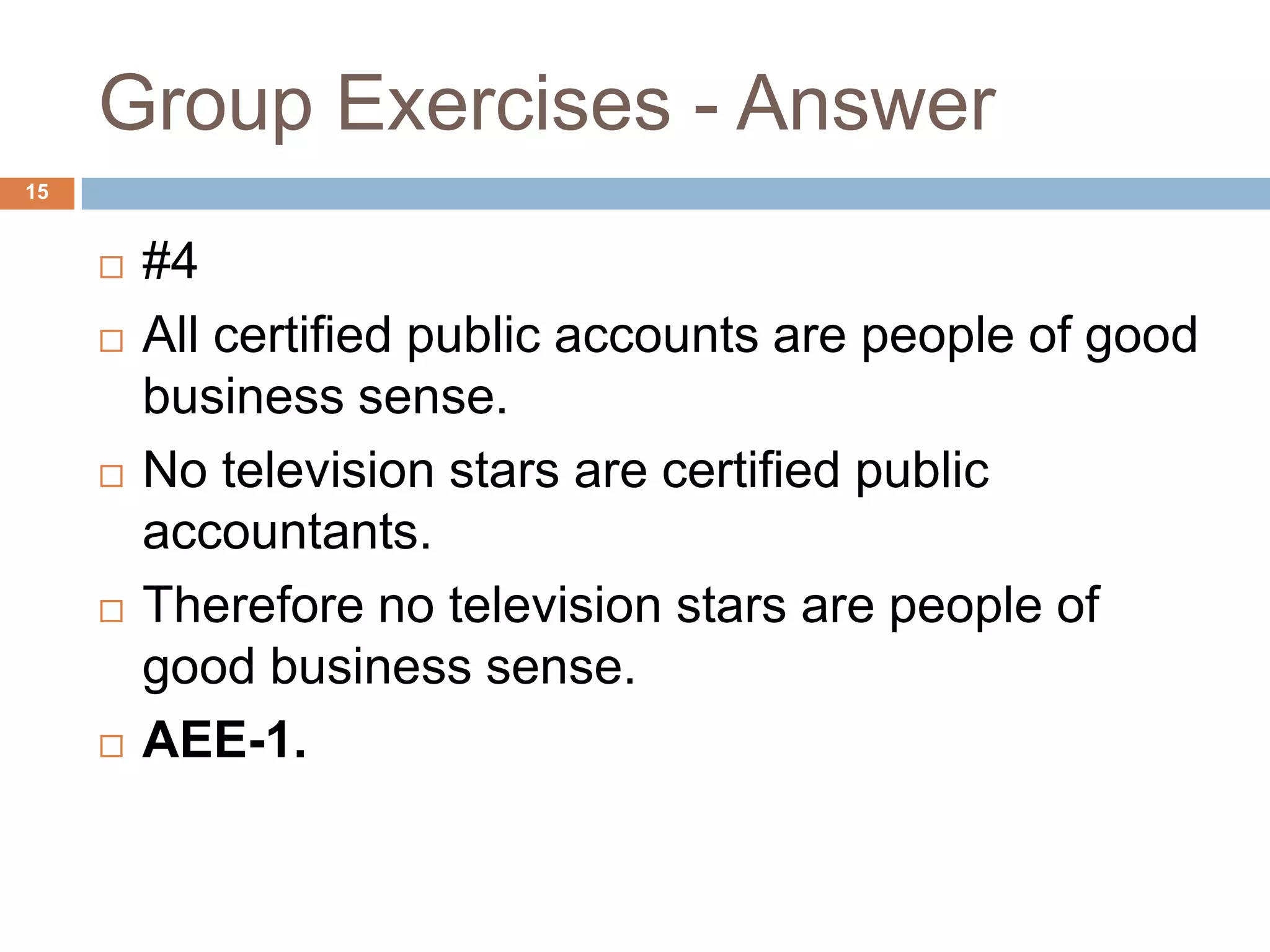
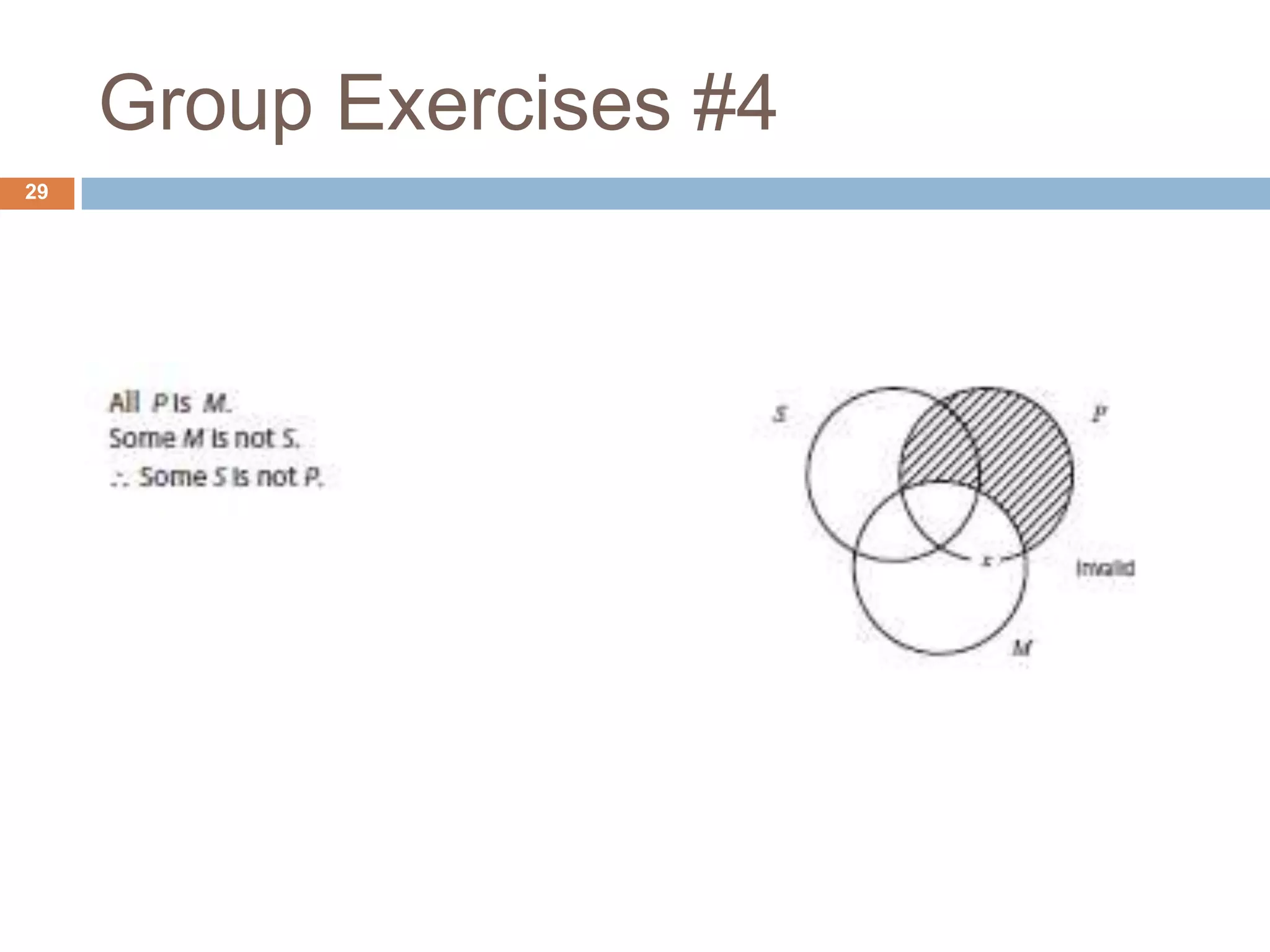
Group Exercises - Answer15#4All certified public accounts are people of good business sense.No television stars are certified public accountants.Therefore no television stars are people of good business sense.AEE-1.
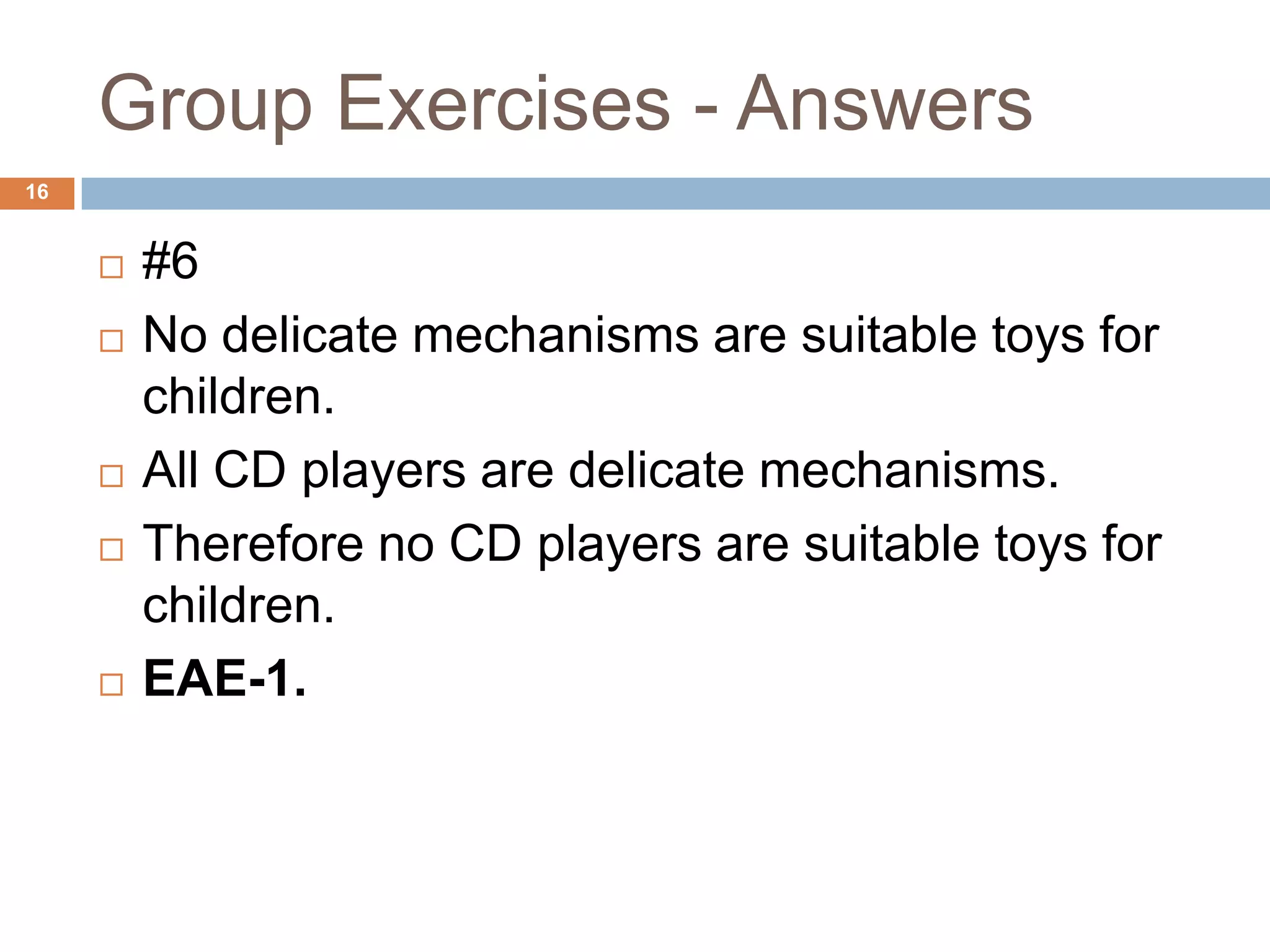
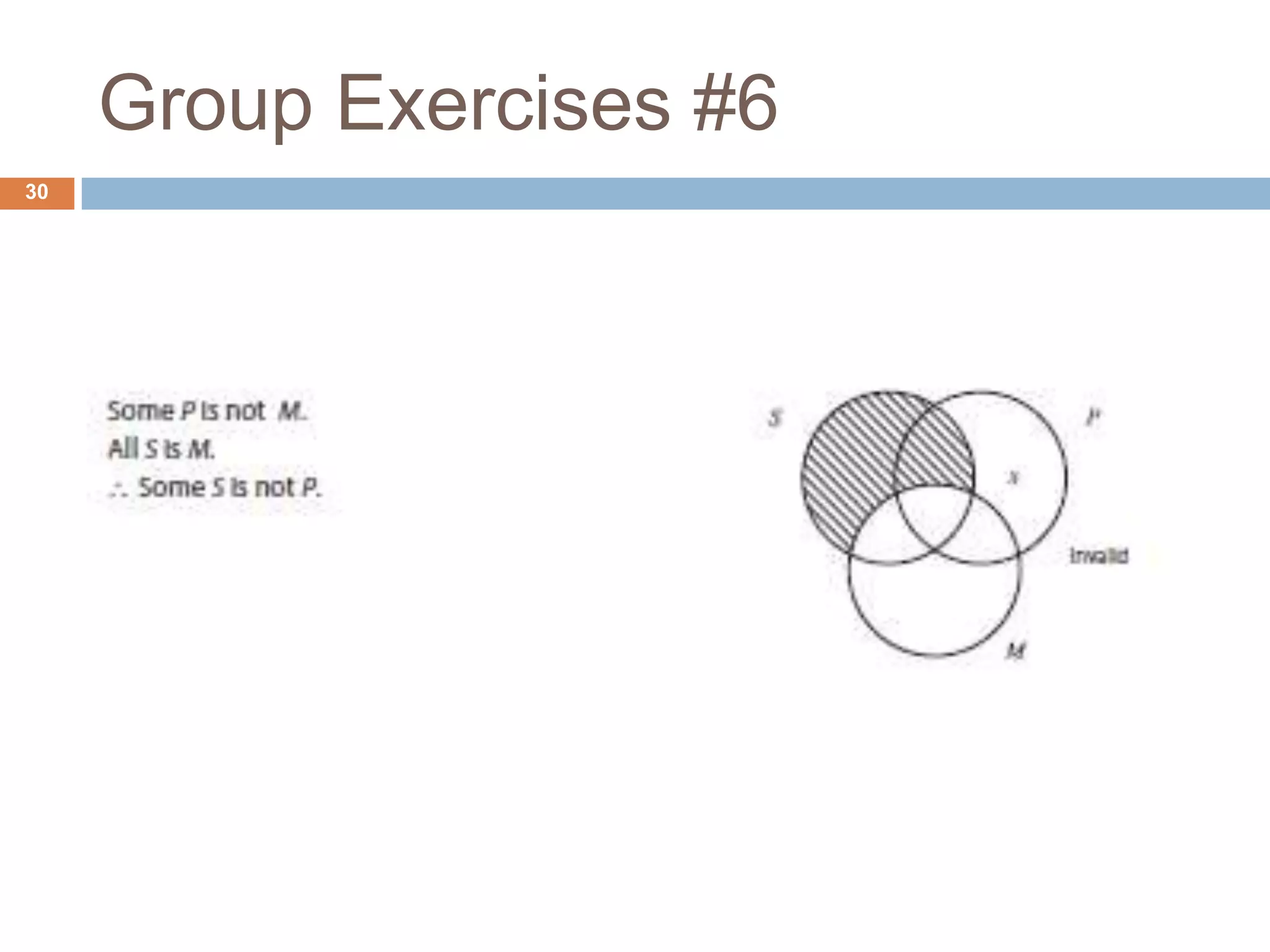
Group Exercises - Answers 16#6No delicate mechanisms are suitable toys for children.All CD players are delicate mechanisms.Therefore no CD players are suitable toys for children.EAE-1.
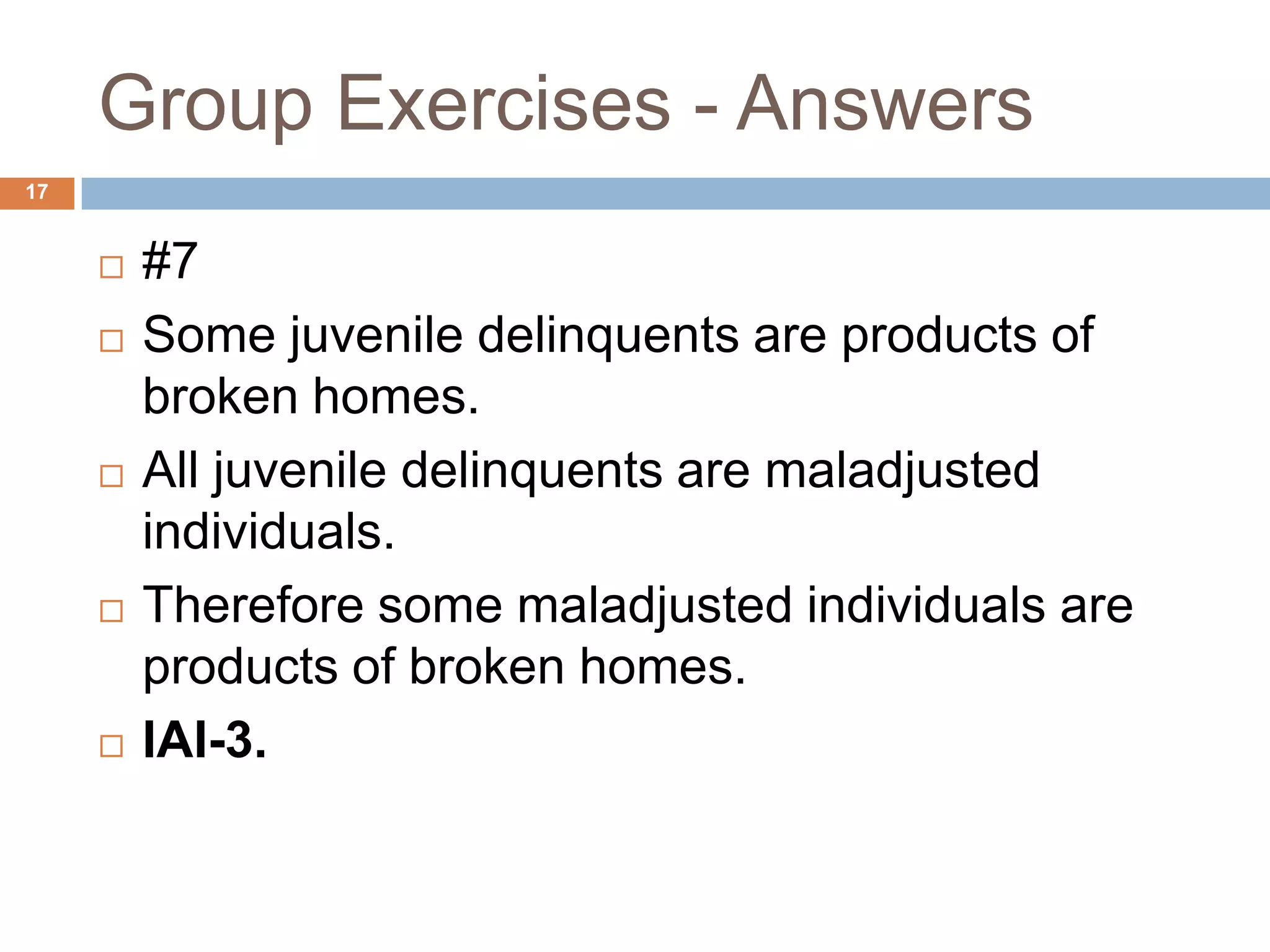
Group Exercises - Answers 17#7Some juvenile delinquents are products of broken homes.All juvenile delinquents are maladjusted individuals.Therefore some maladjusted individuals are products of broken homes.IAI-3.
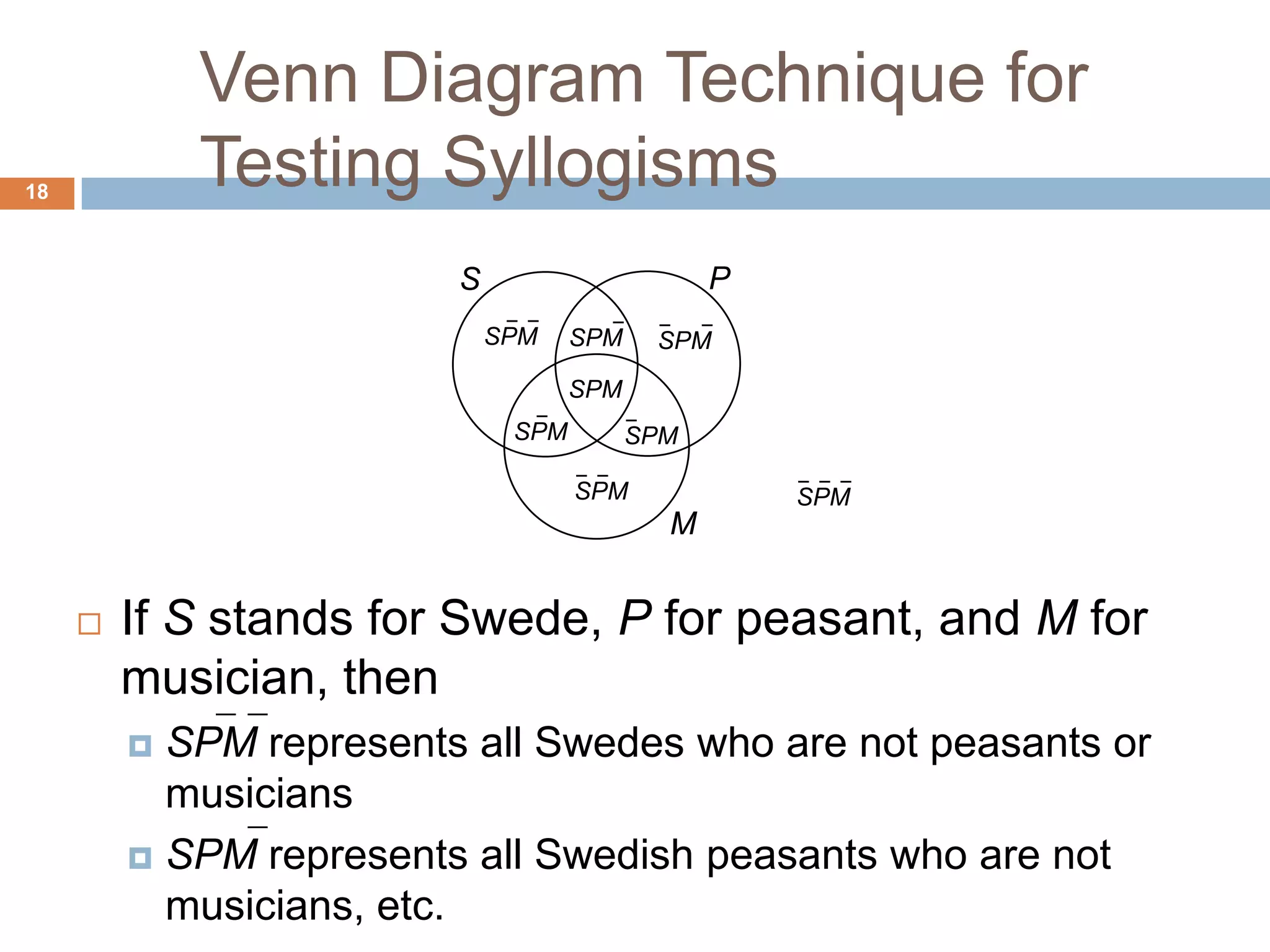
18PSSPMSPMSPMSPMSPMSPMSPMSPMMVenn Diagram Technique for Testing Syllogisms If S stands for Swede, P for peasant, and M for musician, then SPM represents all Swedes who are not peasants or musiciansSPM represents all Swedish peasants who are not musicians, etc.
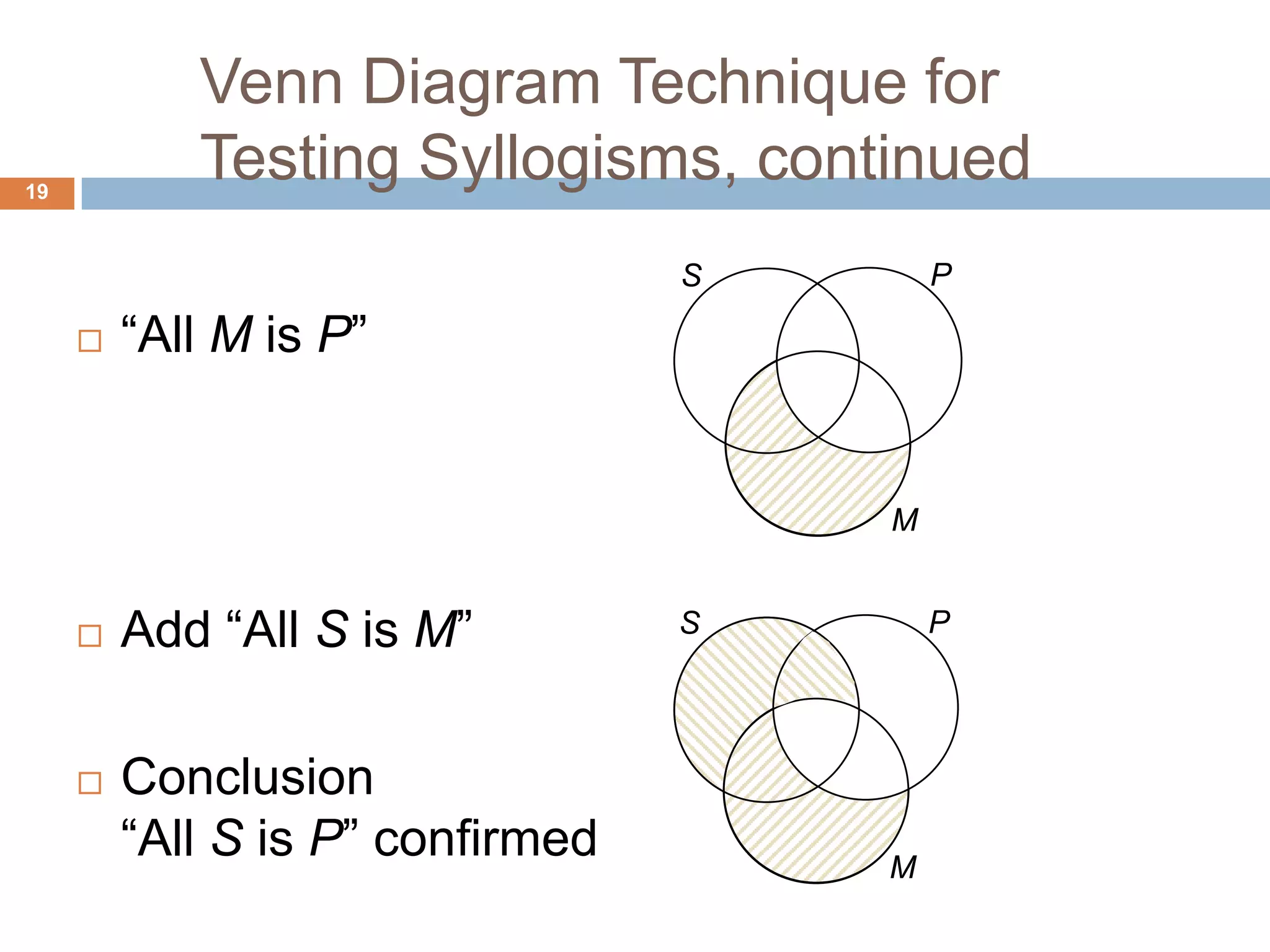
19PSMPSMVenn Diagram Technique for Testing Syllogisms, continued “All M is P”Add “All S is M”Conclusion“All S is P” confirmed
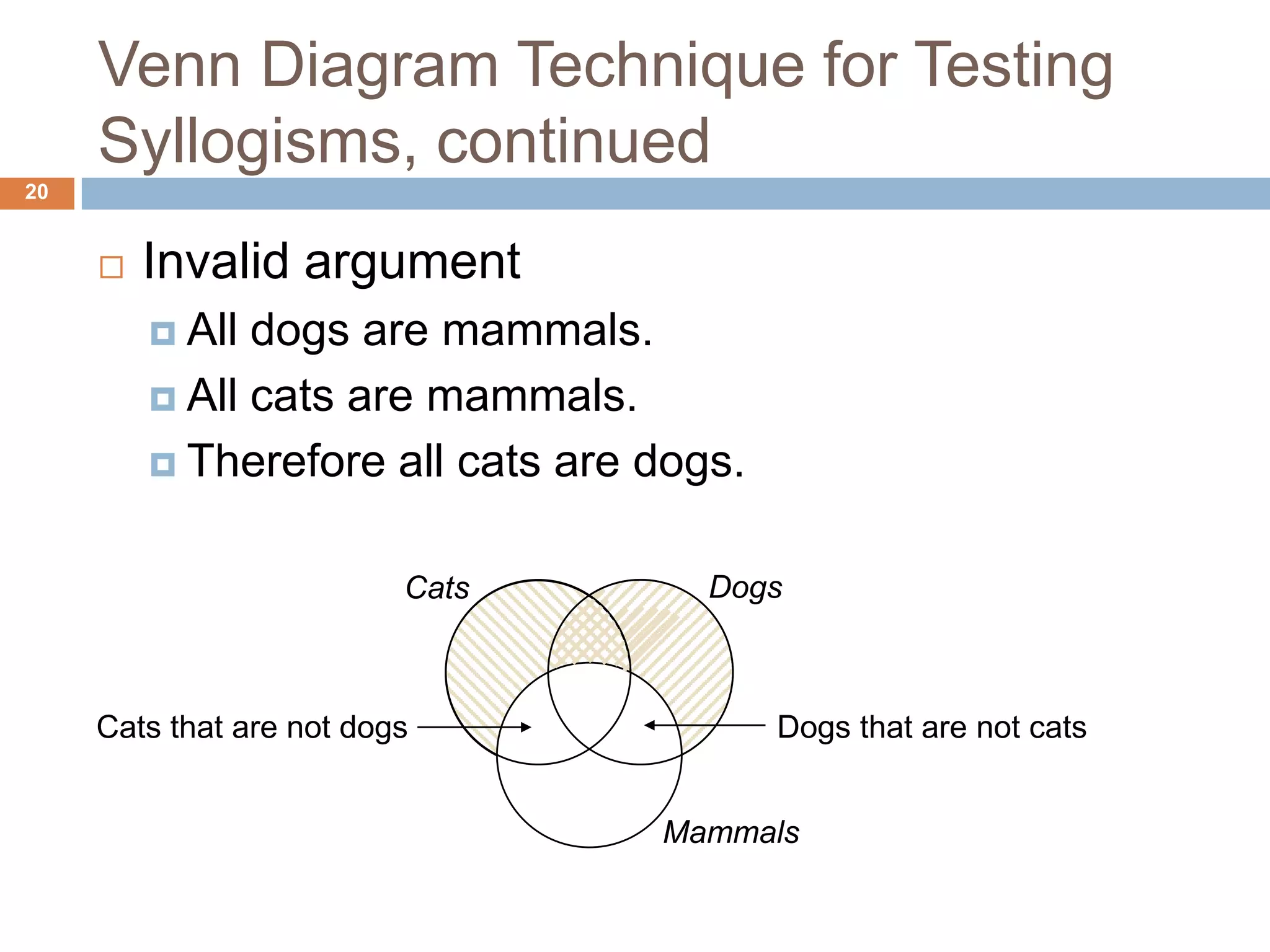
Venn Diagram Technique for Testing Syllogisms, continued 20Invalid argumentAll dogs are mammals.All cats are mammals.Therefore all cats are dogs. DogsCatsCats that are not dogsDogs that are not catsMammals
Exercises pg. 232-23321#1All business executives are active opponents of increased corporation taxes, for all active opponents of increased corporation taxes are members of the chamber of commerce, and all members of the chamber of commerce are business executives.One possible refuting analogy is this: All bipeds are astronauts, All astronauts are humans Therefore all humans are bipeds.
Group Exercises pg. 232-23322Do numbers 3, 4, 5 and 7
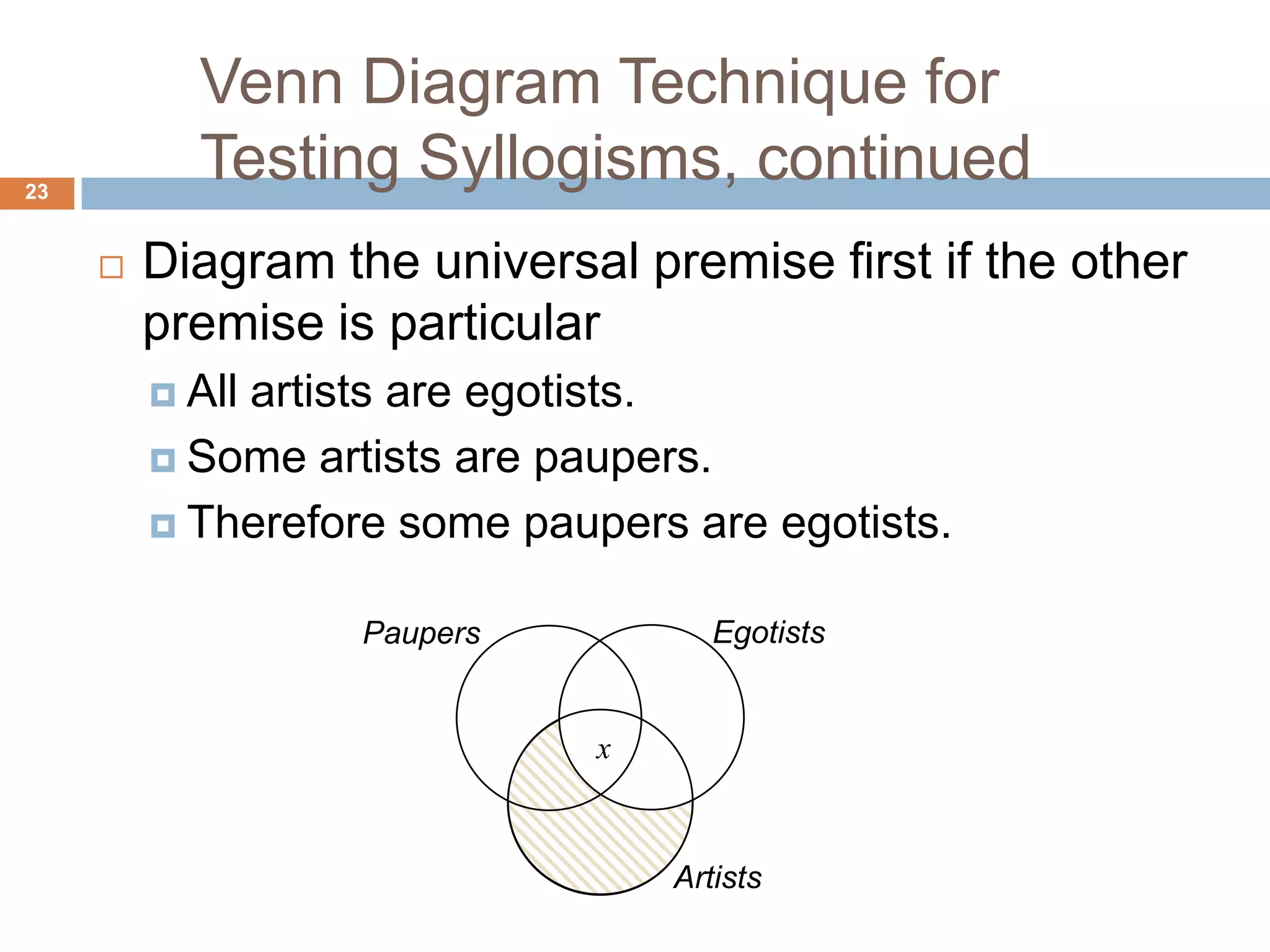
23Diagram the universal premise first if the other premise is particularAll artists are egotists.Some artists are paupers.Therefore some paupers are egotists. EgotistsPaupersxArtistsVenn Diagram Technique for Testing Syllogisms, continued
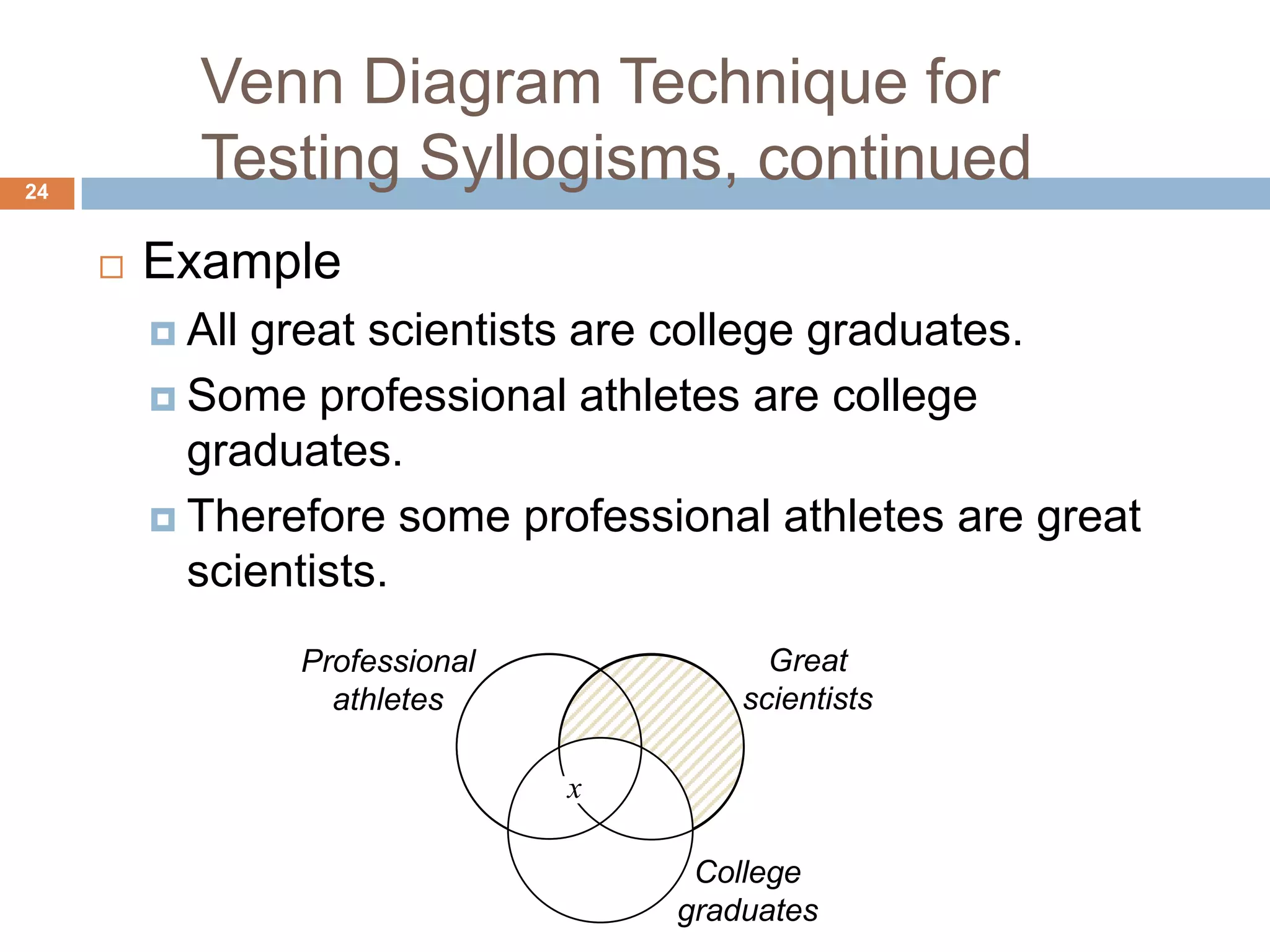
Venn Diagram Technique for Testing Syllogisms, continued 24ExampleAll great scientists are college graduates.Some professional athletes are college graduates. Therefore some professional athletes are great scientists. GreatscientistsProfessionalathletesxCollegegraduates
Venn Diagram Technique for Testing Syllogisms, continued 25Label the circles of a three-circle Venn diagram with the syllogism’s three terms Diagram both premises, starting with the universal premiseInspect the diagram to see whether the diagram of the premises contains a diagram of the conclusion
Group Exercises26Do 2,3,4 and 6
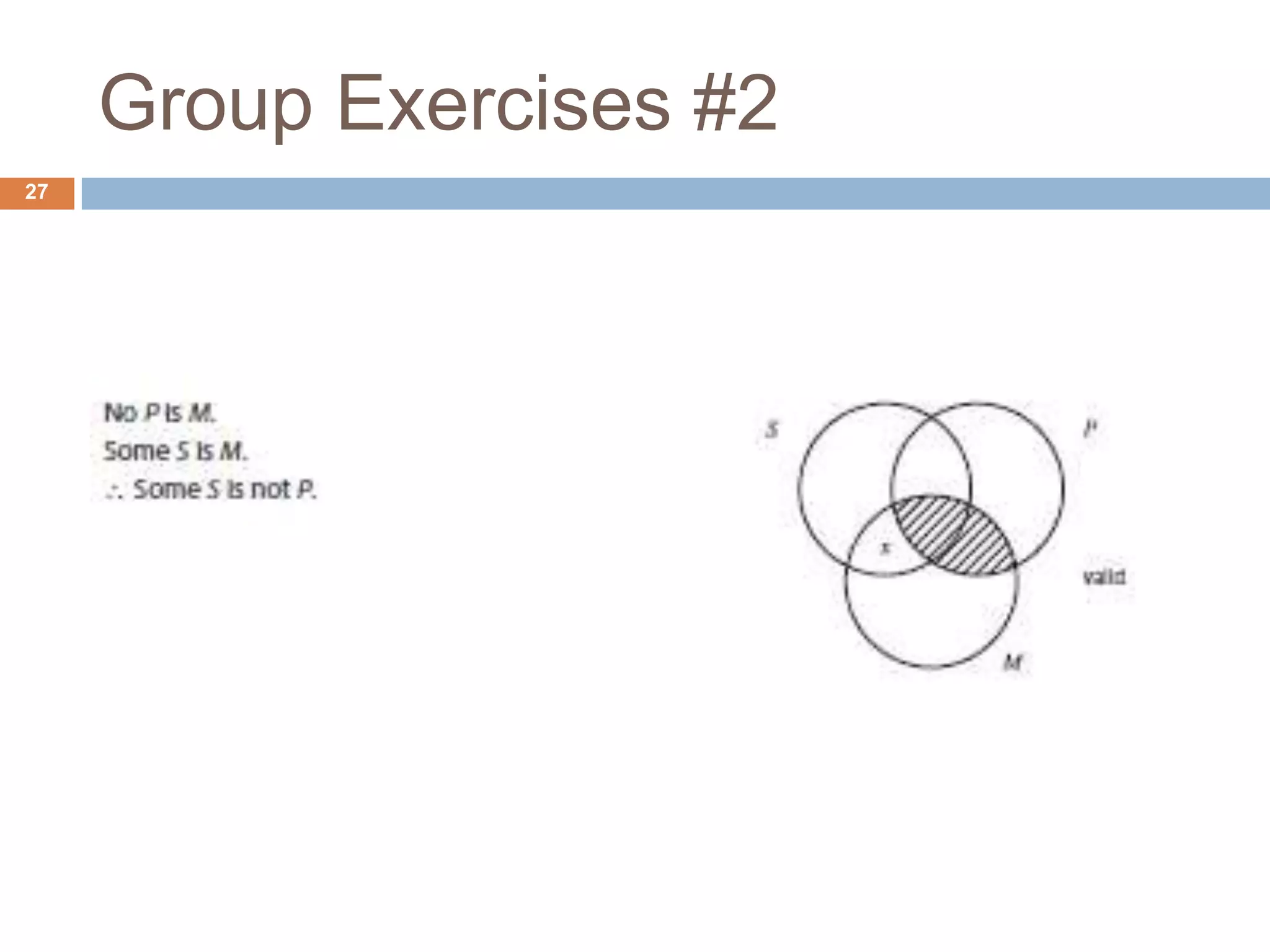
Group Exercises #227
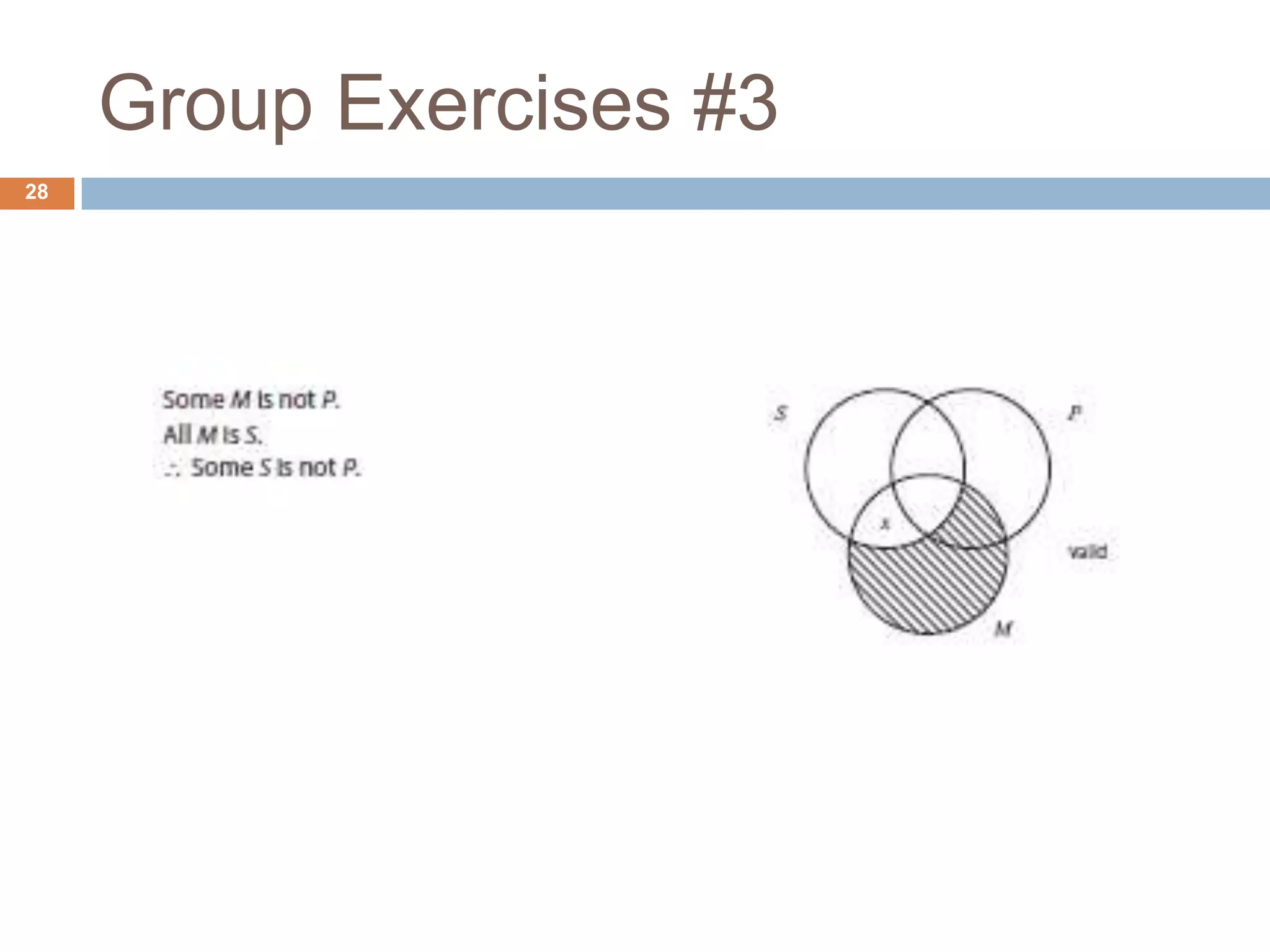
Group Exercises #328
Group Exercises #429
Group Exercises #630
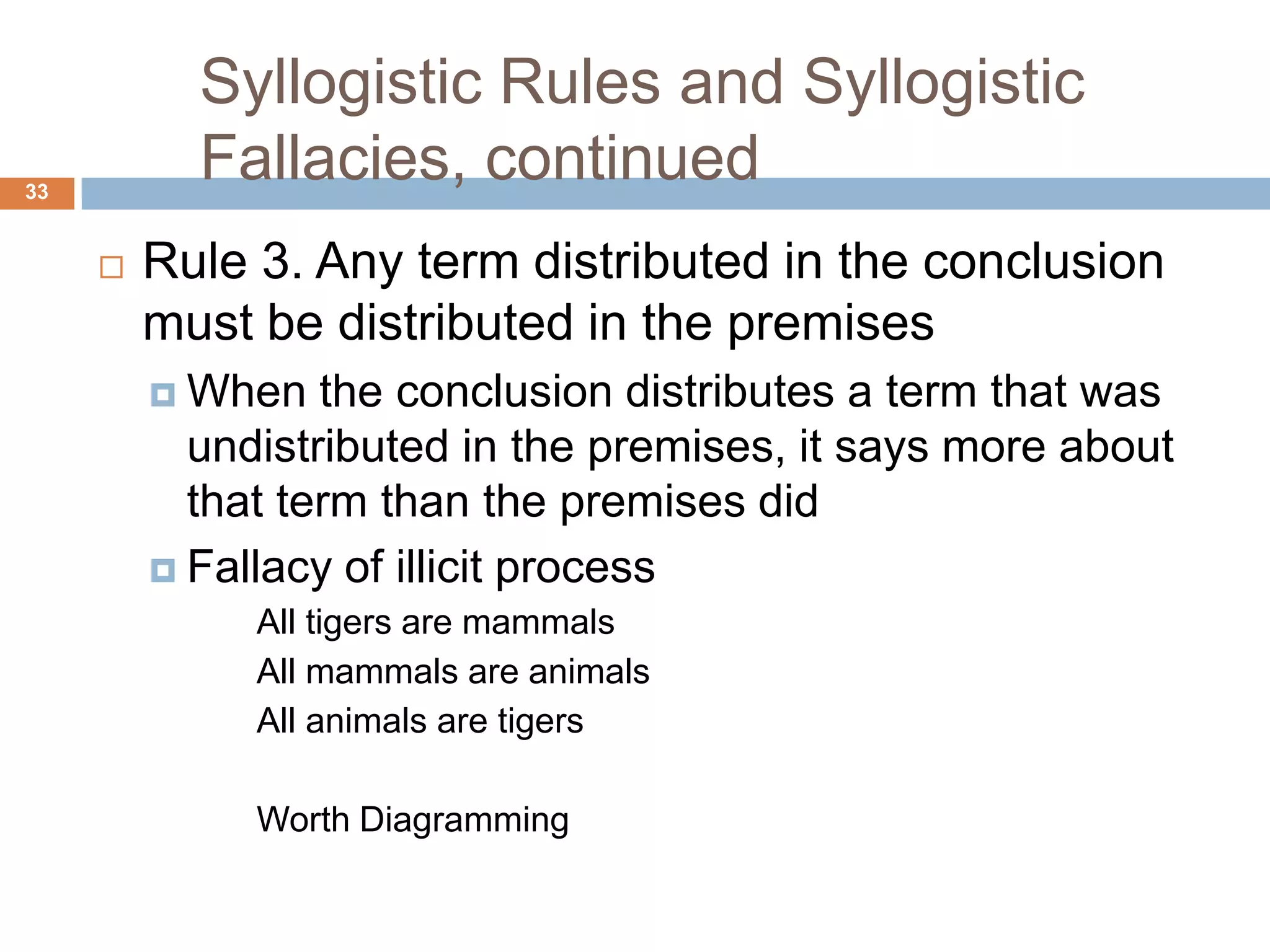
Syllogistic Rules and Syllogistic Fallacies 31Rule 1. Avoid four termsSyllogism must contain exactly three terms, each of which is used in the same sense throughout the argument Fallacy of four termsPower tends to corrupt Knowledge is power Knowledge tends to corrupt Justification: This syllogism appears to have only three terms, but there are really four since one of them, the middle term “power” is used in different senses in the two premises. To reveal the argument’s invalidity we need only note that the word “power” in the first premise means “ the possession of control or command over people,” whereas the word “power” in the second premise means “the ability to control things.
Syllogistic Rules and Syllogistic Fallacies, continued 32Rule 2. Distribute the middle term in at least one premiseIf the middle term is not distributed in at least one premise, the connection required by the conclusion cannot be made Fallacy of the undistributed middleAll sharks are fish All salmon are fish All salmon are sharks Justification: The middle term is what connects the major and the minor term. If the middle term is never distributed, then the major and minor terms might be related to different parts of the M class, thus giving no common ground to relate S and P.
Syllogistic Rules and Syllogistic Fallacies, continued 33Rule 3. Any term distributed in the conclusion must be distributed in the premisesWhen the conclusion distributes a term that was undistributed in the premises, it says more about that term than the premises did Fallacy of illicit processAll tigers are mammals All mammals are animals All animals are tigersWorth Diagramming
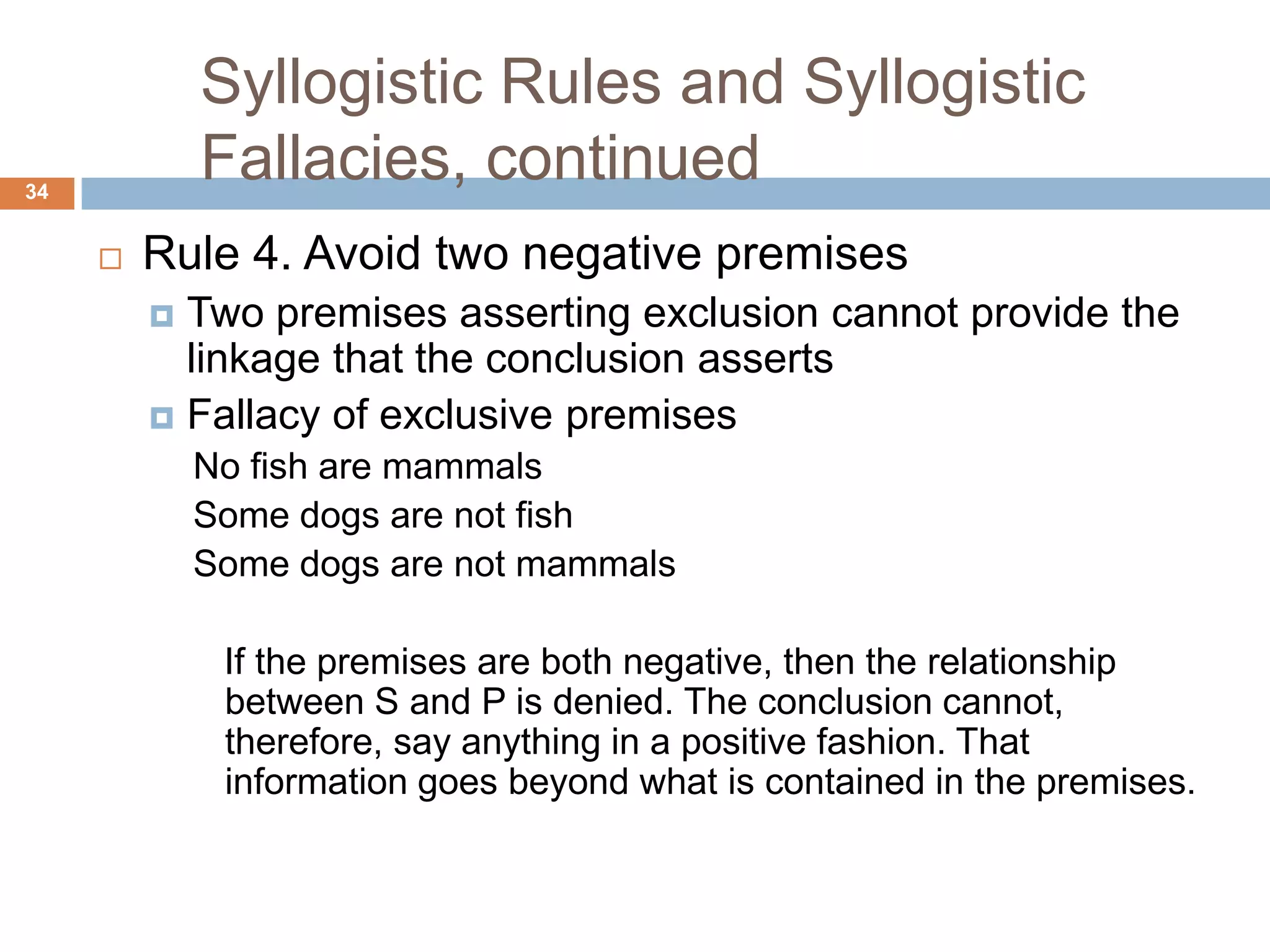
Syllogistic Rules and Syllogistic Fallacies, continued 34Rule 4. Avoid two negative premisesTwo premises asserting exclusion cannot provide the linkage that the conclusion assertsFallacy of exclusive premises No fish are mammals Some dogs are not fish Some dogs are not mammalsIf the premises are both negative, then the relationship between S and P is denied. The conclusion cannot, therefore, say anything in a positive fashion. That information goes beyond what is contained in the premises.
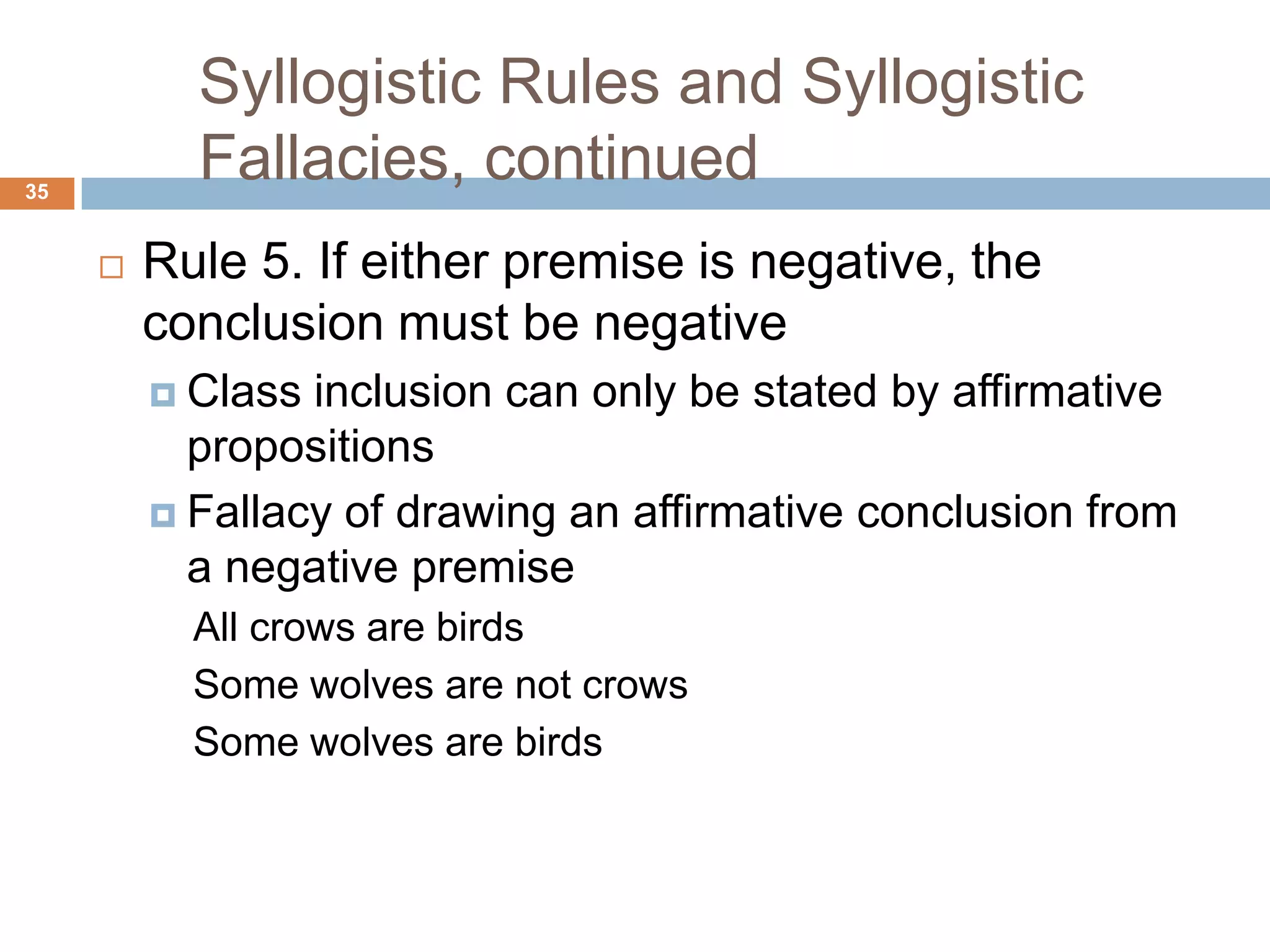
Syllogistic Rules and Syllogistic Fallacies, continued 35Rule 5. If either premise is negative, the conclusion must be negativeClass inclusion can only be stated by affirmative propositions Fallacy of drawing an affirmative conclusion from a negative premiseAll crows are birds Some wolves are not crows Some wolves are birds
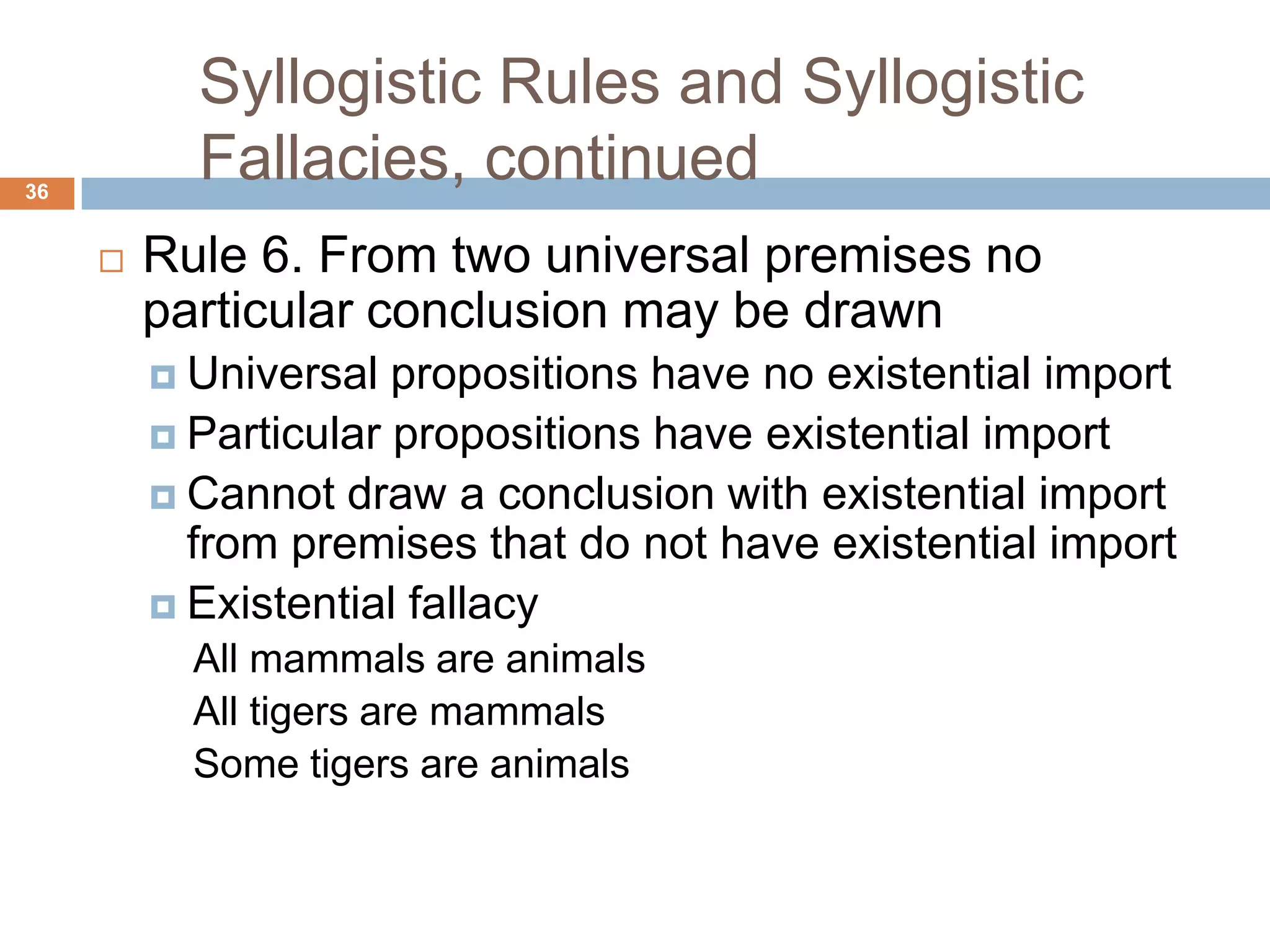
Syllogistic Rules and Syllogistic Fallacies, continued 36Rule 6. From two universal premises no particular conclusion may be drawnUniversal propositions have no existential importParticular propositions have existential import Cannot draw a conclusion with existential import from premises that do not have existential importExistential fallacyAll mammals are animals All tigers are mammals Some tigers are animals
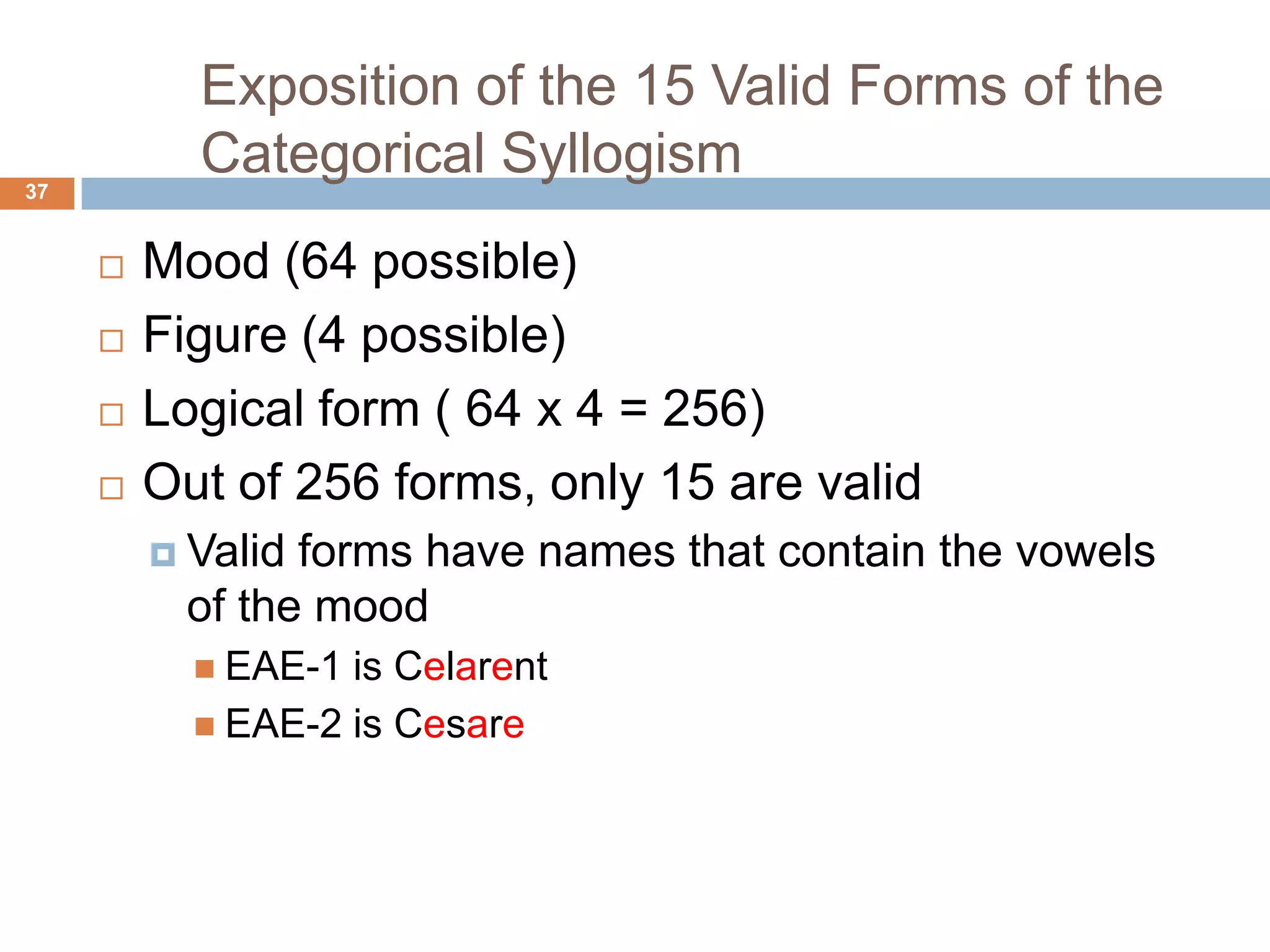
Exposition of the 15 Valid Forms of the Categorical Syllogism 37Mood (64 possible)Figure (4 possible)Logical form ( 64 x 4 = 256)Out of 256 forms, only 15 are validValid forms have names that contain the vowels of the moodEAE-1 is CelarentEAE-2 is Cesare
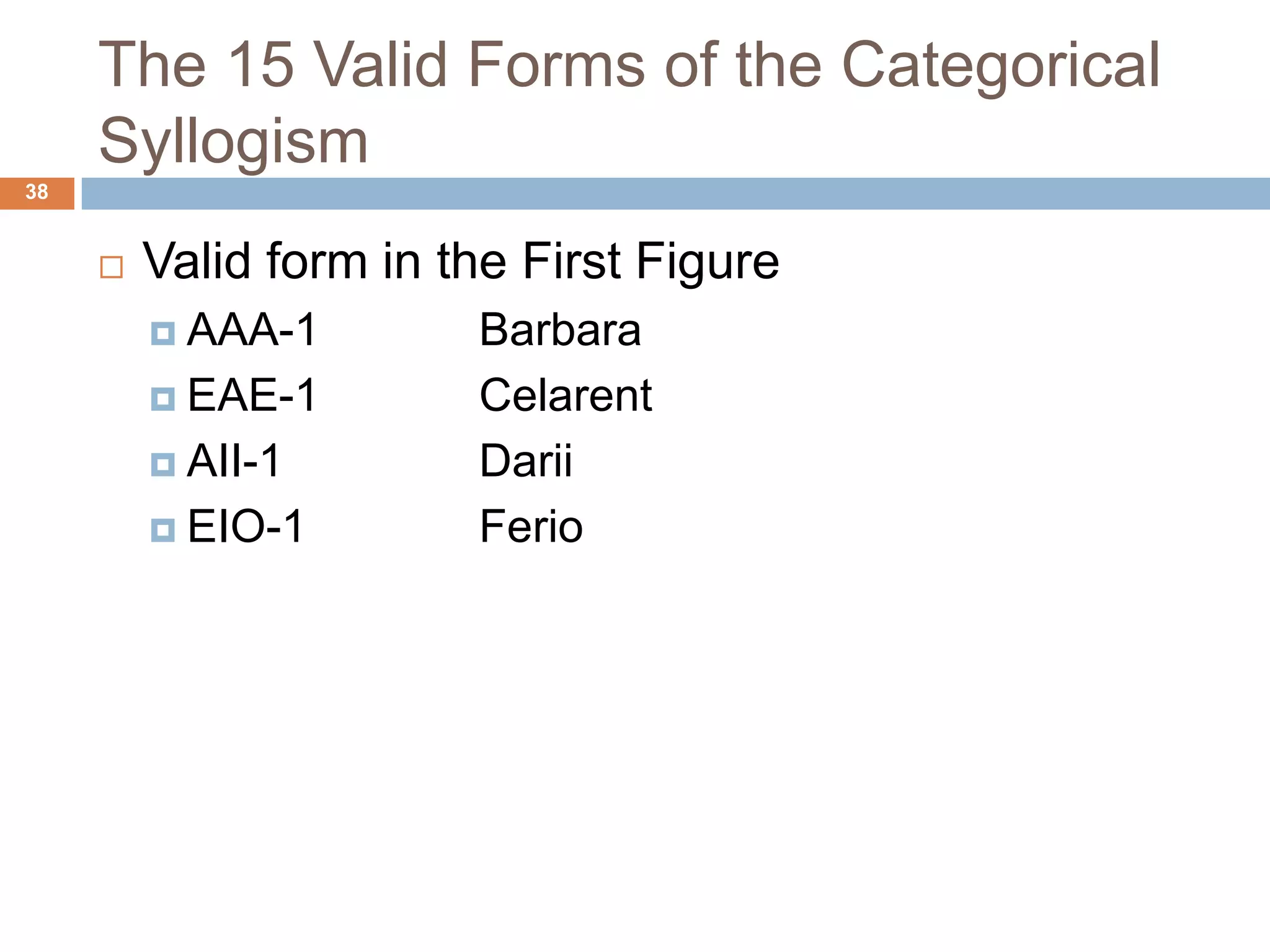
The 15 Valid Forms of the Categorical Syllogism 38Valid form in the First FigureAAA-1BarbaraEAE-1CelarentAII-1DariiEIO-1Ferio
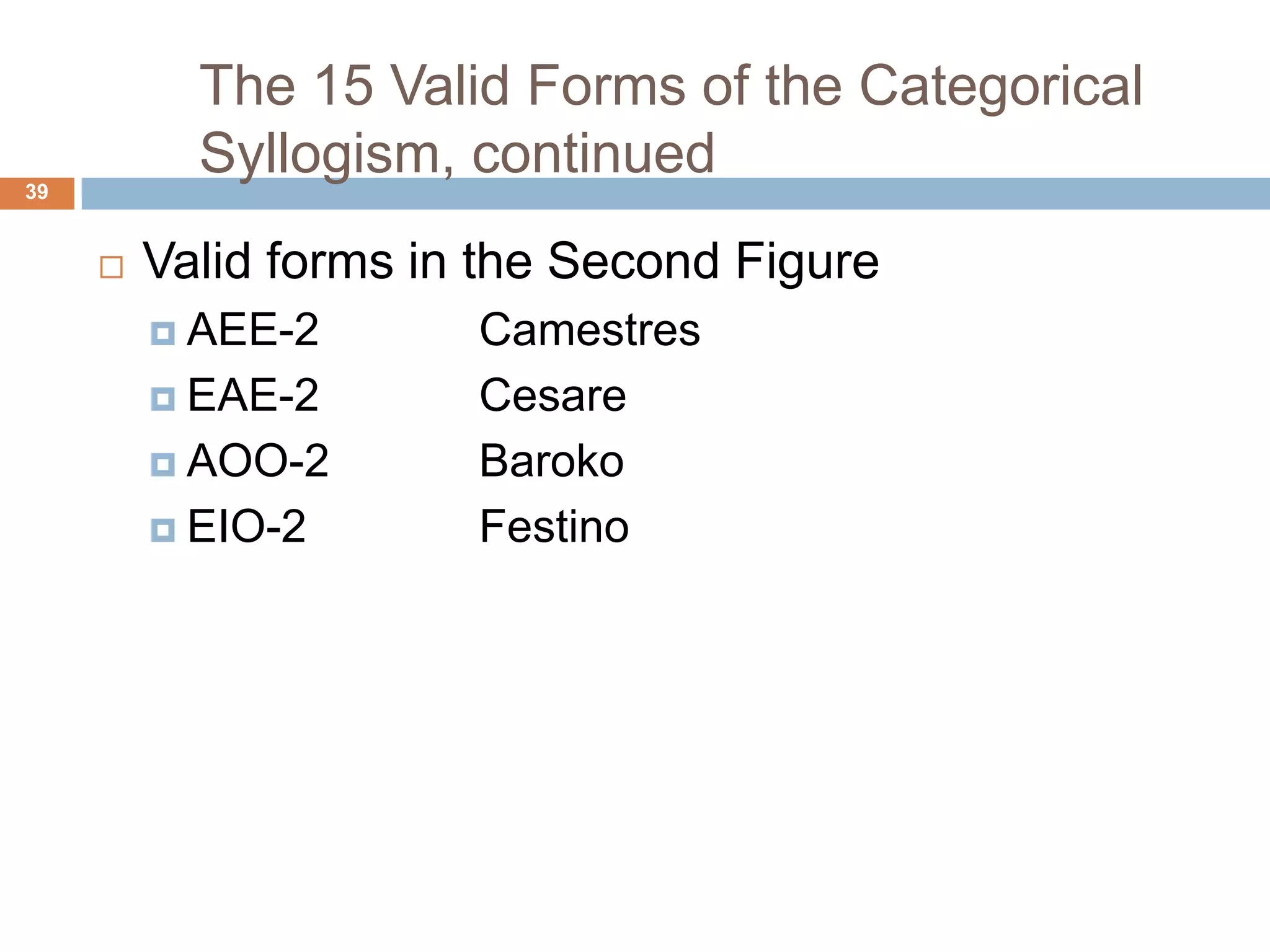
The 15 Valid Forms of the Categorical Syllogism, continued 39Valid forms in the Second FigureAEE-2CamestresEAE-2CesareAOO-2BarokoEIO-2Festino
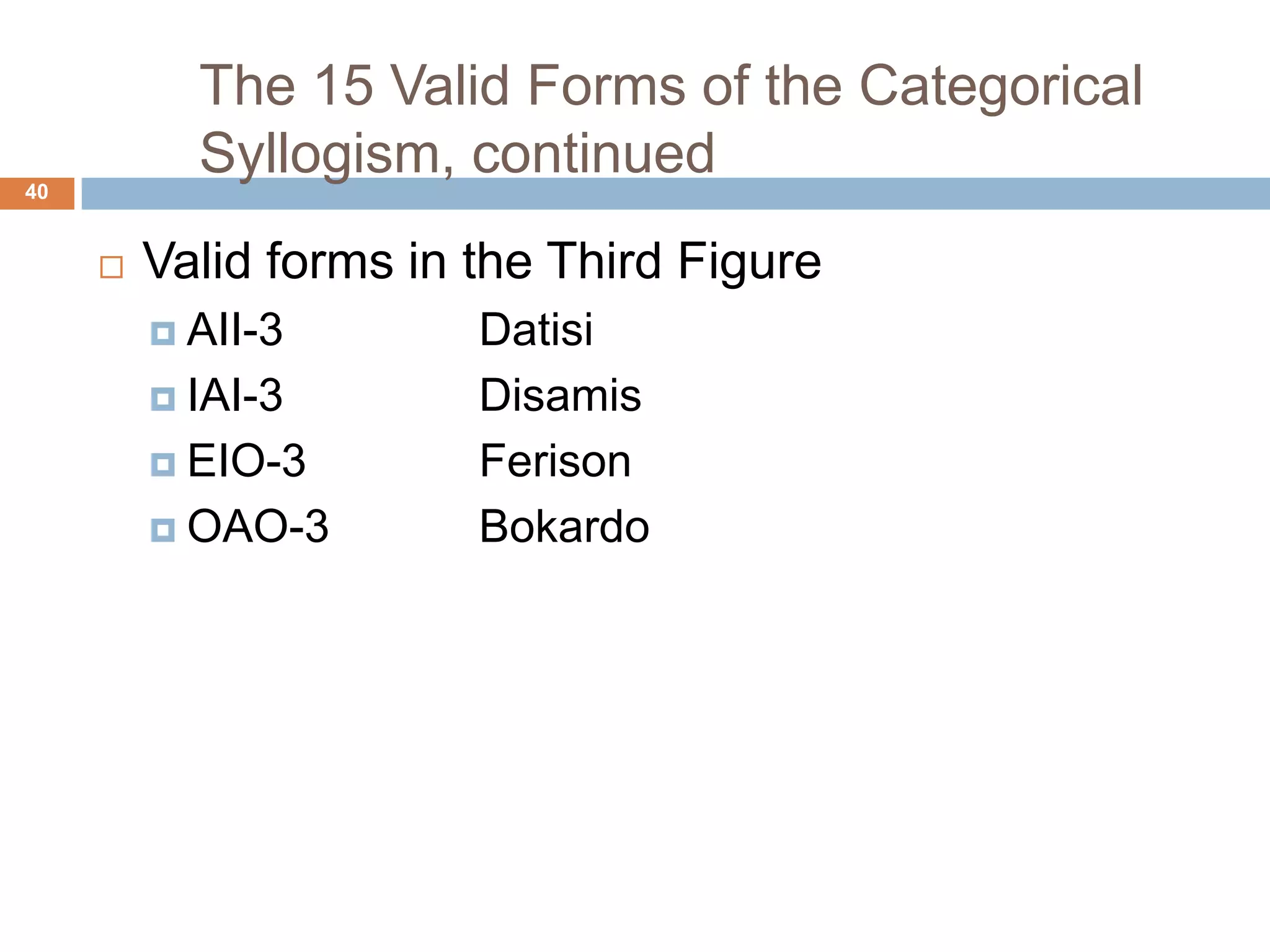
The 15 Valid Forms of the Categorical Syllogism, continued 40Valid forms in the Third FigureAII-3DatisiIAI-3DisamisEIO-3FerisonOAO-3Bokardo
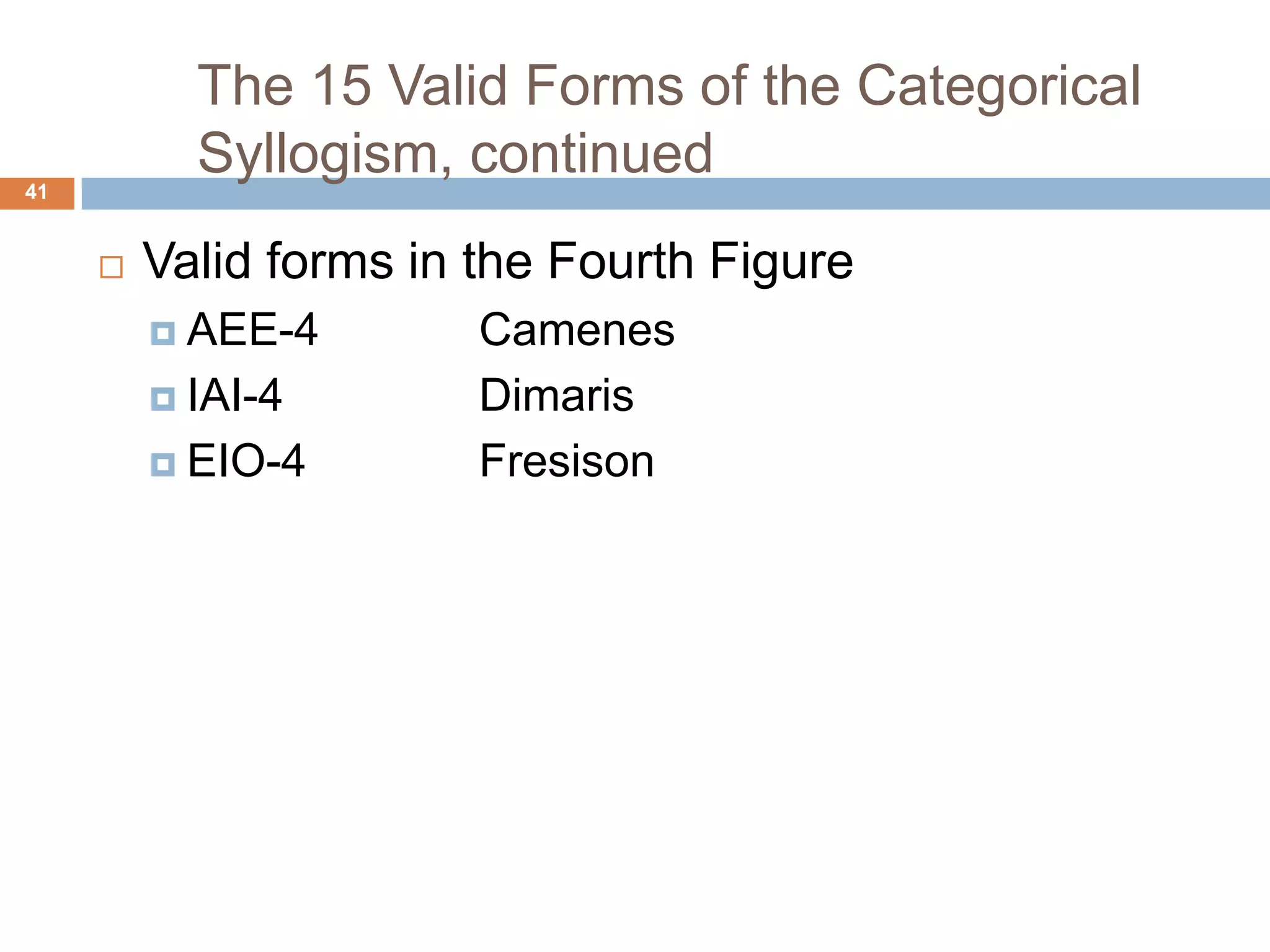
The 15 Valid Forms of the Categorical Syllogism, continued 41Valid forms in the Fourth FigureAEE-4CamenesIAI-4DimarisEIO-4Fresison
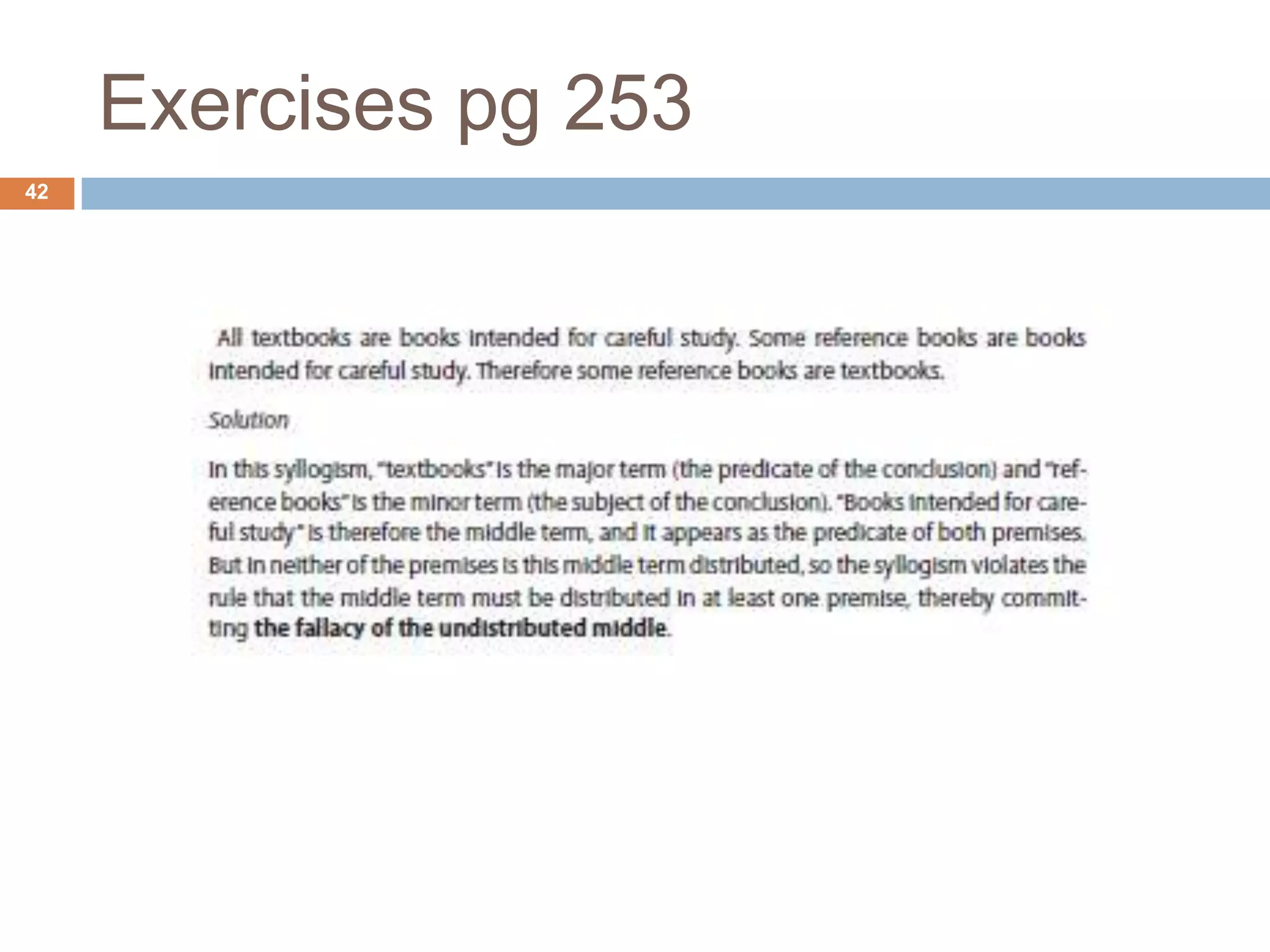
Exercises pg 25342
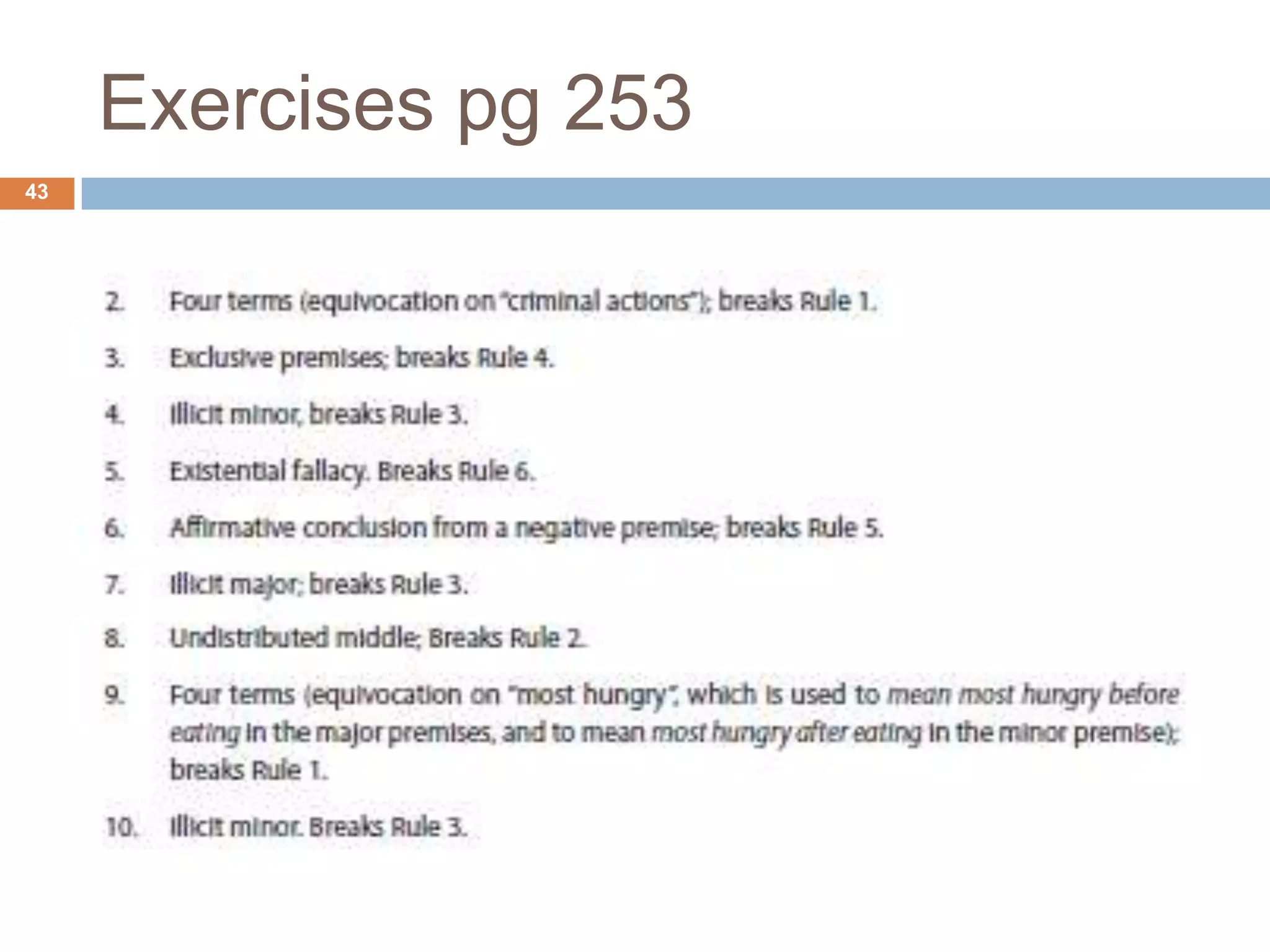
Exercises pg 25343
Summary 44Standard-form categorical syllogismSyllogism termsMood and figureVenn diagram technique for testing syllogismsSyllogistic rules and syllogistic fallaciesValid forms of the categorical syllogism

Hum 200 w7 ch6 syllog

  • 1.
    Logic HUM200 Categorical Syllogisms1
  • 2.
    Objectives2When you completethis lesson, you will be able to:Describe a standard-form categorical syllogismRecognize the terms of the syllogismIdentify the mood and figure of a syllogismUse the Venn diagram technique for testing syllogismsList and describe the syllogistic rules and syllogistic fallaciesList the fifteen valid forms of the categorical syllogism
  • 3.
    Standard-Form Categorical Syllogisms3SyllogismAny deductive argument in which a conclusion is inferred from two premisesCategorical syllogismDeductive argument consisting of three categorical propositions that together contain exactly three terms, each of which occurs in exactly two of the constituent propositions
  • 4.
    Standard-Form Categorical Syllogisms,continued 4ExampleNo heroes are cowards.Some soldiers are cowards.Therefore some soldiers are not heroes. Standard-form categorical syllogismPremises and conclusion are all standard-form categorical propositions Propositions are arranged in a specific standard order
  • 5.
    Terms of theSyllogism 5To identify the terms by name, look at the conclusion “Some soldiers are not heroes.”Major termTerm that occurs as the predicate (heroes)Minor termTerm that occurs as the subject (soldiers)Middle termNever appears in the conclusion (cowards)
  • 6.
    Terms of theSyllogism, continued 6Major premiseContains the major term (heroes)“No heroes are cowards” Minor premiseContains the minor term (soldiers)“Some soldiers are cowards” Order of standard formThe major premise is stated firstThe minor premise is stated secondThe conclusion is stated last
  • 7.
    Mood of theSyllogism 7Determined by the types of categorical propositions contained in the argument No heroes are cowards (E proposition)Some soldiers are cowards (I proposition)Some soldiers are not heroes (O proposition)Mood is EIO64 possible moods
  • 8.
    The Figure ofthe Syllogism 8Determined by the position of the middle term TypesFirst figureMiddle term is the subject term of the major premise and the predicate term of the minor premise Second figureMiddle term is the predicate term of both premises Third figureMiddle term is the subject of both premises Fourth figureMiddle term is the predicate term of the major premise and the subject of the minor premise
  • 9.
    The Figure ofthe Syllogism, continued 9M – PS – M ∴ S – PP – MS – M ∴ S – PM – PM – S ∴ S – PP – MM – S ∴ S – PFirst FigureSecond FigureThird FigureFourth Figure
  • 10.
    The Figure ofthe Syllogism, continued 10ExampleNo heroes are cowards.Some soldiers are cowards.Therefore some soldiers are not heroes.Middle term (cowards) appears as predicate in both premises (second figure)The syllogism is EIO-2
  • 11.
    The Formal Natureof Syllogistic Argument 11A valid syllogism is valid by virtue of its form alone AAA-1 syllogisms are always validAll M is P.All S is M.Therefore all S is P. Valid regardless of subject matterAll Greeks are humans.All Athenians are Greeks.Therefore all Athenians are humans.
  • 12.
    Exercises12No nuclear-powered submarinesare commercial vessels, so no warships are commercialvessels, since all nuclear-powered submarines are warships.SolutionStep 1. The conclusion is “No warships are commercial vessels”.Step 2. “Commercial vessels” is the predicate term of this conclusion, and is therefore themajor terms of the syllogism.Step 3. The major premise, the premise that contains this term, is “No nuclear-poweredsubmarines are commercial vessels”.Step 4. The remaining premise, “All nuclear-powered submarines are warships”, is indeedthe major premise, since it does contain the subject term of the conclusion, “warships”.Step 5. In standard form this syllogism is written thus:No nuclear-powered submarines are commercial vessels.All nuclear-powered submarines are warships.Therefore no warships are commercial vessels.Step 6. The three propositions in this syllogism are, in order, E, A and E. The middle term“nuclear-powered submarines,” is the subject term of both premises, so the syllogismis in the third figure. The mood and figure of the syllogism therefore areEAE-3.
  • 13.
    Exercises - Answer13Someobjects of worship are fir trees. All fir trees are evergreens.Therefore some evergreens are objects of worship. IAI-4.
  • 14.
    Exercises - Answer14Someartificial satellites are not American inventions.All artificial satellites are important scientific achievements.Therefore some important scientific achievements are not American inventions.OAO-3.
  • 15.
    Group Exercises -Answer15#4All certified public accounts are people of good business sense.No television stars are certified public accountants.Therefore no television stars are people of good business sense.AEE-1.
  • 16.
    Group Exercises -Answers 16#6No delicate mechanisms are suitable toys for children.All CD players are delicate mechanisms.Therefore no CD players are suitable toys for children.EAE-1.
  • 17.
    Group Exercises -Answers 17#7Some juvenile delinquents are products of broken homes.All juvenile delinquents are maladjusted individuals.Therefore some maladjusted individuals are products of broken homes.IAI-3.
  • 18.
    18PSSPMSPMSPMSPMSPMSPMSPMSPMMVenn Diagram Techniquefor Testing Syllogisms If S stands for Swede, P for peasant, and M for musician, then SPM represents all Swedes who are not peasants or musiciansSPM represents all Swedish peasants who are not musicians, etc.
  • 19.
    19PSMPSMVenn Diagram Techniquefor Testing Syllogisms, continued “All M is P”Add “All S is M”Conclusion“All S is P” confirmed
  • 20.
    Venn Diagram Techniquefor Testing Syllogisms, continued 20Invalid argumentAll dogs are mammals.All cats are mammals.Therefore all cats are dogs. DogsCatsCats that are not dogsDogs that are not catsMammals
  • 21.
    Exercises pg. 232-23321#1Allbusiness executives are active opponents of increased corporation taxes, for all active opponents of increased corporation taxes are members of the chamber of commerce, and all members of the chamber of commerce are business executives.One possible refuting analogy is this: All bipeds are astronauts, All astronauts are humans Therefore all humans are bipeds.
  • 22.
    Group Exercises pg.232-23322Do numbers 3, 4, 5 and 7
  • 23.
    23Diagram the universalpremise first if the other premise is particularAll artists are egotists.Some artists are paupers.Therefore some paupers are egotists. EgotistsPaupersxArtistsVenn Diagram Technique for Testing Syllogisms, continued
  • 24.
    Venn Diagram Techniquefor Testing Syllogisms, continued 24ExampleAll great scientists are college graduates.Some professional athletes are college graduates. Therefore some professional athletes are great scientists. GreatscientistsProfessionalathletesxCollegegraduates
  • 25.
    Venn Diagram Techniquefor Testing Syllogisms, continued 25Label the circles of a three-circle Venn diagram with the syllogism’s three terms Diagram both premises, starting with the universal premiseInspect the diagram to see whether the diagram of the premises contains a diagram of the conclusion
  • 26.
  • 27.
  • 28.
  • 29.
  • 30.
  • 31.
    Syllogistic Rules andSyllogistic Fallacies 31Rule 1. Avoid four termsSyllogism must contain exactly three terms, each of which is used in the same sense throughout the argument Fallacy of four termsPower tends to corrupt Knowledge is power Knowledge tends to corrupt Justification: This syllogism appears to have only three terms, but there are really four since one of them, the middle term “power” is used in different senses in the two premises. To reveal the argument’s invalidity we need only note that the word “power” in the first premise means “ the possession of control or command over people,” whereas the word “power” in the second premise means “the ability to control things.
  • 32.
    Syllogistic Rules andSyllogistic Fallacies, continued 32Rule 2. Distribute the middle term in at least one premiseIf the middle term is not distributed in at least one premise, the connection required by the conclusion cannot be made Fallacy of the undistributed middleAll sharks are fish All salmon are fish All salmon are sharks Justification: The middle term is what connects the major and the minor term. If the middle term is never distributed, then the major and minor terms might be related to different parts of the M class, thus giving no common ground to relate S and P.
  • 33.
    Syllogistic Rules andSyllogistic Fallacies, continued 33Rule 3. Any term distributed in the conclusion must be distributed in the premisesWhen the conclusion distributes a term that was undistributed in the premises, it says more about that term than the premises did Fallacy of illicit processAll tigers are mammals All mammals are animals All animals are tigersWorth Diagramming
  • 34.
    Syllogistic Rules andSyllogistic Fallacies, continued 34Rule 4. Avoid two negative premisesTwo premises asserting exclusion cannot provide the linkage that the conclusion assertsFallacy of exclusive premises No fish are mammals Some dogs are not fish Some dogs are not mammalsIf the premises are both negative, then the relationship between S and P is denied. The conclusion cannot, therefore, say anything in a positive fashion. That information goes beyond what is contained in the premises.
  • 35.
    Syllogistic Rules andSyllogistic Fallacies, continued 35Rule 5. If either premise is negative, the conclusion must be negativeClass inclusion can only be stated by affirmative propositions Fallacy of drawing an affirmative conclusion from a negative premiseAll crows are birds Some wolves are not crows Some wolves are birds
  • 36.
    Syllogistic Rules andSyllogistic Fallacies, continued 36Rule 6. From two universal premises no particular conclusion may be drawnUniversal propositions have no existential importParticular propositions have existential import Cannot draw a conclusion with existential import from premises that do not have existential importExistential fallacyAll mammals are animals All tigers are mammals Some tigers are animals
  • 37.
    Exposition of the15 Valid Forms of the Categorical Syllogism 37Mood (64 possible)Figure (4 possible)Logical form ( 64 x 4 = 256)Out of 256 forms, only 15 are validValid forms have names that contain the vowels of the moodEAE-1 is CelarentEAE-2 is Cesare
  • 38.
    The 15 ValidForms of the Categorical Syllogism 38Valid form in the First FigureAAA-1BarbaraEAE-1CelarentAII-1DariiEIO-1Ferio
  • 39.
    The 15 ValidForms of the Categorical Syllogism, continued 39Valid forms in the Second FigureAEE-2CamestresEAE-2CesareAOO-2BarokoEIO-2Festino
  • 40.
    The 15 ValidForms of the Categorical Syllogism, continued 40Valid forms in the Third FigureAII-3DatisiIAI-3DisamisEIO-3FerisonOAO-3Bokardo
  • 41.
    The 15 ValidForms of the Categorical Syllogism, continued 41Valid forms in the Fourth FigureAEE-4CamenesIAI-4DimarisEIO-4Fresison
  • 42.
  • 43.
  • 44.
    Summary 44Standard-form categoricalsyllogismSyllogism termsMood and figureVenn diagram technique for testing syllogismsSyllogistic rules and syllogistic fallaciesValid forms of the categorical syllogism