
Media Planning

   Lecture 1.
Why Media Planning
• Mushroom growth in electronic and print media.
• 10 years back there was PTV and Radio Pakistan
  only. Now there are around 70 TV channels and
  umpteen radio options.
• Newspapers were Jang, Nawa e waqt, Dawn,
  Business Recorder and Nation mainly.
• Budgets dwindling.
• TV Channels and newspapers are very expensive.
• This becomes more tricky for companies which
  are serving in small/limited territories.
Media Planning Objectives
There are basically two objectives to have a
  media plan.
• Value for money!
• “Top of the mind” positioning.
Advertising Process & Media Planning
• It starts from new idea generation.
• Translation of idea into a brief.
     o   Target markets identification.
     o   Research data.
     o   Territories identification
     o   Nature of the message
•   Creative designs / mood boards.
•   Presentation and Approvals.
•   Media selection.
•   Placements.
•   Monitoring
•   Droppage Reporting.
•   Recording and archiving.
Qs to be Answered
• Do you know where your business is coming
  from and where the potential for increased
  business lies?
• Do you know which markets offer the greatest
  opportunity?
• Do you need to reach everybody or only a
  select group of consumers?
• How often is the product used?
• How much product loyalty exists?
Qs to be Answered
• What does the cost benefit analysis say?
• What volumes we are planning to sell?
• Do you want to reach lots of people in a wide
  area (to get the most out of your advertising
  rupee)? Then mass media, like newspaper and
  radio, might work for you.
• If your target market is a select group in a
  defined geographic area, then direct mail
  could be your best bet.
Qs to be Answered
• Which schedules work best with different
  media. For example, the rule of thumb is that
  a print ad must run three times before it gets
  noticed.
• Similarly Radio and TV advertising is most
  effective when run at certain times of the day
  or around certain programs, depending on
  what market you're trying to reach.
Advertising media generally include:

•   Television
•   Radio
•   Newspapers
•   Magazines (consumer and trade)
•   Outdoor billboards
•   Public transportation
•   Social media (Facebook, twitter, linkedin, skype etc.)
•   Direct mail
•   Giveaway items
•   Other media (brochures, newsletters and so on)
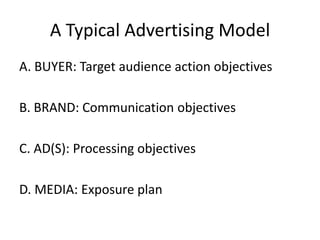
A Typical Advertising Model
A. BUYER: Target audience action objectives

B. BRAND: Communication objectives

C. AD(S): Processing objectives

D. MEDIA: Exposure plan
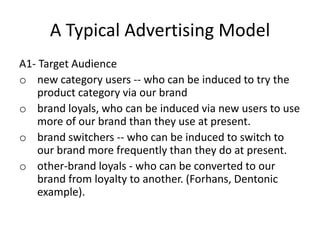
A Typical Advertising Model
A1- Target Audience
o new category users -- who can be induced to try the
    product category via our brand
o brand loyals, who can be induced via new users to use
    more of our brand than they use at present.
o brand switchers -- who can be induced to switch to
    our brand more frequently than they do at present.
o other-brand loyals - who can be converted to our
    brand from loyalty to another. (Forhans, Dentonic
    example).
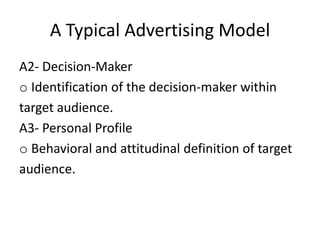
A Typical Advertising Model
A2- Decision-Maker
o Identification of the decision-maker within
target audience.
A3- Personal Profile
o Behavioral and attitudinal definition of target
audience.
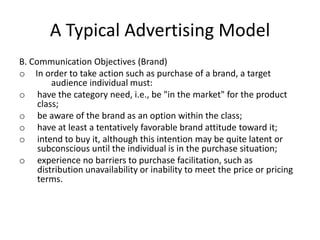
A Typical Advertising Model
B. Communication Objectives (Brand)
o In order to take action such as purchase of a brand, a target
         audience individual must:
o have the category need, i.e., be "in the market" for the product
     class;
o be aware of the brand as an option within the class;
o have at least a tentatively favorable brand attitude toward it;
o intend to buy it, although this intention may be quite latent or
     subconscious until the individual is in the purchase situation;
o experience no barriers to purchase facilitation, such as
     distribution unavailability or inability to meet the price or pricing
     terms.
A Typical Advertising Model
C. Executional Processing (Making an ad)
o Emotional Portrayal (sequence of emotions i.e
  your mood board)
o Message to be communicated
o Use of presenter.
A Typical Advertising Model
D. Exposure (Media)

o Media selection
o Media Scheduling
Face of Communication in Pakistan
Mainly there are 6 categories of
communication agencies in Pakistan:
1. Advertising agencies
2. PR agencies
3. Media buying houses
4. Creative houses
5. Digital media agencies
6. Outdoor media agencies
ENDS

Media planning cbm (2)

  • 1.
    Media Planning Lecture 1.
  • 2.
    Why Media Planning •Mushroom growth in electronic and print media. • 10 years back there was PTV and Radio Pakistan only. Now there are around 70 TV channels and umpteen radio options. • Newspapers were Jang, Nawa e waqt, Dawn, Business Recorder and Nation mainly. • Budgets dwindling. • TV Channels and newspapers are very expensive. • This becomes more tricky for companies which are serving in small/limited territories.
  • 3.
    Media Planning Objectives Thereare basically two objectives to have a media plan. • Value for money! • “Top of the mind” positioning.
  • 4.
    Advertising Process &Media Planning • It starts from new idea generation. • Translation of idea into a brief. o Target markets identification. o Research data. o Territories identification o Nature of the message • Creative designs / mood boards. • Presentation and Approvals. • Media selection. • Placements. • Monitoring • Droppage Reporting. • Recording and archiving.
  • 5.
    Qs to beAnswered • Do you know where your business is coming from and where the potential for increased business lies? • Do you know which markets offer the greatest opportunity? • Do you need to reach everybody or only a select group of consumers? • How often is the product used? • How much product loyalty exists?
  • 6.
    Qs to beAnswered • What does the cost benefit analysis say? • What volumes we are planning to sell? • Do you want to reach lots of people in a wide area (to get the most out of your advertising rupee)? Then mass media, like newspaper and radio, might work for you. • If your target market is a select group in a defined geographic area, then direct mail could be your best bet.
  • 7.
    Qs to beAnswered • Which schedules work best with different media. For example, the rule of thumb is that a print ad must run three times before it gets noticed. • Similarly Radio and TV advertising is most effective when run at certain times of the day or around certain programs, depending on what market you're trying to reach.
  • 8.
    Advertising media generallyinclude: • Television • Radio • Newspapers • Magazines (consumer and trade) • Outdoor billboards • Public transportation • Social media (Facebook, twitter, linkedin, skype etc.) • Direct mail • Giveaway items • Other media (brochures, newsletters and so on)
  • 9.
    A Typical AdvertisingModel A. BUYER: Target audience action objectives B. BRAND: Communication objectives C. AD(S): Processing objectives D. MEDIA: Exposure plan
  • 10.
    A Typical AdvertisingModel A1- Target Audience o new category users -- who can be induced to try the product category via our brand o brand loyals, who can be induced via new users to use more of our brand than they use at present. o brand switchers -- who can be induced to switch to our brand more frequently than they do at present. o other-brand loyals - who can be converted to our brand from loyalty to another. (Forhans, Dentonic example).
  • 11.
    A Typical AdvertisingModel A2- Decision-Maker o Identification of the decision-maker within target audience. A3- Personal Profile o Behavioral and attitudinal definition of target audience.
  • 12.
    A Typical AdvertisingModel B. Communication Objectives (Brand) o In order to take action such as purchase of a brand, a target audience individual must: o have the category need, i.e., be "in the market" for the product class; o be aware of the brand as an option within the class; o have at least a tentatively favorable brand attitude toward it; o intend to buy it, although this intention may be quite latent or subconscious until the individual is in the purchase situation; o experience no barriers to purchase facilitation, such as distribution unavailability or inability to meet the price or pricing terms.
  • 13.
    A Typical AdvertisingModel C. Executional Processing (Making an ad) o Emotional Portrayal (sequence of emotions i.e your mood board) o Message to be communicated o Use of presenter.
  • 14.
    A Typical AdvertisingModel D. Exposure (Media) o Media selection o Media Scheduling
  • 15.
    Face of Communicationin Pakistan Mainly there are 6 categories of communication agencies in Pakistan: 1. Advertising agencies 2. PR agencies 3. Media buying houses 4. Creative houses 5. Digital media agencies 6. Outdoor media agencies
  • 16.