IMC( Integrated Marketing Communication):
Presenatation topic: Advertisment .
DEPT: MGT
BBA 5th Marketing
UOH
Group members:
Arqam zubair F19-0036
Zeeshan F19-0005
Hashir Whaeed Mughal F19-0031
Zainab Bibi F19-0008
Abdullah Javed F19-0015
Chaudhary Hassnat Ali F19-0048
8/19/2022
1
What is advertisement?
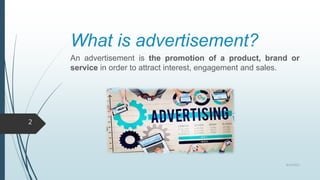
An advertisement is the promotion of a product, brand or
service in order to attract interest, engagement and sales.
8/19/2022
2
Advertising….
 Advertising is an important element of the marketing
communications mix. Advertising directs a message at large
numbers of people with a single communication.
8/19/2022
3
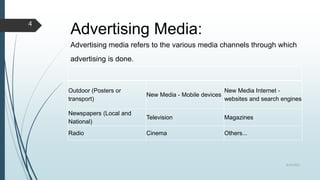
Advertising Media:
Advertising media refers to the various media channels through which
advertising is done.
Outdoor (Posters or
transport)
New Media - Mobile devices
New Media Internet -
websites and search engines
Newspapers (Local and
National)
Television Magazines
Radio Cinema Others...
8/19/2022
4
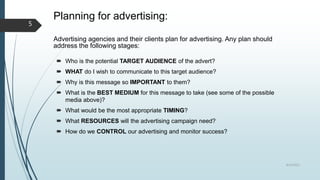
Planning for advertising:
Advertising agencies and their clients plan for advertising. Any plan should
address the following stages:
 Who is the potential TARGET AUDIENCE of the advert?
 WHAT do I wish to communicate to this target audience?
 Why is this message so IMPORTANT to them?
 What is the BEST MEDIUM for this message to take (see some of the possible
media above)?
 What would be the most appropriate TIMING?
 What RESOURCES will the advertising campaign need?
 How do we CONTROL our advertising and monitor success?
8/19/2022
5
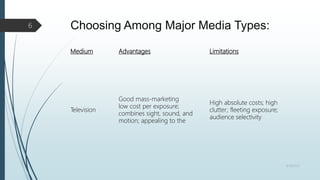
Choosing Among Major Media Types:
Medium Advantages Limitations
Television
Good mass-marketing
low cost per exposure;
combines sight, sound, and
motion; appealing to the
High absolute costs; high
clutter; fleeting exposure;
audience selectivity
8/19/2022
6
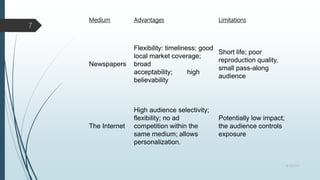
Medium Advantages Limitations
Newspapers
Flexibility: timeliness; good
local market coverage;
broad
acceptability; high
believability
Short life; poor
reproduction quality,
small pass-along
audience
The Internet
High audience selectivity;
flexibility; no ad
competition within the
same medium; allows
personalization.
Potentially low impact;
the audience controls
exposure
8/19/2022
7
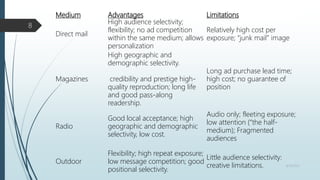
Medium Advantages Limitations
Direct mail
High audience selectivity;
flexibility; no ad competition
within the same medium; allows
personalization
Relatively high cost per
exposure; “junk mail” image
Magazines
High geographic and
demographic selectivity.
credibility and prestige high-
quality reproduction; long life
and good pass-along
readership.
Long ad purchase lead time;
high cost; no guarantee of
position
Radio
Good local acceptance; high
geographic and demographic
selectivity, low cost.
Audio only; fleeting exposure;
low attention (“the half-
medium); Fragmented
audiences
Outdoor
Flexibility; high repeat exposure;
low message competition; good
positional selectivity.
Little audience selectivity:
creative limitations. 8/19/2022
8
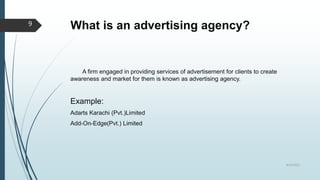
What is an advertising agency?
A firm engaged in providing services of advertisement for clients to create
awareness and market for them is known as advertising agency.
Example:
Adarts Karachi (Pvt.)Limited
Add-On-Edge(Pvt.) Limited
8/19/2022
9
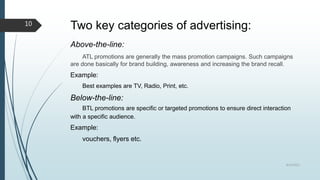
Two key categories of advertising:
Above-the-line:
ATL promotions are generally the mass promotion campaigns. Such campaigns
are done basically for brand building, awareness and increasing the brand recall.
Example:
Best examples are TV, Radio, Print, etc.
Below-the-line:
BTL promotions are specific or targeted promotions to ensure direct interaction
with a specific audience.
Example:
vouchers, flyers etc.
8/19/2022
10
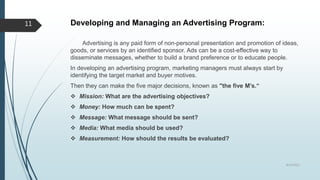
Developing and Managing an Advertising Program:
Advertising is any paid form of non-personal presentation and promotion of ideas,
goods, or services by an identified sponsor. Ads can be a cost-effective way to
disseminate messages, whether to build a brand preference or to educate people.
In developing an advertising program, marketing managers must always start by
identifying the target market and buyer motives.
Then they can make the five major decisions, known as "the five M’s.“
 Mission: What are the advertising objectives?
 Money: How much can be spent?
 Message: What message should be sent?
 Media: What media should be used?
 Measurement: How should the results be evaluated?
8/19/2022
11
Setting the Objectives:
An advertising goal (or objective) is a specific communications task and
achievement level to be accomplished with a specific audience in a specific
period of time.
Advertising objectives can be classified according to whether their aim is to
inform, persuade, remind, or reinforce.
8/19/2022
12
Informative advertising:
Informative advertising aims to create brand awareness and knowledge
of new products or new features of existing products.
Example:
Haier refrigerator.
8/19/2022
13
Persuasive advertising:
Persuasive advertising aims to create liking, preference, conviction, and
purchase of a product or service.
Example:
Nescafe, Shan salt, Arial etc.
8/19/2022
14
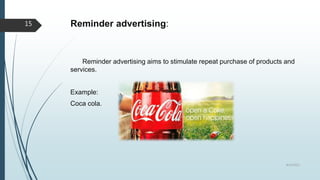
Reminder advertising:
Reminder advertising aims to stimulate repeat purchase of products and
services.
Example:
Coca cola.
8/19/2022
15
Reinforcement advertising:
Reinforcement advertising aims to convince current purchasers that they
made the right choice.
Example:
Automobile ads often depict satisfied customers enjoying special
features of their new car.
8/19/2022
16
Deciding on Media and Measuring Effectiveness:
After choosing the message, the advertiser's next task is to
choose media to carry it. The steps here are deciding on desired
reach, frequency, and impact; choosing among major media
types; selecting specific media vehicles; deciding on media
timing; and deciding on geographical media allocation. Then the
results of these decisions need to be evaluated.
8/19/2022
17
Deciding on Reach, Frequency, and
Impact:
 Media selection is finding the most cost-effective media to deliver the
desired number and type of exposures to the target audience.
 The next task is to find out how many exposures, E", will produce a level
of audience awareness of A'. The effect of exposures on audience
awareness depends on the exposures'
reach, frequency, and impact:
8/19/2022
18
 Reach (R). The number of different persons or households exposed to a
particular media schedule at least once during a specified time period.
 Frequency (F). The number of times within the specified time period that
an average person or household is exposed to the message.
 Impact (I). The qualitative value of an exposure through a given medium.
8/19/2022
19
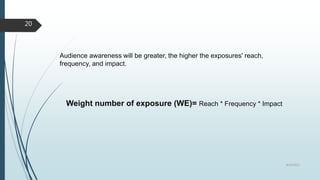
Audience awareness will be greater, the higher the exposures' reach,
frequency, and impact.
Weight number of exposure (WE)= Reach * Frequency * Impact
8/19/2022
20
Selecting Specific Vehicles:
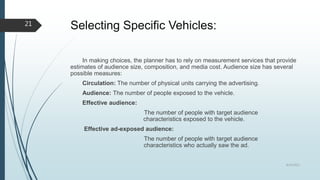
In making choices, the planner has to rely on measurement services that provide
estimates of audience size, composition, and media cost. Audience size has several
possible measures:
Circulation: The number of physical units carrying the advertising.
Audience: The number of people exposed to the vehicle.
Effective audience:
The number of people with target audience
characteristics exposed to the vehicle.
Effective ad-exposed audience:
The number of people with target audience
characteristics who actually saw the ad.
8/19/2022
21
Deciding on Media Timing and Allocation:
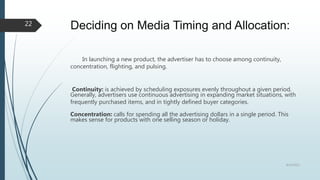
In launching a new product, the advertiser has to choose among continuity,
concentration, flighting, and pulsing.
Continuity: is achieved by scheduling exposures evenly throughout a given period.
Generally, advertisers use continuous advertising in expanding market situations, with
frequently purchased items, and in tightly defined buyer categories.
Concentration: calls for spending all the advertising dollars in a single period. This
makes sense for products with one selling season or holiday.
8/19/2022
22
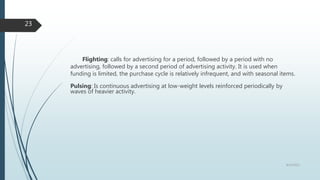
Flighting: calls for advertising for a period, followed by a period with no
advertising, followed by a second period of advertising activity. It is used when
funding is limited, the purchase cycle is relatively infrequent, and with seasonal items.
Pulsing: Is continuous advertising at low-weight levels reinforced periodically by
waves of heavier activity.
8/19/2022
23
Evaluating Advertising Effectiveness:
Good planning and control of advertising depend on measures of advertising
effectiveness. Most advertisers try to measure the communication effect of an ad—
that is, its potential effect on awareness, knowledge, or preference. They would also
like to measure the ad's sales effect.
8/19/2022
24
Communication-effect Research:
Communication-effect research seeks to determine whether an ad is communicating
effectively. Called copy testing, it can be done before an ad is put into media and after
it is printed or broadcast.
There are three major methods of pretesting. The consumer feedback method asks
consumers for their reactions to a proposed ad. They respond to questions such as
these:
 1. What is the main message you get from this ad?
 2. What do you think they want you to know, believe, or do?
8/19/2022
25
 3. How likely is it that this ad will influence you to undertake the action?
 4. What works well in the ad and what works poorly?
 5. How does the ad make you feel?
 6. Where is the best place to reach you with this message?
-----------------------------------------------------------------------------------------------------------
END OF SELIDES
8/19/2022
26
That’s All From Our Presentation:
If you have any question so kindly let us
know we will answer you.
8/19/2022
27
8/19/2022
28

WHAT IS ADVERTISMENT...pptx

  • 1.
    IMC( Integrated MarketingCommunication): Presenatation topic: Advertisment . DEPT: MGT BBA 5th Marketing UOH Group members: Arqam zubair F19-0036 Zeeshan F19-0005 Hashir Whaeed Mughal F19-0031 Zainab Bibi F19-0008 Abdullah Javed F19-0015 Chaudhary Hassnat Ali F19-0048 8/19/2022 1
  • 2.
    What is advertisement? Anadvertisement is the promotion of a product, brand or service in order to attract interest, engagement and sales. 8/19/2022 2
  • 3.
    Advertising….  Advertising isan important element of the marketing communications mix. Advertising directs a message at large numbers of people with a single communication. 8/19/2022 3
  • 4.
    Advertising Media: Advertising mediarefers to the various media channels through which advertising is done. Outdoor (Posters or transport) New Media - Mobile devices New Media Internet - websites and search engines Newspapers (Local and National) Television Magazines Radio Cinema Others... 8/19/2022 4
  • 5.
    Planning for advertising: Advertisingagencies and their clients plan for advertising. Any plan should address the following stages:  Who is the potential TARGET AUDIENCE of the advert?  WHAT do I wish to communicate to this target audience?  Why is this message so IMPORTANT to them?  What is the BEST MEDIUM for this message to take (see some of the possible media above)?  What would be the most appropriate TIMING?  What RESOURCES will the advertising campaign need?  How do we CONTROL our advertising and monitor success? 8/19/2022 5
  • 6.
    Choosing Among MajorMedia Types: Medium Advantages Limitations Television Good mass-marketing low cost per exposure; combines sight, sound, and motion; appealing to the High absolute costs; high clutter; fleeting exposure; audience selectivity 8/19/2022 6
  • 7.
    Medium Advantages Limitations Newspapers Flexibility:timeliness; good local market coverage; broad acceptability; high believability Short life; poor reproduction quality, small pass-along audience The Internet High audience selectivity; flexibility; no ad competition within the same medium; allows personalization. Potentially low impact; the audience controls exposure 8/19/2022 7
  • 8.
    Medium Advantages Limitations Directmail High audience selectivity; flexibility; no ad competition within the same medium; allows personalization Relatively high cost per exposure; “junk mail” image Magazines High geographic and demographic selectivity. credibility and prestige high- quality reproduction; long life and good pass-along readership. Long ad purchase lead time; high cost; no guarantee of position Radio Good local acceptance; high geographic and demographic selectivity, low cost. Audio only; fleeting exposure; low attention (“the half- medium); Fragmented audiences Outdoor Flexibility; high repeat exposure; low message competition; good positional selectivity. Little audience selectivity: creative limitations. 8/19/2022 8
  • 9.
    What is anadvertising agency? A firm engaged in providing services of advertisement for clients to create awareness and market for them is known as advertising agency. Example: Adarts Karachi (Pvt.)Limited Add-On-Edge(Pvt.) Limited 8/19/2022 9
  • 10.
    Two key categoriesof advertising: Above-the-line: ATL promotions are generally the mass promotion campaigns. Such campaigns are done basically for brand building, awareness and increasing the brand recall. Example: Best examples are TV, Radio, Print, etc. Below-the-line: BTL promotions are specific or targeted promotions to ensure direct interaction with a specific audience. Example: vouchers, flyers etc. 8/19/2022 10
  • 11.
    Developing and Managingan Advertising Program: Advertising is any paid form of non-personal presentation and promotion of ideas, goods, or services by an identified sponsor. Ads can be a cost-effective way to disseminate messages, whether to build a brand preference or to educate people. In developing an advertising program, marketing managers must always start by identifying the target market and buyer motives. Then they can make the five major decisions, known as "the five M’s.“  Mission: What are the advertising objectives?  Money: How much can be spent?  Message: What message should be sent?  Media: What media should be used?  Measurement: How should the results be evaluated? 8/19/2022 11
  • 12.
    Setting the Objectives: Anadvertising goal (or objective) is a specific communications task and achievement level to be accomplished with a specific audience in a specific period of time. Advertising objectives can be classified according to whether their aim is to inform, persuade, remind, or reinforce. 8/19/2022 12
  • 13.
    Informative advertising: Informative advertisingaims to create brand awareness and knowledge of new products or new features of existing products. Example: Haier refrigerator. 8/19/2022 13
  • 14.
    Persuasive advertising: Persuasive advertisingaims to create liking, preference, conviction, and purchase of a product or service. Example: Nescafe, Shan salt, Arial etc. 8/19/2022 14
  • 15.
    Reminder advertising: Reminder advertisingaims to stimulate repeat purchase of products and services. Example: Coca cola. 8/19/2022 15
  • 16.
    Reinforcement advertising: Reinforcement advertisingaims to convince current purchasers that they made the right choice. Example: Automobile ads often depict satisfied customers enjoying special features of their new car. 8/19/2022 16
  • 17.
    Deciding on Mediaand Measuring Effectiveness: After choosing the message, the advertiser's next task is to choose media to carry it. The steps here are deciding on desired reach, frequency, and impact; choosing among major media types; selecting specific media vehicles; deciding on media timing; and deciding on geographical media allocation. Then the results of these decisions need to be evaluated. 8/19/2022 17
  • 18.
    Deciding on Reach,Frequency, and Impact:  Media selection is finding the most cost-effective media to deliver the desired number and type of exposures to the target audience.  The next task is to find out how many exposures, E", will produce a level of audience awareness of A'. The effect of exposures on audience awareness depends on the exposures' reach, frequency, and impact: 8/19/2022 18
  • 19.
     Reach (R).The number of different persons or households exposed to a particular media schedule at least once during a specified time period.  Frequency (F). The number of times within the specified time period that an average person or household is exposed to the message.  Impact (I). The qualitative value of an exposure through a given medium. 8/19/2022 19
  • 20.
    Audience awareness willbe greater, the higher the exposures' reach, frequency, and impact. Weight number of exposure (WE)= Reach * Frequency * Impact 8/19/2022 20
  • 21.
    Selecting Specific Vehicles: Inmaking choices, the planner has to rely on measurement services that provide estimates of audience size, composition, and media cost. Audience size has several possible measures: Circulation: The number of physical units carrying the advertising. Audience: The number of people exposed to the vehicle. Effective audience: The number of people with target audience characteristics exposed to the vehicle. Effective ad-exposed audience: The number of people with target audience characteristics who actually saw the ad. 8/19/2022 21
  • 22.
    Deciding on MediaTiming and Allocation: In launching a new product, the advertiser has to choose among continuity, concentration, flighting, and pulsing. Continuity: is achieved by scheduling exposures evenly throughout a given period. Generally, advertisers use continuous advertising in expanding market situations, with frequently purchased items, and in tightly defined buyer categories. Concentration: calls for spending all the advertising dollars in a single period. This makes sense for products with one selling season or holiday. 8/19/2022 22
  • 23.
    Flighting: calls foradvertising for a period, followed by a period with no advertising, followed by a second period of advertising activity. It is used when funding is limited, the purchase cycle is relatively infrequent, and with seasonal items. Pulsing: Is continuous advertising at low-weight levels reinforced periodically by waves of heavier activity. 8/19/2022 23
  • 24.
    Evaluating Advertising Effectiveness: Goodplanning and control of advertising depend on measures of advertising effectiveness. Most advertisers try to measure the communication effect of an ad— that is, its potential effect on awareness, knowledge, or preference. They would also like to measure the ad's sales effect. 8/19/2022 24
  • 25.
    Communication-effect Research: Communication-effect researchseeks to determine whether an ad is communicating effectively. Called copy testing, it can be done before an ad is put into media and after it is printed or broadcast. There are three major methods of pretesting. The consumer feedback method asks consumers for their reactions to a proposed ad. They respond to questions such as these:  1. What is the main message you get from this ad?  2. What do you think they want you to know, believe, or do? 8/19/2022 25
  • 26.
     3. Howlikely is it that this ad will influence you to undertake the action?  4. What works well in the ad and what works poorly?  5. How does the ad make you feel?  6. Where is the best place to reach you with this message? ----------------------------------------------------------------------------------------------------------- END OF SELIDES 8/19/2022 26
  • 27.
    That’s All FromOur Presentation: If you have any question so kindly let us know we will answer you. 8/19/2022 27
  • 28.