Copyright Š Jayanti Rajdevendra Pande (ProNotesJRP), 2024 and beyond. All rights reserved
RASHTRASANT TUKDOJI MAHARAJ NAGPUR UNIVERSITY
MBA
SEMESTER: 3
SPECIALIZATION
MARKETING MANAGEMENT
SUBJECT
INTEGRATED MARKETING COMMUNICATION
& BRAND MANAGEMENT
MODULE NO : 3
ADVERTISING MEDIA & IMC TOOLS
- By Jayanti R Pande
Copyright Š Jayanti Rajdevendra Pande (ProNotesJRP), 2024 and beyond. All rights reserved
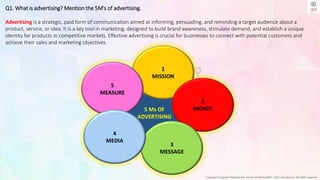
Q1. What is advertising? Mention the 5M’s of advertising.
Advertising is a strategic, paid form of communication aimed at informing, persuading, and reminding a target audience about a
product, service, or idea. It is a key tool in marketing, designed to build brand awareness, stimulate demand, and establish a unique
identity for products in competitive markets. Effective advertising is crucial for businesses to connect with potential customers and
achieve their sales and marketing objectives.
5 Ms OF
ADVERTISING
1
MISSION
2
MONEY
5
MEASURE
3
MESSAGE
4
MEDIA
Copyright Š Jayanti Rajdevendra Pande (ProNotesJRP), 2024 and beyond. All rights reserved
The 5Ms of Advertising:
1. Mission : The mission defines the purpose of the advertisement, which can vary from creating awareness of a new product
to increasing sales of an existing one. Objectives should be SMART (Specific, Measurable, Achievable, Relevant, Time-bound).
For example, the goal might be to increase brand recall by 30% within six months or boost market share by 5% in a year.
2. Money : Budget allocation depends on various factors, such as the stage of the product lifecycle, competition, and media
costs. Companies must balance cost efficiency with adequate investment to achieve the desired impact. For example, a new
product launch may demand a higher advertising budget for maximum visibility.
3. Message : The message is the core content of the advertisement, aimed at influencing the audience’s perception and
actions. It should align with the brand's positioning and appeal to emotions, logic, or values. For instance, a luxury car ad
might highlight premium quality and status, while a health drink ad may focus on nutritional benefits.
4. Media : Media planning involves choosing the right platforms to reach the target audience effectively, such as television,
radio, print, digital, or social media. Factors like audience demographics, media consumption habits, and budget influence
the selection. Scheduling ensures the ad reaches viewers at the optimal time, such as during peak viewing hours or festive
seasons.
5. Measure : Measuring advertising effectiveness helps determine whether the campaign achieved its objectives. Metrics like
brand recall, customer engagement, sales figures, and ROI are analyzed. For example, a digital ad's performance can be
measured through click-through rates (CTR) and conversion rates, while TV ads may rely on reach and frequency data.
Copyright Š Jayanti Rajdevendra Pande (ProNotesJRP), 2024 and beyond. All rights reserved
Q2. Classify the various types of advertising.
Advertising plays a vital role in communicating a product’s message to its target audience. It is a structured and non-personal
form of communication used by organizations to promote products, services, or ideas. Depending on factors like geography,
medium, or purpose, advertising can be classified into various types.
Types of Advertising:
1. Local Advertising: Focuses on promoting products or services within a specific geographic area. This is often used by small
businesses like local shops or eateries to attract nearby customers.
2. National Advertising: Targets a countrywide audience to create brand awareness and demand for products that are widely
distributed. Examples include advertisements for consumer electronics or packaged foods.
3. Audio Advertising: Relies on sound to deliver the message through mediums like radio or podcasts. It’s cost-effective and can
reach audiences during their commute or leisure time.
4. Visual Advertising: Includes static visuals like posters, print ads, or digital banners. This type is effective for creating strong
visual impressions and brand recall.
5. Consumer Advertising: Targets individual consumers to drive product demand. It uses emotional and persuasive appeals to
connect with the buyer. Examples include ads for personal care products or food items.
6. Trade Advertising: Aimed at intermediaries like wholesalers or retailers, encouraging them to stock or promote the product.
It’s crucial in business-to-business (B2B) marketing strategies.
7. Persuasive Brand Advertising: Highlights the unique features or benefits of a brand to differentiate it from competitors. It often
uses storytelling to engage the audience emotionally.
8. Surrogate Advertising: Used to promote restricted products like alcohol by advertising related items, such as soda or events. It
indirectly keeps the brand in public consciousness.
Copyright Š Jayanti Rajdevendra Pande (ProNotesJRP), 2024 and beyond. All rights reserved
Q3. Describe advertising media. Give the characteristic of advertising media.
Advertising media are the channels or platforms used to deliver promotional messages to the target audience. Choosing the
right medium is crucial for ensuring the advertisement’s effectiveness in terms of reach, frequency, and cost-efficiency. Each
medium has distinct characteristics that cater to specific advertising goals.
Advertising Media and Their Characteristics:
4.Digital Media:
•Includes social media, search engines, and websites.
•Allows precise targeting and real-time performance
tracking.
•Flexible budget options make it accessible for
businesses of all sizes.
5.Outdoor Media (Billboards and Transit Advertising):
•Grabs attention through large, bold visuals in high-
traffic areas.
•Provides repeated exposure to commuters, creating
strong brand recall.
•Limited message content due to space constraints.
6.Direct Mail:
•Personalized and directly delivered to the target
audience.
•High response rates due to tailored content.
•Costs and reliance on accurate addresses can be
limitations.
1.Television:
•Combines visual, audio, and motion to create impactful
advertisements.
•Offers a wide reach and can target specific audiences through
time slots or programs.
•High production and airing costs make it suitable for large-scale
campaigns.
2.Radio:
•Cost-effective and ideal for local or regional advertising.
•Relies solely on audio, making it engaging for auditory learners.
•Limited ability to convey complex messages due to the absence
of visuals.
3.Print Media (Newspapers and Magazines):
•Newspapers provide timely messages to a broad audience,
while magazines focus on niche segments.
•Effective for detailed information and visually appealing layouts.
•Static nature limits interaction or immediate action from
readers.
Copyright Š Jayanti Rajdevendra Pande (ProNotesJRP), 2024 and beyond. All rights reserved
Q4. What do you understand by IMC media planning? Explain the various step involved in media planning.
Integrated Marketing Communications (IMC) media planning is a crucial process that aligns various promotional tools to deliver a
consistent message to the target audience. It involves analyzing different media platforms, setting objectives, and strategizing effectively to
achieve marketing goals. This process integrates traditional and digital media channels, ensuring a unified and cohesive approach to reach
the desired audience efficiently.
Steps in IMC Media Planning:
1.Market and Environmental Analysis: The first step in media planning is to analyze the market and the environment. This involves understanding
the target audience’s needs, preferences, and media consumption habits. It also includes assessing external factors like competition, economic
conditions, and industry trends, which influence media choices and the success of the campaign. The insights gained help tailor the media
strategy to the audience’s expectations.
2.Establishing Media Objectives: Once the analysis is complete, the next step is to set clear media objectives. These objectives typically revolve
around reach, frequency, and desired outcomes. For example, a campaign may aim to increase brand awareness, drive engagement, or boost
sales. Setting measurable goals helps in selecting the right media channels and determining the effectiveness of the campaign. It ensures that all
media activities align with the overarching marketing objectives.
3.Developing and Implementing Media Strategies: In this step, marketers develop media strategies that align with the objectives. This involves
selecting the most effective media channels based on audience research. Whether it's traditional media like TV or print, or digital platforms such
as social media, search engines, or display ads, the strategy ensures that the message reaches the target audience in the most impactful way. The
implementation phase involves scheduling and distributing content across the selected media, ensuring consistency and timing in message
delivery.
4.Implementation of Media Plan :The media plan is then put into action. This phase involves executing the media strategy by preparing the
content and collaborating with media outlets for ad placements or digital content distribution. Timely and coordinated execution is key to
ensuring the message reaches the audience as planned. This step requires constant monitoring to ensure that the campaign is running as per the
set timeline and objectives.
5.Evaluation and Follow-up: After the campaign is live, it’s essential to evaluate its effectiveness. This includes tracking key performance metrics
such as ROI, engagement rates, conversions, and overall audience reach. The evaluation phase helps determine if the media objectives were met
and identifies areas for improvement. The feedback gathered is crucial for optimizing future media plans.
Copyright Š Jayanti Rajdevendra Pande (ProNotesJRP), 2024 and beyond. All rights reserved
Q5. How advertising is different from sales promotion?
Advertising and sales promotion are two fundamental components of marketing strategies, each serving a distinct role in
promoting a brand or product. Advertising is focused on creating awareness and building a long-term brand presence. It helps in
positioning the brand in the minds of consumers. Sales promotion, on the other hand, focuses on short-term tactics to boost
immediate sales, drive customer traffic, and create urgency. Both are vital, but their purposes, execution, and outcomes differ.
Advertising Sales Promotion
• Aims to build long-term brand awareness and customer loyalty. • Focuses on short-term sales boosts and immediate results.
• It involves a consistent message to create brand recognition
over time.
• It uses incentives like discounts and coupons to encourage
immediate purchases.
• Typically involves higher costs due to media buys and creative
production.
• Generally has lower costs, using tools like discounts, contests,
or samples.
• Message is emotional or informational, aiming to connect with
consumers.
• Message is action-oriented, urging customers to take
immediate action.
• Its impact is long-term, reinforcing the brand’s position in the
market.
• Its impact is short-term, leading to immediate purchases or
promotions.
• Primarily focuses on building and maintaining a brand's image.
• Primarily focuses on driving customer behavior in the short
run.
• Can be seen through various channels like TV, print, and digital
media.
• Can be seen through tactics like coupons, contests, and point-
of-purchase displays.
• Advertising campaigns are usually continuous, ensuring
constant brand exposure.
• Sales promotions are time-sensitive and often include a clear
start and end date.
Copyright Š Jayanti Rajdevendra Pande (ProNotesJRP), 2024 and beyond. All rights reserved
Q6. Define sales promotion, explain various tools and techniques.
Sales promotion refers to short-term incentives aimed at encouraging customers to take immediate action, whether it’s making a
purchase, trying a new product, or increasing the purchase volume. Unlike advertising, which builds long-term brand equity, sales
promotion is designed to create quick, measurable results. There are several tools and techniques used in sales promotions to achieve
these goals, each with its own unique purpose and impact.
Sales Promotion Tools and Techniques:
1. Free Distribution of Samples: Distributing free samples allows potential customers to try the product without any financial commitment. This
technique is effective in building awareness and encouraging product trials, particularly for new or innovative products. By experiencing the
product firsthand, customers are more likely to make a purchase.
2. Coupons: Coupons offer discounts on products, encouraging customers to make a purchase by offering them a perceived value. They can be
distributed through various channels, including newspapers, websites, or in-store, providing customers with the incentive to act quickly to
avail of the discount. This can drive both new and repeat purchases.
3. Money Refund Offer (Rebates): This technique involves offering customers a refund on part of their purchase price after they buy the product,
often upon submitting a form or receipt. It incentivizes customers to buy immediately with the promise of saving money afterward, and it also
encourages repeat business once the customer has experienced the product.
4. Contests or Bonus Stamps: Contests and bonus stamps are used to engage customers actively. For example, a brand might hold a contest
where customers can win prizes by purchasing a product or collecting stamps from multiple purchases. This encourages repeated buying
behavior while adding an element of excitement and anticipation.
5. Buyback or Display and Advertising Allowance: A buyback allowance encourages distributors and retailers to stock up on products by offering a
discount or reimbursement for unsold goods. Similarly, display allowances are provided to retailers for using in-store displays or advertising to
promote a product. This technique is effective for increasing product visibility and availability in retail locations.
6. Sales Contests: Sales contests are designed to motivate sales staff or distributors to achieve certain sales targets, often with rewards for the
highest performers. These contests are used to boost motivation and increase sales productivity by adding a competitive element to the sales
process.
7. Bonuses to Salesforce or Salesforce Contests: involves offering additional incentives to sales staff or agents who meet or exceed their sales
targets. It boosts encourages sales teams to perform at their best, helping to increase overall sales and drive the success of campaigns.
Copyright Š Jayanti Rajdevendra Pande (ProNotesJRP), 2024 and beyond. All rights reserved
Q7. Explain the process involved in planning sales promotion programme.
Planning a successful sales promotion program involves several structured steps to ensure the objectives are met, the right tools are
selected, and the promotion is executed effectively. The process focuses on maximizing the impact of promotional activities, ensuring that
they resonate with the target audience, and achieving measurable results. The steps in planning a sales promotion program guide the
development and implementation of a strategy that can boost sales and enhance customer engagement.
Steps in Planning a Sales Promotion Program:
1. Establishing Objectives: The first step in planning a sales promotion program is setting clear and measurable objectives. These could be
increasing sales, boosting brand awareness, introducing a new product, or encouraging repeat purchases. Objectives should be specific,
measurable, achievable, relevant, and time-bound (SMART), providing a clear direction for the entire campaign.
2. Selecting Tools: Once the objectives are defined, the next step is to select the appropriate promotional tools and techniques. The tools could
include discounts, coupons, contests, free samples, or loyalty programs. The choice of tools depends on the target audience, the type of
product, and the desired outcome, ensuring that the promotion aligns with the overall marketing strategy.
3. Developing the Plan: At this stage, a detailed plan is created, outlining how the promotion will be executed. The plan includes setting a timeline,
identifying the target audience, allocating a budget, and determining how the promotion will be communicated (e.g., through advertisements,
social media, or in-store displays). Coordination between various departments, like sales, marketing, and distribution, is crucial during this
phase.
4. Pre-testing the Program: Before launching the promotion, it’s important to test the program on a small scale. This can be done through pilot
campaigns or focus groups to measure the effectiveness of the promotional tools, communication strategies, and overall approach. Pre-testing
helps identify potential problems and fine-tune the program for better results.
5. Implementing and Controlling the Program: Once the promotion is launched, it is essential to implement the plan efficiently. This involves
coordinating all activities, ensuring that promotional materials are delivered on time, and that the sales force is well-trained to communicate
the offer. During the implementation phase, monitoring and controlling the execution are necessary to address any issues promptly and ensure
smooth execution.
6. Evaluating Results: After the promotion has ended, evaluating its effectiveness is crucial. This includes assessing whether the objectives were
met, analyzing sales data, customer feedback, and the overall impact on brand image. Evaluating results helps identify strengths and
weaknesses, providing valuable insights for future promotional campaigns.
Copyright Š Jayanti Rajdevendra Pande (ProNotesJRP), 2024 and beyond. All rights reserved
Q8. Give advantages and disadvantages of sales promotion and personal selling.
Sales promotion and personal selling are both critical tools in a company’s marketing mix, each offering unique benefits and drawbacks. Sales
promotions are typically short-term incentives designed to stimulate immediate customer action, while personal selling involves direct
interaction between a sales representative and a customer. Both have their roles in driving sales and customer loyalty but work in different ways.
Below are the advantages and disadvantages of each to help understand their impact on a marketing strategy.
Disadvantages of Sales Promotion:
1. Short-Term Focus:
Sales promotions are often temporary, and their effectiveness wanes
once the promotion ends. Over-reliance on promotions can cause a
brand to lose its value and may lead to diminished long-term sales.
2. Profit Erosion:
Promotions, especially those offering deep discounts, can erode
profit margins if not managed carefully. Companies may face
challenges if the increased sales do not outweigh the discount given.
3. Customer Expectation of Discounts:
Frequent use of promotions can lead to customers expecting
constant discounts. This can undermine brand value and make it
difficult to sell products at regular prices.
4. Potential Brand Dilution:
If sales promotions are not aligned with the brand’s positioning, they
may dilute the brand’s premium image. For example, constant
discounts can make a high-end product appear cheap.
5. Complex Management:
Planning and managing sales promotions can be time-consuming
and complex. Coordination across departments and ensuring the
promotion is executed smoothly can be a challenge for the company.
Advantages of Sales Promotion:
1. Immediate Impact on Sales:
Sales promotions encourage quick consumer action, resulting in
immediate increases in sales. For example, limited-time discounts or
special offers prompt customers to make quicker purchase decisions.
2. Attracts Attention and Increases Awareness:
Promotions can capture customer attention, especially in crowded
markets. Special deals or freebies can make a brand more
memorable and spark curiosity about the product or service.
3. Helps Build Customer Loyalty:
While promoting sales, promotions can also foster customer loyalty.
Frequent buyers may benefit from loyalty programs, which reward
repeat purchases and enhance customer retention.
4. Increases Market Penetration:
Sales promotions can help companies reach a broader audience,
particularly in new markets or segments. Special deals can attract
new customers and increase the brand's visibility.
5. Encourages Trial of New Products:
Promotions like free samples or trials can reduce the perceived risk
of trying new products. This encourages customers to experiment
with unfamiliar products, increasing the chances of adoption.
Copyright Š Jayanti Rajdevendra Pande (ProNotesJRP), 2024 and beyond. All rights reserved
Advantages of Personal Selling:
1. Personalized Communication: Personal selling offers direct
interaction with customers, allowing sales representatives to
tailor their messages and approaches to the specific needs
and concerns of the individual. This personal touch helps
build trust and rapport.
2. Effective for Complex Products: When selling complex or high-
involvement products, personal selling is highly effective.
Sales representatives can explain the product in detail,
answer questions, and guide customers through the buying
decision process.
3. Builds Long-Term Relationships: Personal selling fosters long-
term relationships with customers. Through ongoing
communication and follow-ups, sales representatives can
develop customer loyalty and trust, leading to repeat
business and referrals.
4. Immediate Feedback and Adaptation: Personal selling allows
salespeople to receive immediate feedback from potential
customers, enabling them to adjust their pitch or clarify
misunderstandings on the spot.
5. Higher Closing Rates: Since personal selling involves direct
interaction, there is a greater opportunity to address
objections, clarify benefits, and close sales. This often leads
to higher conversion rates compared to passive sales
strategies.
Disadvantages of Personal Selling:
1. High Cost: Personal selling is more expensive than other
methods of promotion, as it requires skilled sales
personnel, training, and ongoing costs related to travel,
commissions, and incentives.
2. Limited Reach: Unlike mass advertising, personal selling
has limited reach. A salesperson can only interact with
a limited number of prospects in a given time, which
may restrict the overall impact of the sales effort.
3. Inconsistent Performance: The success of personal
selling heavily relies on the skills and performance of
the individual salesperson. Variations in performance
can result in inconsistent results across different
salespeople.
4. Time-Consuming: Personal selling is a slow process
compared to other promotional methods. The
salesperson needs time to develop rapport, build trust,
and close each sale, which makes it less effective for
reaching large audiences quickly.
5. Requires Ongoing Training: Salespeople must continually
improve their skills to stay effective, especially when
dealing with new products or changing market
conditions. Continuous training and support are
essential, which can be resource-intensive for
companies.
Copyright Š Jayanti Rajdevendra Pande (ProNotesJRP), 2024 and beyond. All rights reserved
Q9. Differentiate between
1 Advertising and personal selling
Advertising: Advertising is a paid form of communication intended to inform or persuade a large audience about products, services, or ideas. It
is typically one-way communication through various media such as TV, print, radio, or digital platforms.
Personal Selling: Personal selling is a face-to-face interaction between a salesperson and a prospective buyer. It is a direct communication tool
aimed at creating a personal connection to influence buying decisions.
Advertising Personal Selling
• A paid form of communication designed to inform or persuade
a broad audience through media.
• A direct, personal interaction between a salesperson and a potential
customer aimed at closing a sale.
• Impersonal and mass communication method. • Personal, direct interaction with customers.
• Can reach a large audience through mediums like TV, radio,
and online platforms.
• Limited reach, as it is one-on-one interaction.
• Typically lower cost per contact but can require a substantial
budget for mass media.
• Higher cost due to salesperson salaries, commissions, and training.
• Indirect feedback from audience through sales figures or
market research.
• Immediate feedback from customers, allowing quick adjustments.
• Marketers control the message, timing, and medium of
delivery.
• Salesperson controls the interaction and message delivery based on
the situation.
• Effective for creating awareness and reaching large segments.
• Effective for closing sales, especially in complex or high-involvement
purchases.
• Long-lasting impact depending on the frequency of ads. • Short-term impact as it depends on the interaction and follow-up.
• Standardized message for all viewers. • Customized message tailored to each individual customer.
• Primarily to inform, persuade, or remind a broad audience. • To build relationships, answer questions, and close sales.
Copyright Š Jayanti Rajdevendra Pande (ProNotesJRP), 2024 and beyond. All rights reserved
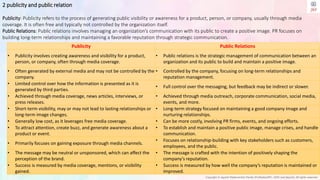
2 publicity and public relation
Publicity: Publicity refers to the process of generating public visibility or awareness for a product, person, or company, usually through media
coverage. It is often free and typically not controlled by the organization itself.
Public Relations: Public relations involves managing an organization’s communication with its public to create a positive image. PR focuses on
building long-term relationships and maintaining a favorable reputation through strategic communication.
Publicity Public Relations
• Publicity involves creating awareness and visibility for a product,
person, or company, often through media coverage.
• Public relations is the strategic management of communication between an
organization and its public to build and maintain a positive image.
• Often generated by external media and may not be controlled by the
company.
• Controlled by the company, focusing on long-term relationships and
reputation management.
• Limited control over how the information is presented as it is
generated by third parties.
• Full control over the messaging, but feedback may be indirect or slower.
• Achieved through media coverage, news articles, interviews, or
press releases.
• Achieved through media outreach, corporate communication, social media,
events, and more.
• Short-term visibility, may or may not lead to lasting relationships or
long-term image changes.
• Long-term strategy focused on maintaining a good company image and
nurturing relationships.
• Generally low cost, as it leverages free media coverage. • Can be more costly, involving PR firms, events, and ongoing efforts.
• To attract attention, create buzz, and generate awareness about a
product or event.
• To establish and maintain a positive public image, manage crises, and handle
communication.
• Primarily focuses on gaining exposure through media channels.
• Focuses on relationship-building with key stakeholders such as customers,
employees, and the public.
• The message may be neutral or unsponsored, which can affect the
perception of the brand.
• The message is crafted with the intention of positively shaping the
company's reputation.
• Success is measured by media coverage, mentions, or visibility
gained.
• Success is measured by how well the company’s reputation is maintained or
improved.
Copyright Š Jayanti Rajdevendra Pande (ProNotesJRP), 2024 and beyond. All rights reserved
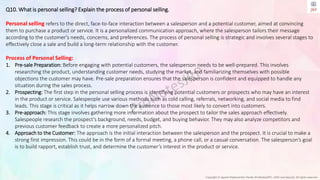
Q10. What is personal selling? Explain the process of personal selling.
Personal selling refers to the direct, face-to-face interaction between a salesperson and a potential customer, aimed at convincing
them to purchase a product or service. It is a personalized communication approach, where the salesperson tailors their message
according to the customer's needs, concerns, and preferences. The process of personal selling is strategic and involves several stages to
effectively close a sale and build a long-term relationship with the customer.
Process of Personal Selling:
1. Pre-sale Preparation: Before engaging with potential customers, the salesperson needs to be well-prepared. This involves
researching the product, understanding customer needs, studying the market, and familiarizing themselves with possible
objections the customer may have. Pre-sale preparation ensures that the salesperson is confident and equipped to handle any
situation during the sales process.
2. Prospecting: The first step in the personal selling process is identifying potential customers or prospects who may have an interest
in the product or service. Salespeople use various methods such as cold calling, referrals, networking, and social media to find
leads. This stage is critical as it helps narrow down the audience to those most likely to convert into customers.
3. Pre-approach: This stage involves gathering more information about the prospect to tailor the sales approach effectively.
Salespeople research the prospect’s background, needs, budget, and buying behavior. They may also analyze competitors and
previous customer feedback to create a more personalized pitch.
4. Approach to the Customer: The approach is the initial interaction between the salesperson and the prospect. It is crucial to make a
strong first impression. This could be in the form of a formal meeting, a phone call, or a casual conversation. The salesperson’s goal
is to build rapport, establish trust, and determine the customer’s interest in the product or service.
Copyright Š Jayanti Rajdevendra Pande (ProNotesJRP), 2024 and beyond. All rights reserved
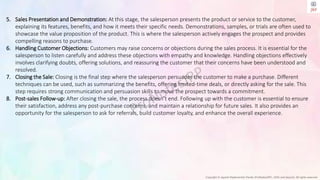
5. Sales Presentation and Demonstration: At this stage, the salesperson presents the product or service to the customer,
explaining its features, benefits, and how it meets their specific needs. Demonstrations, samples, or trials are often used to
showcase the value proposition of the product. This is where the salesperson actively engages the prospect and provides
compelling reasons to purchase.
6. Handling Customer Objections: Customers may raise concerns or objections during the sales process. It is essential for the
salesperson to listen carefully and address these objections with empathy and knowledge. Handling objections effectively
involves clarifying doubts, offering solutions, and reassuring the customer that their concerns have been understood and
resolved.
7. Closing the Sale: Closing is the final step where the salesperson persuades the customer to make a purchase. Different
techniques can be used, such as summarizing the benefits, offering limited-time deals, or directly asking for the sale. This
step requires strong communication and persuasion skills to move the prospect towards a commitment.
8. Post-sales Follow-up: After closing the sale, the process doesn’t end. Following up with the customer is essential to ensure
their satisfaction, address any post-purchase concerns, and maintain a relationship for future sales. It also provides an
opportunity for the salesperson to ask for referrals, build customer loyalty, and enhance the overall experience.
Copyright Š Jayanti Rajdevendra Pande (ProNotesJRP), 2024 and beyond. All rights reserved
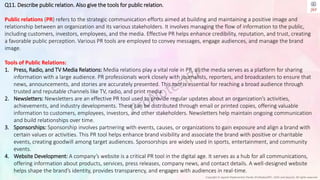
Q11. Describe public relation. Also give the tools for public relation.
Public relations (PR) refers to the strategic communication efforts aimed at building and maintaining a positive image and
relationship between an organization and its various stakeholders. It involves managing the flow of information to the public,
including customers, investors, employees, and the media. Effective PR helps enhance credibility, reputation, and trust, creating
a favorable public perception. Various PR tools are employed to convey messages, engage audiences, and manage the brand
image.
Tools of Public Relations:
1. Press, Radio, and TV Media Relations: Media relations play a vital role in PR, as the media serves as a platform for sharing
information with a large audience. PR professionals work closely with journalists, reporters, and broadcasters to ensure that
news, announcements, and stories are accurately presented. This tool is essential for reaching a broad audience through
trusted and reputable channels like TV, radio, and print media.
2. Newsletters: Newsletters are an effective PR tool used to provide regular updates about an organization’s activities,
achievements, and industry developments. These can be distributed through email or printed copies, offering valuable
information to customers, employees, investors, and other stakeholders. Newsletters help maintain ongoing communication
and build relationships over time.
3. Sponsorships: Sponsorship involves partnering with events, causes, or organizations to gain exposure and align a brand with
certain values or activities. This PR tool helps enhance brand visibility and associate the brand with positive or charitable
events, creating goodwill among target audiences. Sponsorships are widely used in sports, entertainment, and community
events.
4. Website Development: A company’s website is a critical PR tool in the digital age. It serves as a hub for all communications,
offering information about products, services, press releases, company news, and contact details. A well-designed website
helps shape the brand’s identity, provides transparency, and engages with audiences in real-time.
Copyright Š Jayanti Rajdevendra Pande (ProNotesJRP), 2024 and beyond. All rights reserved
5. Media Tour: A media tour involves taking key journalists, reporters, or influencers on a trip or event to experience the
brand’s offerings firsthand. This tool provides an opportunity for media professionals to gather content, conduct
interviews, and develop stories that will be featured in their respective outlets. It’s an effective way to gain media
coverage and increase brand visibility.
6. Special Events: Special events are organized by companies to engage with customers, stakeholders, or the public in
unique and memorable ways. These events could include product launches, press conferences, workshops, or
community engagement activities. Special events help foster strong relationships with key stakeholders and attract
media attention, building the brand’s image.
7. Employee Communications and Relations: Effective internal communication with employees is crucial for maintaining a
positive workplace culture and ensuring alignment with company goals. PR efforts aimed at employees include
newsletters, emails, intranet systems, and meetings. A positive internal PR strategy helps improve employee morale and
productivity, leading to better customer relations and brand advocacy.
8. Market Monitoring: Market monitoring involves tracking media coverage, industry trends, and competitor activities. By
assessing how the brand is being portrayed in the media and how the market is responding, PR professionals can make
necessary adjustments to communication strategies. It ensures the brand remains relevant and maintains a positive
image in the marketplace.
9. Customer Service: Customer service is an essential part of PR because it reflects how well an organization cares about its
customers. Effective customer service communication helps resolve issues quickly, maintain customer satisfaction, and
build a positive reputation. Handling customer complaints publicly with empathy and professionalism can significantly
enhance the company’s image.
Copyright Š Jayanti Rajdevendra Pande (ProNotesJRP), 2024 and beyond. All rights reserved
Q12. Explain the meaning and types of publicity.
Publicity is a type of communication that aims to spread information about a brand, product, or service through media channels, without
directly paying for the coverage. Unlike advertising, which involves paid promotions, publicity relies on media outlets such as newspapers, TV, or
social media to generate attention. Publicity is often seen as more credible by audiences because it is perceived as independent reporting or
endorsement, but it also carries the risk of being less controllable by the organization.
4. Product Releases: Product releases are announcements made
to the public regarding new products or services being
launched. These releases often include product features,
benefits, and availability details, and are distributed to the
media, customers, and other stakeholders. A well-crafted
product release can generate significant buzz and media
coverage.
5. Background Editorial Material: Background editorial material
consists of in-depth background information provided to
journalists to support news stories. These materials give
reporters a broader context, such as company history, industry
trends, or expert opinions, which can be used in creating more
detailed articles and reports about the brand or topic.
6. Emergency Publicity: Emergency publicity is a type of publicity
used in crisis situations when an organization needs to quickly
respond to an unexpected event, such as a product recall,
scandal, or disaster. The goal is to manage the flow of
information, minimize negative publicity, and restore public
trust through transparent and timely communication.
Types of Publicity:
1. News Release: A news release (also known as a press release) is an
official statement issued to the media to announce important
company updates, product launches, events, or other newsworthy
activities. It is a fundamental tool used by public relations
professionals to share timely and relevant information with
journalists and the public, generating media coverage.
2. Press Conference: A press conference is an organized event where
company representatives address the media to make
announcements, provide updates, or answer questions from
journalists. It is typically used for major news, such as crisis
management, product launches, or important organizational
changes, and is an effective way to control the narrative while
engaging directly with the press.
3. Feature Article: Feature articles are in-depth, editorial pieces written
for publication in newspapers, magazines, or online platforms.
These articles provide detailed information about a company,
product, or issue, often with a human interest angle or compelling
story. Feature articles allow for more creativity and flexibility in
messaging and can help position a brand as an industry leader.
Copyright Š Jayanti Rajdevendra Pande (ProNotesJRP), 2024 and beyond. All rights reserved
Q13. Mention the features and functions of direct marketing.
Direct marketing is a promotional strategy where businesses communicate directly with potential customers without
intermediaries such as retailers or agents. This form of marketing focuses on building a direct relationship with individual
consumers through targeted communication channels, aiming to generate an immediate response or action. Direct marketing
can include various techniques like direct mail, email, telemarketing, and online ads, offering personalized and measurable
marketing efforts.
Features of Direct Marketing:
1. Targeted Communication: Direct marketing allows companies to target specific consumer segments based on data such as
demographics, purchase history, and preferences. This ensures that marketing messages are relevant to the recipient,
leading to higher engagement and conversion rates.
2. Measurability: The effectiveness of direct marketing campaigns can be easily tracked and measured. With responses being
directly linked to the marketing effort (e.g., click-through rates, phone calls, purchases), businesses can evaluate return on
investment (ROI) and adjust strategies accordingly.
3. Personalization: One of the key features of direct marketing is the ability to personalize messages for individual
consumers. Personalization can be based on previous interactions, purchase history, or personal preferences, making the
communication more relevant and engaging.
4. Immediate Response: Direct marketing aims to provoke a quick response from the consumer, whether it’s placing an
order, signing up for a service, or making an inquiry. This immediacy helps drive quick sales or customer engagement.
5. Cost Efficiency: Direct marketing is often more cost-effective than mass media advertising. By targeting specific
consumers, businesses can avoid wastage in their marketing efforts and focus on high-potential leads, making it a more
efficient use of marketing resources.
Copyright Š Jayanti Rajdevendra Pande (ProNotesJRP), 2024 and beyond. All rights reserved
Functions of Direct Marketing:
1.Customer Acquisition: Direct marketing is an effective tool for attracting new customers by directly reaching out to
individuals who may be interested in a product or service. Through various methods like emails, catalogs, or
telemarketing, businesses can introduce their brand to potential customers and encourage them to make a purchase.
2.Customer Retention: Direct marketing helps in maintaining long-term relationships with existing customers by sending
personalized offers, loyalty programs, and updates. Retaining customers is often more cost-effective than acquiring new
ones, and direct marketing strengthens customer loyalty and engagement.
3.Lead Generation: Direct marketing generates leads by reaching out to potential customers through personalized
channels like email or direct mail. These leads can be nurtured over time, eventually leading to conversions or sales.
4.Sales Support: Direct marketing serves as a powerful tool for driving immediate sales. By targeting consumers with
promotional offers, discounts, or product information, businesses can create a sense of urgency and incentivize
immediate purchases.
5.Brand Awareness: While direct marketing is primarily focused on generating responses, it also plays a role in building
brand awareness. By continuously engaging with consumers through various marketing materials, companies can
establish a consistent brand presence and stay top-of-mind.
Copyright Š Jayanti Rajdevendra Pande (ProNotesJRP), 2024 and beyond. All rights reserved
Q14. Determine the various form of direct marketing.
Direct marketing refers to a promotional strategy where businesses reach out directly to potential customers to generate sales or
responses. It bypasses intermediaries like retailers, focusing on building personal connections with customers. Direct marketing
includes several forms, each offering unique ways to engage consumers and gather immediate feedback or action. The different
forms of direct marketing help businesses reach specific target audiences and measure the success of their campaigns.
Forms of Direct Marketing:
1. Mail Order Marketing or Catalog Marketing: This involves sending physical catalogs or brochures to customers or potential customers,
showcasing products or services for purchase. Catalog marketing allows businesses to present a wide range of items, provide detailed
descriptions, and offer promotions. Customers can order directly from the catalog via mail or online.
2. Direct Mail Marketing: Direct mail marketing is a form of communication where businesses send promotional materials such as letters,
postcards, or brochures to a targeted list of customers. The objective is to drive sales, inform customers about new offers, or promote specific
products. It is personalized and can include special offers or calls to action to encourage an immediate response.
3. Telemarketing: Telemarketing involves direct communication with potential or existing customers through phone calls. This form of direct
marketing is used for generating sales, conducting surveys, or providing customer service. It can be inbound (receiving calls from customers) or
outbound (businesses initiate the call to potential customers).
4. Direct Face-to-Face Selling: This form of direct marketing involves in-person interactions between a salesperson and a customer. Face-to-face
selling allows businesses to build a personal connection with customers, answer questions, and close sales in real-time. It’s often used in
settings like trade shows, exhibitions, or door-to-door selling.
5. Direct Response Marketing: Direct response marketing is designed to encourage immediate action from the recipient. It includes
advertisements that feature a call to action, such as placing an order, signing up for a newsletter, or clicking on an ad. This type of marketing
can appear in various media formats, including print, television, and online.
6. Teleshopping or Homeshopping: Teleshopping is a form of direct marketing where products are sold through television programs. Consumers
can call a toll-free number to place orders during a live broadcast or through recorded infomercials. It is an effective form of direct marketing,
particularly for demonstrating product benefits and encouraging impulse buys.
Copyright Š Jayanti Rajdevendra Pande (ProNotesJRP), 2024 and beyond. All rights reserved
Q15. What do you understand by event marketing ad evet marketing mix?
Event marketing refers to the strategic promotion of a product, service, or brand through a live event. These events are designed to
engage participants, create experiences, and drive attention to the brand or product being showcased. Event marketing can include
product launches, trade shows, exhibitions, and sponsorship of events, all aimed at creating brand awareness and generating leads. The
event marketing mix refers to the specific components involved in the planning and execution of an event to ensure its success and
maximize the impact it has on the target audience.
Event Marketing Mix:
1. Product: In event marketing, the "product" refers to what is being promoted during the event, whether it's a physical product, a
service, or a brand experience. This is the focal point of the event, and its presentation and delivery are critical to creating a positive
impression. The product should be clearly aligned with the theme of the event and meet the expectations of the target audience.
2. Price: Price in event marketing refers to the cost of participation for the attendees or the cost to the organizer to host the event. For
the attendees, it may be the cost of tickets, registration fees, or any exclusive offers available during the event. For event organizers,
pricing involves budgeting for the event's infrastructure, promotion, and execution costs, ensuring profitability and value for both the
business and participants.
3. Place: The "place" aspect of event marketing concerns the location or platform where the event will take place. It could be a physical
venue like a conference hall, a convention center, or even an outdoor space, or it could be an online platform for virtual events. The
choice of place should align with the type of event and ensure easy access for the target audience.
4. Promotion: Promotion involves the strategies used to advertise the event and attract attendees. This includes digital marketing,
social media campaigns, partnerships, traditional advertising, and public relations. Effective promotion is key to driving awareness,
generating interest, and ensuring a strong turnout. It also involves building excitement around the event through pre-event
marketing and content.
Copyright Š Jayanti Rajdevendra Pande (ProNotesJRP), 2024 and beyond. All rights reserved
Q16. What is customer service? Give the various element of customer service.
Customer service is the assistance and support provided by a company to its customers before, during, and after a purchase. It plays
a crucial role in building customer loyalty and ensuring customer satisfaction. A company that offers excellent customer service
enhances its reputation, encourages repeat business, and often benefits from positive word-of-mouth. Customer service can be
delivered through various channels such as phone, email, live chat, or in person.
Elements of Customer Service:
1. Communication: Clear, concise, and timely communication is fundamental in customer service. It involves listening actively to the
customer's needs, providing accurate information, and responding promptly to queries. Effective communication helps build trust
and ensures that customers feel valued and understood.
2. Responsiveness: Responsiveness is the ability of a company to quickly address and resolve customer concerns. Whether it's
answering questions, processing returns, or fixing issues, timely responses demonstrate a company’s commitment to customer
satisfaction. The faster a company can respond to customer requests, the better the customer experience.
3. Knowledge and Expertise: Customer service representatives must possess in-depth knowledge of the company’s products, services,
policies, and procedures. This knowledge enables them to answer questions, solve problems, and provide accurate information. A
well-trained customer service team enhances the overall customer experience by delivering expert solutions to inquiries.
4. Empathy: Empathy involves understanding and addressing the emotional needs of customers. By showing care and concern,
customer service representatives can foster positive relationships, even when dealing with complaints or difficult situations.
Empathy helps in defusing tense situations and turning negative experiences into positive ones.
5. Personalization: Personalization is the act of tailoring services to the specific needs and preferences of each customer. By
remembering customer details, previous interactions, and preferences, companies can create a more personalized and satisfying
experience. Personalization demonstrates that the company values individual customers and is dedicated to meeting their specific
needs.
Copyright Š Jayanti Rajdevendra Pande (ProNotesJRP), 2024 and beyond. All rights reserved
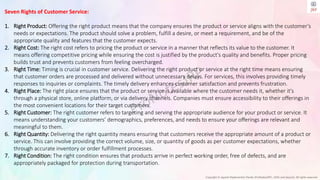
Q17. Elaborate the seven rights of customer service.
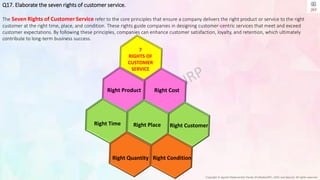
The Seven Rights of Customer Service refer to the core principles that ensure a company delivers the right product or service to the right
customer at the right time, place, and condition. These rights guide companies in designing customer-centric services that meet and exceed
customer expectations. By following these principles, companies can enhance customer satisfaction, loyalty, and retention, which ultimately
contribute to long-term business success.
7
RIGHTS OF
CUSTOMER
SERVICE
Right Product Right Cost
Right Time Right Place Right Customer
Right Quantity Right Condition
Copyright Š Jayanti Rajdevendra Pande (ProNotesJRP), 2024 and beyond. All rights reserved
Seven Rights of Customer Service:
1. Right Product: Offering the right product means that the company ensures the product or service aligns with the customer’s
needs or expectations. The product should solve a problem, fulfill a desire, or meet a requirement, and be of the
appropriate quality and features that the customer expects.
2. Right Cost: The right cost refers to pricing the product or service in a manner that reflects its value to the customer. It
means offering competitive pricing while ensuring the cost is justified by the product's quality and benefits. Proper pricing
builds trust and prevents customers from feeling overcharged.
3. Right Time: Timing is crucial in customer service. Delivering the right product or service at the right time means ensuring
that customer orders are processed and delivered without unnecessary delays. For services, this involves providing timely
responses to inquiries or complaints. The timely delivery enhances customer satisfaction and prevents frustration.
4. Right Place: The right place ensures that the product or service is available where the customer needs it, whether it's
through a physical store, online platform, or via delivery channels. Companies must ensure accessibility to their offerings in
the most convenient locations for their target customers.
5. Right Customer: The right customer refers to targeting and serving the appropriate audience for your product or service. It
means understanding your customers’ demographics, preferences, and needs to ensure your offerings are relevant and
meaningful to them.
6. Right Quantity: Delivering the right quantity means ensuring that customers receive the appropriate amount of a product or
service. This can involve providing the correct volume, size, or quantity of goods as per customer expectations, whether
through accurate inventory or order fulfillment processes.
7. Right Condition: The right condition ensures that products arrive in perfect working order, free of defects, and are
appropriately packaged for protection during transportation.
Copyright Š Jayanti Rajdevendra Pande (ProNotesJRP), 2024 and beyond. All rights reserved
Q18. How to measure the effectiveness of all promotional tools?
Measuring the effectiveness of promotional tools is essential for businesses to understand how well their marketing efforts are
performing and how they contribute to achieving the desired outcomes, such as increased sales, brand awareness, or customer loyalty.
Each promotional tool, whether it’s advertising, sales promotion, personal selling, or publicity, requires specific metrics and methods to
evaluate its impact. By measuring effectiveness, businesses can adjust their strategies to optimize results.
Methods to Measure Effectiveness of Promotional Tools:
Advertising Effectiveness:
• Reach and Frequency: These metrics assess how many people have been exposed to the advertisement and how often they have seen
it. This helps determine the reach and the frequency at which the target audience has been engaged.
• Sales Impact: Comparing sales data before and after an advertising campaign can help assess whether the promotion directly led to
increased sales.
• Brand Awareness and Recall: Surveys and consumer research can be used to evaluate whether the target audience recognizes the
brand and recalls the ad, measuring its effectiveness in terms of brand awareness.
Sales Promotion Effectiveness:
• Redemption Rates: For tools like coupons or discounts, tracking how many customers actually redeem the offers can help determine
the success of the promotion.
• Sales Uplift: Comparing sales during and after the promotion period with normal sales can show whether the promotion drove
increased demand.
• Customer Feedback: Collecting customer feedback or conducting surveys can gauge how well customers received the promotion and
whether it met their needs.
Personal Selling Effectiveness:
• Conversion Rate: The percentage of leads that are converted into sales is an important metric to evaluate how effectively the sales team is
performing.
• Customer Satisfaction: Measuring customer satisfaction through surveys or feedback can provide insight into how effective the personal selling
process was in meeting customer needs.
Copyright Š Jayanti Rajdevendra Pande (ProNotesJRP), 2024 and beyond. All rights reserved
Publicity and Public Relations Effectiveness:
• Media Coverage: The quantity and quality of media coverage obtained through press releases, events, or media
relationships can be a good indicator of success.
• Audience Reach and Engagement: Tracking how many people engaged with the PR content, such as through social media
shares, comments, or website traffic, can measure the effectiveness.
• Brand Sentiment Analysis: Monitoring the sentiment of online conversations or customer opinions can help gauge how
the public perceives the brand after the publicity efforts.
Direct Marketing Effectiveness:
• Response Rate: Measuring the percentage of recipients who respond to direct mail, emails, or telemarketing campaigns
helps evaluate the effectiveness of the call-to-action.
• ROI (Return on Investment): By comparing the revenue generated from direct marketing efforts with the costs incurred,
businesses can assess whether the campaign provided a positive return.
Event Marketing Effectiveness:
• Attendance Numbers: The number of attendees at an event is a straightforward metric for evaluating the initial success of
the event marketing campaign.
• Lead Generation: Measuring how many leads were generated during or after the event can indicate the event’s impact on
future business.
• Post-event Surveys: Gathering feedback from event attendees helps assess the quality of the event and its impact on
brand perception.
Copyright Š Jayanti Rajdevendra Pande (ProNotesJRP), 2024 and beyond. All rights reserved
Q19. What do you understand by measuring overall efficiency? Also explain the process of evaluating IMC effectiveness.
Measuring overall efficiency refers to evaluating how effectively a company uses its resources to achieve its marketing and
communication goals. It involves analyzing the return on investment (ROI) of promotional campaigns and determining whether
the desired outcomes, such as increased sales, customer engagement, or brand awareness, were achieved with the least
amount of resources and effort. A key component of overall efficiency is evaluating the Integrated Marketing Communications
(IMC) effectiveness, which involves assessing the synergy between various promotional tools and the impact of their combined
efforts.
Process of Evaluating IMC Effectiveness:
Measuring Effectiveness of Advertising:
• Ad Recall and Recognition: This can be measured through surveys or focus groups to determine whether consumers
remember the ad and its content.
• Sales Tracking: Comparing sales figures before, during, and after an advertising campaign can help determine if there’s a
direct correlation between the ad and an increase in sales.
• Brand Awareness Studies: Surveys or digital analytics can measure the growth of brand awareness, assessing how many
people are familiar with the brand after the advertising campaign.
Measuring Effectiveness of Sales Promotion:
• Redemption Rates: For promotions like discounts, coupons, or giveaways, tracking the redemption rate helps measure
consumer participation.
• Sales Uplift: Comparing sales during and after the promotion period with normal sales periods can provide insight into the
success of the promotional strategy.
• Customer Feedback: Surveying consumers about their satisfaction with the sales promotion can help understand if the
promotion met customer expectations.
Copyright Š Jayanti Rajdevendra Pande (ProNotesJRP), 2024 and beyond. All rights reserved
Measuring Effectiveness of Publicity and Public Relations:
• Media Mentions: Tracking the number of media mentions or press coverage a brand receives can indicate how effective PR
efforts have been in increasing brand visibility.
• Sentiment Analysis: Analyzing social media and public opinion can help measure the emotional response to PR activities,
identifying whether the brand’s image has been enhanced.
• Website Traffic and Engagement: Monitoring changes in website traffic and engagement after PR campaigns can help assess
if public relations activities generated interest in the brand.
Measuring Effectiveness of Sponsorship:
• Audience Reach: Evaluating how many people were exposed to the brand through sponsorships or events is a key indicator of
effectiveness.
• Brand Recall: Measuring whether consumers remember the brand after being exposed to the sponsorship helps determine
its impact.
• Sales Growth: Tracking any increase in sales or brand interest following sponsorship activities helps assess the ROI of
sponsorship investments.
Measuring Effectiveness of Other Promotional Tools:
• Direct Response Metrics: For tools like direct mail, telemarketing, or email campaigns, response rates and conversion rates
are key indicators of effectiveness.
• Lead Generation: Evaluating the number of leads generated from various promotional tools can help assess how effective
they are in driving interest.
• Customer Engagement: Monitoring social media interactions, website clicks, or event participation can provide insights into
how well other promotional tools are driving engagement.
Copyright Š Jayanti Rajdevendra Pande (ProNotesJRP), 2024 and beyond. All rights reserved
Jayanti Pande
ProNotesJRP by Jayanti Pande ProNotesJRP by Jayanti Pande
Jayanti Pande
Copyright Š Jayanti Rajdevendra Pande (ProNotesJRP), 2024 and beyond. All rights reserved
This content may be printed for personal use only. It may not be copied, distributed, or used for any other
purpose without the express written permission of the copyright owner.
This content is protected by copyright law. Any unauthorized use of the content, including but not limited to
plagiarism, reproduction for sale, distribution without permission, or use in academic dishonesty such as
cheating on exams, is strictly prohibited and may result in legal action.
Furthermore, no part of this content may be altered, modified, or used to create derivative works without prior
written consent.
Please note: The copyright owner is not liable for any issues or complications arising from the printing or use of
this material. Additionally, any attempt to copy or post this material online without permission is a violation of
copyright law and may result in legal consequences.
For any further queries contact on email: jayantipande17@gmail.com

Marketing Management Paper 3 Module 3 .pdf

  • 1.
    Copyright Š JayantiRajdevendra Pande (ProNotesJRP), 2024 and beyond. All rights reserved RASHTRASANT TUKDOJI MAHARAJ NAGPUR UNIVERSITY MBA SEMESTER: 3 SPECIALIZATION MARKETING MANAGEMENT SUBJECT INTEGRATED MARKETING COMMUNICATION & BRAND MANAGEMENT MODULE NO : 3 ADVERTISING MEDIA & IMC TOOLS - By Jayanti R Pande
  • 2.
    Copyright © JayantiRajdevendra Pande (ProNotesJRP), 2024 and beyond. All rights reserved Q1. What is advertising? Mention the 5M’s of advertising. Advertising is a strategic, paid form of communication aimed at informing, persuading, and reminding a target audience about a product, service, or idea. It is a key tool in marketing, designed to build brand awareness, stimulate demand, and establish a unique identity for products in competitive markets. Effective advertising is crucial for businesses to connect with potential customers and achieve their sales and marketing objectives. 5 Ms OF ADVERTISING 1 MISSION 2 MONEY 5 MEASURE 3 MESSAGE 4 MEDIA
  • 3.
    Copyright © JayantiRajdevendra Pande (ProNotesJRP), 2024 and beyond. All rights reserved The 5Ms of Advertising: 1. Mission : The mission defines the purpose of the advertisement, which can vary from creating awareness of a new product to increasing sales of an existing one. Objectives should be SMART (Specific, Measurable, Achievable, Relevant, Time-bound). For example, the goal might be to increase brand recall by 30% within six months or boost market share by 5% in a year. 2. Money : Budget allocation depends on various factors, such as the stage of the product lifecycle, competition, and media costs. Companies must balance cost efficiency with adequate investment to achieve the desired impact. For example, a new product launch may demand a higher advertising budget for maximum visibility. 3. Message : The message is the core content of the advertisement, aimed at influencing the audience’s perception and actions. It should align with the brand's positioning and appeal to emotions, logic, or values. For instance, a luxury car ad might highlight premium quality and status, while a health drink ad may focus on nutritional benefits. 4. Media : Media planning involves choosing the right platforms to reach the target audience effectively, such as television, radio, print, digital, or social media. Factors like audience demographics, media consumption habits, and budget influence the selection. Scheduling ensures the ad reaches viewers at the optimal time, such as during peak viewing hours or festive seasons. 5. Measure : Measuring advertising effectiveness helps determine whether the campaign achieved its objectives. Metrics like brand recall, customer engagement, sales figures, and ROI are analyzed. For example, a digital ad's performance can be measured through click-through rates (CTR) and conversion rates, while TV ads may rely on reach and frequency data.
  • 4.
    Copyright © JayantiRajdevendra Pande (ProNotesJRP), 2024 and beyond. All rights reserved Q2. Classify the various types of advertising. Advertising plays a vital role in communicating a product’s message to its target audience. It is a structured and non-personal form of communication used by organizations to promote products, services, or ideas. Depending on factors like geography, medium, or purpose, advertising can be classified into various types. Types of Advertising: 1. Local Advertising: Focuses on promoting products or services within a specific geographic area. This is often used by small businesses like local shops or eateries to attract nearby customers. 2. National Advertising: Targets a countrywide audience to create brand awareness and demand for products that are widely distributed. Examples include advertisements for consumer electronics or packaged foods. 3. Audio Advertising: Relies on sound to deliver the message through mediums like radio or podcasts. It’s cost-effective and can reach audiences during their commute or leisure time. 4. Visual Advertising: Includes static visuals like posters, print ads, or digital banners. This type is effective for creating strong visual impressions and brand recall. 5. Consumer Advertising: Targets individual consumers to drive product demand. It uses emotional and persuasive appeals to connect with the buyer. Examples include ads for personal care products or food items. 6. Trade Advertising: Aimed at intermediaries like wholesalers or retailers, encouraging them to stock or promote the product. It’s crucial in business-to-business (B2B) marketing strategies. 7. Persuasive Brand Advertising: Highlights the unique features or benefits of a brand to differentiate it from competitors. It often uses storytelling to engage the audience emotionally. 8. Surrogate Advertising: Used to promote restricted products like alcohol by advertising related items, such as soda or events. It indirectly keeps the brand in public consciousness.
  • 5.
    Copyright © JayantiRajdevendra Pande (ProNotesJRP), 2024 and beyond. All rights reserved Q3. Describe advertising media. Give the characteristic of advertising media. Advertising media are the channels or platforms used to deliver promotional messages to the target audience. Choosing the right medium is crucial for ensuring the advertisement’s effectiveness in terms of reach, frequency, and cost-efficiency. Each medium has distinct characteristics that cater to specific advertising goals. Advertising Media and Their Characteristics: 4.Digital Media: •Includes social media, search engines, and websites. •Allows precise targeting and real-time performance tracking. •Flexible budget options make it accessible for businesses of all sizes. 5.Outdoor Media (Billboards and Transit Advertising): •Grabs attention through large, bold visuals in high- traffic areas. •Provides repeated exposure to commuters, creating strong brand recall. •Limited message content due to space constraints. 6.Direct Mail: •Personalized and directly delivered to the target audience. •High response rates due to tailored content. •Costs and reliance on accurate addresses can be limitations. 1.Television: •Combines visual, audio, and motion to create impactful advertisements. •Offers a wide reach and can target specific audiences through time slots or programs. •High production and airing costs make it suitable for large-scale campaigns. 2.Radio: •Cost-effective and ideal for local or regional advertising. •Relies solely on audio, making it engaging for auditory learners. •Limited ability to convey complex messages due to the absence of visuals. 3.Print Media (Newspapers and Magazines): •Newspapers provide timely messages to a broad audience, while magazines focus on niche segments. •Effective for detailed information and visually appealing layouts. •Static nature limits interaction or immediate action from readers.
  • 6.
    Copyright © JayantiRajdevendra Pande (ProNotesJRP), 2024 and beyond. All rights reserved Q4. What do you understand by IMC media planning? Explain the various step involved in media planning. Integrated Marketing Communications (IMC) media planning is a crucial process that aligns various promotional tools to deliver a consistent message to the target audience. It involves analyzing different media platforms, setting objectives, and strategizing effectively to achieve marketing goals. This process integrates traditional and digital media channels, ensuring a unified and cohesive approach to reach the desired audience efficiently. Steps in IMC Media Planning: 1.Market and Environmental Analysis: The first step in media planning is to analyze the market and the environment. This involves understanding the target audience’s needs, preferences, and media consumption habits. It also includes assessing external factors like competition, economic conditions, and industry trends, which influence media choices and the success of the campaign. The insights gained help tailor the media strategy to the audience’s expectations. 2.Establishing Media Objectives: Once the analysis is complete, the next step is to set clear media objectives. These objectives typically revolve around reach, frequency, and desired outcomes. For example, a campaign may aim to increase brand awareness, drive engagement, or boost sales. Setting measurable goals helps in selecting the right media channels and determining the effectiveness of the campaign. It ensures that all media activities align with the overarching marketing objectives. 3.Developing and Implementing Media Strategies: In this step, marketers develop media strategies that align with the objectives. This involves selecting the most effective media channels based on audience research. Whether it's traditional media like TV or print, or digital platforms such as social media, search engines, or display ads, the strategy ensures that the message reaches the target audience in the most impactful way. The implementation phase involves scheduling and distributing content across the selected media, ensuring consistency and timing in message delivery. 4.Implementation of Media Plan :The media plan is then put into action. This phase involves executing the media strategy by preparing the content and collaborating with media outlets for ad placements or digital content distribution. Timely and coordinated execution is key to ensuring the message reaches the audience as planned. This step requires constant monitoring to ensure that the campaign is running as per the set timeline and objectives. 5.Evaluation and Follow-up: After the campaign is live, it’s essential to evaluate its effectiveness. This includes tracking key performance metrics such as ROI, engagement rates, conversions, and overall audience reach. The evaluation phase helps determine if the media objectives were met and identifies areas for improvement. The feedback gathered is crucial for optimizing future media plans.
  • 7.
    Copyright © JayantiRajdevendra Pande (ProNotesJRP), 2024 and beyond. All rights reserved Q5. How advertising is different from sales promotion? Advertising and sales promotion are two fundamental components of marketing strategies, each serving a distinct role in promoting a brand or product. Advertising is focused on creating awareness and building a long-term brand presence. It helps in positioning the brand in the minds of consumers. Sales promotion, on the other hand, focuses on short-term tactics to boost immediate sales, drive customer traffic, and create urgency. Both are vital, but their purposes, execution, and outcomes differ. Advertising Sales Promotion • Aims to build long-term brand awareness and customer loyalty. • Focuses on short-term sales boosts and immediate results. • It involves a consistent message to create brand recognition over time. • It uses incentives like discounts and coupons to encourage immediate purchases. • Typically involves higher costs due to media buys and creative production. • Generally has lower costs, using tools like discounts, contests, or samples. • Message is emotional or informational, aiming to connect with consumers. • Message is action-oriented, urging customers to take immediate action. • Its impact is long-term, reinforcing the brand’s position in the market. • Its impact is short-term, leading to immediate purchases or promotions. • Primarily focuses on building and maintaining a brand's image. • Primarily focuses on driving customer behavior in the short run. • Can be seen through various channels like TV, print, and digital media. • Can be seen through tactics like coupons, contests, and point- of-purchase displays. • Advertising campaigns are usually continuous, ensuring constant brand exposure. • Sales promotions are time-sensitive and often include a clear start and end date.
  • 8.
    Copyright © JayantiRajdevendra Pande (ProNotesJRP), 2024 and beyond. All rights reserved Q6. Define sales promotion, explain various tools and techniques. Sales promotion refers to short-term incentives aimed at encouraging customers to take immediate action, whether it’s making a purchase, trying a new product, or increasing the purchase volume. Unlike advertising, which builds long-term brand equity, sales promotion is designed to create quick, measurable results. There are several tools and techniques used in sales promotions to achieve these goals, each with its own unique purpose and impact. Sales Promotion Tools and Techniques: 1. Free Distribution of Samples: Distributing free samples allows potential customers to try the product without any financial commitment. This technique is effective in building awareness and encouraging product trials, particularly for new or innovative products. By experiencing the product firsthand, customers are more likely to make a purchase. 2. Coupons: Coupons offer discounts on products, encouraging customers to make a purchase by offering them a perceived value. They can be distributed through various channels, including newspapers, websites, or in-store, providing customers with the incentive to act quickly to avail of the discount. This can drive both new and repeat purchases. 3. Money Refund Offer (Rebates): This technique involves offering customers a refund on part of their purchase price after they buy the product, often upon submitting a form or receipt. It incentivizes customers to buy immediately with the promise of saving money afterward, and it also encourages repeat business once the customer has experienced the product. 4. Contests or Bonus Stamps: Contests and bonus stamps are used to engage customers actively. For example, a brand might hold a contest where customers can win prizes by purchasing a product or collecting stamps from multiple purchases. This encourages repeated buying behavior while adding an element of excitement and anticipation. 5. Buyback or Display and Advertising Allowance: A buyback allowance encourages distributors and retailers to stock up on products by offering a discount or reimbursement for unsold goods. Similarly, display allowances are provided to retailers for using in-store displays or advertising to promote a product. This technique is effective for increasing product visibility and availability in retail locations. 6. Sales Contests: Sales contests are designed to motivate sales staff or distributors to achieve certain sales targets, often with rewards for the highest performers. These contests are used to boost motivation and increase sales productivity by adding a competitive element to the sales process. 7. Bonuses to Salesforce or Salesforce Contests: involves offering additional incentives to sales staff or agents who meet or exceed their sales targets. It boosts encourages sales teams to perform at their best, helping to increase overall sales and drive the success of campaigns.
  • 9.
    Copyright © JayantiRajdevendra Pande (ProNotesJRP), 2024 and beyond. All rights reserved Q7. Explain the process involved in planning sales promotion programme. Planning a successful sales promotion program involves several structured steps to ensure the objectives are met, the right tools are selected, and the promotion is executed effectively. The process focuses on maximizing the impact of promotional activities, ensuring that they resonate with the target audience, and achieving measurable results. The steps in planning a sales promotion program guide the development and implementation of a strategy that can boost sales and enhance customer engagement. Steps in Planning a Sales Promotion Program: 1. Establishing Objectives: The first step in planning a sales promotion program is setting clear and measurable objectives. These could be increasing sales, boosting brand awareness, introducing a new product, or encouraging repeat purchases. Objectives should be specific, measurable, achievable, relevant, and time-bound (SMART), providing a clear direction for the entire campaign. 2. Selecting Tools: Once the objectives are defined, the next step is to select the appropriate promotional tools and techniques. The tools could include discounts, coupons, contests, free samples, or loyalty programs. The choice of tools depends on the target audience, the type of product, and the desired outcome, ensuring that the promotion aligns with the overall marketing strategy. 3. Developing the Plan: At this stage, a detailed plan is created, outlining how the promotion will be executed. The plan includes setting a timeline, identifying the target audience, allocating a budget, and determining how the promotion will be communicated (e.g., through advertisements, social media, or in-store displays). Coordination between various departments, like sales, marketing, and distribution, is crucial during this phase. 4. Pre-testing the Program: Before launching the promotion, it’s important to test the program on a small scale. This can be done through pilot campaigns or focus groups to measure the effectiveness of the promotional tools, communication strategies, and overall approach. Pre-testing helps identify potential problems and fine-tune the program for better results. 5. Implementing and Controlling the Program: Once the promotion is launched, it is essential to implement the plan efficiently. This involves coordinating all activities, ensuring that promotional materials are delivered on time, and that the sales force is well-trained to communicate the offer. During the implementation phase, monitoring and controlling the execution are necessary to address any issues promptly and ensure smooth execution. 6. Evaluating Results: After the promotion has ended, evaluating its effectiveness is crucial. This includes assessing whether the objectives were met, analyzing sales data, customer feedback, and the overall impact on brand image. Evaluating results helps identify strengths and weaknesses, providing valuable insights for future promotional campaigns.
  • 10.
    Copyright © JayantiRajdevendra Pande (ProNotesJRP), 2024 and beyond. All rights reserved Q8. Give advantages and disadvantages of sales promotion and personal selling. Sales promotion and personal selling are both critical tools in a company’s marketing mix, each offering unique benefits and drawbacks. Sales promotions are typically short-term incentives designed to stimulate immediate customer action, while personal selling involves direct interaction between a sales representative and a customer. Both have their roles in driving sales and customer loyalty but work in different ways. Below are the advantages and disadvantages of each to help understand their impact on a marketing strategy. Disadvantages of Sales Promotion: 1. Short-Term Focus: Sales promotions are often temporary, and their effectiveness wanes once the promotion ends. Over-reliance on promotions can cause a brand to lose its value and may lead to diminished long-term sales. 2. Profit Erosion: Promotions, especially those offering deep discounts, can erode profit margins if not managed carefully. Companies may face challenges if the increased sales do not outweigh the discount given. 3. Customer Expectation of Discounts: Frequent use of promotions can lead to customers expecting constant discounts. This can undermine brand value and make it difficult to sell products at regular prices. 4. Potential Brand Dilution: If sales promotions are not aligned with the brand’s positioning, they may dilute the brand’s premium image. For example, constant discounts can make a high-end product appear cheap. 5. Complex Management: Planning and managing sales promotions can be time-consuming and complex. Coordination across departments and ensuring the promotion is executed smoothly can be a challenge for the company. Advantages of Sales Promotion: 1. Immediate Impact on Sales: Sales promotions encourage quick consumer action, resulting in immediate increases in sales. For example, limited-time discounts or special offers prompt customers to make quicker purchase decisions. 2. Attracts Attention and Increases Awareness: Promotions can capture customer attention, especially in crowded markets. Special deals or freebies can make a brand more memorable and spark curiosity about the product or service. 3. Helps Build Customer Loyalty: While promoting sales, promotions can also foster customer loyalty. Frequent buyers may benefit from loyalty programs, which reward repeat purchases and enhance customer retention. 4. Increases Market Penetration: Sales promotions can help companies reach a broader audience, particularly in new markets or segments. Special deals can attract new customers and increase the brand's visibility. 5. Encourages Trial of New Products: Promotions like free samples or trials can reduce the perceived risk of trying new products. This encourages customers to experiment with unfamiliar products, increasing the chances of adoption.
  • 11.
    Copyright Š JayantiRajdevendra Pande (ProNotesJRP), 2024 and beyond. All rights reserved Advantages of Personal Selling: 1. Personalized Communication: Personal selling offers direct interaction with customers, allowing sales representatives to tailor their messages and approaches to the specific needs and concerns of the individual. This personal touch helps build trust and rapport. 2. Effective for Complex Products: When selling complex or high- involvement products, personal selling is highly effective. Sales representatives can explain the product in detail, answer questions, and guide customers through the buying decision process. 3. Builds Long-Term Relationships: Personal selling fosters long- term relationships with customers. Through ongoing communication and follow-ups, sales representatives can develop customer loyalty and trust, leading to repeat business and referrals. 4. Immediate Feedback and Adaptation: Personal selling allows salespeople to receive immediate feedback from potential customers, enabling them to adjust their pitch or clarify misunderstandings on the spot. 5. Higher Closing Rates: Since personal selling involves direct interaction, there is a greater opportunity to address objections, clarify benefits, and close sales. This often leads to higher conversion rates compared to passive sales strategies. Disadvantages of Personal Selling: 1. High Cost: Personal selling is more expensive than other methods of promotion, as it requires skilled sales personnel, training, and ongoing costs related to travel, commissions, and incentives. 2. Limited Reach: Unlike mass advertising, personal selling has limited reach. A salesperson can only interact with a limited number of prospects in a given time, which may restrict the overall impact of the sales effort. 3. Inconsistent Performance: The success of personal selling heavily relies on the skills and performance of the individual salesperson. Variations in performance can result in inconsistent results across different salespeople. 4. Time-Consuming: Personal selling is a slow process compared to other promotional methods. The salesperson needs time to develop rapport, build trust, and close each sale, which makes it less effective for reaching large audiences quickly. 5. Requires Ongoing Training: Salespeople must continually improve their skills to stay effective, especially when dealing with new products or changing market conditions. Continuous training and support are essential, which can be resource-intensive for companies.
  • 12.
    Copyright © JayantiRajdevendra Pande (ProNotesJRP), 2024 and beyond. All rights reserved Q9. Differentiate between 1 Advertising and personal selling Advertising: Advertising is a paid form of communication intended to inform or persuade a large audience about products, services, or ideas. It is typically one-way communication through various media such as TV, print, radio, or digital platforms. Personal Selling: Personal selling is a face-to-face interaction between a salesperson and a prospective buyer. It is a direct communication tool aimed at creating a personal connection to influence buying decisions. Advertising Personal Selling • A paid form of communication designed to inform or persuade a broad audience through media. • A direct, personal interaction between a salesperson and a potential customer aimed at closing a sale. • Impersonal and mass communication method. • Personal, direct interaction with customers. • Can reach a large audience through mediums like TV, radio, and online platforms. • Limited reach, as it is one-on-one interaction. • Typically lower cost per contact but can require a substantial budget for mass media. • Higher cost due to salesperson salaries, commissions, and training. • Indirect feedback from audience through sales figures or market research. • Immediate feedback from customers, allowing quick adjustments. • Marketers control the message, timing, and medium of delivery. • Salesperson controls the interaction and message delivery based on the situation. • Effective for creating awareness and reaching large segments. • Effective for closing sales, especially in complex or high-involvement purchases. • Long-lasting impact depending on the frequency of ads. • Short-term impact as it depends on the interaction and follow-up. • Standardized message for all viewers. • Customized message tailored to each individual customer. • Primarily to inform, persuade, or remind a broad audience. • To build relationships, answer questions, and close sales.
  • 13.
    Copyright © JayantiRajdevendra Pande (ProNotesJRP), 2024 and beyond. All rights reserved 2 publicity and public relation Publicity: Publicity refers to the process of generating public visibility or awareness for a product, person, or company, usually through media coverage. It is often free and typically not controlled by the organization itself. Public Relations: Public relations involves managing an organization’s communication with its public to create a positive image. PR focuses on building long-term relationships and maintaining a favorable reputation through strategic communication. Publicity Public Relations • Publicity involves creating awareness and visibility for a product, person, or company, often through media coverage. • Public relations is the strategic management of communication between an organization and its public to build and maintain a positive image. • Often generated by external media and may not be controlled by the company. • Controlled by the company, focusing on long-term relationships and reputation management. • Limited control over how the information is presented as it is generated by third parties. • Full control over the messaging, but feedback may be indirect or slower. • Achieved through media coverage, news articles, interviews, or press releases. • Achieved through media outreach, corporate communication, social media, events, and more. • Short-term visibility, may or may not lead to lasting relationships or long-term image changes. • Long-term strategy focused on maintaining a good company image and nurturing relationships. • Generally low cost, as it leverages free media coverage. • Can be more costly, involving PR firms, events, and ongoing efforts. • To attract attention, create buzz, and generate awareness about a product or event. • To establish and maintain a positive public image, manage crises, and handle communication. • Primarily focuses on gaining exposure through media channels. • Focuses on relationship-building with key stakeholders such as customers, employees, and the public. • The message may be neutral or unsponsored, which can affect the perception of the brand. • The message is crafted with the intention of positively shaping the company's reputation. • Success is measured by media coverage, mentions, or visibility gained. • Success is measured by how well the company’s reputation is maintained or improved.
  • 14.
    Copyright © JayantiRajdevendra Pande (ProNotesJRP), 2024 and beyond. All rights reserved Q10. What is personal selling? Explain the process of personal selling. Personal selling refers to the direct, face-to-face interaction between a salesperson and a potential customer, aimed at convincing them to purchase a product or service. It is a personalized communication approach, where the salesperson tailors their message according to the customer's needs, concerns, and preferences. The process of personal selling is strategic and involves several stages to effectively close a sale and build a long-term relationship with the customer. Process of Personal Selling: 1. Pre-sale Preparation: Before engaging with potential customers, the salesperson needs to be well-prepared. This involves researching the product, understanding customer needs, studying the market, and familiarizing themselves with possible objections the customer may have. Pre-sale preparation ensures that the salesperson is confident and equipped to handle any situation during the sales process. 2. Prospecting: The first step in the personal selling process is identifying potential customers or prospects who may have an interest in the product or service. Salespeople use various methods such as cold calling, referrals, networking, and social media to find leads. This stage is critical as it helps narrow down the audience to those most likely to convert into customers. 3. Pre-approach: This stage involves gathering more information about the prospect to tailor the sales approach effectively. Salespeople research the prospect’s background, needs, budget, and buying behavior. They may also analyze competitors and previous customer feedback to create a more personalized pitch. 4. Approach to the Customer: The approach is the initial interaction between the salesperson and the prospect. It is crucial to make a strong first impression. This could be in the form of a formal meeting, a phone call, or a casual conversation. The salesperson’s goal is to build rapport, establish trust, and determine the customer’s interest in the product or service.
  • 15.
    Copyright © JayantiRajdevendra Pande (ProNotesJRP), 2024 and beyond. All rights reserved 5. Sales Presentation and Demonstration: At this stage, the salesperson presents the product or service to the customer, explaining its features, benefits, and how it meets their specific needs. Demonstrations, samples, or trials are often used to showcase the value proposition of the product. This is where the salesperson actively engages the prospect and provides compelling reasons to purchase. 6. Handling Customer Objections: Customers may raise concerns or objections during the sales process. It is essential for the salesperson to listen carefully and address these objections with empathy and knowledge. Handling objections effectively involves clarifying doubts, offering solutions, and reassuring the customer that their concerns have been understood and resolved. 7. Closing the Sale: Closing is the final step where the salesperson persuades the customer to make a purchase. Different techniques can be used, such as summarizing the benefits, offering limited-time deals, or directly asking for the sale. This step requires strong communication and persuasion skills to move the prospect towards a commitment. 8. Post-sales Follow-up: After closing the sale, the process doesn’t end. Following up with the customer is essential to ensure their satisfaction, address any post-purchase concerns, and maintain a relationship for future sales. It also provides an opportunity for the salesperson to ask for referrals, build customer loyalty, and enhance the overall experience.
  • 16.
    Copyright © JayantiRajdevendra Pande (ProNotesJRP), 2024 and beyond. All rights reserved Q11. Describe public relation. Also give the tools for public relation. Public relations (PR) refers to the strategic communication efforts aimed at building and maintaining a positive image and relationship between an organization and its various stakeholders. It involves managing the flow of information to the public, including customers, investors, employees, and the media. Effective PR helps enhance credibility, reputation, and trust, creating a favorable public perception. Various PR tools are employed to convey messages, engage audiences, and manage the brand image. Tools of Public Relations: 1. Press, Radio, and TV Media Relations: Media relations play a vital role in PR, as the media serves as a platform for sharing information with a large audience. PR professionals work closely with journalists, reporters, and broadcasters to ensure that news, announcements, and stories are accurately presented. This tool is essential for reaching a broad audience through trusted and reputable channels like TV, radio, and print media. 2. Newsletters: Newsletters are an effective PR tool used to provide regular updates about an organization’s activities, achievements, and industry developments. These can be distributed through email or printed copies, offering valuable information to customers, employees, investors, and other stakeholders. Newsletters help maintain ongoing communication and build relationships over time. 3. Sponsorships: Sponsorship involves partnering with events, causes, or organizations to gain exposure and align a brand with certain values or activities. This PR tool helps enhance brand visibility and associate the brand with positive or charitable events, creating goodwill among target audiences. Sponsorships are widely used in sports, entertainment, and community events. 4. Website Development: A company’s website is a critical PR tool in the digital age. It serves as a hub for all communications, offering information about products, services, press releases, company news, and contact details. A well-designed website helps shape the brand’s identity, provides transparency, and engages with audiences in real-time.
  • 17.
    Copyright © JayantiRajdevendra Pande (ProNotesJRP), 2024 and beyond. All rights reserved 5. Media Tour: A media tour involves taking key journalists, reporters, or influencers on a trip or event to experience the brand’s offerings firsthand. This tool provides an opportunity for media professionals to gather content, conduct interviews, and develop stories that will be featured in their respective outlets. It’s an effective way to gain media coverage and increase brand visibility. 6. Special Events: Special events are organized by companies to engage with customers, stakeholders, or the public in unique and memorable ways. These events could include product launches, press conferences, workshops, or community engagement activities. Special events help foster strong relationships with key stakeholders and attract media attention, building the brand’s image. 7. Employee Communications and Relations: Effective internal communication with employees is crucial for maintaining a positive workplace culture and ensuring alignment with company goals. PR efforts aimed at employees include newsletters, emails, intranet systems, and meetings. A positive internal PR strategy helps improve employee morale and productivity, leading to better customer relations and brand advocacy. 8. Market Monitoring: Market monitoring involves tracking media coverage, industry trends, and competitor activities. By assessing how the brand is being portrayed in the media and how the market is responding, PR professionals can make necessary adjustments to communication strategies. It ensures the brand remains relevant and maintains a positive image in the marketplace. 9. Customer Service: Customer service is an essential part of PR because it reflects how well an organization cares about its customers. Effective customer service communication helps resolve issues quickly, maintain customer satisfaction, and build a positive reputation. Handling customer complaints publicly with empathy and professionalism can significantly enhance the company’s image.
  • 18.
    Copyright Š JayantiRajdevendra Pande (ProNotesJRP), 2024 and beyond. All rights reserved Q12. Explain the meaning and types of publicity. Publicity is a type of communication that aims to spread information about a brand, product, or service through media channels, without directly paying for the coverage. Unlike advertising, which involves paid promotions, publicity relies on media outlets such as newspapers, TV, or social media to generate attention. Publicity is often seen as more credible by audiences because it is perceived as independent reporting or endorsement, but it also carries the risk of being less controllable by the organization. 4. Product Releases: Product releases are announcements made to the public regarding new products or services being launched. These releases often include product features, benefits, and availability details, and are distributed to the media, customers, and other stakeholders. A well-crafted product release can generate significant buzz and media coverage. 5. Background Editorial Material: Background editorial material consists of in-depth background information provided to journalists to support news stories. These materials give reporters a broader context, such as company history, industry trends, or expert opinions, which can be used in creating more detailed articles and reports about the brand or topic. 6. Emergency Publicity: Emergency publicity is a type of publicity used in crisis situations when an organization needs to quickly respond to an unexpected event, such as a product recall, scandal, or disaster. The goal is to manage the flow of information, minimize negative publicity, and restore public trust through transparent and timely communication. Types of Publicity: 1. News Release: A news release (also known as a press release) is an official statement issued to the media to announce important company updates, product launches, events, or other newsworthy activities. It is a fundamental tool used by public relations professionals to share timely and relevant information with journalists and the public, generating media coverage. 2. Press Conference: A press conference is an organized event where company representatives address the media to make announcements, provide updates, or answer questions from journalists. It is typically used for major news, such as crisis management, product launches, or important organizational changes, and is an effective way to control the narrative while engaging directly with the press. 3. Feature Article: Feature articles are in-depth, editorial pieces written for publication in newspapers, magazines, or online platforms. These articles provide detailed information about a company, product, or issue, often with a human interest angle or compelling story. Feature articles allow for more creativity and flexibility in messaging and can help position a brand as an industry leader.
  • 19.
    Copyright © JayantiRajdevendra Pande (ProNotesJRP), 2024 and beyond. All rights reserved Q13. Mention the features and functions of direct marketing. Direct marketing is a promotional strategy where businesses communicate directly with potential customers without intermediaries such as retailers or agents. This form of marketing focuses on building a direct relationship with individual consumers through targeted communication channels, aiming to generate an immediate response or action. Direct marketing can include various techniques like direct mail, email, telemarketing, and online ads, offering personalized and measurable marketing efforts. Features of Direct Marketing: 1. Targeted Communication: Direct marketing allows companies to target specific consumer segments based on data such as demographics, purchase history, and preferences. This ensures that marketing messages are relevant to the recipient, leading to higher engagement and conversion rates. 2. Measurability: The effectiveness of direct marketing campaigns can be easily tracked and measured. With responses being directly linked to the marketing effort (e.g., click-through rates, phone calls, purchases), businesses can evaluate return on investment (ROI) and adjust strategies accordingly. 3. Personalization: One of the key features of direct marketing is the ability to personalize messages for individual consumers. Personalization can be based on previous interactions, purchase history, or personal preferences, making the communication more relevant and engaging. 4. Immediate Response: Direct marketing aims to provoke a quick response from the consumer, whether it’s placing an order, signing up for a service, or making an inquiry. This immediacy helps drive quick sales or customer engagement. 5. Cost Efficiency: Direct marketing is often more cost-effective than mass media advertising. By targeting specific consumers, businesses can avoid wastage in their marketing efforts and focus on high-potential leads, making it a more efficient use of marketing resources.
  • 20.
    Copyright Š JayantiRajdevendra Pande (ProNotesJRP), 2024 and beyond. All rights reserved Functions of Direct Marketing: 1.Customer Acquisition: Direct marketing is an effective tool for attracting new customers by directly reaching out to individuals who may be interested in a product or service. Through various methods like emails, catalogs, or telemarketing, businesses can introduce their brand to potential customers and encourage them to make a purchase. 2.Customer Retention: Direct marketing helps in maintaining long-term relationships with existing customers by sending personalized offers, loyalty programs, and updates. Retaining customers is often more cost-effective than acquiring new ones, and direct marketing strengthens customer loyalty and engagement. 3.Lead Generation: Direct marketing generates leads by reaching out to potential customers through personalized channels like email or direct mail. These leads can be nurtured over time, eventually leading to conversions or sales. 4.Sales Support: Direct marketing serves as a powerful tool for driving immediate sales. By targeting consumers with promotional offers, discounts, or product information, businesses can create a sense of urgency and incentivize immediate purchases. 5.Brand Awareness: While direct marketing is primarily focused on generating responses, it also plays a role in building brand awareness. By continuously engaging with consumers through various marketing materials, companies can establish a consistent brand presence and stay top-of-mind.
  • 21.
    Copyright © JayantiRajdevendra Pande (ProNotesJRP), 2024 and beyond. All rights reserved Q14. Determine the various form of direct marketing. Direct marketing refers to a promotional strategy where businesses reach out directly to potential customers to generate sales or responses. It bypasses intermediaries like retailers, focusing on building personal connections with customers. Direct marketing includes several forms, each offering unique ways to engage consumers and gather immediate feedback or action. The different forms of direct marketing help businesses reach specific target audiences and measure the success of their campaigns. Forms of Direct Marketing: 1. Mail Order Marketing or Catalog Marketing: This involves sending physical catalogs or brochures to customers or potential customers, showcasing products or services for purchase. Catalog marketing allows businesses to present a wide range of items, provide detailed descriptions, and offer promotions. Customers can order directly from the catalog via mail or online. 2. Direct Mail Marketing: Direct mail marketing is a form of communication where businesses send promotional materials such as letters, postcards, or brochures to a targeted list of customers. The objective is to drive sales, inform customers about new offers, or promote specific products. It is personalized and can include special offers or calls to action to encourage an immediate response. 3. Telemarketing: Telemarketing involves direct communication with potential or existing customers through phone calls. This form of direct marketing is used for generating sales, conducting surveys, or providing customer service. It can be inbound (receiving calls from customers) or outbound (businesses initiate the call to potential customers). 4. Direct Face-to-Face Selling: This form of direct marketing involves in-person interactions between a salesperson and a customer. Face-to-face selling allows businesses to build a personal connection with customers, answer questions, and close sales in real-time. It’s often used in settings like trade shows, exhibitions, or door-to-door selling. 5. Direct Response Marketing: Direct response marketing is designed to encourage immediate action from the recipient. It includes advertisements that feature a call to action, such as placing an order, signing up for a newsletter, or clicking on an ad. This type of marketing can appear in various media formats, including print, television, and online. 6. Teleshopping or Homeshopping: Teleshopping is a form of direct marketing where products are sold through television programs. Consumers can call a toll-free number to place orders during a live broadcast or through recorded infomercials. It is an effective form of direct marketing, particularly for demonstrating product benefits and encouraging impulse buys.
  • 22.
    Copyright Š JayantiRajdevendra Pande (ProNotesJRP), 2024 and beyond. All rights reserved Q15. What do you understand by event marketing ad evet marketing mix? Event marketing refers to the strategic promotion of a product, service, or brand through a live event. These events are designed to engage participants, create experiences, and drive attention to the brand or product being showcased. Event marketing can include product launches, trade shows, exhibitions, and sponsorship of events, all aimed at creating brand awareness and generating leads. The event marketing mix refers to the specific components involved in the planning and execution of an event to ensure its success and maximize the impact it has on the target audience. Event Marketing Mix: 1. Product: In event marketing, the "product" refers to what is being promoted during the event, whether it's a physical product, a service, or a brand experience. This is the focal point of the event, and its presentation and delivery are critical to creating a positive impression. The product should be clearly aligned with the theme of the event and meet the expectations of the target audience. 2. Price: Price in event marketing refers to the cost of participation for the attendees or the cost to the organizer to host the event. For the attendees, it may be the cost of tickets, registration fees, or any exclusive offers available during the event. For event organizers, pricing involves budgeting for the event's infrastructure, promotion, and execution costs, ensuring profitability and value for both the business and participants. 3. Place: The "place" aspect of event marketing concerns the location or platform where the event will take place. It could be a physical venue like a conference hall, a convention center, or even an outdoor space, or it could be an online platform for virtual events. The choice of place should align with the type of event and ensure easy access for the target audience. 4. Promotion: Promotion involves the strategies used to advertise the event and attract attendees. This includes digital marketing, social media campaigns, partnerships, traditional advertising, and public relations. Effective promotion is key to driving awareness, generating interest, and ensuring a strong turnout. It also involves building excitement around the event through pre-event marketing and content.
  • 23.
    Copyright © JayantiRajdevendra Pande (ProNotesJRP), 2024 and beyond. All rights reserved Q16. What is customer service? Give the various element of customer service. Customer service is the assistance and support provided by a company to its customers before, during, and after a purchase. It plays a crucial role in building customer loyalty and ensuring customer satisfaction. A company that offers excellent customer service enhances its reputation, encourages repeat business, and often benefits from positive word-of-mouth. Customer service can be delivered through various channels such as phone, email, live chat, or in person. Elements of Customer Service: 1. Communication: Clear, concise, and timely communication is fundamental in customer service. It involves listening actively to the customer's needs, providing accurate information, and responding promptly to queries. Effective communication helps build trust and ensures that customers feel valued and understood. 2. Responsiveness: Responsiveness is the ability of a company to quickly address and resolve customer concerns. Whether it's answering questions, processing returns, or fixing issues, timely responses demonstrate a company’s commitment to customer satisfaction. The faster a company can respond to customer requests, the better the customer experience. 3. Knowledge and Expertise: Customer service representatives must possess in-depth knowledge of the company’s products, services, policies, and procedures. This knowledge enables them to answer questions, solve problems, and provide accurate information. A well-trained customer service team enhances the overall customer experience by delivering expert solutions to inquiries. 4. Empathy: Empathy involves understanding and addressing the emotional needs of customers. By showing care and concern, customer service representatives can foster positive relationships, even when dealing with complaints or difficult situations. Empathy helps in defusing tense situations and turning negative experiences into positive ones. 5. Personalization: Personalization is the act of tailoring services to the specific needs and preferences of each customer. By remembering customer details, previous interactions, and preferences, companies can create a more personalized and satisfying experience. Personalization demonstrates that the company values individual customers and is dedicated to meeting their specific needs.
  • 24.
    Copyright Š JayantiRajdevendra Pande (ProNotesJRP), 2024 and beyond. All rights reserved Q17. Elaborate the seven rights of customer service. The Seven Rights of Customer Service refer to the core principles that ensure a company delivers the right product or service to the right customer at the right time, place, and condition. These rights guide companies in designing customer-centric services that meet and exceed customer expectations. By following these principles, companies can enhance customer satisfaction, loyalty, and retention, which ultimately contribute to long-term business success. 7 RIGHTS OF CUSTOMER SERVICE Right Product Right Cost Right Time Right Place Right Customer Right Quantity Right Condition
  • 25.
    Copyright © JayantiRajdevendra Pande (ProNotesJRP), 2024 and beyond. All rights reserved Seven Rights of Customer Service: 1. Right Product: Offering the right product means that the company ensures the product or service aligns with the customer’s needs or expectations. The product should solve a problem, fulfill a desire, or meet a requirement, and be of the appropriate quality and features that the customer expects. 2. Right Cost: The right cost refers to pricing the product or service in a manner that reflects its value to the customer. It means offering competitive pricing while ensuring the cost is justified by the product's quality and benefits. Proper pricing builds trust and prevents customers from feeling overcharged. 3. Right Time: Timing is crucial in customer service. Delivering the right product or service at the right time means ensuring that customer orders are processed and delivered without unnecessary delays. For services, this involves providing timely responses to inquiries or complaints. The timely delivery enhances customer satisfaction and prevents frustration. 4. Right Place: The right place ensures that the product or service is available where the customer needs it, whether it's through a physical store, online platform, or via delivery channels. Companies must ensure accessibility to their offerings in the most convenient locations for their target customers. 5. Right Customer: The right customer refers to targeting and serving the appropriate audience for your product or service. It means understanding your customers’ demographics, preferences, and needs to ensure your offerings are relevant and meaningful to them. 6. Right Quantity: Delivering the right quantity means ensuring that customers receive the appropriate amount of a product or service. This can involve providing the correct volume, size, or quantity of goods as per customer expectations, whether through accurate inventory or order fulfillment processes. 7. Right Condition: The right condition ensures that products arrive in perfect working order, free of defects, and are appropriately packaged for protection during transportation.
  • 26.
    Copyright © JayantiRajdevendra Pande (ProNotesJRP), 2024 and beyond. All rights reserved Q18. How to measure the effectiveness of all promotional tools? Measuring the effectiveness of promotional tools is essential for businesses to understand how well their marketing efforts are performing and how they contribute to achieving the desired outcomes, such as increased sales, brand awareness, or customer loyalty. Each promotional tool, whether it’s advertising, sales promotion, personal selling, or publicity, requires specific metrics and methods to evaluate its impact. By measuring effectiveness, businesses can adjust their strategies to optimize results. Methods to Measure Effectiveness of Promotional Tools: Advertising Effectiveness: • Reach and Frequency: These metrics assess how many people have been exposed to the advertisement and how often they have seen it. This helps determine the reach and the frequency at which the target audience has been engaged. • Sales Impact: Comparing sales data before and after an advertising campaign can help assess whether the promotion directly led to increased sales. • Brand Awareness and Recall: Surveys and consumer research can be used to evaluate whether the target audience recognizes the brand and recalls the ad, measuring its effectiveness in terms of brand awareness. Sales Promotion Effectiveness: • Redemption Rates: For tools like coupons or discounts, tracking how many customers actually redeem the offers can help determine the success of the promotion. • Sales Uplift: Comparing sales during and after the promotion period with normal sales can show whether the promotion drove increased demand. • Customer Feedback: Collecting customer feedback or conducting surveys can gauge how well customers received the promotion and whether it met their needs. Personal Selling Effectiveness: • Conversion Rate: The percentage of leads that are converted into sales is an important metric to evaluate how effectively the sales team is performing. • Customer Satisfaction: Measuring customer satisfaction through surveys or feedback can provide insight into how effective the personal selling process was in meeting customer needs.
  • 27.
    Copyright © JayantiRajdevendra Pande (ProNotesJRP), 2024 and beyond. All rights reserved Publicity and Public Relations Effectiveness: • Media Coverage: The quantity and quality of media coverage obtained through press releases, events, or media relationships can be a good indicator of success. • Audience Reach and Engagement: Tracking how many people engaged with the PR content, such as through social media shares, comments, or website traffic, can measure the effectiveness. • Brand Sentiment Analysis: Monitoring the sentiment of online conversations or customer opinions can help gauge how the public perceives the brand after the publicity efforts. Direct Marketing Effectiveness: • Response Rate: Measuring the percentage of recipients who respond to direct mail, emails, or telemarketing campaigns helps evaluate the effectiveness of the call-to-action. • ROI (Return on Investment): By comparing the revenue generated from direct marketing efforts with the costs incurred, businesses can assess whether the campaign provided a positive return. Event Marketing Effectiveness: • Attendance Numbers: The number of attendees at an event is a straightforward metric for evaluating the initial success of the event marketing campaign. • Lead Generation: Measuring how many leads were generated during or after the event can indicate the event’s impact on future business. • Post-event Surveys: Gathering feedback from event attendees helps assess the quality of the event and its impact on brand perception.
  • 28.
    Copyright © JayantiRajdevendra Pande (ProNotesJRP), 2024 and beyond. All rights reserved Q19. What do you understand by measuring overall efficiency? Also explain the process of evaluating IMC effectiveness. Measuring overall efficiency refers to evaluating how effectively a company uses its resources to achieve its marketing and communication goals. It involves analyzing the return on investment (ROI) of promotional campaigns and determining whether the desired outcomes, such as increased sales, customer engagement, or brand awareness, were achieved with the least amount of resources and effort. A key component of overall efficiency is evaluating the Integrated Marketing Communications (IMC) effectiveness, which involves assessing the synergy between various promotional tools and the impact of their combined efforts. Process of Evaluating IMC Effectiveness: Measuring Effectiveness of Advertising: • Ad Recall and Recognition: This can be measured through surveys or focus groups to determine whether consumers remember the ad and its content. • Sales Tracking: Comparing sales figures before, during, and after an advertising campaign can help determine if there’s a direct correlation between the ad and an increase in sales. • Brand Awareness Studies: Surveys or digital analytics can measure the growth of brand awareness, assessing how many people are familiar with the brand after the advertising campaign. Measuring Effectiveness of Sales Promotion: • Redemption Rates: For promotions like discounts, coupons, or giveaways, tracking the redemption rate helps measure consumer participation. • Sales Uplift: Comparing sales during and after the promotion period with normal sales periods can provide insight into the success of the promotional strategy. • Customer Feedback: Surveying consumers about their satisfaction with the sales promotion can help understand if the promotion met customer expectations.
  • 29.
    Copyright © JayantiRajdevendra Pande (ProNotesJRP), 2024 and beyond. All rights reserved Measuring Effectiveness of Publicity and Public Relations: • Media Mentions: Tracking the number of media mentions or press coverage a brand receives can indicate how effective PR efforts have been in increasing brand visibility. • Sentiment Analysis: Analyzing social media and public opinion can help measure the emotional response to PR activities, identifying whether the brand’s image has been enhanced. • Website Traffic and Engagement: Monitoring changes in website traffic and engagement after PR campaigns can help assess if public relations activities generated interest in the brand. Measuring Effectiveness of Sponsorship: • Audience Reach: Evaluating how many people were exposed to the brand through sponsorships or events is a key indicator of effectiveness. • Brand Recall: Measuring whether consumers remember the brand after being exposed to the sponsorship helps determine its impact. • Sales Growth: Tracking any increase in sales or brand interest following sponsorship activities helps assess the ROI of sponsorship investments. Measuring Effectiveness of Other Promotional Tools: • Direct Response Metrics: For tools like direct mail, telemarketing, or email campaigns, response rates and conversion rates are key indicators of effectiveness. • Lead Generation: Evaluating the number of leads generated from various promotional tools can help assess how effective they are in driving interest. • Customer Engagement: Monitoring social media interactions, website clicks, or event participation can provide insights into how well other promotional tools are driving engagement.
  • 30.
    Copyright Š JayantiRajdevendra Pande (ProNotesJRP), 2024 and beyond. All rights reserved Jayanti Pande ProNotesJRP by Jayanti Pande ProNotesJRP by Jayanti Pande Jayanti Pande
  • 31.
    Copyright Š JayantiRajdevendra Pande (ProNotesJRP), 2024 and beyond. All rights reserved Copyright Š Jayanti Rajdevendra Pande (ProNotesJRP), 2024 and beyond. All rights reserved This content may be printed for personal use only. It may not be copied, distributed, or used for any other purpose without the express written permission of the copyright owner. This content is protected by copyright law. Any unauthorized use of the content, including but not limited to plagiarism, reproduction for sale, distribution without permission, or use in academic dishonesty such as cheating on exams, is strictly prohibited and may result in legal action. Furthermore, no part of this content may be altered, modified, or used to create derivative works without prior written consent. Please note: The copyright owner is not liable for any issues or complications arising from the printing or use of this material. Additionally, any attempt to copy or post this material online without permission is a violation of copyright law and may result in legal consequences. For any further queries contact on email: jayantipande17@gmail.com