ADVERTISING
Introduction
   •   A shop wants to attract more customers or clear stocks, so it decides to offer special
       discounts for a period. It advertises in the daily newspapers to inform the public of
       its ―sale‖.
   •   A     company    brings     out     a   new     product    which     is     much
       more     economical    than     the    existing   ones    in    its     category.
       If the company cannot advertise the product, it would never be able to enter the
       market.
   •   The Government wants corporate, businessmen and salaried people to pay taxes. It
       advertises in newspapers, radio and television to reach the target audience.


What is ADVERTISING?
― the action of calling something to the attention of public‖


                                    WEBSTER‘s Dictionary
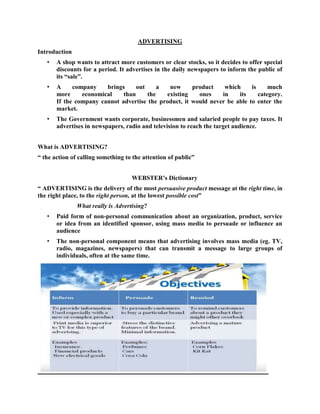
― ADVERTISING is the delivery of the most persuasive product message at the right time, in
the right place, to the right person, at the lowest possible cost‖
               What really is Advertising?
   •   Paid form of non-personal communication about an organization, product, service
       or idea from an identified sponsor, using mass media to persuade or influence an
       audience
   •   The non-personal component means that advertising involves mass media (eg. TV,
       radio, magazines, newspapers) that can transmit a message to large groups of
       individuals, often at the same time.
Importance of Advertising
   •   It is very cost effective method to communicate to a large audience.
   •   It helps create brand image and symbolic appeal for the brand which is a very
       important for companies selling product/services that are difficult to differentiate
       on functional attributes.
   •   Popular advertising campaigns attract customers attentions and can help generate
       sales.
   •   E.g., Pepsi‘s – ‗Oye bubbly‘, ‗Mera number kab aye ga‘, Asian Paints – ‗Badiaya
       hai‘, Alpenleibe -Lage raho, etc
   •   The targets of an organization's advertising efforts often vary as do the advertising
       role and function in the marketing program.
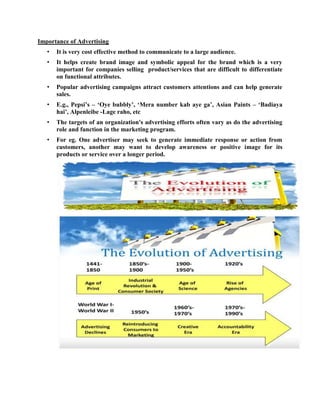
   •   For eg. One advertiser may seek to generate immediate response or action from
       customers, another may want to develop awareness or positive image for its
       products or service over a longer period.
 By the end of the 18th century several daily newspapers were being published and
  competition for the advertisers' money had started in earnest.
The Five Players of Advertising
•   Advertiser
       – Organization that needs to advertise
•   Advertising agency
       – Firms that plan and implement advertising efforts
•   Media
       – Channels that carry the message from advertiser to audience
•   Vendors
       – Service people/organizations that assist advertisers, agencies, and media
•   Target audience
Functions of Advertising
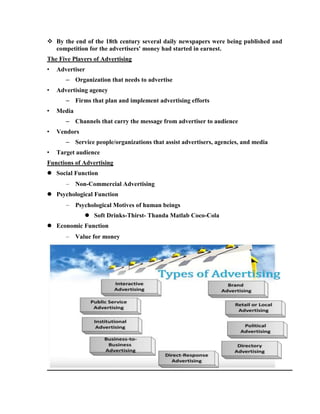
 Social Function
            Non-Commercial Advertising
 Psychological Function
            Psychological Motives of human beings
                Soft Drinks-Thirst- Thanda Matlab Coco-Cola
 Economic Function
            Value for money
 Professional Advertising:
   •    There are certain products for which the consumers themselves are not responsible
        for the buying choice.
   •    Example:
        Pharmaceuticals – doctors
       Construction-architects, civil engineers, contractors.
PUBLIC AWARENESS ADVERTISING
1.Product advertising: (Taste, color, texture, aroma, design, packaging)
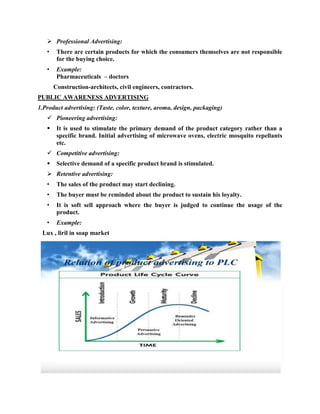
    Pioneering advertising:
       It is used to stimulate the primary demand of the product category rather than a
        specific brand. Initial advertising of microwave ovens, electric mosquito repellants
        etc.
    Competitive advertising:
       Selective demand of a specific product brand is stimulated.
    Retentive advertising:
   •    The sales of the product may start declining.
   •    The buyer must be reminded about the product to sustain his loyalty.
   •    It is soft sell approach where the buyer is judged to continue the usage of the
        product.
   •    Example:
 Lux , liril in soap market
3. Institutional Advertising or Corporate advertising:
      The institute presents its own story to build up an image of itself in the public mind.
      It is a public relations approach advertising.
      It may list its social contributions.
      It shows how its actions are consistent with overall national objectives like
       environmental protection, employment generation, health for all etc.
      Example: The Taj group of Hotels- ―Nobody cares as much‖
4. Public relation Advertising:
   •   It is a part of institutional advertising.
   •   It is the deliberate, planned and sustained effort to establish and maintain mutual
       understanding between an organization and its public.
   •   It also includes the annual reports of the company and the chairman‘s speech.
5. Public Service Advertising:
   •   It is done as a part of social responsibility by the advertising agencies.
   •   Example: Handicapped children and their help, female foeticid, drug addiction,
       blood donation etc.
 Seagram ad says that ― drinking and driving do not mix‖
6. Financial Advertising:
      Promoting capital issues has become a very specialized segment of advertising called
       financial advertising.
      The copy of financial ad gives the highlights of the project, details of the issue, crisis
       rating, closing date of issue, name of company and its address.
Benefits of Advertising
Economic Benefits of Advertising
    It is a necessary part of the functioning of modern market economies.
    Advertising can be a useful tool for sustaining honest and ethically responsible
     competition that contributes to economic growth in the service of authentic human
     development.
    Advertising informs people about the availability of rationally desirable new products
     and services and improvements in existing ones, helping them to make informed,
     contributing to efficiency and the lowering of prices, and stimulating economic
     progress through the expansion of business and trade.
•   An advertisement is said to evil to the society if it unethical
   •   Ethics
          – Ethics is a branch of philosophy which seeks to address questions about
            morality; that is, about concepts such as good and bad, right and wrong,
            justice, and virtue.
   •   Advertisement is considered unethical in the following situations;
          – When it gives false or misleading information on the value of the product.
          – When it fails to give useful information on the possible reaction or side
            effects of the product. And
          – When it has degraded or underestimated the substitute or rival's product
          – When it is immoral.
Social aspects of advertising
Taste:- Sometimes ads are offensive, tasteless, irritating, boring and so on.
   a) Sources of distaste
   b) Sexual Appeals
   c) Shock advertising
Some examples of the Advertisements with social aspects:-
           Grow-more-trees advertisements
           Drink milk
           Eat healthy food, eat eggs
           Mother‘s milk is best for the baby
           Say no to drugs every time
           Get your child vaccinations in times
Cultural Harms of Advertising
    In the competition to attract ever larger audiences and deliver them to advertisers,
     communicators can find themselves tempted — in fact pressured,— to set aside high
     artistic and moral standards and lapse into superficiality, tawdriness and moral
     squalor
    Communicators also can find themselves tempted to ignore the educational and
     social needs of certain segments of the audience — the very young, the very old, the
     poor — who do not match the demographic patterns (age, education, income, habits
     of buying and consuming, etc.) of the kinds of audiences advertisers want to reach
Advertisements and children
   •   Children are inexperienced and easy prey
   •   Children between ages 2-11 watch on average21.5 hours of TV per week and may
       see 22,000 commercials per year.
   •   Television is an important source of information for children about products.
   •   In a study by boddewyn for the international advertising association ,it was noted
       that decency and sexism appeared to be issues causing less concern in future issues
       than advertising to children
Children in advertising
    Children are easily persuaded and have a large pull on today's markets, as is known
     by all advertisers, even ones who do not intend for their products to be consumed by
     children.
Legal aspects of advertising
  The government in each country has to make sure that advertisements appearing do not
flaunt of their rules & regulations.
 It should not:-
           show anti-national feelings
           contain misleading information about the product
           Violate government rules
Some examples of the Advertisements with legal aspects:-
    Get your car checked for pollution
    Drinks & driving do not mix
    Weight, price, manufacturing date, date of expiry should be mentioned on the packing
     case
Advertising Standards Council of India (ASCI)
   •   Advertising Standards Council of India is a self regulatory voluntary organization
       of the advertising industry.
   •   The main role is to deal with Complaints received from consumers and industry,
       Against Ads- false, misleading, indecent, illegal,Code for self regulation in advertising.
   •   ASCI,1985 is a commitment to honest advertising and to fair competition in the market
       place
Advertising

Advertising

  • 1.
    ADVERTISING Introduction • A shop wants to attract more customers or clear stocks, so it decides to offer special discounts for a period. It advertises in the daily newspapers to inform the public of its ―sale‖. • A company brings out a new product which is much more economical than the existing ones in its category. If the company cannot advertise the product, it would never be able to enter the market. • The Government wants corporate, businessmen and salaried people to pay taxes. It advertises in newspapers, radio and television to reach the target audience. What is ADVERTISING? ― the action of calling something to the attention of public‖ WEBSTER‘s Dictionary ― ADVERTISING is the delivery of the most persuasive product message at the right time, in the right place, to the right person, at the lowest possible cost‖ What really is Advertising? • Paid form of non-personal communication about an organization, product, service or idea from an identified sponsor, using mass media to persuade or influence an audience • The non-personal component means that advertising involves mass media (eg. TV, radio, magazines, newspapers) that can transmit a message to large groups of individuals, often at the same time.
  • 2.
    Importance of Advertising • It is very cost effective method to communicate to a large audience. • It helps create brand image and symbolic appeal for the brand which is a very important for companies selling product/services that are difficult to differentiate on functional attributes. • Popular advertising campaigns attract customers attentions and can help generate sales. • E.g., Pepsi‘s – ‗Oye bubbly‘, ‗Mera number kab aye ga‘, Asian Paints – ‗Badiaya hai‘, Alpenleibe -Lage raho, etc • The targets of an organization's advertising efforts often vary as do the advertising role and function in the marketing program. • For eg. One advertiser may seek to generate immediate response or action from customers, another may want to develop awareness or positive image for its products or service over a longer period.
  • 3.
     By theend of the 18th century several daily newspapers were being published and competition for the advertisers' money had started in earnest. The Five Players of Advertising • Advertiser – Organization that needs to advertise • Advertising agency – Firms that plan and implement advertising efforts • Media – Channels that carry the message from advertiser to audience • Vendors – Service people/organizations that assist advertisers, agencies, and media • Target audience Functions of Advertising  Social Function Non-Commercial Advertising  Psychological Function Psychological Motives of human beings  Soft Drinks-Thirst- Thanda Matlab Coco-Cola  Economic Function Value for money
  • 4.
     Professional Advertising: • There are certain products for which the consumers themselves are not responsible for the buying choice. • Example: Pharmaceuticals – doctors Construction-architects, civil engineers, contractors. PUBLIC AWARENESS ADVERTISING 1.Product advertising: (Taste, color, texture, aroma, design, packaging)  Pioneering advertising:  It is used to stimulate the primary demand of the product category rather than a specific brand. Initial advertising of microwave ovens, electric mosquito repellants etc.  Competitive advertising:  Selective demand of a specific product brand is stimulated.  Retentive advertising: • The sales of the product may start declining. • The buyer must be reminded about the product to sustain his loyalty. • It is soft sell approach where the buyer is judged to continue the usage of the product. • Example: Lux , liril in soap market
  • 5.
    3. Institutional Advertisingor Corporate advertising:  The institute presents its own story to build up an image of itself in the public mind.  It is a public relations approach advertising.  It may list its social contributions.  It shows how its actions are consistent with overall national objectives like environmental protection, employment generation, health for all etc.  Example: The Taj group of Hotels- ―Nobody cares as much‖ 4. Public relation Advertising: • It is a part of institutional advertising. • It is the deliberate, planned and sustained effort to establish and maintain mutual understanding between an organization and its public. • It also includes the annual reports of the company and the chairman‘s speech. 5. Public Service Advertising: • It is done as a part of social responsibility by the advertising agencies. • Example: Handicapped children and their help, female foeticid, drug addiction, blood donation etc. Seagram ad says that ― drinking and driving do not mix‖ 6. Financial Advertising:  Promoting capital issues has become a very specialized segment of advertising called financial advertising.  The copy of financial ad gives the highlights of the project, details of the issue, crisis rating, closing date of issue, name of company and its address. Benefits of Advertising Economic Benefits of Advertising  It is a necessary part of the functioning of modern market economies.  Advertising can be a useful tool for sustaining honest and ethically responsible competition that contributes to economic growth in the service of authentic human development.  Advertising informs people about the availability of rationally desirable new products and services and improvements in existing ones, helping them to make informed, contributing to efficiency and the lowering of prices, and stimulating economic progress through the expansion of business and trade.
  • 6.
    An advertisement is said to evil to the society if it unethical • Ethics – Ethics is a branch of philosophy which seeks to address questions about morality; that is, about concepts such as good and bad, right and wrong, justice, and virtue. • Advertisement is considered unethical in the following situations; – When it gives false or misleading information on the value of the product. – When it fails to give useful information on the possible reaction or side effects of the product. And – When it has degraded or underestimated the substitute or rival's product – When it is immoral. Social aspects of advertising Taste:- Sometimes ads are offensive, tasteless, irritating, boring and so on. a) Sources of distaste b) Sexual Appeals c) Shock advertising Some examples of the Advertisements with social aspects:-  Grow-more-trees advertisements  Drink milk  Eat healthy food, eat eggs  Mother‘s milk is best for the baby  Say no to drugs every time  Get your child vaccinations in times Cultural Harms of Advertising  In the competition to attract ever larger audiences and deliver them to advertisers, communicators can find themselves tempted — in fact pressured,— to set aside high artistic and moral standards and lapse into superficiality, tawdriness and moral squalor  Communicators also can find themselves tempted to ignore the educational and social needs of certain segments of the audience — the very young, the very old, the poor — who do not match the demographic patterns (age, education, income, habits of buying and consuming, etc.) of the kinds of audiences advertisers want to reach
  • 7.
    Advertisements and children • Children are inexperienced and easy prey • Children between ages 2-11 watch on average21.5 hours of TV per week and may see 22,000 commercials per year. • Television is an important source of information for children about products. • In a study by boddewyn for the international advertising association ,it was noted that decency and sexism appeared to be issues causing less concern in future issues than advertising to children Children in advertising  Children are easily persuaded and have a large pull on today's markets, as is known by all advertisers, even ones who do not intend for their products to be consumed by children. Legal aspects of advertising The government in each country has to make sure that advertisements appearing do not flaunt of their rules & regulations. It should not:-  show anti-national feelings  contain misleading information about the product  Violate government rules Some examples of the Advertisements with legal aspects:-  Get your car checked for pollution  Drinks & driving do not mix  Weight, price, manufacturing date, date of expiry should be mentioned on the packing case Advertising Standards Council of India (ASCI) • Advertising Standards Council of India is a self regulatory voluntary organization of the advertising industry. • The main role is to deal with Complaints received from consumers and industry, Against Ads- false, misleading, indecent, illegal,Code for self regulation in advertising. • ASCI,1985 is a commitment to honest advertising and to fair competition in the market place