
Marketing Essentials

       WEEK 2
      Advertising
Advertising


          “Advertising says to people,
            ‘Here’s what we’ve got.
          Here’s what it will do for you.
             Here’s how to get it.’ ”

      ~ Leo Burnett, Ad Industry Pioneer, 1891-1971
Advertising


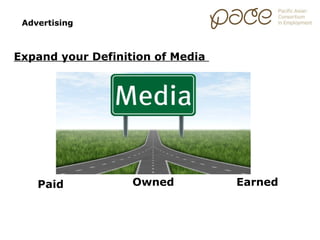
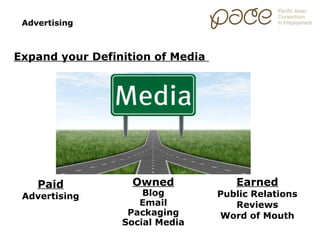
Expand your Definition of Media


    Paid           Owned          Earned
Advertising


Expand your Definition of Media


    Paid           Owned             Earned
 Advertising         Blog         Public Relations
                    Email            Reviews
                  Packaging       Word of Mouth
                 Social Media
Advertising


Paid Media / Advertising Formats

• Print – Magazines / Newspapers
• Broadcast – TV / Radio
• Digital – Web / Mobile
• Out Of Home (OOH) - Billboards / Transit
• Other – Free Standing Insert (FSI) / Direct
Advertising


Advertising Terminology
•   CPM
•   CPA/CPC
•   CPP
•   CTR
•   Impression
•   Frequency vs. Reach
•   Avails
•   Roadblock
•   GeoFencing
Advertising


Advertising Terminology

• CPM - Cost per Thousand (Impressions)
• CPA - Cost per Action
• CPC - Cost per Click
• CPP - Cost per Point (Gross Ratings Point)
• CTR - Click Thru Rate
• Impression - Ad viewed once by a visitor or
displayed once on a web page
Advertising


Advertising Terminology
               Frequency vs. Reach

• Frequency - the number of times an ad unit
occurs in a specific amount of time (how often?)

• Reach - the total number of different people or
households exposed, at least once, to an ad
medium during a given period of time
(how many?)
Advertising


Advertising Terminology
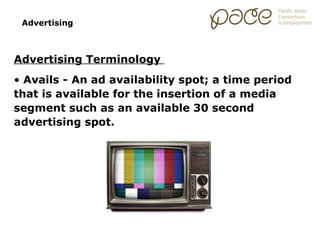
• Avails - An ad availability spot; a time period
that is available for the insertion of a media
segment such as an available 30 second
advertising spot.
Advertising


Advertising Terminology
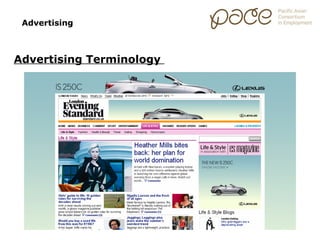
• Roadblock - buying all of the ad impressions
for a specific web page or section of a site for
specific period of time, providing a form of
exclusivity to the advertiser.

   The Roadblock guarantees an advertiser's
 branding exposure for that page/section and
  also prevents competitors from sharing the
                content space.
Advertising


Advertising Terminology
Advertising


Advertising Terminology
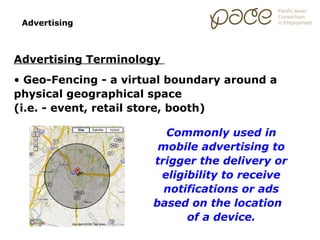
• Geo-Fencing - a virtual boundary around a
physical geographical space
(i.e. - event, retail store, booth)

                        Commonly used in
                       mobile advertising to
                      trigger the delivery or
                       eligibility to receive
                        notifications or ads
                      based on the location
                            of a device.
Advertising


Advertising Objective
Define exactly what you want the advertising to
accomplish…

 Do you want the advertising to get people to:
                   Think?
                    Feel?
               Do something?
         A combination of the three?
Advertising


Advertising Objective
         What’s the most important task
             for your advertising?

Is it to encourage an emotional connection with
the brand?

To challenge or offer an incentive to re-appraise
the brand, give the product another try?
Advertising


Advertising Objective
         What’s the most important task
             for your advertising?

Is it to convince an audience that your
product/service delivers better value for the
money?

To get consumers to change their usage
patterns, to try your product instead of what
they always buy?
Advertising


Advertising Objective


You will get the best return on your advertising
spend by getting your message in front of your
customers during the decision-making and
buying cycle.
Advertising


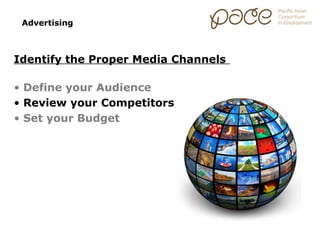
Identify the Proper Media Channels

• Define your Audience
• Review your Competitors
• Set your Budget
Advertising


Define Your Audience
Advertising


Define Your Audience

Demographics
 • Age
 • Gender
 • Location
 • Education Level
 • Marital Status
 • Income
 • Ethnicity
Advertising


Define Your Audience

•   What are their media consumption habits?
•   What are their expectations and aspirations?
•   What are their priorities?
•   How much disposable income do they have?
•   What are their buying habits?
•   Are they likely to have children?
•   How many vacations do they take each year?
•   How much money do they give to charity?
•   How can you help them?
Advertising


Define Your Audience

Commonly used market research methods:

•   Sales analysis and buying patterns
•   Questionnaires
•   Web/Social Media statistics
•   Focus Groups
•   Face-to-face interviews
•   Specialist Market Research Companies
Advertising


Define Your Audience
Psychographics:
   Attitudes / Values / Lifestyles / Opinions
• How will the customer approach the purchase
decision?
• Is it high or low involvement?
• Rational or Emotional?
• Are they looking for security? A thrill?
Advertising


Identify the Proper Media Channels

• Define your Audience
• Review your Competitors
• Set your Budget
Advertising


Review Your Competitors’ Media Strategy

•   What channels do they use?
•   How often? (Frequency)
•   What message are they delivering?
•   What new outlets are emerging?
• How will your company/brand be positioned in
the marketplace?
Advertising


Create Your Positioning Statement

• Who is your brand?
• What is your business or industry?
• Who is your target audience?
• What are their needs and/or problems?
• Who are your competitors?
• What is your key/unique benefit or
differentiator over your competitors?
• Why should your target audience believe you
can deliver the benefits?
Advertising


Create Your Positioning Statement

• What is your key/unique benefit or
differentiator over your competitors?

     Your position defines your competitors.
     Your competitors define your position.
Advertising


Create Your Positioning Statement - Template

For (target audience), (brand) is the (category)
that delivers (benefit/point of difference) by
(reason to believe).
Advertising


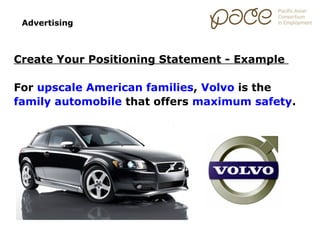
Create Your Positioning Statement - Example

For upscale American families, Volvo is the
family automobile that offers maximum safety.
Advertising


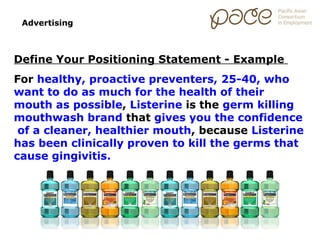
Define Your Positioning Statement - Example
For healthy, proactive preventers, 25-40, who
want to do as much for the health of their
mouth as possible, Listerine is the germ killing
mouthwash brand that gives you the confidence
 of a cleaner, healthier mouth, because Listerine
has been clinically proven to kill the germs that
cause gingivitis.
Advertising


Identify the Proper Media Channels

• Define your Audience
• Review your Competitors
• Set your Budget
Advertising


Setting your Advertising Budget

• Fixed Percentage of Sales
• Competition Based
• Objective/Task Based
• Maximum Amount Available
Advertising


Setting your Advertising Budget

               Fixed Percentage of Sales

• LY gross sales (or avg. sales for the past few
years), then allocate a specific percentage

• Common is 2% to 5% of annual revenues.
 $300,000 sales = $6,000 - $15,000 ad budget
Advertising


Setting your Advertising Budget

               Fixed Percentage of Sales
PROS: Easy to understand and safe; keeps your
budget in relation to sales volume -- the very
thing advertising is attempting to drive.

CONS: Based on past performance -- can’t
capitalize on shifts in the business climate or
customer trends; assumes that sales are
directly related to advertising -- other factors
affect your sales.
Advertising


Setting your Advertising Budget

                Competition Based

• Adopt an “Industry Average” for ad budgets
   Auto = less than 1%
   Retail = 2.5%
   Service = 3.5%
   CPG = 8% - 10%
   Pharmaceutical = 20%

• Trade Associations / Publications
Advertising


Setting your Advertising Budget

               Competition Based
PROS: Easy for companies with predictable sales
patterns.

CONS: assumes the industry average applies to
ALL businesses in the marketplace; ignores local
market forces -- missed opportunities to
increase market share.
Advertising


Setting your Advertising Budget

                 Objective/Task Based
• Set specific marketing objectives and decide
on the tasks required to meet those objectives.
(Ex: Increase out-of-state clients by 5%)


• Determine your budget by estimating the costs
of carrying out those tasks; prioritize if you
can’t afford to fund all of your ideas.
Advertising


Setting your Advertising Budget

               Objective/Task Based
PROS: Accurate -- ties the use of funds directly
to the tasks you want to accomplish; if properly
executed, advertising becomes an investment,
not an expense. By spending whatever is
needed, the company may grow at a faster rate.

CONS: If your advertising campaign fails, it can
be costly -- very difficult to recoup expenses on
a bad promotion.
Advertising


Setting your Advertising Budget

               Maximum Amount Available
• Set aside just enough money to sustain the
business (and yourself) and spend the rest on
advertising

• Common with start-ups and fast growth
businesses
Advertising


Setting your Advertising Budget

               Maximum Amount Available
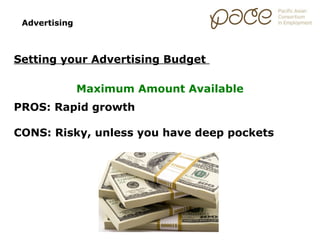
PROS: Rapid growth

CONS: Risky, unless you have deep pockets
Advertising


Media Buying

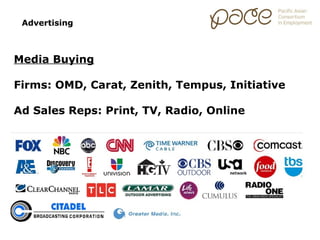
Firms: OMD, Carat, Zenith, Tempus, Initiative

Ad Sales Reps: Print, TV, Radio, Online
Advertising


Evaluation

• How will you track sales?
• How will you link sales to advertising?
• Who in your company will do that?

   Branding focused campaigns are not easy
            to directly link to sales
Advertising

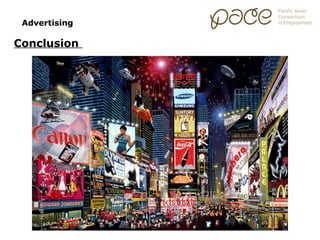
Conclusion
Advertising


  “Doing business without advertising is like
        winking at a girl in the dark.
        You know what you’re doing,
           but nobody else does.”

              ~ Stuart Henderson Britt
Advertising


Resources
www.Adweek.com
www.AdAge.com
www.Clickz.com (online)
www.MarketingProfs.com (online)
www.MediaPost.com
www.ThinkLA.com (Southern California)
www.DOmedia.com (OOH Marketplace)

Marketing Essentials: Advertising and Paid Media

  • 1.
    Marketing Essentials WEEK 2 Advertising
  • 2.
    Advertising “Advertising says to people, ‘Here’s what we’ve got. Here’s what it will do for you. Here’s how to get it.’ ” ~ Leo Burnett, Ad Industry Pioneer, 1891-1971
  • 3.
    Advertising Expand your Definitionof Media Paid Owned Earned
  • 4.
    Advertising Expand your Definitionof Media Paid Owned Earned Advertising Blog Public Relations Email Reviews Packaging Word of Mouth Social Media
  • 5.
    Advertising Paid Media /Advertising Formats • Print – Magazines / Newspapers • Broadcast – TV / Radio • Digital – Web / Mobile • Out Of Home (OOH) - Billboards / Transit • Other – Free Standing Insert (FSI) / Direct
  • 6.
    Advertising Advertising Terminology • CPM • CPA/CPC • CPP • CTR • Impression • Frequency vs. Reach • Avails • Roadblock • GeoFencing
  • 7.
    Advertising Advertising Terminology • CPM- Cost per Thousand (Impressions) • CPA - Cost per Action • CPC - Cost per Click • CPP - Cost per Point (Gross Ratings Point) • CTR - Click Thru Rate • Impression - Ad viewed once by a visitor or displayed once on a web page
  • 8.
    Advertising Advertising Terminology Frequency vs. Reach • Frequency - the number of times an ad unit occurs in a specific amount of time (how often?) • Reach - the total number of different people or households exposed, at least once, to an ad medium during a given period of time (how many?)
  • 9.
    Advertising Advertising Terminology • Avails- An ad availability spot; a time period that is available for the insertion of a media segment such as an available 30 second advertising spot.
  • 10.
    Advertising Advertising Terminology • Roadblock- buying all of the ad impressions for a specific web page or section of a site for specific period of time, providing a form of exclusivity to the advertiser. The Roadblock guarantees an advertiser's branding exposure for that page/section and also prevents competitors from sharing the content space.
  • 11.
  • 12.
    Advertising Advertising Terminology • Geo-Fencing- a virtual boundary around a physical geographical space (i.e. - event, retail store, booth) Commonly used in mobile advertising to trigger the delivery or eligibility to receive notifications or ads based on the location of a device.
  • 13.
    Advertising Advertising Objective Define exactlywhat you want the advertising to accomplish… Do you want the advertising to get people to: Think? Feel? Do something? A combination of the three?
  • 14.
    Advertising Advertising Objective What’s the most important task for your advertising? Is it to encourage an emotional connection with the brand? To challenge or offer an incentive to re-appraise the brand, give the product another try?
  • 15.
    Advertising Advertising Objective What’s the most important task for your advertising? Is it to convince an audience that your product/service delivers better value for the money? To get consumers to change their usage patterns, to try your product instead of what they always buy?
  • 16.
    Advertising Advertising Objective You willget the best return on your advertising spend by getting your message in front of your customers during the decision-making and buying cycle.
  • 17.
    Advertising Identify the ProperMedia Channels • Define your Audience • Review your Competitors • Set your Budget
  • 18.
  • 19.
    Advertising Define Your Audience Demographics • Age • Gender • Location • Education Level • Marital Status • Income • Ethnicity
  • 20.
    Advertising Define Your Audience • What are their media consumption habits? • What are their expectations and aspirations? • What are their priorities? • How much disposable income do they have? • What are their buying habits? • Are they likely to have children? • How many vacations do they take each year? • How much money do they give to charity? • How can you help them?
  • 21.
    Advertising Define Your Audience Commonlyused market research methods: • Sales analysis and buying patterns • Questionnaires • Web/Social Media statistics • Focus Groups • Face-to-face interviews • Specialist Market Research Companies
  • 22.
    Advertising Define Your Audience Psychographics: Attitudes / Values / Lifestyles / Opinions • How will the customer approach the purchase decision? • Is it high or low involvement? • Rational or Emotional? • Are they looking for security? A thrill?
  • 23.
    Advertising Identify the ProperMedia Channels • Define your Audience • Review your Competitors • Set your Budget
  • 24.
    Advertising Review Your Competitors’Media Strategy • What channels do they use? • How often? (Frequency) • What message are they delivering? • What new outlets are emerging? • How will your company/brand be positioned in the marketplace?
  • 25.
    Advertising Create Your PositioningStatement • Who is your brand? • What is your business or industry? • Who is your target audience? • What are their needs and/or problems? • Who are your competitors? • What is your key/unique benefit or differentiator over your competitors? • Why should your target audience believe you can deliver the benefits?
  • 26.
    Advertising Create Your PositioningStatement • What is your key/unique benefit or differentiator over your competitors? Your position defines your competitors. Your competitors define your position.
  • 27.
    Advertising Create Your PositioningStatement - Template For (target audience), (brand) is the (category) that delivers (benefit/point of difference) by (reason to believe).
  • 28.
    Advertising Create Your PositioningStatement - Example For upscale American families, Volvo is the family automobile that offers maximum safety.
  • 29.
    Advertising Define Your PositioningStatement - Example For healthy, proactive preventers, 25-40, who want to do as much for the health of their mouth as possible, Listerine is the germ killing mouthwash brand that gives you the confidence of a cleaner, healthier mouth, because Listerine has been clinically proven to kill the germs that cause gingivitis.
  • 30.
    Advertising Identify the ProperMedia Channels • Define your Audience • Review your Competitors • Set your Budget
  • 31.
    Advertising Setting your AdvertisingBudget • Fixed Percentage of Sales • Competition Based • Objective/Task Based • Maximum Amount Available
  • 32.
    Advertising Setting your AdvertisingBudget Fixed Percentage of Sales • LY gross sales (or avg. sales for the past few years), then allocate a specific percentage • Common is 2% to 5% of annual revenues. $300,000 sales = $6,000 - $15,000 ad budget
  • 33.
    Advertising Setting your AdvertisingBudget Fixed Percentage of Sales PROS: Easy to understand and safe; keeps your budget in relation to sales volume -- the very thing advertising is attempting to drive. CONS: Based on past performance -- can’t capitalize on shifts in the business climate or customer trends; assumes that sales are directly related to advertising -- other factors affect your sales.
  • 34.
    Advertising Setting your AdvertisingBudget Competition Based • Adopt an “Industry Average” for ad budgets Auto = less than 1% Retail = 2.5% Service = 3.5% CPG = 8% - 10% Pharmaceutical = 20% • Trade Associations / Publications
  • 35.
    Advertising Setting your AdvertisingBudget Competition Based PROS: Easy for companies with predictable sales patterns. CONS: assumes the industry average applies to ALL businesses in the marketplace; ignores local market forces -- missed opportunities to increase market share.
  • 36.
    Advertising Setting your AdvertisingBudget Objective/Task Based • Set specific marketing objectives and decide on the tasks required to meet those objectives. (Ex: Increase out-of-state clients by 5%) • Determine your budget by estimating the costs of carrying out those tasks; prioritize if you can’t afford to fund all of your ideas.
  • 37.
    Advertising Setting your AdvertisingBudget Objective/Task Based PROS: Accurate -- ties the use of funds directly to the tasks you want to accomplish; if properly executed, advertising becomes an investment, not an expense. By spending whatever is needed, the company may grow at a faster rate. CONS: If your advertising campaign fails, it can be costly -- very difficult to recoup expenses on a bad promotion.
  • 38.
    Advertising Setting your AdvertisingBudget Maximum Amount Available • Set aside just enough money to sustain the business (and yourself) and spend the rest on advertising • Common with start-ups and fast growth businesses
  • 39.
    Advertising Setting your AdvertisingBudget Maximum Amount Available PROS: Rapid growth CONS: Risky, unless you have deep pockets
  • 40.
    Advertising Media Buying Firms: OMD,Carat, Zenith, Tempus, Initiative Ad Sales Reps: Print, TV, Radio, Online
  • 41.
    Advertising Evaluation • How willyou track sales? • How will you link sales to advertising? • Who in your company will do that? Branding focused campaigns are not easy to directly link to sales
  • 42.
  • 43.
    Advertising “Doingbusiness without advertising is like winking at a girl in the dark. You know what you’re doing, but nobody else does.” ~ Stuart Henderson Britt
  • 44.