ADVERTISING
By
Mita Biswas
Charuchandra College
ADVERTISING
London Institute of Practitioners: Advertising presents the most persuasive possible
selling message to the to the right prospect for the product or service at the lowest
possible cost.
American Marketing Association: Advertising is any form of non-personal
presentation of goods, services or ideas for action, openly paid for by an identified
sponsor.
Wright, Winter & Zeigler: Controlled, identified information and persuasion by means
of mass communication media.
Philip Kotler: “Advertising is any paid form of non-personal presentation and
promotion of goods, services, or ideas by an identified sponsor.”
Characteristic features:
 Non- personal communication differentiated from personal selling or
interpersonal communication.
 It should persuade the target audience with relevant information.
 It may be presented in any form in any medium.
 Paid for
 Controlled- time, message, direction controlled by advertiser
 Source and purpose of the message should be identifiable.
6 M’s of Advertising
 1. The first ‘M’ stands for Mission – Advertising Objectives.
 2. The second ‘M stands for Money – Advertising Budget.
 3. The third ‘M’ stands for Message – Creating Advertising Message and Copy.
 4. The forth ‘M’ stand for Monitoring – Managing (organising) of Advertising
Efforts.
 5. The fifth ‘M’ stands for Media – Advertising Media Selection and Media
Scheduling.
 6. The sixth ‘M’ stands for Measurement – Measuring and Evaluating
Advertising Effectiveness (MEAE).
Objectives of Advertisement
 To stimulate demand
 To induce trial
 To intensify usage
 To sustain preference
 To conform imagery
 To change habits
 To build line acceptance
 To make announcements
 To inform trading circles
 To improve and sustain corporate image.
Types of advertising
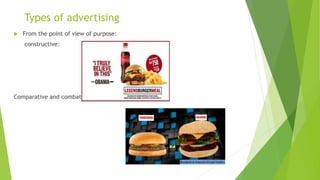
 From the point of view of purpose:
constructive:
Comparative and combative:
Types of advertising
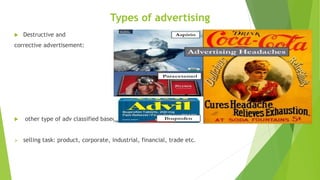
 Destructive and
corrective advertisement:
 other type of adv classified based on:
 selling task: product, corporate, industrial, financial, trade etc.
Types of advertising
 Strategies adopted: primary and selective demand adv, push and pull adv etc.
 Presentation style: Display, classified, classified display
Most commonly identified types:
1. Advertising for marketing or product advertisement: AIDA
2. Corporate advertisement
Corporate vs product advertisement
Corporate
1. Corporate objective
2. Wide variety of publics to
convince about the image and
identity of the org.
3. Target audience: opinion
leaders, policy makers,
communities, investment and
financial institutions.
4. Important PR tool, aims at
enhancing and sustaining org
image thrugh advertising
message and planned PR
Product
1. Marketing objective of the org.
2. Aims at persuading the
consumer to purchase the
product
3. Target audience: the consumers
within the identified market
segment.
4. Concerned about selling the
product.
Corporate vs product advertisement
Types of advertising
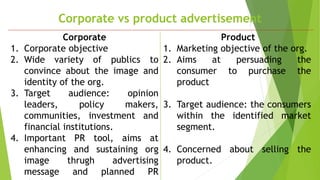
3. Financial advertising:
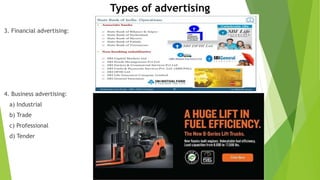
4. Business advertising:
a) Industrial
b) Trade
c) Professional
d) Tender
Types of advertising
5. National advertising
6. Retail advertising:
Types of advertising
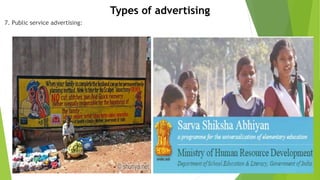
7. Public service advertising:
Types of advertising
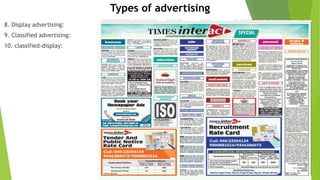
8. Display advertising:
9. Classified advertising:
10. classified-display:
ADVERTISING MEDIA
 Media types: relationship to agency--1. above-the-line 2. below-the-line
 Press, TV, radio, cinema, outdoor, transportation/ direct mail, POP, sales promotion merchandising
 Utilisation- primary and secondary
Media Characteristics
 NRS, INS, TAM, TRP
 Quantitative aspects:1.Reach and frequency: coverage,penetration, flexibility
2. Circulation
3. Cost
Qualitative :
3. Readership
4. Selectivity
5. Editorial character
Newspaper
Advantages: Disadvantages
 High selectivity 1. Literary barrier
 Low cost 2. Problems of demonstration
 Flexibility 3. Spotty reading pattern
 Scope for detail information 4. Short life span
 Credibility 5. Competition with news
 Scope for feedback 6. Lesser impact on youth
 Others 7. Editorial character
ddd
Radio
Advantages
1. Wide and area specific coverage
2. Affordability and transportability
3. Crosses illiteracy barrier
4. Availability of commercial channel
5. Strong rural listenership
6. Low cost
7. Advantageous for awareness and immediacy
Disadvantages
1. Transient character
2. Low attention level
3. Limited information delivering capacity
4. No demonstration capacity
5. Product identification impossible
6. Less impact in urban areas
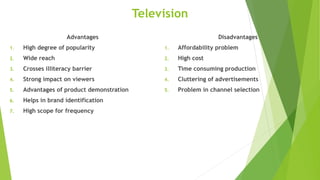
Television
Advantages
1. High degree of popularity
2. Wide reach
3. Crosses illiteracy barrier
4. Strong impact on viewers
5. Advantages of product demonstration
6. Helps in brand identification
7. High scope for frequency
Disadvantages
1. Affordability problem
2. High cost
3. Time consuming production
4. Cluttering of advertisements
5. Problem in channel selection

Advertising

  • 1.
  • 2.
    ADVERTISING London Institute ofPractitioners: Advertising presents the most persuasive possible selling message to the to the right prospect for the product or service at the lowest possible cost. American Marketing Association: Advertising is any form of non-personal presentation of goods, services or ideas for action, openly paid for by an identified sponsor. Wright, Winter & Zeigler: Controlled, identified information and persuasion by means of mass communication media. Philip Kotler: “Advertising is any paid form of non-personal presentation and promotion of goods, services, or ideas by an identified sponsor.”
  • 3.
    Characteristic features:  Non-personal communication differentiated from personal selling or interpersonal communication.  It should persuade the target audience with relevant information.  It may be presented in any form in any medium.  Paid for  Controlled- time, message, direction controlled by advertiser  Source and purpose of the message should be identifiable.
  • 6.
    6 M’s ofAdvertising  1. The first ‘M’ stands for Mission – Advertising Objectives.  2. The second ‘M stands for Money – Advertising Budget.  3. The third ‘M’ stands for Message – Creating Advertising Message and Copy.  4. The forth ‘M’ stand for Monitoring – Managing (organising) of Advertising Efforts.  5. The fifth ‘M’ stands for Media – Advertising Media Selection and Media Scheduling.  6. The sixth ‘M’ stands for Measurement – Measuring and Evaluating Advertising Effectiveness (MEAE).
  • 7.
    Objectives of Advertisement To stimulate demand  To induce trial  To intensify usage  To sustain preference  To conform imagery  To change habits  To build line acceptance  To make announcements  To inform trading circles  To improve and sustain corporate image.
  • 8.
    Types of advertising From the point of view of purpose: constructive: Comparative and combative:
  • 9.
    Types of advertising Destructive and corrective advertisement:  other type of adv classified based on:  selling task: product, corporate, industrial, financial, trade etc.
  • 10.
    Types of advertising Strategies adopted: primary and selective demand adv, push and pull adv etc.  Presentation style: Display, classified, classified display Most commonly identified types: 1. Advertising for marketing or product advertisement: AIDA 2. Corporate advertisement
  • 11.
    Corporate vs productadvertisement Corporate 1. Corporate objective 2. Wide variety of publics to convince about the image and identity of the org. 3. Target audience: opinion leaders, policy makers, communities, investment and financial institutions. 4. Important PR tool, aims at enhancing and sustaining org image thrugh advertising message and planned PR Product 1. Marketing objective of the org. 2. Aims at persuading the consumer to purchase the product 3. Target audience: the consumers within the identified market segment. 4. Concerned about selling the product.
  • 12.
    Corporate vs productadvertisement
  • 13.
    Types of advertising 3.Financial advertising: 4. Business advertising: a) Industrial b) Trade c) Professional d) Tender
  • 14.
    Types of advertising 5.National advertising 6. Retail advertising:
  • 15.
    Types of advertising 7.Public service advertising:
  • 16.
    Types of advertising 8.Display advertising: 9. Classified advertising: 10. classified-display:
  • 17.
    ADVERTISING MEDIA  Mediatypes: relationship to agency--1. above-the-line 2. below-the-line  Press, TV, radio, cinema, outdoor, transportation/ direct mail, POP, sales promotion merchandising  Utilisation- primary and secondary
  • 18.
    Media Characteristics  NRS,INS, TAM, TRP  Quantitative aspects:1.Reach and frequency: coverage,penetration, flexibility 2. Circulation 3. Cost Qualitative : 3. Readership 4. Selectivity 5. Editorial character
  • 19.
    Newspaper Advantages: Disadvantages  Highselectivity 1. Literary barrier  Low cost 2. Problems of demonstration  Flexibility 3. Spotty reading pattern  Scope for detail information 4. Short life span  Credibility 5. Competition with news  Scope for feedback 6. Lesser impact on youth  Others 7. Editorial character
  • 20.
  • 22.
    Radio Advantages 1. Wide andarea specific coverage 2. Affordability and transportability 3. Crosses illiteracy barrier 4. Availability of commercial channel 5. Strong rural listenership 6. Low cost 7. Advantageous for awareness and immediacy Disadvantages 1. Transient character 2. Low attention level 3. Limited information delivering capacity 4. No demonstration capacity 5. Product identification impossible 6. Less impact in urban areas
  • 23.
    Television Advantages 1. High degreeof popularity 2. Wide reach 3. Crosses illiteracy barrier 4. Strong impact on viewers 5. Advantages of product demonstration 6. Helps in brand identification 7. High scope for frequency Disadvantages 1. Affordability problem 2. High cost 3. Time consuming production 4. Cluttering of advertisements 5. Problem in channel selection