Written Codes
The study of written codes includes:
• Headlines/Titles
• Typeface/Font
• Slogans/Taglines
• Captions (print) or inter-titles
(moving image)
• Style
• Choice of words
• Emphasis of words
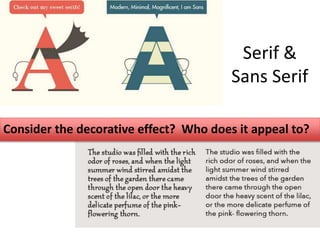
Serif &
Sans Serif
Consider the decorative effect? Who does it appeal to?
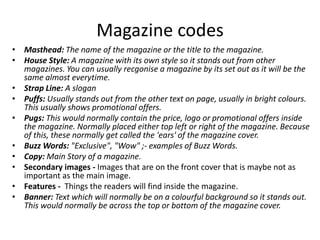
Magazine codes
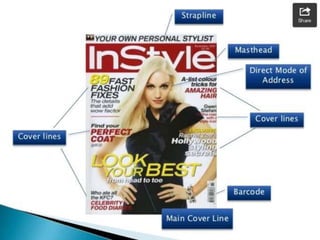
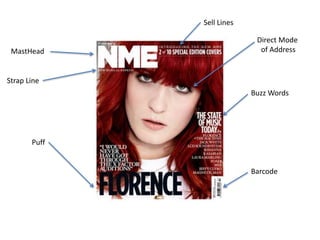
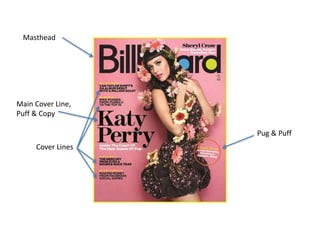
• Masthead: The name of the magazine or the title to the magazine.
• House Style: A magazine with its own style so it stands out from other
magazines. You can usually recgonise a magazine by its set out as it will be the
same almost everytime.
• Strap Line: A slogan
• Puffs: Usually stands out from the other text on page, usually in bright colours.
This usually shows promotional offers.
• Pugs: This would normally contain the price, logo or promotional offers inside
the magazine. Normally placed either top left or right of the magazine. Because
of this, these normally get called the 'ears' of the magazine cover.
• Buzz Words: "Exclusive", "Wow" ;- examples of Buzz Words.
• Copy: Main Story of a magazine.
• Secondary images - Images that are on the front cover that is maybe not as
important as the main image.
• Features - Things the readers will find inside the magazine.
• Banner: Text which will normally be on a colourful background so it stands out.
This would normally be across the top or bottom of the magazine cover.
Articles and spreads
• Caption: description of a main image.
• Headline: The title for the main article, this would
normally be catchy.
• Drop Capitals: A letter that starts off either the article or
the paragraph, this letter is usually 10x bigger than the
actual writing so it stands out.
• Lead: The introduction paragraph to a piece, usually
written in bold.
• Sell lines: Text on the front cover to sell the magazine to
audiences.
• Strapline: A phrase that can be linked to the magazine so
it is recognisable.
• Anchorage Text: The way text helps to pin down a
meaning on an image.
MastHead
Puff
Buzz Words
Strap Line
Barcode
Direct Mode
of Address
Sell Lines
Masthead
Pug & Puff
Main Cover Line,
Puff & Copy
Cover Lines
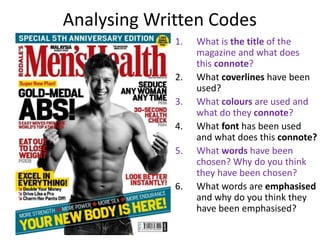
Analysing Written Codes
1. What is the title of the
magazine and what does
this connote?
2. What coverlines have been
used?
3. What colours are used and
what do they connote?
4. What font has been used
and what does this connote?
5. What words have been
chosen? Why do you think
they have been chosen?
6. What words are emphasised
and why do you think they
have been emphasised?

Media Language Lesson 7 - written codes - magazines

  • 1.
    Written Codes The studyof written codes includes: • Headlines/Titles • Typeface/Font • Slogans/Taglines • Captions (print) or inter-titles (moving image) • Style • Choice of words • Emphasis of words
  • 2.
    Serif & Sans Serif Considerthe decorative effect? Who does it appeal to?
  • 3.
    Magazine codes • Masthead:The name of the magazine or the title to the magazine. • House Style: A magazine with its own style so it stands out from other magazines. You can usually recgonise a magazine by its set out as it will be the same almost everytime. • Strap Line: A slogan • Puffs: Usually stands out from the other text on page, usually in bright colours. This usually shows promotional offers. • Pugs: This would normally contain the price, logo or promotional offers inside the magazine. Normally placed either top left or right of the magazine. Because of this, these normally get called the 'ears' of the magazine cover. • Buzz Words: "Exclusive", "Wow" ;- examples of Buzz Words. • Copy: Main Story of a magazine. • Secondary images - Images that are on the front cover that is maybe not as important as the main image. • Features - Things the readers will find inside the magazine. • Banner: Text which will normally be on a colourful background so it stands out. This would normally be across the top or bottom of the magazine cover.
  • 4.
    Articles and spreads •Caption: description of a main image. • Headline: The title for the main article, this would normally be catchy. • Drop Capitals: A letter that starts off either the article or the paragraph, this letter is usually 10x bigger than the actual writing so it stands out. • Lead: The introduction paragraph to a piece, usually written in bold. • Sell lines: Text on the front cover to sell the magazine to audiences. • Strapline: A phrase that can be linked to the magazine so it is recognisable. • Anchorage Text: The way text helps to pin down a meaning on an image.
  • 6.
  • 7.
    Masthead Pug & Puff MainCover Line, Puff & Copy Cover Lines
  • 8.
    Analysing Written Codes 1.What is the title of the magazine and what does this connote? 2. What coverlines have been used? 3. What colours are used and what do they connote? 4. What font has been used and what does this connote? 5. What words have been chosen? Why do you think they have been chosen? 6. What words are emphasised and why do you think they have been emphasised?