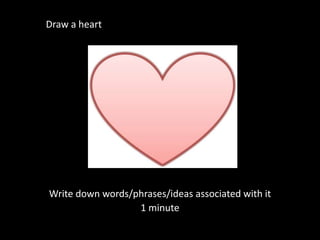
Write down words/phrases/ideas associated with it
1 minute
Draw a heart
Blood Pump Muscle Life
Red Emotions
Feeling Strength
Body Love
Centre Care
Organ Courage Bravery
Sincerity Determination
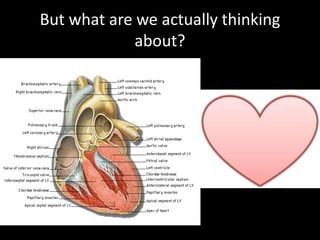
But what are we actually thinking
about?
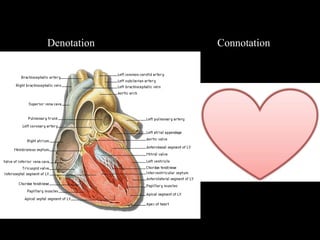
Denotation Connotation
Denotation and connotation
• Denotation is the everyday meaning of a sign
e.g. a red rose is a garden plant
• Connotation is the associated meaning that it
carries e.g. a red rose can symbolise love,
England or pride.
Heart
Denotations Connotations
Heart
Denotations
e.g. muscle
Connotations
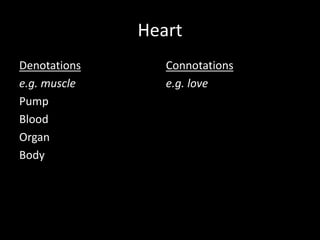
Heart
Denotations
e.g. muscle
Connotations
e.g. love
Heart
Denotations
e.g. muscle
Pump
Blood
Organ
Body
Connotations
e.g. love
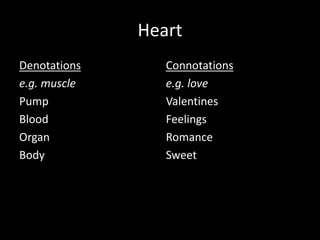
Heart
Denotations
e.g. muscle
Pump
Blood
Organ
Body
Connotations
e.g. love
Valentines
Feelings
Romance
Sweet
Media Language
KEY TERM: Semiotics
Definition: The study of SIGNS/CODES
• Examines how visual (inc written), audio and
technical codes construct meaning
• Looks at how meaning is made and understood
Key Term
• Means “put in scene”
• The idea is that everything is in the
scene for a reason.
• This includes props, lighting, music,
setting, characters
Mise-en-scene
Pronunciation:
mee-zon sen
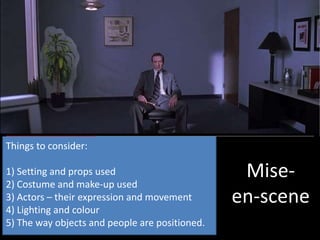
Mise-
en-scene
Things to consider:
1) Setting and props used
2) Costume and make-up used
3) Actors – their expression and movement
4) Lighting and colour
5) The way objects and people are positioned.
1. Settings & Props
• Settings & Locations play an important part in film-making
and are not just ‘backgrounds’
• Sets are either built from scratch or a great deal of time is
spent to find a setting which already exists
• Settings can manipulate an audience by building certain
expectations and then taking a different turn
• What settings and props you would find in:
1. A Science Fiction Film
2. A Romantic Comedy
3. A Horror Film
2. Costume, Hair & Make Up
• Costume, Hair & Make Up act as an instant
indicator to us of a character’s personality, status &
job
• It tells us immediately whether the film is set in the
present and what society/or culture it will centre
around
• Certain costumes can signify certain individuals (i.e.
black cloak of a vampire, Spidey’s Spiderman suit)
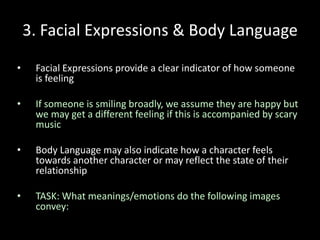
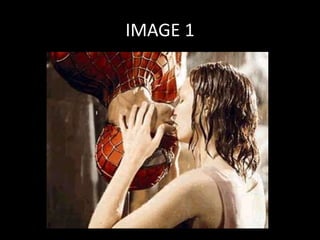
3. Facial Expressions & Body Language
• Facial Expressions provide a clear indicator of how someone
is feeling
• If someone is smiling broadly, we assume they are happy but
we may get a different feeling if this is accompanied by scary
music
• Body Language may also indicate how a character feels
towards another character or may reflect the state of their
relationship
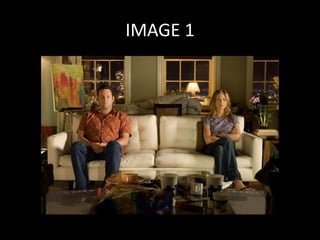
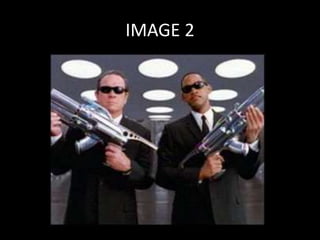
• TASK: What meanings/emotions do the following images
convey:
IMAGE 1
IMAGE 2
4. Positioning of Characters & Objects
within a frame
• Positioning within a frame can draw our
attention to an important character/object
• A film-maker can use positioning to indicate
relationships between people
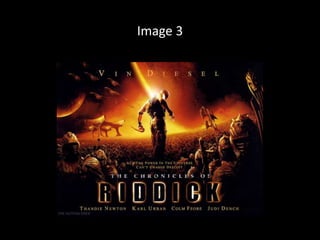
• What does the positioning in the following
images reveal about the characters/film:
IMAGE 1
IMAGE 2
IMAGE 4Image 3
Language and mode of address
• How does the text speak to the audience?
• The language used gives clues to the
audience, genre and purpose
• Language
• Colloquial – chatty slang
• Vocabulary – polysyllabic, technical jargon
• Hyperbole - exaggerated
Mode of address
• Informal
• Formal
• Direct mode of address
• Indirect mode of address

Lesson 6 - semiotics

  • 2.
    Write down words/phrases/ideasassociated with it 1 minute Draw a heart
  • 3.
    Blood Pump MuscleLife Red Emotions Feeling Strength Body Love Centre Care Organ Courage Bravery Sincerity Determination
  • 4.
    But what arewe actually thinking about?
  • 5.
  • 6.
    Denotation and connotation •Denotation is the everyday meaning of a sign e.g. a red rose is a garden plant • Connotation is the associated meaning that it carries e.g. a red rose can symbolise love, England or pride.
  • 7.
  • 8.
  • 9.
  • 10.
  • 11.
  • 12.
    Media Language KEY TERM:Semiotics Definition: The study of SIGNS/CODES • Examines how visual (inc written), audio and technical codes construct meaning • Looks at how meaning is made and understood
  • 13.
    Key Term • Means“put in scene” • The idea is that everything is in the scene for a reason. • This includes props, lighting, music, setting, characters Mise-en-scene Pronunciation: mee-zon sen
  • 14.
    Mise- en-scene Things to consider: 1)Setting and props used 2) Costume and make-up used 3) Actors – their expression and movement 4) Lighting and colour 5) The way objects and people are positioned.
  • 15.
    1. Settings &Props • Settings & Locations play an important part in film-making and are not just ‘backgrounds’ • Sets are either built from scratch or a great deal of time is spent to find a setting which already exists • Settings can manipulate an audience by building certain expectations and then taking a different turn • What settings and props you would find in: 1. A Science Fiction Film 2. A Romantic Comedy 3. A Horror Film
  • 16.
    2. Costume, Hair& Make Up • Costume, Hair & Make Up act as an instant indicator to us of a character’s personality, status & job • It tells us immediately whether the film is set in the present and what society/or culture it will centre around • Certain costumes can signify certain individuals (i.e. black cloak of a vampire, Spidey’s Spiderman suit)
  • 17.
    3. Facial Expressions& Body Language • Facial Expressions provide a clear indicator of how someone is feeling • If someone is smiling broadly, we assume they are happy but we may get a different feeling if this is accompanied by scary music • Body Language may also indicate how a character feels towards another character or may reflect the state of their relationship • TASK: What meanings/emotions do the following images convey:
  • 18.
  • 19.
  • 20.
    4. Positioning ofCharacters & Objects within a frame • Positioning within a frame can draw our attention to an important character/object • A film-maker can use positioning to indicate relationships between people • What does the positioning in the following images reveal about the characters/film:
  • 21.
  • 22.
  • 23.
  • 24.
    Language and modeof address • How does the text speak to the audience? • The language used gives clues to the audience, genre and purpose • Language • Colloquial – chatty slang • Vocabulary – polysyllabic, technical jargon • Hyperbole - exaggerated
  • 25.
    Mode of address •Informal • Formal • Direct mode of address • Indirect mode of address