21ST
CENTURY
LITERATURE
FROM THE
PHILIPPINES
AND THE
WORLD
LESSON 2: TEXTS AND AUTHORS FROM EACH
REGION
Competency 1B: Identify representative texts and authors from each
region (e.g. engage in oral history research with focus on key personalities
from the students’ region, province, and town, EN12Lit-Ib-22 (2 hours).
At the end of this lesson, you will be able to:
1. enumerate Filipino authors across the regions; and
2. appreciate their contributions on the development of Philippine
literature.
Activity 1:
Directions: Write T if the statement is true and F if it is false. Write your
answer in your notebook.
_____1. Due to diverse environment, our ancestors developed separate
cultures and beliefs.
_____2. Good number of performances can be found in video-sharing
site like YouTube.
_____3. Rich biodiversity of the Philippines has made through
archipelagic nature.
_____4. Our study of literature can help us understanding different
cultures across the country.
_____5. Ilocos Region belongs to Region 2.
_____6. CAR Region stands for Cordillera Administrative Region.
_____7. Jose Ayala is a writer who comes from Region 10.
_____8. CARAGA Region is the same as CAR Region.
_____9. Our topography allows us to enjoy endemic flora and fauna.
_____10. Western Visayas region is part of NCR region.
In the previous lesson, you have already identified the geographic,
linguistic, and ethnic dimensions of Philippine literary history from pre-
colonial to the contemporary. Now, you are ready to move forward and
learn more.
During a 2014 conference in Cebu City, Senator Alan Peter
Cayetano remarked that the national government should stop giving the
bulk of its national budget to Metro Manila alone. He said “Let us
remember that Metro Manila is not the Philippines, and the Philippines is
not Metro Manila. We should not always build in Manila. Other provinces
and regions should share in the resources such as Clark, Zamboanga,
Peninsula, Caraga and etc.” Providing equal resources to all regions of
the country has been a continuous problem in more than a century of our
independence as nation.
The archipelagic nature of the Republic of the Philippines has
made the country enjoy a rich biodiversity. Our topography, which consists
of mountainous terrains, dense forests, plains, and coastal areas, allow us
to enjoy endemic flora and fauna. As a result of this diverse environment,
our ancestors developed separate cultures and languages.
Our country has a total of 182 living languages. With these
languages our ancestors communicated, built their communities, and
created unique cultural products. Separated by seas, cultures, and
languages, the Filipinos of today must consciously choose to maintain a
united front in order for all of us to be truly equal and free as a people in
one nation. How can we do this? Perhaps our study of literature can help
point us toward the direction of understanding different cultures across the
country, and hopefully this would provide the opportunity for a true sense
of pride to grow within us for being part of this nation.
21st century technology can help propel this goal into something
obtainable. With the help of the Internet, many contemporary authors from
the regions are publishing their work online. Whether they are using their
regional language, Filipino, or English, these young authors are beginning
to speak a national audience about their reality. Some 21st century
literature of the Philippines can be found in blogs, online newspapers,
online magazines, online journals, etc. Also, a good number of
performances of songs, skits, and amateur films showcasing regional
works can be found in video-sharing sites like YouTube.
Motivation questions.
From the article that you have read, answer the following questions:
1. What are the 5 important points that Senator Alan Peter Cayetano
emphasized?
2. How do you describe the geographical location of the Philippines?
3. How do these contribute to the development of our literature?
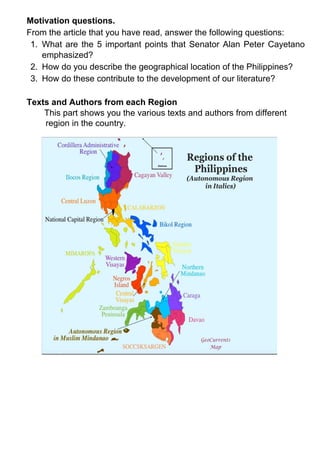
Texts and Authors from each Region
This part shows you the various texts and authors from different
region in the country.
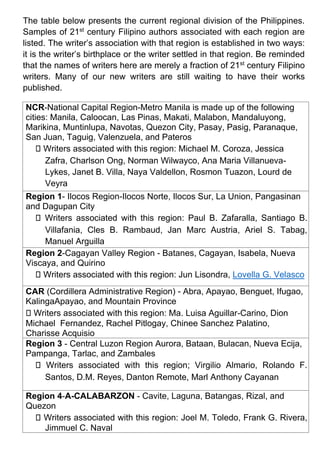
The table below presents the current regional division of the Philippines.
Samples of 21st
century Filipino authors associated with each region are
listed. The writer’s association with that region is established in two ways:
it is the writer’s birthplace or the writer settled in that region. Be reminded
that the names of writers here are merely a fraction of 21st
century Filipino
writers. Many of our new writers are still waiting to have their works
published.
NCR-National Capital Region-Metro Manila is made up of the following
cities: Manila, Caloocan, Las Pinas, Makati, Malabon, Mandaluyong,
Marikina, Muntinlupa, Navotas, Quezon City, Pasay, Pasig, Paranaque,
San Juan, Taguig, Valenzuela, and Pateros
Writers associated with this region: Michael M. Coroza, Jessica
Zafra, Charlson Ong, Norman Wilwayco, Ana Maria Villanueva-
Lykes, Janet B. Villa, Naya Valdellon, Rosmon Tuazon, Lourd de
Veyra
Region 1- Ilocos Region-Ilocos Norte, Ilocos Sur, La Union, Pangasinan
and Dagupan City
Writers associated with this region: Paul B. Zafaralla, Santiago B.
Villafania, Cles B. Rambaud, Jan Marc Austria, Ariel S. Tabag,
Manuel Arguilla
Region 2-Cagayan Valley Region - Batanes, Cagayan, Isabela, Nueva
Viscaya, and Quirino
Writers associated with this region: Jun Lisondra, Lovella G. Velasco
CAR (Cordillera Administrative Region) - Abra, Apayao, Benguet, Ifugao,
KalingaApayao, and Mountain Province
Writers associated with this region: Ma. Luisa Aguillar-Carino, Dion
Michael Fernandez, Rachel Pitlogay, Chinee Sanchez Palatino,
Charisse Acquisio
Region 3 - Central Luzon Region Aurora, Bataan, Bulacan, Nueva Ecija,
Pampanga, Tarlac, and Zambales
Writers associated with this region; Virgilio Almario, Rolando F.
Santos, D.M. Reyes, Danton Remote, Marl Anthony Cayanan
Region 4-A-CALABARZON - Cavite, Laguna, Batangas, Rizal, and
Quezon
Writers associated with this region: Joel M. Toledo, Frank G. Rivera,
Jimmuel C. Naval
Region 4-B - MIMAROPA (Occidental Mindoro and Oriental Mindoro),
Marinduque, Romblon, and Palawan
Writer associated with this region: Jose Dalisay Jr.
Region 5-Bicol Region - Camarines Norte, Camarines Sur, Albay,
Catanduanes, Masbate, and Sorsogon
Writers associated with this region: Merlinda Bobis, Ricardo Lee,
Victor Dennis Tino Nierva
Region 6- Western Visayas Region - Aklan Antique, Capiz, Guimaras,
and Iloilo
Writers associated with this region: Felino GarciaJr., John Iramil, Isidro
Cruz
NIR-Negros Island Region - Negros Occidental and Negros Oriental
Writers associated with this region: Isabel D. Sibullen, Marianne
Villanueva
Region 7- Central Visayas Region - Bohol, Cebu, Siquijor
Writers associated with this region: Michael Obenieta, Jeneen R.
Garcia
Region 8 - Eastern Visayas region - Samar, Leyte, and Biliran Writers:
Voltaire Oyzon, Timothy R. Montes
Region 9 - Zamboanga Peninsula - Zamboanga del Norte, Zamboanga
del Sur, Zamboanga Sibugay, Zamboanga City, and Isabela
Writers: Mig Alvarez Enriquez, Servando D. Halili Jr. Antonio R.
Enriquez
Region 10- Northern Mindanao Region- Bukidnon, Camiguin, Lanao del
Norte, Misamis Oriental, Misamis Occidental
Writers: Ralph Semino Galan, Judith R. Dharmdas, Anthony Tan
Region 11- Davao Region or Southern Mindanao Region-Compostela
Valley, Daval del Norte, Davao del Sur, Davao Oriental, and Davao
Occidental
Writers: Candy Gourlay, Salud M. Carrido
Region 12 - SOCCSKSARGEN or Central Mindanao Region- South
Cotabato, Cotabato, Sultan Kudarat, Sarangani, and General Santos
Writers: Christine Godines-Ortega, Jaime An Lim
Region 13 - CARAGA Region- Agusan del Sur, Agusan del Norte,
Surigao del Norte, Surigao del Sur, and Dinagat Islands
Writers: Joey Ayala, Tita Lacambra-Ayala
ARMM (Autonomous Region in Muslim Mindanao) - Asila (except Isabela
City), Lanao del Sur, Maguindanao, Sulu, and Tawi-Tawi
Writers: Steven Prince Patrick C. Fernandez, Mehol K. Sadain
Source: Beyond Borders (Reading Literature in the 21st
century) by MARIA GABRIELA P MARTIN et.al.
SOME NOTABLE WRITERS FROM DIFFERENT REGIONS
AND THEIR CONTRIBUTIONS TO PHILIPPINE LITERATURES
Michael M. Coroza writes poetry, fiction, critical essays
and is engaged in literary translation. The writer's works
have been published in national and international literary
magazines: Kritika Kultura, Philippine Studies, Unitas,
Tomas, Bulawan Journal of Arts and Culture, Daluyan,
Loyola Schools Review, and the Malay Indonesian
Studies. He is famous for promoting the traditional poetic
genre of the Philippines "Balagtasan". He participated in
international poetry readings "Kuala Lumpur-10" (2004)
and the Second literary festival "Korea-ASEAN" in Jakarta
(2011). Among his works are: ASEANO: An Anthology of
Poems from Southeast Asia (1995), Dili’t Dilim (1997),
Source:
panitikan.ph
Retrieved:
May 20, 2020
Sounds of Asia (2011), Ang mga Lambing ni Lolo Ding
(2012), and Nawawala si Muningning (2015).
Source: panitikan.ph
Retrieved: May 20, 2020
MANUEL E. ARGUILLA (1911-1944) was an Ilocano
who
wrote in English. He was best known for his short story,
"How My Brother Leon Brought Home a Wife", which
received first prize in the Commonwealth Literary
Contest in 1940. Most of his stories depict life in Barrio
Nagrebcan, Bauang, La Union, where he was born in
1911.
Source:
http://pinoylit.hy
perm art.net
Retrieved:
May 20, 2020
Source: http://pinoylit.hypermart.net
Retrieved: May 20, 2020
Source:
https://www.xu.edu.p
h/xavier-news
Retrieved:
May 25, 2020
Anthony Tan was born on 26 August 1947, Siasi
[Muddas], Sulu. His degrees AB English, 1968, MA
Creative Writing, 1975, and Ph.D. English Lit., 1982
were all obtained from the Silliman University where he
edited Sands and Coral, 1976. For more than a decade,
he was a member of the English faculty at SU and
regular member of the panel of critics in the Silliman
Writers Workshop. He taught briefly at the DLSU and
was Chair of the English Dept. at MSUIligan Institute of
Technology where he continues to teach. A member of
the Iligan Arts Council, he helps Jaime An Lim and
Christine Godinez-Ortega run the Iligan Writers
Workshop/Literature Teachers Conference. He also
writes fiction and children’s stories. He has won a
number of awards, among them, the Focus Award for
poetry, the Palanca 1st prize for Poems for Muddas in
1993; also, the Palanca for essay. Among his works are
The Badjao Cemetery and Other Poems, 1985 and
Poems for Muddas, Anvil, 1996.
Source:
https://www.xu.edu.ph/images/Kinaadman_Research_Cente
r/doc Retrieved: May 25, 2020
José Iñigo Homer Lacambra Ayala or also known as
Joey Ayala was born on June 1, 1956 in Bukidnon,
Philippines. He was known for his folk and
contemporary pop music artist in the Philippines, he is
also known for his songs that are more on the
improvement of the environment. He is a finalist of
Philippine Popular Music
Source:
songhits.ph
Retrieved:
May 28, 2020
Festival 2013.
Source: songhits.ph
Retrieved: May 28, 2020
Source: philstar.com
Retrieved:
May 25, 2020
Merlie M. Alunan graduated from Silliman University
with an MA in Creative Writing in 1974. She teaches at
the Creative Writing Center, University of the Philippines
Visayas Tacloban College. She lives in Tacloban City.
She received various awards like Lillian Jerome
Thornton Award for Nonfiction, Don Carlos Palanca
Memorial Award for
Literature, National Book Award, Sunthorn Phu Literary
Awards, and Ani ng Dangal. Among her works are
Heartstone, Sacred Tree, Amina among the angels,
Selected poems, Kabilin: 100 Years of Negros Oriental,
Fern Garden: An Anthology of Women Writing in the
South, Songs of ourselves: writings by Filipino women
in English, and many other
Source: philstar.com Retrieved: May 25, 2020
Source:
https://en.wikipedia.
org/wiki/Ivy_Alvarez
Retrieved: May 20,
2020
Ivy Alvarez is a New Zealand-based Filipino
Australian poet, editor, and reviewer. Alvarez has had
her work featured in various publications in Australia,
Canada, England, the Philippines, New Zealand,
Ireland, Russia, Scotland, Wales, the US, South Africa,
and online. Alvarez was born in the Philippines and grew
up in Tasmania, Australia. While reading English at the
University of Tasmania, she published in various literary
journals and anthologies, and subsequently became the
reviews editor of Cordite Poetry Review, an Australian
online poetry journal.
Source: https://en.wikipedia.org/wiki/Ivy_Alvarez
Retrieved: May 20, 2020
Source:
https://en.wikipedia.or
g/wiki/Suzette_Doctol
ero
Retrieved:
June 1, 2020
Suzette Severo Doctolero (born December 16, 1968
Calabanga, Camarines Sur) is a Filipino screenwriter for
film and television. She is best known for being the
creator of Encantadia in 2005 and the succeeding
related television series including the Encantadia 2016
reboot. She is mostly credited as screenwriter, series
creator and creative consultant for GMA Network. Her
other works include Amaya, Indio[
and My Husband's
Lover. She also wrote the story for the film Let the Love
Begin and became the creative consultant for the
television series Alyas Robin Hood[
and Destined to be
Yours.
Source: https://en.wikipedia.org/wiki/Suzette_Doctolero
Retrieved: June 1, 2020
Source: panitikan.ph
Retrieved: May 24,
2020
Aida Rivera-Ford was born in Jolo, Sulu. She became
the editor of the first two issues of Sands and Coral, the
literary magazine of Silliman University. In 1949, she
graduated with an AB degree, major in English, Cum
Laude. In 1954, she obtained an MA in English
Language and Literature at the University of Michigan
and won the prestigious Jules and Avery Hopwood for
fiction. In 1980, she founded the first school of Fine Arts
in Mindanao – the Learning Center of the Arts, now
known as the Ford Academy of the Arts.
Source: panitikan.ph
Retrieved: May 24, 2020
SAMPLE OF THEIR WORKS:
Sample 1
Midsummer
By: Manuel Arguilla
(American Colonial Literature)
He pulled down his hat until the wide brim touched his shoulders. He
crouched lower under the cover of his cart and peered ahead. The road
seemed to writhe under the lash of the noon-day heat; it swum from side to
side, humped and bent itself like a feeling serpent, and disappeared behind
the spur of a low hill on which grew a scrawny thicket of bamboo.
There was not a house in sight. Along the left side of the road ran the
deep, dry gorge of a stream, the banks sparsely covered by sun-burned
cogon grass. In places, the rocky, waterless bed showed aridly. Farther,
beyond the shimmer of quivering heat waves rose ancient hills not less blue
than the cloud-palisaded sky. On the right stretched a land waste of low
rolling dunes. Scattered clumps of hardy ledda relieved the otherwise
barren monotony of the landscape. Far away he could discern a thin indigo
line that was the sea.
The grating of the cartwheels on the pebbles of the road and the almost
soundless shuffle of the weary bull but emphasized the stillness. Now and
then came the dry rustling of falling earth as lumps from the cracked sides
of the gorge fell down to the bottom.
He struck at the bull with the slack of the rope. The animal broke into a
heavy trot. The dust stirred slumbrously. The bull slowed down, threw up
his head, and a glistening thread of saliva spun out into the dry air. The
dying rays of the sun were reflected in points of light on the wet, heaving
flanks.
The man in the cart did not notice the woman until she had rounded the
spur of land and stood unmoving beside the road, watching the cart and its
occupant come toward her. She was young, surprisingly sweet and fresh
amidst her parched surroundings. A gaily stripped kerchief covered her
head, the ends tied at the nape of her neck. She wore a homespun bodice
of light red cloth with small white checks. Her skirt was also homespun and
showed a pattern of white checks with narrow stripes of yellow and red.
With both hands she held by the mouth a large, apparently empty, water
jug, the cool red of which blended well with her dress. She was barefoot.
She stood straight and still beside the road and regarded him with frank
curiosity. Suddenly she turned and disappeared into the dry gorge. Coming
to where she had stood a few moments before, he pulled up the bull and
got out of the cart. He saw where a narrow path had been cut into the bank
and stood a while lost in thought, absently wiping the perspiration from his
face. Then he unhitched his bull and for a few moments, with strong brown
fingers, kneaded the hot neck of the beast. Driving the animal before him,
he followed the path. It led up the dry bed of the stream; the sharp
fragments of sun-heated rocks were like burning coals under his feet. There
was no sign of the young woman.
He came upon her beyond a bed in the gorge, where a big mango tree,
which had partly fallen from the side of the ravine, cast its cool shade over
a well.
She had filled her jar and was rolling the kerchief around her hand into a
flat coil which she placed on her head. Without glancing at him, where he
had stopped some distance off, she sat down of her heels, gathering the
fold of her skirt between her wide-spread knees. She tilted the brimful jar
to remove part of the water. One hand on the rim, the other supporting the
bottom, she began to raise it to her head. She knelt on one knee resting,
for a moment, the jar onto her head, getting to her feet at the same time.
But she staggered a little and water splashed down on her breast. The
single bodice instantly clung to her bosom molding the twin hillocks of her
breasts warmly brown through the wet cloth. One arm remained uplifted,
holding the jar, while the other shook the clinging cloth free of her drenched
flesh. Then not once having raised her eyes, she passed by the young man,
who stood mutely gazing beside his bull. The animal had found some grass
along the path and was industriously grazing.
He turned to watch the graceful figure beneath the jar until it vanished
around a bend in the path leading to the road. Then he led the bull to the
well, and tethered it to a root of the mango tree.
"The underpart of her arm is white and smooth," he said to his blurred
image on the water of the well, as he leaned over before lowering the
bucket made of half a petroleum can. "And her hair is thick and black." The
bucket struck with a rattling impact. It filled with one long gurgle. He threw
his hat on the grass and pulled the bucket up with both hands.
The twisted bamboo rope bit into his hardened palms, and he thought
how... the same rope must hurt her.
He placed the dripping bucket on a flat stone, and the bull drank. "Son of
lightning!" he said, thumping the side of the bull after it had drunk the third
bucketful, "you drink like the great Kuantitao!" A low, rich rumbling rolled
through the cavernous body of the beast. He tied it again to the root, and
the animal idly rubbed its horns against the wood. The sun had fallen from
the perpendicular, and noticing that the bull stood partly exposed to the
sun, he pushed it farther into shade. He fanned himself with his hat. He
whistled to entice the wind from the sea, but not a breeze stirred.
After a while he put on his hat and hurriedly walked the short distance
through the gorge up to the road where his cart stood. From inside he took
a jute sack which he slung over one shoulder. With the other arm, he
gathered part of the hay at the bottom of the cart. He returned to the well,
slips of straw falling behind him as he picked his way from one tuft of grass
to another, for the broken rocks of the path has grown exceedingly hot.
He gave the hay to the bull, its rump was again in the sun, and he had to
push it back. "Fool, do you want to broil yourself alive?" he said good-
humoredly, slapping the thick haunches. It switched its long-haired tail and
fell to eating. The dry, sweetsmelling hay made harsh gritting sounds in the
mouth of the hungry animal. Saliva rolled out from the corners, clung to the
stiff hairs that fringed the thick lower lip, fell and gleamed and evaporated
in the heated air.
He took out of the jute sack a polished coconut shell. The top had been
sawed off and holes bored at opposite sides, through which a string tied to
the lower part of the shell passed in a loop. The smaller piece could thus
be slipped up and down as a cover. The coconut shell contained cooked
rice still a little warm. Buried on the top was an egg now boiled hard. He
next brought out a bamboo tube of salt, a cake of brown sugar wrapped in
banana leaf, and some dried shrimps. Then he spread the sack in what
remained of the shade, placed his simple meal thereon, and prepared to
eat his dinner. But first he drew a bucketful of water from the well, setting
the bucket on a rock. He seated himself on another rock and ate with his
fingers. From time to time he drank from the bucket.
He was half through with his meal when the girl came down the path once
more. She had changed the wetted bodice. He watched her with lowered
head as she approached, and felt a difficulty in continuing to eat, but went
through the motions of filling his mouth nevertheless. He strained his eyes
looking at the girl from beneath his eyebrows. How graceful she was! Her
hips tapered smoothly down to round thighs and supple legs, showing
against her skirt and moving straight and free. Her shoulders, small but
firm, bore her shapely neck and head with shy pride.
When she was very near, he ate more hurriedly, so that he almost
choked. He did not look at her. She placed the jar between three stones.
When she picked up the rope of the bucket, he came to himself. He
looked up--straight into her face. He saw her eyes. They were brown and
were regarding him gravely, without embarrassment; he forgot his own
timidity.
"Won't you join me, Ading?" he said simply. He remained seated.
Her lips parted in a half smile and a little dimple appeared high upon her
right cheek. She shook her head and said: "God reward you, Manong."
"Perhaps the poor food I have is not fit for you?"
"No, no. It isn't that. How can you think of it? I should be ashamed. It is
that I have must eaten myself. That is why I came to get water in the middle
of the day--we ran out of it. I see you have eggs and shrimps and sugar.
Why, he had nothing but rice and salt."
"Salt? Surely you joke."
"I would be ashamed..."
"But what is the matter with salt?"
"Salt...salt...Makes baby stout," he intoned. "My grandmother used to
sing that to me when I complained of our food."
They laughed and felt more at ease and regarded each other more
openly. He took a long time fingering his rice before raising it to his mouth,
the while he gazed up at her and smiled for no reason. She smiles back in
turn and gave the rope which she held an absent-minded tug. The bucket
came down from its perch of rock in a miniature flood. He leaped to his feet
with a surprised yell, and the next instant the jute sack on which he lay his
meal was drenched. Only the rice inside the coconut shell and the bamboo
of tube of salt were saved from the water.
She was distressed, but he only laughed.
"It is nothing," he said. "It was time I stopped eating. I have filled up to my
neck."
"Forgive me, Manong," she insisted. "It was all my fault. Such a clumsy
creature
I am."
"It was not your fault," she assured him. "I am to blame for placing the
bucket of water where I did."
"I will draw you another bucketful," he said. "I am stronger than you."
"No, you must let me do it."
But when he caught hold of the bucket and stretched forth a brawny arm
for the coil of rope in her hands, she surrendered both to him quickly and
drew back a step as though shy of his touch. He lowered the bucket with
his back to her, and she had time to take in the tallness of him, the breadth
of his shoulders, the sinewy strength of his legs. Down below in the small
of his back, two parallel ridges of rope-like muscle stuck out against the wet
shirt. As he hauled up the bucket, muscles rippled all over his body. His
hair, which was wavy, cut short behind but long in fronts fell in a cluster
over his forehead.
"Let me hold the bucket while you drink," she offered.
He flashed her a smile over his shoulders as he poured the water into her
jar, and again lowered the bucket.
"No, no, you must not do that." She hurried to his side and held one of
his arms
"I couldn't let you, a stranger..."
"Why not?" He smiled down at her, and noticed a slight film of moisture
clinging to the down on her upper lip and experienced a sudden desire to
wipe it away with his forefinger. He continued to lower the bucket while she
had to stand by.
"Hadn't you better move over to the shade?" he suggested, as the bucket
struck the water.
"What shall I do there?" she asked sharply, as though the idea of seeking
protection from the heat were contemptible to her.
"You will get roasted standing here in the sun," he said, and began to
haul up the bucket.
But she remained beside him, catching the rope as it fell from his hands,
coiling it carefully. The jar was filled, with plenty to drink as she tilted the
half-filled can until the water lapped the rim. He gulped a mouthful, gargled
noisily, spewed it out, then commenced to drink in earnest. He took long,
deep droughts of the sweetish water, for he was more thirsty than he had
thought. A chuckling sound persisted in forming inside his throat at every
swallow. It made him self-conscious. He was breathless when through, and
red in the face.
"I don't know why it makes that sound," he said, fingering his throat and
laughing shamefacedly.
"Father also makes that sound when he drinks, and mother always
laughs at him," she said. She untied the headkerchief over her hair and
started to roll it.
Then sun had descended considerably and there was now hardly any
shade under the tree. The bull was gathering with its tongue stray slips of
straw. He untied the animal to lead it to the other side of the girl who spoke;
"Manong, why don't you come to our house and bring your animal with you?
There is shade and you can sleep, though our house is very poor."
She had already placed the jar on her head and stood, half-turned to him,
waiting for his answer.
"I would be troubling you, Ading."
"No. You come. I have told mother about you." She turned and went down
the path.
He sent the bull after her with smart slap on its side. Then he quickly
gathered the remains of his meal, put them inside the jute sack which had
almost dried, and himself followed. Then seeing that the bull had stopped
to nibble the tufts of grass that dotted the bottom of the gorge, he picked
up the dragging rope and urged the animal on into a trot. They caught up
with the girl near the cart. She stopped to wait.
He did not volunteer a word. He walked a step behind, the bull lumbering
in front. More than ever he was conscious of her person. She carried the
jar on her head without holding it. Her hands swung to her even steps. He
drew back his square shoulders, lifted his chin, and sniffed the motionless
air. There was a flourish in the way he flicked the rump of the bull with the
rope in his hand. He felt strong. He felt very strong. He felt that he could
follow the slender, lithe figure to the end of the world.
Sample 2
LOVE IN THE CORNHUSKS
By: Aida Rivera-Ford
Tinang stopped before the Señora’s gate and adjusted the baby’s cap.
The dogs that came to bark at the gate were strange dogs, big-mouthed
animals with a sense of superiority. They stuck their heads through the
hogfence, lolling their tongues and straining. Suddenly, from the gumamela
row, a little black mongrel emerged and slithered through the fence with
ease. It came to her, head down and body quivering.
“Bantay! Ay, Bantay!” she exclaimed as the little dog laid its paws upon
her shirt to sniff the baby on her arm. The baby was afraid and cried. The
big animals barked with displeasure.
Tito, the young master, had seen her and was calling to his mother. “Ma,
it’s Tinang. Ma, Ma, it’s Tinang.” He came running down to open the gate.
“Aba, you are so tall now, Tito.” He smiled his girl’s smile as he stood by,
warding the dogs off. Tinang passed quickly up the veranda stairs lined
with ferns and many-colored bougainvilla. On landing, she paused to wipe
her shoes carefully. About her, the Señora’s white and lavender butterfly
orchids fluttered delicately in the sunshine. She noticed though that the
purple waling-waling that had once been her task to shade from the hot sun
with banana leaves and to water with mixture of charcoal and eggs and
water was not in bloom.
“Is no one covering the waling-waling now?” Tinang asked. “It will die.”
“Oh, the maid will come to cover the orchids later.”
The Señora called from inside. “Tinang, let me see your baby. Is it a boy?”
“Yes, Ma,” Tito shouted from downstairs. “And the ears are huge!”
“What do you expect,” replied his mother; “the father is a Bagobo. Even
Tinang looks like a Bagobo now.”
Tinang laughed and felt warmness for her former mistress and the boy
Tito. She sat self-consciously on the black narra sofa, for the first time a
visitor. Her eyes clouded. The sight of the Señora’s flaccidly plump figure,
swathed in a loose waistless housedress that came down to her ankles,
and the faint scent of agua de colonia blended with kitchen spice, seemed
to her the essence of the comfortable world, and she sighed thinking of the
long walk home through the mud, the baby’s legs straddled to her waist,
and Inggo, her husband, waiting for her, his body stinking of tuba and
sweat, squatting on the floor, clad only in his foul undergarments.
“Ano, Tinang, is it not a good thing to be married?” the Señora asked,
pitying Tinang because her dress gave way at the placket and pressed at
her swollen breasts. It was, as a matter of fact, a dress she had given
Tinang a long time ago.
“It is hard, Señora, very hard. Better that I was working here again.”
“There!” the Señora said. “Didn’t I tell you what it would be like, huh? . . .
that you would be a slave to your husband and that you would work a baby
eternally strapped to you. Are you not pregnant again?”
Tinang squirmed at the Señora’s directness but admitted she was.
“Hala! You will have a dozen before long.” The Señora got up. “Come, I
will give you some dresses and an old blanket that you can cut into things
for the baby.”
They went into a cluttered room which looked like a huge closet and as
the Señora sorted out some clothes, Tinang asked, “How is Señor?
“Ay, he is always losing his temper over the tractor drivers. It is not the
way it was when Amado was here. You remember what a good driver he
was. The tractors were always kept in working condition. But now . . . I
wonder why he left all of a sudden.
He said he would be gone for only two days . . . .”
“I don’t know,” Tinang said. The baby began to cry. Tinang shushed him
with irritation.
“Oy, Tinang, come to the kitchen; your Bagobito is hungry.”
For the next hour, Tinang sat in the kitchen with an odd feeling; she
watched the girl who was now in possession of the kitchen work around
with a handkerchief clutched I one hand. She had lipstick on too, Tinang
noted. the girl looked at her briefly but did not smile. She set down a can of
evaporated milk for the baby and served her coffee and cake. The Señora
drank coffee with her and lectured about keeping the baby’s stomach
bound and training it to stay by itself so she could work. Finally, Tinang
brought up, haltingly, with phrases like “if it will not offend you” and “if you
are not too busy” the purpose of her visit–which was to ask Señora to be a
madrina in baptism. The Señora readily assented and said she would
provide the baptismal clothes and the fee for the priest. It was time to go.
“When are you coming again, Tinang?” the Señora asked as Tinang got
the baby ready. “Don’t forget the bundle of clothes and . . . oh, Tinang, you
better stop by the drugstore. They asked me once whether you were still
with us. You have a letter there and I was going to open it to see if there
was bad news but I thought you would be coming.”
A letter! Tinang’s heart beat violently. Somebody is dead; I know
somebody is dead, she thought. She crossed herself and after thanking
the Señora profusely, she hurried down. The dogs came forward and Tito
had to restrain them. “Bring me some young corn next time, Tinang,” he
called after her.
Tinang waited a while at the drugstore which was also the post office of
the barrio. Finally, the man turned to her: “Mrs., do you want medicine for
your baby or for yourself?”
“No, I came for my letter. I was told I have a letter.” “And
what is your name, Mrs.?” He drawled.
“Constantina Tirol.”
The man pulled a box and slowly went through the pile of envelopes most
of which were scribbled in pencil, “Tirol, Tirol, Tirol. . . .” He finally pulled
out a letter and handed it to her. She stared at the unfamiliar scrawl. It was
not from her sister and she could think of no one else who could write to
her.
Santa Maria, she thought; maybe something has happened to my sister.
“Do you want me to read it for you?”
“No, no.” She hurried from the drugstore, crushed that he should think
her illiterate. With the baby on one arm and the bundle of clothes on the
other and the letter clutched in her hand she found herself walking toward
home.
The rains had made a deep slough of the clay road and Tinang followed
the prints left by the men and the carabaos that had gone before her to
keep from sinking mud up to her knees. She was deep in the road before
she became conscious of her shoes. In horror, she saw that they were
coated with thick, black clay. Gingerly, she pulled off one shoe after the
other with the hand still clutching to the letter. When she had tied the shoes
together with the laces and had slung them on an arm, the baby, the
bundle, and the letter were all smeared with mud.
There must be a place to put the baby down, she thought, desperate now
about the letter. She walked on until she spotted a corner of a field where
cornhusks were scattered under a kamansi tree. She shoved together a
pile of husks with her foot and laid the baby down upon it. With a sigh, she
drew the letter from the envelope. She stared at the letter which was written
in English.
My dearest Tinay,
Hello, how is life getting along? Are you still in good condition? As for
myself, the same as usual. But you’re far from my side. It is not easy to be
far from our lover.
Tinay, do you still love me? I hope your kind and generous heart will never
fade. Someday or somehow I’ll be there again to fulfill our promise.
Many weeks and months have elapsed. Still I remember our bygone
days. Especially when I was suffering with the heat of the tractor under the
heat of the sun. I was always in despair until I imagine your personal
appearance coming forward bearing the sweetest smile that enabled me to
view the distant horizon.
Tinay, I could not return because I found that my mother was very ill. That
is why I was not able to take you as a partner of life. Please respond to my
missive at once so that I know whether you still love me or not. I hope you
did not love anybody except myself.
I think I am going beyond the limit of your leisure hours, so I close with
best wishes to you, my friends Gonding, Sefarin, Bondio, etc.
Yours forever,
Amado
P.S. My mother died last month.
Address your letter:
Mr. Amado Galauran
Binalunan, Cotabato
It was Tinang’s first love letter. A flush spread over her face and crept
into her body. She re ad the letter again. “It is not easy to be far from our
lover. . . . I imagine your personal appearance coming forward. . . .
Someday, somehow I’ll be there to fulfill our promise. . . .” Tinang was
intoxicated. She pressed herself against the kamansi tree.
My lover is true to me. He never meant to desert me. Amado, she thought.
Amado.
And she cried, remembering the young girl she was less than two years
ago when she would take food to Señor in the field and the laborers would
eye her furtively. She thought herself above them for she was always neat
and clean in her hometown, before she went away to work, she had gone
to school and had reached sixth grade. Her skin, too, was not as dark as
those of the girls who worked in the fields weeding around the clumps of
abaca. Her lower lip jutted out disdainfully when the farm hands spoke to
her with many flattering words. She laughed when a Bagobo with two
hectares of land asked her to marry him. It was only Amado, the tractor
driver, who could look at her and make her lower her eyes. He was very
dark and wore filthy and torn clothes on the farm but on Saturdays when
he came up to the house for his week’s salary, his hair was slicked down
and he would be dressed as well as Mr. Jacinto, the school teacher. Once
he told her he would study in the city night-schools and take up mechanical
engineering someday. He had not said much more to her but one afternoon
when she was bidden to take some bolts and tools to him in the field, a
great excitement came over her. The shadows moved fitfully in the bamboo
groves she passed and the cool November air edged into her nostrils
sharply. He stood unmoving beside the tractor with tools and parts
scattered on the ground around him. His eyes were a black glow as he
watched her draw near. When she held out the bolts, he seized her wrist
and said: “Come,” pulling her to the screen of trees beyond. She resisted
but his arms were strong. He embraced her roughly and awkwardly, and
she trembled and gasped and clung to him. . . .
A little green snake slithered languidly into the tall grass a few yards from
the kamansi tree. Tinang started violently and remembered her child. It lay
motionless on the mat of husk. With a shriek she grabbed it wildly and
hugged it close. The baby awoke from its sleep and cries lustily. Ave Maria
Santisima. Do not punish me, she prayed, searching the baby’s skin for
marks. Among the cornhusks, the letter fell unnoticed.
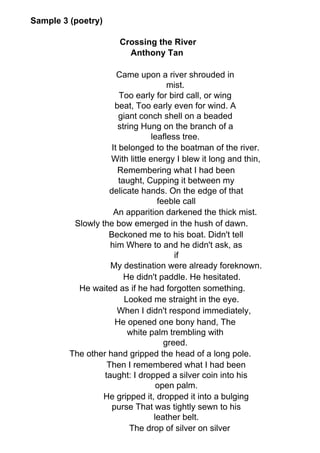
Sample 3 (poetry)
Crossing the River
Anthony Tan
Came upon a river shrouded in
mist.
Too early for bird call, or wing
beat, Too early even for wind. A
giant conch shell on a beaded
string Hung on the branch of a
leafless tree.
It belonged to the boatman of the river.
With little energy I blew it long and thin,
Remembering what I had been
taught, Cupping it between my
delicate hands. On the edge of that
feeble call
An apparition darkened the thick mist.
Slowly the bow emerged in the hush of dawn.
Beckoned me to his boat. Didn't tell
him Where to and he didn't ask, as
if
My destination were already foreknown.
He didn't paddle. He hesitated.
He waited as if he had forgotten something.
Looked me straight in the eye.
When I didn't respond immediately,
He opened one bony hand, The
white palm trembling with
greed.
The other hand gripped the head of a long pole.
Then I remembered what I had been
taught: I dropped a silver coin into his
open palm.
He gripped it, dropped it into a bulging
purse That was tightly sewn to his
leather belt.
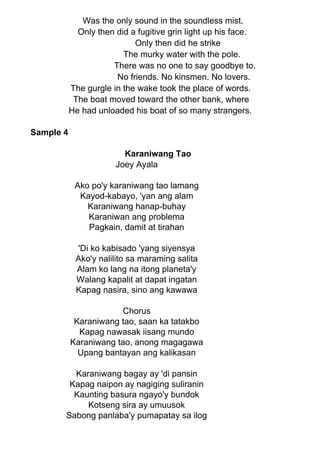
The drop of silver on silver
Was the only sound in the soundless mist.
Only then did a fugitive grin light up his face.
Only then did he strike
The murky water with the pole.
There was no one to say goodbye to.
No friends. No kinsmen. No lovers.
The gurgle in the wake took the place of words.
The boat moved toward the other bank, where
He had unloaded his boat of so many strangers.
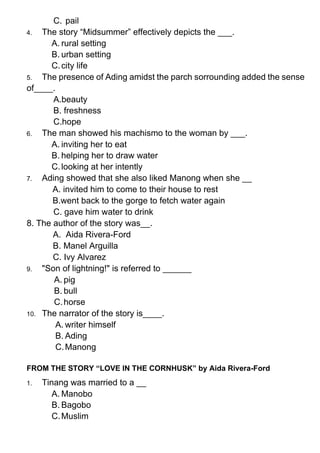
Sample 4
Karaniwang Tao
Joey Ayala
Ako po'y karaniwang tao lamang
Kayod-kabayo, 'yan ang alam
Karaniwang hanap-buhay
Karaniwan ang problema
Pagkain, damit at tirahan
'Di ko kabisado 'yang siyensya
Ako'y nalilito sa maraming salita
Alam ko lang na itong planeta'y
Walang kapalit at dapat ingatan
Kapag nasira, sino ang kawawa
Chorus
Karaniwang tao, saan ka tatakbo
Kapag nawasak iisang mundo
Karaniwang tao, anong magagawa
Upang bantayan ang kalikasan
Karaniwang bagay ay 'di pansin
Kapag naipon ay nagiging suliranin
Kaunting basura ngayo'y bundok
Kotseng sira ay umuusok
Sabong panlaba'y pumapatay sa ilog
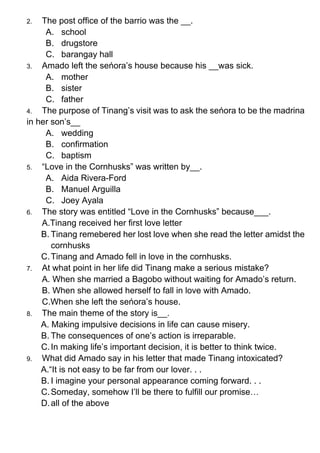
May lason na galing sa industriya
Ibinubuga ng mga pabrika
Ngunit 'di lamang higante
Ang nagkakalat ng dumi
May kinalaman din ang tulad natin
[Repeat chorus twice]
Karaniwang tao [4x]
[Repeat chorus]
Karaniwang tao
[Repeat till fade]
Activity 2. On your notebook, enumerate at least 3 contributions of
literature of each of the following writers:
1. Michael M. Coroza
2. Ivy Alvarez
3. Suzette Severo Doctolero
4. Anthony Tan
5. Manuel Arguilla
Activity 3. Appreciating literary pieces.
A. Noting Details. On your notebook, write the letter of your answer.
FROM THE STORY “MIDSUMMER” BY MANUEL ARGUILLA
1. The two contrasting images in the story are__
A. aridity and freshness
B. love and hate
C.hope and despair
2. Manong came upon Ading beyond a bend in the gorge where a big
__tree cast a cool shade
A. bamboo
B. atis
C.mango
3. Ading brought with her a __ when she met Manong.
A. jug
B. coconut shell
C. pail
4. The story “Midsummer” effectively depicts the ___.
A. rural setting
B. urban setting
C.city life
5. The presence of Ading amidst the parch sorrounding added the sense
of____.
A.beauty
B. freshness
C.hope
6. The man showed his machismo to the woman by ___.
A. inviting her to eat
B. helping her to draw water
C.looking at her intently
7. Ading showed that she also liked Manong when she __
A. invited him to come to their house to rest
B.went back to the gorge to fetch water again
C. gave him water to drink
8. The author of the story was__.
A. Aida Rivera-Ford
B. Manel Arguilla
C. Ivy Alvarez
9. "Son of lightning!" is referred to ______
A. pig
B. bull
C.horse
10. The narrator of the story is____.
A. writer himself
B. Ading
C.Manong
FROM THE STORY “LOVE IN THE CORNHUSK” by Aida Rivera-Ford
1. Tinang was married to a __
A. Manobo
B. Bagobo
C.Muslim
2. The post office of the barrio was the __.
A. school
B. drugstore
C. barangay hall
3. Amado left the seńora’s house because his __was sick.
A. mother
B. sister
C. father
4. The purpose of Tinang’s visit was to ask the seńora to be the madrina
in her son’s__
A. wedding
B. confirmation
C. baptism
5. “Love in the Cornhusks” was written by__.
A. Aida Rivera-Ford
B. Manuel Arguilla
C. Joey Ayala
6. The story was entitled “Love in the Cornhusks” because___.
A.Tinang received her first love letter
B. Tinang remebered her lost love when she read the letter amidst the
cornhusks
C.Tinang and Amado fell in love in the cornhusks.
7. At what point in her life did Tinang make a serious mistake?
A. When she married a Bagobo without waiting for Amado’s return.
B. When she allowed herself to fall in love with Amado.
C.When she left the seńora’s house.
8. The main theme of the story is__.
A. Making impulsive decisions in life can cause misery.
B. The consequences of one’s action is irreparable.
C.In making life’s important decision, it is better to think twice.
9. What did Amado say in his letter that made Tinang intoxicated?
A.“It is not easy to be far from our lover. . .
B. I imagine your personal appearance coming forward. . .
C.Someday, somehow I’ll be there to fulfill our promise…
D.all of the above
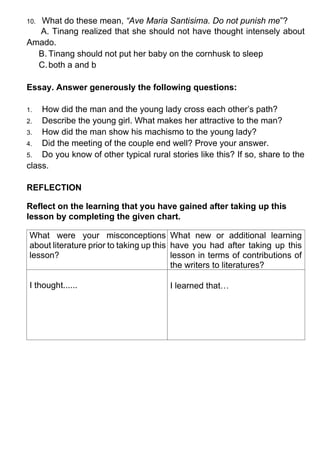
10. What do these mean, “Ave Maria Santisima. Do not punish me”?
A. Tinang realized that she should not have thought intensely about
Amado.
B. Tinang should not put her baby on the cornhusk to sleep
C.both a and b
Essay. Answer generously the following questions:
1. How did the man and the young lady cross each other’s path?
2. Describe the young girl. What makes her attractive to the man?
3. How did the man show his machismo to the young lady?
4. Did the meeting of the couple end well? Prove your answer.
5. Do you know of other typical rural stories like this? If so, share to the
class.
REFLECTION
Reflect on the learning that you have gained after taking up this
lesson by completing the given chart.
What were your misconceptions
about literature prior to taking up this
lesson?
What new or additional learning
have you had after taking up this
lesson in terms of contributions of
the writers to literatures?
I thought...... I learned that…

21 st module 2

  • 1.
  • 2.
    LESSON 2: TEXTSAND AUTHORS FROM EACH REGION Competency 1B: Identify representative texts and authors from each region (e.g. engage in oral history research with focus on key personalities from the students’ region, province, and town, EN12Lit-Ib-22 (2 hours). At the end of this lesson, you will be able to: 1. enumerate Filipino authors across the regions; and 2. appreciate their contributions on the development of Philippine literature. Activity 1: Directions: Write T if the statement is true and F if it is false. Write your answer in your notebook. _____1. Due to diverse environment, our ancestors developed separate cultures and beliefs. _____2. Good number of performances can be found in video-sharing site like YouTube. _____3. Rich biodiversity of the Philippines has made through archipelagic nature. _____4. Our study of literature can help us understanding different cultures across the country. _____5. Ilocos Region belongs to Region 2. _____6. CAR Region stands for Cordillera Administrative Region. _____7. Jose Ayala is a writer who comes from Region 10. _____8. CARAGA Region is the same as CAR Region. _____9. Our topography allows us to enjoy endemic flora and fauna. _____10. Western Visayas region is part of NCR region. In the previous lesson, you have already identified the geographic, linguistic, and ethnic dimensions of Philippine literary history from pre- colonial to the contemporary. Now, you are ready to move forward and learn more.
  • 3.
    During a 2014conference in Cebu City, Senator Alan Peter Cayetano remarked that the national government should stop giving the bulk of its national budget to Metro Manila alone. He said “Let us remember that Metro Manila is not the Philippines, and the Philippines is not Metro Manila. We should not always build in Manila. Other provinces and regions should share in the resources such as Clark, Zamboanga, Peninsula, Caraga and etc.” Providing equal resources to all regions of the country has been a continuous problem in more than a century of our independence as nation. The archipelagic nature of the Republic of the Philippines has made the country enjoy a rich biodiversity. Our topography, which consists of mountainous terrains, dense forests, plains, and coastal areas, allow us to enjoy endemic flora and fauna. As a result of this diverse environment, our ancestors developed separate cultures and languages. Our country has a total of 182 living languages. With these languages our ancestors communicated, built their communities, and created unique cultural products. Separated by seas, cultures, and languages, the Filipinos of today must consciously choose to maintain a united front in order for all of us to be truly equal and free as a people in one nation. How can we do this? Perhaps our study of literature can help point us toward the direction of understanding different cultures across the country, and hopefully this would provide the opportunity for a true sense of pride to grow within us for being part of this nation. 21st century technology can help propel this goal into something obtainable. With the help of the Internet, many contemporary authors from the regions are publishing their work online. Whether they are using their regional language, Filipino, or English, these young authors are beginning to speak a national audience about their reality. Some 21st century literature of the Philippines can be found in blogs, online newspapers, online magazines, online journals, etc. Also, a good number of performances of songs, skits, and amateur films showcasing regional works can be found in video-sharing sites like YouTube.
  • 4.
    Motivation questions. From thearticle that you have read, answer the following questions: 1. What are the 5 important points that Senator Alan Peter Cayetano emphasized? 2. How do you describe the geographical location of the Philippines? 3. How do these contribute to the development of our literature? Texts and Authors from each Region This part shows you the various texts and authors from different region in the country.
  • 5.
    The table belowpresents the current regional division of the Philippines. Samples of 21st century Filipino authors associated with each region are listed. The writer’s association with that region is established in two ways: it is the writer’s birthplace or the writer settled in that region. Be reminded that the names of writers here are merely a fraction of 21st century Filipino writers. Many of our new writers are still waiting to have their works published. NCR-National Capital Region-Metro Manila is made up of the following cities: Manila, Caloocan, Las Pinas, Makati, Malabon, Mandaluyong, Marikina, Muntinlupa, Navotas, Quezon City, Pasay, Pasig, Paranaque, San Juan, Taguig, Valenzuela, and Pateros Writers associated with this region: Michael M. Coroza, Jessica Zafra, Charlson Ong, Norman Wilwayco, Ana Maria Villanueva- Lykes, Janet B. Villa, Naya Valdellon, Rosmon Tuazon, Lourd de Veyra Region 1- Ilocos Region-Ilocos Norte, Ilocos Sur, La Union, Pangasinan and Dagupan City Writers associated with this region: Paul B. Zafaralla, Santiago B. Villafania, Cles B. Rambaud, Jan Marc Austria, Ariel S. Tabag, Manuel Arguilla Region 2-Cagayan Valley Region - Batanes, Cagayan, Isabela, Nueva Viscaya, and Quirino Writers associated with this region: Jun Lisondra, Lovella G. Velasco CAR (Cordillera Administrative Region) - Abra, Apayao, Benguet, Ifugao, KalingaApayao, and Mountain Province Writers associated with this region: Ma. Luisa Aguillar-Carino, Dion Michael Fernandez, Rachel Pitlogay, Chinee Sanchez Palatino, Charisse Acquisio Region 3 - Central Luzon Region Aurora, Bataan, Bulacan, Nueva Ecija, Pampanga, Tarlac, and Zambales Writers associated with this region; Virgilio Almario, Rolando F. Santos, D.M. Reyes, Danton Remote, Marl Anthony Cayanan Region 4-A-CALABARZON - Cavite, Laguna, Batangas, Rizal, and Quezon Writers associated with this region: Joel M. Toledo, Frank G. Rivera, Jimmuel C. Naval
  • 6.
    Region 4-B -MIMAROPA (Occidental Mindoro and Oriental Mindoro), Marinduque, Romblon, and Palawan Writer associated with this region: Jose Dalisay Jr. Region 5-Bicol Region - Camarines Norte, Camarines Sur, Albay, Catanduanes, Masbate, and Sorsogon Writers associated with this region: Merlinda Bobis, Ricardo Lee, Victor Dennis Tino Nierva Region 6- Western Visayas Region - Aklan Antique, Capiz, Guimaras, and Iloilo Writers associated with this region: Felino GarciaJr., John Iramil, Isidro Cruz NIR-Negros Island Region - Negros Occidental and Negros Oriental Writers associated with this region: Isabel D. Sibullen, Marianne Villanueva Region 7- Central Visayas Region - Bohol, Cebu, Siquijor Writers associated with this region: Michael Obenieta, Jeneen R. Garcia Region 8 - Eastern Visayas region - Samar, Leyte, and Biliran Writers: Voltaire Oyzon, Timothy R. Montes Region 9 - Zamboanga Peninsula - Zamboanga del Norte, Zamboanga del Sur, Zamboanga Sibugay, Zamboanga City, and Isabela Writers: Mig Alvarez Enriquez, Servando D. Halili Jr. Antonio R. Enriquez Region 10- Northern Mindanao Region- Bukidnon, Camiguin, Lanao del Norte, Misamis Oriental, Misamis Occidental Writers: Ralph Semino Galan, Judith R. Dharmdas, Anthony Tan Region 11- Davao Region or Southern Mindanao Region-Compostela Valley, Daval del Norte, Davao del Sur, Davao Oriental, and Davao Occidental Writers: Candy Gourlay, Salud M. Carrido Region 12 - SOCCSKSARGEN or Central Mindanao Region- South Cotabato, Cotabato, Sultan Kudarat, Sarangani, and General Santos Writers: Christine Godines-Ortega, Jaime An Lim
  • 7.
    Region 13 -CARAGA Region- Agusan del Sur, Agusan del Norte, Surigao del Norte, Surigao del Sur, and Dinagat Islands Writers: Joey Ayala, Tita Lacambra-Ayala ARMM (Autonomous Region in Muslim Mindanao) - Asila (except Isabela City), Lanao del Sur, Maguindanao, Sulu, and Tawi-Tawi Writers: Steven Prince Patrick C. Fernandez, Mehol K. Sadain Source: Beyond Borders (Reading Literature in the 21st century) by MARIA GABRIELA P MARTIN et.al. SOME NOTABLE WRITERS FROM DIFFERENT REGIONS AND THEIR CONTRIBUTIONS TO PHILIPPINE LITERATURES Michael M. Coroza writes poetry, fiction, critical essays and is engaged in literary translation. The writer's works have been published in national and international literary magazines: Kritika Kultura, Philippine Studies, Unitas, Tomas, Bulawan Journal of Arts and Culture, Daluyan, Loyola Schools Review, and the Malay Indonesian Studies. He is famous for promoting the traditional poetic genre of the Philippines "Balagtasan". He participated in international poetry readings "Kuala Lumpur-10" (2004) and the Second literary festival "Korea-ASEAN" in Jakarta (2011). Among his works are: ASEANO: An Anthology of Poems from Southeast Asia (1995), Dili’t Dilim (1997), Source: panitikan.ph Retrieved: May 20, 2020 Sounds of Asia (2011), Ang mga Lambing ni Lolo Ding (2012), and Nawawala si Muningning (2015). Source: panitikan.ph Retrieved: May 20, 2020 MANUEL E. ARGUILLA (1911-1944) was an Ilocano who wrote in English. He was best known for his short story, "How My Brother Leon Brought Home a Wife", which received first prize in the Commonwealth Literary Contest in 1940. Most of his stories depict life in Barrio Nagrebcan, Bauang, La Union, where he was born in 1911.
  • 8.
    Source: http://pinoylit.hy perm art.net Retrieved: May 20,2020 Source: http://pinoylit.hypermart.net Retrieved: May 20, 2020 Source: https://www.xu.edu.p h/xavier-news Retrieved: May 25, 2020 Anthony Tan was born on 26 August 1947, Siasi [Muddas], Sulu. His degrees AB English, 1968, MA Creative Writing, 1975, and Ph.D. English Lit., 1982 were all obtained from the Silliman University where he edited Sands and Coral, 1976. For more than a decade, he was a member of the English faculty at SU and regular member of the panel of critics in the Silliman Writers Workshop. He taught briefly at the DLSU and was Chair of the English Dept. at MSUIligan Institute of Technology where he continues to teach. A member of the Iligan Arts Council, he helps Jaime An Lim and Christine Godinez-Ortega run the Iligan Writers Workshop/Literature Teachers Conference. He also writes fiction and children’s stories. He has won a number of awards, among them, the Focus Award for poetry, the Palanca 1st prize for Poems for Muddas in 1993; also, the Palanca for essay. Among his works are The Badjao Cemetery and Other Poems, 1985 and Poems for Muddas, Anvil, 1996. Source: https://www.xu.edu.ph/images/Kinaadman_Research_Cente r/doc Retrieved: May 25, 2020 José Iñigo Homer Lacambra Ayala or also known as Joey Ayala was born on June 1, 1956 in Bukidnon, Philippines. He was known for his folk and contemporary pop music artist in the Philippines, he is also known for his songs that are more on the improvement of the environment. He is a finalist of Philippine Popular Music
  • 9.
    Source: songhits.ph Retrieved: May 28, 2020 Festival2013. Source: songhits.ph Retrieved: May 28, 2020 Source: philstar.com Retrieved: May 25, 2020 Merlie M. Alunan graduated from Silliman University with an MA in Creative Writing in 1974. She teaches at the Creative Writing Center, University of the Philippines Visayas Tacloban College. She lives in Tacloban City. She received various awards like Lillian Jerome Thornton Award for Nonfiction, Don Carlos Palanca Memorial Award for Literature, National Book Award, Sunthorn Phu Literary Awards, and Ani ng Dangal. Among her works are Heartstone, Sacred Tree, Amina among the angels, Selected poems, Kabilin: 100 Years of Negros Oriental, Fern Garden: An Anthology of Women Writing in the South, Songs of ourselves: writings by Filipino women in English, and many other Source: philstar.com Retrieved: May 25, 2020 Source: https://en.wikipedia. org/wiki/Ivy_Alvarez Retrieved: May 20, 2020 Ivy Alvarez is a New Zealand-based Filipino Australian poet, editor, and reviewer. Alvarez has had her work featured in various publications in Australia, Canada, England, the Philippines, New Zealand, Ireland, Russia, Scotland, Wales, the US, South Africa, and online. Alvarez was born in the Philippines and grew up in Tasmania, Australia. While reading English at the University of Tasmania, she published in various literary journals and anthologies, and subsequently became the reviews editor of Cordite Poetry Review, an Australian online poetry journal. Source: https://en.wikipedia.org/wiki/Ivy_Alvarez Retrieved: May 20, 2020
  • 10.
    Source: https://en.wikipedia.or g/wiki/Suzette_Doctol ero Retrieved: June 1, 2020 SuzetteSevero Doctolero (born December 16, 1968 Calabanga, Camarines Sur) is a Filipino screenwriter for film and television. She is best known for being the creator of Encantadia in 2005 and the succeeding related television series including the Encantadia 2016 reboot. She is mostly credited as screenwriter, series creator and creative consultant for GMA Network. Her other works include Amaya, Indio[ and My Husband's Lover. She also wrote the story for the film Let the Love Begin and became the creative consultant for the television series Alyas Robin Hood[ and Destined to be Yours. Source: https://en.wikipedia.org/wiki/Suzette_Doctolero Retrieved: June 1, 2020 Source: panitikan.ph Retrieved: May 24, 2020 Aida Rivera-Ford was born in Jolo, Sulu. She became the editor of the first two issues of Sands and Coral, the literary magazine of Silliman University. In 1949, she graduated with an AB degree, major in English, Cum Laude. In 1954, she obtained an MA in English Language and Literature at the University of Michigan and won the prestigious Jules and Avery Hopwood for fiction. In 1980, she founded the first school of Fine Arts in Mindanao – the Learning Center of the Arts, now known as the Ford Academy of the Arts. Source: panitikan.ph Retrieved: May 24, 2020
  • 11.
    SAMPLE OF THEIRWORKS: Sample 1 Midsummer By: Manuel Arguilla (American Colonial Literature) He pulled down his hat until the wide brim touched his shoulders. He crouched lower under the cover of his cart and peered ahead. The road seemed to writhe under the lash of the noon-day heat; it swum from side to side, humped and bent itself like a feeling serpent, and disappeared behind the spur of a low hill on which grew a scrawny thicket of bamboo. There was not a house in sight. Along the left side of the road ran the deep, dry gorge of a stream, the banks sparsely covered by sun-burned cogon grass. In places, the rocky, waterless bed showed aridly. Farther, beyond the shimmer of quivering heat waves rose ancient hills not less blue than the cloud-palisaded sky. On the right stretched a land waste of low rolling dunes. Scattered clumps of hardy ledda relieved the otherwise barren monotony of the landscape. Far away he could discern a thin indigo line that was the sea. The grating of the cartwheels on the pebbles of the road and the almost soundless shuffle of the weary bull but emphasized the stillness. Now and then came the dry rustling of falling earth as lumps from the cracked sides of the gorge fell down to the bottom. He struck at the bull with the slack of the rope. The animal broke into a heavy trot. The dust stirred slumbrously. The bull slowed down, threw up his head, and a glistening thread of saliva spun out into the dry air. The dying rays of the sun were reflected in points of light on the wet, heaving flanks. The man in the cart did not notice the woman until she had rounded the spur of land and stood unmoving beside the road, watching the cart and its occupant come toward her. She was young, surprisingly sweet and fresh amidst her parched surroundings. A gaily stripped kerchief covered her head, the ends tied at the nape of her neck. She wore a homespun bodice of light red cloth with small white checks. Her skirt was also homespun and showed a pattern of white checks with narrow stripes of yellow and red.
  • 12.
    With both handsshe held by the mouth a large, apparently empty, water jug, the cool red of which blended well with her dress. She was barefoot. She stood straight and still beside the road and regarded him with frank curiosity. Suddenly she turned and disappeared into the dry gorge. Coming to where she had stood a few moments before, he pulled up the bull and got out of the cart. He saw where a narrow path had been cut into the bank and stood a while lost in thought, absently wiping the perspiration from his face. Then he unhitched his bull and for a few moments, with strong brown fingers, kneaded the hot neck of the beast. Driving the animal before him, he followed the path. It led up the dry bed of the stream; the sharp fragments of sun-heated rocks were like burning coals under his feet. There was no sign of the young woman. He came upon her beyond a bed in the gorge, where a big mango tree, which had partly fallen from the side of the ravine, cast its cool shade over a well. She had filled her jar and was rolling the kerchief around her hand into a flat coil which she placed on her head. Without glancing at him, where he had stopped some distance off, she sat down of her heels, gathering the fold of her skirt between her wide-spread knees. She tilted the brimful jar to remove part of the water. One hand on the rim, the other supporting the bottom, she began to raise it to her head. She knelt on one knee resting, for a moment, the jar onto her head, getting to her feet at the same time. But she staggered a little and water splashed down on her breast. The single bodice instantly clung to her bosom molding the twin hillocks of her breasts warmly brown through the wet cloth. One arm remained uplifted, holding the jar, while the other shook the clinging cloth free of her drenched flesh. Then not once having raised her eyes, she passed by the young man, who stood mutely gazing beside his bull. The animal had found some grass along the path and was industriously grazing. He turned to watch the graceful figure beneath the jar until it vanished around a bend in the path leading to the road. Then he led the bull to the well, and tethered it to a root of the mango tree. "The underpart of her arm is white and smooth," he said to his blurred image on the water of the well, as he leaned over before lowering the bucket made of half a petroleum can. "And her hair is thick and black." The
  • 13.
    bucket struck witha rattling impact. It filled with one long gurgle. He threw his hat on the grass and pulled the bucket up with both hands. The twisted bamboo rope bit into his hardened palms, and he thought how... the same rope must hurt her. He placed the dripping bucket on a flat stone, and the bull drank. "Son of lightning!" he said, thumping the side of the bull after it had drunk the third bucketful, "you drink like the great Kuantitao!" A low, rich rumbling rolled through the cavernous body of the beast. He tied it again to the root, and the animal idly rubbed its horns against the wood. The sun had fallen from the perpendicular, and noticing that the bull stood partly exposed to the sun, he pushed it farther into shade. He fanned himself with his hat. He whistled to entice the wind from the sea, but not a breeze stirred. After a while he put on his hat and hurriedly walked the short distance through the gorge up to the road where his cart stood. From inside he took a jute sack which he slung over one shoulder. With the other arm, he gathered part of the hay at the bottom of the cart. He returned to the well, slips of straw falling behind him as he picked his way from one tuft of grass to another, for the broken rocks of the path has grown exceedingly hot. He gave the hay to the bull, its rump was again in the sun, and he had to push it back. "Fool, do you want to broil yourself alive?" he said good- humoredly, slapping the thick haunches. It switched its long-haired tail and fell to eating. The dry, sweetsmelling hay made harsh gritting sounds in the mouth of the hungry animal. Saliva rolled out from the corners, clung to the stiff hairs that fringed the thick lower lip, fell and gleamed and evaporated in the heated air. He took out of the jute sack a polished coconut shell. The top had been sawed off and holes bored at opposite sides, through which a string tied to the lower part of the shell passed in a loop. The smaller piece could thus be slipped up and down as a cover. The coconut shell contained cooked rice still a little warm. Buried on the top was an egg now boiled hard. He next brought out a bamboo tube of salt, a cake of brown sugar wrapped in banana leaf, and some dried shrimps. Then he spread the sack in what remained of the shade, placed his simple meal thereon, and prepared to eat his dinner. But first he drew a bucketful of water from the well, setting
  • 14.
    the bucket ona rock. He seated himself on another rock and ate with his fingers. From time to time he drank from the bucket. He was half through with his meal when the girl came down the path once more. She had changed the wetted bodice. He watched her with lowered head as she approached, and felt a difficulty in continuing to eat, but went through the motions of filling his mouth nevertheless. He strained his eyes looking at the girl from beneath his eyebrows. How graceful she was! Her hips tapered smoothly down to round thighs and supple legs, showing against her skirt and moving straight and free. Her shoulders, small but firm, bore her shapely neck and head with shy pride. When she was very near, he ate more hurriedly, so that he almost choked. He did not look at her. She placed the jar between three stones. When she picked up the rope of the bucket, he came to himself. He looked up--straight into her face. He saw her eyes. They were brown and were regarding him gravely, without embarrassment; he forgot his own timidity. "Won't you join me, Ading?" he said simply. He remained seated. Her lips parted in a half smile and a little dimple appeared high upon her right cheek. She shook her head and said: "God reward you, Manong." "Perhaps the poor food I have is not fit for you?" "No, no. It isn't that. How can you think of it? I should be ashamed. It is that I have must eaten myself. That is why I came to get water in the middle of the day--we ran out of it. I see you have eggs and shrimps and sugar. Why, he had nothing but rice and salt." "Salt? Surely you joke." "I would be ashamed..." "But what is the matter with salt?" "Salt...salt...Makes baby stout," he intoned. "My grandmother used to sing that to me when I complained of our food."
  • 15.
    They laughed andfelt more at ease and regarded each other more openly. He took a long time fingering his rice before raising it to his mouth, the while he gazed up at her and smiled for no reason. She smiles back in turn and gave the rope which she held an absent-minded tug. The bucket came down from its perch of rock in a miniature flood. He leaped to his feet with a surprised yell, and the next instant the jute sack on which he lay his meal was drenched. Only the rice inside the coconut shell and the bamboo of tube of salt were saved from the water. She was distressed, but he only laughed. "It is nothing," he said. "It was time I stopped eating. I have filled up to my neck." "Forgive me, Manong," she insisted. "It was all my fault. Such a clumsy creature I am." "It was not your fault," she assured him. "I am to blame for placing the bucket of water where I did." "I will draw you another bucketful," he said. "I am stronger than you." "No, you must let me do it." But when he caught hold of the bucket and stretched forth a brawny arm for the coil of rope in her hands, she surrendered both to him quickly and drew back a step as though shy of his touch. He lowered the bucket with his back to her, and she had time to take in the tallness of him, the breadth of his shoulders, the sinewy strength of his legs. Down below in the small of his back, two parallel ridges of rope-like muscle stuck out against the wet shirt. As he hauled up the bucket, muscles rippled all over his body. His hair, which was wavy, cut short behind but long in fronts fell in a cluster over his forehead. "Let me hold the bucket while you drink," she offered.
  • 16.
    He flashed hera smile over his shoulders as he poured the water into her jar, and again lowered the bucket. "No, no, you must not do that." She hurried to his side and held one of his arms "I couldn't let you, a stranger..." "Why not?" He smiled down at her, and noticed a slight film of moisture clinging to the down on her upper lip and experienced a sudden desire to wipe it away with his forefinger. He continued to lower the bucket while she had to stand by. "Hadn't you better move over to the shade?" he suggested, as the bucket struck the water. "What shall I do there?" she asked sharply, as though the idea of seeking protection from the heat were contemptible to her. "You will get roasted standing here in the sun," he said, and began to haul up the bucket. But she remained beside him, catching the rope as it fell from his hands, coiling it carefully. The jar was filled, with plenty to drink as she tilted the half-filled can until the water lapped the rim. He gulped a mouthful, gargled noisily, spewed it out, then commenced to drink in earnest. He took long, deep droughts of the sweetish water, for he was more thirsty than he had thought. A chuckling sound persisted in forming inside his throat at every swallow. It made him self-conscious. He was breathless when through, and red in the face. "I don't know why it makes that sound," he said, fingering his throat and laughing shamefacedly. "Father also makes that sound when he drinks, and mother always laughs at him," she said. She untied the headkerchief over her hair and started to roll it.
  • 17.
    Then sun haddescended considerably and there was now hardly any shade under the tree. The bull was gathering with its tongue stray slips of straw. He untied the animal to lead it to the other side of the girl who spoke; "Manong, why don't you come to our house and bring your animal with you? There is shade and you can sleep, though our house is very poor." She had already placed the jar on her head and stood, half-turned to him, waiting for his answer. "I would be troubling you, Ading." "No. You come. I have told mother about you." She turned and went down the path. He sent the bull after her with smart slap on its side. Then he quickly gathered the remains of his meal, put them inside the jute sack which had almost dried, and himself followed. Then seeing that the bull had stopped to nibble the tufts of grass that dotted the bottom of the gorge, he picked up the dragging rope and urged the animal on into a trot. They caught up with the girl near the cart. She stopped to wait. He did not volunteer a word. He walked a step behind, the bull lumbering in front. More than ever he was conscious of her person. She carried the jar on her head without holding it. Her hands swung to her even steps. He drew back his square shoulders, lifted his chin, and sniffed the motionless air. There was a flourish in the way he flicked the rump of the bull with the rope in his hand. He felt strong. He felt very strong. He felt that he could follow the slender, lithe figure to the end of the world. Sample 2 LOVE IN THE CORNHUSKS By: Aida Rivera-Ford Tinang stopped before the Señora’s gate and adjusted the baby’s cap. The dogs that came to bark at the gate were strange dogs, big-mouthed animals with a sense of superiority. They stuck their heads through the
  • 18.
    hogfence, lolling theirtongues and straining. Suddenly, from the gumamela row, a little black mongrel emerged and slithered through the fence with ease. It came to her, head down and body quivering. “Bantay! Ay, Bantay!” she exclaimed as the little dog laid its paws upon her shirt to sniff the baby on her arm. The baby was afraid and cried. The big animals barked with displeasure. Tito, the young master, had seen her and was calling to his mother. “Ma, it’s Tinang. Ma, Ma, it’s Tinang.” He came running down to open the gate. “Aba, you are so tall now, Tito.” He smiled his girl’s smile as he stood by, warding the dogs off. Tinang passed quickly up the veranda stairs lined with ferns and many-colored bougainvilla. On landing, she paused to wipe her shoes carefully. About her, the Señora’s white and lavender butterfly orchids fluttered delicately in the sunshine. She noticed though that the purple waling-waling that had once been her task to shade from the hot sun with banana leaves and to water with mixture of charcoal and eggs and water was not in bloom. “Is no one covering the waling-waling now?” Tinang asked. “It will die.” “Oh, the maid will come to cover the orchids later.” The Señora called from inside. “Tinang, let me see your baby. Is it a boy?” “Yes, Ma,” Tito shouted from downstairs. “And the ears are huge!” “What do you expect,” replied his mother; “the father is a Bagobo. Even Tinang looks like a Bagobo now.” Tinang laughed and felt warmness for her former mistress and the boy Tito. She sat self-consciously on the black narra sofa, for the first time a visitor. Her eyes clouded. The sight of the Señora’s flaccidly plump figure, swathed in a loose waistless housedress that came down to her ankles, and the faint scent of agua de colonia blended with kitchen spice, seemed to her the essence of the comfortable world, and she sighed thinking of the long walk home through the mud, the baby’s legs straddled to her waist, and Inggo, her husband, waiting for her, his body stinking of tuba and sweat, squatting on the floor, clad only in his foul undergarments. “Ano, Tinang, is it not a good thing to be married?” the Señora asked, pitying Tinang because her dress gave way at the placket and pressed at
  • 19.
    her swollen breasts.It was, as a matter of fact, a dress she had given Tinang a long time ago. “It is hard, Señora, very hard. Better that I was working here again.” “There!” the Señora said. “Didn’t I tell you what it would be like, huh? . . . that you would be a slave to your husband and that you would work a baby eternally strapped to you. Are you not pregnant again?” Tinang squirmed at the Señora’s directness but admitted she was. “Hala! You will have a dozen before long.” The Señora got up. “Come, I will give you some dresses and an old blanket that you can cut into things for the baby.” They went into a cluttered room which looked like a huge closet and as the Señora sorted out some clothes, Tinang asked, “How is Señor? “Ay, he is always losing his temper over the tractor drivers. It is not the way it was when Amado was here. You remember what a good driver he was. The tractors were always kept in working condition. But now . . . I wonder why he left all of a sudden. He said he would be gone for only two days . . . .” “I don’t know,” Tinang said. The baby began to cry. Tinang shushed him with irritation. “Oy, Tinang, come to the kitchen; your Bagobito is hungry.” For the next hour, Tinang sat in the kitchen with an odd feeling; she watched the girl who was now in possession of the kitchen work around with a handkerchief clutched I one hand. She had lipstick on too, Tinang noted. the girl looked at her briefly but did not smile. She set down a can of evaporated milk for the baby and served her coffee and cake. The Señora drank coffee with her and lectured about keeping the baby’s stomach bound and training it to stay by itself so she could work. Finally, Tinang brought up, haltingly, with phrases like “if it will not offend you” and “if you are not too busy” the purpose of her visit–which was to ask Señora to be a madrina in baptism. The Señora readily assented and said she would provide the baptismal clothes and the fee for the priest. It was time to go. “When are you coming again, Tinang?” the Señora asked as Tinang got the baby ready. “Don’t forget the bundle of clothes and . . . oh, Tinang, you
  • 20.
    better stop bythe drugstore. They asked me once whether you were still with us. You have a letter there and I was going to open it to see if there was bad news but I thought you would be coming.” A letter! Tinang’s heart beat violently. Somebody is dead; I know somebody is dead, she thought. She crossed herself and after thanking the Señora profusely, she hurried down. The dogs came forward and Tito had to restrain them. “Bring me some young corn next time, Tinang,” he called after her. Tinang waited a while at the drugstore which was also the post office of the barrio. Finally, the man turned to her: “Mrs., do you want medicine for your baby or for yourself?” “No, I came for my letter. I was told I have a letter.” “And what is your name, Mrs.?” He drawled. “Constantina Tirol.” The man pulled a box and slowly went through the pile of envelopes most of which were scribbled in pencil, “Tirol, Tirol, Tirol. . . .” He finally pulled out a letter and handed it to her. She stared at the unfamiliar scrawl. It was not from her sister and she could think of no one else who could write to her. Santa Maria, she thought; maybe something has happened to my sister. “Do you want me to read it for you?” “No, no.” She hurried from the drugstore, crushed that he should think her illiterate. With the baby on one arm and the bundle of clothes on the other and the letter clutched in her hand she found herself walking toward home. The rains had made a deep slough of the clay road and Tinang followed the prints left by the men and the carabaos that had gone before her to keep from sinking mud up to her knees. She was deep in the road before she became conscious of her shoes. In horror, she saw that they were coated with thick, black clay. Gingerly, she pulled off one shoe after the other with the hand still clutching to the letter. When she had tied the shoes together with the laces and had slung them on an arm, the baby, the bundle, and the letter were all smeared with mud.
  • 21.
    There must bea place to put the baby down, she thought, desperate now about the letter. She walked on until she spotted a corner of a field where cornhusks were scattered under a kamansi tree. She shoved together a pile of husks with her foot and laid the baby down upon it. With a sigh, she drew the letter from the envelope. She stared at the letter which was written in English. My dearest Tinay, Hello, how is life getting along? Are you still in good condition? As for myself, the same as usual. But you’re far from my side. It is not easy to be far from our lover. Tinay, do you still love me? I hope your kind and generous heart will never fade. Someday or somehow I’ll be there again to fulfill our promise. Many weeks and months have elapsed. Still I remember our bygone days. Especially when I was suffering with the heat of the tractor under the heat of the sun. I was always in despair until I imagine your personal appearance coming forward bearing the sweetest smile that enabled me to view the distant horizon. Tinay, I could not return because I found that my mother was very ill. That is why I was not able to take you as a partner of life. Please respond to my missive at once so that I know whether you still love me or not. I hope you did not love anybody except myself. I think I am going beyond the limit of your leisure hours, so I close with best wishes to you, my friends Gonding, Sefarin, Bondio, etc. Yours forever, Amado P.S. My mother died last month. Address your letter: Mr. Amado Galauran Binalunan, Cotabato It was Tinang’s first love letter. A flush spread over her face and crept into her body. She re ad the letter again. “It is not easy to be far from our
  • 22.
    lover. . .. I imagine your personal appearance coming forward. . . . Someday, somehow I’ll be there to fulfill our promise. . . .” Tinang was intoxicated. She pressed herself against the kamansi tree. My lover is true to me. He never meant to desert me. Amado, she thought. Amado. And she cried, remembering the young girl she was less than two years ago when she would take food to Señor in the field and the laborers would eye her furtively. She thought herself above them for she was always neat and clean in her hometown, before she went away to work, she had gone to school and had reached sixth grade. Her skin, too, was not as dark as those of the girls who worked in the fields weeding around the clumps of abaca. Her lower lip jutted out disdainfully when the farm hands spoke to her with many flattering words. She laughed when a Bagobo with two hectares of land asked her to marry him. It was only Amado, the tractor driver, who could look at her and make her lower her eyes. He was very dark and wore filthy and torn clothes on the farm but on Saturdays when he came up to the house for his week’s salary, his hair was slicked down and he would be dressed as well as Mr. Jacinto, the school teacher. Once he told her he would study in the city night-schools and take up mechanical engineering someday. He had not said much more to her but one afternoon when she was bidden to take some bolts and tools to him in the field, a great excitement came over her. The shadows moved fitfully in the bamboo groves she passed and the cool November air edged into her nostrils sharply. He stood unmoving beside the tractor with tools and parts scattered on the ground around him. His eyes were a black glow as he watched her draw near. When she held out the bolts, he seized her wrist and said: “Come,” pulling her to the screen of trees beyond. She resisted but his arms were strong. He embraced her roughly and awkwardly, and she trembled and gasped and clung to him. . . . A little green snake slithered languidly into the tall grass a few yards from the kamansi tree. Tinang started violently and remembered her child. It lay motionless on the mat of husk. With a shriek she grabbed it wildly and hugged it close. The baby awoke from its sleep and cries lustily. Ave Maria Santisima. Do not punish me, she prayed, searching the baby’s skin for marks. Among the cornhusks, the letter fell unnoticed.
  • 23.
    Sample 3 (poetry) Crossingthe River Anthony Tan Came upon a river shrouded in mist. Too early for bird call, or wing beat, Too early even for wind. A giant conch shell on a beaded string Hung on the branch of a leafless tree. It belonged to the boatman of the river. With little energy I blew it long and thin, Remembering what I had been taught, Cupping it between my delicate hands. On the edge of that feeble call An apparition darkened the thick mist. Slowly the bow emerged in the hush of dawn. Beckoned me to his boat. Didn't tell him Where to and he didn't ask, as if My destination were already foreknown. He didn't paddle. He hesitated. He waited as if he had forgotten something. Looked me straight in the eye. When I didn't respond immediately, He opened one bony hand, The white palm trembling with greed. The other hand gripped the head of a long pole. Then I remembered what I had been taught: I dropped a silver coin into his open palm. He gripped it, dropped it into a bulging purse That was tightly sewn to his leather belt. The drop of silver on silver
  • 24.
    Was the onlysound in the soundless mist. Only then did a fugitive grin light up his face. Only then did he strike The murky water with the pole. There was no one to say goodbye to. No friends. No kinsmen. No lovers. The gurgle in the wake took the place of words. The boat moved toward the other bank, where He had unloaded his boat of so many strangers. Sample 4 Karaniwang Tao Joey Ayala Ako po'y karaniwang tao lamang Kayod-kabayo, 'yan ang alam Karaniwang hanap-buhay Karaniwan ang problema Pagkain, damit at tirahan 'Di ko kabisado 'yang siyensya Ako'y nalilito sa maraming salita Alam ko lang na itong planeta'y Walang kapalit at dapat ingatan Kapag nasira, sino ang kawawa Chorus Karaniwang tao, saan ka tatakbo Kapag nawasak iisang mundo Karaniwang tao, anong magagawa Upang bantayan ang kalikasan Karaniwang bagay ay 'di pansin Kapag naipon ay nagiging suliranin Kaunting basura ngayo'y bundok Kotseng sira ay umuusok Sabong panlaba'y pumapatay sa ilog
  • 25.
    May lason nagaling sa industriya Ibinubuga ng mga pabrika Ngunit 'di lamang higante Ang nagkakalat ng dumi May kinalaman din ang tulad natin [Repeat chorus twice] Karaniwang tao [4x] [Repeat chorus] Karaniwang tao [Repeat till fade] Activity 2. On your notebook, enumerate at least 3 contributions of literature of each of the following writers: 1. Michael M. Coroza 2. Ivy Alvarez 3. Suzette Severo Doctolero 4. Anthony Tan 5. Manuel Arguilla Activity 3. Appreciating literary pieces. A. Noting Details. On your notebook, write the letter of your answer. FROM THE STORY “MIDSUMMER” BY MANUEL ARGUILLA 1. The two contrasting images in the story are__ A. aridity and freshness B. love and hate C.hope and despair 2. Manong came upon Ading beyond a bend in the gorge where a big __tree cast a cool shade A. bamboo B. atis C.mango 3. Ading brought with her a __ when she met Manong. A. jug B. coconut shell
  • 26.
    C. pail 4. Thestory “Midsummer” effectively depicts the ___. A. rural setting B. urban setting C.city life 5. The presence of Ading amidst the parch sorrounding added the sense of____. A.beauty B. freshness C.hope 6. The man showed his machismo to the woman by ___. A. inviting her to eat B. helping her to draw water C.looking at her intently 7. Ading showed that she also liked Manong when she __ A. invited him to come to their house to rest B.went back to the gorge to fetch water again C. gave him water to drink 8. The author of the story was__. A. Aida Rivera-Ford B. Manel Arguilla C. Ivy Alvarez 9. "Son of lightning!" is referred to ______ A. pig B. bull C.horse 10. The narrator of the story is____. A. writer himself B. Ading C.Manong FROM THE STORY “LOVE IN THE CORNHUSK” by Aida Rivera-Ford 1. Tinang was married to a __ A. Manobo B. Bagobo C.Muslim
  • 27.
    2. The postoffice of the barrio was the __. A. school B. drugstore C. barangay hall 3. Amado left the seńora’s house because his __was sick. A. mother B. sister C. father 4. The purpose of Tinang’s visit was to ask the seńora to be the madrina in her son’s__ A. wedding B. confirmation C. baptism 5. “Love in the Cornhusks” was written by__. A. Aida Rivera-Ford B. Manuel Arguilla C. Joey Ayala 6. The story was entitled “Love in the Cornhusks” because___. A.Tinang received her first love letter B. Tinang remebered her lost love when she read the letter amidst the cornhusks C.Tinang and Amado fell in love in the cornhusks. 7. At what point in her life did Tinang make a serious mistake? A. When she married a Bagobo without waiting for Amado’s return. B. When she allowed herself to fall in love with Amado. C.When she left the seńora’s house. 8. The main theme of the story is__. A. Making impulsive decisions in life can cause misery. B. The consequences of one’s action is irreparable. C.In making life’s important decision, it is better to think twice. 9. What did Amado say in his letter that made Tinang intoxicated? A.“It is not easy to be far from our lover. . . B. I imagine your personal appearance coming forward. . . C.Someday, somehow I’ll be there to fulfill our promise… D.all of the above
  • 28.
    10. What dothese mean, “Ave Maria Santisima. Do not punish me”? A. Tinang realized that she should not have thought intensely about Amado. B. Tinang should not put her baby on the cornhusk to sleep C.both a and b Essay. Answer generously the following questions: 1. How did the man and the young lady cross each other’s path? 2. Describe the young girl. What makes her attractive to the man? 3. How did the man show his machismo to the young lady? 4. Did the meeting of the couple end well? Prove your answer. 5. Do you know of other typical rural stories like this? If so, share to the class. REFLECTION Reflect on the learning that you have gained after taking up this lesson by completing the given chart. What were your misconceptions about literature prior to taking up this lesson? What new or additional learning have you had after taking up this lesson in terms of contributions of the writers to literatures? I thought...... I learned that…