Media Interview Essentials:
Tell Your Story Like a Pro
To access the audio for today’s event,
dial 1-866-740-1260 and enter code 2925553#.
About Albers Communications Group
• Full-service PR, social media and marketing
communications agency
• Specialize in integrated strategies
• Represent clients in all 50 states and Canada
• Create national and local market exposure
Today’s Topics
• Working with the media
• Identifying goals
• Developing key messages
• Avoiding misquotes
• Maintaining control
• Case study
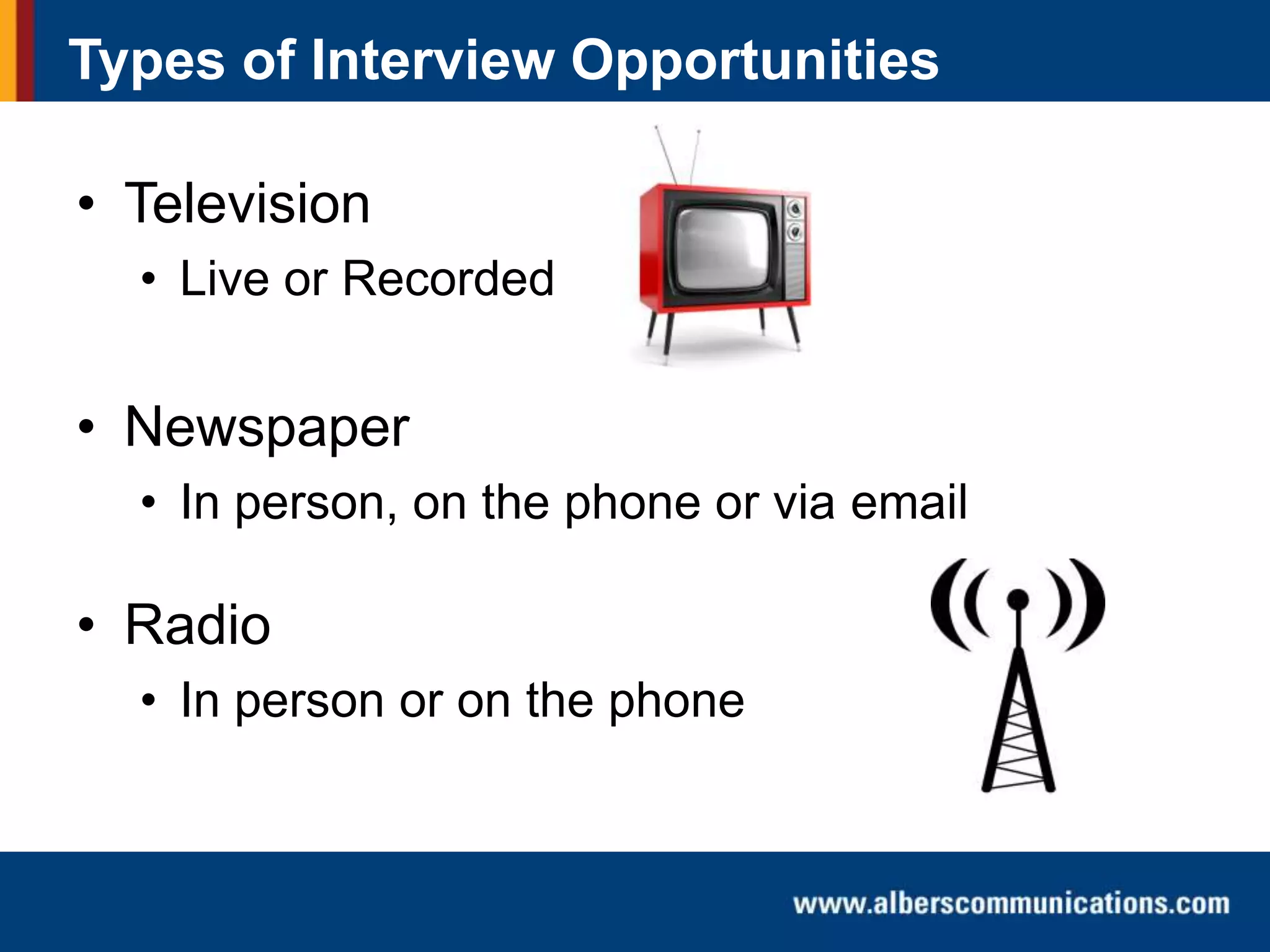
Types of Interview Opportunities

• Television
• Live or Recorded

• Newspaper
• In person, on the phone or via email

• Radio
• In person or on the phone
Benefits of Media Exposure
• It’s credible
• It’s memorable
• It’s lasting
• It’s free
Working with the Media
• Responsiveness is critical
• Reporters aren’t specialists

• Final content is in the hands
of reporters/editors
• Good relationships matter
Interview Agenda
• Reporter’s Agenda
• Informing their audience
• Accuracy

• Meeting their deadline

• Your Agenda
• Meet objectives
• Deliver key messages
• Maintain control
Ground Rules
• What you should know
•
•
•
•
•

Who is interviewing you
When/where the story will run
General direction/angle of the story
Who else is being interviewed for the story
You have the right to decline to interview

• What you shouldn’t expect
• Know questions in advance
• Review/approve the story before it runs
• Get a retraction
Before the Interview
• Determine objectives
• Develop message points
• Write down key messages
• Practice out loud
• Make time to prepare

• Provide support materials
• Press releases
• Fact sheets
• Executive summaries
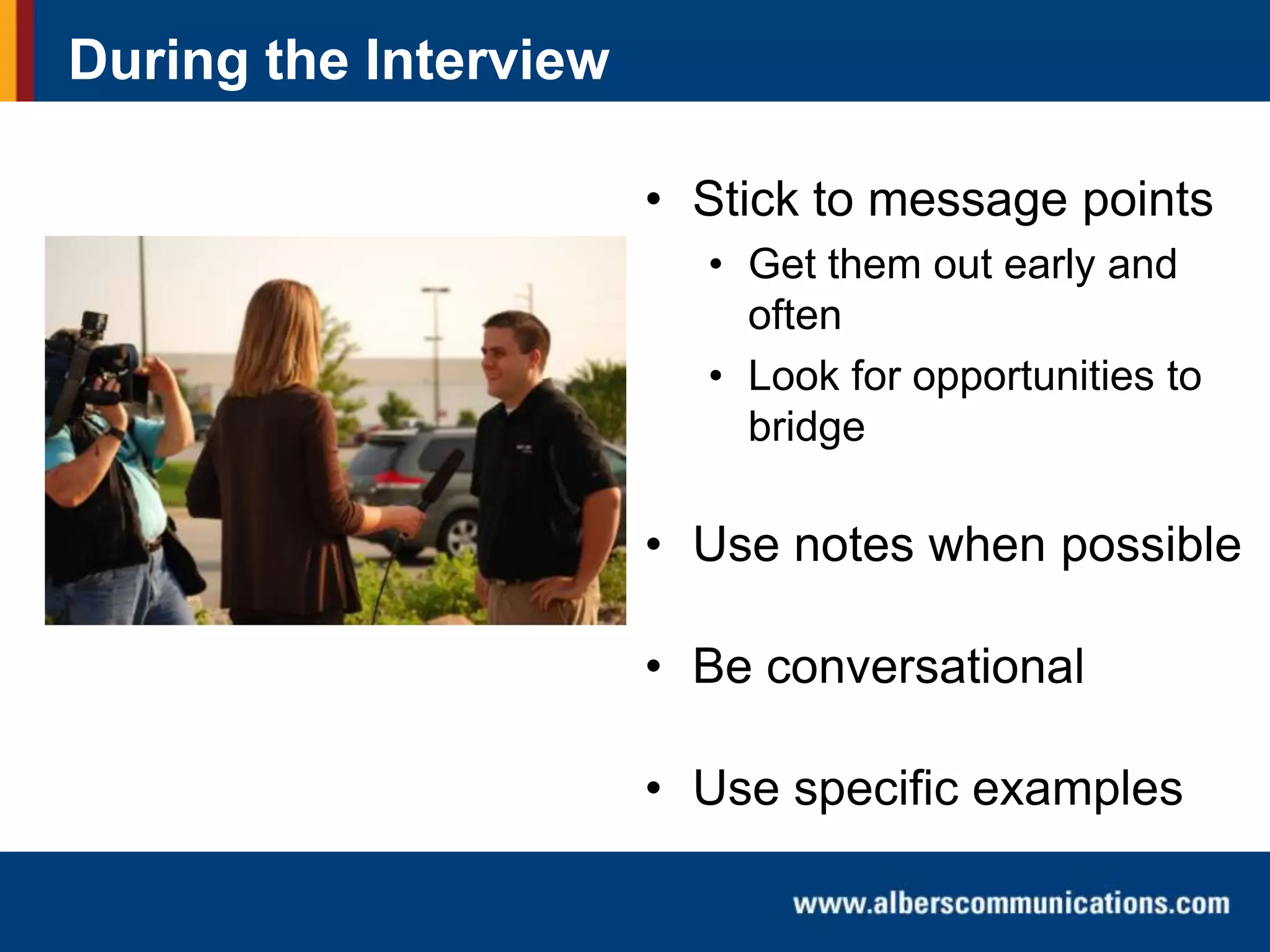
During the Interview
• Stick to message points
• Get them out early and
often
• Look for opportunities to
bridge

• Use notes when possible
• Be conversational
• Use specific examples
During the Interview
• Be quotable
• Don’t ramble
• Be concise
• Avoid jargon

• Assume everything is on the record

• Correct mistakes
During the Interview
• Never say “no comment”
• Take advantage of every opportunity
• Anything to add?
• Reinforce key messages
• Restate earlier comments
• Provide information not included earlier
After the Interview
• Thank the reporter
• Enhance the exposure with your owned and
shared media
• Evaluate your performance
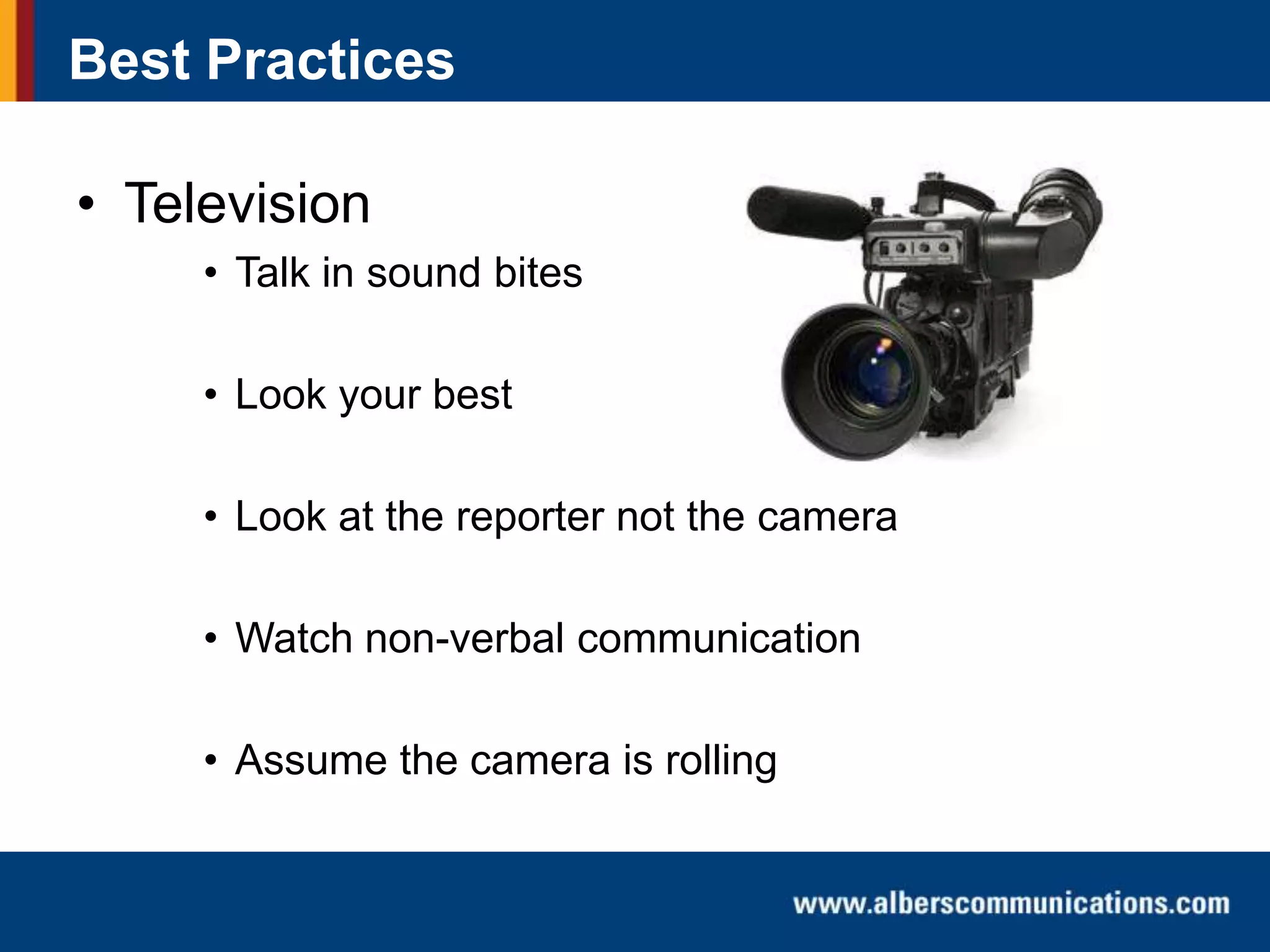
Best Practices

• Television
• Talk in sound bites
• Look your best
• Look at the reporter not the camera

• Watch non-verbal communication
• Assume the camera is rolling
Best Practices

• Newspaper
• Give them time
• Offer fact sheets
• Suggest photos

• Clarify your points
Best Practices

• Radio
• Speak succinctly
• Find out if it is live or taped
• Speak clearly

• Limit distractions and background noise
Case Study- StrategicHealthSolutions

• Identify Goals
•
•
•
•

Increase visibility and engagement
Announce new facility
Showcase company’s growth
Create job applicants
Case Study- StrategicHealthSolutions

• Key Messages
• Strategic has experienced amazing growth. We’ve
outgrown our former space and needed a new
facility that can keep up with our continuing
expansion.
• We’re currently hiring. Strategic has openings for
100 employees - anything from coding specialists
and graphic designers to medical review nurses.
Information is available on our website.
Case Study- StrategicHealthSolutions
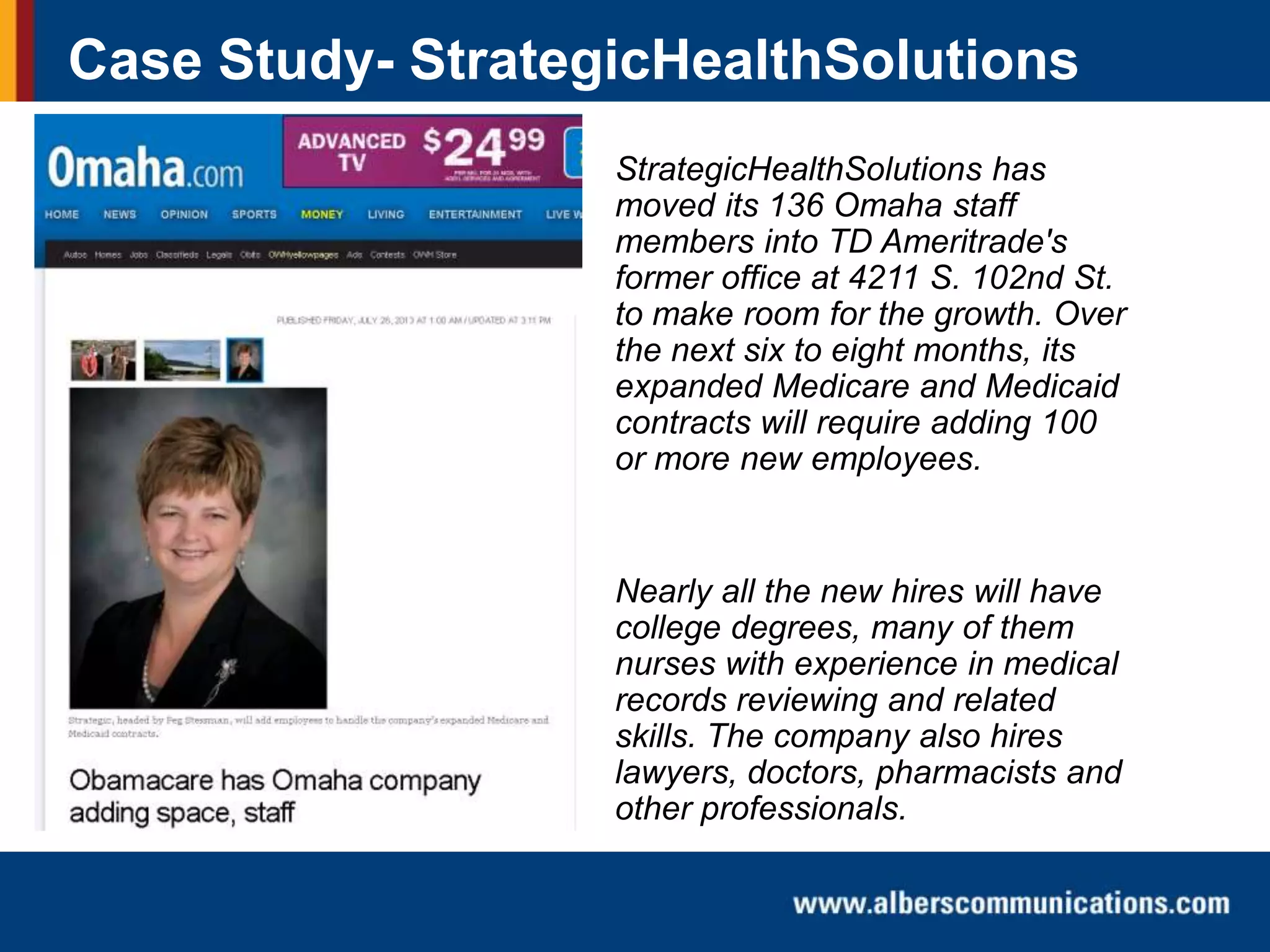
StrategicHealthSolutions has
moved its 136 Omaha staff
members into TD Ameritrade's
former office at 4211 S. 102nd St.
to make room for the growth. Over
the next six to eight months, its
expanded Medicare and Medicaid
contracts will require adding 100
or more new employees.

Nearly all the new hires will have
college degrees, many of them
nurses with experience in medical
records reviewing and related
skills. The company also hires
lawyers, doctors, pharmacists and
other professionals.
Case Study- StrategicHealthSolutions
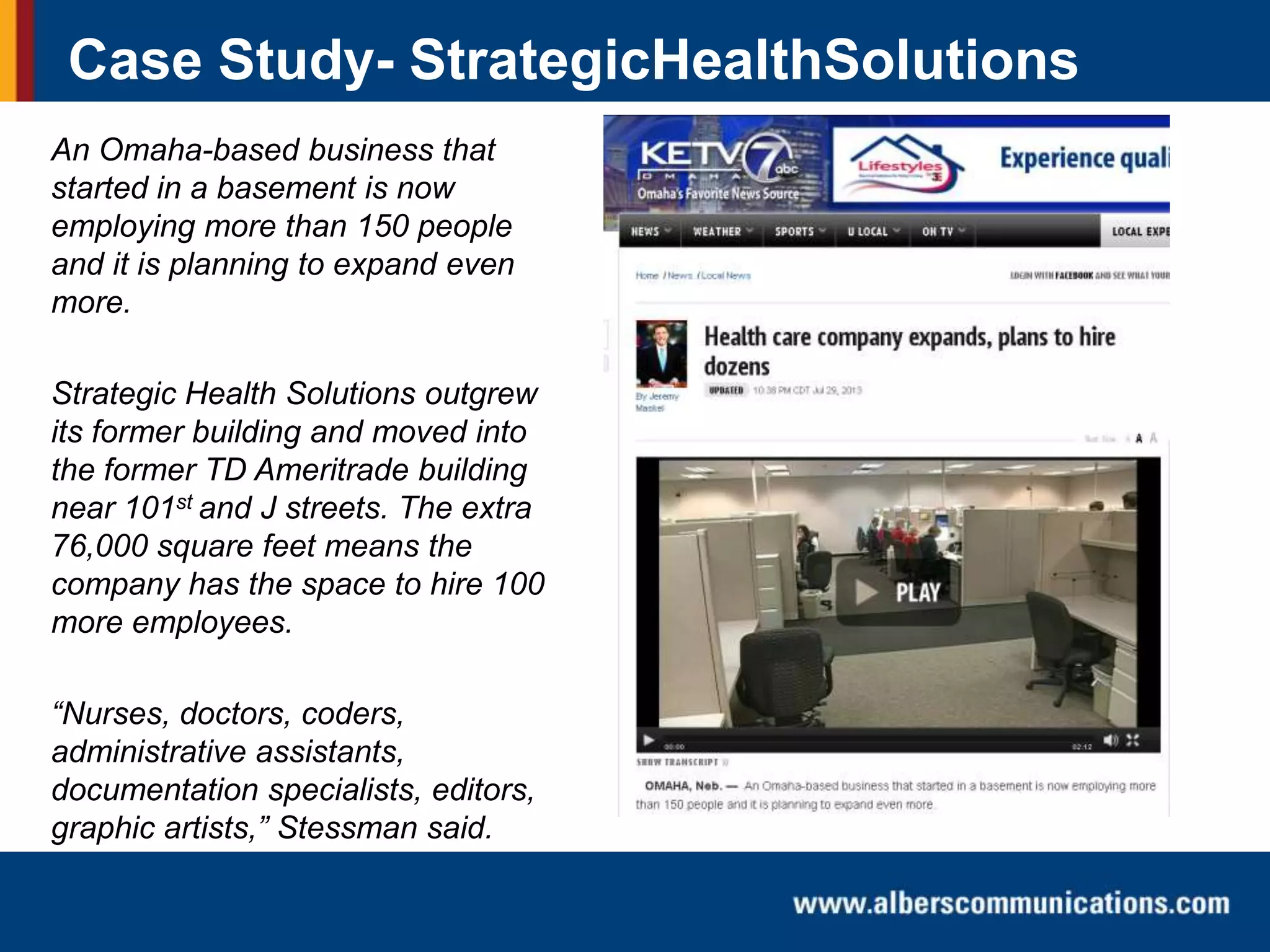
An Omaha-based business that
started in a basement is now
employing more than 150 people
and it is planning to expand even
more.
Strategic Health Solutions outgrew
its former building and moved into
the former TD Ameritrade building
near 101st and J streets. The extra
76,000 square feet means the
company has the space to hire 100
more employees.
“Nurses, doctors, coders,
administrative assistants,
documentation specialists, editors,
graphic artists,” Stessman said.
Case Study- StrategicHealthSolutions
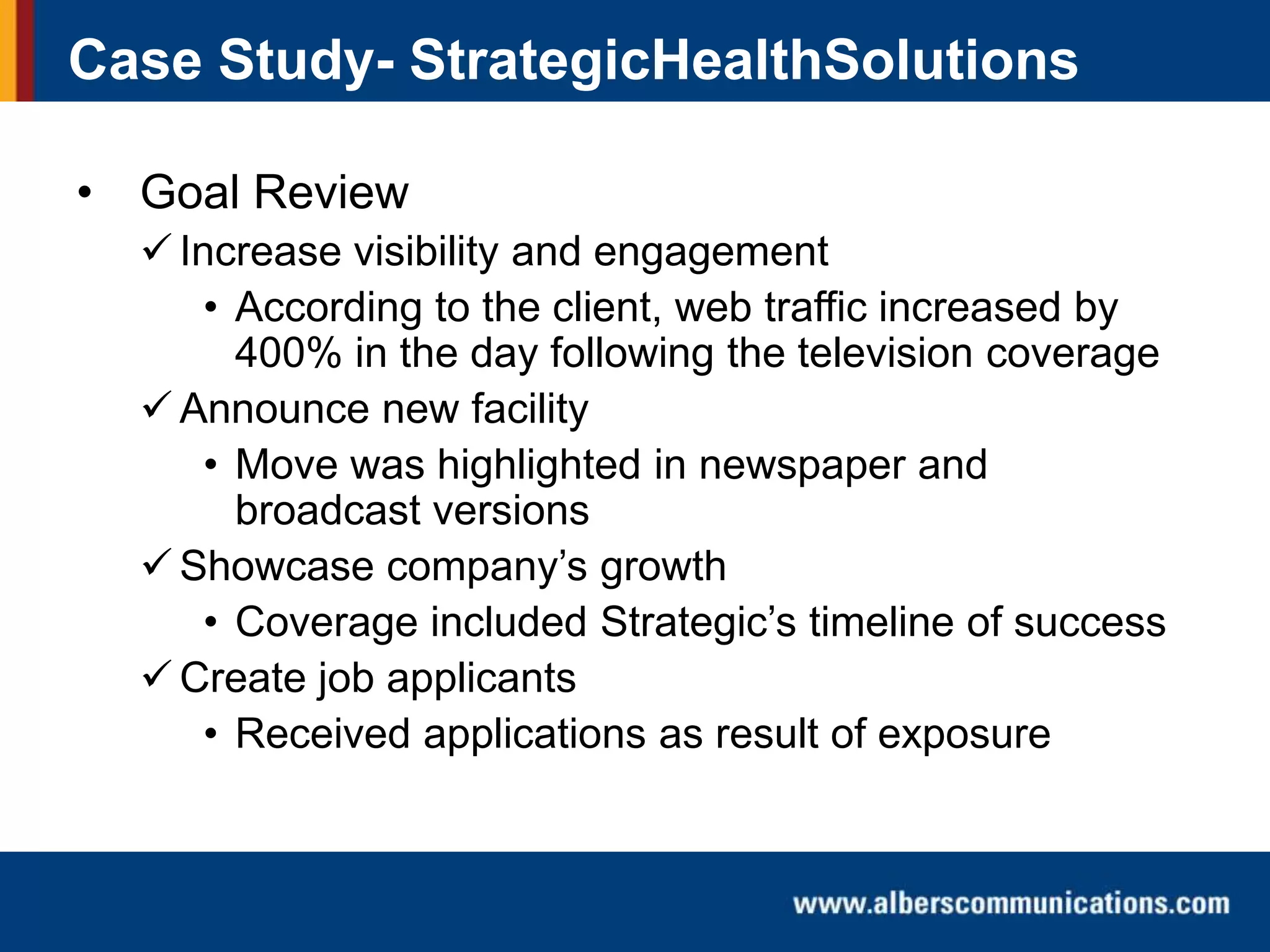
• Goal Review
 Increase visibility and engagement
• According to the client, web traffic increased by
400% in the day following the television coverage
 Announce new facility
• Move was highlighted in newspaper and
broadcast versions
 Showcase company’s growth
• Coverage included Strategic’s timeline of success
 Create job applicants
• Received applications as result of exposure
Upcoming Webinar
PR Planning for a New Year
o Wednesday, October 16, 2013, 10 a.m. Central
o Facilitated by Gina Pappas, Director of New Media

Pre-register at
www.alberscommunications.com/learningopportunities
Questions and Discussion

Media Interview Essentials: Tell Your Story Like a Pro

  • 1.
    Media Interview Essentials: TellYour Story Like a Pro To access the audio for today’s event, dial 1-866-740-1260 and enter code 2925553#.
  • 2.
    About Albers CommunicationsGroup • Full-service PR, social media and marketing communications agency • Specialize in integrated strategies • Represent clients in all 50 states and Canada • Create national and local market exposure
  • 3.
    Today’s Topics • Workingwith the media • Identifying goals • Developing key messages • Avoiding misquotes • Maintaining control • Case study
  • 4.
    Types of InterviewOpportunities • Television • Live or Recorded • Newspaper • In person, on the phone or via email • Radio • In person or on the phone
  • 5.
    Benefits of MediaExposure • It’s credible • It’s memorable • It’s lasting • It’s free
  • 6.
    Working with theMedia • Responsiveness is critical • Reporters aren’t specialists • Final content is in the hands of reporters/editors • Good relationships matter
  • 7.
    Interview Agenda • Reporter’sAgenda • Informing their audience • Accuracy • Meeting their deadline • Your Agenda • Meet objectives • Deliver key messages • Maintain control
  • 8.
    Ground Rules • Whatyou should know • • • • • Who is interviewing you When/where the story will run General direction/angle of the story Who else is being interviewed for the story You have the right to decline to interview • What you shouldn’t expect • Know questions in advance • Review/approve the story before it runs • Get a retraction
  • 9.
    Before the Interview •Determine objectives • Develop message points • Write down key messages • Practice out loud • Make time to prepare • Provide support materials • Press releases • Fact sheets • Executive summaries
  • 10.
    During the Interview •Stick to message points • Get them out early and often • Look for opportunities to bridge • Use notes when possible • Be conversational • Use specific examples
  • 11.
    During the Interview •Be quotable • Don’t ramble • Be concise • Avoid jargon • Assume everything is on the record • Correct mistakes
  • 12.
    During the Interview •Never say “no comment” • Take advantage of every opportunity • Anything to add? • Reinforce key messages • Restate earlier comments • Provide information not included earlier
  • 13.
    After the Interview •Thank the reporter • Enhance the exposure with your owned and shared media • Evaluate your performance
  • 14.
    Best Practices • Television •Talk in sound bites • Look your best • Look at the reporter not the camera • Watch non-verbal communication • Assume the camera is rolling
  • 15.
    Best Practices • Newspaper •Give them time • Offer fact sheets • Suggest photos • Clarify your points
  • 16.
    Best Practices • Radio •Speak succinctly • Find out if it is live or taped • Speak clearly • Limit distractions and background noise
  • 17.
    Case Study- StrategicHealthSolutions •Identify Goals • • • • Increase visibility and engagement Announce new facility Showcase company’s growth Create job applicants
  • 18.
    Case Study- StrategicHealthSolutions •Key Messages • Strategic has experienced amazing growth. We’ve outgrown our former space and needed a new facility that can keep up with our continuing expansion. • We’re currently hiring. Strategic has openings for 100 employees - anything from coding specialists and graphic designers to medical review nurses. Information is available on our website.
  • 19.
    Case Study- StrategicHealthSolutions StrategicHealthSolutionshas moved its 136 Omaha staff members into TD Ameritrade's former office at 4211 S. 102nd St. to make room for the growth. Over the next six to eight months, its expanded Medicare and Medicaid contracts will require adding 100 or more new employees. Nearly all the new hires will have college degrees, many of them nurses with experience in medical records reviewing and related skills. The company also hires lawyers, doctors, pharmacists and other professionals.
  • 20.
    Case Study- StrategicHealthSolutions AnOmaha-based business that started in a basement is now employing more than 150 people and it is planning to expand even more. Strategic Health Solutions outgrew its former building and moved into the former TD Ameritrade building near 101st and J streets. The extra 76,000 square feet means the company has the space to hire 100 more employees. “Nurses, doctors, coders, administrative assistants, documentation specialists, editors, graphic artists,” Stessman said.
  • 21.
  • 22.
    Case Study- StrategicHealthSolutions •Goal Review  Increase visibility and engagement • According to the client, web traffic increased by 400% in the day following the television coverage  Announce new facility • Move was highlighted in newspaper and broadcast versions  Showcase company’s growth • Coverage included Strategic’s timeline of success  Create job applicants • Received applications as result of exposure
  • 23.
    Upcoming Webinar PR Planningfor a New Year o Wednesday, October 16, 2013, 10 a.m. Central o Facilitated by Gina Pappas, Director of New Media Pre-register at www.alberscommunications.com/learningopportunities
  • 24.

Editor's Notes

  • #2 Good morning everyone, and welcome to today’s webinar. My name is Debbie Hilt… and I will be presenting today’s content. Before we get started, I’d like to cover a few administrative details.  If you experience any technical problems on the call, please contact ReadyTalk customer service at (800) 843-9166.  The presentation will take approximately 25 minutes – depending on the number of questions.The lines on today’s call have been muted to avoid any background noise… but youcan use the chat function in the lower left side of your screen to chat in your questions throughout the webinar, and I will answer them at the end. I will be recording today’s webinar and sharing the link with you via email, in case you’d like to review it again or share it with others in your office. Now, I’m going to set up the webinar recording and then we’ll get started. Welcome to today’s webinar titled Media Interview Essentials: Tell Your Story Like a Pro. My name is Debbie Hilt, and I’m the Vice President and Director of Public Relations at Albers Communications Group.
  • #3 First, let me tell you a bit about Albers Communications Group. We are a full-service PR and social media agency headquartered in Omaha, Nebraska. We strongly believe that PR and social media go hand in hand and work best when used as part of an integrated communications strategy.  We represent clients in all 50 states and Canada – where our PR and social media specialist helps our clients achieve positive exposure nationally and locally in their operating markets throughout the country. We have specialized expertise working with companies that have franchises, offices or branch locations in multiple cities.
  • #4 Here’s a look at the topics we will be covering today: We’ll talk about some general rules for working with the media And how to identify your goals for each media interview We’ll also discuss the importance of developing and practicing key messages… how you can avoid being misquoted… and maintain control throughout the interview And we’ll conclude with a recent case study from one of our clients- Strategic Health Solutions.  Just a reminder that you can chat in your questions today using the chat function located in the lower left-hand side of your screen and I will answer questions at the end.
  • #5 Media interviews are most often conducted for three traditional outlets – television, newspaper and radio.With television – interviews are either live or recorded… and they can be conducted in the studio or out in the field.Newspaper interviews have changed over the years. They used to almost always be conducted in person… however, because of significant changes in the industry, reporters are strapped for time and many interviews are now conducted over the phone or even by email.Like TV… radio interviews are either live or recorded. If the interview is recorded… it’s typically done over the phone.
  • #6 Earned media exposure has four core benefits: It’s credible… it’s memorable… it’s lasting… and, best of all, it’s free.Having your story told by a third-party, such as your local newspaper or television station, lends a credibility that purchased advertising simply cannot match. This type of storytelling is often memorable because it typically relates back to a solution, advice or other worthwhile information that your business was able to provide for the community. And it’s lasting – how many people do you know who have clipped an ad out of the paper and saved it? Not many. But it’s not uncommon for people to hang onto stories that have made an impact.
  • #7 There are certain rules of thumb that apply to all media interviews – regardless of the type of outlet.First and foremost… it’s important to be responsive. All reporters work on deadlines – and they will be counting on you to help them meet them. When a reporter calls… respond immediately and, if you choose to participate in the story, set an interview time that works for both of you. That does not mean that you should do the interview during that initial call – you should always give yourself time to prepare. We’ll cover that in just a bit… just remember to never do an interview cold.It’s also important to remember that reporters are not specialists – they often know a little about a lot of topics and industries instead of a lot about one topic or industry. Because of that… it’s always a good idea before any interview to educate the reporter about the topic they’re covering or even your industry. That will help them ask better questions – and ultimately result in better stories.You should also know that the final content of any story lies with the reporters and editors. You can develop great message points and deliver them flawlessly… but the story still might not turn out the way you had hoped.Finally… good relationships matter. Every reporter has “go-to” contacts – those people that he or she knows they can count on for good, timely interviews and accurate information. If you help them develop a good story – and meet their deadlines – they will likely come back to you again when developing positive stories and they may be more considerate of you in the event of negative coverage.
  • #8 With every interview – there are two different agendas at play.The reporter’s goal is to develop a story that informs the audience about an important topic. The story must be accurate and the reporter must meet his or her deadline – which is often very tight – maybe only a few hours.For you… there has to be some benefit for you taking the time out of a busy day to meet with a reporter… in most cases that’s the opportunity to establish yourself as an expert in your field and deliver positive messages about your organization or event.So your agenda is to determine your objectives and then deliver the key messages that will help you meet your goals and help you maintain control over the interview.
  • #9 With all interviews there are things you are entitled to know… and things you should not expect.Always ask who is interviewing you – if it’s the investigative reporter, there may be more at play than you were led to believe.You have the right to know when and where the story will run… as well as the general direction or angle of the story. Keep in mind that reporters will not always be completely upfront when trying to get you to agree to an interview… so it’s a good idea to do a little digging, so you can get as much information about the angle of the story as you can.You also have the right to know who else is being interviewed for the story – which may help you decide whether or not you want to or should participate.And you have the right of refusal – you should not participate in any interview with which you’re not completely comfortable or that may end up reflecting badly on you or your company. In some cases, it’s best to issue a written statement instead of agreeing to an interview.As for what you shouldn’t expect… while you are entitled to know the general direction or angle of the story, don’t expect to see the reporter’s questions in advance. You also should not expect to review or approve the story before it runs or get a retraction if there’s a minor error.
  • #10 So… you’ve agreed to an interview – now what?The first thing you should do is determine your objectives – what do you want to accomplish by participating in the interview.After you have determined your objectives… develop the message points that will help you accomplish your goals. Write down the three or four key messages you want to deliver and then practice them out loud. Always give yourself time to prepare – even if you’ve done dozens of interviews, you should always give yourself some time to gather your thoughts and practice your message points. Never do an interview cold.It’s also a good idea to provide the reporter with support materials, if possible – press releases, fact sheets or executive summaries. This will help them develop good questions – which will ultimately result in a better story.
  • #11 Once the interview begins… focus on your message points. Remember… you’re not there to simply answer the reporter’s questions… you have a job to do.Get your message points out early and often… and take advantage of every opportunity to work them into the interview. If the reporter doesn’t ask a question that gives you an opportunity to deliver your key messages – let them know that you have additional information that they might find helpful. They want a complete and accurate story… so they likely will welcome any information you can give them. If the reporter strays from what you think is the main message… you can often redirect with bridging techniques. You see this a lot with politicians who are being interviewed during those Sunday morning news shows. They will often bridge to their message points with language like – “while that may be the case… the important thing to remember is…” or “I can’t speak to that issue, but what I can tell you is…” By using these techniques you can likely get the interview back on track.If you’re not on camera… feel free to refer to written message points and other notes.Be conversational… but remember it’s not a casual conversation. You don’t want to get too comfortable… because you might say something you wish you hadn’t.And… whenever possible… use specific examples to reinforce your messages.
  • #12 One of the reasons we encourage you to develop and practice message points is so you can provide the reporter with good, usable quotes. Try to speak in “sound bites” -- concise messages that don’t require a lot of editing. I can’t tell you the number of times I’ve heard people say “they didn’t use the part that I wanted them to use.” Well… if you don’t want them to use it… don’t say it. Also avoid jargon or terms that may be specific only to your industry – use language that everyone in the audience will understand. And know that everything you say to the reporter could be included in the story. The days of information being “off the record” are long gone – even in a casual setting. I once had a client who was at a Chamber of Commerce dinner – sitting next to the business editor of her local paper. They had a very nice conversation over dinner… which, in turn, was included in a story about her company the very next day. It was a positive story… but one she certainly hadn’t planned or prepared for.If you make a mistake during the interview… correct it… and be sure to correct the reporter if he or she makes a mistake.
  • #13 Never say “no comment”. Why… because it implies you have something to hide. If a reporter asks you a question you don’t want to answer…instead of saying “no comment” use the bridging techniques we talked about to redirect to your message points.And, finally… as I said earlier… take advantage of every opportunity to deliver your message points. Reporters often ask at the end of interviews – “do you have anything else to add?” Most people almost always say no... which means they’re passing up an opportunity to reinforce their key messages… to restate comments made earlier in the interview… or to provide information that the reporter may not have asked for… but should know.
  • #14 Once the interview is over… there’s still some work to do.Be sure to thank the reporter and encourage him or her to contact you if they have additional questions or need clarification. Enhance positive exposure by sharing links to stories on your website, Facebook page and other social media outlets.And, finally, take a good look at the story or interview and rate your performance. Note the things you did well and would like to repeat in future interviews… as well as those things you would like to improve.
  • #15 Before we move to our case study… I want to pass a long a few tips that are specific for each type of outlet… starting with Television.Think sound bites! TV interviews tend to be short, so keep your answers brief, focusing on your key message points. Look your best. This is the one interview situation that requires you to really think about your appearance. Solid, conservative colors are often best.Look at the reporter not the camera. During the interview, maintain good eye contact with the reporter. View the interview as a conversation with the reporter. Watch non verbal communication. Assume the camera is always focused on you; watch facial expressions, body language and posture. Sit up straight and lean forward to convey that you are engaged in the interview. Let your passion for the topic show. Assume the camera is rolling. Take care at all times when talking with the reporter, because the camera could be live. The same goes for the microphone – always assume it’s hot… especially if it’s on your lapel.
  • #16 When working with a newspaper reporter…Give them time. Newspaper and magazine journalists typically work on larger, more in-depth stories than radio and TV journalists. This means that the interviews are typically longer. Offer fact sheets. It is especially important to offer fact sheets to newspaper journalists. Again, they are typically developing longer stories and will appreciate any background information or statistics that you can provide to them. Suggest photos. Don’t be afraid to suggest that the newspaper take a photograph to use with its story. Clarify your points. Unlike live TV and radio, with newspaper you have the opportunity to offer clarification to the reporter after an interview. An email is a good way to offer further clarification on something you said during an interview.
  • #17 And… for radio… Find out if it will be live or taped. This information can help you better prepare for the interview.Be concise. The interview will most likely be brief, so keep your answers that way.Speak clearly. Remember who your audience is. Most of the listeners will be busy doing something else – driving or working -- so it will be difficult for them to catch every word you say… and remember to avoid jargon or technical language.Limit distractions. If the interview is being conducted over the phone.. find a quiet room – away from the computer and other distractions – so you can concentrate. Also… use a landline, when possible, instead of a cell phone – the quality will be much better and you don’t have to worry about the call dropping during the interview.
  • #18 At this time, I would like to share with you a case study on great media interview preparation and message delivery. One of our clients is StrategicHealthSolutions – a contractor that works with the Federal government to improve the quality, efficiency and value of health care. We wanted to announce their move to a new, high profile facility…and also work in other messaging about their recruitment efforts. Prior to developing the media pitch, our team worked to identify the goals for the media coverage. They included:Increasing Strategic’s profile among its target audienceAnnouncing their move to the new, larger facilityShowcasing the company’s impressive growth since it was foundedAnd generating qualified applicants to fill approximately 100 available positions
  • #19 Upon identifying our goals, we were able to construct a pitch for the news media and simultaneously develop message points to be used during interviews that resulted from the pitch. The key messages included:Strategic has experienced amazing growth. We’ve outgrown our former space and needed a new facility that can keep up with our continuing expansionAndWe’re currently hiring. Strategic has openings for approximately 100 employees, from coding specialists to graphic designers to medical review nurses. Visit our website to learn more.Coaching our media spokesperson, the company’s founder, on these message points allowed Strategic to retain control of the interview and ensure the final product included content that would help them achieve their goals.
  • #20 One story that resulted from our efforts was printed in the Omaha World-Herald and posted on the newspaper’s website. You can see on the slide, both of our message points made it into the final story – “make room for growth” illustrates how the company has grown and its plans to continue doing so, and “adding 100+ new employees” (and including details about the type of qualifications needed for the open positions) helps accomplish the aggressive goal of recruiting qualified job candidates.
  • #21 We received additional coverage of Strategic’s story on KETV, the ABC affiliate in Omaha. Again, our message points were prominently carried through in both the on-air and online stories. Mentioning that Strategic started in owner Peg Stessman’s basement is a direct result of the message point we crafted about the company’s explosive growth, as are the lines about an “extra 76,000 square feet” to accommodate hiring “100 more employees.” Again, the types of employees needed at Strategic also made it into the story, helping encourage the most qualified applicants to consider a position with Strategic.
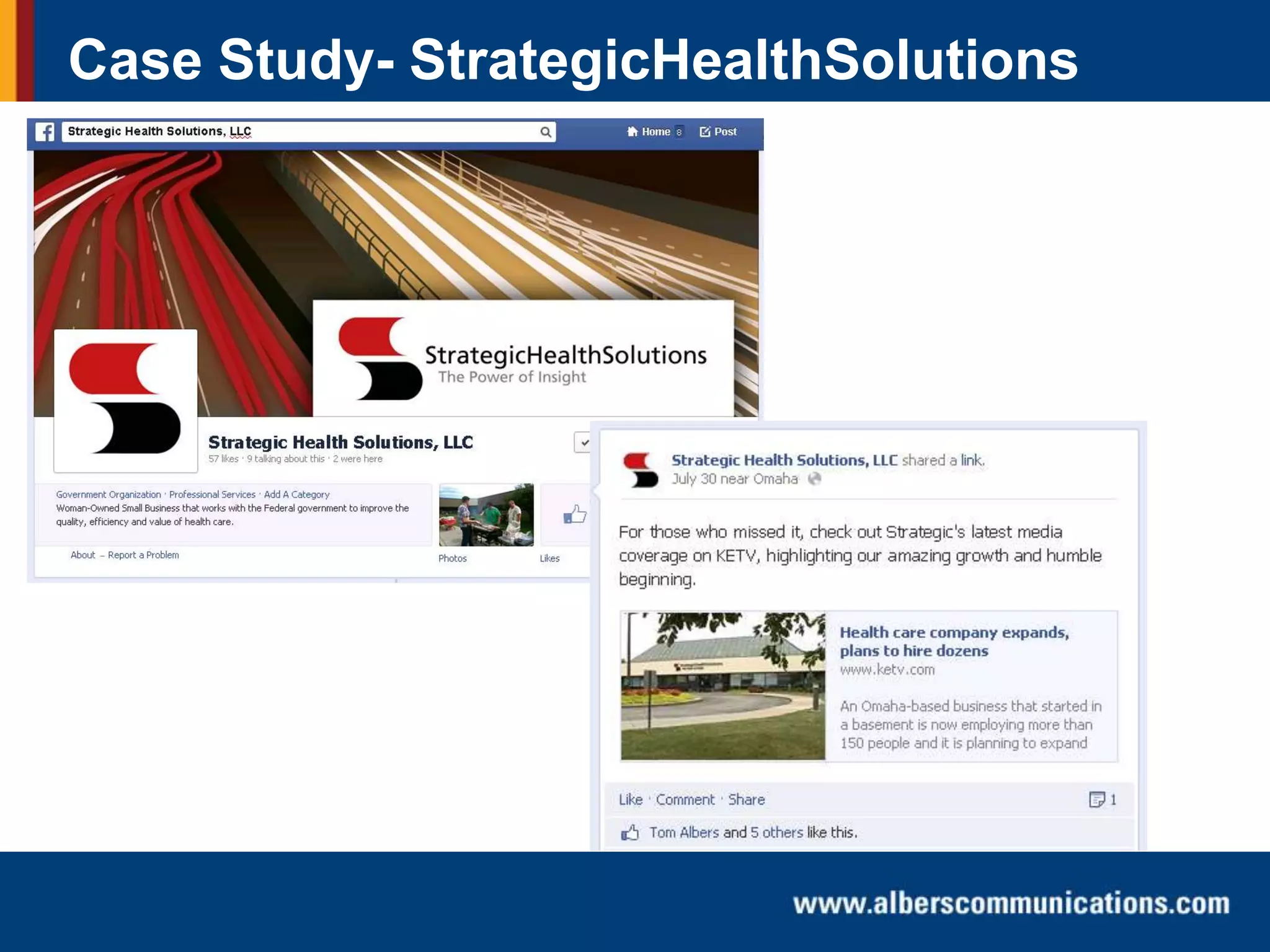
  • #22 To leverage the positive news coverage for our clients, we shared the story on the company’s Facebook and LinkedIn pages. Engagement was strong because the positive media coverage helped Strategic work toward the goals we established…. and the coverage inspired a sense of loyalty and pride among those currently employed by Strategic.
  • #23 Because measurement and evaluation is incorporated into all of our client work, we were able to provide the following analysis of StrategicHealthSolutions’ press opportunity. The outcomes tie directly back to the goals we set at the start of the campaign. Did we help Strategic increase its visibility and engagement? Yes; according to the client, web traffic increased 400% in the day following the KETV story. Next, did we announce the new facility? Yes; the move was prominently mentioned in both the Omaha World-Herald print and online coverage as well as the KETV on-air and online coverage. Did we showcase Strategic’s growth? Yes; the message point about growth was shared by pointing out that the company was founded in its owner’s basement and has now taken over a 75,000 square-foot-building. Lastly, did the coverage generate job applicants? Yes, it did. Applications spiked in the days and weeks following the press coverage.
  • #24 Before getting to your questions, I wanted to tell you about an upcoming webinar in our ongoing series.  On October 16th, our Director of New Media Gina Pappas will talk through the essentials of planningfor PR and social media success in 2014.  You can register for these webinars at: www.alberscommunications.com/learningopportunities  This is the same place that you can go to listen to recordings of all of our past presentations.
  • #25 Also… when this presentation ends, a questionnaire will appear on your screen. If you don’t mind taking a few minutes to provide your comments about today’s webinar or share topic suggestions you’d like us to address in future webinars, we would value the feedback.  And now I’d like to answer any questions you have. If you haven’t done so already, please feel free to chat in your questions.