Your Job and Your Online Image:
It’s Complicated
To access the audio for today’s event,
dial 1-866-740-1260 and enter code 2925553#.
About Albers Communications Group
• Full-service PR, digital marketing and
communications agency
• Specialize in integrated strategies
• Represent clients in all 50 states and Canada
• Work with Omaha’s leading organizations
• Create national and local market exposure
Today’s Presenter
• Alison Paladino, Public Relations Specialist
• Alison@AlbersCommunications.com
• @alisonpaladino
Our Big Idea
Today’s Topics
• What Omaha-area businesses are saying about
their employees’ social media habits
• How you can become an advocate for your
company online
• How to use your social media profiles to support
your résumé and work towards your next
level position
• Questions and discussion
Omaha Research Results
Survey Methodology
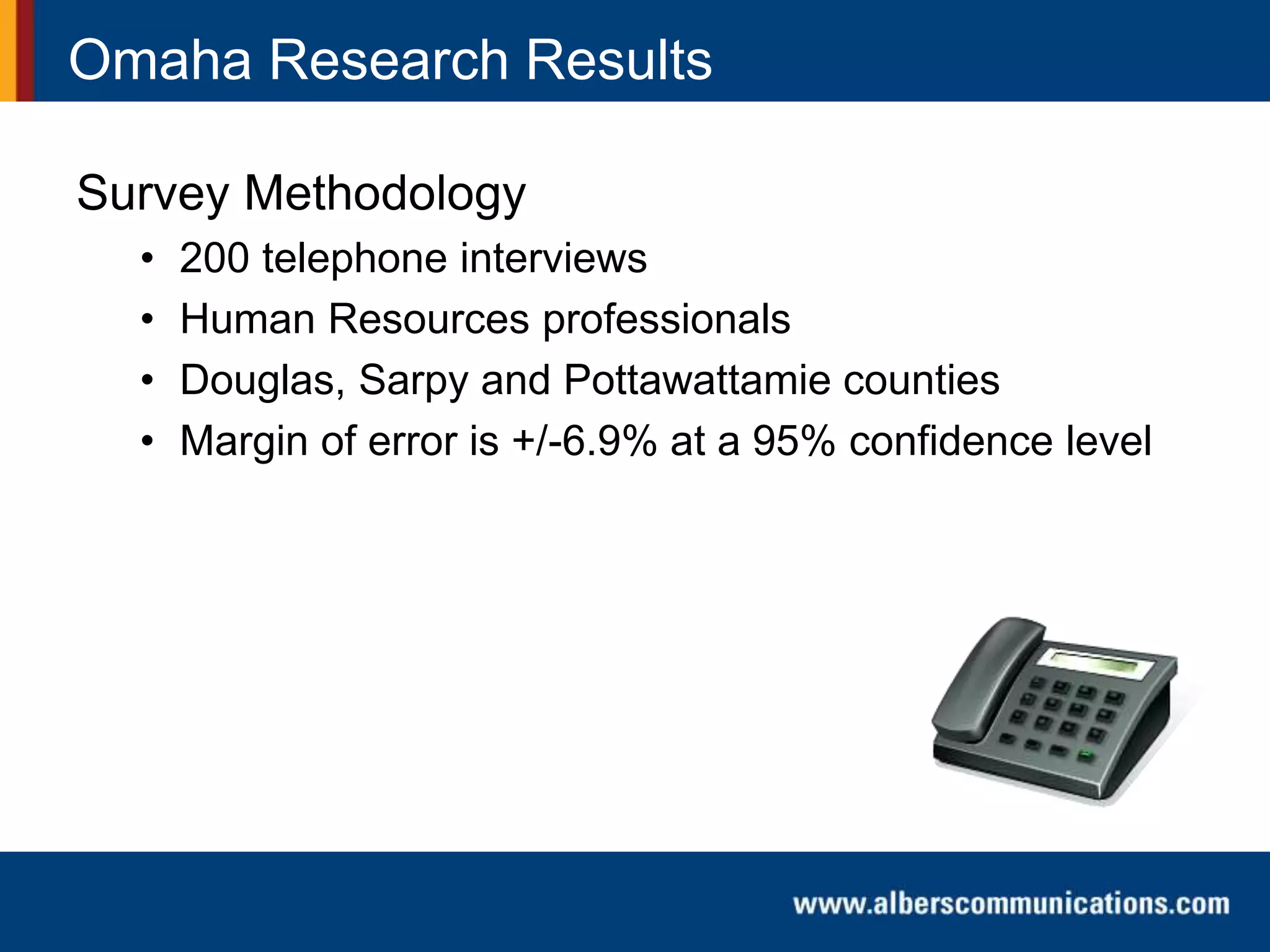
• 200 telephone interviews
• Human Resources professionals
• Douglas, Sarpy and Pottawattamie counties
• Margin of error is +/-6.9% at a 95% confidence level
Omaha Research Results
89%
75%
65%
Social Media and Your Career
Employers who review Facebook during the hiring process
Employers who say professionalism on social media is important
Employers who view social media as an important soft skill
Omaha Research Results
87%
59%
51%
Social Media and Your Company
Employers who believe social media content can reflect positively or negatively
Employers who believe political opinions could potentially be damaging to their brand
Employers concerned that employees do not consider their actions
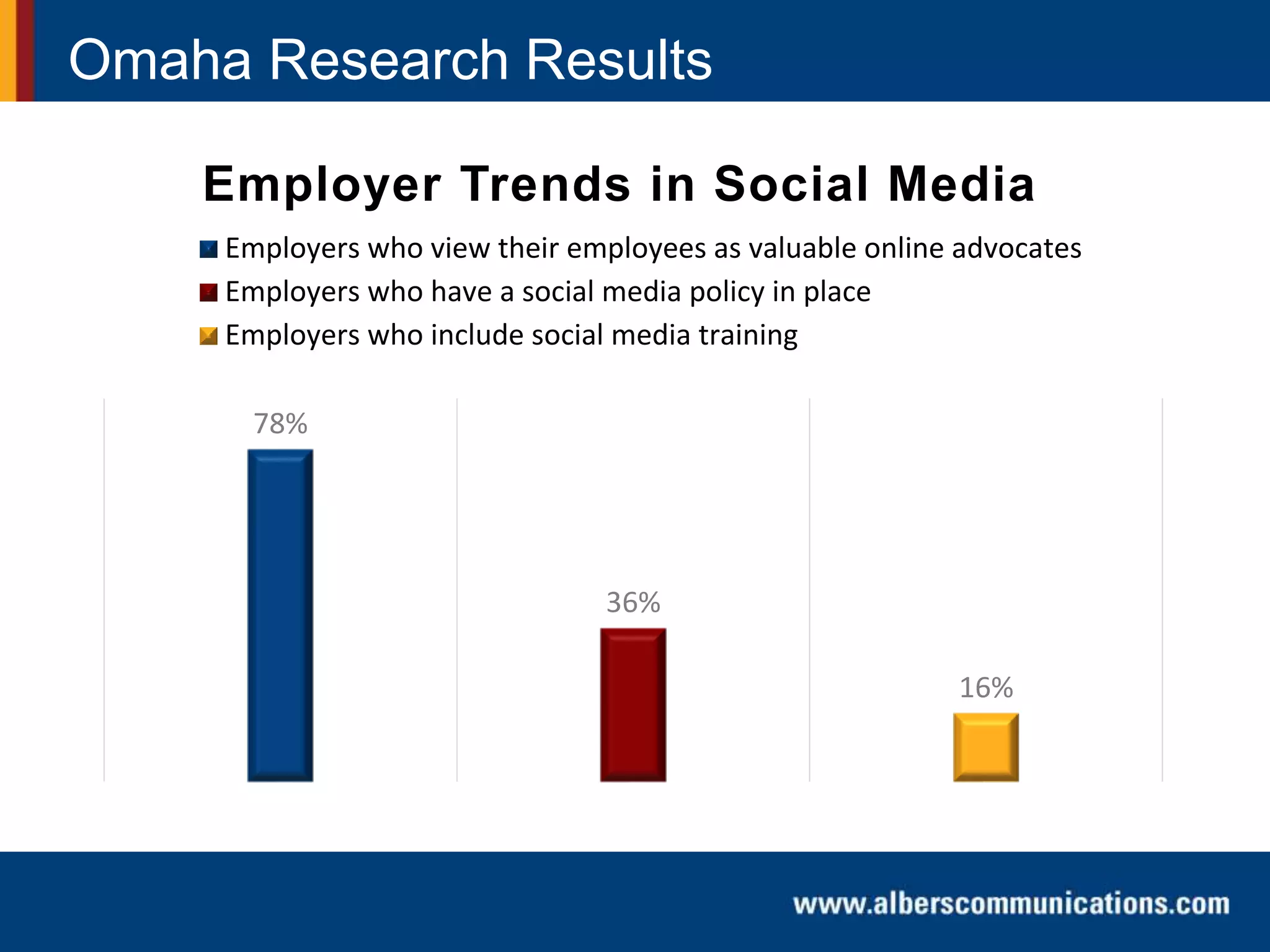
Omaha Research Results
78%
36%
16%
Employer Trends in Social Media
Employers who view their employees as valuable online advocates
Employers who have a social media policy in place
Employers who include social media training
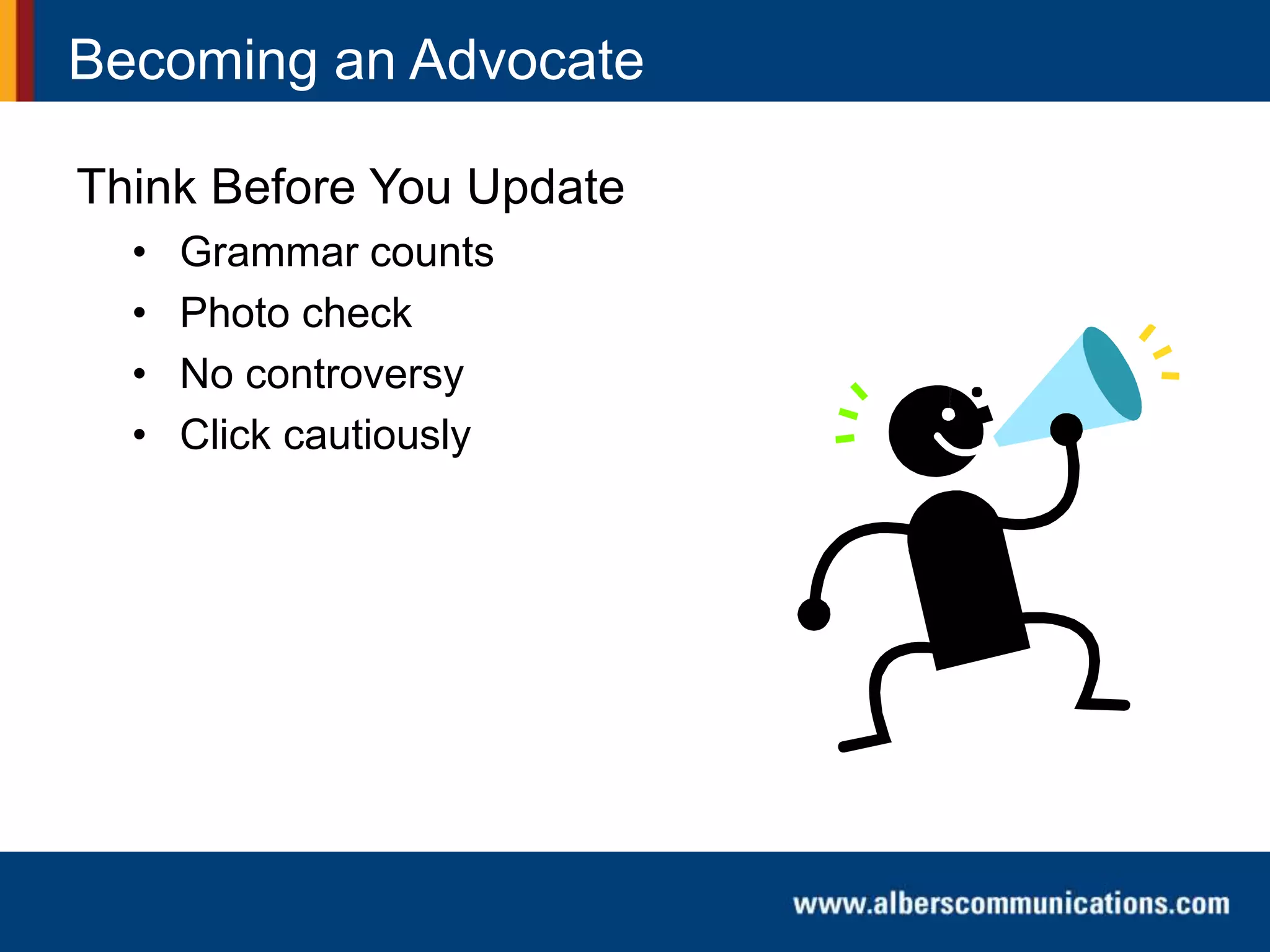
Becoming an Advocate
Think Before You Update
• Grammar counts
• Photo check
• No controversy
• Click cautiously
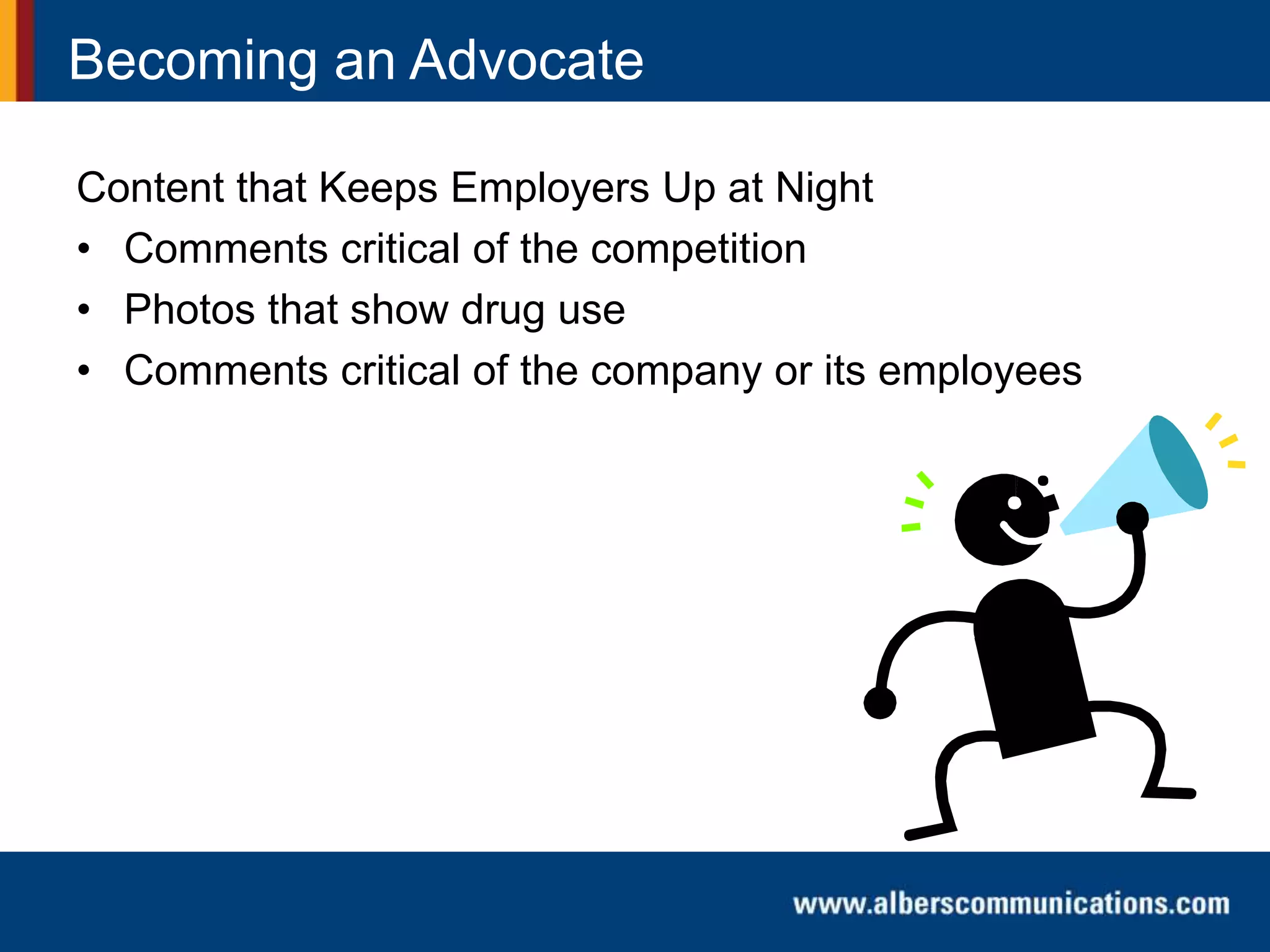
Becoming an Advocate
Content that Keeps Employers Up at Night
• Comments critical of the competition
• Photos that show drug use
• Comments critical of the company or its employees
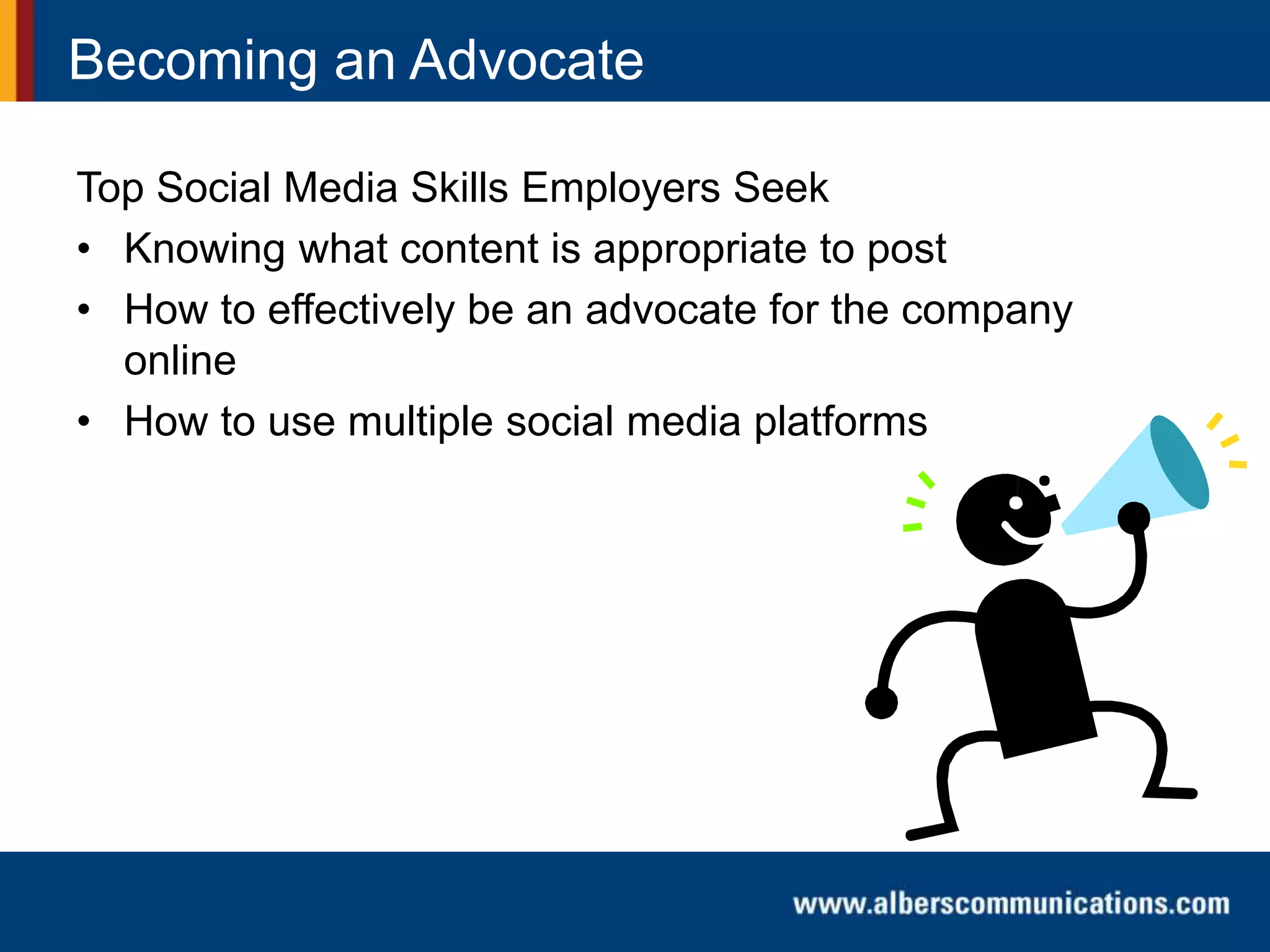
Becoming an Advocate
Top Social Media Skills Employers Seek
• Knowing what content is appropriate to post
• How to effectively be an advocate for the company
online
• How to use multiple social media platforms
Becoming an Advocate
Interact With Your Company
• Like, Follow and Connect
• Interact
• Re-post and Re-tweet
Reach the Next Level
• Take photos at professional events
• Share industry relevant news
• Post free opportunities from your company
• Spread the news about career opportunities
• Talk about your volunteer work
Reach the Next Level
• Don’t sell
• Resist over-updating
• Be friendly to the competition
• Omit client details
Reach the Next Level
Top Factors Prospective Employers Review
• Professionalism displayed on job candidate’s social
media profiles.
• How candidates talk about previous employers
• Whether candidate has a positive or negative reputation
online
• The maturity level of the content and photos they post
Social Media – A New Kind of Résumé
• Use social media to paint the picture of yourself
as a valued employee
• Provide the highlight reel to show your well-
rounded personal and professional image
• Develop social media as a soft skill
Albers Webinar Series
Research: The Beginning and The End
with Tom Albers
July 23, 2014 @ 10 a.m.
Register at www.alberscommunications.com/learning-opportunities
Questions and Discussion
Your Job and Your Online Image:
It’s Complicated

Your Job and Your Online Image: It’s Complicated

  • 1.
    Your Job andYour Online Image: It’s Complicated To access the audio for today’s event, dial 1-866-740-1260 and enter code 2925553#.
  • 2.
    About Albers CommunicationsGroup • Full-service PR, digital marketing and communications agency • Specialize in integrated strategies • Represent clients in all 50 states and Canada • Work with Omaha’s leading organizations • Create national and local market exposure
  • 3.
    Today’s Presenter • AlisonPaladino, Public Relations Specialist • Alison@AlbersCommunications.com • @alisonpaladino
  • 4.
  • 5.
    Today’s Topics • WhatOmaha-area businesses are saying about their employees’ social media habits • How you can become an advocate for your company online • How to use your social media profiles to support your résumé and work towards your next level position • Questions and discussion
  • 6.
    Omaha Research Results SurveyMethodology • 200 telephone interviews • Human Resources professionals • Douglas, Sarpy and Pottawattamie counties • Margin of error is +/-6.9% at a 95% confidence level
  • 7.
    Omaha Research Results 89% 75% 65% SocialMedia and Your Career Employers who review Facebook during the hiring process Employers who say professionalism on social media is important Employers who view social media as an important soft skill
  • 8.
    Omaha Research Results 87% 59% 51% SocialMedia and Your Company Employers who believe social media content can reflect positively or negatively Employers who believe political opinions could potentially be damaging to their brand Employers concerned that employees do not consider their actions
  • 9.
    Omaha Research Results 78% 36% 16% EmployerTrends in Social Media Employers who view their employees as valuable online advocates Employers who have a social media policy in place Employers who include social media training
  • 10.
    Becoming an Advocate ThinkBefore You Update • Grammar counts • Photo check • No controversy • Click cautiously
  • 11.
    Becoming an Advocate Contentthat Keeps Employers Up at Night • Comments critical of the competition • Photos that show drug use • Comments critical of the company or its employees
  • 12.
    Becoming an Advocate TopSocial Media Skills Employers Seek • Knowing what content is appropriate to post • How to effectively be an advocate for the company online • How to use multiple social media platforms
  • 13.
    Becoming an Advocate InteractWith Your Company • Like, Follow and Connect • Interact • Re-post and Re-tweet
  • 14.
    Reach the NextLevel • Take photos at professional events • Share industry relevant news • Post free opportunities from your company • Spread the news about career opportunities • Talk about your volunteer work
  • 15.
    Reach the NextLevel • Don’t sell • Resist over-updating • Be friendly to the competition • Omit client details
  • 16.
  • 17.
  • 18.
    Top Factors ProspectiveEmployers Review • Professionalism displayed on job candidate’s social media profiles. • How candidates talk about previous employers • Whether candidate has a positive or negative reputation online • The maturity level of the content and photos they post Social Media – A New Kind of Résumé
  • 19.
    Social Media –A New Kind of Résumé • Use social media to paint the picture of yourself as a valued employee • Provide the highlight reel to show your well- rounded personal and professional image • Develop social media as a soft skill
  • 20.
    Albers Webinar Series Research:The Beginning and The End with Tom Albers July 23, 2014 @ 10 a.m. Register at www.alberscommunications.com/learning-opportunities
  • 21.
  • 22.
    Your Job andYour Online Image: It’s Complicated

Editor's Notes

  • #2 {Broadcast chat to all: Thank you for joining us today! “Your Job and Your Online Image: It’s Complicated” will begin at 10 a.m. central time. To access the audio portion of the presentation, dial 1-866-740-1260 and enter code 2925553#} {Good morning! Thank you for joining us today! This is Alison Paladino with Albers Communications Group. “Your Job and Your Online Image” will begin at 10 a.m. – we’ll get started in about 10 minutes…} {Slow & Clear!} Good morning everyone, and welcome to today’s webinar. My name is Alison Paladino… and I will be presenting today’s content.   Before we get started, I’d like to cover a few administrative details.   If you experience any technical problems on the call, please contact ReadyTalk customer service at (800) 843-9166.   The presentation will take approximately 30 minutes – depending on the number of questions. The lines on today’s call have been muted to avoid any background noise… but you can use the chat function in the lower left side of your screen to chat in your questions throughout the webinar, and I will answer them at the end.   I will be recording today’s webinar and sharing the link with you via email, in case you’d like to review it again or share it with others in your office. Now, I’m going to set up the webinar recording and then we’ll get started. There will be a pause while the recording initiates. Welcome to today’s webinar – Your Job and Your Online Image: It’s Complicated. My name is Alison Paladino, and I am a Public Relations Specialist with Albers Communications Group.
  • #3 First, let me tell you a bit about Albers Communications Group.   We are a full-service PR, digital marketing and communications agency headquartered in Omaha, Nebraska. We strongly believe that PR and digital marketing go hand-in-hand and work best when used as part of an integrated communications strategy.   We represent clients in all 50 states and Canada – where our public relations and social media specialists help our clients achieve positive exposure nationally and locally in their operating markets. We are proud to help some of Omaha’s leading organizations reach their goals. We also have specialized expertise in helping companies become leaders in their markets and their industries.
  • #4 As I mentioned before, I am Alison Paladino, public relations specialist at Albers Communications Group. In my position, I help our clients increase their brand awareness through a variety of strategies including media relations, cause marketing and digital marketing. Feel free to email me if you’d like to speak in more detail about your company’s communications goals, and you can also follow me on Twitter @AlisonPaladino.
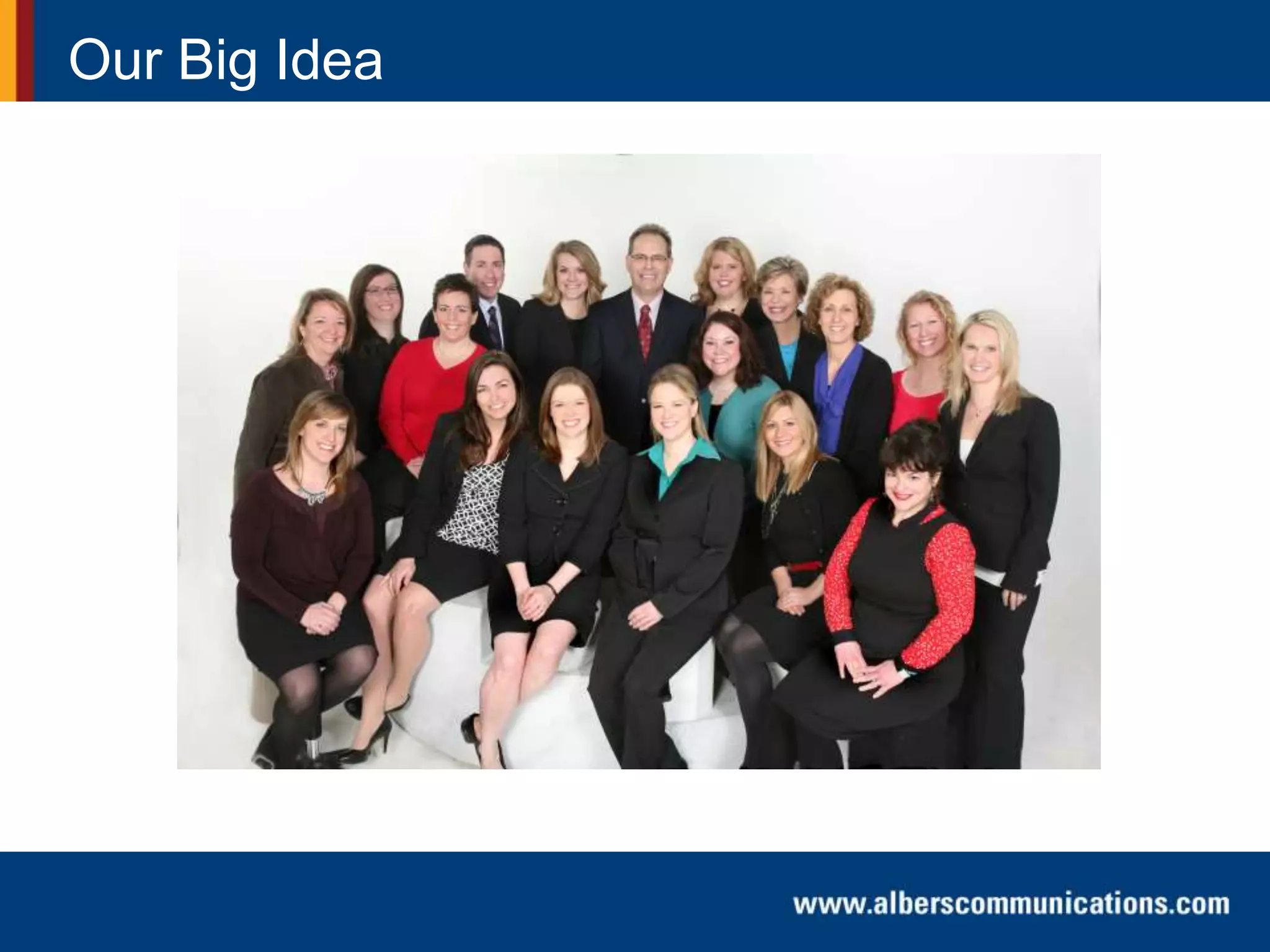
  • #5 In early 2013, the Albers Communications Group team sat around a conference table to discuss how we could impact our community in positive ways through our knowledge and expertise in the public relations and digital marketing industry. Ultimately we landed on one big idea that we thought could help both young professional job seekers and their employers. We liked the concept of contributing to the next generation of leaders and our business community at the same time and that is where “Your Job and Your Online Image: It’s Complicated” was born. When we started formulating ideas for this project, we put ourselves in the average social media user’s shoes and thought about what issues they may face as they search for a job or vie for a promotion. Then, we thought about the challenges employers face in terms of checking social media profiles as part of a background screening process. We developed so many questions from both the employer and employee perspectives that we knew it was time to do research. With our research we hoped to uncover exactly how area employers are viewing their employees’ social media profiles and what they think about them. We knew that would help young professionals in the market truly understand the impact their social media use can have on their careers and how they can craft their profiles in a positive way to show potential employers precisely the type of candidate they are looking for.
  • #6 {slowly & clearly!} Here’s a look at what we’ll be covering today. First, I will share the research that we recently conducted in the Omaha-area that reveals what employers think about their employees’ social media habits. Next, I’ll show you some ways you can become an advocate for your company online. After that, I will share how you can use your social media profiles to support your resume and work towards your next level position. And at the conclusion of the webinar, I will take a few moments to answer any questions that have been chatted in during the webinar.
  • #7 As I mentioned earlier, Albers Communications, LLC, completed research by conducting 200 telephone interviews with Human Resource professionals at companies located in metro-Omaha, primarily in Douglas, Sarpy and Pottawattamie counties. We asked a variety of questions regarding the employers’ views on their employees’ social media habits. To find out the impact social media has on an individual’s career, we asked how many employers check social media profiles as part of the hiring process and which social platforms they choose most often to check. We also asked questions to find out how they interpreted professionalism based on the employee’s online image. To get their views on how the social media use of an individual can effect a company, we asked these employers how concerned they were about their employees’ use of social media and its potential negative impact on their company’s brand or reputation. We also had them identify what types of content could be either damaging or inconsequential. We asked them if employees could be significant advocates for their brand. Outside of the hiring process, we wanted to find out exactly what type of focus employers are putting on social media. How many have social media policies developed for their employees? How many businesses provide training programs to show their employees what is acceptable?
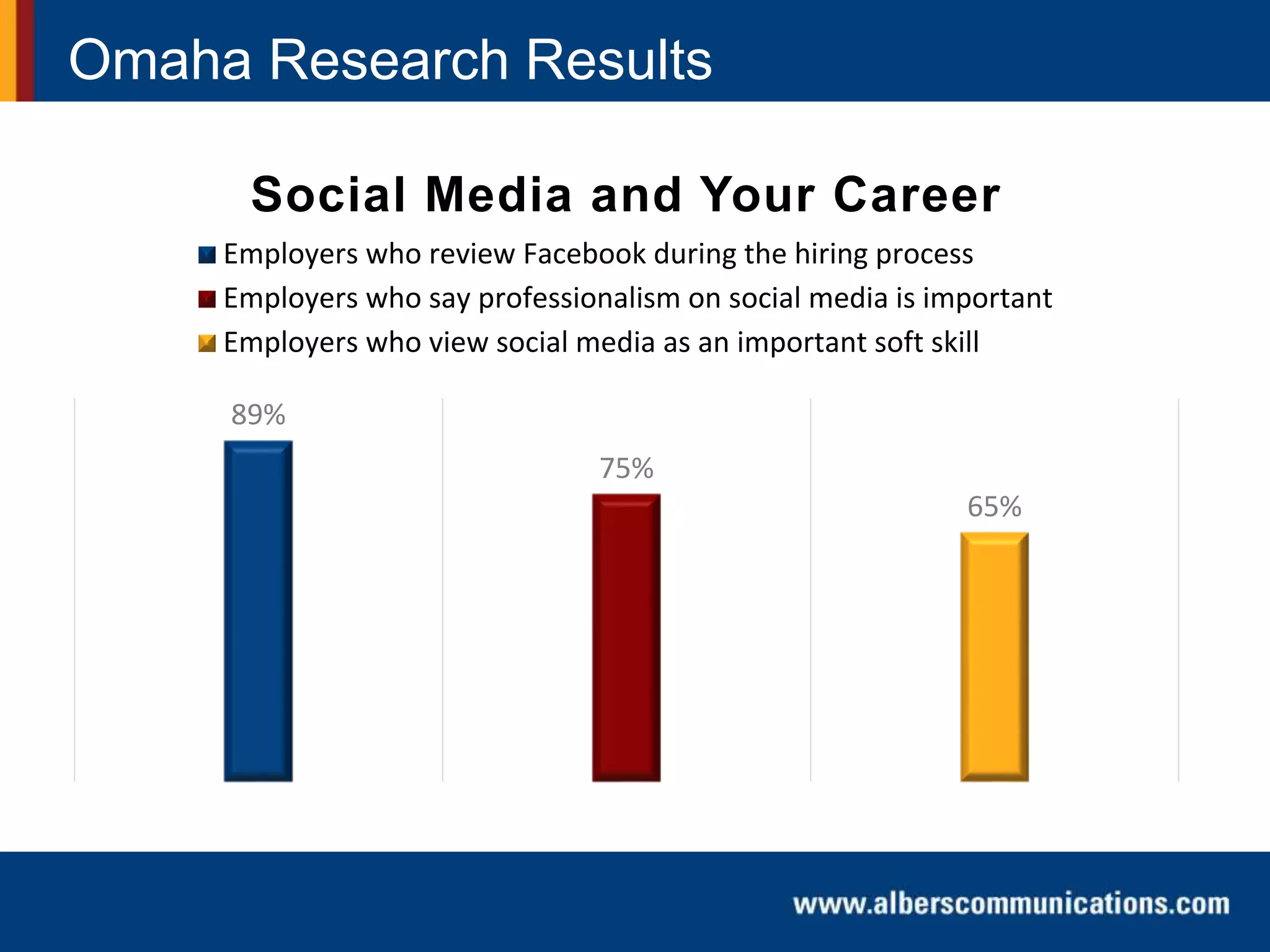
  • #8  First, let’s look at how this group of employers has responded regarding the usage of social media and its impact on careers. 89% of employers who look at social media as part of the hiring process look at Facebook. This comes as no surprise since Facebook is still the most popular social network online. Its important to keep all your social profiles in check, however. This group of employers also reviewed other social networks and 30% included Twitter in their response and another 30% mentioned LinkedIn as part of their hiring process checklist. 75% of employers say the professionalism displayed on prospective employees’ social media pages is important in evaluating them as job candidates. You can wear a suit to the interview and present the best hard copy resume in the pack, but your prospective employer is getting a 360 degree view of your professionalism by checking your online presence out during the interview process. and 65% of employers view social media as an important soft skill for employees that can enhance their job performance and career prospects. Right next to your ability to manage time efficiently, solve problems effectively and act as a team player goes your ability to be active and appropriate in your social media profiles. Later on in this webinar, I’ll show you some easy ways to start working this skill. Our research helped us answer an important question. Does your social media presence impact your career? Absolutely! Not only is the most popular social network being reviewed during the hiring process, its an indicator of your professionalism and is considered by more than half to be a modern soft skill.  
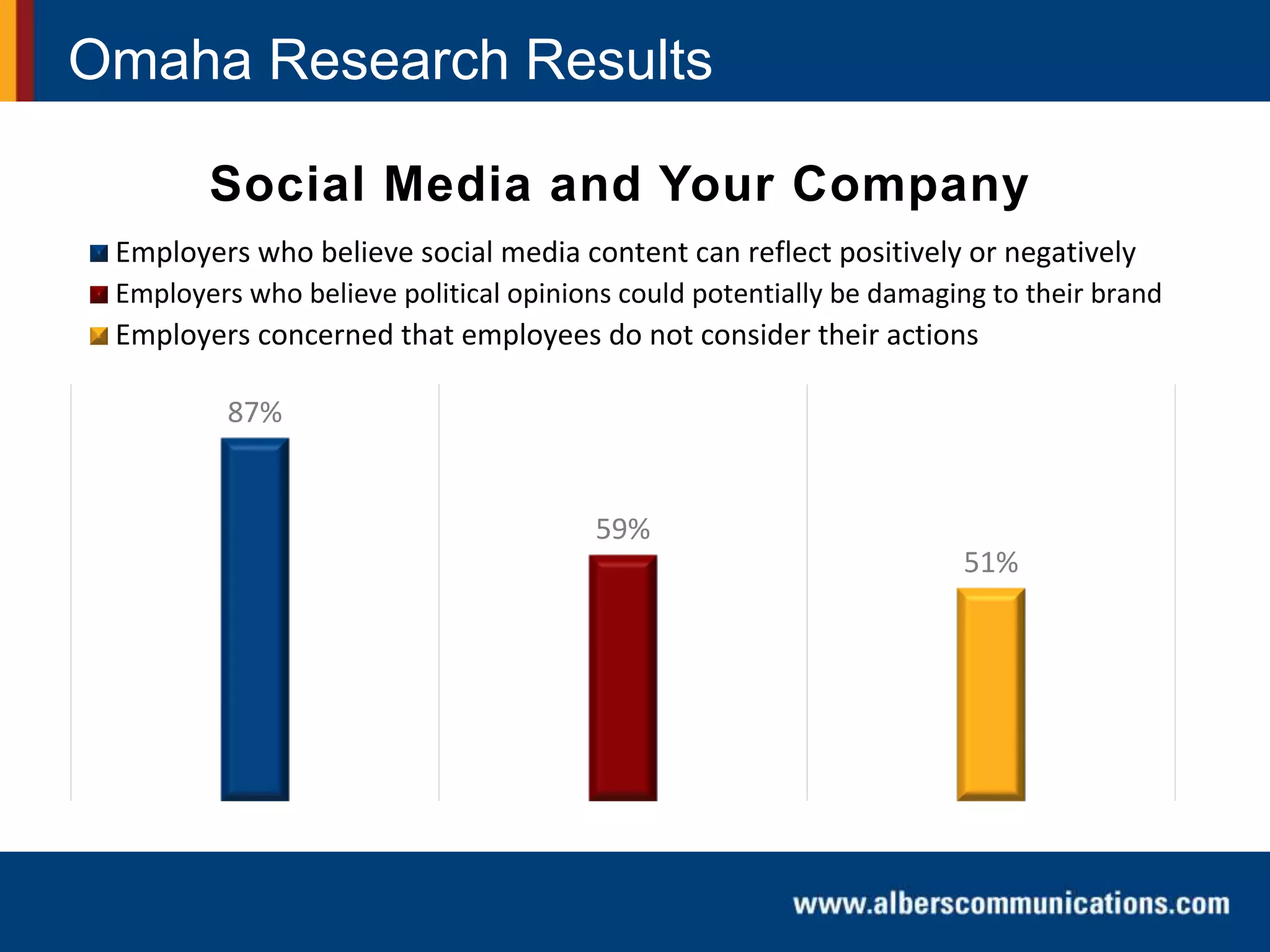
  • #9  We also asked survey participants questions about their employees’ use of social media and its impact on their company’s brand or reputation. Here’s how they responded: 87% of employers agree that the content that their employees post on their personal social media pages, such as Facebook, can reflect either negatively or positively on the company. 59% of employers say that political opinions or comments posted by employees to their personal social media pages could be damaging to the company’s brand or reputation.   and 51% of employers are concerned about their employees not always considering how their actions on social media may impact the company. You probably haven’t heard much guidance from your employer about the statuses you post on social media and for the most part they probably are neutral as to what you post. That is, until the content you post reflects poorly on their brand. Even if you don’t list your employer as part of your profile, its relatively easy to figure out where any social media user works. Putting a few puzzle pieces together from our large digital footprints online can give indication as to where you work or what industry you are a part of. This research tells us that our employers are concerned about content posted in our social profiles, and we should be too.  
  • #10  Here are some telling trends we spotted in the survey results. We found out that… 78% of employers view their employees as valuable online advocates for the brand. but only 36% of employers have a social media use policy that they circulate to employees. and just 16% of employers include social media training for their employees. This is perhaps the most interesting set of data points we have compared. We’ve already established that employers are not only using your online image as part of the hiring process, but also holding their employees’ social media usage as valuable extensions of their brands. So why isn’t there more education and policy being put into place? Here are a couple of possible reasons: Employers aren’t sure where to start. As part of a corporate communications strategy, regulating employees’ social media usage can be a touchy subject and can also involve the employees’ legal rights in some situations. The social media landscape is constantly changing and its difficult for employers to react and if they do create social media policy, it needs constant review to stay relevant. It’s difficult to keep the policy positive. Employers can very simply establish a “don’t list” for their employees’ social media usage, but offering encouragement is a challenge. We’re about to look at the “don’t list” and more importantly, the do’s to keep your profile polished and professional.  
  • #11 As we just learned, the majority of employers we surveyed view their employees as valuable advocates for their brand. Part of becoming an advocate is representing yourself and your company in a positive way. Here are a few guidelines to consider: Think before you update. Since more than half of employers we surveyed said they are concerned about their employees not always considering how their actions on social media may impact the company, its important to consider what you post. With the exception of LinkedIn, not everything you share should be business-related. After all, it is your personal profile and updates you provide to your networks are exactly that – personal. Posts should, however, always be appropriate. Here’s a quick check list: To your knowledge, does your post contain grammatical errors or incorrect spellings? It is easy to make an error or two while posting from your mobile device, but poor grammar can be reputation damaging when it comes in the form of run on sentences, missing punctuation or garbled thoughts. Take a look at what is in your photos. Did you experience a wardrobe malfunction? Did the party get the best of you? Is your pose not quite representative of the way you typically act? Make it a rule not to post photos until the day after an evening out with friends and make sure to set Timeline Review in your Facebook profile so you can keep an eye on your friends’ photos that may creep onto your page before you know it. Is it too controversial? Is your political statement meant to ignite a dramatic comment from one of your Facebook friends on the other side of the issue? Always be thoughtful and considerate of your social relationships when choosing to discuss topics concerning politics, religion and social issues. Or, at the very least, target your message to like-minded individuals through Facebook’s lists function. Click cautiously. Anything you like, comment or interact with has the potential to turn up in someone else’s news feed.
  • #12 When we were completing the research for this project, we really wanted to know what type of content is most important for social media users to stay away from. What keeps employers up at night? During the survey, we asked the group of Omaha employers how damaging they felt specific types of content to be, if posted by their employees. We asked about content such as provocative or inappropriate photos, drug and alcohol use, political opinions, crude humor and even critical or discriminatory comments. It is important to note that all of these content categories totaled a significant number of responses. The highest offenders were comments critical of the competition, photos that show drug use and comments critical of the company or its employees.
  • #13 Part of becoming an advocate is not only understanding what is appropriate, but how to use social media to represent your company in the best possible way. We asked the Omaha-area employers what specific skills are desired for their employees regarding social media usage. More than half responded saying that they find it important for their employees to not only use multiple social media platforms, but also to know how to use them effectively.
  • #14 Now let’s take a look at what you can do to socially interact with your company and become and advocate for your company’s brand in the most effective way. Interact with your Company. If you haven’t already, like your company on Facebook, follow them on Twitter, Instagram and other social platforms and of course, connect on LinkedIn. Interact with your company’s posts. This will not only let others know you have an interest in the business, but help your company’s profiles gain better engagement with your personal network. Re-post and Re-tweet company news, but always let your company tell their news first via the company website or official social profiles.
  • #15 By advocating knowledge and understanding of your workplace, industry and career, you can brand yourself as a professional expert in these topics. This may open you up to advancement within your current workplace or new career opportunities as well as the possibility for invitations to industry-related groups and professional designations. Here are a few ways you can polish up your profiles to support your career: Take photos when you attend professional events. Set Google news alerts using key words for industry related news and share what you find to be interesting, thought provoking and buzz worthy. Share free opportunities for those in your network to take part in what your company brings to the industry. If your company is hiring, let your social networks know by sharing the job posting in your social media profiles. Volunteer. If you donate time to a local charitable organization, your local chamber of commerce or community organization, make sure to post appropriately about it within your social media platforms. Be sensitive to when photos are acceptable and to what degree you can share your good deeds without appearing self-serving.
  • #16 Here are some updates to stay away from when working towards building your professional brand through your social media profiles: Don’t sell. Educating others on your industry in a subtle way is key. Pushing products or service repeatedly with a price attached is the quickest way to find yourself on the “unfriend list”. Resist over-updating. Constant status updates and tweets about work may become mundane to those who are not interested in your message and prefer to only hear from you socially. Be friendly to your competitor. Although you may believe your work and your company to be the best, the old adage always applies “treat others as you wish to be treated.” Never post updates attacking a competing business. Refer to your clients only when they have something to celebrate – and let them post it first. We all have tough days, but when your “TGIF” status update includes a client meeting that went poorly, its best to omit that detail.
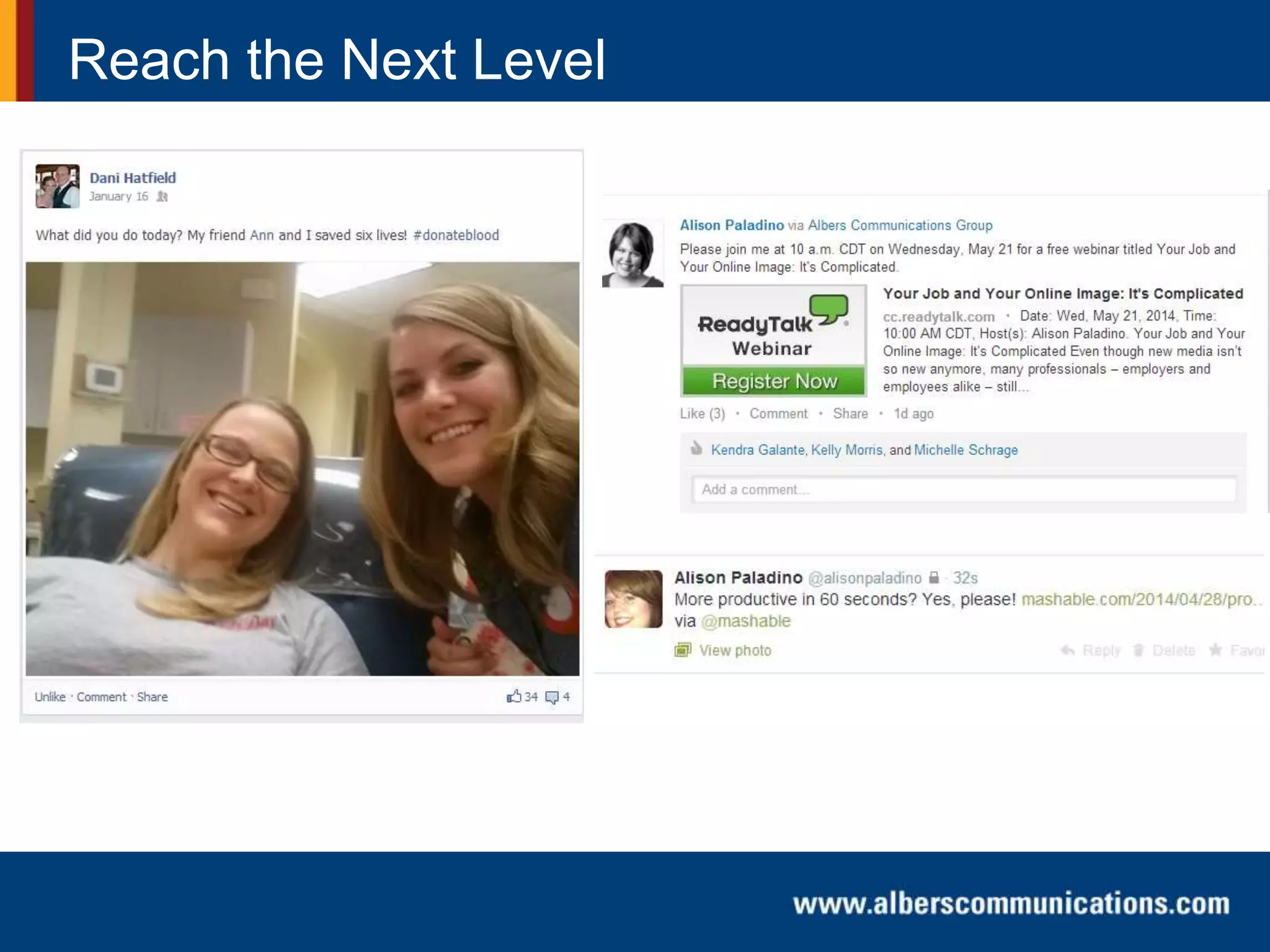
  • #17 Now that we have gone over the do’s and don’ts, here are a few examples of how to use your social media profiles to build your personal brand as a professional in your industry. In the Facebook status screen shot on the left, my co-workers Dani Hatfield and Ann Hadfield are shown giving blood during National Blood Donor month in January. Dani’s status regarding her volunteer work is quick and clever and also helps spread the word about blood drives through the use of the hash tag #donateblood This update shows that Dani gives back to her community and is able to spread the word about it in an appropriate way. For those who make the connection that Dani and Ann work together, it also gives the positive impression that their employer values volunteerism and community involvement. In the LinkedIn screen shot on the right, I have shared the registration for this webinar and encouraged my connections to take part in the free offering my company is hosting. Sharing this type of content from my employer’s LinkedIn profile is quick and easy to do and lets other professionals, even those outside my industry, know about a free offering from my employer that might be a continuing education opportunity applicable to them. In my Tweet near the bottom of the screen, I have shared a professional topic that many of my followers may be interested in – tips for work day productivity! I shared that topic via Twitter purposefully because I know that my peers might want to know some of the tips I am trying to utilize while moving through my to-do list more effectively and also enjoy a quick read on work-place productivity that they can also share with their networks.
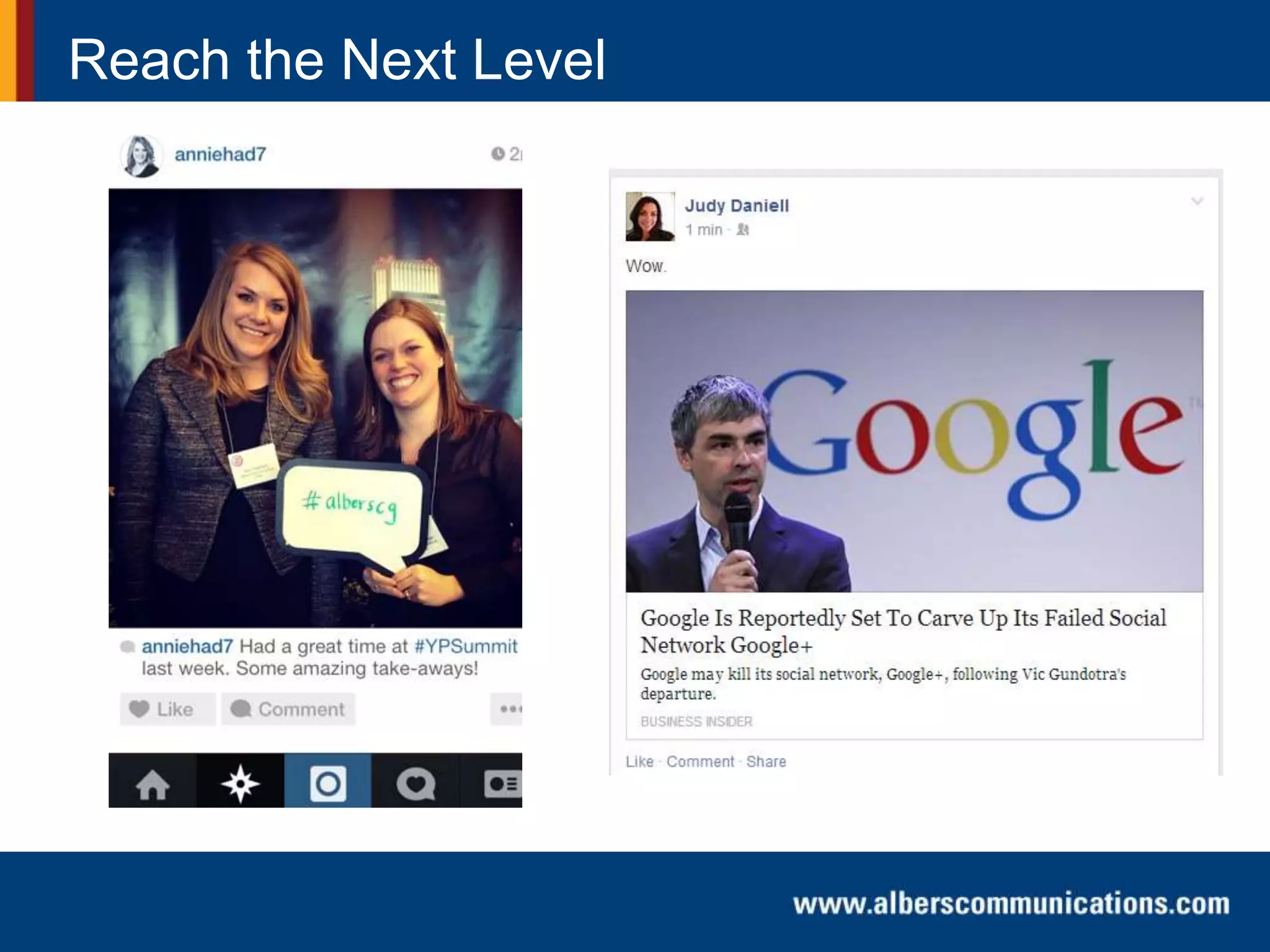
  • #18 In the Instagram screen shot on the left, my co-workers Ann Hadfield and Melissa Hoeman are shown at the Young Professionals Summit event held earlier this year. As a high profile event for Omaha Young Professionals, sharing this photo via social media is intended and encouraged by the YP Summit. Ann and Melissa are spotlighting their professional development and including themselves in the who’s who of young professionals by using the appropriate hash tag for the event. In the Facebook status on the right, my co-worker Judy Daniell has shared an article relevant both to her industry and also to friends and followers in her social networks. This share shows that Judy is on top of what is going on in her industry and let’s even her non-industry friends know that she is an expert in the field and is in the loop on the latest news.
  • #19 As a job seeker, you may have been instructed to utilize your résumé to paint a picture of the type of employee the employer is looking for. While that advice is still an important part of your career growth, we have observed from our research that it is also important to continually brush up your online image as part of the package. Just as you are being judged as a prospective employee by the content in your resume, you are also being reviewed by your active social media presence. The employers who participated in our research said that they are watching to gauge your professionalism, how you talk about previous employers, whether you have a positive or negative reputation based on the content you post and the maturity level of your content as well.
  • #20 Through the research I have shared with you today, you now know that many employers are, in fact, checking out your social media profiles during the hiring process and that they also count you as a valuable advocate for their brand. I hope that the tips and examples I have shared with you today will help you make the most of those realities as you climb your way to the top. Think of your social media profiles as an opportunity to give your network, which may include your employer or potential employers, a glimpse into both your personal and professional life and how well you will represent them. Rather than the reality TV show, make sure to provide just the highlight reel. Continue to develop the soft skill of using social media well across different platforms. As I shared in the research portion of this presentation today, you will be valued by your employer and may even be able to provide insight into your company’s need for a social media policy or even a training program for other employees.
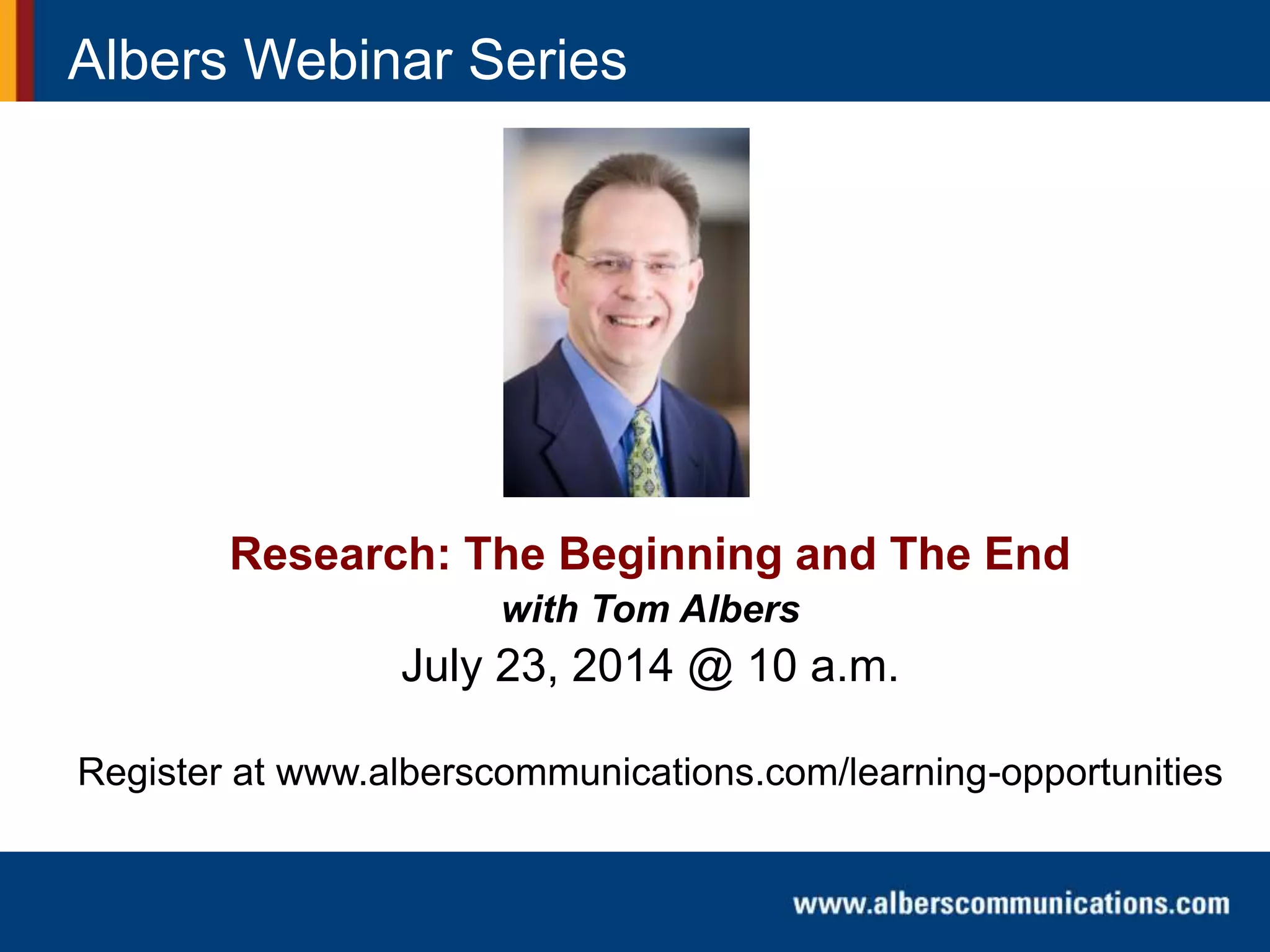
  • #21 Before we get into questions, I would like to invite you to our next webinar – Wednesday, July 23 at 10 a.m. Central. Tom Albers will be presenting: “Research: The Beginning and The End.” Strong research is the foundation of any successful public relations plan. It helps you pinpoint your target audiences, clarify objectives, develop key message points and measure your progress. Valid research also lets the news media and your community know that your story is relevant. Albers Communications Group President Tom Albers will draw on 22 years of experience as a PR research czar to share his insights.
  • #22  And one more housekeeping item – I’d like to ask each of you to take a few moments to fill out the questionnaire that will appear on your screen at the end of the presentation. Please provide your comments about today’s webinar or share topic suggestions you’d like us to address in future webinars.   And now I will take a few moments to answer any questions that have been chatted in. If you haven’t done so already, please feel free to chat in your questions through the box on the lower left side of your screen. Thank you for joining us today, and have a great day!