MEDIA INFORMATION
LITERACY
Lesson 5: Media and
Information Sources
Media and Information Sources
are the communication tools or
channels used to store
information or data.
At the end of this lesson, learners should be
able to:
•Identify the role of Media and Information
Sources
•Understand the role of Media and
Information Sources and;
•Identify different types of Media and
Information Sources.
Media and Information Sources plays a
very important roles. We can disseminate
information by relying on these sources.
These Media and Information Sources
includes the following.
Indigenous communication refers to
transmission of information through local
channels or forms. It is a means by which culture is
preserved, handed down, and adapted.
Indigenous media and information refer to the
original information created by a local group of
people. This also refers to content about
indigenous peoples that may be distributed
through dominant forms of media or through
forms of communication unique to their people
group.
IMPORTANCE OF INDIGENOUS COMMUNICATION
•Indigenous media and information are
highly credible because they are near the
source and are seldom circulated for profit.
•Indigenous media are channels for change,
education, and development because of its
direct access to local channels.
Library is a place set apart to contain books, periodicals,
and other material for reading, viewing, listening, study
of reference, set of rooms, or building where books may
be read or borrowed. As to its characteristics, libraries
are known their reliability, accuracy and value - Libraries
of published books are often considered highly reliable,
accurate, and valuable. Books and documents from
dominant sources are often peer reviewed. ISSN or ISBN
registration ensures that standards were followed in
producing these materials.
Divisions/Sections of Library
Circulation Section - This section houses and
circulates the major library collection covering the
different areas of discipline. This section adopts the
“open shelf” system, where users can go directly to
the shelf and choose the books they would like to
browse or use. All books in this section may be
borrowed for overnight use.
Divisions/Sections of Library
Filipiniana Section - The Filipiniana
Collection consists of publications about the
Philippines, in all its aspects—cultural,
political, social, religious, economic, and
others regardless of author and imprints.
The collection covers a range of reading
materials designed to meet the instructional
and research needs of library users
Divisions/Sections of Library
Reserve Section - This section houses books, which
are in demand and limited in copies. Also, in process
books and newly acquired books. It adopts the “close
shelf system”. Users are not allowed to enter this
section; they seek the assistance of the library staff or
library assistants. Books in this section are for room
use only and may be borrowed for one hour; a
borrower may extend its use provided there is no
prior request for the book. If not returned on time,
the borrower will be fined one (1) peso per hour.
Divisions/Sections of Library
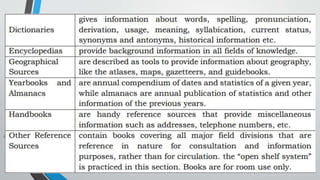
Reference Section - This section
houses a collection of extensive
general reference materials, which
are intended to be consulted for a
particular question or query, rather
than read thoroughly.
Periodical Section - This section houses journals,
magazines, newspapers, and other serial literature.
Bound periodicals are cataloged according to DDC
scheme; professional journals are grouped together
according to subject. Lists of topics of each journal
are made available in lieu of indexing and abstracting.
Collections in this section are for room use only;
bound periodicals maybe borrowed for overnight.
Current issues are displayed on the display shelves.
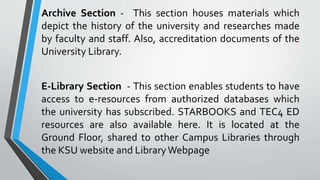
Archive Section - This section houses materials which
depict the history of the university and researches made
by faculty and staff. Also, accreditation documents of the
University Library.
E-Library Section - This section enables students to have
access to e-resources from authorized databases which
the university has subscribed. STARBOOKS and TEC4 ED
resources are also available here. It is located at the
Ground Floor, shared to other Campus Libraries through
the KSU website and LibraryWebpage
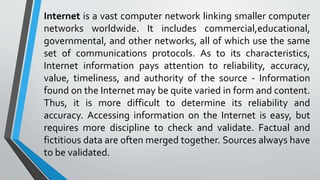
Internet is a vast computer network linking smaller computer
networks worldwide. It includes commercial,educational,
governmental, and other networks, all of which use the same
set of communications protocols. As to its characteristics,
Internet information pays attention to reliability, accuracy,
value, timeliness, and authority of the source - Information
found on the Internet may be quite varied in form and content.
Thus, it is more difficult to determine its reliability and
accuracy. Accessing information on the Internet is easy, but
requires more discipline to check and validate. Factual and
fictitious data are often merged together. Sources always have
to be validated.
Identificatio
n
1. consists of publications
about the Philippines, in all its
aspects—cultural, political,
social, religious, economic, and
others regardless of author and
imprints.
2. a collection of extensive general
reference materials, which are
intended to be consulted for a
particular question or query, rather
than read thoroughly.
3. This section adopts the “open shelf”
system, where users can go directly to the
shelf and choose the books they would like
to browse or use. All books in this section
may be borrowed for overnight use. This
section houses and circulates the major
library collection covering the different
areas of discipline.
4. This section houses materials
which depict the history of the
university and researches made by
faculty and staff. Also, accreditation
documents of the University Library.
5. It adopts the “close shelf system”. Users
are not allowed to enter this section; they
seek the assistance of the library staff or
library assistants.
a borrower may extend its use provided
there is no prior request for the book. If
not returned on time, the borrower will be
fined one (1) peso per hour
True or
False
6. Current issues are displayed on
the Periodical Section of Library.
7. The communication tools or
channels used to store information
or data are called media
information sources
8. Libraries are known their
reliability, accuracy and value -
Libraries of published books are
not considered highly reliable,
accurate, and valuable.
9. The channels for change,
education, and development
because of its direct access to local
channels are called Indigenous
Media and Information
10. Accessing information on the
Internet is easy, but requires more
discipline to check and validate.
Factual and fictitious data are often
merged together. Sources always
have to be validated.
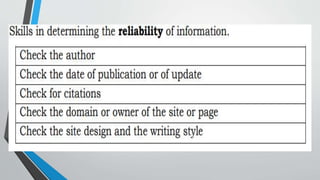
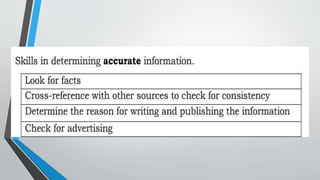
Reliable vs.
Accurate
11. Check for citations
12.Verify the domain or owner of the
site or page
13. Cross-reference with other sources to
check for consistency
14. Check the site design and the
writing style
15. Check for advertising

MEDIA INFORMATION LITERACY.pptx

  • 1.
    MEDIA INFORMATION LITERACY Lesson 5:Media and Information Sources
  • 2.
    Media and InformationSources Media and Information Sources are the communication tools or channels used to store information or data.
  • 3.
    At the endof this lesson, learners should be able to: •Identify the role of Media and Information Sources •Understand the role of Media and Information Sources and; •Identify different types of Media and Information Sources.
  • 4.
    Media and InformationSources plays a very important roles. We can disseminate information by relying on these sources. These Media and Information Sources includes the following.
  • 5.
    Indigenous communication refersto transmission of information through local channels or forms. It is a means by which culture is preserved, handed down, and adapted. Indigenous media and information refer to the original information created by a local group of people. This also refers to content about indigenous peoples that may be distributed through dominant forms of media or through forms of communication unique to their people group.
  • 6.
    IMPORTANCE OF INDIGENOUSCOMMUNICATION •Indigenous media and information are highly credible because they are near the source and are seldom circulated for profit. •Indigenous media are channels for change, education, and development because of its direct access to local channels.
  • 7.
    Library is aplace set apart to contain books, periodicals, and other material for reading, viewing, listening, study of reference, set of rooms, or building where books may be read or borrowed. As to its characteristics, libraries are known their reliability, accuracy and value - Libraries of published books are often considered highly reliable, accurate, and valuable. Books and documents from dominant sources are often peer reviewed. ISSN or ISBN registration ensures that standards were followed in producing these materials.
  • 8.
    Divisions/Sections of Library CirculationSection - This section houses and circulates the major library collection covering the different areas of discipline. This section adopts the “open shelf” system, where users can go directly to the shelf and choose the books they would like to browse or use. All books in this section may be borrowed for overnight use.
  • 9.
    Divisions/Sections of Library FilipinianaSection - The Filipiniana Collection consists of publications about the Philippines, in all its aspects—cultural, political, social, religious, economic, and others regardless of author and imprints. The collection covers a range of reading materials designed to meet the instructional and research needs of library users
  • 10.
    Divisions/Sections of Library ReserveSection - This section houses books, which are in demand and limited in copies. Also, in process books and newly acquired books. It adopts the “close shelf system”. Users are not allowed to enter this section; they seek the assistance of the library staff or library assistants. Books in this section are for room use only and may be borrowed for one hour; a borrower may extend its use provided there is no prior request for the book. If not returned on time, the borrower will be fined one (1) peso per hour.
  • 11.
    Divisions/Sections of Library ReferenceSection - This section houses a collection of extensive general reference materials, which are intended to be consulted for a particular question or query, rather than read thoroughly.
  • 13.
    Periodical Section -This section houses journals, magazines, newspapers, and other serial literature. Bound periodicals are cataloged according to DDC scheme; professional journals are grouped together according to subject. Lists of topics of each journal are made available in lieu of indexing and abstracting. Collections in this section are for room use only; bound periodicals maybe borrowed for overnight. Current issues are displayed on the display shelves.
  • 14.
    Archive Section -This section houses materials which depict the history of the university and researches made by faculty and staff. Also, accreditation documents of the University Library. E-Library Section - This section enables students to have access to e-resources from authorized databases which the university has subscribed. STARBOOKS and TEC4 ED resources are also available here. It is located at the Ground Floor, shared to other Campus Libraries through the KSU website and LibraryWebpage
  • 15.
    Internet is avast computer network linking smaller computer networks worldwide. It includes commercial,educational, governmental, and other networks, all of which use the same set of communications protocols. As to its characteristics, Internet information pays attention to reliability, accuracy, value, timeliness, and authority of the source - Information found on the Internet may be quite varied in form and content. Thus, it is more difficult to determine its reliability and accuracy. Accessing information on the Internet is easy, but requires more discipline to check and validate. Factual and fictitious data are often merged together. Sources always have to be validated.
  • 18.
  • 19.
    1. consists ofpublications about the Philippines, in all its aspects—cultural, political, social, religious, economic, and others regardless of author and imprints.
  • 20.
    2. a collectionof extensive general reference materials, which are intended to be consulted for a particular question or query, rather than read thoroughly.
  • 21.
    3. This sectionadopts the “open shelf” system, where users can go directly to the shelf and choose the books they would like to browse or use. All books in this section may be borrowed for overnight use. This section houses and circulates the major library collection covering the different areas of discipline.
  • 22.
    4. This sectionhouses materials which depict the history of the university and researches made by faculty and staff. Also, accreditation documents of the University Library.
  • 23.
    5. It adoptsthe “close shelf system”. Users are not allowed to enter this section; they seek the assistance of the library staff or library assistants. a borrower may extend its use provided there is no prior request for the book. If not returned on time, the borrower will be fined one (1) peso per hour
  • 24.
  • 25.
    6. Current issuesare displayed on the Periodical Section of Library.
  • 26.
    7. The communicationtools or channels used to store information or data are called media information sources
  • 27.
    8. Libraries areknown their reliability, accuracy and value - Libraries of published books are not considered highly reliable, accurate, and valuable.
  • 28.
    9. The channelsfor change, education, and development because of its direct access to local channels are called Indigenous Media and Information
  • 29.
    10. Accessing informationon the Internet is easy, but requires more discipline to check and validate. Factual and fictitious data are often merged together. Sources always have to be validated.
  • 30.
  • 31.
    11. Check forcitations 12.Verify the domain or owner of the site or page 13. Cross-reference with other sources to check for consistency
  • 32.
    14. Check thesite design and the writing style 15. Check for advertising