DISCIPLINES AND IDEAS IN THE SOCIAL
SCIENCES
DISCIPLINES AND
IDEAS IN THE SOCIAL
SCIENCES
Quarter 2 –Module 1:
Hermeneutical
OBJECTIVES:
At the end of this module you are expected to:
Interpret the message of texts and documents
using Hermeneutics; and
Generate deep insights from the statements,
attitudes and behaviors of others using
Phenomenology.
4
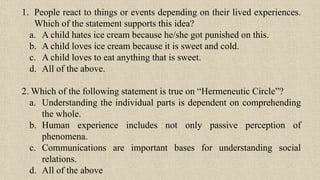
1. People react to things or events depending on their lived experiences.
Which of the statement supports this idea?
a. A child hates ice cream because he/she got punished on this.
b. A child loves ice cream because it is sweet and cold.
c. A child loves to eat anything that is sweet.
d. All of the above.
2. Which of the following statement is true on “Hermeneutic Circle”?
a. Understanding the individual parts is dependent on comprehending
the whole.
b. Human experience includes not only passive perception of
phenomena.
c. Communications are important bases for understanding social
relations.
d. All of the above
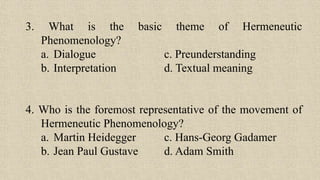
3. What is the basic theme of Hermeneutic
Phenomenology?
a. Dialogue c. Preunderstanding
b. Interpretation d. Textual meaning
4. Who is the foremost representative of the movement of
Hermeneutic Phenomenology?
a. Martin Heidegger c. Hans-Georg Gadamer
b. Jean Paul Gustave d. Adam Smith
5. What is a qualitative research methodology that arose out of
and has remained closely tied to phenomenological
philosophy?
a. Phenomenology
b. Hermeneutic Phenomenology
c. Cosmologic Phenomenon
d. Psychological Phenomenology
6. Which of the following statement is true about
Phenomenology?
a. It is a study of experience and how we perceive reality.
b. It is a study of experience and how we feel its effect.
c. It is a reality and how we live with it.
d. All of the above
7. Who among the forefathers of Hermeneutic Phenomenology
said that the, “Language of the heart can never be fully
expressed through language, something more still to be said
to in order to comprehend the matter fully?”
a. Aurelius Augustine c. Hans-Georg Gadamer
b. Martin Heidegger d. Jean Paul Gustave
8. Who among the forefathers of Hermeneutic Phenomenology
had set the groundwork for the emergence of
phenomenology?
a. Wilhelm Dilthey c. Aurelius Augustine
b. Jean Paul Gustave d. Martin Heidegger
9. The following statements are the features of
Hermeneutic Phenomenology, except _________.
a. Uses scientific methodology
b. Focuses on inquiry as application
c. Concept of attention to the unspoken
d. Emphasizes the nature of human experiences
10.Context and conditions of an experience are very
crucial to the process of ________________.
a. Interpretation c. Comprehension
b. Communication d. Construction
11.The following observable insights are useful for social
researchers, except _____.
a. How people behave and interact
b. How people feel the pain of others
c. How people answer a job interview
d. How people arrange their furniture
12.Phenomenology invites us to be open to variety of
______________
a. Emotions
b. Struggles
c. Experiences
d. All of the above
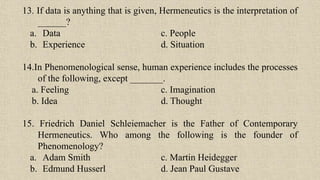
13. If data is anything that is given, Hermeneutics is the interpretation of
______?
a. Data c. People
b. Experience d. Situation
14.In Phenomenological sense, human experience includes the processes
of the following, except _______.
a. Feeling c. Imagination
b. Idea d. Thought
15. Friedrich Daniel Schleiemacher is the Father of Contemporary
Hermeneutics. Who among the following is the founder of
Phenomenology?
a. Adam Smith c. Martin Heidegger
b. Edmund Husserl d. Jean Paul Gustave
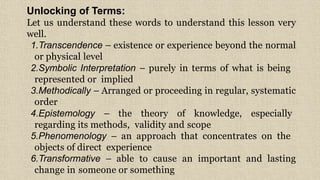
Unlocking of Terms:
Let us understand these words to understand this lesson very
well.
1.Transcendence – existence or experience beyond the normal
or physical level
2.Symbolic Interpretation – purely in terms of what is being
represented or implied
3.Methodically – Arranged or proceeding in regular, systematic
order
4.Epistemology – the theory of knowledge, especially
regarding its methods, validity and scope
5.Phenomenology – an approach that concentrates on the
objects of direct experience
6.Transformative – able to cause an important and lasting
change in someone or something
5
6
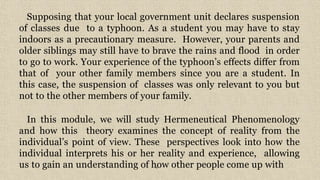
Supposing that your local government unit declares suspension
of classes due to a typhoon. As a student you may have to stay
indoors as a precautionary measure. However, your parents and
older siblings may still have to brave the rains and flood in order
to go to work. Your experience of the typhoon’s effects differ from
that of your other family members since you are a student. In
this case, the suspension of classes was only relevant to you but
not to the other members of your family.
In this module, we will study Hermeneutical Phenomenology
and how this theory examines the concept of reality from the
individual’s point of view. These perspectives look into how the
individual interprets his or her reality and experience, allowing
us to gain an understanding of how other people come up with
6
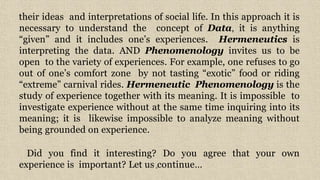
their ideas and interpretations of social life. In this approach it is
necessary to understand the concept of Data, it is anything
“given” and it includes one’s experiences. Hermeneutics is
interpreting the data. AND Phenomenology invites us to be
open to the variety of experiences. For example, one refuses to go
out of one’s comfort zone by not tasting “exotic” food or riding
“extreme” carnival rides. Hermeneutic Phenomenology is the
study of experience together with its meaning. It is impossible to
investigate experience without at the same time inquiring into its
meaning; it is likewise impossible to analyze meaning without
being grounded on experience.
Did you find it interesting? Do you agree that your own
experience is important? Let us continue…
6
Hermeneutics
Hermeneutics originated from biblical studies and is defined
as the understanding and analysis of biblical interpretation.
Bible scholars adopt hermeneutics to avoid committing the
mistakes of misunderstanding and misinterpreting the holy
scriptures.
Using Hermeneutics, scholars understand the scriptures by
analyzing the historical and social contexts when and where
passages were conceptualized and
situated. It also involves careful analysis of the text and its
structure.
Eventually, Hermeneutics evolved and became a tool applicable
in social analysis. According to Hermeneutic scholars, this
approach is equally useful in dealing with non-biblical texts such
as poetry, journals, diaries, text messages,
editorials, caricatures, courtship rituals and religious rituals,
among others.
Hermeneutics and the Writer’s Bias
Hermeneutics enables the reader of the text to understand
materials based on the author’s specific historical and social
contexts. In other words, a text in a literature or history class,
say, a short story or a political speech, can be understood within
the cultural and historical conditions in which it was written, or
when and where it took place.
7
Hermeneutics and the Reader’s Bias
Hermeneutics is also a transformative exercise, because the
reading and interpretation of texts can be determined and
influenced by the reader’s own personal viewpoints and specific
social contexts. It suggests that readers are also active agents
who are capable of reimagining, reproducing, and reconstructing
textual messages, and that they themselves are producers of
textual meanings.
Phenomenology
Phenomenology is a philosophical movement which studies
experience and how we perceive reality, which, according to its
7
proponents, consists of objects and events “phenomena” as
perceived by human consciousness. In the phenomenological
sense, human experience includes not only passive perception of
phenomena, but also other processes such as imagination,
thought and feelings. Similar to interpretivism and social
constructivism, phenomenology focuses on how people attribute
meaning to and make sense of their social interactions.
In Phenomenology, the researcher-respondent relationship is
participative, cooperative and dialogical. Among the useful data
gathering techniques are Key Informant Interviews, Focus Group
Discussion and Participant Observation. The strong emphasis on
personal viewpoints and values contributes significantly to the
depth of social research.
7
Hermeneutical Phenomenology
Transcendental Phenomenology is based on discovering the
objective universal essences of lived experiences and
communicating them through pure description. Hermeneutics is
the tradition, theory, philosophy and practice of interpretation.
Hermeneutical Phenomenology is used to interpret the meaning
of lived experiences and communicate the interpretation
textually or symbolically.
Hermeneutic Phenomenology’s Forefathers
Aurelius Augustine (Thagaste: 354AD-430AD) – formed the
theoretical basis for conceptions of the limits of language to
7
express the inner world, the forgetfulness of language, and the
relationship between language and tradition. “Language of the
heart can never be fully expressed through language, something
more still to be said to in order to comprehend the matter fully.”
Friedrich Daniel Ernst Schleiemacher (Germany:1768-1834) –
has been credited as “one of the first to write systematically
about hermeneutics as a generic form” and as “The father of
contemporary hermeneutics”. He advanced understanding of
Interpretation that included:
o Goal of determining the meaning of a test through the
intention and perspective of the author
o Methods of grammatical and technical interpretation
oA distinction between a laxer(not sufficient) and stricter
practices of interpretation and a belief in misunderstanding
as the natural state from which interpretation proceeds
oClear identification of the relationship between the part and
the whole
Wilhelm Dilthey (Germany:1833-1911)– his conception of the
human sciences as epistemologically and methodically distinct
from the natural sciences, and his “lived experiences” as the
basis for all understanding set the groundwork for the
emergence of phenomenology.
Edmund Husserl (Austria:1859-1938) – has been credited as
“The principal founder of phenomenology”. He developed
transcendental phenomenology, an approach to understanding
human experiences that focus on the essential structures that
allow the naively taken for granted in the ‘natural attitude’ to
‘constitute themselves’ in consciousness.
Jean-Paul Sartre (Paris:1905-1980)– He continued Heidegger’s
project of existential phenomenology, emphasizing our self-
consciousness and drive for meaning.
Features of Hermeneutical Phenomenology
Its focus on inquiry as application
Emphasis on the situated nature of human experiences
 Concept of attention to the unspoken or undisclosed
 Idea of the hermeneutic circle as a link between individual
experiences and larger structures, fusion of horizons and
inclusion of the practitioner identity in research activities
What I Have Learned
Society is made up of individuals who are influenced by their
experiences. Hermeneutical Phenomenology as an approach,
represents an attitude or disposition of sensitivity and openness:
it is a matter of openness to every day’s twists and turns and the
experienced meanings from them.
Illustrate an object or choose any object found at home or
perhaps cut a picture that will capsulize the statement above.
Give explanations or justifications why you choose such.
ASSESSMENT
1. What is the basic theme of Hermeneutic Phenomenology?
a. Dialogue c. Textual meaning
b. Interpretation d. Preunderstanding
2. Who is the foremost representative of the movement of Hermeneutic
Phenomenology?
a. Martin Heidegger c. Jean Paul Gustave
b. Hans-Georg Gadamer d. Adam Smith
3. What is a qualitative research methodology that arose out of and
remains closely tied to phenomenological philosophy?
a. Phenomenology c. Hermeneutic Phenomenology
b. Cosmologic Phenomenon d. Psychological Phenomenology
4. Which of the following statement is true about Phenomenology?
a. It is a study of experience and how we feel its effect.
b. It is a study of experience and how we perceive reality.
c. It is a reality and how we live with it.
d. All of the above
5. Who among the forefathers of Hermeneutic Phenomenology said that
the: “Language of the heart can never be fully expressed through
language, something more still to be said to in order to comprehend
the matter fully.”
a. Martin Heidegger
b. Hans-Georg Gadamer
c. Jean Paul Gustave
a. Aurelius Augustine
6. Who among the forefathers of Hermeneutic Phenomenology had set
the groundwork for the emergence of Phenomenology.
a. Wilhelm Dilthey
b. Aurelius Augustine
c. Jean Paul Gustave
d. Martin Heidegger
7. The following statements are the features of Hermeneutic
Phenomenology, except ___________:
a. Concept of attention to the unspoken
b. Emphasizes the nature of human experiences
c. Uses scientific methodology
d. Focuses on inquiry as application
8. The context and the conditions of an experience are very crucial
to the process of ________________.
a. Comprehension
b. Interpretation
c. Communication
d. Construction
9. Which of the following observable insights are useful for Social
Science Researchers, except ___________?
a. How people behave and interact
b. How people answer a job interview
c. How people arrange their furniture
d. How people feel the pain of others
10. Phenomenology invites us to be opened to variety of
______________.
a. Emotions c. Experiences
b. Struggles d. All of the above
11. If data is anything that is given, Hermeneutic is the interpretation of
______?
a. Data c. Experience
b. People d. Situation
12. In Phenomenological sense, human experience includes the
processes of the following, EXCEPT:
a. Idea c. Imagination
b. Thought d. Feelings
13. Friedrich Daniel Schleiemacher is the Father of contemporary
Hermeneutics while the principal founder of Phenomenology is
_____________.
a. Wilhelm Dilthey c. Jean Paul Sarte
b. Edmund Husserl d. Adam Smith
14. Which of the following statement is true on “Hermeneutic Circle”
a. Understanding the individual parts is dependent on comprehending
the whole
b. Human experience includes not only passive perception of
phenomena
c. Communications are important bases for understanding social
relations
d. All of the above
15. People react to things or events depending on their “lived
experiences”, which of the statement supports this idea?
a. A child loves ice cream because it is sweet.
b. A child hates ice cream because he/she got punished on this.
c. A child loves to eat anything that is sweet.
d. All of the above.

1_Q2-DISS.MODULE 1........................pptx

  • 1.
    DISCIPLINES AND IDEASIN THE SOCIAL SCIENCES DISCIPLINES AND IDEAS IN THE SOCIAL SCIENCES Quarter 2 –Module 1: Hermeneutical
  • 2.
    OBJECTIVES: At the endof this module you are expected to: Interpret the message of texts and documents using Hermeneutics; and Generate deep insights from the statements, attitudes and behaviors of others using Phenomenology. 4
  • 3.
    1. People reactto things or events depending on their lived experiences. Which of the statement supports this idea? a. A child hates ice cream because he/she got punished on this. b. A child loves ice cream because it is sweet and cold. c. A child loves to eat anything that is sweet. d. All of the above. 2. Which of the following statement is true on “Hermeneutic Circle”? a. Understanding the individual parts is dependent on comprehending the whole. b. Human experience includes not only passive perception of phenomena. c. Communications are important bases for understanding social relations. d. All of the above
  • 4.
    3. What isthe basic theme of Hermeneutic Phenomenology? a. Dialogue c. Preunderstanding b. Interpretation d. Textual meaning 4. Who is the foremost representative of the movement of Hermeneutic Phenomenology? a. Martin Heidegger c. Hans-Georg Gadamer b. Jean Paul Gustave d. Adam Smith
  • 5.
    5. What isa qualitative research methodology that arose out of and has remained closely tied to phenomenological philosophy? a. Phenomenology b. Hermeneutic Phenomenology c. Cosmologic Phenomenon d. Psychological Phenomenology 6. Which of the following statement is true about Phenomenology? a. It is a study of experience and how we perceive reality. b. It is a study of experience and how we feel its effect. c. It is a reality and how we live with it. d. All of the above
  • 6.
    7. Who amongthe forefathers of Hermeneutic Phenomenology said that the, “Language of the heart can never be fully expressed through language, something more still to be said to in order to comprehend the matter fully?” a. Aurelius Augustine c. Hans-Georg Gadamer b. Martin Heidegger d. Jean Paul Gustave 8. Who among the forefathers of Hermeneutic Phenomenology had set the groundwork for the emergence of phenomenology? a. Wilhelm Dilthey c. Aurelius Augustine b. Jean Paul Gustave d. Martin Heidegger
  • 7.
    9. The followingstatements are the features of Hermeneutic Phenomenology, except _________. a. Uses scientific methodology b. Focuses on inquiry as application c. Concept of attention to the unspoken d. Emphasizes the nature of human experiences 10.Context and conditions of an experience are very crucial to the process of ________________. a. Interpretation c. Comprehension b. Communication d. Construction
  • 8.
    11.The following observableinsights are useful for social researchers, except _____. a. How people behave and interact b. How people feel the pain of others c. How people answer a job interview d. How people arrange their furniture 12.Phenomenology invites us to be open to variety of ______________ a. Emotions b. Struggles c. Experiences d. All of the above
  • 9.
    13. If datais anything that is given, Hermeneutics is the interpretation of ______? a. Data c. People b. Experience d. Situation 14.In Phenomenological sense, human experience includes the processes of the following, except _______. a. Feeling c. Imagination b. Idea d. Thought 15. Friedrich Daniel Schleiemacher is the Father of Contemporary Hermeneutics. Who among the following is the founder of Phenomenology? a. Adam Smith c. Martin Heidegger b. Edmund Husserl d. Jean Paul Gustave
  • 10.
    Unlocking of Terms: Letus understand these words to understand this lesson very well. 1.Transcendence – existence or experience beyond the normal or physical level 2.Symbolic Interpretation – purely in terms of what is being represented or implied 3.Methodically – Arranged or proceeding in regular, systematic order 4.Epistemology – the theory of knowledge, especially regarding its methods, validity and scope 5.Phenomenology – an approach that concentrates on the objects of direct experience 6.Transformative – able to cause an important and lasting change in someone or something 5
  • 11.
    6 Supposing that yourlocal government unit declares suspension of classes due to a typhoon. As a student you may have to stay indoors as a precautionary measure. However, your parents and older siblings may still have to brave the rains and flood in order to go to work. Your experience of the typhoon’s effects differ from that of your other family members since you are a student. In this case, the suspension of classes was only relevant to you but not to the other members of your family. In this module, we will study Hermeneutical Phenomenology and how this theory examines the concept of reality from the individual’s point of view. These perspectives look into how the individual interprets his or her reality and experience, allowing us to gain an understanding of how other people come up with
  • 12.
    6 their ideas andinterpretations of social life. In this approach it is necessary to understand the concept of Data, it is anything “given” and it includes one’s experiences. Hermeneutics is interpreting the data. AND Phenomenology invites us to be open to the variety of experiences. For example, one refuses to go out of one’s comfort zone by not tasting “exotic” food or riding “extreme” carnival rides. Hermeneutic Phenomenology is the study of experience together with its meaning. It is impossible to investigate experience without at the same time inquiring into its meaning; it is likewise impossible to analyze meaning without being grounded on experience. Did you find it interesting? Do you agree that your own experience is important? Let us continue…
  • 13.
    6 Hermeneutics Hermeneutics originated frombiblical studies and is defined as the understanding and analysis of biblical interpretation. Bible scholars adopt hermeneutics to avoid committing the mistakes of misunderstanding and misinterpreting the holy scriptures. Using Hermeneutics, scholars understand the scriptures by analyzing the historical and social contexts when and where passages were conceptualized and situated. It also involves careful analysis of the text and its structure. Eventually, Hermeneutics evolved and became a tool applicable in social analysis. According to Hermeneutic scholars, this
  • 14.
    approach is equallyuseful in dealing with non-biblical texts such as poetry, journals, diaries, text messages, editorials, caricatures, courtship rituals and religious rituals, among others. Hermeneutics and the Writer’s Bias Hermeneutics enables the reader of the text to understand materials based on the author’s specific historical and social contexts. In other words, a text in a literature or history class, say, a short story or a political speech, can be understood within the cultural and historical conditions in which it was written, or when and where it took place.
  • 15.
    7 Hermeneutics and theReader’s Bias Hermeneutics is also a transformative exercise, because the reading and interpretation of texts can be determined and influenced by the reader’s own personal viewpoints and specific social contexts. It suggests that readers are also active agents who are capable of reimagining, reproducing, and reconstructing textual messages, and that they themselves are producers of textual meanings. Phenomenology Phenomenology is a philosophical movement which studies experience and how we perceive reality, which, according to its
  • 16.
    7 proponents, consists ofobjects and events “phenomena” as perceived by human consciousness. In the phenomenological sense, human experience includes not only passive perception of phenomena, but also other processes such as imagination, thought and feelings. Similar to interpretivism and social constructivism, phenomenology focuses on how people attribute meaning to and make sense of their social interactions. In Phenomenology, the researcher-respondent relationship is participative, cooperative and dialogical. Among the useful data gathering techniques are Key Informant Interviews, Focus Group Discussion and Participant Observation. The strong emphasis on personal viewpoints and values contributes significantly to the depth of social research.
  • 17.
    7 Hermeneutical Phenomenology Transcendental Phenomenologyis based on discovering the objective universal essences of lived experiences and communicating them through pure description. Hermeneutics is the tradition, theory, philosophy and practice of interpretation. Hermeneutical Phenomenology is used to interpret the meaning of lived experiences and communicate the interpretation textually or symbolically. Hermeneutic Phenomenology’s Forefathers Aurelius Augustine (Thagaste: 354AD-430AD) – formed the theoretical basis for conceptions of the limits of language to
  • 18.
    7 express the innerworld, the forgetfulness of language, and the relationship between language and tradition. “Language of the heart can never be fully expressed through language, something more still to be said to in order to comprehend the matter fully.” Friedrich Daniel Ernst Schleiemacher (Germany:1768-1834) – has been credited as “one of the first to write systematically about hermeneutics as a generic form” and as “The father of contemporary hermeneutics”. He advanced understanding of Interpretation that included: o Goal of determining the meaning of a test through the intention and perspective of the author o Methods of grammatical and technical interpretation
  • 19.
    oA distinction betweena laxer(not sufficient) and stricter practices of interpretation and a belief in misunderstanding as the natural state from which interpretation proceeds oClear identification of the relationship between the part and the whole Wilhelm Dilthey (Germany:1833-1911)– his conception of the human sciences as epistemologically and methodically distinct from the natural sciences, and his “lived experiences” as the basis for all understanding set the groundwork for the emergence of phenomenology. Edmund Husserl (Austria:1859-1938) – has been credited as “The principal founder of phenomenology”. He developed
  • 20.
    transcendental phenomenology, anapproach to understanding human experiences that focus on the essential structures that allow the naively taken for granted in the ‘natural attitude’ to ‘constitute themselves’ in consciousness. Jean-Paul Sartre (Paris:1905-1980)– He continued Heidegger’s project of existential phenomenology, emphasizing our self- consciousness and drive for meaning. Features of Hermeneutical Phenomenology Its focus on inquiry as application Emphasis on the situated nature of human experiences
  • 21.
     Concept ofattention to the unspoken or undisclosed  Idea of the hermeneutic circle as a link between individual experiences and larger structures, fusion of horizons and inclusion of the practitioner identity in research activities
  • 23.
    What I HaveLearned Society is made up of individuals who are influenced by their experiences. Hermeneutical Phenomenology as an approach, represents an attitude or disposition of sensitivity and openness: it is a matter of openness to every day’s twists and turns and the experienced meanings from them. Illustrate an object or choose any object found at home or perhaps cut a picture that will capsulize the statement above. Give explanations or justifications why you choose such.
  • 24.
    ASSESSMENT 1. What isthe basic theme of Hermeneutic Phenomenology? a. Dialogue c. Textual meaning b. Interpretation d. Preunderstanding 2. Who is the foremost representative of the movement of Hermeneutic Phenomenology? a. Martin Heidegger c. Jean Paul Gustave b. Hans-Georg Gadamer d. Adam Smith 3. What is a qualitative research methodology that arose out of and remains closely tied to phenomenological philosophy? a. Phenomenology c. Hermeneutic Phenomenology b. Cosmologic Phenomenon d. Psychological Phenomenology
  • 25.
    4. Which ofthe following statement is true about Phenomenology? a. It is a study of experience and how we feel its effect. b. It is a study of experience and how we perceive reality. c. It is a reality and how we live with it. d. All of the above 5. Who among the forefathers of Hermeneutic Phenomenology said that the: “Language of the heart can never be fully expressed through language, something more still to be said to in order to comprehend the matter fully.” a. Martin Heidegger b. Hans-Georg Gadamer c. Jean Paul Gustave a. Aurelius Augustine
  • 26.
    6. Who amongthe forefathers of Hermeneutic Phenomenology had set the groundwork for the emergence of Phenomenology. a. Wilhelm Dilthey b. Aurelius Augustine c. Jean Paul Gustave d. Martin Heidegger 7. The following statements are the features of Hermeneutic Phenomenology, except ___________: a. Concept of attention to the unspoken b. Emphasizes the nature of human experiences c. Uses scientific methodology d. Focuses on inquiry as application
  • 27.
    8. The contextand the conditions of an experience are very crucial to the process of ________________. a. Comprehension b. Interpretation c. Communication d. Construction 9. Which of the following observable insights are useful for Social Science Researchers, except ___________? a. How people behave and interact b. How people answer a job interview c. How people arrange their furniture d. How people feel the pain of others
  • 28.
    10. Phenomenology invitesus to be opened to variety of ______________. a. Emotions c. Experiences b. Struggles d. All of the above 11. If data is anything that is given, Hermeneutic is the interpretation of ______? a. Data c. Experience b. People d. Situation 12. In Phenomenological sense, human experience includes the processes of the following, EXCEPT: a. Idea c. Imagination b. Thought d. Feelings
  • 29.
    13. Friedrich DanielSchleiemacher is the Father of contemporary Hermeneutics while the principal founder of Phenomenology is _____________. a. Wilhelm Dilthey c. Jean Paul Sarte b. Edmund Husserl d. Adam Smith 14. Which of the following statement is true on “Hermeneutic Circle” a. Understanding the individual parts is dependent on comprehending the whole b. Human experience includes not only passive perception of phenomena c. Communications are important bases for understanding social relations d. All of the above
  • 30.
    15. People reactto things or events depending on their “lived experiences”, which of the statement supports this idea? a. A child loves ice cream because it is sweet. b. A child hates ice cream because he/she got punished on this. c. A child loves to eat anything that is sweet. d. All of the above.