Media Camera Shots/Angles
and Movements
Close-Up
A Close-Up shot, focuses on a certain feature
or part of the subject takes up the majority
of the frame. A close up of a person would
mainly be a close up of their face. Close-ups
are useful for showing detail and allows you
to understand the character. A close-up of a
person will also emphasizes their emotional
state. The audience is drawn into the images
personal space and will relate to their
feelings.
Mid-Shot
A shot taken at a
medium distance. To
show the characters
body language and
Often used to show
the characters
power.
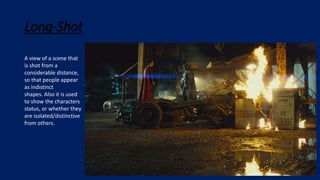
Long-Shot
A view of a scene that
is shot from a
considerable distance,
so that people appear
as indistinct
shapes. Also it is used
to show the characters
status, or whether they
are isolated/distinctive
from others.
Over-The-Shoulder
The back of the shoulder and
head of this person is used to
frame the image of whatever (or
whomever) the camera is
pointing toward. This type
of shot is very common when two
characters are having a
discussion/feud and will usually
show the characters importance
in the film.
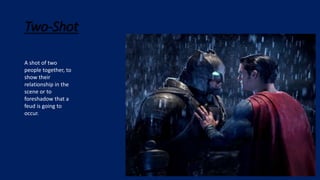
Two-Shot
A shot of two
people together, to
show their
relationship in the
scene or to
foreshadow that a
feud is going to
occur.
Low-Angle
A Low-Angle shot is used
to show the importance
of a character and their
status, could suggests
they have died or meant
something to the person
viewing it; which would
cause the audience to
feel their emotions.
Eye-Level
An eyelevel angle is the one in
which the camera is placed at
the subject's height, so if the
actor is looking at the lens,
they wouldn't have to look up
or down. Eyelevel shots are
incredibly common because
they are neutral. It shows the
characters motives and it
could foreshadow what they
are going to do.
Point-Of-View
A point of view shot (also known
as POV shot or a subjective
camera) is a shot that shows
what a character (the subject) is
looking at (represented through
the camera). It gives you chance
to see and feel what the
character is feeling in the scene.
High-Angle
A high-angle shot is a shot where the
camera looks down on the subject
from a high angle and the point of
focus often gets "swallowed up." High-
angle shots can make the subject
seem vulnerable or powerless when
applied with the correct mood,
setting, and effects. Also it can make
the character look like an underdog
but is ready to fight and prove
themselves.
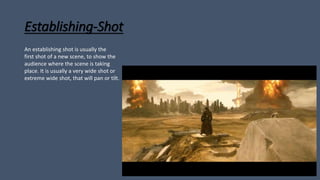
Establishing-Shot
An establishing shot is usually the
first shot of a new scene, to show the
audience where the scene is taking
place. It is usually a very wide shot or
extreme wide shot, that will pan or tilt.
Birds-Eye-View
Bird's eye view. A shot in
which the camera
photographs a scene from
directly overhead. Close-up,
Close shot. A
detailed view of a person or
object, usually without much
context provided. It is mainly
used to show what is
happening in a scene from
an aerial view, to show the
severity of the things
occurring in a scene.

Media camera shots

  • 1.
  • 2.
    Close-Up A Close-Up shot,focuses on a certain feature or part of the subject takes up the majority of the frame. A close up of a person would mainly be a close up of their face. Close-ups are useful for showing detail and allows you to understand the character. A close-up of a person will also emphasizes their emotional state. The audience is drawn into the images personal space and will relate to their feelings.
  • 3.
    Mid-Shot A shot takenat a medium distance. To show the characters body language and Often used to show the characters power.
  • 4.
    Long-Shot A view ofa scene that is shot from a considerable distance, so that people appear as indistinct shapes. Also it is used to show the characters status, or whether they are isolated/distinctive from others.
  • 5.
    Over-The-Shoulder The back ofthe shoulder and head of this person is used to frame the image of whatever (or whomever) the camera is pointing toward. This type of shot is very common when two characters are having a discussion/feud and will usually show the characters importance in the film.
  • 6.
    Two-Shot A shot oftwo people together, to show their relationship in the scene or to foreshadow that a feud is going to occur.
  • 7.
    Low-Angle A Low-Angle shotis used to show the importance of a character and their status, could suggests they have died or meant something to the person viewing it; which would cause the audience to feel their emotions.
  • 8.
    Eye-Level An eyelevel angleis the one in which the camera is placed at the subject's height, so if the actor is looking at the lens, they wouldn't have to look up or down. Eyelevel shots are incredibly common because they are neutral. It shows the characters motives and it could foreshadow what they are going to do.
  • 9.
    Point-Of-View A point ofview shot (also known as POV shot or a subjective camera) is a shot that shows what a character (the subject) is looking at (represented through the camera). It gives you chance to see and feel what the character is feeling in the scene.
  • 10.
    High-Angle A high-angle shotis a shot where the camera looks down on the subject from a high angle and the point of focus often gets "swallowed up." High- angle shots can make the subject seem vulnerable or powerless when applied with the correct mood, setting, and effects. Also it can make the character look like an underdog but is ready to fight and prove themselves.
  • 11.
    Establishing-Shot An establishing shotis usually the first shot of a new scene, to show the audience where the scene is taking place. It is usually a very wide shot or extreme wide shot, that will pan or tilt.
  • 12.
    Birds-Eye-View Bird's eye view.A shot in which the camera photographs a scene from directly overhead. Close-up, Close shot. A detailed view of a person or object, usually without much context provided. It is mainly used to show what is happening in a scene from an aerial view, to show the severity of the things occurring in a scene.