Photography Shots.
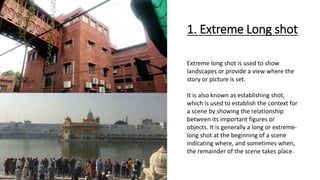
1. Extreme Long shot
Extreme long shot is used to show
landscapes or provide a view where the
story or picture is set.
It is also known as establishing shot,
which is used to establish the context for
a scene by showing the relationship
between its important figures or
objects. It is generally a long or extreme-
long shot at the beginning of a scene
indicating where, and sometimes when,
the remainder of the scene takes place.
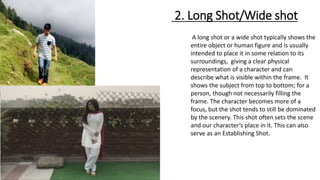
2. Long Shot/Wide shot
A long shot or a wide shot typically shows the
entire object or human figure and is usually
intended to place it in some relation to its
surroundings, giving a clear physical
representation of a character and can
describe what is visible within the frame. It
shows the subject from top to bottom; for a
person, though not necessarily filling the
frame. The character becomes more of a
focus, but the shot tends to still be dominated
by the scenery. This shot often sets the scene
and our character’s place in it. This can also
serve as an Establishing Shot.
3. Full Shot
Frames character from
head to toes, with the
subject roughly filling the
frame. The emphasis
tends to be more on
action rather than a
character’s emotional
state.
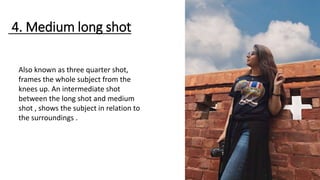
4. Medium long shot
Also known as three quarter shot,
frames the whole subject from the
knees up. An intermediate shot
between the long shot and medium
shot , shows the subject in relation to
the surroundings .
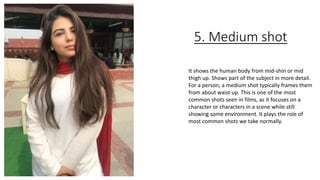
5. Medium shot
It shows the human body from mid-shin or mid
thigh up. Shows part of the subject in more detail.
For a person, a medium shot typically frames them
from about waist up. This is one of the most
common shots seen in films, as it focuses on a
character or characters in a scene while still
showing some environment. It plays the role of
most common shots we take normally.
6. Two shot
A shot of two people together.
It could be full, mid long or mid
shot.
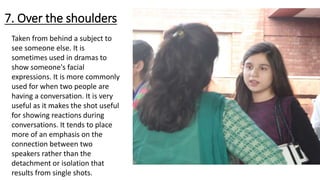
7. Over the shoulders
Taken from behind a subject to
see someone else. It is
sometimes used in dramas to
show someone's facial
expressions. It is more commonly
used for when two people are
having a conversation. It is very
useful as it makes the shot useful
for showing reactions during
conversations. It tends to place
more of an emphasis on the
connection between two
speakers rather than the
detachment or isolation that
results from single shots.
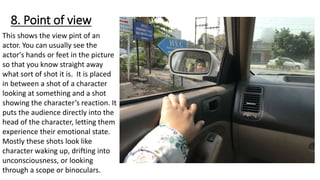
8. Point of view
This shows the view pint of an
actor. You can usually see the
actor's hands or feet in the picture
so that you know straight away
what sort of shot it is. It is placed
in between a shot of a character
looking at something and a shot
showing the character’s reaction. It
puts the audience directly into the
head of the character, letting them
experience their emotional state.
Mostly these shots look like
character waking up, drifting into
unconsciousness, or looking
through a scope or binoculars.
9. MEDIUM CLOSE-UP
A medium closeup is shot that is
from the characters shoulders
and above. It allows the
audience to see the characters
expression clearly, but the
background is harder to see. It’s
commonly falls between a
Medium Shot and a Close-Up,
generally framing the subject
from chest or shoulder up.
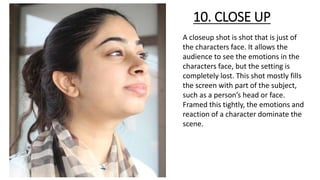
10. CLOSE UP
A closeup shot is shot that is just of
the characters face. It allows the
audience to see the emotions in the
characters face, but the setting is
completely lost. This shot mostly fills
the screen with part of the subject,
such as a person’s head or face.
Framed this tightly, the emotions and
reaction of a character dominate the
scene.
11. EXTREME CLOSE-UP
The shot is so close that only
a detail of a subject
someone’s eyes can be seen.
You would normally need a
specific reason to get this
close. This shot is usually
used to allow the viewer to
enter the character’s intimate
space, revealing certain
characteristics and emotions
that would otherwise go
unnoticed. At such an
extreme proximity, every
subtle expression, muscle
movement, facial
characteristic, reflection and
detail becomes that much
more highlighted.
12. MACRO SHOT
An Extreme closeup of a
very small subject in
which the size of the
subject is greater than
life-size. Through this
flowers, insects and other
small items that you want
a close-up view of can be
seen in with clear details.
Some cameras may be
able to focus when the
lens is less than an inch
away from the subject,
while others may be an
inch or further.

Photography Shots

  • 1.
  • 2.
    1. Extreme Longshot Extreme long shot is used to show landscapes or provide a view where the story or picture is set. It is also known as establishing shot, which is used to establish the context for a scene by showing the relationship between its important figures or objects. It is generally a long or extreme- long shot at the beginning of a scene indicating where, and sometimes when, the remainder of the scene takes place.
  • 3.
    2. Long Shot/Wideshot A long shot or a wide shot typically shows the entire object or human figure and is usually intended to place it in some relation to its surroundings, giving a clear physical representation of a character and can describe what is visible within the frame. It shows the subject from top to bottom; for a person, though not necessarily filling the frame. The character becomes more of a focus, but the shot tends to still be dominated by the scenery. This shot often sets the scene and our character’s place in it. This can also serve as an Establishing Shot.
  • 4.
    3. Full Shot Framescharacter from head to toes, with the subject roughly filling the frame. The emphasis tends to be more on action rather than a character’s emotional state.
  • 5.
    4. Medium longshot Also known as three quarter shot, frames the whole subject from the knees up. An intermediate shot between the long shot and medium shot , shows the subject in relation to the surroundings .
  • 6.
    5. Medium shot Itshows the human body from mid-shin or mid thigh up. Shows part of the subject in more detail. For a person, a medium shot typically frames them from about waist up. This is one of the most common shots seen in films, as it focuses on a character or characters in a scene while still showing some environment. It plays the role of most common shots we take normally.
  • 7.
    6. Two shot Ashot of two people together. It could be full, mid long or mid shot.
  • 8.
    7. Over theshoulders Taken from behind a subject to see someone else. It is sometimes used in dramas to show someone's facial expressions. It is more commonly used for when two people are having a conversation. It is very useful as it makes the shot useful for showing reactions during conversations. It tends to place more of an emphasis on the connection between two speakers rather than the detachment or isolation that results from single shots.
  • 9.
    8. Point ofview This shows the view pint of an actor. You can usually see the actor's hands or feet in the picture so that you know straight away what sort of shot it is. It is placed in between a shot of a character looking at something and a shot showing the character’s reaction. It puts the audience directly into the head of the character, letting them experience their emotional state. Mostly these shots look like character waking up, drifting into unconsciousness, or looking through a scope or binoculars.
  • 10.
    9. MEDIUM CLOSE-UP Amedium closeup is shot that is from the characters shoulders and above. It allows the audience to see the characters expression clearly, but the background is harder to see. It’s commonly falls between a Medium Shot and a Close-Up, generally framing the subject from chest or shoulder up.
  • 11.
    10. CLOSE UP Acloseup shot is shot that is just of the characters face. It allows the audience to see the emotions in the characters face, but the setting is completely lost. This shot mostly fills the screen with part of the subject, such as a person’s head or face. Framed this tightly, the emotions and reaction of a character dominate the scene.
  • 12.
    11. EXTREME CLOSE-UP Theshot is so close that only a detail of a subject someone’s eyes can be seen. You would normally need a specific reason to get this close. This shot is usually used to allow the viewer to enter the character’s intimate space, revealing certain characteristics and emotions that would otherwise go unnoticed. At such an extreme proximity, every subtle expression, muscle movement, facial characteristic, reflection and detail becomes that much more highlighted.
  • 13.
    12. MACRO SHOT AnExtreme closeup of a very small subject in which the size of the subject is greater than life-size. Through this flowers, insects and other small items that you want a close-up view of can be seen in with clear details. Some cameras may be able to focus when the lens is less than an inch away from the subject, while others may be an inch or further.