WAR ON DRUGS
W H E R E C A N Y O U F I N D M E ?
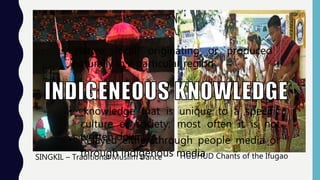
SINGKIL – Traditional Muslim Dance HUDHUD Chants of the Ifugao
• native; local; originating or produced
naturally in a particular region
• knowledge that is unique to a specific
culture or society; most often it is not
written down• Relayed either through people media or
through indigenous media
“Knowledge that is unique
to a given culture or
society.”
- Warren(1991)
“Media owned, controlled, and
managed by indigenous peoples in
order for them to develop and produce
locally appropriate information in the
languages understood by community
by utilizing indigenous materials and
resources, reflecting community needs
and interests, visions and aspirations,
and independent from vested interest
groups”
- (Indigenous Media, Freedom of Expression and Right to
 Any form of media that is:
 Created and controlled by the
community
 For the community
 About the community
 By the community
CHARACTERISTICS
•Oral tradition of communication
•Information are stored in memories
•Information passed orally from
person to person
LIBRARY
- Collection of
sources of
information and
similar resources,
made accessible to
a defined
community for
reference or
borrowing.
- Includes books,
periodicals,
newspapers,
manuscripts,
maps, periodicals,
journals, and etc.
INTERNET
It allows user-to-user
communication and
transfer of data files
from one computer
to another on the
network.
An electronic
communications
network that
connects computer
networks and
organizational
computer facilities
around the world
1. Given the types of media as a
source of information, list down its
advantages and disadvantages.
GROUP ACTIVITY (Do this in five minutes.)
2. In using different sources of
information, what do you
consider on measuring or
validating information quality?
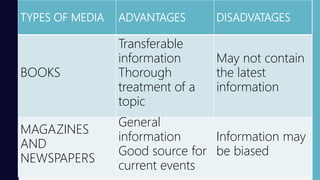
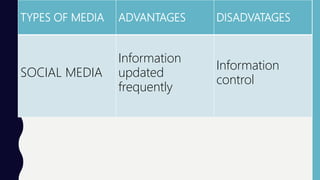
TYPES OF MEDIA ADVANTAGES DISADVATAGES
BOOKS
Transferable
information
Thorough
treatment of a
topic
May not contain
the latest
information
MAGAZINES
AND
NEWSPAPERS
General
information
Good source for
current events
Information may
be biased
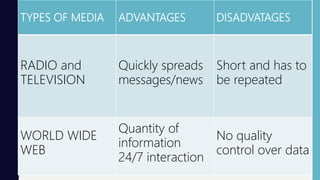
TYPES OF MEDIA ADVANTAGES DISADVATAGES
RADIO and
TELEVISION
Quickly spreads
messages/news
Short and has to
be repeated
WORLD WIDE
WEB
Quantity of
information
24/7 interaction
No quality
control over data
TYPES OF MEDIA ADVANTAGES DISADVATAGES
SOCIAL MEDIA
Information
updated
frequently
Information
control
EVALUATING
INFORMATION
by Eastern Kentucky
University Libraries
based on the work of
Paul and Elder
EVALUATING INFORMATION
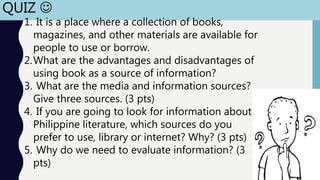
QUIZ 
1. It is a place where a collection of books,
magazines, and other materials are available for
people to use or borrow.
2.What are the advantages and disadvantages of
using book as a source of information?
3. What are the media and information sources?
Give three sources. (3 pts)
4. If you are going to look for information about
Philippine literature, which sources do you
prefer to use, library or internet? Why? (3 pts)
5. Why do we need to evaluate information? (3
pts)
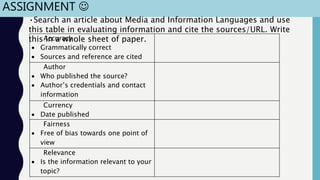
ASSIGNMENT 
Accuracy
 Grammatically correct
 Sources and reference are cited
Author
 Who published the source?
 Author’s credentials and contact
information
Currency
 Date published
Fairness
 Free of bias towards one point of
view
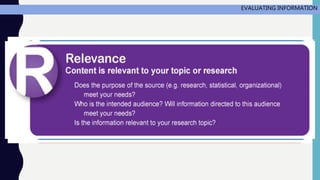
Relevance
 Is the information relevant to your
topic?
•Search an article about Media and Information Languages and use
this table in evaluating information and cite the sources/URL. Write
this in a whole sheet of paper.
REFERENCES
Ping, Arniel. (2017 June 11). Media and Information
Literacy (MIL). Retrieved from
https://www.slideshare.net/arnielping/mil-mass-media-and-media-
effects?qid=20f76147-f1ed-4178-b8f0-
babedeb11506&v=&b=&from_search=1
Credits to all sources of information here.s
THANK YOU FOR
LISTENING AND
COOPERATING
N O N I LY N D. D I A Z
B S E D M AT H E M AT I C S

Media and information sources

  • 1.
    WAR ON DRUGS WH E R E C A N Y O U F I N D M E ?
  • 3.
    SINGKIL – TraditionalMuslim Dance HUDHUD Chants of the Ifugao • native; local; originating or produced naturally in a particular region • knowledge that is unique to a specific culture or society; most often it is not written down• Relayed either through people media or through indigenous media
  • 4.
    “Knowledge that isunique to a given culture or society.” - Warren(1991)
  • 5.
    “Media owned, controlled,and managed by indigenous peoples in order for them to develop and produce locally appropriate information in the languages understood by community by utilizing indigenous materials and resources, reflecting community needs and interests, visions and aspirations, and independent from vested interest groups” - (Indigenous Media, Freedom of Expression and Right to  Any form of media that is:  Created and controlled by the community  For the community  About the community  By the community
  • 6.
    CHARACTERISTICS •Oral tradition ofcommunication •Information are stored in memories •Information passed orally from person to person
  • 7.
    LIBRARY - Collection of sourcesof information and similar resources, made accessible to a defined community for reference or borrowing. - Includes books, periodicals, newspapers, manuscripts, maps, periodicals, journals, and etc.
  • 8.
    INTERNET It allows user-to-user communicationand transfer of data files from one computer to another on the network. An electronic communications network that connects computer networks and organizational computer facilities around the world
  • 9.
    1. Given thetypes of media as a source of information, list down its advantages and disadvantages. GROUP ACTIVITY (Do this in five minutes.) 2. In using different sources of information, what do you consider on measuring or validating information quality?
  • 10.
    TYPES OF MEDIAADVANTAGES DISADVATAGES BOOKS Transferable information Thorough treatment of a topic May not contain the latest information MAGAZINES AND NEWSPAPERS General information Good source for current events Information may be biased
  • 11.
    TYPES OF MEDIAADVANTAGES DISADVATAGES RADIO and TELEVISION Quickly spreads messages/news Short and has to be repeated WORLD WIDE WEB Quantity of information 24/7 interaction No quality control over data
  • 12.
    TYPES OF MEDIAADVANTAGES DISADVATAGES SOCIAL MEDIA Information updated frequently Information control
  • 13.
    EVALUATING INFORMATION by Eastern Kentucky UniversityLibraries based on the work of Paul and Elder
  • 14.
  • 15.
    QUIZ  1. Itis a place where a collection of books, magazines, and other materials are available for people to use or borrow. 2.What are the advantages and disadvantages of using book as a source of information? 3. What are the media and information sources? Give three sources. (3 pts) 4. If you are going to look for information about Philippine literature, which sources do you prefer to use, library or internet? Why? (3 pts) 5. Why do we need to evaluate information? (3 pts)
  • 16.
    ASSIGNMENT  Accuracy  Grammaticallycorrect  Sources and reference are cited Author  Who published the source?  Author’s credentials and contact information Currency  Date published Fairness  Free of bias towards one point of view Relevance  Is the information relevant to your topic? •Search an article about Media and Information Languages and use this table in evaluating information and cite the sources/URL. Write this in a whole sheet of paper.
  • 17.
    REFERENCES Ping, Arniel. (2017June 11). Media and Information Literacy (MIL). Retrieved from https://www.slideshare.net/arnielping/mil-mass-media-and-media- effects?qid=20f76147-f1ed-4178-b8f0- babedeb11506&v=&b=&from_search=1 Credits to all sources of information here.s
  • 18.
    THANK YOU FOR LISTENINGAND COOPERATING N O N I LY N D. D I A Z B S E D M AT H E M AT I C S

Editor's Notes

  • #2 Why do you say so?
  • #4 Tribes. What are their cultures?
  • #5 IDENTITY
  • #7 When we say oral tradition, it includes stories, beliefs that group people share by telling stories or tallking
  • #8 What do we have in the library?
  • #9 WORLD WIDE WEB provides the technology to navigate Pathway of accessing information over the internet through URL(uniform resource locator)