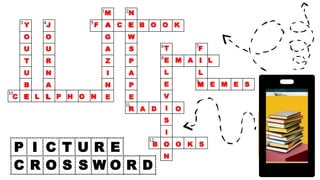
M
A
G
A
Z
I
N
E
N
E
W
S
P
A
P
E
R
Y
O
U
T
U
B
E
J
O
U
R
N
A
L
T
E
L
E
V
I
S
I
O
N
F
I
L
M
F A C E B O O K
E M A I L
M E M E S
C E L L P H O N
R A D O
B O O K S
P I C T U R E
C R O S S W O R D
MEDIA AND
INFORMATION SOURCES
 Media and Information Sources
 Determining the Reliability and
Accuracy of Information
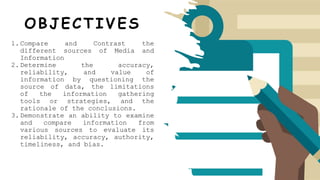
OBJECTIVES
1.Compare and Contrast the
different sources of Media and
Information
2.Determine the accuracy,
reliability, and value of
information by questioning the
source of data, the limitations
of the information gathering
tools or strategies, and the
rationale of the conclusions.
3.Demonstrate an ability to examine
and compare information from
various sources to evaluate its
reliability, accuracy, authority,
timeliness, and bias.
MEDIA AND INFORMATION
SOURCES
LIBRARY
L I B R A R Y
• A library is a collection of resources in a variety of
formats that is
(1) organized by information professionals or other
experts who
(2) provide convenient physical, digital, bibliographic,
or intellectual access and
(3) offer targeted services and programs
(4) with the mission of educating, informing, or
entertaining a variety of audiences
(5) and the goal of stimulating individual learning and
advancing society as a whole.
(American Library Association -
https://libguides.ala.org/library-definition)
•A place in which literary,
musical, artistic, or
reference materials (such
as books, manuscripts,
recordings, or films) are
kept for use but not for
sale (Merriam Webster’s
11th Collegiate Dictionary)
A CA DEMIC
LIBRARY
• Serves colleges and universities.
• Academic libraries encompass research
libraries, baccalaureate, masters and
doctoral degree granting institutions,
junior and community colleges, and
distance learning programs of higher
education.
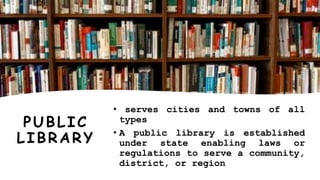
PUBLIC
LIBRARY
• serves cities and towns of all
types
• A public library is established
under state enabling laws or
regulations to serve a community,
district, or region
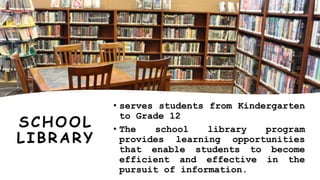
SCHOOL
LIBRARY
• serves students from Kindergarten
to Grade 12
• The school library program
provides learning opportunities
that enable students to become
efficient and effective in the
pursuit of information.
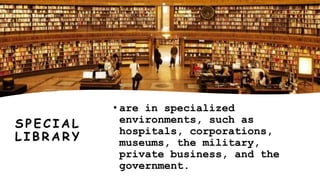
S P E C I A L
L I B R A R Y
• are in specialized
environments, such as
hospitals, corporations,
museums, the military,
private business, and the
government.
CHARACTERISTICS OF LIBRARIES
IN TERMS OF RELIABILITY,
ACCURACY AND VALUE
• Libraries of published books
are often considered highly
reliable, accurate, and
valuable.
• Books and documents from
dominant sources are often
peer reviewed.
• ISSN or ISBN registration
ensures that standards were
followed in producing these
materials.
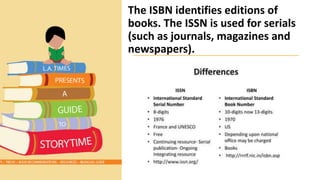
The ISBN identifies editions of
books. The ISSN is used for serials
(such as journals, magazines and
newspapers).
I N T E R N E T
•The internet is a global network of
computers that works much like the
postal system, only at sub-second
speeds. Just as the postal service
enables people to send one another
envelopes containing messages, the
internet enables computers to send one
another small packets of digital data.
BBC WEBWISE
• a global computer network
providing a variety of
information and
communication facilities,
consisting of
interconnected networks
using standardized
communication protocols.
CHARACTERISTIC
S OF INTERNET
INFORMATION
•Reliability
•Accuracy
•Value
•Timeliness, and
•Authority of the
source
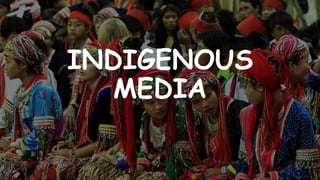
INDIGENOUS
MEDIA
•Native; local;
originating or
produced
naturally in a
particular
region.
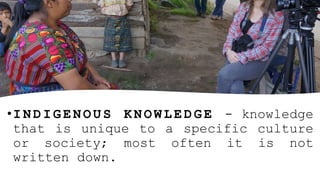
•I N D I G E N O U S K N O W L E D G E - knowledge
that is unique to a specific culture
or society; most often it is not
written down.
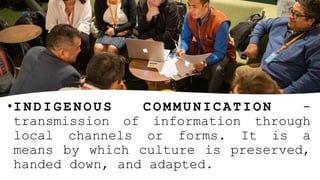
•I N D I G E N O U S C O M M U N I C A T I O N -
transmission of information through
local channels or forms. It is a
means by which culture is preserved,
handed down, and adapted.
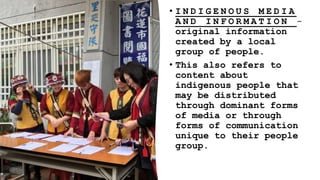
• I N D I G E N O U S M E D I A
A N D I N F O R M A T I O N -
original information
created by a local
group of people.
• This also refers to
content about
indigenous people that
may be distributed
through dominant forms
of media or through
forms of communication
unique to their people
group.
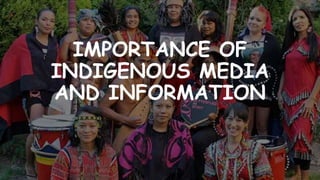
IMPORTANCE OF
INDIGENOUS MEDIA
AND INFORMATION
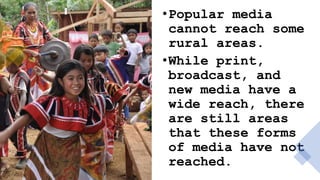
•Popular media
cannot reach some
rural areas.
•While print,
broadcast, and
new media have a
wide reach, there
are still areas
that these forms
of media have not
reached.
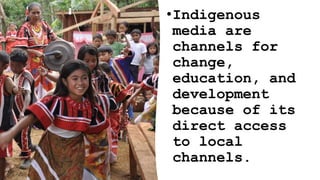
•Indigenous
media are
channels for
change,
education, and
development
because of its
direct access
to local
channels.
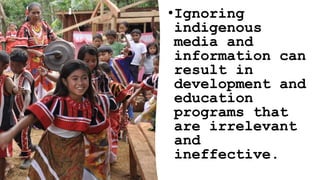
•Ignoring
indigenous
media and
information can
result in
development and
education
programs that
are irrelevant
and
ineffective.
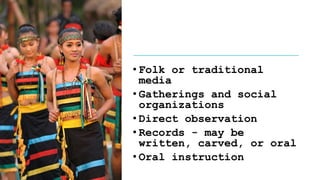
FORMS OF INDIGENOUS MEDIA
• Folk or traditional
media
• Gatherings and social
organizations
• Direct observation
• Records - may be
written, carved, or oral
• Oral instruction
Key Points in
Evaluating
Media and
Information
DEFINITION OF TERMS
• RELIABILITY
• ACCURACY
• VALUE
• TIMELINESS, AND
• AUTHORITY OF THE SOURCE
R E L I A B I L I T Y O F
I N F O R M A T I O N
•Information is said to
be reliable if it can be
verified and evaluated.
•Others refer to the
trustworthiness of the
source in evaluating the
reliability of
information.
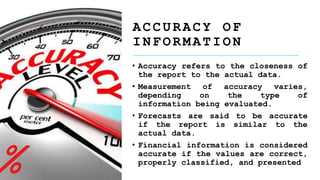
• Accuracy refers to the closeness of
the report to the actual data.
• Measurement of accuracy varies,
depending on the type of
information being evaluated.
• Forecasts are said to be accurate
if the report is similar to the
actual data.
• Financial information is considered
accurate if the values are correct,
properly classified, and presented
A C C U R A C Y O F
I N F O R M A T I O N
V A L U E O F
I N F O R M A T I O N
•Information is
said to be of
value if it aids
the user in making
or improving
decisions.
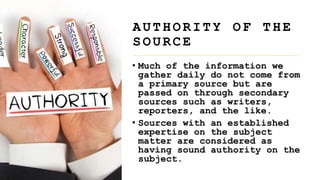
• Much of the information we
gather daily do not come from
a primary source but are
passed on through secondary
sources such as writers,
reporters, and the like.
• Sources with an established
expertise on the subject
matter are considered as
having sound authority on the
subject.
A U T H O R I T Y O F T H E
S O U R C E
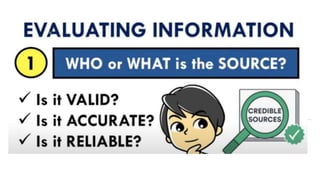
• Reliability, accuracy, and value of
information may vary based on the
time it was produced or acquired.
• While a piece of information may
have been found accurate, reliable,
and valuable during the time it was
produced, it may become irrelevant
and inaccurate with the passing of
time (thus making it less valuable).
• Other information may be timeless,
proven to be the same in
reliability, accuracy, and value
throughout history.
TIMELINESS
Skills in determining the Reliability
of Information
•Check the author. The
author’s willingness to be
identified is a good
indication of reliability.
•Check the date of publication or of
update. While the information may
be true, it may not be reliable if
it is outdated and may have lost
relevance.
•Check for citations. Reliable
authors have the discipline of
citing sources of their
information.
• Check the domain or owner of the site or page. The domains
.edu and .gov are reserved for academic institutions and
the government respectively.
• Information from such sites are presented with caution and
are usually well-grounded.
• Site owners may have an agenda that affects how
information is presented.
•Check the site design and the
writing style. Credible sources
take time to make their
information accessible and easy
to comprehend
Skills in determining the Accuracy of
the Information
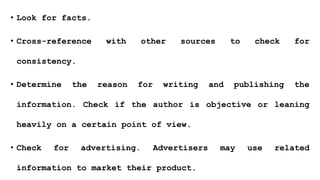
• Look for facts.
• Cross-reference with other sources to check for
consistency.
• Determine the reason for writing and publishing the
information. Check if the author is objective or leaning
heavily on a certain point of view.
• Check for advertising. Advertisers may use related
information to market their product.
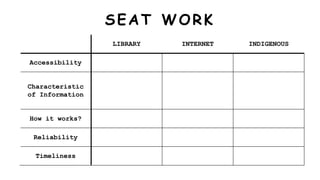
LIBRARY INTERNET INDIGENOUS
Accessibility
Characteristic
of Information
How it works?
Reliability
Timeliness
SEAT WORK
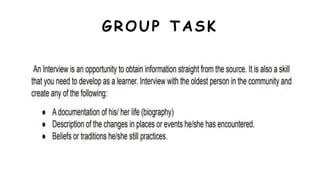
GROUP TASK

MEDIA-AND-INFORMATION-SOURCES-1.pptx

  • 1.
    M A G A Z I N E N E W S P A P E R Y O U T U B E J O U R N A L T E L E V I S I O N F I L M F A CE B O O K E M A I L M E M E S C E L L P H O N R A D O B O O K S P I C T U R E C R O S S W O R D
  • 2.
    MEDIA AND INFORMATION SOURCES Media and Information Sources  Determining the Reliability and Accuracy of Information
  • 3.
    OBJECTIVES 1.Compare and Contrastthe different sources of Media and Information 2.Determine the accuracy, reliability, and value of information by questioning the source of data, the limitations of the information gathering tools or strategies, and the rationale of the conclusions. 3.Demonstrate an ability to examine and compare information from various sources to evaluate its reliability, accuracy, authority, timeliness, and bias.
  • 4.
  • 5.
  • 6.
    L I BR A R Y • A library is a collection of resources in a variety of formats that is (1) organized by information professionals or other experts who (2) provide convenient physical, digital, bibliographic, or intellectual access and (3) offer targeted services and programs (4) with the mission of educating, informing, or entertaining a variety of audiences (5) and the goal of stimulating individual learning and advancing society as a whole. (American Library Association - https://libguides.ala.org/library-definition)
  • 7.
    •A place inwhich literary, musical, artistic, or reference materials (such as books, manuscripts, recordings, or films) are kept for use but not for sale (Merriam Webster’s 11th Collegiate Dictionary)
  • 9.
    A CA DEMIC LIBRARY •Serves colleges and universities. • Academic libraries encompass research libraries, baccalaureate, masters and doctoral degree granting institutions, junior and community colleges, and distance learning programs of higher education.
  • 10.
    PUBLIC LIBRARY • serves citiesand towns of all types • A public library is established under state enabling laws or regulations to serve a community, district, or region
  • 11.
    SCHOOL LIBRARY • serves studentsfrom Kindergarten to Grade 12 • The school library program provides learning opportunities that enable students to become efficient and effective in the pursuit of information.
  • 12.
    S P EC I A L L I B R A R Y • are in specialized environments, such as hospitals, corporations, museums, the military, private business, and the government.
  • 13.
    CHARACTERISTICS OF LIBRARIES INTERMS OF RELIABILITY, ACCURACY AND VALUE
  • 14.
    • Libraries ofpublished books are often considered highly reliable, accurate, and valuable. • Books and documents from dominant sources are often peer reviewed. • ISSN or ISBN registration ensures that standards were followed in producing these materials.
  • 15.
    The ISBN identifieseditions of books. The ISSN is used for serials (such as journals, magazines and newspapers).
  • 16.
    I N TE R N E T •The internet is a global network of computers that works much like the postal system, only at sub-second speeds. Just as the postal service enables people to send one another envelopes containing messages, the internet enables computers to send one another small packets of digital data. BBC WEBWISE
  • 17.
    • a globalcomputer network providing a variety of information and communication facilities, consisting of interconnected networks using standardized communication protocols.
  • 18.
  • 19.
  • 20.
  • 21.
  • 22.
    •I N DI G E N O U S K N O W L E D G E - knowledge that is unique to a specific culture or society; most often it is not written down.
  • 23.
    •I N DI G E N O U S C O M M U N I C A T I O N - transmission of information through local channels or forms. It is a means by which culture is preserved, handed down, and adapted.
  • 24.
    • I ND I G E N O U S M E D I A A N D I N F O R M A T I O N - original information created by a local group of people. • This also refers to content about indigenous people that may be distributed through dominant forms of media or through forms of communication unique to their people group.
  • 25.
  • 26.
    •Popular media cannot reachsome rural areas. •While print, broadcast, and new media have a wide reach, there are still areas that these forms of media have not reached.
  • 27.
    •Indigenous media are channels for change, education,and development because of its direct access to local channels.
  • 28.
    •Ignoring indigenous media and information can resultin development and education programs that are irrelevant and ineffective.
  • 29.
  • 30.
    • Folk ortraditional media • Gatherings and social organizations • Direct observation • Records - may be written, carved, or oral • Oral instruction
  • 31.
  • 36.
  • 37.
    • RELIABILITY • ACCURACY •VALUE • TIMELINESS, AND • AUTHORITY OF THE SOURCE
  • 38.
    R E LI A B I L I T Y O F I N F O R M A T I O N •Information is said to be reliable if it can be verified and evaluated. •Others refer to the trustworthiness of the source in evaluating the reliability of information.
  • 39.
    • Accuracy refersto the closeness of the report to the actual data. • Measurement of accuracy varies, depending on the type of information being evaluated. • Forecasts are said to be accurate if the report is similar to the actual data. • Financial information is considered accurate if the values are correct, properly classified, and presented A C C U R A C Y O F I N F O R M A T I O N
  • 40.
    V A LU E O F I N F O R M A T I O N •Information is said to be of value if it aids the user in making or improving decisions.
  • 41.
    • Much ofthe information we gather daily do not come from a primary source but are passed on through secondary sources such as writers, reporters, and the like. • Sources with an established expertise on the subject matter are considered as having sound authority on the subject. A U T H O R I T Y O F T H E S O U R C E
  • 42.
    • Reliability, accuracy,and value of information may vary based on the time it was produced or acquired. • While a piece of information may have been found accurate, reliable, and valuable during the time it was produced, it may become irrelevant and inaccurate with the passing of time (thus making it less valuable). • Other information may be timeless, proven to be the same in reliability, accuracy, and value throughout history. TIMELINESS
  • 43.
    Skills in determiningthe Reliability of Information
  • 44.
    •Check the author.The author’s willingness to be identified is a good indication of reliability.
  • 45.
    •Check the dateof publication or of update. While the information may be true, it may not be reliable if it is outdated and may have lost relevance.
  • 46.
    •Check for citations.Reliable authors have the discipline of citing sources of their information.
  • 47.
    • Check thedomain or owner of the site or page. The domains .edu and .gov are reserved for academic institutions and the government respectively. • Information from such sites are presented with caution and are usually well-grounded. • Site owners may have an agenda that affects how information is presented.
  • 48.
    •Check the sitedesign and the writing style. Credible sources take time to make their information accessible and easy to comprehend
  • 49.
    Skills in determiningthe Accuracy of the Information
  • 50.
    • Look forfacts. • Cross-reference with other sources to check for consistency. • Determine the reason for writing and publishing the information. Check if the author is objective or leaning heavily on a certain point of view. • Check for advertising. Advertisers may use related information to market their product.
  • 51.
    LIBRARY INTERNET INDIGENOUS Accessibility Characteristic ofInformation How it works? Reliability Timeliness SEAT WORK
  • 52.

Editor's Notes

  • #25 Indigenous media varies from one place to another. The teacher may look for local examples of how communication is passed on within local communities. Key to this is identifying the source of information and the key authorities in a community. Local meetings such as kapihan, balitaktakan, and kwentong barbero are some examples of how news and stories are passed on within a community.