Medicinal Chemistry IV Enzyme Structure and Function
Enzyme as Catalyst
How do enzyme catalyze reactions ?
Active site of Enzyme
Isozyme
Enzyme kinetics
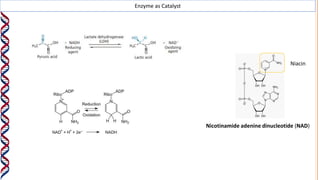
Enzyme as Catalyst
Niacin
Nicotinamide adenine dinucleotide (NAD)
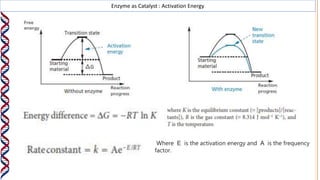
Enzyme as Catalyst : Activation Energy
Where E is the activation energy and A is the frequency
factor.
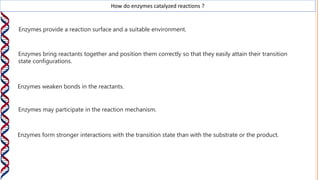
How do enzymes catalyzed reactions ?
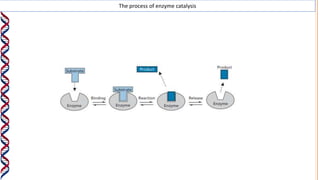
Enzymes provide a reaction surface and a suitable environment.
Enzymes bring reactants together and position them correctly so that they easily attain their transition
state configurations.
Enzymes weaken bonds in the reactants.
Enzymes may participate in the reaction mechanism.
Enzymes form stronger interactions with the transition state than with the substrate or the product.
The process of enzyme catalysis
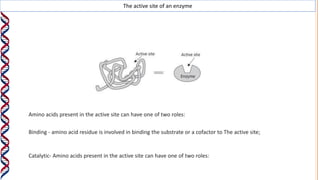
The active site of an enzyme
Binding - amino acid residue is involved in binding the substrate or a cofactor to The active site;
Amino acids present in the active site can have one of two roles:
Catalytic- Amino acids present in the active site can have one of two roles:
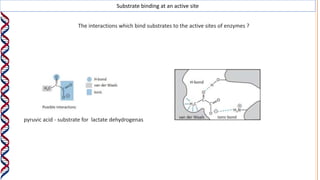
Substrate binding at an active site
The interactions which bind substrates to the active sites of enzymes ?
pyruvic acid - substrate for lactate dehydrogenas
The catalytic role of enzymes
Mechanism of Enzyme catalysis
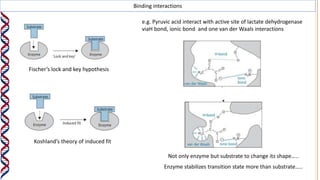
Binding interactions
Acid/Base catalysis
Nucleophilic groups
Cofactors
Binding interactions
Not only enzyme but substrate to change its shape…..
Enzyme stabilizes transition state more than substrate…..
e.g. Pyruvic acid interact with active site of lactate dehydrogenase
viaH bond, ionic bond and one van der Waals interactions
Fischer’s lock and key hypothesis
Koshland’s theory of induced fit
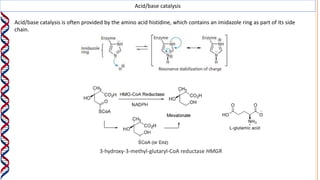
Acid/base catalysis
Acid/base catalysis is often provided by the amino acid histidine, which contains an imidazole ring as part of its side
chain.
3-hydroxy-3-methyl-glutaryl-CoA reductase HMGR
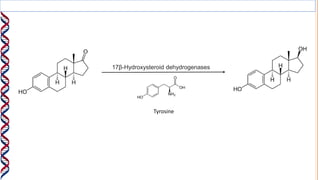
17β-Hydroxysteroid dehydrogenases
Tyrosine
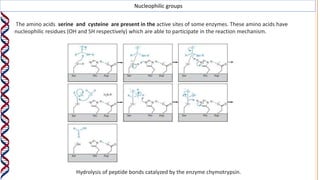
Nucleophilic groups
The amino acids serine and cysteine are present in the active sites of some enzymes. These amino acids have
nucleophilic residues (OH and SH respectively) which are able to participate in the reaction mechanism.
Hydrolysis of peptide bonds catalyzed by the enzyme chymotrypsin.
Cofactors
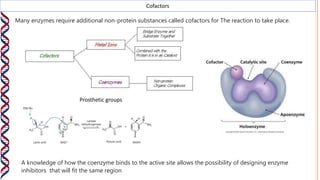
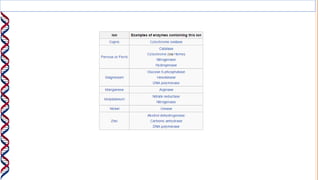
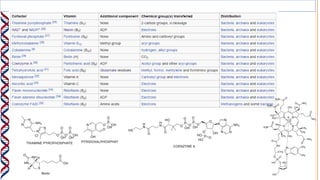
Many enzymes require additional non-protein substances called cofactors for The reaction to take place.
Prosthetic groups
A knowledge of how the coenzyme binds to the active site allows the possibility of designing enzyme
inhibitors that will fit the same region
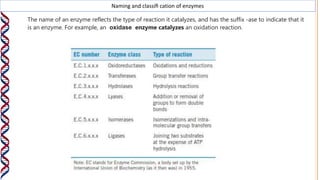
Naming and classifi cation of enzymes
The name of an enzyme reflects the type of reaction it catalyzes, and has the suffix -ase to indicate that it
is an enzyme. For example, an oxidase enzyme catalyzes an oxidation reaction.
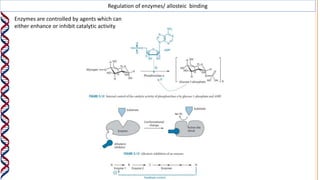
Regulation of enzymes/ allosteic binding
Enzymes are controlled by agents which can
either enhance or inhibit catalytic activity
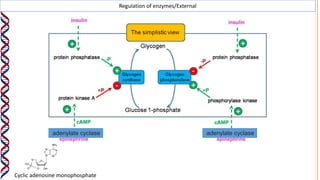
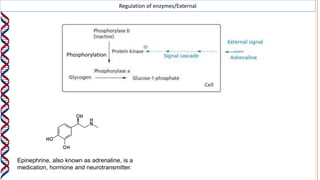
Regulation of enzymes/External
Phosphorylation
Epinephrine, also known as adrenaline, is a
medication, hormone and neurotransmitter.
Regulation of enzymes/External
Cyclic adenosine monophosphate
adenylate cyclase adenylate cyclase
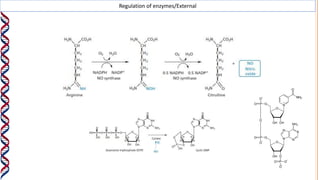
Regulation of enzymes/External
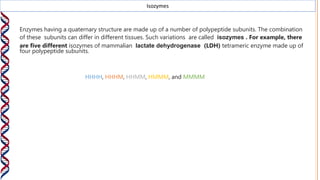
Isozymes
Enzymes having a quaternary structure are made up of a number of polypeptide subunits. The combination
of these subunits can differ in different tissues. Such variations are called isozymes . For example, there
are five different isozymes of mammalian lactate dehydrogenase (LDH) tetrameric enzyme made up of
four polypeptide subunits.
HHHH, HHHM, HHMM, HMMM, and MMMM
Points to remember
Enzymes are proteins that act as the body’s catalysts by binding substrates and participating in the reaction
mechanism.
The active site of an enzyme is usually a hollow or cleft in the protein. There are important amino acids
present in the active site that either bind substrates or participate in the reaction mechanism
Binding of substrate to an active site involves intermolecular bonds.
The amino acid histidine is often present in active sites and acts as an acid/base catalyst. Glutamic acid, aspartic
acid, and tyrosine also act as acid/base catalysts in some enzymes
Cofactors are metal ions or small organic molecules (coenzymes) which are required by many enzymes.
Coenzymes can be viewed as the body’s chemical reagents

Medicinal Chemistry : Enzyme structure and function

  • 1.
    Medicinal Chemistry IVEnzyme Structure and Function Enzyme as Catalyst How do enzyme catalyze reactions ? Active site of Enzyme Isozyme Enzyme kinetics
  • 2.
    Enzyme as Catalyst Niacin Nicotinamideadenine dinucleotide (NAD)
  • 3.
    Enzyme as Catalyst: Activation Energy Where E is the activation energy and A is the frequency factor.
  • 4.
    How do enzymescatalyzed reactions ? Enzymes provide a reaction surface and a suitable environment. Enzymes bring reactants together and position them correctly so that they easily attain their transition state configurations. Enzymes weaken bonds in the reactants. Enzymes may participate in the reaction mechanism. Enzymes form stronger interactions with the transition state than with the substrate or the product.
  • 5.
    The process ofenzyme catalysis
  • 6.
    The active siteof an enzyme Binding - amino acid residue is involved in binding the substrate or a cofactor to The active site; Amino acids present in the active site can have one of two roles: Catalytic- Amino acids present in the active site can have one of two roles:
  • 7.
    Substrate binding atan active site The interactions which bind substrates to the active sites of enzymes ? pyruvic acid - substrate for lactate dehydrogenas
  • 8.
    The catalytic roleof enzymes Mechanism of Enzyme catalysis Binding interactions Acid/Base catalysis Nucleophilic groups Cofactors
  • 9.
    Binding interactions Not onlyenzyme but substrate to change its shape….. Enzyme stabilizes transition state more than substrate….. e.g. Pyruvic acid interact with active site of lactate dehydrogenase viaH bond, ionic bond and one van der Waals interactions Fischer’s lock and key hypothesis Koshland’s theory of induced fit
  • 10.
    Acid/base catalysis Acid/base catalysisis often provided by the amino acid histidine, which contains an imidazole ring as part of its side chain. 3-hydroxy-3-methyl-glutaryl-CoA reductase HMGR
  • 11.
  • 12.
    Nucleophilic groups The aminoacids serine and cysteine are present in the active sites of some enzymes. These amino acids have nucleophilic residues (OH and SH respectively) which are able to participate in the reaction mechanism. Hydrolysis of peptide bonds catalyzed by the enzyme chymotrypsin.
  • 13.
    Cofactors Many enzymes requireadditional non-protein substances called cofactors for The reaction to take place. Prosthetic groups A knowledge of how the coenzyme binds to the active site allows the possibility of designing enzyme inhibitors that will fit the same region
  • 16.
    Naming and classification of enzymes The name of an enzyme reflects the type of reaction it catalyzes, and has the suffix -ase to indicate that it is an enzyme. For example, an oxidase enzyme catalyzes an oxidation reaction.
  • 17.
    Regulation of enzymes/allosteic binding Enzymes are controlled by agents which can either enhance or inhibit catalytic activity
  • 18.
    Regulation of enzymes/External Phosphorylation Epinephrine,also known as adrenaline, is a medication, hormone and neurotransmitter.
  • 19.
    Regulation of enzymes/External Cyclicadenosine monophosphate adenylate cyclase adenylate cyclase
  • 20.
  • 21.
    Isozymes Enzymes having aquaternary structure are made up of a number of polypeptide subunits. The combination of these subunits can differ in different tissues. Such variations are called isozymes . For example, there are five different isozymes of mammalian lactate dehydrogenase (LDH) tetrameric enzyme made up of four polypeptide subunits. HHHH, HHHM, HHMM, HMMM, and MMMM
  • 22.
    Points to remember Enzymesare proteins that act as the body’s catalysts by binding substrates and participating in the reaction mechanism. The active site of an enzyme is usually a hollow or cleft in the protein. There are important amino acids present in the active site that either bind substrates or participate in the reaction mechanism Binding of substrate to an active site involves intermolecular bonds. The amino acid histidine is often present in active sites and acts as an acid/base catalyst. Glutamic acid, aspartic acid, and tyrosine also act as acid/base catalysts in some enzymes Cofactors are metal ions or small organic molecules (coenzymes) which are required by many enzymes. Coenzymes can be viewed as the body’s chemical reagents

Editor's Notes

  • #3 Enzymes are proteins which act as the body筑s catalysts抑 agents that speed up a chemical reaction without being consumed themselves. Without them, the cells chemical reactions would either be too slow or not take place at all. An example of an enzyme-catalysed reaction is the reduction of pyruvic acid to lactic acid , which takes place when muscles are over-exercised, and is catalysed by an enzyme called lactate dehydrogenase Other names Diphosphopyridine nucleotide (DPN+), Coenzyme I Nicotinamide adenine dinucleotide (NAD) is a coenzyme found in all living cells. The compound is a dinucleotide, because it consists of twonucleotides joined through their phosphate groups. One nucleotide contains an adenine base and the other nicotinamide. Nicotinamide adenine dinucleotide exists in two forms, an oxidized and reduced form abbreviated as NAD+ and NADH respectively. In organisms, NAD can be synthesized from simple building-blocks (de novo) from the amino acids tryptophan or aspartic acid. In an alternative fashion, more complex components of the coenzymes are taken up from food as the vitamin called niacin. Note that the reaction is shown as an equilibrium. It is, therefore, more correct to describe an enzyme as an agent that speeds up the approach to equilibrium, because the enzyme speeds up the reverse reaction just as efficiently as the forward reaction. Th e fi nal equilibrium concentrations of the starting materials and products are unaffected by the presence of an enzyme
  • #4 How do enzymes affect the rate of a reaction without affecting the equilibrium? Th e answer lies in the existence of a high-energy transition statenthat must Be formed Before the starting material (the substrate) can be converted to the product. The difference in energy between the transition state and the substrate is the activation energy, and it is the size of this activation energy that determines the rate of A reaction, rather the difference in energy between the substrate and the product An enzyme acts to lower the activation energy by helping to stabilize the transition state. Note that the rate constant k does not depend on the equilibrium constant K . We have stated that enzymes catalyse reactions, but we have still to explain how.
  • #5 An enzyme catalyses a reaction by providing a surface to which a substrate can bind, resulting in the weakening of high-energy bonds. The binding also holds the substrate in the correct orientation to increase the chances of reaction. The reaction takes place, aided by the enzyme, to give a product which is then released. Note again that it is a reversible process. Enzymes can catalyse both forward and backward reactions. The final equilibrium Mixture will, however, be the same, regardless of whether we supply the enzyme with substrate or product. Substrates bind to, and react at, a specific area of the enzyme called the active site 蓉sually quite a small part of the overall protein structure.
  • #6 An enzyme catalyses a reaction by providing a surface to which a substrate can bind, resulting in the weakening of high-energy bonds. The binding also holds the sub- strate in the correct orientation to increase the chances of reaction. The reaction takes place, aided by the enzyme, to give a product which is then released Note again that it is a reversible process. Enzymes can catalyse both forward and backward reactions. The final equilibrium mixture will, however, be the same, regardless of whether we supply the enzyme with substrate or product. Substrates bind to, and react at, a specific area of the enzyme called the active site 蓉sually Quite a small part of the Overall protein structure.
  • #7  Th e active site of an enzyme ( Fig. 3.4 ) has to be on or near the surface of the enzyme if a substrate is to reach it. However, the site could be a groove, hollow, or gully allowing the substrate to sink into the enzyme. Normally, the active site is more hydrophobic in character than the surface of the enzyme, providing a suitable environment for many reactions that would be difficult or impossible to carry out in an aqueous environment
  • #8 Th e interactions which bind substrates to the active sites of enzymes include ionic bonds, hydrogen bonds, dipole謀ipole, and ion謀ipole interactions, as well as van der Waals and hydrophobic interactions (section 1.3). Th ese binding interactions are the same bonding interactions responsible for the Tertiary structure of proteins, but their relative importance differs. Ionic bonding plays a relatively Minor role in protein tertiary structure compared with hydrogen bonding or van der Waals interactions, but it can play a crucial role in the binding of a substrate to an active site. As intermolecular bonding forces are involved in substrate binding, it is possible to look at the structure of a substrate and postulate the probable interactions that it will have with its active site. As an example, consider pyruvic acid 葉he substrate for lactate dehydrogenase it means that within the active site there must be binding regions containing suitable amino acids that can take part in these intermolecular interactions. Lysine, serine, and phenylalanine residues respectively would fi t the bill. A knowledge of how a substrate binds to its active site is invaluable in designing drugs that will target specifi c enzymes
  • #9 We now move on to consider the mechanism of enzymes and how they catalyse reactions. In general, enzymes catalyse Reactions by providing binding interactions, acid/ base catalysis, nucleophilic groups, and cofactors. A cofactor is a non-protein chemical compound that is required for the protein's biological activity. These proteins are commonlyenzymes, and cofactors can be considered "helper molecules" that assist in biochemical transformations.
  • #10 In the past, it was thought that a substrate fi tted its active site in a similar way to a key fi tting a lock ( Fischer’s lock and key hypothesis ). Both the enzyme and the substrate were seen as rigid structures, with the substrate (the key) fi tting perfectly into the active site (the lock) ( Fig. 3.6 ). However, this scenario does not explain how some enzymes can catalyse a reaction on a range of diff erent substrates. It implies, instead, that an enzyme has an optimum substrate that fi ts it perfectly, whereas all other substrates fi t less perfectly. It is now proposed that the substrate is not quite the ideal shape for the active site, and that it forces the active site to change shape when it enters預 kind of moulding process. Th is theory is known as Koshland’s theory of induced fi t as the substrate induces the active site to take up the ideal shape to accommodate it For example, a substrate such as pyruvic acid might interact with specifi c binding regions in the active site of lactate dehydrogenase via one hydrogen bond, one ionic bond, and one van der Waals interaction. However, if the fi t is not perfect, the three bonding interactions are not ideal either. For example, the binding groups may be slightly too far away from the corresponding binding regions in the active site. In order to maximize the strength of these bonds, the enzyme changes shape such that the amino acid residues involved in the binding move closer to the Substrate Th is theory of induced fi t helps to explain why some enzymes can catalyse reactions involving a wide range of substrates. Each substrate induces the active site into a shape that is ideal for it and, as long as the moulding process does not distort the active site so much that the reaction mechanism proves impossible, the reaction can proceed. Th e range of substrates that can be accepted depends on the substrates being the correct size to fi t the active site and having the correct binding groups in the correct relative positions Once bound to an active site, the substrate is now held ready for the subsequent reaction. Binding has fi xed the 挿victim・(substrate) so that it cannot evade attack, and this same binding has weakened its defences (bonds) so that reaction is easier (a lower activation energy). Finally, it is important to realize that the enzyme also binds the transition state involved in the enzyme- catalysed reaction. Indeed, the binding interactions involved are stronger than those binding the substrate, which means that the transition state is stabilized relatively More than the substrate. This results in a lower activation energy compared with the non-catalyzed reaction.
  • #11 Acid/base catalysis is often provided by the amino acid histidine , which contains an imidazole ring as part of its side chain. Th e imidazole ring acts as a weak base, which means that it exists in equilibrium between its protonated and free base forms ( Fig. 3.8 ), allowing it to accept or donate protons during a reaction mechanism. Th is is important, as there are oft en very few water molecules present in an active site to carry out This role. Histidine is not The only amino acid residue that can provide acid/base catalysis. For example, a glutamic acid residue acts as a proton source in the reaction mechanism of The enzyme HMG-CoA Reductase (Case Study 1), While aspartic acid and aspartate residues act as proton donors And proton acceptors, respectively, in other enzyme-catalysed reactions . Tyrosine acts as a proton source in the mechanism by which the enzyme 17ß-hydroxysteroid type 1 catalyses the conversion of estrone to estradiol
  • #13  They do this by reacting with the substrate to form intermediates that would not be formed in the uncatalysed reaction. These intermediates off er an alternative reaction pathway. that may avoid a high-energy transition state and hence increase the rate of the reaction. Normally, an alcoholic OH group, such as the one on serine, is not a good nucleophile. However, there is usually a histidine residue close by to catalyse the reaction. For example, the mechanism by which chymotrypsin hydrolyses peptide bonds Involves a catalytic triad of amino acids耀erine, histidine, and aspartic acid. Serine and histidine participate in the mechanism as a nucleophile and acid/base catalyst respectively. Th e aspartate group interacts with the histidine ring and serves to activate and orient it correctly for the mechanism.
  • #14 Defi ciency of cofactors can arise from a poor diet resulting in the loss of enzyme activity And subsequent disease (e.g. scurvy). Cofactors are either metal ions (e.g. zinc) or small Organic molecules called coenzymes (e.g. NAD pyridoxal phosphate). Most coenzymes are bound by ionic bonds and other non-covalent bonding interactions, But some are bound covalently and are called prosthetic groups . Coenzymes are derived from water-soluble vitamins and act as the body筑s chemical reagents. For example, lactate dehydrogenase requires The coenzyme nicotinamideadenine dinucleotide (NAD ) ( Fig. 3.10 ) in order to catalyse the dehydrogenation of lactic acid to pyruvic acid . NAD is bound to the active site along with lactic acid, and acts as the oxidizing agent. During the reaction it is converted to its reduced form (NADH) ( Fig. 3.11 ). Conversely, NADH can bind to the enzyme and act as a reducing agent when the enzyme catalyses the reverse reaction. A cofactor is a non-protein chemical compound that is required for the protein's biological activity. These proteins are commonlyenzymes, and cofactors can be considered "helper molecules" that assist in biochemical transformations. An inactive enzyme without the cofactor is called an apoenzyme, while the complete enzyme with cofactor is called a holoenzyme
  • #17 Th ere are oft en subtle diff erences in the structure and properties of an enzyme between diff erent individuals. Th is is owing to the fact that the DNA that codes for proteins (Chapter 6) is not identical from person to person. On average, there is a diff erence of one base pair in every thousand between individuals. Th is is known as genetic polymorphism .
  • #18 Virtually all enzymes are controlled by agents which can either enhance or inhibit catalytic activity. Such control refl ects the local conditions within the cell. For example, the enzyme phosphorylase a catalyses the breakdown of glycogen (a polymer of glucose monomers) to glucose1-phosphate subunits ( Fig. 3.12 ). It is stimulated by adenosine 5'-monophosphate (AMP) and inhibited by glucose-1-phosphate. Th us, rising levels of the product (glucose-1-phosphate) act as a self-regulating 礎rake筑 on the enzyme// Th e answer is that many enzymes have a binding site which is separate from the active site called the allosteric binding site Th is is where the agents controlling the activity of the enzyme bind. When this occurs, an induced fi t takes place which alters not only the allosteric binding site, but also the active site. Agents that inhibit the enzyme produce an induced fi t that makes the active site unrecognizable to the substrate.
  • #19 Many enzymes can also be regulated externally ( Box 3.1 ). We shall look at this in more detail in Chapter 5, but, in essence, cells receive chemical messages from their environment which trigger a cascade of signals within the cell. In turn, these ultimately activate a set of enzymes known as protein kinases . Th e protein kinases play an important part in controlling enzyme activity within the cell by phosphorylating amino acids such as serine, threonine , or tyrosine in target enzymes抑 a covalent modifi cation. For example, the hormone adrenaline is an external messenger which triggers a signalling sequence resulting in the activation of a protein Kinase enzyme. Once activated, the protein Kinase phosphorylates An inactive enzyme called phosphorylase Th is enzyme now becomes active and is called phosphorylasea . It catalyses the breakdown of glycogen and remains active until it is dephosphorylated back to phosphorylase b . In this case, phosphorylation of the target enzyme leads to activation. Other enzymes may be deacti- vated by phosphorylation. For example, glycogen
  • #20 Many enzymes can also be regulated externally ( Box 3.1 ). We shall look at this in more detail in Chapter 5, but, in essence, cells receive chemical messages from their environment which trigger a cascade of signals within the cell. In turn, these ultimately activate a set of enzymes known as protein kinases . Th e protein kinases play an important part in controlling enzyme activity within the cell by phosphorylating amino acids such as serine, threonine , or tyrosine in target enzymes抑 a covalent modifi cation. For example, the hormone adrenaline is an external messenger which triggers a signalling sequence resulting in the activation of a protein Kinase enzyme. Once activated, the protein Kinase phosphorylates An inactive enzyme called phosphorylase Th is enzyme now becomes active and is called phosphorylasea . It catalyses the breakdown of glycogen and remains active until it is dephosphorylated back to phosphorylase b . In this case, phosphorylation of the target enzyme leads to activation. Other enzymes may be deacti- vated by phosphorylation. For example, glycogen
  • #21 The external control of enzymes is usually initiated by external chemical messengers which do not enter the cell. However, there is an exception to this. It has been discovered that cells can generate the gas nitric Oxide by the reaction sequence shown in Fig. 1 catalysed by the enzyme nitric oxide synthase Because nitric oxide is a gas, it can diffuse easily through cell membranes into target cells. There, it activates enzymes called cyclases to generate cyclic GMP from GTP ( Fig. 2 ). Cyclic GMP then acts as a secondary messenger to infl uence other reactions within the cell. By this process, nitric oxide has an infl uence on a diverse range of physiological processes, including blood pressure, neurotransmission , and immunological defence mechanisms