Meconium Aspiration
Syndrome (MAS)
Objectives
■ Definition
■ Epidemiology
■ Etiology
■ Pathophysiology
■ Clinical features
■ Differential Diagnosis
■ Diagnosis
■ Management
■ Prognosis
Definition
Meconium aspiration syndrome
(MAS) is a respiratory distress in an
infant born through
Meconium stained amniotic fluid
whose symptoms cannot be
otherwise explained.
Epidemiology
■ MAS overall incidence varies in (8-20)%
of all births.
■ MAS occurs in 5% of newborns delivered
through MSAF.
■ It is a disease of Term or Post-term
Infant who are SGA / IUGR
Composition of meconium
■ Epithelial cells
■ Fetal hair
■ Mucus
■ Bile
Cause of MSAF
■ Normally The passage of meconium from the fetus
into amnion is prevented by lack of peristalsis(low
motilin level) , tonic contraction of the anal sphincter,
terminal cap of viscous meconium.
■ Fetal maturation post term(high motilin level)
■ Vagal stimulation by cord or head compression in
absence of fetal distress.
In utero stress(hypoxia, acidosis)/ chronic placental
insufficiency producing relaxation of anal sphincter with
passage of meconium. The meconium-stained liquor
may be aspirated by the fetus-in utero or during first
breath
Risk factors for MAS
■ Maternal HT
■ Maternal DM
■ Maternal heavy cigarette smoking
■ Maternal chronic respiratory or Cardio vascular
disease
■ Post term pregnancy
■ Pre-eclampsia/eclampsia
■ Oligohydramnios
■ IUGR
■ Abnormal fetal HR pattern
Pathophysiology
Mechanical obstruction of
airway
■ Thick and viscous meconium lead to
Complete or partial airway obstruction.
■ With onset of respiration – meconium
migrates from central to peripheral
airways.
Complete obstruction – atelectasis
Partial obstruction –
- Ball-valve – air trapping.
- Risk of pneumothorax - 15 – 33%
■
■
Pathophysiology
■ Chemical pneumonitis: with distal
progressing of meconium chemical
pneumonitis, release of cytokines leading
to development of bronchiolar edema and
narrowing of the small airway.
■ Surfactant inactivation: Bilirubin, fatty
acid, triglycerides, cholesterol content of
meconium inhibit surfactant function and
inactivation.
Pathophysiology
■ Pulmonary hypertension: meconium in
lungs stimulate release of proinflammatory
cytokines and vasoactive substance which
cause pulmonary vasoconstriction. Also
hypoxia, acidosis, and hyperinflation
contribute to pulmonary hypertension.
CLINICAL FEATURES -History
■ Infants with MAS must have a history of
MSAF.
■ They often are Term or post-term, IUGR.
■ Many are depressed at birth.
■ Not all the infants with meconium aspiration
will develop MAS.
■
CLINICAL FEATURES Physical examination
■ Evidence of postmaturity: peeling skin,long
fingernails, and decreased vernix.
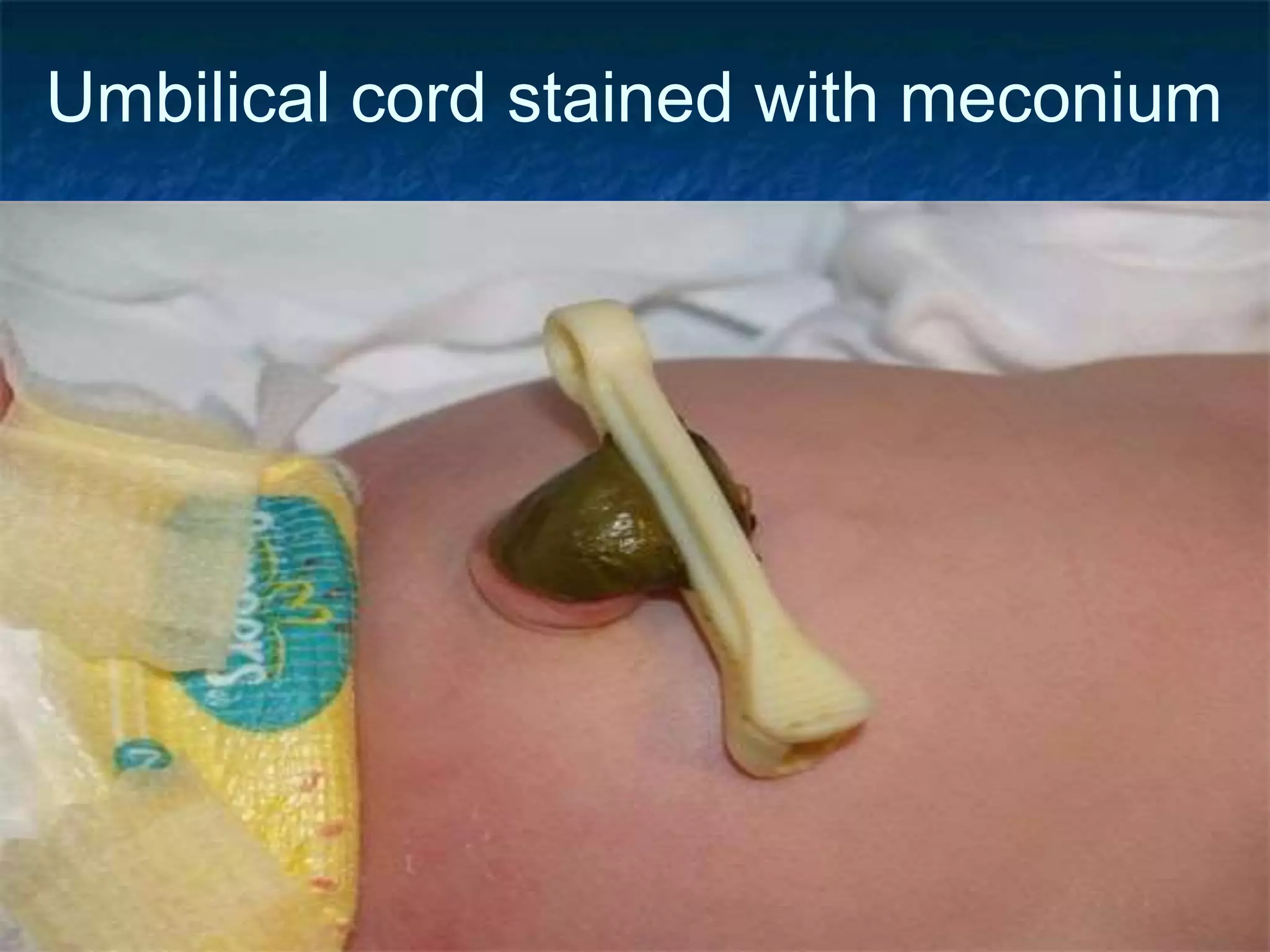
■ The vernix, umbilical cord, and nails may be
meconium-stained, depending upon how long
the infant has been exposed in utero.
■ In general, nails will become stained after 6
hours and vernix after 12 to 14 hours of
exposure and umbilical cord staining (thick-
15min, thin-1hour)
Umbilical cord stained with meconium
CLINICAL FEATURES
■ Features of respiratory distress develop immediately
after birth in only 5–10% infants. Infant manifests
with tachypnea, nasal flaring, intercostal retractions
and cyanosis. Affected newborns typically have
respiratory distress with marked tachypnea and
cyanosis.
■ Use of accessory muscles of respiration are
evidenced by intercostal and subcostal
retractions and abdominal breathing, often with
grunting and nasal flaring.
CLINICAL FEATURES
Physical examination
■ The chest typically appears barrel-shaped, with
an increased anterior-posterior diameter caused
by overinflation.
■ Auscultation reveals rales and rhonchi
-immediately after birth.
■ Some patients are asymptomatic at birth and
develop worsening signs of respiratory distress
as the meconium moves from the large airways
into the lower tracheobronchial tree.
Differential Diagnosis
■ Perinatal Asphyxia
■ Bacterial Pneumonia
■ Respiratory Distress Syndrome
■ Transient Tachypnea Of Newborn
■ Congenital Heart Disease
Diagnosis
MAS must be considered in any infant born
through MSAF who develops symptoms of RDS
with typical chest x ray findings
■ A chest radiographs shows hyperinflation of
the lung field and flatten diagphragms.
■ There are coarse irregular patchy
infiltrates
■ A pneumothorax and pneumomediastinum may
be present .
Coarse irregular patchy infiltrate with emphysema.
Diagnosis
■ Arterial blood gas measurements typically
show hypoxemia and hypercarbia.
■ Echocardiogram for evaluation of PPH.
Management
■ Prenatal management: Key management lies in
prevention during prenatal period.
■ Identification of high risk pregnancies and close
monitoring.
■ Pregnancy that continue past due date, induction as
early as 41 weeks may help prevent meconium
aspiration.
■ If there is sign of fetal distress corrective
measure should be undertaken or infant
should be delivered in timely manner.
Management
Management
■ When the infant is not vigorous:
1. Clear airways as quickly as possible.
2. Free flow 02.
3. Radiant warmer but drying and stimulation should
be delayed.
4. Direct laryngoscopy with suction of the mouth
and hypopharynx under direct visualizationn
followedby intubation and then suction directly to
the ET tube .
5. The process is repeated until either ‘‘little additional
meconium is recovered, or until the baby’s heart rate
indicates that resuscitation must proceed without
delay’’.
MGT.-
Maintenance of
(a)Thermoneutral environment
(b)Minimum handling
(c)To correct metabolic abnormalities
(d) Circulatory support (N. saline or whole blood)
(e) Airway and oral suctioning may be needed
Liberal oxygen supply
Postnatal Management
Apparently well child born through MSAF
■ Most of them do not require any interventions
besides close monitoring for RDS.
■ Most infants who develop symptoms will do so in
the first 12 hours of life.
Postnatal Management
Approach to the ill newborns:
■ Transfer to NICU.
■ Monitor closely.
■ Full range of respiratory support should be
given.
■ Sepsis work up and Antibiotics indicated.
Treatment in NICU
Goals:
■ Increased oxygenation while minimizing
the barotrauma (may lead to air leak).
■ Prevent pulmonary hypertension.
■ Successful transition from intrauterine to
extrauterine life with a drop in pulmonary
arterial resistance and an increase in
pulmonary blood flow.
Treatment in NICU
• Ventilatory support depends on the amount of
respiratory distress: O2 hood , CPAP, mechanical
ventilation
• Surfactant therapy in MAS showed
promising results with decrease in the number of
infants requiring ECMO and possible reduction of
pneumothorax
• Inhaled Nitric oxide (NO)- Selective pulmonary
vasodilation. Decreases need for ECMO but no
difference in mortality. Pretreatment with surfactant
improves delivery of NO to alveoli.
ECMO
■ 40% of infants with MAS treated with
inhaled NO fail to respond and require
ECMO.
■ 35% of ECMO patients are with MAS.
■ Survival rate after ECMO 93-100%.
Progonosis
■ Mortality reduced to <5% with new modalities of
therapy such as administration of surfactant,
HFV, iNO, ECMO.
■ Chronic lung disease may result from prolong
mechanical ventilation
■ Those with significant asphyxial insult may
demonstrate neurologic sequel, cerebral
palsy and mental retardation
Summary
■ Optimal care of an infant born through
MSAF involves close collaboration
between OBs and Neonatoloy team.
■ Effective communication and anticipation
of potential problems is a corner stone of
the successful partnership.
meconium aspiration syndrome- Anju.pptx

meconium aspiration syndrome- Anju.pptx

  • 1.
  • 2.
    Objectives ■ Definition ■ Epidemiology ■Etiology ■ Pathophysiology ■ Clinical features ■ Differential Diagnosis ■ Diagnosis ■ Management ■ Prognosis
  • 3.
    Definition Meconium aspiration syndrome (MAS)is a respiratory distress in an infant born through Meconium stained amniotic fluid whose symptoms cannot be otherwise explained.
  • 4.
    Epidemiology ■ MAS overallincidence varies in (8-20)% of all births. ■ MAS occurs in 5% of newborns delivered through MSAF. ■ It is a disease of Term or Post-term Infant who are SGA / IUGR
  • 5.
    Composition of meconium ■Epithelial cells ■ Fetal hair ■ Mucus ■ Bile
  • 6.
    Cause of MSAF ■Normally The passage of meconium from the fetus into amnion is prevented by lack of peristalsis(low motilin level) , tonic contraction of the anal sphincter, terminal cap of viscous meconium. ■ Fetal maturation post term(high motilin level) ■ Vagal stimulation by cord or head compression in absence of fetal distress. In utero stress(hypoxia, acidosis)/ chronic placental insufficiency producing relaxation of anal sphincter with passage of meconium. The meconium-stained liquor may be aspirated by the fetus-in utero or during first breath
  • 7.
    Risk factors forMAS ■ Maternal HT ■ Maternal DM ■ Maternal heavy cigarette smoking ■ Maternal chronic respiratory or Cardio vascular disease ■ Post term pregnancy ■ Pre-eclampsia/eclampsia ■ Oligohydramnios ■ IUGR ■ Abnormal fetal HR pattern
  • 8.
    Pathophysiology Mechanical obstruction of airway ■Thick and viscous meconium lead to Complete or partial airway obstruction. ■ With onset of respiration – meconium migrates from central to peripheral airways. Complete obstruction – atelectasis Partial obstruction – - Ball-valve – air trapping. - Risk of pneumothorax - 15 – 33% ■ ■
  • 9.
    Pathophysiology ■ Chemical pneumonitis:with distal progressing of meconium chemical pneumonitis, release of cytokines leading to development of bronchiolar edema and narrowing of the small airway. ■ Surfactant inactivation: Bilirubin, fatty acid, triglycerides, cholesterol content of meconium inhibit surfactant function and inactivation.
  • 10.
    Pathophysiology ■ Pulmonary hypertension:meconium in lungs stimulate release of proinflammatory cytokines and vasoactive substance which cause pulmonary vasoconstriction. Also hypoxia, acidosis, and hyperinflation contribute to pulmonary hypertension.
  • 12.
    CLINICAL FEATURES -History ■Infants with MAS must have a history of MSAF. ■ They often are Term or post-term, IUGR. ■ Many are depressed at birth. ■ Not all the infants with meconium aspiration will develop MAS. ■
  • 13.
    CLINICAL FEATURES Physicalexamination ■ Evidence of postmaturity: peeling skin,long fingernails, and decreased vernix. ■ The vernix, umbilical cord, and nails may be meconium-stained, depending upon how long the infant has been exposed in utero. ■ In general, nails will become stained after 6 hours and vernix after 12 to 14 hours of exposure and umbilical cord staining (thick- 15min, thin-1hour)
  • 14.
  • 15.
    CLINICAL FEATURES ■ Featuresof respiratory distress develop immediately after birth in only 5–10% infants. Infant manifests with tachypnea, nasal flaring, intercostal retractions and cyanosis. Affected newborns typically have respiratory distress with marked tachypnea and cyanosis. ■ Use of accessory muscles of respiration are evidenced by intercostal and subcostal retractions and abdominal breathing, often with grunting and nasal flaring.
  • 16.
    CLINICAL FEATURES Physical examination ■The chest typically appears barrel-shaped, with an increased anterior-posterior diameter caused by overinflation. ■ Auscultation reveals rales and rhonchi -immediately after birth. ■ Some patients are asymptomatic at birth and develop worsening signs of respiratory distress as the meconium moves from the large airways into the lower tracheobronchial tree.
  • 17.
    Differential Diagnosis ■ PerinatalAsphyxia ■ Bacterial Pneumonia ■ Respiratory Distress Syndrome ■ Transient Tachypnea Of Newborn ■ Congenital Heart Disease
  • 18.
    Diagnosis MAS must beconsidered in any infant born through MSAF who develops symptoms of RDS with typical chest x ray findings ■ A chest radiographs shows hyperinflation of the lung field and flatten diagphragms. ■ There are coarse irregular patchy infiltrates ■ A pneumothorax and pneumomediastinum may be present .
  • 19.
    Coarse irregular patchyinfiltrate with emphysema.
  • 20.
    Diagnosis ■ Arterial bloodgas measurements typically show hypoxemia and hypercarbia. ■ Echocardiogram for evaluation of PPH.
  • 21.
    Management ■ Prenatal management:Key management lies in prevention during prenatal period. ■ Identification of high risk pregnancies and close monitoring. ■ Pregnancy that continue past due date, induction as early as 41 weeks may help prevent meconium aspiration. ■ If there is sign of fetal distress corrective measure should be undertaken or infant should be delivered in timely manner.
  • 22.
  • 23.
    Management ■ When theinfant is not vigorous: 1. Clear airways as quickly as possible. 2. Free flow 02. 3. Radiant warmer but drying and stimulation should be delayed. 4. Direct laryngoscopy with suction of the mouth and hypopharynx under direct visualizationn followedby intubation and then suction directly to the ET tube . 5. The process is repeated until either ‘‘little additional meconium is recovered, or until the baby’s heart rate indicates that resuscitation must proceed without delay’’.
  • 24.
    MGT.- Maintenance of (a)Thermoneutral environment (b)Minimumhandling (c)To correct metabolic abnormalities (d) Circulatory support (N. saline or whole blood) (e) Airway and oral suctioning may be needed Liberal oxygen supply
  • 25.
    Postnatal Management Apparently wellchild born through MSAF ■ Most of them do not require any interventions besides close monitoring for RDS. ■ Most infants who develop symptoms will do so in the first 12 hours of life.
  • 26.
    Postnatal Management Approach tothe ill newborns: ■ Transfer to NICU. ■ Monitor closely. ■ Full range of respiratory support should be given. ■ Sepsis work up and Antibiotics indicated.
  • 27.
    Treatment in NICU Goals: ■Increased oxygenation while minimizing the barotrauma (may lead to air leak). ■ Prevent pulmonary hypertension. ■ Successful transition from intrauterine to extrauterine life with a drop in pulmonary arterial resistance and an increase in pulmonary blood flow.
  • 28.
    Treatment in NICU •Ventilatory support depends on the amount of respiratory distress: O2 hood , CPAP, mechanical ventilation • Surfactant therapy in MAS showed promising results with decrease in the number of infants requiring ECMO and possible reduction of pneumothorax • Inhaled Nitric oxide (NO)- Selective pulmonary vasodilation. Decreases need for ECMO but no difference in mortality. Pretreatment with surfactant improves delivery of NO to alveoli.
  • 29.
    ECMO ■ 40% ofinfants with MAS treated with inhaled NO fail to respond and require ECMO. ■ 35% of ECMO patients are with MAS. ■ Survival rate after ECMO 93-100%.
  • 30.
    Progonosis ■ Mortality reducedto <5% with new modalities of therapy such as administration of surfactant, HFV, iNO, ECMO. ■ Chronic lung disease may result from prolong mechanical ventilation ■ Those with significant asphyxial insult may demonstrate neurologic sequel, cerebral palsy and mental retardation
  • 31.
    Summary ■ Optimal careof an infant born through MSAF involves close collaboration between OBs and Neonatoloy team. ■ Effective communication and anticipation of potential problems is a corner stone of the successful partnership.

Editor's Notes

  • #30 extracorporeal membrane oxygenation