Mechanisms Of Therapeutic Exercise Progression Allan Besselink, PT, Dip.MDT Smart Life Project Austin, Texas
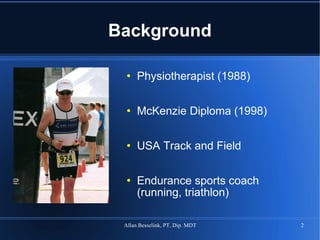
Background Physiotherapist (1988) McKenzie Diploma (1998) USA Track and Field Endurance sports coach (running, triathlon)
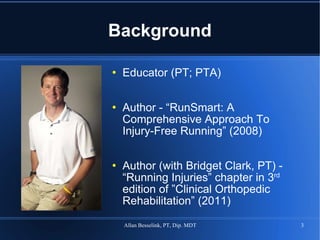
Background Educator (PT; PTA) Author - “RunSmart: A Comprehensive Approach To Injury-Free Running” (2008) Author (with Bridget Clark, PT) - “Running Injuries” chapter in 3 rd  edition of ”Clinical Orthopedic Rehabilitation” (2011)
Why This Topic? The vast majority of  "treatments" have little to no confirmed scientific basis …  …  yet we claim to be focused on "evidence-based practice"
Why This Topic? There are too many clinicians using yellow theraband forever … ... yet we promote ourselves as the experts in therapeutic exercise
Why This Topic? We have 50+ years of cellular physiology research …  …  and yet we choose to ignore it
Objectives Identify and examine the current scientific literature on therapeutic exercise and tissue repair Identify the three primary components of Recovery-Centered Training and explain their relevance to therapeutic exercise progression
Objectives Discuss the physiological mechanisms underlying tissue repair and development in the context of therapeutic exercise Define the principles of mechanical loading and their application to therapeutic exercise programs
Objectives Implement optimized therapeutic exercise progressions utilizing the critical parameters and dosage of various loading strategies
Overview The Basics Stimulus – Response and Homeostasis Mechanisms Loading Strategies to attain Desired Response Tissue- And System-Based Progressions Symptomatic, Mechanical, And Functional
Overview Traditional Approaches To Therapeutic Exercise Optimal Critical Parameters? Competent Self Care – Is It Enough? What Is The Role Of The PT? Summary
Discussion In groups of 3 to 5, discuss the scenario presented to you Assume no "red flags" are present What is the primary mode of therapeutic exercise required?
The Basics
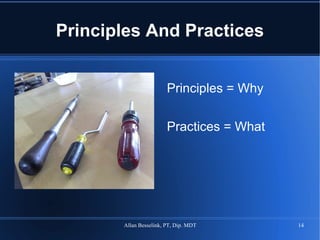
Principles And Practices Principles = Why Practices = What
The Basics Stimulus – Response Homeostasis Specific Adaptation To Imposed Demands Wolfe's Law Building Capacity Critical Parameters
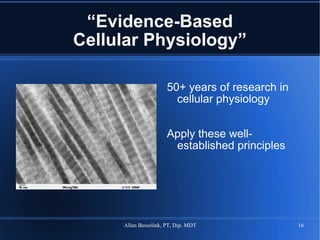
“ Evidence-Based Cellular Physiology” 50+ years of research in cellular physiology Apply these well-established principles
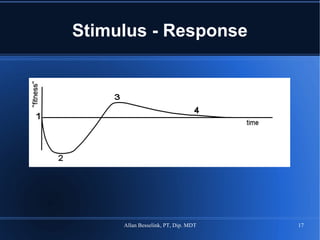
Stimulus - Response
Homeostasis "The maintenance of relatively stable internal physiological conditions under fluctuating environmental conditions" Are we ever "out of balance"? Do we ever really, by definition, have a "muscle imbalance"?
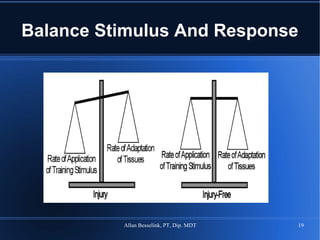
Balance Stimulus And Response
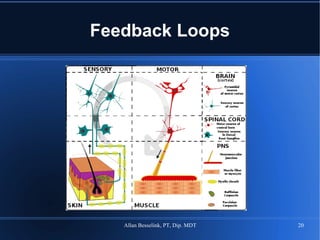
Feedback Loops
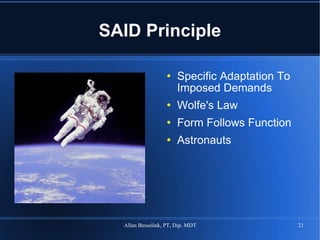
SAID Principle Specific Adaptation To Imposed Demands Wolfe's Law Form Follows Function Astronauts
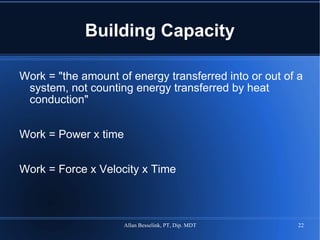
Building Capacity Work = "the amount of energy transferred into or out of a system, not counting energy transferred by heat conduction" Work = Power x time Work = Force x Velocity x Time
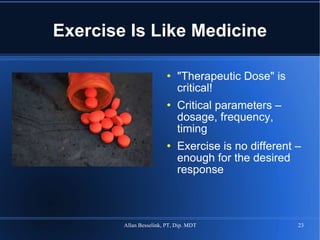
Exercise Is Like Medicine "Therapeutic Dose" is critical! Critical parameters – dosage, frequency, timing Exercise is no different – enough for the desired response
Traditional Systems Cardiovascular / Aerobic system Endurance = the  capacity  to withstand physiological or psychological stressors over a sustained period of time The heart is a muscle!
True Systems Thinking Involves understanding the behavior of the system as a whole (Peter Senge "The Fifth Discipline") Recovery-Centered Training – A Model Of Human Performance Mechanical Diagnosis And Therapy (MDT)
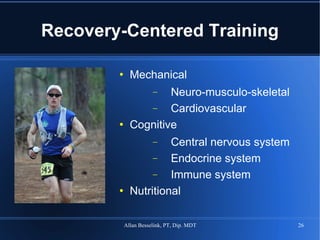
Recovery-Centered Training Mechanical Neuro-musculo-skeletal Cardiovascular Cognitive Central nervous system Endocrine system Immune system Nutritional
MDT Mechanical Diagnosis and Therapy (MDT) A systems thinking approach to musculoskeletal care Mutually exclusive diagnostic categories based on system behavior (responses to repeated movements and sustained loading) Derangement, Dysfunction, Posture, Other
Scenarios Stress reaction Osteoporosis Osteoarthritis Capsular tightness Tendinopathy Derangement Weight loss Muscle strength Muscle endurance Post-surgical ROM Neuromotor facilitation Neuromotor inhibition Flexibility Aerobic capacity / deconditioning
Mechanisms
Mechanisms Mechanisms of Optimal Human Performance = Mechanisms of Injury Recovery = Mechanisms of Injury Prevention (Besselink 1992)
Mechanisms Stimulate appropriate cellular activity to attain desired cellular response Critical parameters of mechanical loading to attain desired cellular response Appropriate Symptomatic, Mechanical and Functional Responses
Relationship Between Function And Cellular Activity Cellular Level Protein synthesis Collagen synthesis Mitochondrial density etc Changes In ... Tendon tensile strength Muscle strength Cartilage volume etc
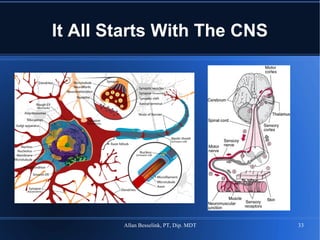
It All Starts With The CNS
Mechanotransduction Khan KM, Scott A. Mechanotherapy: how physical therapists' prescription of exercise promotes tissue repair. Br J Sports Med 2009;43:247-252. Kaneko D et al. Temporal effects of cyclic stretching on distribution and gene expression of integrin and cytoskeleton by ligament fibroblasts in vitro.Connect Tiss Res 2009; 50(4), 263-269.
Mechanisms Tissues Connective Muscle Nervous (Epithelial) Systems Traditional i.e. Cardiovascular "Systems Thinking" (incl. MDT)
Mechanical Loading Strategies What mechanical loading strategy is required to stimulate the desired cellular activity and to "turn on the gene"? Which mechanical loading strategy is required to attain the desired functional response(s)?
Critical Parameters Every training session/exercise has an intent – and a desired cellular response Critical parameters of dosage/potency and frequency
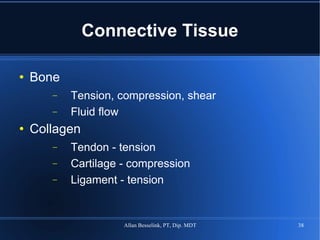
Connective Tissue Bone Tension, compression, shear Fluid flow Collagen Tendon - tension Cartilage - compression Ligament - tension
Muscle Tissue Number of muscle fibers recruited Velocity of muscle fiber recruitment Mitochondria = cellular powerhouse (active muscle fibers only) = endurance Tension / Load / Resistance
Nervous Tissue CNS Recruitment Motor patterns Synaptogenesis Facilitation and inhibition
Discussion In your original groups, discuss the scenario presented to you With what you now know, what is the primary mode of therapeutic exercise (mechanical loading strategy) required to attain the desired cellular response? What are the critical parameters necessary to do so?
Building Capacity Work = Force x Velocity x Time Intensity is your friend, not your enemy
Critical Parameters Tissues Connective – bone; cartilage; collagen Muscle Nervous Systems RCT – signs of under-recovery MDT – directional preference
Scenarios Stress reaction Osteoporosis Osteoarthritis Capsular tightness Tendinopathy Derangement Weight loss Muscle strength Muscle endurance Post-surgical ROM Neuromotor facilitation Neuromotor inhibition Flexibility Aerobic capacity / deconditioning
Tissue Repair And Remodeling Acute Phase = 1 to 3 days = "your friend, not your foe" Fibroplastic = up to 3 weeks = "prime time" for mechanical loading Remodeling = 6 weeks to 2 years = still very responsive to mechanical loading
Progressions
Progression Based on Symptomatic, Mechanical, and Functional Responses to Loading Strategies Need benchmarks and baselines!
Responses To Loading Strategies Symptomatic Mechanical Functional
Progression Progression will vary depending on the ability of the patient to adapt to the imposed demands Age Metabolic state
Progression And Limiters Be aware of the signs and symptoms of “under-recovery” (Recovery-Centered Training) Mechanical Cognitive Nutritional Safety Hurt Not Harm
Traditional Approaches To Therapeutic Exercise
Traditional Approaches Insufficient or inappropriate exercise parameters to elicit desired (or optimal) physiological response Garbage In, Garbage Out Modalities as a passive mechanical loading strategy
Woollard et al (2011) JOSPT "Change in Knee Cartilage Volume in Individuals Completing a Therapeutic Exercise Program for Knee Osteoarthritis" Loss of cartilage volume
Therapeutic Exercise Program Stretching, quadriceps setting, SLR Leg press at 70% of 1-RM: 3 x 10 PT 2x per week for 6 weeks HEP 2x per week for 4 weeks Based on the critical parameters, would I expect anything different?
Problem “ The inability to challenge our belief systems in the face of good scientific evidence is the primary limiting factor in the advancement of both health care and coaching, as well as human performance and injury prevention” (Besselink 2008)
Competent Self Care -  Is It Enough?
Competent Self Care Can the patient perform the necessary loading strategies to promote optimal repair and remodeling on their own? What is the role of the PT? Competent self care and health mentorship is an opportunity for the PT profession
Summary
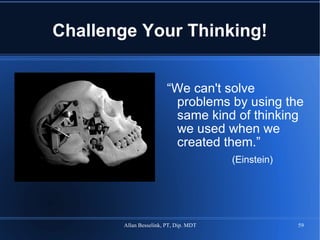
Challenge Your Thinking! “ We can't solve problems by using the same kind of thinking we used when we created them.” (Einstein)
For More Information: Smart Life Project www.allanbesselink.com/slp www.allanbesselink/subscribe “ RunSmart: A Comprehensive Approach To Injury-Free Running”
Move Forward (APTA) www.moveforwardpt.com
The Finish Line Is Upon Us!
Photo Credits http://www.flickr.com/photos/monsieurlui/ http://www.flickr.com/photos/emilianohorcada/ http://www.flickr.com/photos/pinksherbet/ http://www.flickr.com/photos/53921113@N02/ http://www.flickr.com/photos/panduadnyana/ Allan Besselink All others public domain or fair use Creative Commons

Mechanisms Of Therapeutic Exercise Progression - TPTA Annual Conference 2011

  • 1.
    Mechanisms Of TherapeuticExercise Progression Allan Besselink, PT, Dip.MDT Smart Life Project Austin, Texas
  • 2.
    Background Physiotherapist (1988)McKenzie Diploma (1998) USA Track and Field Endurance sports coach (running, triathlon)
  • 3.
    Background Educator (PT;PTA) Author - “RunSmart: A Comprehensive Approach To Injury-Free Running” (2008) Author (with Bridget Clark, PT) - “Running Injuries” chapter in 3 rd edition of ”Clinical Orthopedic Rehabilitation” (2011)
  • 4.
    Why This Topic?The vast majority of "treatments" have little to no confirmed scientific basis … … yet we claim to be focused on "evidence-based practice"
  • 5.
    Why This Topic?There are too many clinicians using yellow theraband forever … ... yet we promote ourselves as the experts in therapeutic exercise
  • 6.
    Why This Topic?We have 50+ years of cellular physiology research … … and yet we choose to ignore it
  • 7.
    Objectives Identify andexamine the current scientific literature on therapeutic exercise and tissue repair Identify the three primary components of Recovery-Centered Training and explain their relevance to therapeutic exercise progression
  • 8.
    Objectives Discuss thephysiological mechanisms underlying tissue repair and development in the context of therapeutic exercise Define the principles of mechanical loading and their application to therapeutic exercise programs
  • 9.
    Objectives Implement optimizedtherapeutic exercise progressions utilizing the critical parameters and dosage of various loading strategies
  • 10.
    Overview The BasicsStimulus – Response and Homeostasis Mechanisms Loading Strategies to attain Desired Response Tissue- And System-Based Progressions Symptomatic, Mechanical, And Functional
  • 11.
    Overview Traditional ApproachesTo Therapeutic Exercise Optimal Critical Parameters? Competent Self Care – Is It Enough? What Is The Role Of The PT? Summary
  • 12.
    Discussion In groupsof 3 to 5, discuss the scenario presented to you Assume no "red flags" are present What is the primary mode of therapeutic exercise required?
  • 13.
  • 14.
    Principles And PracticesPrinciples = Why Practices = What
  • 15.
    The Basics Stimulus– Response Homeostasis Specific Adaptation To Imposed Demands Wolfe's Law Building Capacity Critical Parameters
  • 16.
    “ Evidence-Based CellularPhysiology” 50+ years of research in cellular physiology Apply these well-established principles
  • 17.
  • 18.
    Homeostasis "The maintenanceof relatively stable internal physiological conditions under fluctuating environmental conditions" Are we ever "out of balance"? Do we ever really, by definition, have a "muscle imbalance"?
  • 19.
  • 20.
  • 21.
    SAID Principle SpecificAdaptation To Imposed Demands Wolfe's Law Form Follows Function Astronauts
  • 22.
    Building Capacity Work= "the amount of energy transferred into or out of a system, not counting energy transferred by heat conduction" Work = Power x time Work = Force x Velocity x Time
  • 23.
    Exercise Is LikeMedicine "Therapeutic Dose" is critical! Critical parameters – dosage, frequency, timing Exercise is no different – enough for the desired response
  • 24.
    Traditional Systems Cardiovascular/ Aerobic system Endurance = the capacity to withstand physiological or psychological stressors over a sustained period of time The heart is a muscle!
  • 25.
    True Systems ThinkingInvolves understanding the behavior of the system as a whole (Peter Senge "The Fifth Discipline") Recovery-Centered Training – A Model Of Human Performance Mechanical Diagnosis And Therapy (MDT)
  • 26.
    Recovery-Centered Training MechanicalNeuro-musculo-skeletal Cardiovascular Cognitive Central nervous system Endocrine system Immune system Nutritional
  • 27.
    MDT Mechanical Diagnosisand Therapy (MDT) A systems thinking approach to musculoskeletal care Mutually exclusive diagnostic categories based on system behavior (responses to repeated movements and sustained loading) Derangement, Dysfunction, Posture, Other
  • 28.
    Scenarios Stress reactionOsteoporosis Osteoarthritis Capsular tightness Tendinopathy Derangement Weight loss Muscle strength Muscle endurance Post-surgical ROM Neuromotor facilitation Neuromotor inhibition Flexibility Aerobic capacity / deconditioning
  • 29.
  • 30.
    Mechanisms Mechanisms ofOptimal Human Performance = Mechanisms of Injury Recovery = Mechanisms of Injury Prevention (Besselink 1992)
  • 31.
    Mechanisms Stimulate appropriatecellular activity to attain desired cellular response Critical parameters of mechanical loading to attain desired cellular response Appropriate Symptomatic, Mechanical and Functional Responses
  • 32.
    Relationship Between FunctionAnd Cellular Activity Cellular Level Protein synthesis Collagen synthesis Mitochondrial density etc Changes In ... Tendon tensile strength Muscle strength Cartilage volume etc
  • 33.
    It All StartsWith The CNS
  • 34.
    Mechanotransduction Khan KM,Scott A. Mechanotherapy: how physical therapists' prescription of exercise promotes tissue repair. Br J Sports Med 2009;43:247-252. Kaneko D et al. Temporal effects of cyclic stretching on distribution and gene expression of integrin and cytoskeleton by ligament fibroblasts in vitro.Connect Tiss Res 2009; 50(4), 263-269.
  • 35.
    Mechanisms Tissues ConnectiveMuscle Nervous (Epithelial) Systems Traditional i.e. Cardiovascular "Systems Thinking" (incl. MDT)
  • 36.
    Mechanical Loading StrategiesWhat mechanical loading strategy is required to stimulate the desired cellular activity and to "turn on the gene"? Which mechanical loading strategy is required to attain the desired functional response(s)?
  • 37.
    Critical Parameters Everytraining session/exercise has an intent – and a desired cellular response Critical parameters of dosage/potency and frequency
  • 38.
    Connective Tissue BoneTension, compression, shear Fluid flow Collagen Tendon - tension Cartilage - compression Ligament - tension
  • 39.
    Muscle Tissue Numberof muscle fibers recruited Velocity of muscle fiber recruitment Mitochondria = cellular powerhouse (active muscle fibers only) = endurance Tension / Load / Resistance
  • 40.
    Nervous Tissue CNSRecruitment Motor patterns Synaptogenesis Facilitation and inhibition
  • 41.
    Discussion In youroriginal groups, discuss the scenario presented to you With what you now know, what is the primary mode of therapeutic exercise (mechanical loading strategy) required to attain the desired cellular response? What are the critical parameters necessary to do so?
  • 42.
    Building Capacity Work= Force x Velocity x Time Intensity is your friend, not your enemy
  • 43.
    Critical Parameters TissuesConnective – bone; cartilage; collagen Muscle Nervous Systems RCT – signs of under-recovery MDT – directional preference
  • 44.
    Scenarios Stress reactionOsteoporosis Osteoarthritis Capsular tightness Tendinopathy Derangement Weight loss Muscle strength Muscle endurance Post-surgical ROM Neuromotor facilitation Neuromotor inhibition Flexibility Aerobic capacity / deconditioning
  • 45.
    Tissue Repair AndRemodeling Acute Phase = 1 to 3 days = "your friend, not your foe" Fibroplastic = up to 3 weeks = "prime time" for mechanical loading Remodeling = 6 weeks to 2 years = still very responsive to mechanical loading
  • 46.
  • 47.
    Progression Based onSymptomatic, Mechanical, and Functional Responses to Loading Strategies Need benchmarks and baselines!
  • 48.
    Responses To LoadingStrategies Symptomatic Mechanical Functional
  • 49.
    Progression Progression willvary depending on the ability of the patient to adapt to the imposed demands Age Metabolic state
  • 50.
    Progression And LimitersBe aware of the signs and symptoms of “under-recovery” (Recovery-Centered Training) Mechanical Cognitive Nutritional Safety Hurt Not Harm
  • 51.
    Traditional Approaches ToTherapeutic Exercise
  • 52.
    Traditional Approaches Insufficientor inappropriate exercise parameters to elicit desired (or optimal) physiological response Garbage In, Garbage Out Modalities as a passive mechanical loading strategy
  • 53.
    Woollard et al(2011) JOSPT "Change in Knee Cartilage Volume in Individuals Completing a Therapeutic Exercise Program for Knee Osteoarthritis" Loss of cartilage volume
  • 54.
    Therapeutic Exercise ProgramStretching, quadriceps setting, SLR Leg press at 70% of 1-RM: 3 x 10 PT 2x per week for 6 weeks HEP 2x per week for 4 weeks Based on the critical parameters, would I expect anything different?
  • 55.
    Problem “ Theinability to challenge our belief systems in the face of good scientific evidence is the primary limiting factor in the advancement of both health care and coaching, as well as human performance and injury prevention” (Besselink 2008)
  • 56.
    Competent Self Care- Is It Enough?
  • 57.
    Competent Self CareCan the patient perform the necessary loading strategies to promote optimal repair and remodeling on their own? What is the role of the PT? Competent self care and health mentorship is an opportunity for the PT profession
  • 58.
  • 59.
    Challenge Your Thinking!“ We can't solve problems by using the same kind of thinking we used when we created them.” (Einstein)
  • 60.
    For More Information:Smart Life Project www.allanbesselink.com/slp www.allanbesselink/subscribe “ RunSmart: A Comprehensive Approach To Injury-Free Running”
  • 61.
    Move Forward (APTA)www.moveforwardpt.com
  • 62.
    The Finish LineIs Upon Us!
  • 63.
    Photo Credits http://www.flickr.com/photos/monsieurlui/http://www.flickr.com/photos/emilianohorcada/ http://www.flickr.com/photos/pinksherbet/ http://www.flickr.com/photos/53921113@N02/ http://www.flickr.com/photos/panduadnyana/ Allan Besselink All others public domain or fair use Creative Commons

Editor's Notes

  • #2 Welcome to the 2011 TPTA Annual Conference.
  • #3 Born and raised in small town Canada. PT at Queen's University in 1988; completed the highest level of training in MDT, the Diploma, in 1998. One of 330 in the world. Involvement in the US national track and field program (3 national teams) and the 1996 Summer Olympics Endurance sports coaching: this past summer, Western States 100 under 24:00 + double World Masters world champion at 800m and 1500m; sprint triathlon to Ironman to UT triathlon team head coach)
  • #4 Adjunct faculty at ACC and TSU, spoken at ASU and MII, MIUSA, APTA After 20 years, author
  • #5 Why this topic? Has special significance to me with the background I bring to the table. Having taught therapeutic exercise at the entry level of PTA practice, worked with all levels of athletes and coaches, other PTs
  • #7 Cellular physiology is ignored by physical therapists, health care providers, coaches, athletes, trainers …
  • #10 The slides have been updated – this is the extended dance remix version of the originals. I will post an updated presentation / pdf on my website.
  • #12 End time = 10:00
  • #13 14 groups End time = 0:20:00
  • #15 There is a big difference between principles – the WHY we do – and practices – the WHAT we do. We will start this discussion with the principles of therapeutic exercise, and then discuss the practical applications. Just having more tools in the toolbox isn't sufficient. You have to know when to use a screwdriver – you can't use it for everything!
  • #17 The gold standard of clinical practice!
  • #18 - description - training effect and detraining - periodization; time is important - everyone focuses on the stimulus – but what about the recovery?
  • #19 Being in balance – is human physiology ever "out of balance"? We maintain stable internal physiological conditions
  • #20 Balancing rate of adaptation with rate of application of training stimulus; importance of recovery and adaptation + time (conversely, detraining/periodization, under-recovery) Balancing stimulus with response Balancing mechanical loading with functional response Balancing afferent input with efferent output
  • #21 Allow homeostasis to occur GIGO ** afferent and efferent – efferent response to afferent input (inhibition/facilitation)
  • #22 specific adaptations to imposed demands Wolfe's Law – initially bone, now all tissues Form follows function: are we seeing overuse injuries or under-recovery injuries? summarized by using example of astronauts and deep sea divers;
  • #23 "ability to perform work" = FVT Capacity = functional responses such as strength, endurance, bone density
  • #24 – need critical parameters of training/exercise stimulus to attain the desired physiological response - critical parameters = therapeutic dosage (rate/load sensitivity, duration, intensity), frequency; time for adaptations, viscoelasticity
  • #25 If you use energy systems, how does interval work increase aerobic capacity? Current "systems" are still a little fragmented Must be a way to synthesize all into a broader overview
  • #26 Peter Senge – perhaps one of the most important PT references I have read that wasn't a PT reference!
  • #27 My model of physiotherapy, performance, and prevention (mechanisms are the same) Model For Human Performance – Mechanical + Cognitive + Nutritional Draw diagram on flip chart
  • #28 Repeated movements; sustained postures
  • #29 Stress reaction tibia – 35 yr female Osteoporosis – 80 yr female Osteoarthritis knee – 65 yr male Capsular tightness elbow – 20 yr male Achilles tendinopathy – 30 yr female Lumbar derangement – 18 yr female Weight loss – 40 yr male Muscle strength – 25 yr male Muscle endurance – 25 yr female Post-surgical ROM TKR – 70 yr male Neuro facilitation stroke – 60 yr female Neuro inhibition – 60 yr male Flexibility hamstrings – 25 yr female Aerobic/deconditioning – 40 yr male End time = 0:50:00
  • #31 All mechanisms are the same! Have been working from this premise since 1992.
  • #32 Given the systems and tissues, what are the mechanisms at play? What is the appropriate mechanical loading strategy to stimulate cellular (and system) activity and attain the desired response? What are the critical parameters? Nagi's model of the process of disablement … disease – impairment ([practice patterns = cardiopulmonary, musculoskeletal, neuromuscular, integumentary) – functional limitations (physical, psychological, social) - disability
  • #33 Impairment – function
  • #34 The primary limiter to performance All physiological mechanisms Brain – Synapse – Neuromuscular Junction – Muscle and fuel supply Draw diagram on flip chart
  • #35 Mechanotransduction – "mechanical loading stimulates protein synthesis at the cellular level"; mechanical loading stimulates neural facilitation/inhibition at the cellular level. What mechanical loading will stimulate the correct mechanisms at the cellular level to promote the desired responses? (1) mechanocoupling (mechanical trigger, cell deformation) (2) cell–cell communication (the communication throughout a tissue to distribute the loading message – singalling proteins) (3) the effector response (tissue “factory” that produces and assembles the necessary materials in the correct alignment)
  • #36 What cells are stimulated to attain the desired response? What systems can be assessed? Stimulate activity – Appropriate mechanical loading – critical parameters – response Nervous: neuroblasts Connective: fibroblasts / osteoblasts Muscle: myoblasts Epithelial Systems-based Repeated movement; sustained loading Recovery-Centered Training focus Circadian rhythms
  • #37 What is the appropriate mechanical loading strategy to stimulate tissue/cellular activity? What is the critical dosage required? Stress-strain curve, force-velocity, length-tension Afferent and efferent – inhibition of quadriceps, facilitation
  • #39 collagen = compression, tension; bone = compression, shear, flow
  • #40 - motor recruitment, tension - glycogen repletion + glucose transporters
  • #41 - CNS recruitment, motor patterns - Na/K - glucose transporters, esp. With blood glucose End time 1:20:00
  • #42 What mechanical loading will stimulate activity of cells/systems? What is the desired cellular response? Critical parameters for all mechanical loading strategies End time 1:30:00 (break if needed)
  • #43 intensity is your friend, not your enemy Most mechanisms are intensity (load)-sensitive
  • #44 Circadian rhythms? Scott A, Khan KM, Duronio V, Hart DA. Mechanotransduction in human bone: in vitro cellular physiology that underpins bone changes with exercise. Sports Med. 2008; 38(2): 139-60. "Finally, the data suggest that exercise should emphasize the amount of load rather than the number of repetitions. End time 1:40:00
  • #45 Discuss critical parameters for all scenarios Nagi's model of the process of disablement … disease – impairment ([practice patterns = cardiopulmonary, musculoskeletal, neuromuscular, integumentary) – functional limitations (physical, psychological, social) – disability End time 1:55:00
  • #46 The game changer? Or the same as normal tissue development? Scientific literature End time 2:05:00
  • #49 Appropriate and inappropriate responses Incl. RCT, MDT
  • #50 progression dependent upon ability to adapt to imposed demands; increased time required due to age, metabolic state, etc. Intensity is your friend, not your foe – as long as you and the patient have a good understaninf of hurt vs harm
  • #51 Daily reassessment is a hallmark of the McKenzie method – and is critical to optimal progression of loading! The body wants to adapt – if you give it the stimulus to do so. under-recovery; symptoms (hurt not harm) Mechanical Loading Strategies based on desired responses Recovery and Adaptation – using Model of Human Performance - Appropriate cognitive, mechanical, nutritional responses End time: 2:25:00
  • #53 (weak stimulus, diminished dosage = diminished or no response, or no response that adds any value to what the patient can do themselves); garbage in, garbage out Modalities i.e. ultrasound – vibration = mechanical loading; estim
  • #56 A quote from my book End time 2:40:00
  • #58 Is mechanical loading enough? As compared to other treatments Can the patient do it all themselves? Patient-generated forces, competent self care Our Role? Opportunity for profession to stake our claim as "health mentor" vs "fixer" Group Discussion – Role of PT? End time 2:55:00
  • #60 , especially when it comes to systems thinking