4/26/2018
GROUP MEMBERS
IHTESHAM UL HAQ
SYED SHEHBAZ AHMAD
FARMAN ULLAH
HAROON KHAN
NAVEED KHAN
AMIR HAMZA
Subject:- IPC
Instructor:- Engr ADNAN SUMROO
BUITEMS
Temperature
• Definition:- Temperature is the measure of the hotness or coldness of a
substance is known as temperature
• Coldness is caused because of absence of heat energy.
“motion of molecule due to KE”
• Hotness is caused because of presence of heat energy.
4/26/2018
4/26/2018
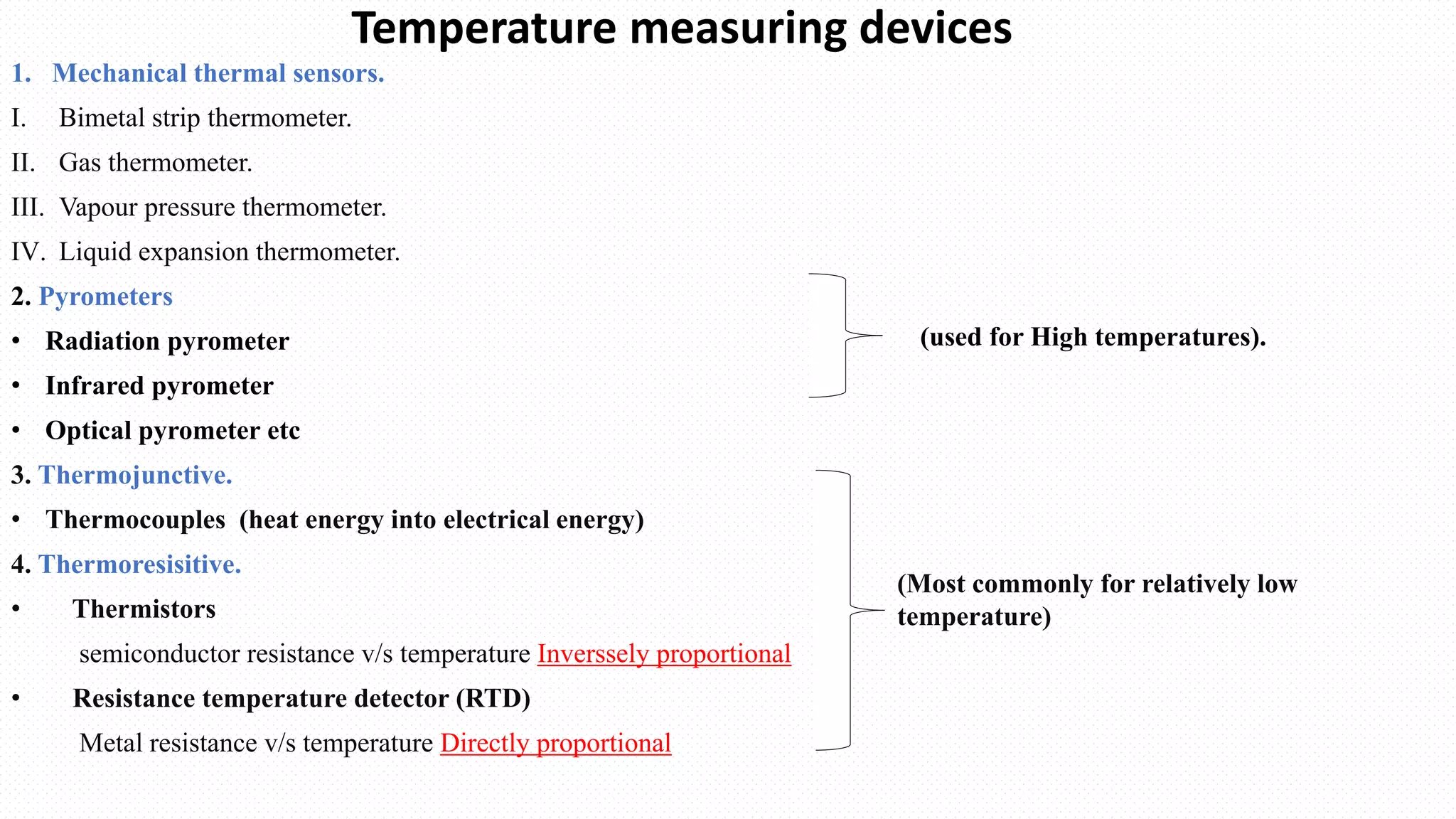
Temperature measuring devices
1. Mechanical thermal sensors.
I. Bimetal strip thermometer.
II. Gas thermometer.
III. Vapour pressure thermometer.
IV. Liquid expansion thermometer.
2. Pyrometers
• Radiation pyrometer
• Infrared pyrometer
• Optical pyrometer etc
3. Thermojunctive.
• Thermocouples (heat energy into electrical energy)
4. Thermoresisitive.
• Thermistors
semiconductor resistance v/s temperature Inverssely proportional
• Resistance temperature detector (RTD)
Metal resistance v/s temperature Directly proportional
(Most commonly for relatively low
temperature)
(used for High temperatures).
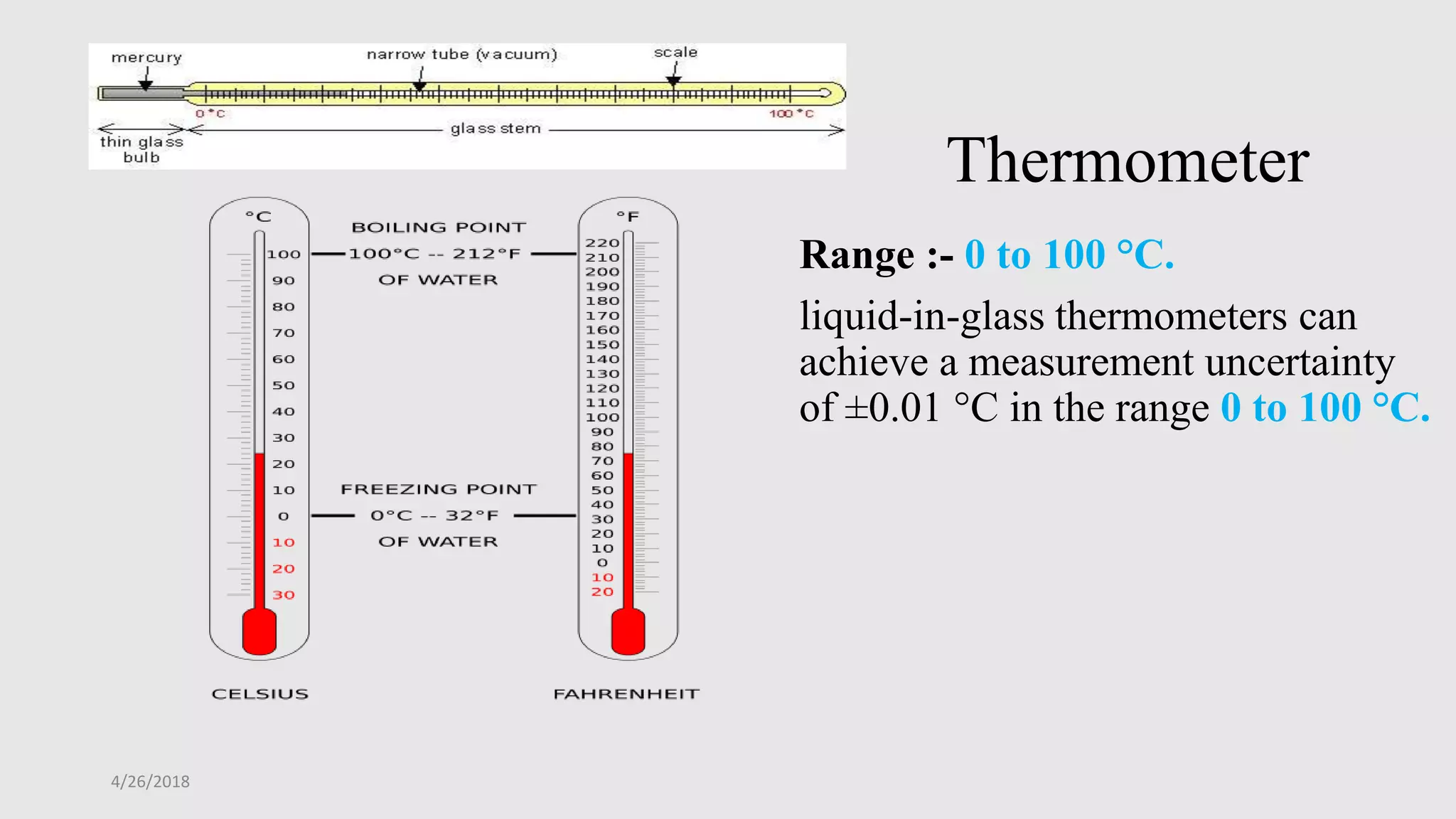
Thermometer:--
• Definition:-Thermometer is a device that measures temperature or
a temperature gradient.Or
oA thermometer has two important elements:
ophysical change occurs with temperature.
ophysical change into a numerical value.
• Working principle:-The basis of the thermometer’s operation is the
thermal expansion of a working fluid(mercury in this case).
4/26/2018
Thermometer
Range :- 0 to 100 °C.
liquid-in-glass thermometers can
achieve a measurement uncertainty
of ±0.01 °C in the range 0 to 100 °C.
4/26/2018
4/26/2018
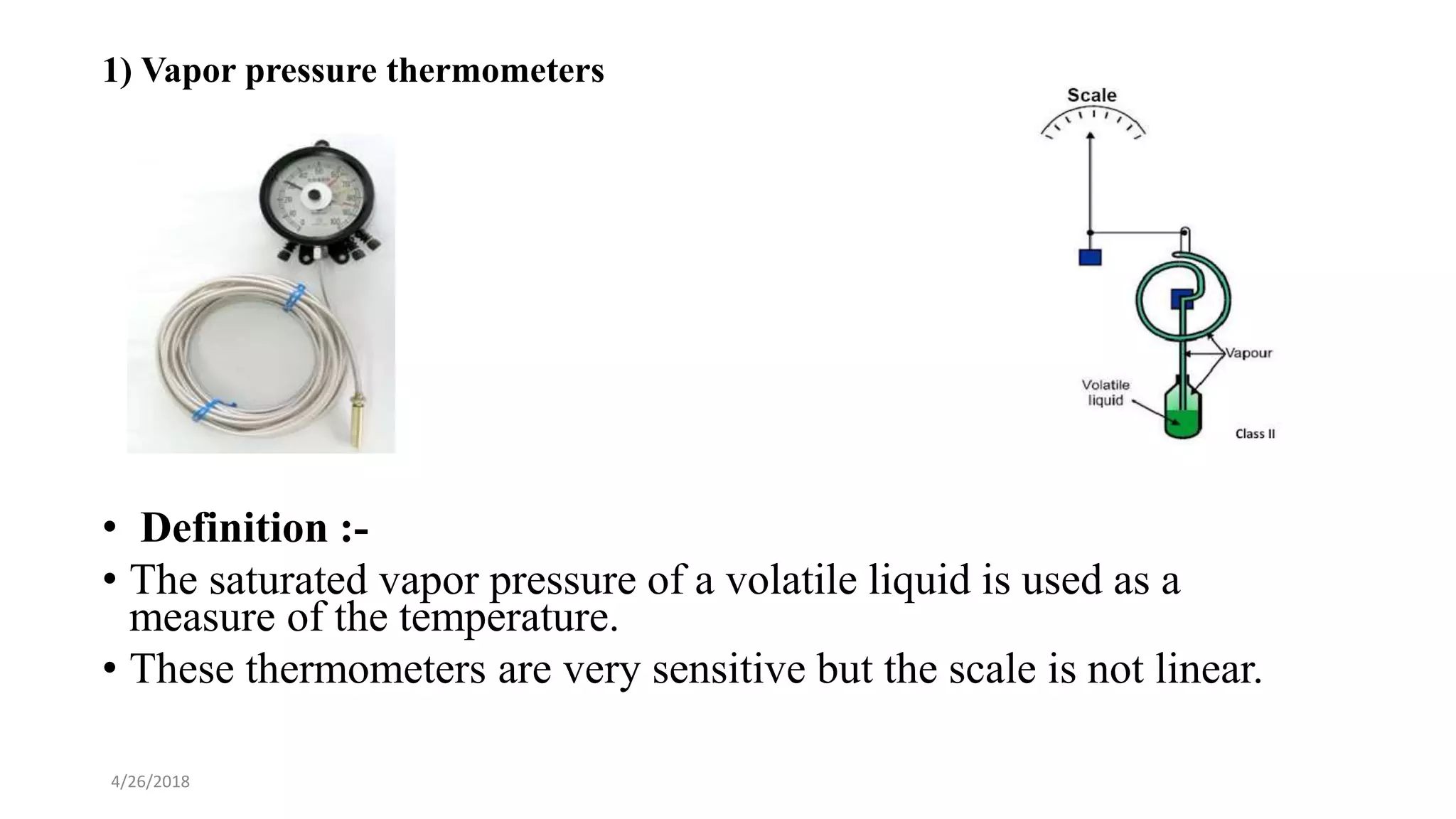
1) Vapor pressure thermometers
• Definition :-
• The saturated vapor pressure of a volatile liquid is used as a
measure of the temperature.
• These thermometers are very sensitive but the scale is not linear.
4/26/2018
Working principle:-
• The liquid is partially stored in a closed vessels or container then the space above
the liquid will consist of evaporated vapors of the liquid at a pressure that depends
on the temperature.
• As the temperature increases the vapor pressure in the liquid increases and the
temperature of the material is measured.
Temperature range is from - 20° C to 280° C depending on the nature of the
gas.
4/26/2018
2) Liquid expansion ( thermometer) OR liquid pressure thermometer:-
• Definition:--
It’s a temperature measuring device whose operation is based on thermal expansion of a liquid.
• Working principle :-
• The insides of the thermo-sensor cylinder, capillary, and Bourdon tube are filled with Volatile liquid which
changes volume with varying temperature.
• The liquid in the thermo-sensor cylinder is expanded and contracted as the temperature changes, and the
pressure change in the Bourdon tube that is transmitted through the capillary is indicated as a temperature.
• Liquid filled thermometers have scales with divisions from 10° to 0.01°C.
• The measurement accuracy depends on the depth of immersion of the thermometer in the medium to be
measured.
• Range:- 80-400 ℃.
4/26/2018
Liquid pressure thermometer
1. A common application of this type of thermometer is measurement of outside temperature from the inside
of a building.
4/26/2018
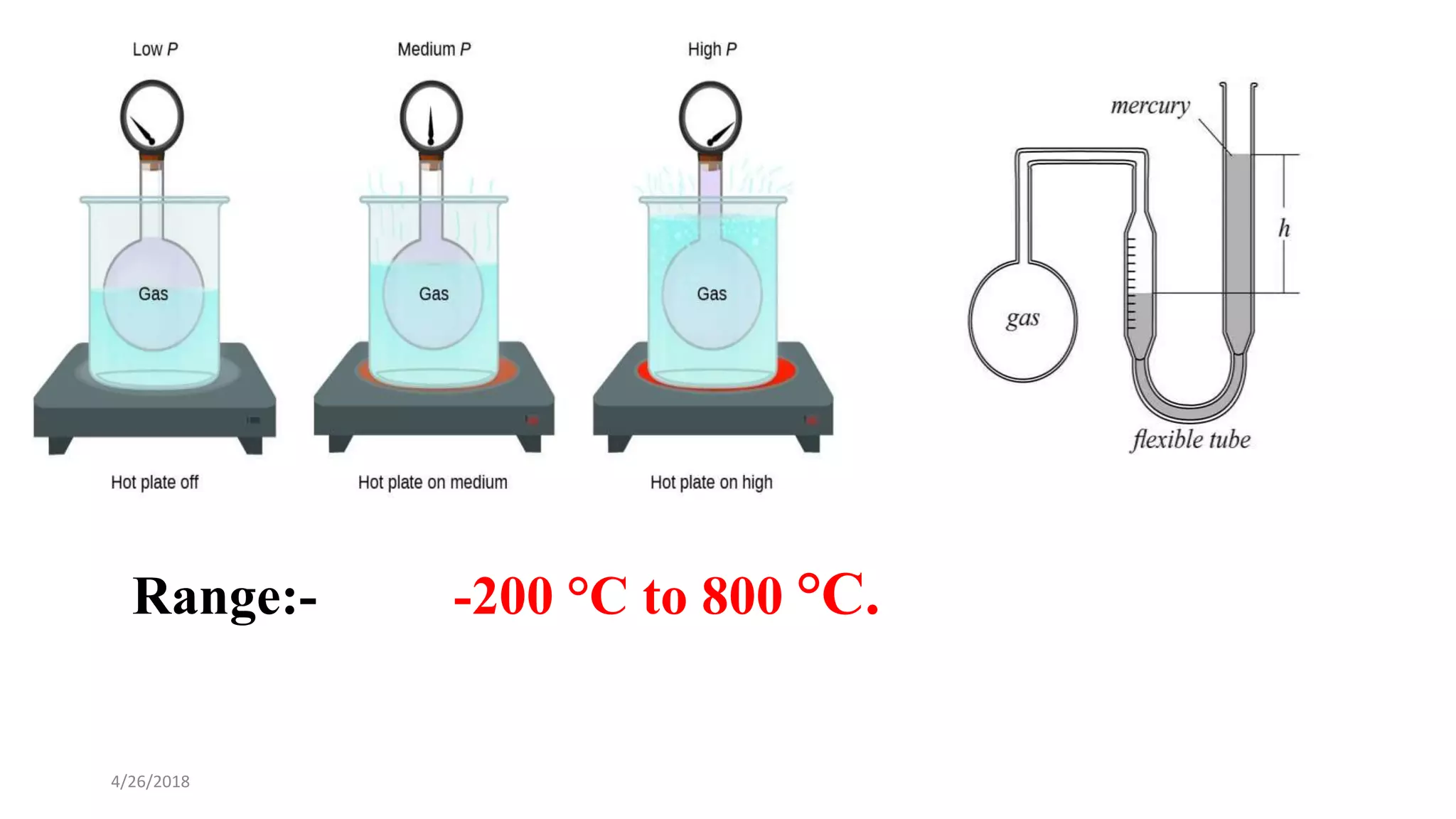
Gas Thermometer:-
• Definition:- The type of sensors in which the gas is used in the tank which
is increase with the increase in the temperature.
• Working principle:-This sensors is based on basic law of gases, if gas is
kept in a container the pressure and volume is constant and the temperature
is changing. The ratio of gas pressure and temperature is a constant.
OR
• Pressure of a gas at constant volume with increase in temperature.
• The gas thermometer convert temperature information directly into pressure
signals. Useful in pneumatic systems.
• Mostly used inert gases Nitrogen gas is also used.
4/26/2018
Range:- -200 °C to 800 °C.
4/26/2018
4) Bimetallic Thermometer:
Definition:--A bimetallic strip is used to convert a temperature change into mechanical displacement.
The temperature is measured by means of a bimetal system inside the temperature sensor.
Working Principle:-
• The bimetal is made from two metal strips, permanently joined together, each metal
having a different thermal expansion coefficient.
• This causes the strip to deflect in proportion to the temperature variation.
• The actual bimetal system consists of a bimetal strip that is either helically or spirally
wound, depending on the size of the sensor and the temperature range to be measured.
• Any temperature variation causes the bimetal to rotate an attached spindle and it
is indicated by a pointer on a dial.
It is used for ON/OFF control in a system.
4/26/2018
• Range:- -70 to 600 °C OR -65 to 430 °C
4/26/2018
Bimetal Helix
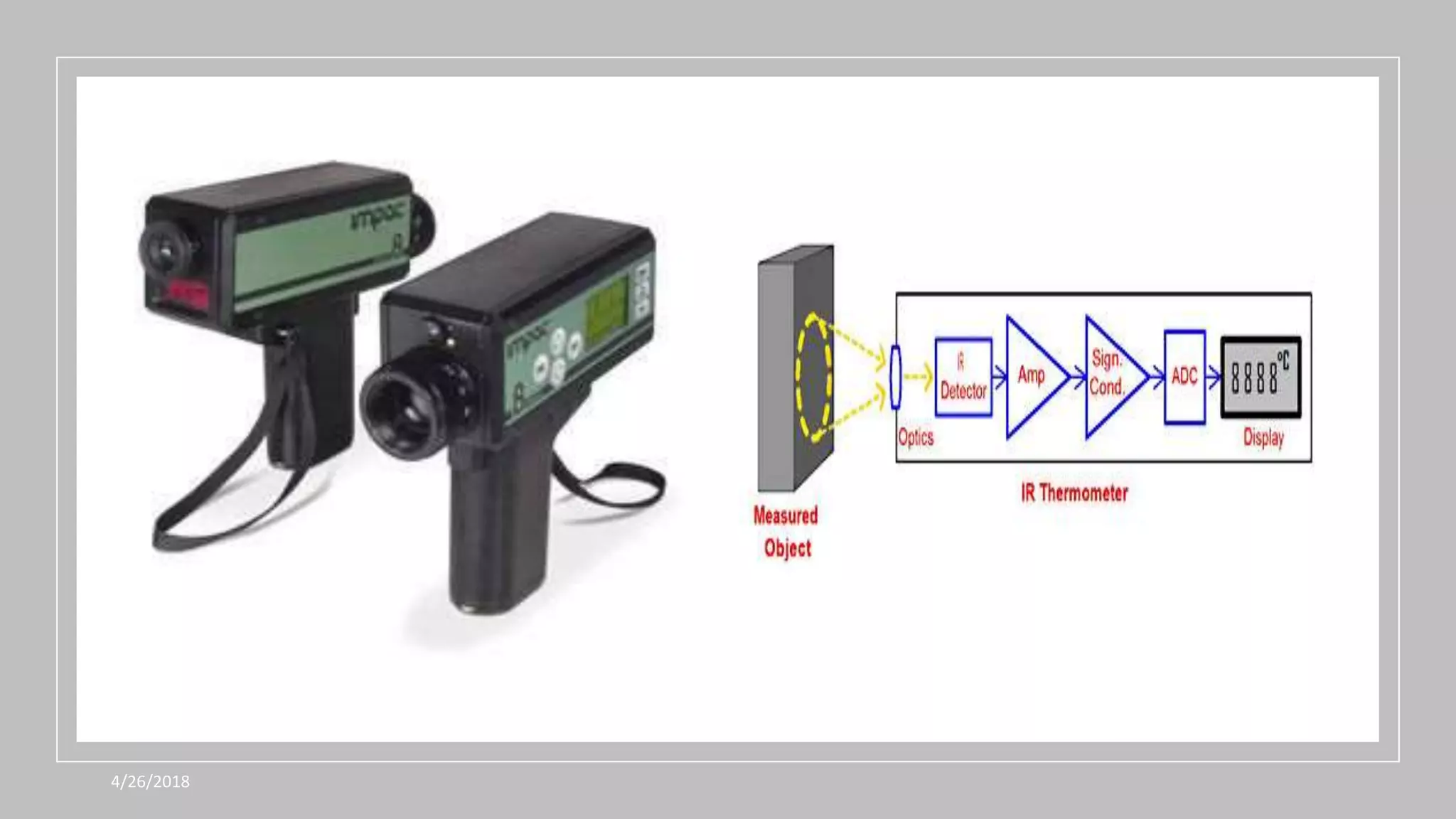
Radiation Pyrometer:-
• Definition:- its is a type of thermometer which is used for measuring
temperature without any physical contact.
• Working principle:-When body is heated it emit a thermal energy
known as heat radiation. These radiation is passed into a better focus
and passes to a detector then the detector convert these signal into
electric signal and the AD converter convert the signal show measured
value on the display screen.
4/26/2018
RANGE:- 103 to 104 °K. For pyrometer -50 to 4000 °C RANGE DEPEND UPON FOR DIFFERENT APPLICATION
4/26/2018
4/26/2018
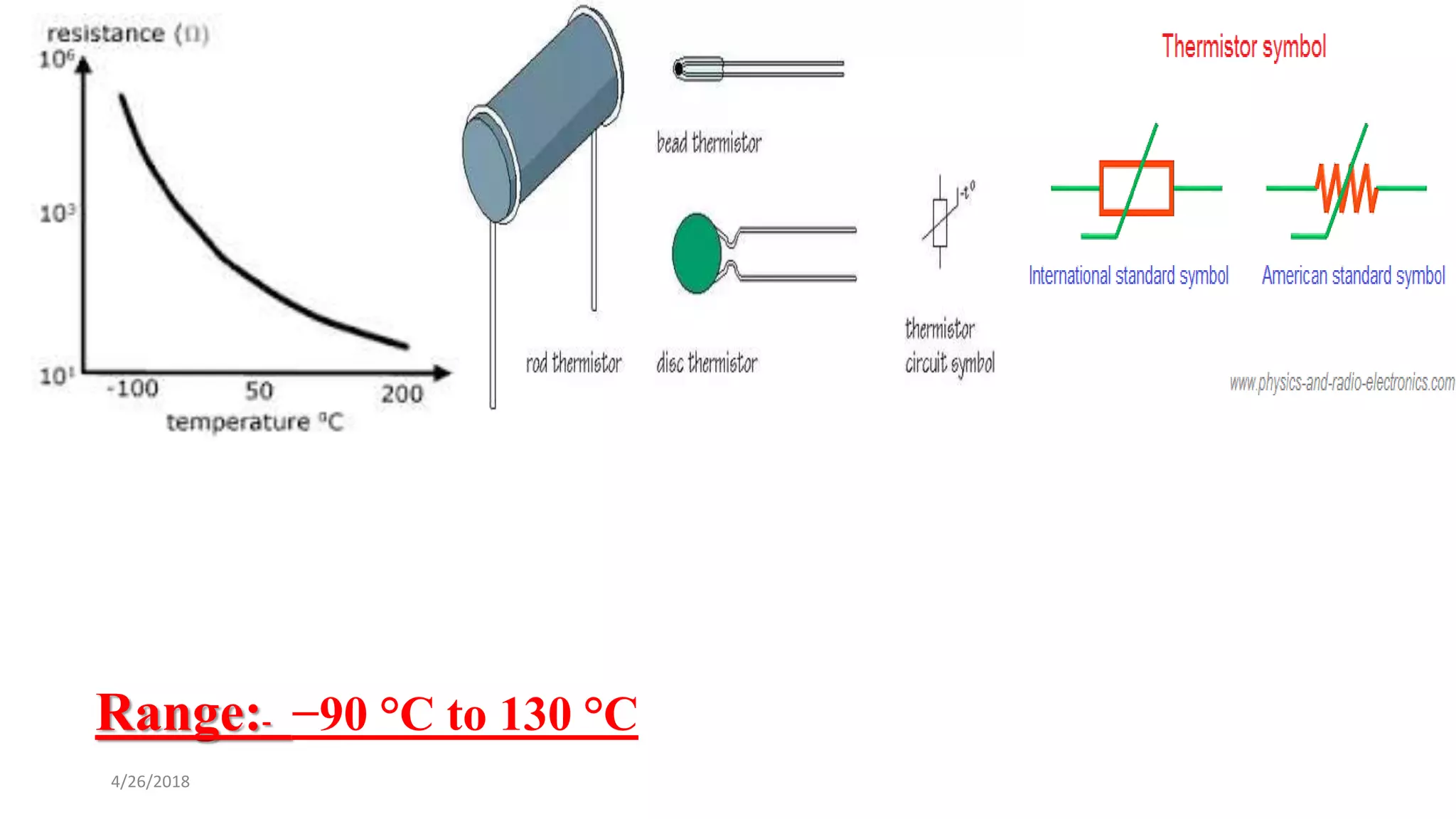
Thermistor:-
• Definition:-An electrical resistor whose resistance is greatly reduced
by heating, used for measurement and control of temperature.
• Working principle:-It's resistance is depends upon temperature.
When temperature changes, the resistance of the thermistor changes in
a predictable way. Advantages,The benefits of using a thermistor is
accuracy and stability.
4/26/2018
4/26/2018
Range:- −90 °C to 130 °C
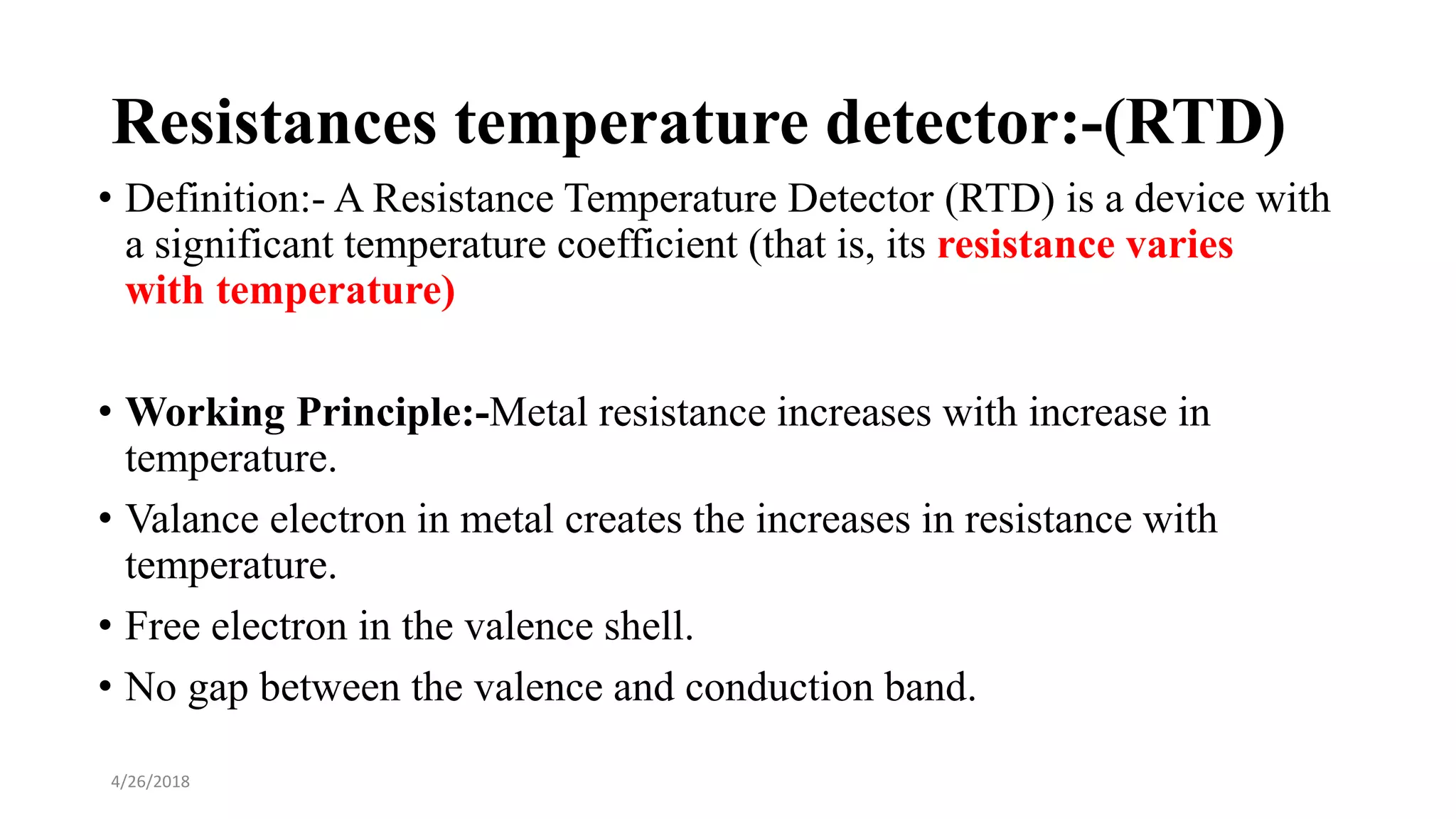
Resistances temperature detector:-(RTD)
• Definition:- A Resistance Temperature Detector (RTD) is a device with
a significant temperature coefficient (that is, its resistance varies
with temperature)
• Working Principle:-Metal resistance increases with increase in
temperature.
• Valance electron in metal creates the increases in resistance with
temperature.
• Free electron in the valence shell.
• No gap between the valence and conduction band.
4/26/2018
4/26/2018
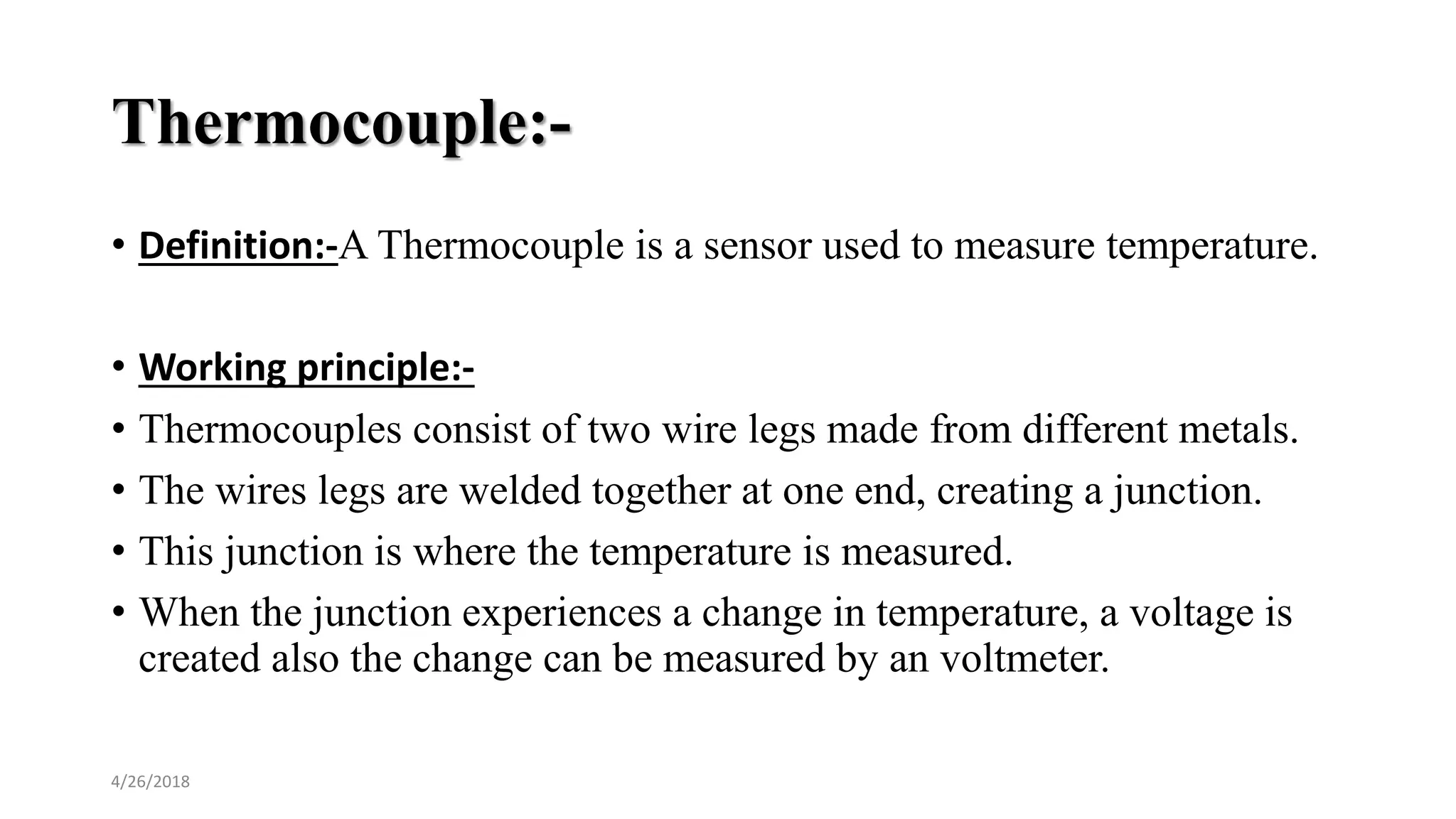
Thermocouple:-
• Definition:-A Thermocouple is a sensor used to measure temperature.
• Working principle:-
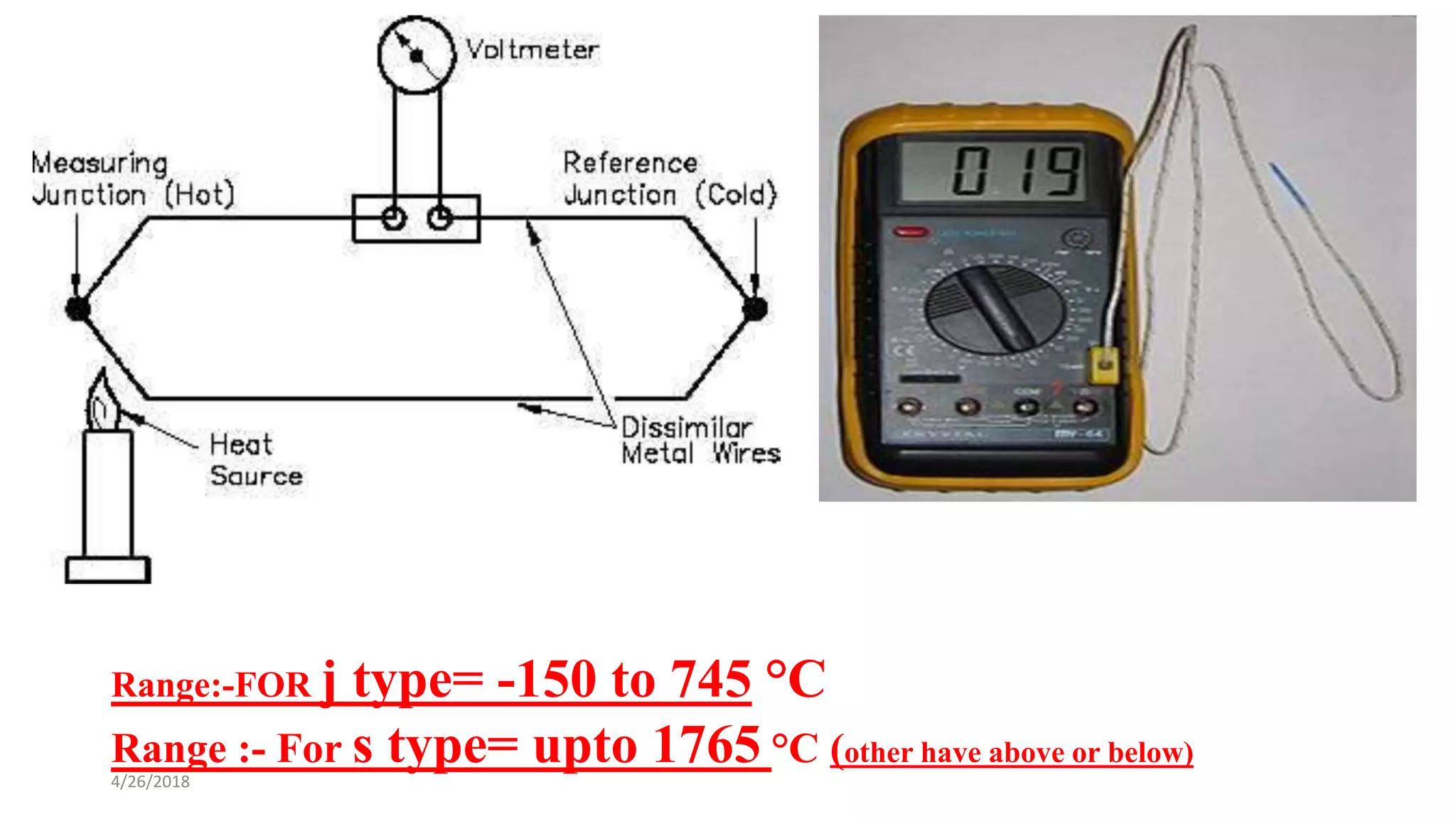
• Thermocouples consist of two wire legs made from different metals.
• The wires legs are welded together at one end, creating a junction.
• This junction is where the temperature is measured.
• When the junction experiences a change in temperature, a voltage is
created also the change can be measured by an voltmeter.
4/26/2018
4/26/2018
Range:-FOR j type= -150 to 745 °C
Range :- For s type= upto 1765 °C (other have above or below)
References:-
1. https://www.amazon.com/Process-Control-Instrumentation-Technology-8th/dp/0131194577
(by CURTON D JHONSON)
2.
https://books.google.com.pk/books/about/Principles_and_Methods_of_Temperature_Me.html?id=qfmS7g4JzjwC&redir_esc=y
( by Thomas D. McGee)
3. http://www.hayashidenko.co.jp/en/info04.html
4. http://www.wika.us/upload/BR_RF_Handbook_en_us_18447.pdf
WIKA-Handbook Pressure and Temperature Measurement U.S. Edition
5. https://www.youtube.com/results?search_query=nptel+lec+on+instrumentation+and+process+control
6. https://www.slideshare.net/anandprithviraj/mechanical-temperature-measuring-devices
( by Anand prith viraj)
7. https://www.slideshare.net/mohamedmusmar?utm_campaign=profiletracking&utm_medium=sssite&utm_source=ssslideview
(by Mohamed musmar )
8. https://docs.google.com/file/d/0Bz_j50pBnEarX3JUTDJ6ckFxU2c/view Chemical process controle by George Stephen apolus
4/26/2018
Q/A
4/26/2018
Quartz Crystal Thermometer for Measuring
Temperature Deviations in the 10−3 to 10−6 °C Range
Thank You
4/26/2018 Mechanical Temprature Mesurement 28

Ihtesham ipc presentation

  • 1.
  • 2.
    GROUP MEMBERS IHTESHAM ULHAQ SYED SHEHBAZ AHMAD FARMAN ULLAH HAROON KHAN NAVEED KHAN AMIR HAMZA Subject:- IPC Instructor:- Engr ADNAN SUMROO BUITEMS
  • 3.
    Temperature • Definition:- Temperatureis the measure of the hotness or coldness of a substance is known as temperature • Coldness is caused because of absence of heat energy. “motion of molecule due to KE” • Hotness is caused because of presence of heat energy. 4/26/2018
  • 4.
  • 5.
    Temperature measuring devices 1.Mechanical thermal sensors. I. Bimetal strip thermometer. II. Gas thermometer. III. Vapour pressure thermometer. IV. Liquid expansion thermometer. 2. Pyrometers • Radiation pyrometer • Infrared pyrometer • Optical pyrometer etc 3. Thermojunctive. • Thermocouples (heat energy into electrical energy) 4. Thermoresisitive. • Thermistors semiconductor resistance v/s temperature Inverssely proportional • Resistance temperature detector (RTD) Metal resistance v/s temperature Directly proportional (Most commonly for relatively low temperature) (used for High temperatures).
  • 6.
    Thermometer:-- • Definition:-Thermometer isa device that measures temperature or a temperature gradient.Or oA thermometer has two important elements: ophysical change occurs with temperature. ophysical change into a numerical value. • Working principle:-The basis of the thermometer’s operation is the thermal expansion of a working fluid(mercury in this case). 4/26/2018
  • 7.
    Thermometer Range :- 0to 100 °C. liquid-in-glass thermometers can achieve a measurement uncertainty of ±0.01 °C in the range 0 to 100 °C. 4/26/2018
  • 8.
    4/26/2018 1) Vapor pressurethermometers • Definition :- • The saturated vapor pressure of a volatile liquid is used as a measure of the temperature. • These thermometers are very sensitive but the scale is not linear.
  • 9.
    4/26/2018 Working principle:- • Theliquid is partially stored in a closed vessels or container then the space above the liquid will consist of evaporated vapors of the liquid at a pressure that depends on the temperature. • As the temperature increases the vapor pressure in the liquid increases and the temperature of the material is measured. Temperature range is from - 20° C to 280° C depending on the nature of the gas.
  • 10.
    4/26/2018 2) Liquid expansion( thermometer) OR liquid pressure thermometer:- • Definition:-- It’s a temperature measuring device whose operation is based on thermal expansion of a liquid. • Working principle :- • The insides of the thermo-sensor cylinder, capillary, and Bourdon tube are filled with Volatile liquid which changes volume with varying temperature. • The liquid in the thermo-sensor cylinder is expanded and contracted as the temperature changes, and the pressure change in the Bourdon tube that is transmitted through the capillary is indicated as a temperature. • Liquid filled thermometers have scales with divisions from 10° to 0.01°C. • The measurement accuracy depends on the depth of immersion of the thermometer in the medium to be measured. • Range:- 80-400 ℃.
  • 11.
    4/26/2018 Liquid pressure thermometer 1.A common application of this type of thermometer is measurement of outside temperature from the inside of a building.
  • 12.
    4/26/2018 Gas Thermometer:- • Definition:-The type of sensors in which the gas is used in the tank which is increase with the increase in the temperature. • Working principle:-This sensors is based on basic law of gases, if gas is kept in a container the pressure and volume is constant and the temperature is changing. The ratio of gas pressure and temperature is a constant. OR • Pressure of a gas at constant volume with increase in temperature. • The gas thermometer convert temperature information directly into pressure signals. Useful in pneumatic systems. • Mostly used inert gases Nitrogen gas is also used.
  • 13.
  • 14.
    4/26/2018 4) Bimetallic Thermometer: Definition:--Abimetallic strip is used to convert a temperature change into mechanical displacement. The temperature is measured by means of a bimetal system inside the temperature sensor. Working Principle:- • The bimetal is made from two metal strips, permanently joined together, each metal having a different thermal expansion coefficient. • This causes the strip to deflect in proportion to the temperature variation. • The actual bimetal system consists of a bimetal strip that is either helically or spirally wound, depending on the size of the sensor and the temperature range to be measured. • Any temperature variation causes the bimetal to rotate an attached spindle and it is indicated by a pointer on a dial.
  • 15.
    It is usedfor ON/OFF control in a system. 4/26/2018 • Range:- -70 to 600 °C OR -65 to 430 °C
  • 16.
  • 17.
    Radiation Pyrometer:- • Definition:-its is a type of thermometer which is used for measuring temperature without any physical contact. • Working principle:-When body is heated it emit a thermal energy known as heat radiation. These radiation is passed into a better focus and passes to a detector then the detector convert these signal into electric signal and the AD converter convert the signal show measured value on the display screen. 4/26/2018
  • 18.
    RANGE:- 103 to104 °K. For pyrometer -50 to 4000 °C RANGE DEPEND UPON FOR DIFFERENT APPLICATION 4/26/2018
  • 19.
  • 20.
    Thermistor:- • Definition:-An electricalresistor whose resistance is greatly reduced by heating, used for measurement and control of temperature. • Working principle:-It's resistance is depends upon temperature. When temperature changes, the resistance of the thermistor changes in a predictable way. Advantages,The benefits of using a thermistor is accuracy and stability. 4/26/2018
  • 21.
  • 22.
    Resistances temperature detector:-(RTD) •Definition:- A Resistance Temperature Detector (RTD) is a device with a significant temperature coefficient (that is, its resistance varies with temperature) • Working Principle:-Metal resistance increases with increase in temperature. • Valance electron in metal creates the increases in resistance with temperature. • Free electron in the valence shell. • No gap between the valence and conduction band. 4/26/2018
  • 23.
  • 24.
    Thermocouple:- • Definition:-A Thermocoupleis a sensor used to measure temperature. • Working principle:- • Thermocouples consist of two wire legs made from different metals. • The wires legs are welded together at one end, creating a junction. • This junction is where the temperature is measured. • When the junction experiences a change in temperature, a voltage is created also the change can be measured by an voltmeter. 4/26/2018
  • 25.
    4/26/2018 Range:-FOR j type=-150 to 745 °C Range :- For s type= upto 1765 °C (other have above or below)
  • 26.
    References:- 1. https://www.amazon.com/Process-Control-Instrumentation-Technology-8th/dp/0131194577 (by CURTOND JHONSON) 2. https://books.google.com.pk/books/about/Principles_and_Methods_of_Temperature_Me.html?id=qfmS7g4JzjwC&redir_esc=y ( by Thomas D. McGee) 3. http://www.hayashidenko.co.jp/en/info04.html 4. http://www.wika.us/upload/BR_RF_Handbook_en_us_18447.pdf WIKA-Handbook Pressure and Temperature Measurement U.S. Edition 5. https://www.youtube.com/results?search_query=nptel+lec+on+instrumentation+and+process+control 6. https://www.slideshare.net/anandprithviraj/mechanical-temperature-measuring-devices ( by Anand prith viraj) 7. https://www.slideshare.net/mohamedmusmar?utm_campaign=profiletracking&utm_medium=sssite&utm_source=ssslideview (by Mohamed musmar ) 8. https://docs.google.com/file/d/0Bz_j50pBnEarX3JUTDJ6ckFxU2c/view Chemical process controle by George Stephen apolus 4/26/2018
  • 27.
    Q/A 4/26/2018 Quartz Crystal Thermometerfor Measuring Temperature Deviations in the 10−3 to 10−6 °C Range
  • 28.
    Thank You 4/26/2018 MechanicalTemprature Mesurement 28