MEASURING AND EVALUATING PORT PERFORMANCE AND
PRODUCTIVITY
Submitted by
Mohammed Naseer Khan (1226114117)
Shruthi Shanmukhan (12261141
Introduction:-
In the past 20 years a significant number of studies reports and conferences have looked into
subject of port performance and productivity. Generally speaking their outcomes left most of
interested parties rather unsatisfied. Such a state of affairs cannot be explained by a mere
failure of the authors to treat the subject competently. In fact the challenge taken up anyone
wanting to analyze port performance is most formidable as a result of the combination of the
following factors:-
1. The sheer number of parameters is involved.
2. The lack of up to date factual and reliable data collected in a accepted manner and
available for publications.
3. The absence of generally agreed and acceptable definitions.
4. The profound influence of local factors on the data obtained.
5. The divergent interpretations given by various interests to identical results.
The principal objective of this monograph is to attempt to:
1. Arrive at synthesis of many past analyse carried out.
2. Formulate generally acceptable definitions.
3. Propose commonsense interpretations of the results obtained and devise practical
applications for the accumulated outputs.
In the given circumstances it is of crucial importance to agree on a basic and common
methodology. Analysing the factors for port performance and then suggesting the
methods of measuring and comparing through generally agreed system of port
statistics and indicators.
Measuring the port performance and productivity:-
Ports are essentially providers of service activities in particular vessels, cargo and
inland transport. The degree of satisfaction that is obtained on the basis of pre set
standards will indicate the level of port performance achieved. From forgoing it is
already obvious that port performance levels will be different depending on whether
ships, cargo and inland transport vehicles served. Thus a port at least in theory may
offer a very satisfactory service to vessel operators and at the same time be judged
inadequate by cargo interest or inland transport operators. It is obviously more likely
that poor performance will not be limited to one group of port users, but rather
provide all services offered by the port. The important lesson to learn from this is that
port performance cannot be accessed on the basis of single value or measure. In fact a
meaningful evaluation of a ports performance will require sets of measure related to:
a.) Duration of a ship stay in port.
b.) The quality of the cargo handling.
c.) The quality of services to inland transport vehicles during there passage through
the port.
The complicating factor is the factor strong interrelationship that exists between
the 3sets and between the various performance measures in each thus it is virtually
impossible and certainly inappropriate to study each of these in isolation.
However because of the particular importance of the first 2 sets, and there
dominant position with respective to the main port users, this monograph will
mainly concentrate on a more detailed discussion of these first two.
The duration of the ships stay in port:-
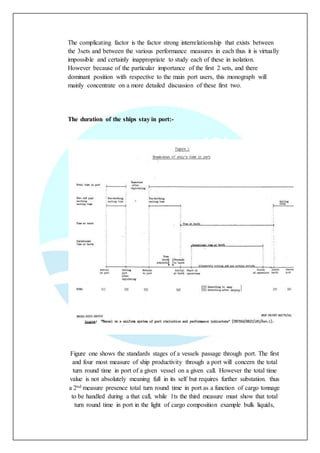
Figure one shows the standards stages of a vessels passage through port. The first
and four most measure of ship productivity through a port will concern the total
turn round time in port of a given vessel on a given call. However the total time
value is not absolutely meaning full in its self but requires further substation. thus
a 2nd measure presence total turn round time in port as a function of cargo tonnage
to be handled during a that call, while 1ts the third measure must show that total
turn round time in port in the light of cargo composition example bulk liquids,
bulk solids, conventional general cargo and containerized cargo. In an economic
analysis a special effort may be made to express above mentioned ship
productivity values in monetary terms by duly taking into account the daily cost of
the vessel in port. up to this point the total turn round time in port as been
examined without any break down of this ships time periods as shown in figure
one all though a the reduction of any of this may improve this over productivity of
this shipping port at least two of this periods required special efficacies, namely
the ship waiting time for a birth and ships time at birth. These 2 measures are
particularly crucial imports facing latent or acute portal congestions, where ships
have regularly to wait before berthing because all adequate service points are
already occupied.
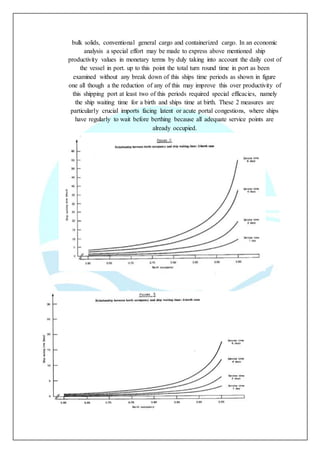
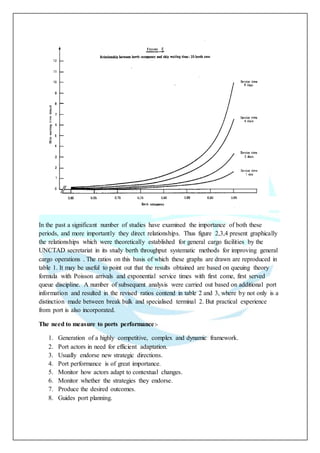
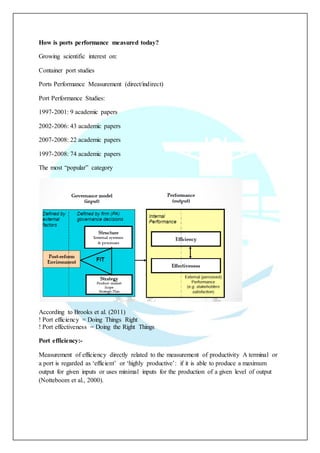
In the past a significant number of studies have examined the importance of both these
periods, and more importantly they direct relationships. Thus figure 2,3,4 present graphically
the relationships which were theoretically established for general cargo facilities by the
UNCTAD secretariat in its study berth throughput systematic methods for improving general
cargo operations . The ratios on this basis of which these graphs are drawn are reproduced in
table 1. It may be useful to point out that the results obtained are based on queuing theory
formula with Poisson arrivals and exponential service times with first come, first served
queue discipline. A number of subsequent analysis were carried out based on additional port
information and resulted in the revised ratios contend in table 2 and 3, where by not only is a
distinction made between break bulk and specialised terminal 2. But practical experience
from port is also incorporated.
The need to measure to ports performance:-
1. Generation of a highly competitive, complex and dynamic framework.
2. Port actors in need for efficient adaptation.
3. Usually endorse new strategic directions.
4. Port performance is of great importance.
5. Monitor how actors adapt to contextual changes.
6. Monitor whether the strategies they endorse.
7. Produce the desired outcomes.
8. Guides port planning.
How is ports performance measured today?
Growing scientific interest on:
Container port studies
Ports Performance Measurement (direct/indirect)
Port Performance Studies:
1997-2001: 9 academic papers
2002-2006: 43 academic papers
2007-2008: 22 academic papers
1997-2008: 74 academic papers
The most “popular” category
According to Brooks et al. (2011)
! Port efficiency = Doing Things Right
! Port effectiveness = Doing the Right Things
Port efficiency:-
Measurement of efficiency directly related to the measurement of productivity A terminal or
a port is regarded as ‘efficient’ or ‘highly productive’: if it is able to produce a maximum
output for given inputs or uses minimal inputs for the production of a given level of output
(Notteboom et al., 2000).
Efficiency: Not so easy
1. Port services are perishables and cannot be store.
2. Port services are not standard – output of complex.
3. Procedures with lots of unexpected events.
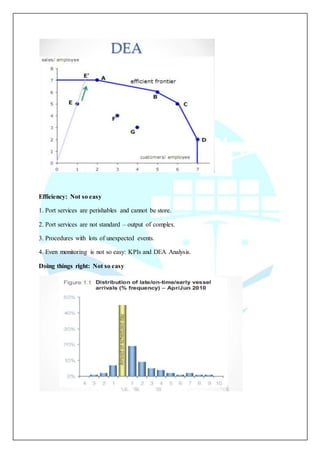
4. Even monitoring is not so easy: KPIs and DEA Analysis.
Doing things right: Not so easy
Port Efficiency:-
Frontier approach: Efficient units operating on the cost or production frontier Data
Envelopment Analysis Total Factor Productivity Stochastic Frontier Models Inputs: Labour,
infrastructure, capital Output: Cargo throughput internally generated data Emphasis on
efficiency and financial data at practical level as well
Performance Indicators:-
1. Performance indicators quantify and simplify information for decision-makers and
other stakeholders to assess how activities and operations affect the direction and
magnitude of change in terms of social economic, governance and environmental
conditions.
2. Easily available Goals that are challenging yet realistic Easily quantifiable
Strategically relevant Customer focused
3. In ports Pis can help to create a transparent performance led ports industry Useful for
customers and stakeholders Difficult to use PIs to compare the different sectors and
ports Communication across the industry Indicators to be set by individual ports But
still a need to benchmark…
Benchmarking:-
Works well in airport industry High level of difficulty: Need for common set of questions
Need for accurate sample of port users Frequency.
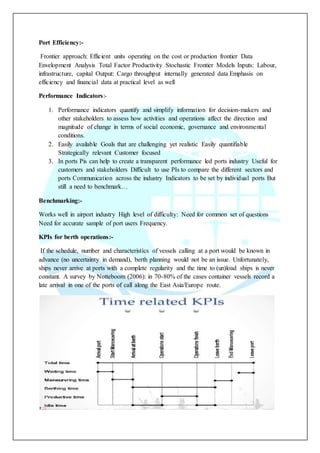
KPIs for berth operations:-
If the schedule, number and characteristics of vessels calling at a port would be known in
advance (no uncertainty in demand), berth planning would not be an issue. Unfortunately,
ships never arrive at ports with a complete regularity and the time to (un)load ships is never
constant. A survey by Notteboom (2006): in 70-80% of the cases container vessels record a
late arrival in one of the ports of call along the East Asia/Europe route.
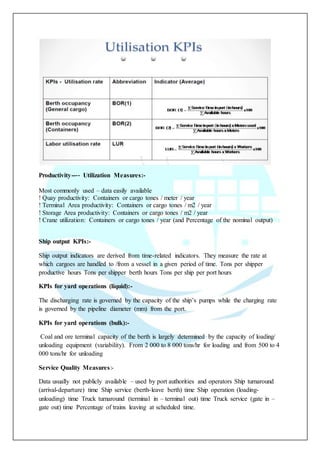
Productivity--‐‐ Utilization Measures:-
Most commonly used – data easily available
! Quay productivity: Containers or cargo tones / meter / year
! Terminal Area productivity: Containers or cargo tones / m2 / year
! Storage Area productivity: Containers or cargo tones / m2 / year
! Crane utilization: Containers or cargo tones / year (and Percentage of the nominal output)
Ship output KPIs:-
Ship output indicators are derived from time-related indicators. They measure the rate at
which cargoes are handled to /from a vessel in a given period of time. Tons per shipper
productive hours Tons per shipper berth hours Tons per ship per port hours
KPIs for yard operations (liquid):-
The discharging rate is governed by the capacity of the ship’s pumps while the charging rate
is governed by the pipeline diameter (mm) from the port.
KPIs for yard operations (bulk):-
Coal and ore terminal capacity of the berth is largely determined by the capacity of loading/
unloading equipment (variability). From 2 000 to 8 000 tons/hr for loading and from 500 to 4
000 tons/hr for unloading
Service Quality Measures:-
Data usually not publicly available – used by port authorities and operators Ship turnaround
(arrival-departure) time Ship service (berth-leave berth) time Ship operation (loading-
unloading) time Truck turnaround (terminal in – terminal out) time Truck service (gate in –
gate out) time Percentage of trains leaving at scheduled time.
Doing the right things:-
1. Not so clear
2. Limited information available.
Port of Rotterdam:-
We conduct an employee satisfaction survey every two years. In the May 2010 survey a
score of 7.7 was achieved, our initial target for 2010 was a score of 7.3; the score in 2008 was
7.2. We carried out a customer satisfaction survey at the beginning of 2010. The score for
general customer satisfaction levels was 7.2, similar to the 2007 result. The target for 2009
was a score of 7.4.
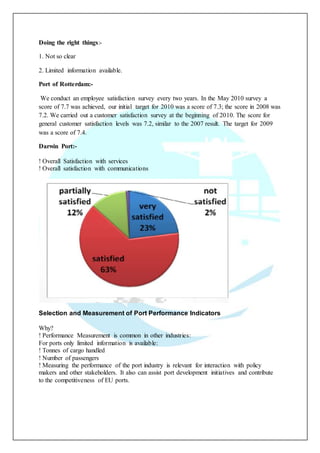
Darwin Port:-
! Overall Satisfaction with services
! Overall satisfaction with communications
Selection and Measurement of Port Performance Indicators
Why?
! Performance Measurement is common in other industries:
For ports only limited information is available:
! Tonnes of cargo handled
! Number of passengers
! Measuring the performance of the port industry is relevant for interaction with policy
makers and other stakeholders. It also can assist port development initiatives and contribute
to the competitiveness of EU ports.
Objectives:-
‘PPRISM aims to identify a key list of sustainable and feasible indicators to monitor the
overall performance of the EU port system and assess its impact on the society, environment
and the economy of the EU’ !
1. Quantification is possible in time series in the long Term
2. Measurement of the performance on EU level (not on a port level)!
3. Precisely defined and collected in a coherent manner for different seaports
Port Performance Dashboard --‐‐ PPD:-
 (Virtual) Easy-to-read textual or graphical representation of a limited number of port
performance indicators (PPIs).
 Contains summarized data
 Enables users to quickly interpret and understand a snapshot perspective of port sector
performance
 Will monitor trends of significant indicators
 Will generate overall view of port sector performance
 Delivers summarized key information to large users
 communities
 ! Easily adapted to each PA’s needs
 ! Provides actionable business information
 ! Clearly linked with the strategy/policy objectives
 ! Alerts users as to where they are
 ! In relationship to their objectives
Stakeholder relevance:-
 ! For (EU) policy makers:
Relevant information on the performance of the EU port system.
 ! For stakeholders of the port industry:
Indicators that respond to stakeholder concerns (e.g. environmental performance,
safety, employment).
 ! For the port industry:
Contribution to quality of port policies and societal acceptance of port activities.
 ! For port authorities:
Next to the above mentioned effects, an opportunity to benchmark against EU average
(taking into account port specificity, cf. Typology indicator)
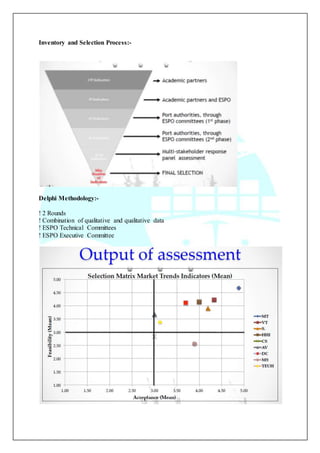
Inventory and Selection Process:-
Delphi Methodology:-
! 2 Rounds
! Combination of qualitative and qualitative data
! ESPO Technical Committees
! ESPO Executive Committee
In the above figure shows the top 10 indicators for the measurement and performance of the
port that shows the acceptance and feasibility on x and y axis.
In the above analysis the different fields of expertise shows the capacity of fields in port
authority, terminal operator, ship-owner, shipper, academics and others.
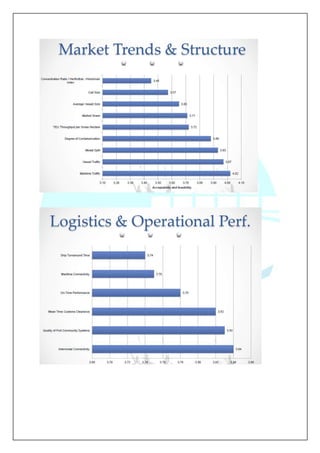
In the above analysis shows the different parameters and indicators for the port performance
and measurement.
Conclusion:-
 ! Short term:
 ! Create a culture of performance measurement
 ! Getting the indicators right (learning process with stakeholders)
 ! Design the organizational structure behind the dashboard
 ! Medium to long term:
 ! Analyse and understand port system performance indicators linkages with policy,
socio-economic and technological development.
 ! Support tool for decision-making and evaluation in the EU port industry.
In this conclusion then measures of the duration of a ship s stay in port are vital indicators of
the quality of the service offered to the major users of a port. It should be noted that identical
values may be perceived quite differently by the various ship operators depending on their
priority requirements and that their judgement of the quality of service offered may therefore
greatly offer.
Bibliography:-
1. Ashar A. Productivity and capacity of container terminals. Worldwide shipping.
2. Baudez L. La measure de la productivity and transportation.
3. Dally H.K. Review of British shipping national ports council.
4. Port productivity in manual port management Geneva 1970.
5. Port performance index 1984 carmel valley California.

Measuring and evaluating port performance and productivity

  • 1.
    MEASURING AND EVALUATINGPORT PERFORMANCE AND PRODUCTIVITY Submitted by Mohammed Naseer Khan (1226114117) Shruthi Shanmukhan (12261141
  • 2.
    Introduction:- In the past20 years a significant number of studies reports and conferences have looked into subject of port performance and productivity. Generally speaking their outcomes left most of interested parties rather unsatisfied. Such a state of affairs cannot be explained by a mere failure of the authors to treat the subject competently. In fact the challenge taken up anyone wanting to analyze port performance is most formidable as a result of the combination of the following factors:- 1. The sheer number of parameters is involved. 2. The lack of up to date factual and reliable data collected in a accepted manner and available for publications. 3. The absence of generally agreed and acceptable definitions. 4. The profound influence of local factors on the data obtained. 5. The divergent interpretations given by various interests to identical results. The principal objective of this monograph is to attempt to: 1. Arrive at synthesis of many past analyse carried out. 2. Formulate generally acceptable definitions. 3. Propose commonsense interpretations of the results obtained and devise practical applications for the accumulated outputs. In the given circumstances it is of crucial importance to agree on a basic and common methodology. Analysing the factors for port performance and then suggesting the methods of measuring and comparing through generally agreed system of port statistics and indicators. Measuring the port performance and productivity:- Ports are essentially providers of service activities in particular vessels, cargo and inland transport. The degree of satisfaction that is obtained on the basis of pre set standards will indicate the level of port performance achieved. From forgoing it is already obvious that port performance levels will be different depending on whether ships, cargo and inland transport vehicles served. Thus a port at least in theory may offer a very satisfactory service to vessel operators and at the same time be judged inadequate by cargo interest or inland transport operators. It is obviously more likely that poor performance will not be limited to one group of port users, but rather provide all services offered by the port. The important lesson to learn from this is that port performance cannot be accessed on the basis of single value or measure. In fact a meaningful evaluation of a ports performance will require sets of measure related to: a.) Duration of a ship stay in port. b.) The quality of the cargo handling. c.) The quality of services to inland transport vehicles during there passage through the port.
  • 3.
    The complicating factoris the factor strong interrelationship that exists between the 3sets and between the various performance measures in each thus it is virtually impossible and certainly inappropriate to study each of these in isolation. However because of the particular importance of the first 2 sets, and there dominant position with respective to the main port users, this monograph will mainly concentrate on a more detailed discussion of these first two. The duration of the ships stay in port:- Figure one shows the standards stages of a vessels passage through port. The first and four most measure of ship productivity through a port will concern the total turn round time in port of a given vessel on a given call. However the total time value is not absolutely meaning full in its self but requires further substation. thus a 2nd measure presence total turn round time in port as a function of cargo tonnage to be handled during a that call, while 1ts the third measure must show that total turn round time in port in the light of cargo composition example bulk liquids,
  • 4.
    bulk solids, conventionalgeneral cargo and containerized cargo. In an economic analysis a special effort may be made to express above mentioned ship productivity values in monetary terms by duly taking into account the daily cost of the vessel in port. up to this point the total turn round time in port as been examined without any break down of this ships time periods as shown in figure one all though a the reduction of any of this may improve this over productivity of this shipping port at least two of this periods required special efficacies, namely the ship waiting time for a birth and ships time at birth. These 2 measures are particularly crucial imports facing latent or acute portal congestions, where ships have regularly to wait before berthing because all adequate service points are already occupied.
  • 5.
    In the pasta significant number of studies have examined the importance of both these periods, and more importantly they direct relationships. Thus figure 2,3,4 present graphically the relationships which were theoretically established for general cargo facilities by the UNCTAD secretariat in its study berth throughput systematic methods for improving general cargo operations . The ratios on this basis of which these graphs are drawn are reproduced in table 1. It may be useful to point out that the results obtained are based on queuing theory formula with Poisson arrivals and exponential service times with first come, first served queue discipline. A number of subsequent analysis were carried out based on additional port information and resulted in the revised ratios contend in table 2 and 3, where by not only is a distinction made between break bulk and specialised terminal 2. But practical experience from port is also incorporated. The need to measure to ports performance:- 1. Generation of a highly competitive, complex and dynamic framework. 2. Port actors in need for efficient adaptation. 3. Usually endorse new strategic directions. 4. Port performance is of great importance. 5. Monitor how actors adapt to contextual changes. 6. Monitor whether the strategies they endorse. 7. Produce the desired outcomes. 8. Guides port planning.
  • 7.
    How is portsperformance measured today? Growing scientific interest on: Container port studies Ports Performance Measurement (direct/indirect) Port Performance Studies: 1997-2001: 9 academic papers 2002-2006: 43 academic papers 2007-2008: 22 academic papers 1997-2008: 74 academic papers The most “popular” category According to Brooks et al. (2011) ! Port efficiency = Doing Things Right ! Port effectiveness = Doing the Right Things Port efficiency:- Measurement of efficiency directly related to the measurement of productivity A terminal or a port is regarded as ‘efficient’ or ‘highly productive’: if it is able to produce a maximum output for given inputs or uses minimal inputs for the production of a given level of output (Notteboom et al., 2000).
  • 8.
    Efficiency: Not soeasy 1. Port services are perishables and cannot be store. 2. Port services are not standard – output of complex. 3. Procedures with lots of unexpected events. 4. Even monitoring is not so easy: KPIs and DEA Analysis. Doing things right: Not so easy
  • 9.
    Port Efficiency:- Frontier approach:Efficient units operating on the cost or production frontier Data Envelopment Analysis Total Factor Productivity Stochastic Frontier Models Inputs: Labour, infrastructure, capital Output: Cargo throughput internally generated data Emphasis on efficiency and financial data at practical level as well Performance Indicators:- 1. Performance indicators quantify and simplify information for decision-makers and other stakeholders to assess how activities and operations affect the direction and magnitude of change in terms of social economic, governance and environmental conditions. 2. Easily available Goals that are challenging yet realistic Easily quantifiable Strategically relevant Customer focused 3. In ports Pis can help to create a transparent performance led ports industry Useful for customers and stakeholders Difficult to use PIs to compare the different sectors and ports Communication across the industry Indicators to be set by individual ports But still a need to benchmark… Benchmarking:- Works well in airport industry High level of difficulty: Need for common set of questions Need for accurate sample of port users Frequency. KPIs for berth operations:- If the schedule, number and characteristics of vessels calling at a port would be known in advance (no uncertainty in demand), berth planning would not be an issue. Unfortunately, ships never arrive at ports with a complete regularity and the time to (un)load ships is never constant. A survey by Notteboom (2006): in 70-80% of the cases container vessels record a late arrival in one of the ports of call along the East Asia/Europe route.
  • 10.
    Productivity--‐‐ Utilization Measures:- Mostcommonly used – data easily available ! Quay productivity: Containers or cargo tones / meter / year ! Terminal Area productivity: Containers or cargo tones / m2 / year ! Storage Area productivity: Containers or cargo tones / m2 / year ! Crane utilization: Containers or cargo tones / year (and Percentage of the nominal output) Ship output KPIs:- Ship output indicators are derived from time-related indicators. They measure the rate at which cargoes are handled to /from a vessel in a given period of time. Tons per shipper productive hours Tons per shipper berth hours Tons per ship per port hours KPIs for yard operations (liquid):- The discharging rate is governed by the capacity of the ship’s pumps while the charging rate is governed by the pipeline diameter (mm) from the port. KPIs for yard operations (bulk):- Coal and ore terminal capacity of the berth is largely determined by the capacity of loading/ unloading equipment (variability). From 2 000 to 8 000 tons/hr for loading and from 500 to 4 000 tons/hr for unloading Service Quality Measures:- Data usually not publicly available – used by port authorities and operators Ship turnaround (arrival-departure) time Ship service (berth-leave berth) time Ship operation (loading- unloading) time Truck turnaround (terminal in – terminal out) time Truck service (gate in – gate out) time Percentage of trains leaving at scheduled time.
  • 11.
    Doing the rightthings:- 1. Not so clear 2. Limited information available. Port of Rotterdam:- We conduct an employee satisfaction survey every two years. In the May 2010 survey a score of 7.7 was achieved, our initial target for 2010 was a score of 7.3; the score in 2008 was 7.2. We carried out a customer satisfaction survey at the beginning of 2010. The score for general customer satisfaction levels was 7.2, similar to the 2007 result. The target for 2009 was a score of 7.4. Darwin Port:- ! Overall Satisfaction with services ! Overall satisfaction with communications Selection and Measurement of Port Performance Indicators Why? ! Performance Measurement is common in other industries: For ports only limited information is available: ! Tonnes of cargo handled ! Number of passengers ! Measuring the performance of the port industry is relevant for interaction with policy makers and other stakeholders. It also can assist port development initiatives and contribute to the competitiveness of EU ports.
  • 12.
    Objectives:- ‘PPRISM aims toidentify a key list of sustainable and feasible indicators to monitor the overall performance of the EU port system and assess its impact on the society, environment and the economy of the EU’ ! 1. Quantification is possible in time series in the long Term 2. Measurement of the performance on EU level (not on a port level)! 3. Precisely defined and collected in a coherent manner for different seaports Port Performance Dashboard --‐‐ PPD:-  (Virtual) Easy-to-read textual or graphical representation of a limited number of port performance indicators (PPIs).  Contains summarized data  Enables users to quickly interpret and understand a snapshot perspective of port sector performance  Will monitor trends of significant indicators  Will generate overall view of port sector performance  Delivers summarized key information to large users  communities  ! Easily adapted to each PA’s needs  ! Provides actionable business information  ! Clearly linked with the strategy/policy objectives  ! Alerts users as to where they are  ! In relationship to their objectives Stakeholder relevance:-  ! For (EU) policy makers: Relevant information on the performance of the EU port system.  ! For stakeholders of the port industry: Indicators that respond to stakeholder concerns (e.g. environmental performance, safety, employment).  ! For the port industry: Contribution to quality of port policies and societal acceptance of port activities.  ! For port authorities: Next to the above mentioned effects, an opportunity to benchmark against EU average (taking into account port specificity, cf. Typology indicator)
  • 13.
    Inventory and SelectionProcess:- Delphi Methodology:- ! 2 Rounds ! Combination of qualitative and qualitative data ! ESPO Technical Committees ! ESPO Executive Committee
  • 14.
    In the abovefigure shows the top 10 indicators for the measurement and performance of the port that shows the acceptance and feasibility on x and y axis. In the above analysis the different fields of expertise shows the capacity of fields in port authority, terminal operator, ship-owner, shipper, academics and others.
  • 16.
    In the aboveanalysis shows the different parameters and indicators for the port performance and measurement. Conclusion:-  ! Short term:  ! Create a culture of performance measurement  ! Getting the indicators right (learning process with stakeholders)  ! Design the organizational structure behind the dashboard  ! Medium to long term:  ! Analyse and understand port system performance indicators linkages with policy, socio-economic and technological development.  ! Support tool for decision-making and evaluation in the EU port industry. In this conclusion then measures of the duration of a ship s stay in port are vital indicators of the quality of the service offered to the major users of a port. It should be noted that identical values may be perceived quite differently by the various ship operators depending on their priority requirements and that their judgement of the quality of service offered may therefore greatly offer.
  • 17.
    Bibliography:- 1. Ashar A.Productivity and capacity of container terminals. Worldwide shipping. 2. Baudez L. La measure de la productivity and transportation. 3. Dally H.K. Review of British shipping national ports council. 4. Port productivity in manual port management Geneva 1970. 5. Port performance index 1984 carmel valley California.