PORT TARIFFS
INTRODUCTION
●Port Tariff : is the reward / payment
payable to the port authority for the rendering
of a service.
●Pricing – depends on the forces of supply &
demand.
●Effected by direct competition between
carriers, port authority, commodity &
alternative transport (inland & air transport).
●Cost of port charges is significant in final
market price of goods.
●Mostly, sea transport cost including port
expenses is between 8% to 15%.
FACTORS INFLUENCING THE
LEVEL OF PORT TARIFFS
1.Competition in its many forms
●Location of competing port
●Quality and ancillary services
●Use of discount rates, usually based in
traffic volume
2.The nature of product
●For loose cargo, it will depend on type of
commodity, quantity, overall cubic
measurement, value, & period of shipments.
●Dangerous, dirty @ unobvious cargo –
higher rate. On negotiation.
FACTORS INFLUENCING THE
LEVEL OF PORT TARIFFS
3.Trade which cargo originates
●Coastal or deep sea.
●Deep sea cargo – higher tariff than coastal @ short voyage.
●Why? Total sea freight for coastal tend to be lower in volume.
4.Port cost
●Cost of value added service provided by port authority, based on direct &
indirect cost plus profit.
●Direct : Labor, electricity, fuel, maintenance etc.
●Indirect : Depreciation, loan interest, administration etc.
●Level of technology
FACTORS INFLUENCING THE
LEVEL OF PORT TARIFFS
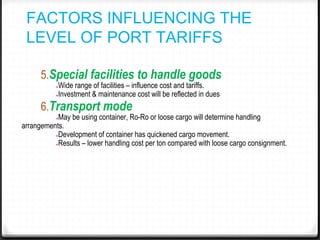
5.Special facilities to handle goods
●Wide range of facilities – influence cost and tariffs.
●Investment & maintenance cost will be reflected in dues
6.Transport mode
●May be using container, Ro-Ro or loose cargo will determine handling
arrangements.
●Development of container has quickened cargo movement.
●Results – lower handling cost per ton compared with loose cargo consignment.
FACTORS INFLUENCING THE
LEVEL OF PORT TARIFFS
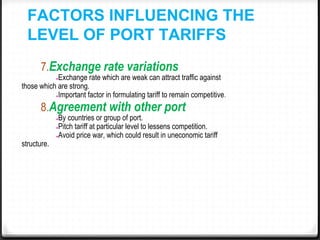
7.Exchange rate variations
●Exchange rate which are weak can attract traffic against
those which are strong.
●Important factor in formulating tariff to remain competitive.
8.Agreement with other port
●By countries or group of port.
●Pitch tariff at particular level to lessens competition.
●Avoid price war, which could result in uneconomic tariff
structure.
FACTORS INFLUENCING THE
LEVEL OF PORT TARIFFS
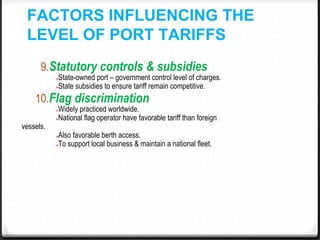
9.Statutory controls & subsidies
●State-owned port – government control level of charges.
●State subsidies to ensure tariff remain competitive.
10.Flag discrimination
●Widely practiced worldwide.
●National flag operator have favorable tariff than foreign
vessels.
●Also favorable berth access.
●To support local business & maintain a national fleet.
FACTORS INFLUENCING THE
LEVEL OF PORT TARIFFS
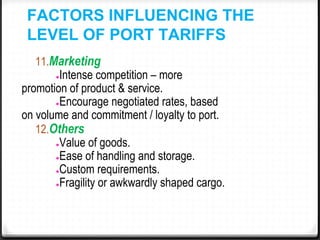
11.Marketing
●Intense competition – more
promotion of product & service.
●Encourage negotiated rates, based
on volume and commitment / loyalty to port.
12.Others
●Value of goods.
●Ease of handling and storage.
●Custom requirements.
●Fragility or awkwardly shaped cargo.
TYPES OF PORT TARIFF
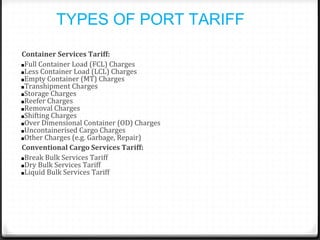
Container Services Tariff:
■Full Container Load (FCL) Charges
■Less Container Load (LCL) Charges
■Empty Container (MT) Charges
■Transhipment Charges
■Storage Charges
■Reefer Charges
■Removal Charges
■Shifting Charges
■Over Dimensional Container (OD) Charges
■Uncontainerised Cargo Charges
■Other Charges (e.g. Garbage, Repair)
Conventional Cargo Services Tariff:
■Break Bulk Services Tariff
■Dry Bulk Services Tariff
■Liquid Bulk Services Tariff
TYPES OF PORT TARIFF
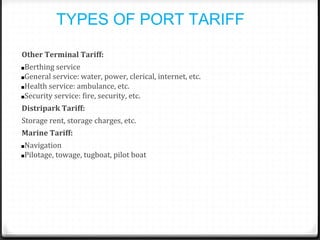
Other Terminal Tariff:
■Berthing service
■General service: water, power, clerical, internet, etc.
■Health service: ambulance, etc.
■Security service: fire, security, etc.
Distripark Tariff:
Storage rent, storage charges, etc.
Marine Tariff:
■Navigation
■Pilotage, towage, tugboat, pilot boat
SHIP DUES
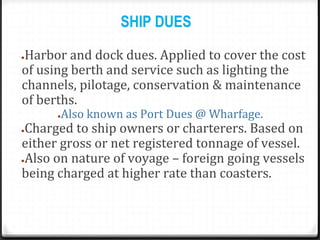
●Harbor and dock dues. Applied to cover the cost
of using berth and service such as lighting the
channels, pilotage, conservation & maintenance
of berths.
●Also known as Port Dues @ Wharfage.
●Charged to ship owners or charterers. Based on
either gross or net registered tonnage of vessel.
●Also on nature of voyage – foreign going vessels
being charged at higher rate than coasters.
SHIP DUES
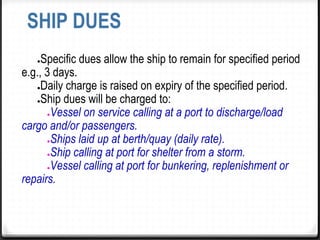
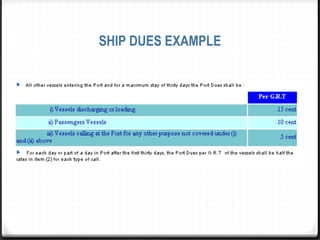
●Specific dues allow the ship to remain for specified period
e.g., 3 days.
●Daily charge is raised on expiry of the specified period.
●Ship dues will be charged to:
●Vessel on service calling at a port to discharge/load
cargo and/or passengers.
●Ships laid up at berth/quay (daily rate).
●Ship calling at port for shelter from a storm.
●Vessel calling at port for bunkering, replenishment or
repairs.
SHIP DUES
●Discounted rate granted to:
●Liner operators that use port regularly.
●Vessels calling only to bunker
●Vessels berthing only to change crews
●National flag ship
●Ships docking for repairs.
●Free : Vessels which call at the port for
emergency purposes, provided no cargo is
discharged or loaded, nor is water taken.
●In most major port, pilotage is compulsory. To
lead through the seaway access & in the port itself.
SHIP DUES EXAMPLE
GOODS DUES
●Dues levied on cargo passing over a berth as import or
export merchandise.
●Also known as cargo dues, dock rates, wharfage rates or
quay rates depending on port.
●Goods dues shall apply to all goods discharged or loaded
and to any transfer of goods from ship to ship, ship to
shore and from shore to ship.
●Paid by importers or exporters to the port authority
GOODS DUES
●Charge by some unit of weight, volume or number and
nature of goods. (e.g. Dry bulk – RM 0.85 per ton, Cars –
RM 45 per cars)
●Charges in respect of goods, including container,
general cargo, livestock etc., brought into, taken out of
or carried through a harbor by a vessel.
●But not including charges in respect of work
performed, services rendered or facilities provided in
respect of goods so brought, taken or carried
TYPES OF GOODS DUE
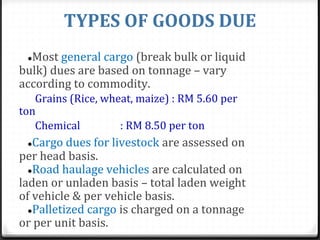
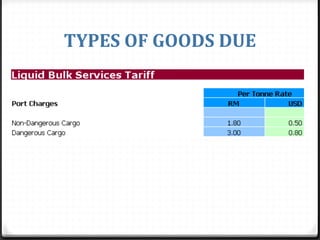
●Most general cargo (break bulk or liquid
bulk) dues are based on tonnage – vary
according to commodity.
Grains (Rice, wheat, maize) : RM 5.60 per
ton
Chemical : RM 8.50 per ton
●Cargo dues for livestock are assessed on
per head basis.
●Road haulage vehicles are calculated on
laden or unladen basis – total laden weight
of vehicle & per vehicle basis.
●Palletized cargo is charged on a tonnage
or per unit basis.
TYPES OF GOODS DUE
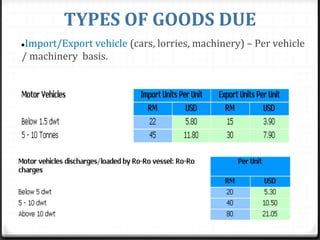
●Import/Export vehicle (cars, lorries, machinery) – Per vehicle
/ machinery basis.
TYPES OF GOODS DUE
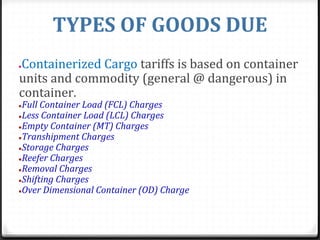
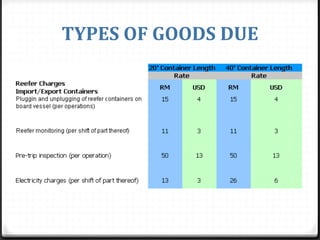
●Containerized Cargo tariffs is based on container
units and commodity (general @ dangerous) in
container.
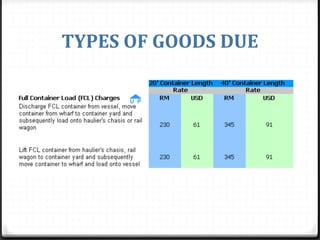
●Full Container Load (FCL) Charges
●Less Container Load (LCL) Charges
●Empty Container (MT) Charges
●Transhipment Charges
●Storage Charges
●Reefer Charges
●Removal Charges
●Shifting Charges
●Over Dimensional Container (OD) Charge
TYPES OF GOODS DUE
TYPES OF GOODS DUE
TYPES OF GOODS DUE
PASSENGER DUES
●Levied by port authority on ship owner or charterer for
the passenger, motorist, car or coach passing over the
berth.
●For the facilities provided – Lounges, refreshment,
immigration, baggage facilities etc.
●Based on number of passengers / cars / coach.
●Charged to the account of ship owner. Will be
incorporated in passenger or motorist fare.
GOODS DUES EXEMPTION
●The following goods are exempt from Goods Dues:
●Luggage of travelers
●Containers, pallets and other transport
bases used to facilitate transport and not
themselves merchant goods
●Requisites and victuals acquired for the
ship´s own use except fuel
●Coastal transport of the dock industry
MISCELLANEOUS CHARGES
1. Warehouse or transit shed rental
■Cargo in process of transshipment will be
subjected to warehouse rental (daily or weekly
basis).
■Tariff on the metreage area occupied or the
tonnage of cargo.
■Cargo handling charges to move cargo into or
from warehouse would be raised separately, based
on tonnage.
■Bonded warehouse – Goods not yet paid
custom duty. Charged separately, normally
negotiated price.
MISCELLANEOUS CHARGES
2. Port equipment hire charge
●Wide range of equipment may be hired :
Pallets, fork lift, platform, rope hand truck,
conveyer etc.
●Charged on daily hire basis
3. Pilotage and tugboat charges – Based on GRT
of ships
4. Cargo palletizing service – Use of mechanical
appliances or machinery for palletizing and strapping
cargo on pallets
5. Removal of refuse from port authority
premises
MISCELLANEOUS CHARGES
6. Fire service – Most port have fire fighting
vessels. Charged only when used.
7. Police, Security guards service – Charged on
per hour basis.
8. Anchorage dues – Charged on ship lying at
anchor (lay up berth). Per day and per ton.
9. Fresh water supply
THE END!!!

Port tariff

  • 1.
  • 2.
    INTRODUCTION ●Port Tariff :is the reward / payment payable to the port authority for the rendering of a service. ●Pricing – depends on the forces of supply & demand. ●Effected by direct competition between carriers, port authority, commodity & alternative transport (inland & air transport). ●Cost of port charges is significant in final market price of goods. ●Mostly, sea transport cost including port expenses is between 8% to 15%.
  • 3.
    FACTORS INFLUENCING THE LEVELOF PORT TARIFFS 1.Competition in its many forms ●Location of competing port ●Quality and ancillary services ●Use of discount rates, usually based in traffic volume 2.The nature of product ●For loose cargo, it will depend on type of commodity, quantity, overall cubic measurement, value, & period of shipments. ●Dangerous, dirty @ unobvious cargo – higher rate. On negotiation.
  • 4.
    FACTORS INFLUENCING THE LEVELOF PORT TARIFFS 3.Trade which cargo originates ●Coastal or deep sea. ●Deep sea cargo – higher tariff than coastal @ short voyage. ●Why? Total sea freight for coastal tend to be lower in volume. 4.Port cost ●Cost of value added service provided by port authority, based on direct & indirect cost plus profit. ●Direct : Labor, electricity, fuel, maintenance etc. ●Indirect : Depreciation, loan interest, administration etc. ●Level of technology
  • 5.
    FACTORS INFLUENCING THE LEVELOF PORT TARIFFS 5.Special facilities to handle goods ●Wide range of facilities – influence cost and tariffs. ●Investment & maintenance cost will be reflected in dues 6.Transport mode ●May be using container, Ro-Ro or loose cargo will determine handling arrangements. ●Development of container has quickened cargo movement. ●Results – lower handling cost per ton compared with loose cargo consignment.
  • 6.
    FACTORS INFLUENCING THE LEVELOF PORT TARIFFS 7.Exchange rate variations ●Exchange rate which are weak can attract traffic against those which are strong. ●Important factor in formulating tariff to remain competitive. 8.Agreement with other port ●By countries or group of port. ●Pitch tariff at particular level to lessens competition. ●Avoid price war, which could result in uneconomic tariff structure.
  • 7.
    FACTORS INFLUENCING THE LEVELOF PORT TARIFFS 9.Statutory controls & subsidies ●State-owned port – government control level of charges. ●State subsidies to ensure tariff remain competitive. 10.Flag discrimination ●Widely practiced worldwide. ●National flag operator have favorable tariff than foreign vessels. ●Also favorable berth access. ●To support local business & maintain a national fleet.
  • 8.
    FACTORS INFLUENCING THE LEVELOF PORT TARIFFS 11.Marketing ●Intense competition – more promotion of product & service. ●Encourage negotiated rates, based on volume and commitment / loyalty to port. 12.Others ●Value of goods. ●Ease of handling and storage. ●Custom requirements. ●Fragility or awkwardly shaped cargo.
  • 9.
    TYPES OF PORTTARIFF Container Services Tariff: ■Full Container Load (FCL) Charges ■Less Container Load (LCL) Charges ■Empty Container (MT) Charges ■Transhipment Charges ■Storage Charges ■Reefer Charges ■Removal Charges ■Shifting Charges ■Over Dimensional Container (OD) Charges ■Uncontainerised Cargo Charges ■Other Charges (e.g. Garbage, Repair) Conventional Cargo Services Tariff: ■Break Bulk Services Tariff ■Dry Bulk Services Tariff ■Liquid Bulk Services Tariff
  • 10.
    TYPES OF PORTTARIFF Other Terminal Tariff: ■Berthing service ■General service: water, power, clerical, internet, etc. ■Health service: ambulance, etc. ■Security service: fire, security, etc. Distripark Tariff: Storage rent, storage charges, etc. Marine Tariff: ■Navigation ■Pilotage, towage, tugboat, pilot boat
  • 11.
    SHIP DUES ●Harbor anddock dues. Applied to cover the cost of using berth and service such as lighting the channels, pilotage, conservation & maintenance of berths. ●Also known as Port Dues @ Wharfage. ●Charged to ship owners or charterers. Based on either gross or net registered tonnage of vessel. ●Also on nature of voyage – foreign going vessels being charged at higher rate than coasters.
  • 12.
    SHIP DUES ●Specific duesallow the ship to remain for specified period e.g., 3 days. ●Daily charge is raised on expiry of the specified period. ●Ship dues will be charged to: ●Vessel on service calling at a port to discharge/load cargo and/or passengers. ●Ships laid up at berth/quay (daily rate). ●Ship calling at port for shelter from a storm. ●Vessel calling at port for bunkering, replenishment or repairs.
  • 13.
    SHIP DUES ●Discounted rategranted to: ●Liner operators that use port regularly. ●Vessels calling only to bunker ●Vessels berthing only to change crews ●National flag ship ●Ships docking for repairs. ●Free : Vessels which call at the port for emergency purposes, provided no cargo is discharged or loaded, nor is water taken. ●In most major port, pilotage is compulsory. To lead through the seaway access & in the port itself.
  • 14.
  • 15.
    GOODS DUES ●Dues leviedon cargo passing over a berth as import or export merchandise. ●Also known as cargo dues, dock rates, wharfage rates or quay rates depending on port. ●Goods dues shall apply to all goods discharged or loaded and to any transfer of goods from ship to ship, ship to shore and from shore to ship. ●Paid by importers or exporters to the port authority
  • 16.
    GOODS DUES ●Charge bysome unit of weight, volume or number and nature of goods. (e.g. Dry bulk – RM 0.85 per ton, Cars – RM 45 per cars) ●Charges in respect of goods, including container, general cargo, livestock etc., brought into, taken out of or carried through a harbor by a vessel. ●But not including charges in respect of work performed, services rendered or facilities provided in respect of goods so brought, taken or carried
  • 17.
    TYPES OF GOODSDUE ●Most general cargo (break bulk or liquid bulk) dues are based on tonnage – vary according to commodity. Grains (Rice, wheat, maize) : RM 5.60 per ton Chemical : RM 8.50 per ton ●Cargo dues for livestock are assessed on per head basis. ●Road haulage vehicles are calculated on laden or unladen basis – total laden weight of vehicle & per vehicle basis. ●Palletized cargo is charged on a tonnage or per unit basis.
  • 18.
    TYPES OF GOODSDUE ●Import/Export vehicle (cars, lorries, machinery) – Per vehicle / machinery basis.
  • 19.
    TYPES OF GOODSDUE ●Containerized Cargo tariffs is based on container units and commodity (general @ dangerous) in container. ●Full Container Load (FCL) Charges ●Less Container Load (LCL) Charges ●Empty Container (MT) Charges ●Transhipment Charges ●Storage Charges ●Reefer Charges ●Removal Charges ●Shifting Charges ●Over Dimensional Container (OD) Charge
  • 20.
  • 21.
  • 22.
  • 23.
    PASSENGER DUES ●Levied byport authority on ship owner or charterer for the passenger, motorist, car or coach passing over the berth. ●For the facilities provided – Lounges, refreshment, immigration, baggage facilities etc. ●Based on number of passengers / cars / coach. ●Charged to the account of ship owner. Will be incorporated in passenger or motorist fare.
  • 24.
    GOODS DUES EXEMPTION ●Thefollowing goods are exempt from Goods Dues: ●Luggage of travelers ●Containers, pallets and other transport bases used to facilitate transport and not themselves merchant goods ●Requisites and victuals acquired for the ship´s own use except fuel ●Coastal transport of the dock industry
  • 25.
    MISCELLANEOUS CHARGES 1. Warehouseor transit shed rental ■Cargo in process of transshipment will be subjected to warehouse rental (daily or weekly basis). ■Tariff on the metreage area occupied or the tonnage of cargo. ■Cargo handling charges to move cargo into or from warehouse would be raised separately, based on tonnage. ■Bonded warehouse – Goods not yet paid custom duty. Charged separately, normally negotiated price.
  • 26.
    MISCELLANEOUS CHARGES 2. Portequipment hire charge ●Wide range of equipment may be hired : Pallets, fork lift, platform, rope hand truck, conveyer etc. ●Charged on daily hire basis 3. Pilotage and tugboat charges – Based on GRT of ships 4. Cargo palletizing service – Use of mechanical appliances or machinery for palletizing and strapping cargo on pallets 5. Removal of refuse from port authority premises
  • 27.
    MISCELLANEOUS CHARGES 6. Fireservice – Most port have fire fighting vessels. Charged only when used. 7. Police, Security guards service – Charged on per hour basis. 8. Anchorage dues – Charged on ship lying at anchor (lay up berth). Per day and per ton. 9. Fresh water supply
  • 28.