Analytic Port Information System
PARADIGMA, Vienna, August 7, 2012
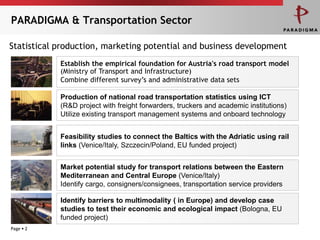
PARADIGMA & Transportation Sector

Statistical production, marketing potential and business development
            Establish the empirical foundation for Austria's road transport model
            (Ministry of Transport and Infrastructure)
            Combine different survey‟s and administrative data sets

            Production of national road transportation statistics using ICT
            (R&D project with freight forwarders, truckers and academic institutions)
            Utilize existing transport management systems and onboard technology


            Feasibility studies to connect the Baltics with the Adriatic using rail
            links (Venice/Italy, Szczecin/Poland, EU funded project)


            Market potential study for transport relations between the Eastern
            Mediterranean and Central Europe (Venice/Italy)
            Identify cargo, consigners/consignees, transportation service providers

            Identify barriers to multimodality ( in Europe) and develop case
            studies to test their economic and ecological impact (Bologna, EU
            funded project)
Page  2
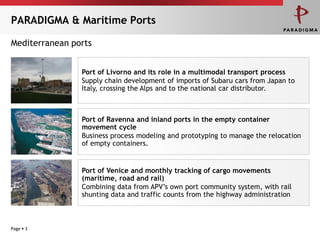
PARADIGMA & Maritime Ports

Mediterranean ports


                Port of Livorno and its role in a multimodal transport process
                Supply chain development of imports of Subaru cars from Japan to
                Italy, crossing the Alps and to the national car distributor.


                Port of Ravenna and inland ports in the empty container
                movement cycle
                Business process modeling and prototyping to manage the relocation
                of empty containers.


                Port of Venice and monthly tracking of cargo movements
                (maritime, road and rail)
                Combining data from APV‟s own port community system, with rail
                shunting data and traffic counts from the highway administration


Page  3
 Maritime ports are faced with a plethora of challenges that require
  decisions founded on solid empirical evidence as opposed to
  subjective experience only.
 In spite of the considerable investment in information technology
  made in the past, port communities are not satisfied with the quality
  of the data nor with the decision support.
 More often than not information is not current, lacks detail as well as
  reliability making any analysis, no matter how sophisticated, which is
  based on such data, dubious at best.


   … a set of methods and software components to support Port
   Authorities in their the analytical, planning, monitoring, controlling
   and publishing work.
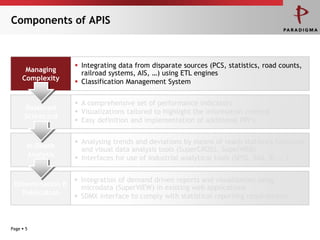
Components of APIS


                    Integrating data from disparate sources (PCS, statistics, road counts,
      Managing       railroad systems, AIS, …) using ETL engines
     Complexity     Classification Management System


                    A comprehensive set of performance indicators
      Balanced
                    Visualizations tailored to highlight the information content
      Scorecard
                    Easy definition and implementation of additional PPI„s


                    Analysing trends and deviations by means of reach statistics functions
       In-Depth      and visual data analysis tools (SuperCROSS, SuperWEB)
       Analysis     Interfaces for use of industrial analytical tools (SPSS, SAS, R, … )


                  Integration of demand driven reports and visualization using
 Dissemination &   microdata (SuperVIEW) in existing web applications
   Publication    SDMX interface to comply with statistical reporting requirements


Page  5
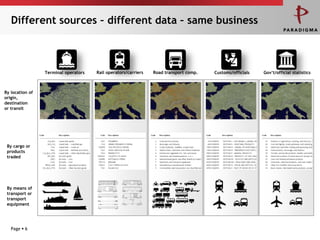
Different sources – different data – same business


                 Terminal operators   Rail operators/carriers   Road transport comp.   Customs/officials   Gov‘t/official statistics


By location of
origin,
destination
or transit


 By cargo or
 products
 traded


 By means of
 transport or
 transport
 equipment


   Page  6
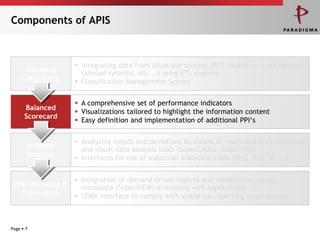
Components of APIS


                    Integrating data from disparate sources (PCS, statistics, road counts,
      Managing       railroad systems, AIS, …) using ETL engines
     Complexity     Classification Management System


                    A comprehensive set of performance indicators
      Balanced
                    Visualizations tailored to highlight the information content
      Scorecard
                    Easy definition and implementation of additional PPI„s


                    Analysing trends and deviations by means of reach statistics functions
       In-Depth      and visual data analysis tools (SuperCROSS, SuperWEB)
       Analysis     Interfaces for use of industrial analytical tools (SPSS, SAS, R, … )


                  Integration of demand driven reports and visualization using
 Dissemination &   microdata (SuperVIEW) in existing web applications
   Publication    SDMX interface to comply with statistical reporting requirements


Page  7
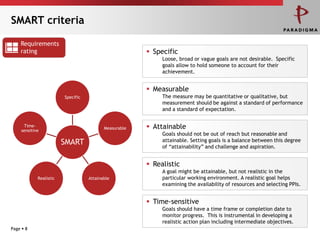
SMART criteria

    Requirements
    rating                                               Specific
                                                             Loose, broad or vague goals are not desirable. Specific
                                                             goals allow to hold someone to account for their
                                                             achievement.


                                                         Measurable
                         Specific                            The measure may be quantitative or qualitative, but
                                                             measurement should be against a standard of performance
                                                             and a standard of expectation.


      Time-
     sensitive
                                           Measurable    Attainable
                                                             Goals should not be out of reach but reasonable and
                         SMART                               attainable. Setting goals is a balance between this degree
                                                             of “attainability” and challenge and aspiration.


                                                         Realistic
                                                             A goal might be attainable, but not realistic in the
             Realistic              Attainable               particular working environment. A realistic goal helps
                                                             examining the availability of resources and selecting PPIs.


                                                         Time-sensitive
                                                             Goals should have a time frame or completion date to
                                                             monitor progress. This is instrumental in developing a
                                                             realistic action plan including intermediate objectives.
Page  8
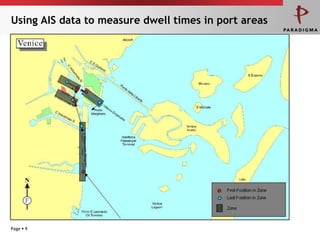
Using AIS data to measure dwell times in port areas


Page  9
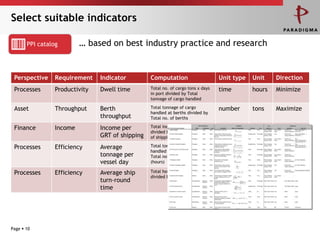
Select suitable indicators

       PPI catalog        … based on best industry practice and research


 Perspective     Requirement    Indicator         Computation                       Unit type   Unit    Direction
 Processes       Productivity   Dwell time        Total no. of cargo tons x days    time        hours   Minimize
                                                  in port divided by Total
                                                  tonnage of cargo handled

 Asset           Throughput     Berth             Total tonnage of cargo            number      tons    Maximize
                                                  handled at berths divided by
                                throughput        Total no. of berths

 Finance         Income         Income per        Total income (expenditure)        number      €       Maximize
                                                  divided by Total GRT (or NRT)
                                GRT of shipping   of shipping

 Processes       Efficiency     Average           Total tonnage of cargo            number      tons    Maximize
                                                  handled divided by (hour)
                                tonnage per       Total no. of vessel days
                                vessel day        (hours)

 Processes       Efficiency     Average ship      Total hours vessel stay in port   time        hours   Minimize
                                                  divided by Total no. of vessels
                                turn-round
                                time


Page  10
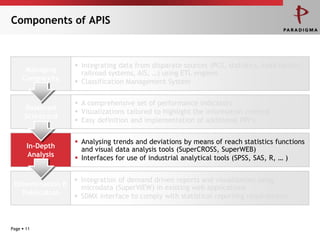
Components of APIS


                    Integrating data from disparate sources (PCS, statistics, road counts,
      Managing       railroad systems, AIS, …) using ETL engines
     Complexity     Classification Management System


                    A comprehensive set of performance indicators
      Balanced
                    Visualizations tailored to highlight the information content
      Scorecard
                    Easy definition and implementation of additional PPI„s


                    Analysing trends and deviations by means of reach statistics functions
       In-Depth      and visual data analysis tools (SuperCROSS, SuperWEB)
       Analysis     Interfaces for use of industrial analytical tools (SPSS, SAS, R, … )


                  Integration of demand driven reports and visualization using
 Dissemination &   microdata (SuperVIEW) in existing web applications
   Publication    SDMX interface to comply with statistical reporting requirements


Page  11
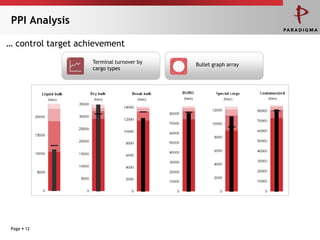
PPI Analysis

… control target achievement
                    Terminal turnover by   Bullet graph array
                    cargo types


 Page  12
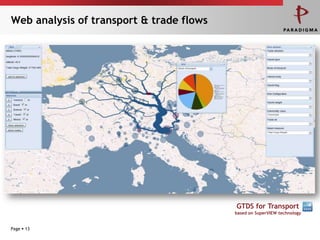
Web analysis of transport & trade flows


                                          GTDS for Transport
                                          based on SuperVIEW technology


Page  13
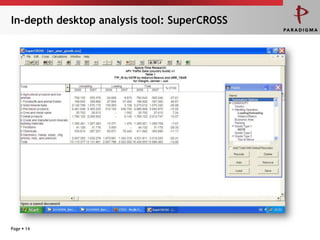
In-depth desktop analysis tool: SuperCROSS


Page  14
Components of APIS


                    Integrating data from disparate sources (PCS, statistics, road counts,
      Managing       railroad systems, AIS, …) using ETL engines
     Complexity     Classification Management System


                    A comprehensive set of performance indicators
      Balanced
                    Visualizations tailored to highlight the information content
      Scorecard
                    Easy definition and implementation of additional PPI„s


                    Analysing trends and deviations by means of reach statistics functions
       In-Depth      and visual data analysis tools (SuperCROSS, SuperWEB)
       Analysis     Interfaces for use of industrial analytical tools (SPSS, SAS, R, … )


                  Integration of demand driven reports and visualization using
 Dissemination &   microdata (SuperVIEW) in existing web applications
   Publication    SDMX interface to comply with statistical reporting requirements


Page  15
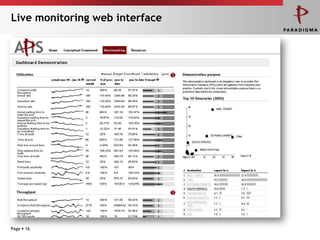
Live monitoring web interface


Page  16
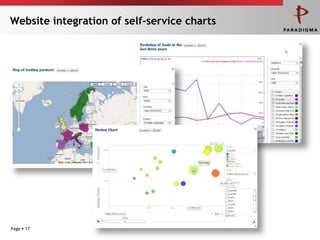
Website integration of self-service charts


Page  17
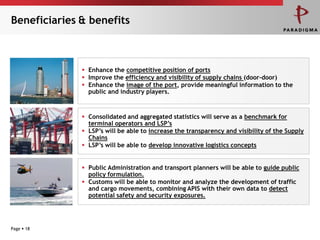
Beneficiaries & benefits


               Enhance the competitive position of ports
               Improve the efficiency and visibility of supply chains (door-door)
               Enhance the image of the port, provide meaningful information to the
                public and industry players.


               Consolidated and aggregated statistics will serve as a benchmark for
                terminal operators and LSP’s
               LSP’s will be able to increase the transparency and visibility of the Supply
                Chains
               LSP’s will be able to develop innovative logistics concepts


               Public Administration and transport planners will be able to guide public
                policy formulation.
               Customs will be able to monitor and analyze the development of traffic
                and cargo movements, combining APIS with their own data to detect
                potential safety and security exposures.


Page  18
APIS Hallmarks & Differentiators

            Seamless integration with existing PCS and other datasources, without
  1         impacting the performance of the operational systems

            A comprehensive and consolidated view of all essential aspects of a ports
  2         business ready for analysis and reporting

            Enabling different user groups within the port community to develop their
  3         own analysis from simple tables to advanced analytics without the
            involvement of IT staff
            Comprehensive set of predefined and extensible indicators which allow
  4         the management of the port to plan, manage and monitor the execution
            of strategies
            Built in and customizable access control features, ensuring the
  5         confidentiality and sensitivity of underlying microdata
            Integrated mechanisms (SuperVIEW, SDMX) to support the publication and
  6         dissemination of statistics, meeting stakeholder expectations and
            complying with international reporting requirements
Page  19
Backup


Page  20
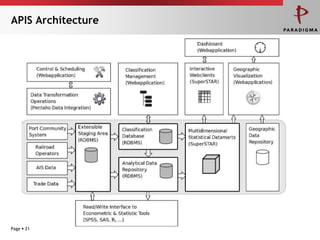
APIS Architecture


Page  21
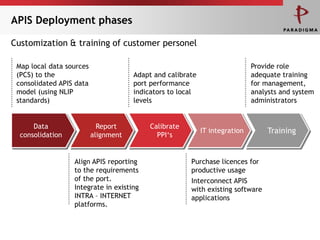
APIS Deployment phases

Customization & training of customer personel

  Map local data sources                                                      Provide role
  (PCS) to the                         Adapt and calibrate                    adequate training
  consolidated APIS data               port performance                       for management,
  model (using NLIP                    indicators to local                    analysts and system
  standards)                           levels                                 administrators


        Data                 Report         Calibrate
    consolidation          alignment          PPI„s
                                                             IT integration        Training


                    Align APIS reporting                Purchase licences for
                    to the requirements                 productive usage
                    of the port.                        Interconnect APIS
                    Integrate in existing               with existing software
                    INTRA – INTERNET                    applications
                    platforms.


Page  22

APIS Briefing

  • 1.
    Analytic Port InformationSystem PARADIGMA, Vienna, August 7, 2012
  • 2.
    PARADIGMA & TransportationSector Statistical production, marketing potential and business development Establish the empirical foundation for Austria's road transport model (Ministry of Transport and Infrastructure) Combine different survey‟s and administrative data sets Production of national road transportation statistics using ICT (R&D project with freight forwarders, truckers and academic institutions) Utilize existing transport management systems and onboard technology Feasibility studies to connect the Baltics with the Adriatic using rail links (Venice/Italy, Szczecin/Poland, EU funded project) Market potential study for transport relations between the Eastern Mediterranean and Central Europe (Venice/Italy) Identify cargo, consigners/consignees, transportation service providers Identify barriers to multimodality ( in Europe) and develop case studies to test their economic and ecological impact (Bologna, EU funded project) Page  2
  • 3.
    PARADIGMA & MaritimePorts Mediterranean ports Port of Livorno and its role in a multimodal transport process Supply chain development of imports of Subaru cars from Japan to Italy, crossing the Alps and to the national car distributor. Port of Ravenna and inland ports in the empty container movement cycle Business process modeling and prototyping to manage the relocation of empty containers. Port of Venice and monthly tracking of cargo movements (maritime, road and rail) Combining data from APV‟s own port community system, with rail shunting data and traffic counts from the highway administration Page  3
  • 4.
     Maritime portsare faced with a plethora of challenges that require decisions founded on solid empirical evidence as opposed to subjective experience only.  In spite of the considerable investment in information technology made in the past, port communities are not satisfied with the quality of the data nor with the decision support.  More often than not information is not current, lacks detail as well as reliability making any analysis, no matter how sophisticated, which is based on such data, dubious at best. … a set of methods and software components to support Port Authorities in their the analytical, planning, monitoring, controlling and publishing work.
  • 5.
    Components of APIS  Integrating data from disparate sources (PCS, statistics, road counts, Managing railroad systems, AIS, …) using ETL engines Complexity  Classification Management System  A comprehensive set of performance indicators Balanced  Visualizations tailored to highlight the information content Scorecard  Easy definition and implementation of additional PPI„s  Analysing trends and deviations by means of reach statistics functions In-Depth and visual data analysis tools (SuperCROSS, SuperWEB) Analysis  Interfaces for use of industrial analytical tools (SPSS, SAS, R, … )  Integration of demand driven reports and visualization using Dissemination & microdata (SuperVIEW) in existing web applications Publication  SDMX interface to comply with statistical reporting requirements Page  5
  • 6.
    Different sources –different data – same business Terminal operators Rail operators/carriers Road transport comp. Customs/officials Gov‘t/official statistics By location of origin, destination or transit By cargo or products traded By means of transport or transport equipment Page  6
  • 7.
    Components of APIS  Integrating data from disparate sources (PCS, statistics, road counts, Managing railroad systems, AIS, …) using ETL engines Complexity  Classification Management System  A comprehensive set of performance indicators Balanced  Visualizations tailored to highlight the information content Scorecard  Easy definition and implementation of additional PPI„s  Analysing trends and deviations by means of reach statistics functions In-Depth and visual data analysis tools (SuperCROSS, SuperWEB) Analysis  Interfaces for use of industrial analytical tools (SPSS, SAS, R, … )  Integration of demand driven reports and visualization using Dissemination & microdata (SuperVIEW) in existing web applications Publication  SDMX interface to comply with statistical reporting requirements Page  7
  • 8.
    SMART criteria Requirements rating  Specific Loose, broad or vague goals are not desirable. Specific goals allow to hold someone to account for their achievement.  Measurable Specific The measure may be quantitative or qualitative, but measurement should be against a standard of performance and a standard of expectation. Time- sensitive Measurable  Attainable Goals should not be out of reach but reasonable and SMART attainable. Setting goals is a balance between this degree of “attainability” and challenge and aspiration.  Realistic A goal might be attainable, but not realistic in the Realistic Attainable particular working environment. A realistic goal helps examining the availability of resources and selecting PPIs.  Time-sensitive Goals should have a time frame or completion date to monitor progress. This is instrumental in developing a realistic action plan including intermediate objectives. Page  8
  • 9.
    Using AIS datato measure dwell times in port areas Page  9
  • 10.
    Select suitable indicators PPI catalog … based on best industry practice and research Perspective Requirement Indicator Computation Unit type Unit Direction Processes Productivity Dwell time Total no. of cargo tons x days time hours Minimize in port divided by Total tonnage of cargo handled Asset Throughput Berth Total tonnage of cargo number tons Maximize handled at berths divided by throughput Total no. of berths Finance Income Income per Total income (expenditure) number € Maximize divided by Total GRT (or NRT) GRT of shipping of shipping Processes Efficiency Average Total tonnage of cargo number tons Maximize handled divided by (hour) tonnage per Total no. of vessel days vessel day (hours) Processes Efficiency Average ship Total hours vessel stay in port time hours Minimize divided by Total no. of vessels turn-round time Page  10
  • 11.
    Components of APIS  Integrating data from disparate sources (PCS, statistics, road counts, Managing railroad systems, AIS, …) using ETL engines Complexity  Classification Management System  A comprehensive set of performance indicators Balanced  Visualizations tailored to highlight the information content Scorecard  Easy definition and implementation of additional PPI„s  Analysing trends and deviations by means of reach statistics functions In-Depth and visual data analysis tools (SuperCROSS, SuperWEB) Analysis  Interfaces for use of industrial analytical tools (SPSS, SAS, R, … )  Integration of demand driven reports and visualization using Dissemination & microdata (SuperVIEW) in existing web applications Publication  SDMX interface to comply with statistical reporting requirements Page  11
  • 12.
    PPI Analysis … controltarget achievement Terminal turnover by Bullet graph array cargo types Page  12
  • 13.
    Web analysis oftransport & trade flows GTDS for Transport based on SuperVIEW technology Page  13
  • 14.
    In-depth desktop analysistool: SuperCROSS Page  14
  • 15.
    Components of APIS  Integrating data from disparate sources (PCS, statistics, road counts, Managing railroad systems, AIS, …) using ETL engines Complexity  Classification Management System  A comprehensive set of performance indicators Balanced  Visualizations tailored to highlight the information content Scorecard  Easy definition and implementation of additional PPI„s  Analysing trends and deviations by means of reach statistics functions In-Depth and visual data analysis tools (SuperCROSS, SuperWEB) Analysis  Interfaces for use of industrial analytical tools (SPSS, SAS, R, … )  Integration of demand driven reports and visualization using Dissemination & microdata (SuperVIEW) in existing web applications Publication  SDMX interface to comply with statistical reporting requirements Page  15
  • 16.
    Live monitoring webinterface Page  16
  • 17.
    Website integration ofself-service charts Page  17
  • 18.
    Beneficiaries & benefits  Enhance the competitive position of ports  Improve the efficiency and visibility of supply chains (door-door)  Enhance the image of the port, provide meaningful information to the public and industry players.  Consolidated and aggregated statistics will serve as a benchmark for terminal operators and LSP’s  LSP’s will be able to increase the transparency and visibility of the Supply Chains  LSP’s will be able to develop innovative logistics concepts  Public Administration and transport planners will be able to guide public policy formulation.  Customs will be able to monitor and analyze the development of traffic and cargo movements, combining APIS with their own data to detect potential safety and security exposures. Page  18
  • 19.
    APIS Hallmarks &Differentiators Seamless integration with existing PCS and other datasources, without 1 impacting the performance of the operational systems A comprehensive and consolidated view of all essential aspects of a ports 2 business ready for analysis and reporting Enabling different user groups within the port community to develop their 3 own analysis from simple tables to advanced analytics without the involvement of IT staff Comprehensive set of predefined and extensible indicators which allow 4 the management of the port to plan, manage and monitor the execution of strategies Built in and customizable access control features, ensuring the 5 confidentiality and sensitivity of underlying microdata Integrated mechanisms (SuperVIEW, SDMX) to support the publication and 6 dissemination of statistics, meeting stakeholder expectations and complying with international reporting requirements Page  19
  • 20.
  • 21.
  • 22.
    APIS Deployment phases Customization& training of customer personel Map local data sources Provide role (PCS) to the Adapt and calibrate adequate training consolidated APIS data port performance for management, model (using NLIP indicators to local analysts and system standards) levels administrators Data Report Calibrate consolidation alignment PPI„s IT integration Training Align APIS reporting Purchase licences for to the requirements productive usage of the port. Interconnect APIS Integrate in existing with existing software INTRA – INTERNET applications platforms. Page  22