Measurement Uncertainty
for testing Laboratories (bias
on gold fire assay)
Author: Selwyn Dickson
What is Measurement Uncertainty(MU)?
Definition: The margin of doubt that exists for the result of any measurement, as well as how
significant the doubt is.
In simple terms: It is the error in measurement , that is unavoidable and should be
accounted for in testing.
Terms associated with MU
• Trueness- Theoretical scientific value that cannot be obtained
practically. E.g. theoretical density of water is 1 g/cmᶟ but rather the
experimental average is 0.9998 g/cmᶟ.
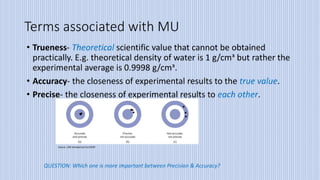
• Accuracy- the closeness of experimental results to the true value.
• Precise- the closeness of experimental results to each other.
Source: CNX Introduction to CHEM
QUESTION: Which one is more important between Precision & Accuracy?
Sources of Uncertainty
2 Types of Errors in MU
• 1.Random Errors
These are caused by unknown and unpredictable changes in the
experiment. This may include:
• temperature changes
• air pressure changes
• other environmental changes etc
2 Types of Errors in MU
• 2.Systematic Errors
These result mostly from measuring devices being worn out or are out of
calibration.
Systematic errors may include:
• Calibration changes
• Instrument errors
• Change of standards used in calibration
• Wrong experiment procedures
• Incorrectly prepared reagents
Example of MU inception in Gold Cupellation
Fire Assay Method
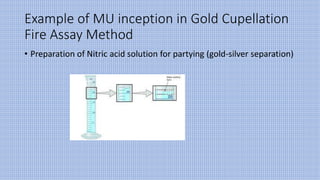
• Preparation of Nitric acid solution for partying (gold-silver separation)
Example of MU inception in Gold Cupellation
Fire Assay Method
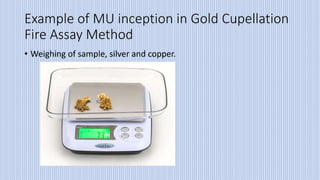
• Weighing of sample, silver and copper.
Example of MU inception in Gold Cupellation
Fire Assay Method
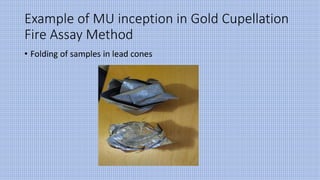
• Folding of samples in lead cones
Example of MU inception in Gold Cupellation
Fire Assay Method
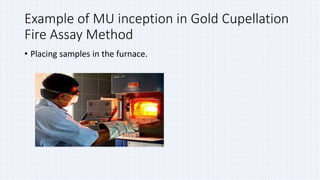
• Placing samples in the furnace.
Example of MU inception in Gold Cupellation
Fire Assay Method
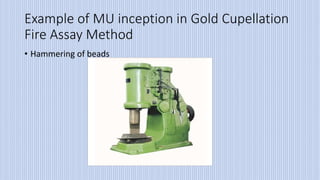
• Hammering of beads
Example of MU inception in Gold Cupellation
Fire Assay Method
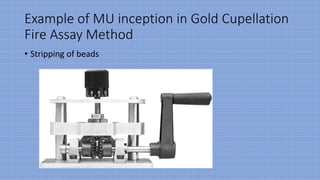
• Stripping of beads
Example of MU inception in Gold Cupellation
Fire Assay Method
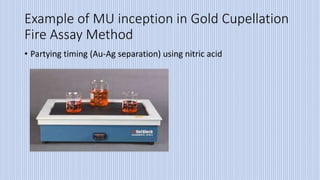
• Partying timing (Au-Ag separation) using nitric acid
Example of MU inception in Gold Cupellation
Fire Assay Method
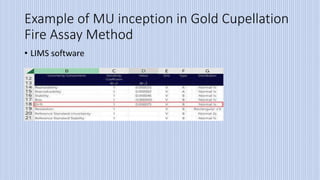
• LIMS software
Example of MU inception in Gold Cupellation
Fire Assay Method
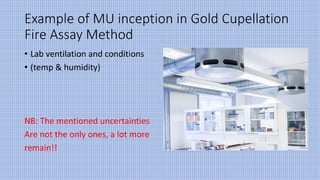
• Lab ventilation and conditions
• (temp & humidity)
NB: The mentioned uncertainties
Are not the only ones, a lot more
remain!!
ISO17025:2017 standard comments on MU
Clause 7.2.1
The laboratory shall use appropriate methods and procedures for all laboratory activities and, where
appropriate, for evaluation of the measurement uncertainty as well as statistical techniques for analysis
of data.
Clause 7.2.2.1.f Method validation shall be as extensive as necessary including:
evaluation of measurement uncertainty of the results based on an understanding of the theoretical
principles of the method and practical experience of the performance of the sampling or test method.
NOTES: According to the ISO standard, It is mandatory to prioritize MU and its evaluation in a testing lab,
especially that is accredited.
7 Basic steps to determine MU
1.Specify the Measurement Process.
2.Identify Sources of Uncertainty.
3.Quantify Sources of Uncertainty.
4.Characterize Sources of Uncertainty.
5.Convert Uncertainties to Standard Deviations.
6.Calculate the Combined Uncertainty.
7.Calculate the Expanded Uncertainty.
General formula for calculation of mu
• Measurement Uncertainty (MU) = √ [∑ (xi – μ)2 / (n * (n-1))]
• Where xi is reading(measured value)
μ is mean
n is number of tests
What is
Standard Expanded Uncertainty?
Combined Expanded Uncertainty?
ASK ME ANYTHING of course not about my
breakfast
THE END
• SAD TO SEE YOU GO
Presentation by Selwyn Dickson

MEASUREMENT UNCERTAINTY (Gold testing labs).pptx

  • 1.
    Measurement Uncertainty for testingLaboratories (bias on gold fire assay) Author: Selwyn Dickson
  • 2.
    What is MeasurementUncertainty(MU)? Definition: The margin of doubt that exists for the result of any measurement, as well as how significant the doubt is. In simple terms: It is the error in measurement , that is unavoidable and should be accounted for in testing.
  • 3.
    Terms associated withMU • Trueness- Theoretical scientific value that cannot be obtained practically. E.g. theoretical density of water is 1 g/cmᶟ but rather the experimental average is 0.9998 g/cmᶟ. • Accuracy- the closeness of experimental results to the true value. • Precise- the closeness of experimental results to each other. Source: CNX Introduction to CHEM QUESTION: Which one is more important between Precision & Accuracy?
  • 4.
  • 5.
    2 Types ofErrors in MU • 1.Random Errors These are caused by unknown and unpredictable changes in the experiment. This may include: • temperature changes • air pressure changes • other environmental changes etc
  • 6.
    2 Types ofErrors in MU • 2.Systematic Errors These result mostly from measuring devices being worn out or are out of calibration. Systematic errors may include: • Calibration changes • Instrument errors • Change of standards used in calibration • Wrong experiment procedures • Incorrectly prepared reagents
  • 7.
    Example of MUinception in Gold Cupellation Fire Assay Method • Preparation of Nitric acid solution for partying (gold-silver separation)
  • 8.
    Example of MUinception in Gold Cupellation Fire Assay Method • Weighing of sample, silver and copper.
  • 9.
    Example of MUinception in Gold Cupellation Fire Assay Method • Folding of samples in lead cones
  • 10.
    Example of MUinception in Gold Cupellation Fire Assay Method • Placing samples in the furnace.
  • 11.
    Example of MUinception in Gold Cupellation Fire Assay Method • Hammering of beads
  • 12.
    Example of MUinception in Gold Cupellation Fire Assay Method • Stripping of beads
  • 13.
    Example of MUinception in Gold Cupellation Fire Assay Method • Partying timing (Au-Ag separation) using nitric acid
  • 14.
    Example of MUinception in Gold Cupellation Fire Assay Method • LIMS software
  • 15.
    Example of MUinception in Gold Cupellation Fire Assay Method • Lab ventilation and conditions • (temp & humidity) NB: The mentioned uncertainties Are not the only ones, a lot more remain!!
  • 16.
    ISO17025:2017 standard commentson MU Clause 7.2.1 The laboratory shall use appropriate methods and procedures for all laboratory activities and, where appropriate, for evaluation of the measurement uncertainty as well as statistical techniques for analysis of data. Clause 7.2.2.1.f Method validation shall be as extensive as necessary including: evaluation of measurement uncertainty of the results based on an understanding of the theoretical principles of the method and practical experience of the performance of the sampling or test method. NOTES: According to the ISO standard, It is mandatory to prioritize MU and its evaluation in a testing lab, especially that is accredited.
  • 17.
    7 Basic stepsto determine MU 1.Specify the Measurement Process. 2.Identify Sources of Uncertainty. 3.Quantify Sources of Uncertainty. 4.Characterize Sources of Uncertainty. 5.Convert Uncertainties to Standard Deviations. 6.Calculate the Combined Uncertainty. 7.Calculate the Expanded Uncertainty.
  • 18.
    General formula forcalculation of mu • Measurement Uncertainty (MU) = √ [∑ (xi – μ)2 / (n * (n-1))] • Where xi is reading(measured value) μ is mean n is number of tests
  • 19.
    What is Standard ExpandedUncertainty? Combined Expanded Uncertainty?
  • 20.
    ASK ME ANYTHINGof course not about my breakfast
  • 21.
    THE END • SADTO SEE YOU GO Presentation by Selwyn Dickson