MEASUREMENT
UNCERTAINTY
Deniz Ertekin
Contents
• What is Measurement Uncertainty?
• How does Measurement Uncertainty Arise?
• When Should Measurement Uncertainty be Assessed?
• How is Measurement Uncertainty Calculated?
• Why Measurement Uncertainty is Important?
What is Measurement Uncertainty?
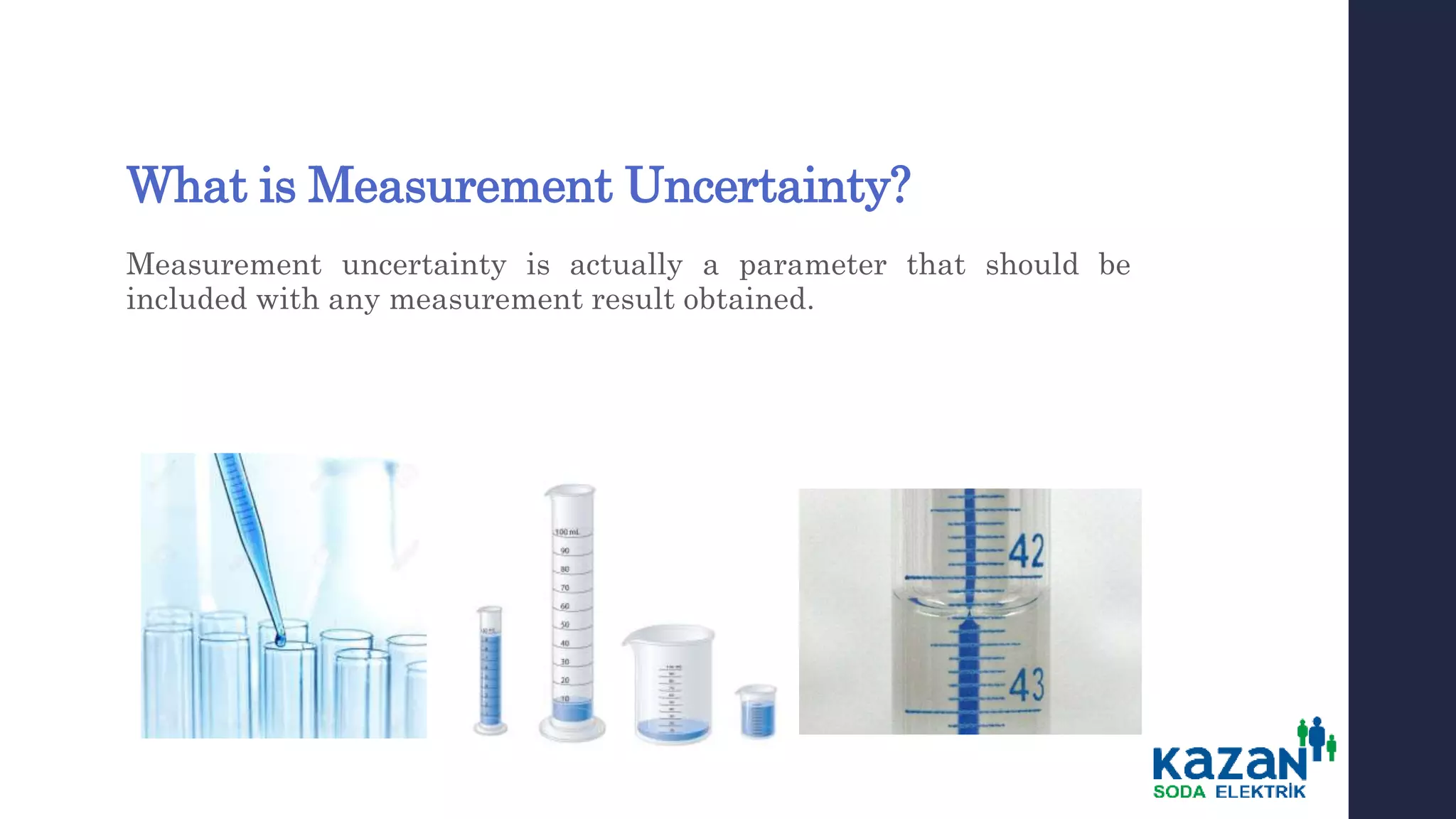
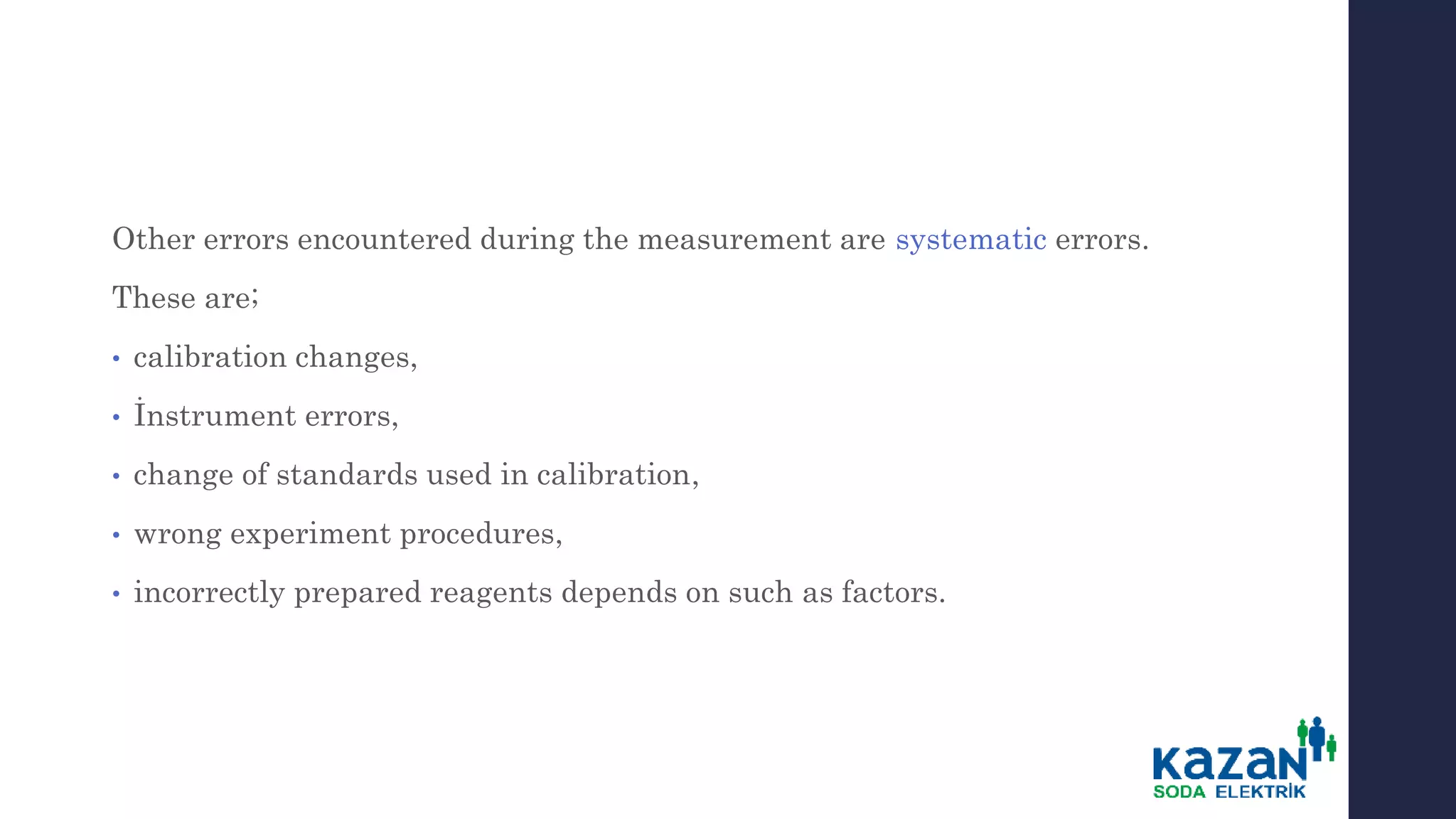
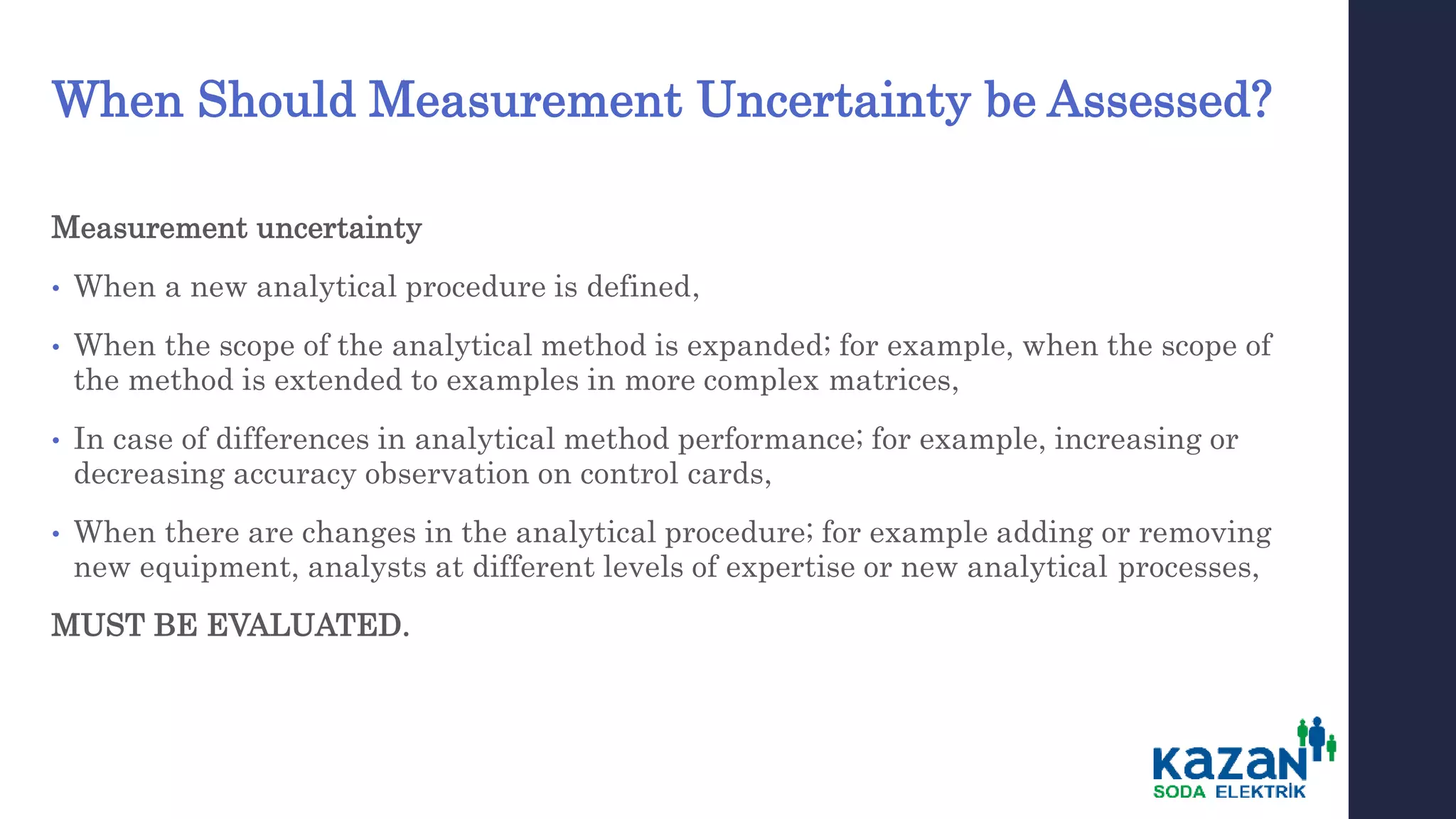
Measurement uncertainty is actually a parameter that should be
included with any measurement result obtained.
SOURCES OF
UNCERTAINTY
Sampling
Storage
Conditions
Device
Effects
Chemical
Purity
Stoichiometry
Measurement
Conditions
Sample
Effect
Calculation
Error
Personal
Effects
Random
Effects
How does Measurement Uncertainty Arise?
Some of the errors encountered during the measurement are random
errors.
These are;
• temperature changes,
• air pressure changes,
• the performance of the employee depends on such as factors.
Other errors encountered during the measurement are systematic errors.
These are;
• calibration changes,
• İnstrument errors,
• change of standards used in calibration,
• wrong experiment procedures,
• incorrectly prepared reagents depends on such as factors.
• It affects precision.
• Tekrarların ortalamadan
sapmasına neden olur.
• It can be determined by
repeat measurements
• It can be minimized by good
working techniques; but not
completely eliminated.
• It caused from employees
and equipment.
Systematic Error
• It creates bias, indicates
deviation from the actual
value when the random error
is low.
• Causes all results to be too
high or too low.
• It cannot be determined by
repeat measurements.
• Can be corrected with
standard methods and
materials
• It caused from employees
and equipment.
Random Error
When Should Measurement Uncertainty be Assessed?
Measurement uncertainty
• When a new analytical procedure is defined,
• When the scope of the analytical method is expanded; for example, when the scope of
the method is extended to examples in more complex matrices,
• In case of differences in analytical method performance; for example, increasing or
decreasing accuracy observation on control cards,
• When there are changes in the analytical procedure; for example adding or removing
new equipment, analysts at different levels of expertise or new analytical processes,
MUST BE EVALUATED.
Matrix Differences
• Measurement uncertainties are often different for different matrices.
If the method covers different matrices, measurement uncertainty
calculations for all matrices should be performed separately for each
matrix.
• In order to determine whether the uncertainties of measurement
change with the matrix change, the given accuracy data of the
method is examined. Alert data (such as adaptability or adaptation
standard deviation) is evaluated. If the standard deviations change
with the matrix, the measurement uncertainties must be calculated
separately for each matrix.
Measurement Range / Test Levels
• In order to determine whether the measurement range changes and
measurement uncertainties change, the given accuracy data of the
method is examined. Accuracy data (such as adaptation or standard
deviation of adaptation) are evaluated to determine whether the
measurement uncertainty will vary at different levels (eg.
concentrations)
Measurement Uncertainty
Approaches Based on In-
Laboratory Studies
Model Approach
Single Laboratory
Validation
Approach
Approaches Based on Interlaboratory
Studies
Interlaboratory
Validation
Approach
Proficiency Test
Results Approach
Validation
Validation is a validation study in which the parameters of the method
are determined and examined to determine the suitability of the
method to the relevant performance criteria, or it may be carried out
by interlaboratory studies involving many laboratories.
Laboratories decide which measurement uncertainty method to use. First, it
should be checked whether the measurement uncertainty value or the
measurement uncertainty calculation method is given by the test method or
the legal authority. If such guidance is available, laboratories should at least
and firstly comply.
In the absence of such information in the test method, laboratories can
make the measurement uncertainty by using a method that it deems
appropriate by evaluating the general applications and the data pool
in their hands. In general, it should be noted that all measurement
uncertainty methods are valid, none of them is superior to others. In
addition, it should be noted that each method has weaknesses and
strengths and there may be different measurement uncertainty values
than difference measurement uncertainty methods.
How is Measurement Uncertainty Calculated?
• Experimental laboratories should have procedures to estimate
measurement uncertainty and apply these procedures. In some
cases, the test method makes it impossible to make accurate,
metrological and statistical estimates of measurement uncertainty.
In such cases, the laboratory should at least try to identify all the
components of uncertainty, make the best possible estimate, and
ensure that the written report does not give a false idea of
uncertainty.
Standard Deviation
• Standard deviation is the main criterion of variability.
• Shows how much data is scattered from the average
Accuracy
The accuracy parameter consists of two main components. These are
trueness and precision. Accuracy is the expression of the proximity of
the obtained value and the actual value.
TRUE and PRECISE PRECISE but not TRUE Not PRECISE and
not TRUE
TRUENESS AND PRECISION
Why Measurement Uncertainty is Important?
• Why do we need measurement uncertainty?
• Measurement uncertainty is not a figure added to the measurement
result; is the main part of the measurement result.
• The measurement uncertainty value allows an unbiased and
independent interpretation of the measurement result.
• It can be used to prove the adequacy of the measurement and to
check the quality, taking into consideration the intended use.

Measurement Uncertainty

  • 1.
  • 2.
    Contents • What isMeasurement Uncertainty? • How does Measurement Uncertainty Arise? • When Should Measurement Uncertainty be Assessed? • How is Measurement Uncertainty Calculated? • Why Measurement Uncertainty is Important?
  • 3.
    What is MeasurementUncertainty? Measurement uncertainty is actually a parameter that should be included with any measurement result obtained.
  • 4.
  • 5.
    How does MeasurementUncertainty Arise? Some of the errors encountered during the measurement are random errors. These are; • temperature changes, • air pressure changes, • the performance of the employee depends on such as factors.
  • 6.
    Other errors encounteredduring the measurement are systematic errors. These are; • calibration changes, • İnstrument errors, • change of standards used in calibration, • wrong experiment procedures, • incorrectly prepared reagents depends on such as factors.
  • 7.
    • It affectsprecision. • Tekrarların ortalamadan sapmasına neden olur. • It can be determined by repeat measurements • It can be minimized by good working techniques; but not completely eliminated. • It caused from employees and equipment. Systematic Error • It creates bias, indicates deviation from the actual value when the random error is low. • Causes all results to be too high or too low. • It cannot be determined by repeat measurements. • Can be corrected with standard methods and materials • It caused from employees and equipment. Random Error
  • 8.
    When Should MeasurementUncertainty be Assessed? Measurement uncertainty • When a new analytical procedure is defined, • When the scope of the analytical method is expanded; for example, when the scope of the method is extended to examples in more complex matrices, • In case of differences in analytical method performance; for example, increasing or decreasing accuracy observation on control cards, • When there are changes in the analytical procedure; for example adding or removing new equipment, analysts at different levels of expertise or new analytical processes, MUST BE EVALUATED.
  • 9.
    Matrix Differences • Measurementuncertainties are often different for different matrices. If the method covers different matrices, measurement uncertainty calculations for all matrices should be performed separately for each matrix. • In order to determine whether the uncertainties of measurement change with the matrix change, the given accuracy data of the method is examined. Alert data (such as adaptability or adaptation standard deviation) is evaluated. If the standard deviations change with the matrix, the measurement uncertainties must be calculated separately for each matrix.
  • 10.
    Measurement Range /Test Levels • In order to determine whether the measurement range changes and measurement uncertainties change, the given accuracy data of the method is examined. Accuracy data (such as adaptation or standard deviation of adaptation) are evaluated to determine whether the measurement uncertainty will vary at different levels (eg. concentrations)
  • 11.
    Measurement Uncertainty Approaches Basedon In- Laboratory Studies Model Approach Single Laboratory Validation Approach Approaches Based on Interlaboratory Studies Interlaboratory Validation Approach Proficiency Test Results Approach
  • 12.
    Validation Validation is avalidation study in which the parameters of the method are determined and examined to determine the suitability of the method to the relevant performance criteria, or it may be carried out by interlaboratory studies involving many laboratories.
  • 13.
    Laboratories decide whichmeasurement uncertainty method to use. First, it should be checked whether the measurement uncertainty value or the measurement uncertainty calculation method is given by the test method or the legal authority. If such guidance is available, laboratories should at least and firstly comply.
  • 14.
    In the absenceof such information in the test method, laboratories can make the measurement uncertainty by using a method that it deems appropriate by evaluating the general applications and the data pool in their hands. In general, it should be noted that all measurement uncertainty methods are valid, none of them is superior to others. In addition, it should be noted that each method has weaknesses and strengths and there may be different measurement uncertainty values than difference measurement uncertainty methods.
  • 15.
    How is MeasurementUncertainty Calculated? • Experimental laboratories should have procedures to estimate measurement uncertainty and apply these procedures. In some cases, the test method makes it impossible to make accurate, metrological and statistical estimates of measurement uncertainty. In such cases, the laboratory should at least try to identify all the components of uncertainty, make the best possible estimate, and ensure that the written report does not give a false idea of uncertainty.
  • 16.
    Standard Deviation • Standarddeviation is the main criterion of variability. • Shows how much data is scattered from the average
  • 17.
    Accuracy The accuracy parameterconsists of two main components. These are trueness and precision. Accuracy is the expression of the proximity of the obtained value and the actual value.
  • 18.
    TRUE and PRECISEPRECISE but not TRUE Not PRECISE and not TRUE TRUENESS AND PRECISION
  • 19.
    Why Measurement Uncertaintyis Important? • Why do we need measurement uncertainty? • Measurement uncertainty is not a figure added to the measurement result; is the main part of the measurement result. • The measurement uncertainty value allows an unbiased and independent interpretation of the measurement result. • It can be used to prove the adequacy of the measurement and to check the quality, taking into consideration the intended use.