PRESENTED BY,
MR. KAILASH NAGAR
ASSIST. PROF.
DEPT. OF COMMUNITY HEALTH NSG.
DINSHA PATEL COLLEGE OF NURSING, NADIAD
 Mortality.
 Morbidity.
 Disability.
 Presence & absence or distribution of..
 Medical needs.
 Utilization of health services.
 Demographic variables.
Rate
Ratio
Proportion
 Measures the occurrence of an event or
disease in a given population during a given
period (one Year).
(Birth rate, growth rate, accident rate)
 Usually expressed per 100 or per1000
population.
 It has a time dimension, whereas a
PROPORTION does not.
 A fraction is made up of 2 numbers.
 The top number is called the
NUMERATOR
 and the bottom number is called the
DENOMINATOR.
 In the fraction ¾ the 3 is the numerator
and the 4 is the denominator.
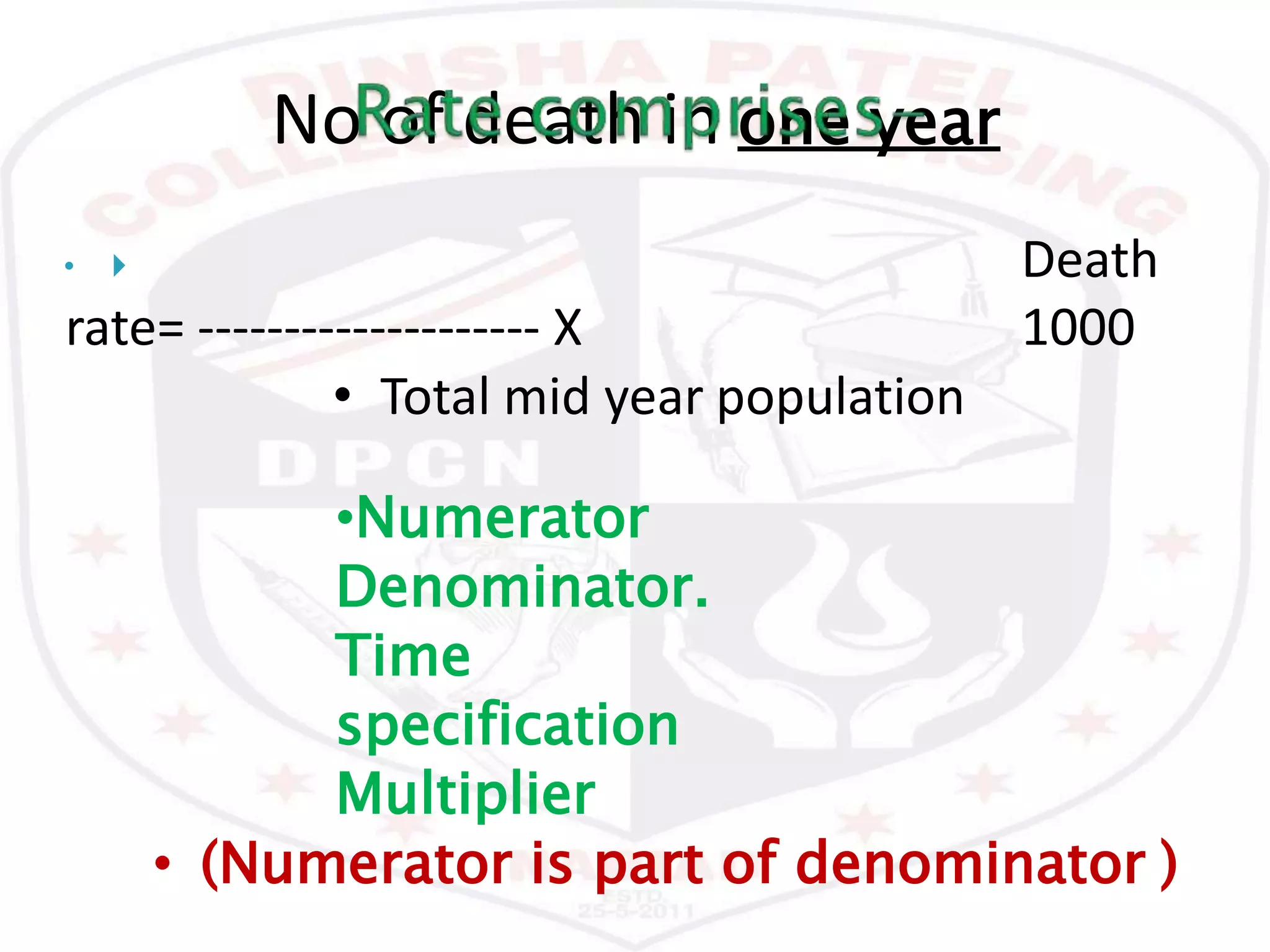
No of death in one year
•  Death
rate= -------------------- X 1000
• Total mid year population
•Numerator
Denominator.
Time
specification
Multiplier
• (Numerator is part of denominator )
 The value obtained by dividing one
quantity by another- X/Y.
 Male to female ratio.
 A ratio often compares two rates,
death rates for women and men at a
given age.
 Ratio also expresses relation of size
between the two quantities.
 Numerator is not part of Denominator.
 Expressed as X / Y.
Doctor : Population ratio.
Male : Female ratio.
WBC : RBC ratio
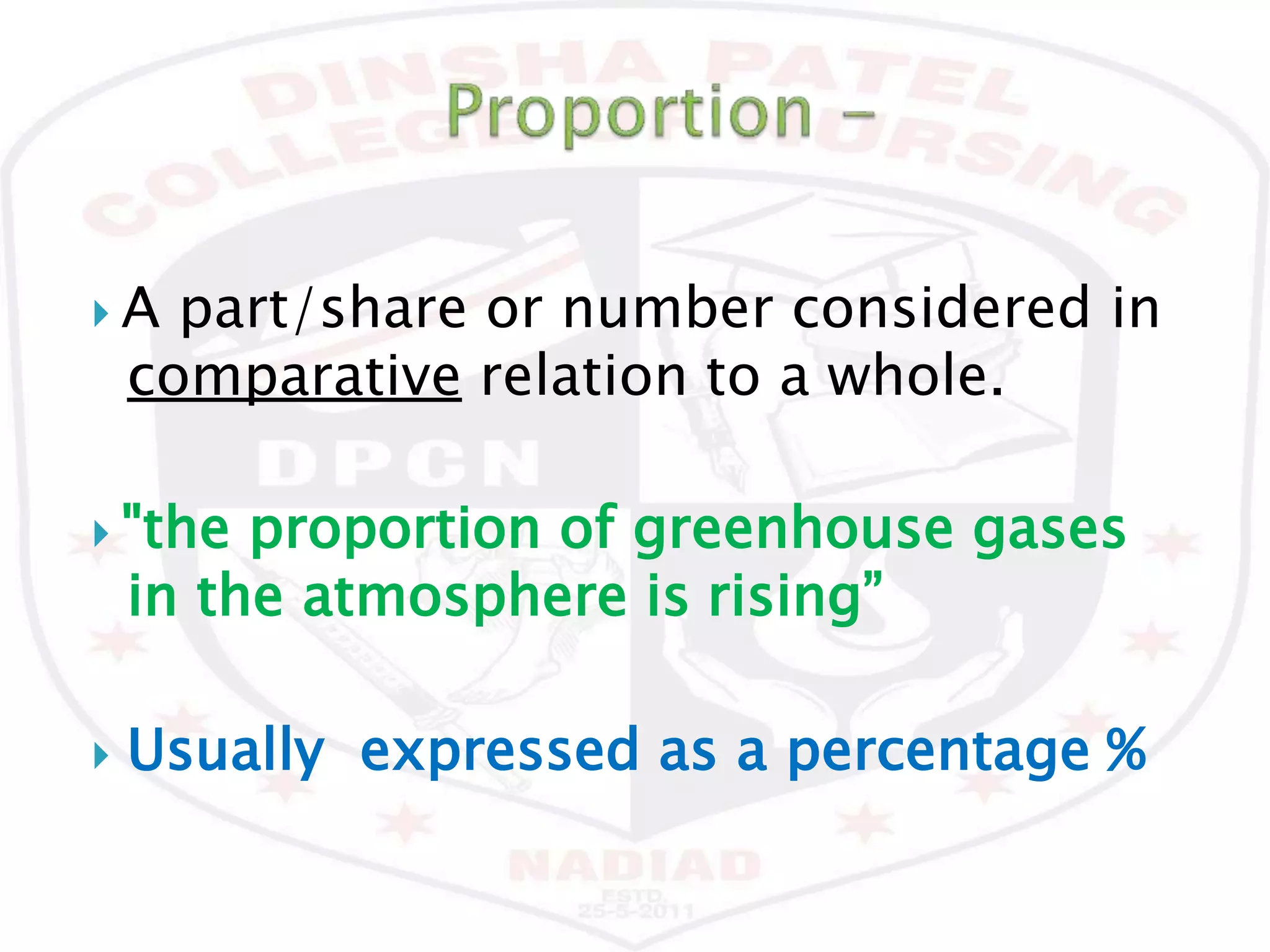
 A part/share or number considered in
comparative relation to a whole.
 "the proportion of greenhouse gases
in the atmosphere is rising”
 Usually expressed as a percentage %
 This is also relation /magnitude between
two quantities, And numerator is always
part of denominator.
 And expressed as percentage
-Proportion of female students .
-Proportion of anemic mothers
(60% mothers are anemic)
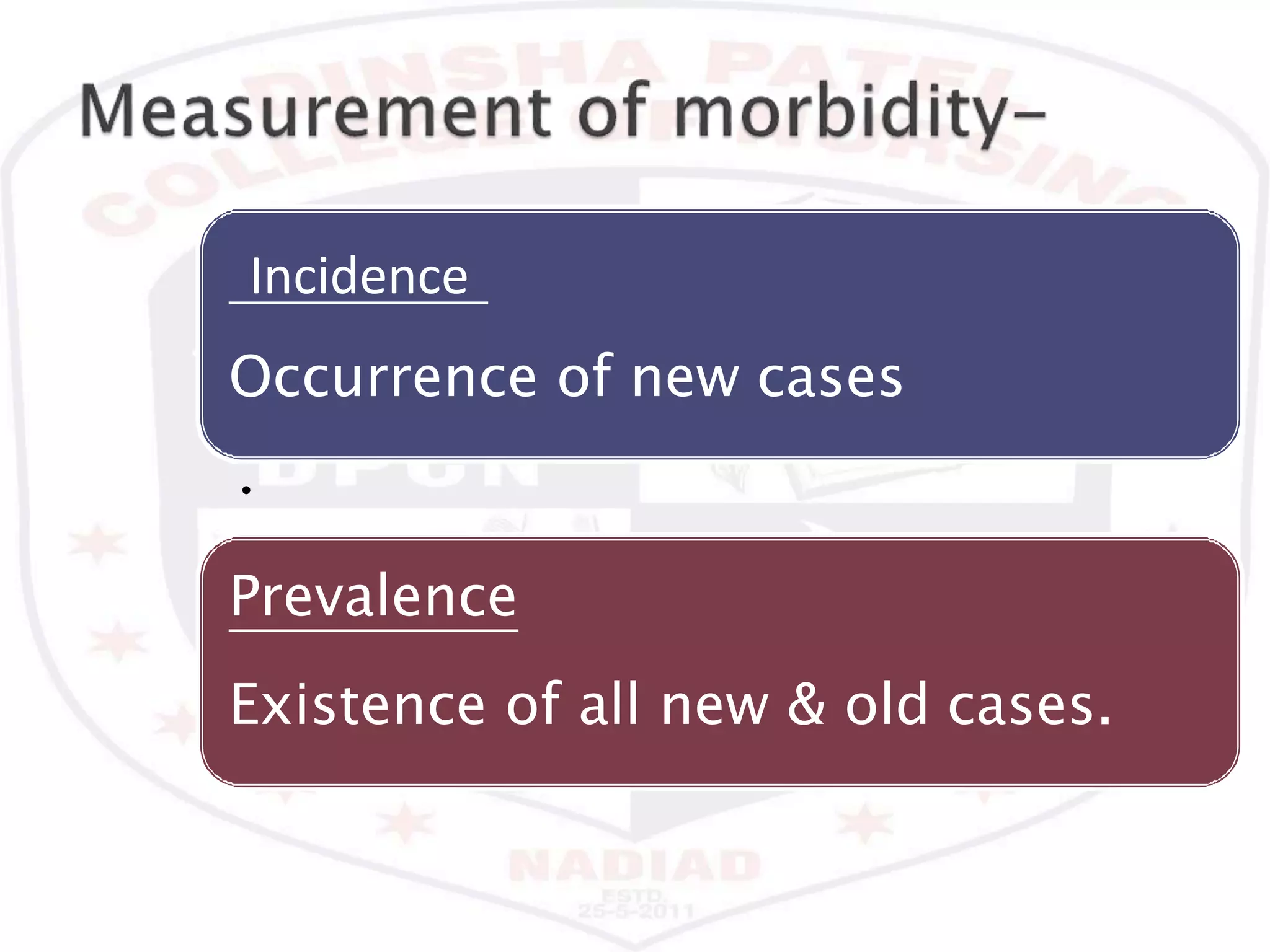
Incidence
Occurrence of new cases
•
Prevalence
Existence of all new & old cases.
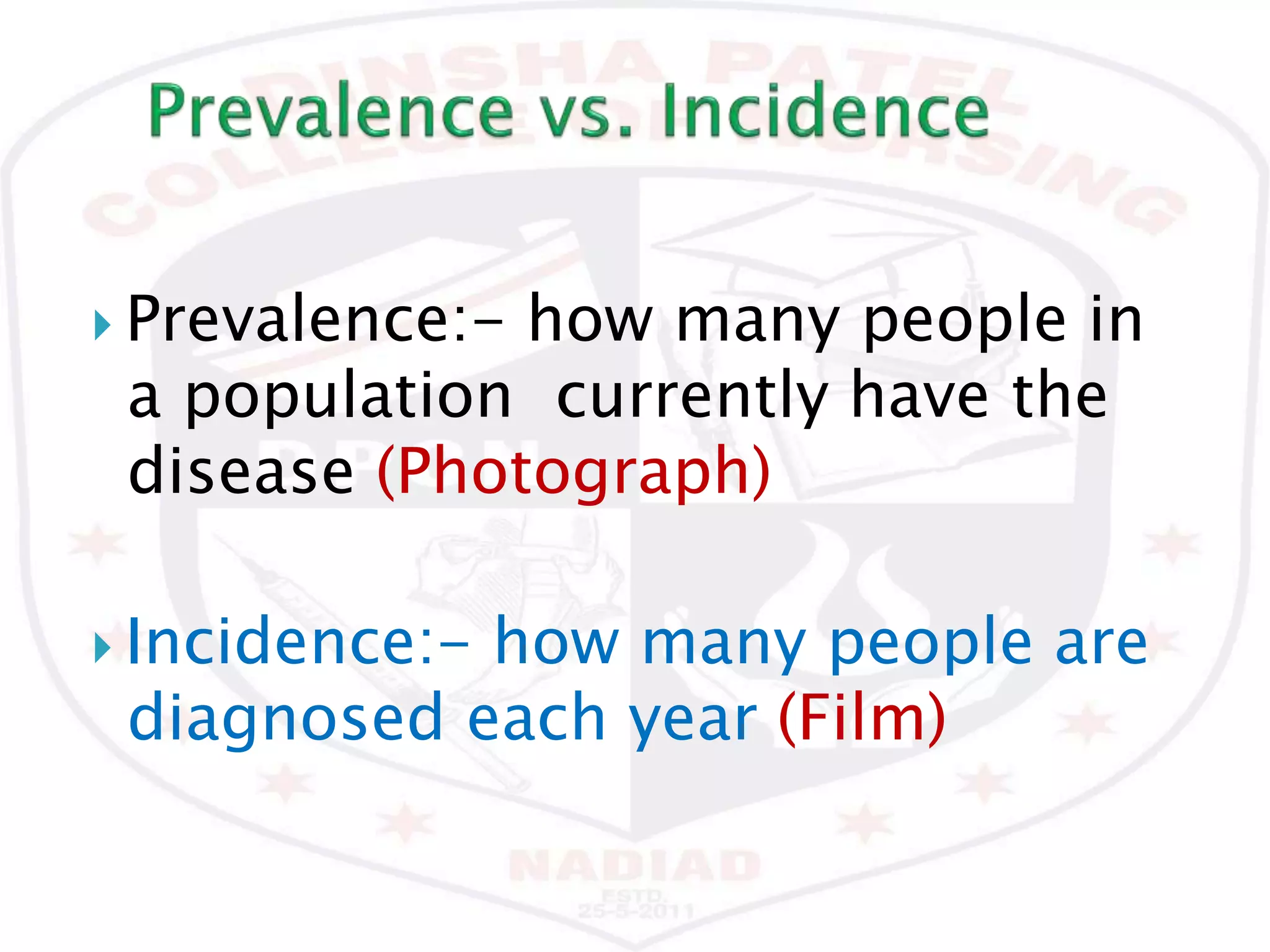
 Prevalence:- how many people in
a population currently have the
disease (Photograph)
 Incidence:- how many people are
diagnosed each year (Film)
Cure rate
New cases
• The rate at which acute
disease is spreading --
used during epidemics
& expressed in %.
Attack rate
• % of exposed persons
developing disease after
primary case exposure
Secondary
attack rate
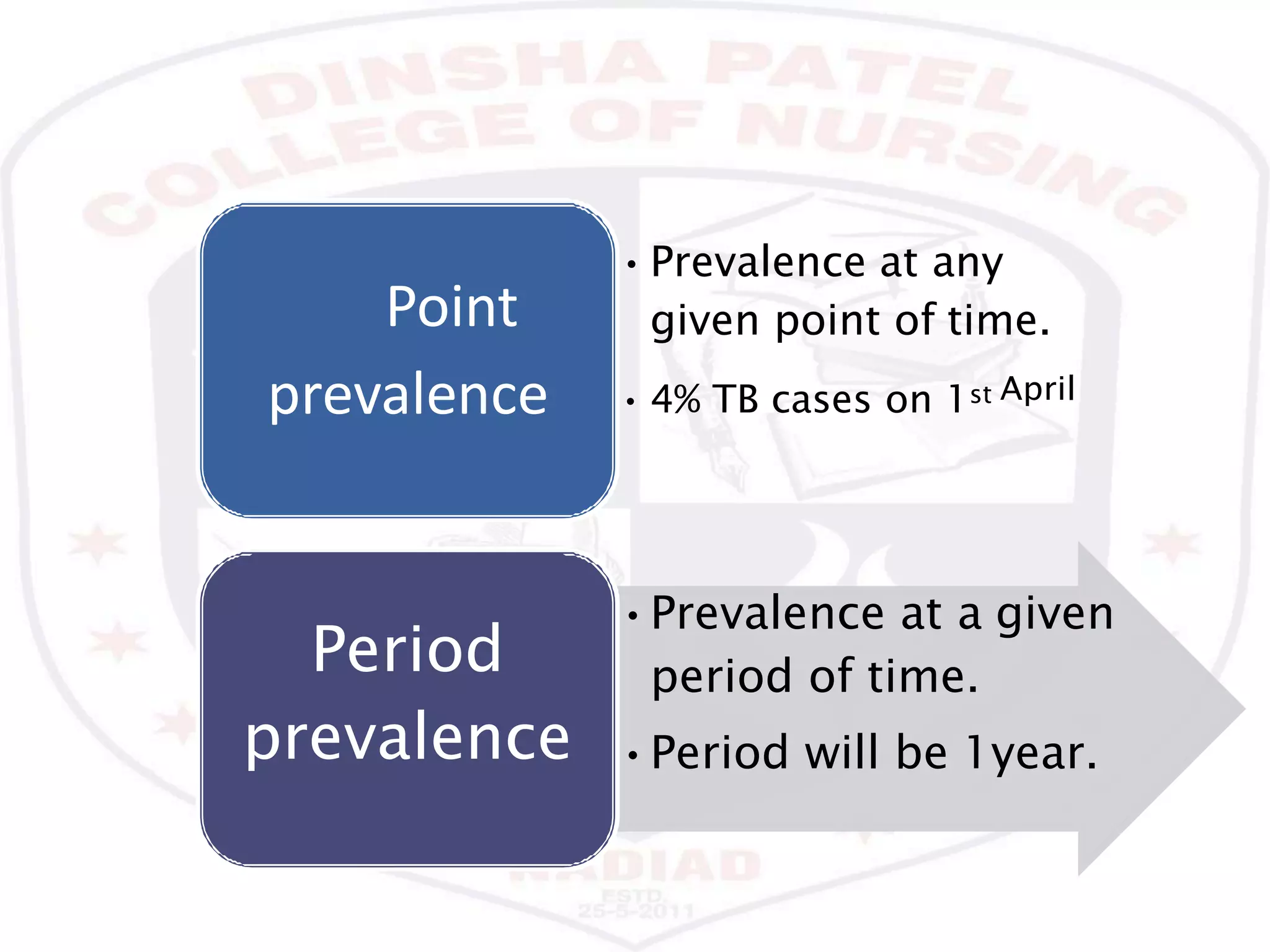
•Prevalence at any
given point of time.
• 4% TB cases on 1st April
Point
prevalence
•Prevalence at a given
period of time.
•Period will be 1year.
Period
prevalence
 Longer duration of the disease.
 Prolongation of life, with treatment.
 If incidence increases.
 Immigration of new cases.
 Better reporting of cases.

Longer
duration of
disease
Incidence
increases.
Prolongation
of life
without
cure.
20
 Shorter duration of diseases.
 Improved cure rate.
 Incidence decreases.
 Emigration of new cases.
 Under reporting of cases.
Improved cure rate.
Short duration of
disease.
Incidence decreases
 Crude Death Rate.
 Specific death rate.
 Case fatality rate.
 Proportional mortality rate.
 Survival rate.
 Standardized death rate.
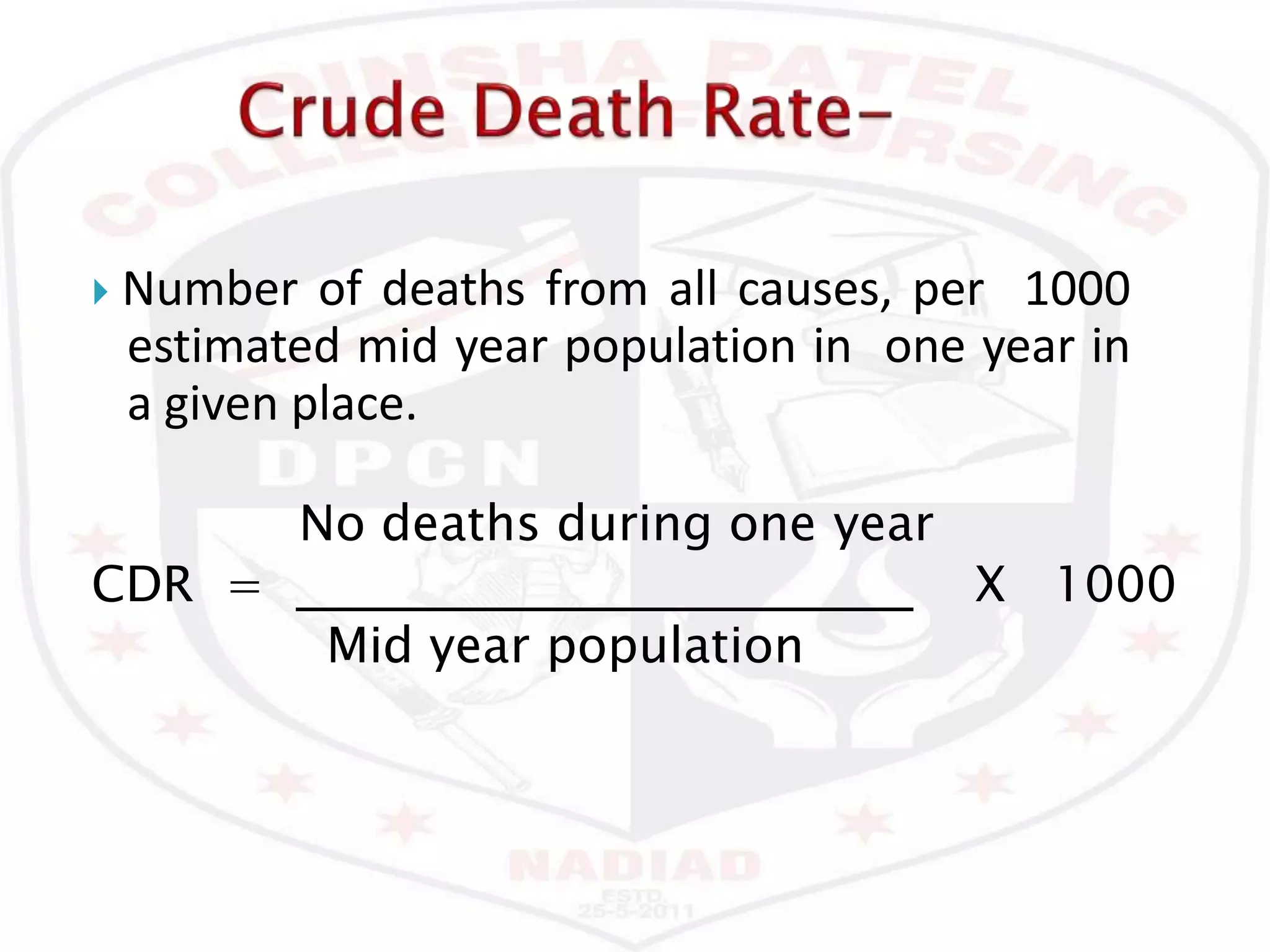
 Number of deaths from all causes, per 1000
estimated mid year population in one year in
a given place.
No deaths during one year
CDR = X 1000
Mid year population
 Cause Specific death ratelike
disease death rate, Road accident…
 Age specific-IMR, Child Mortality rate
 Sex specific death rate – MMR/female
 Period specific death rate–Death in May
 Percentage of particular cases dying
during particular disease epidemic.
 Killing power of disease particularly
acute diseases
No of deaths due to cholera
 CFR= ----------------------- X 100
Total No of cholera cases
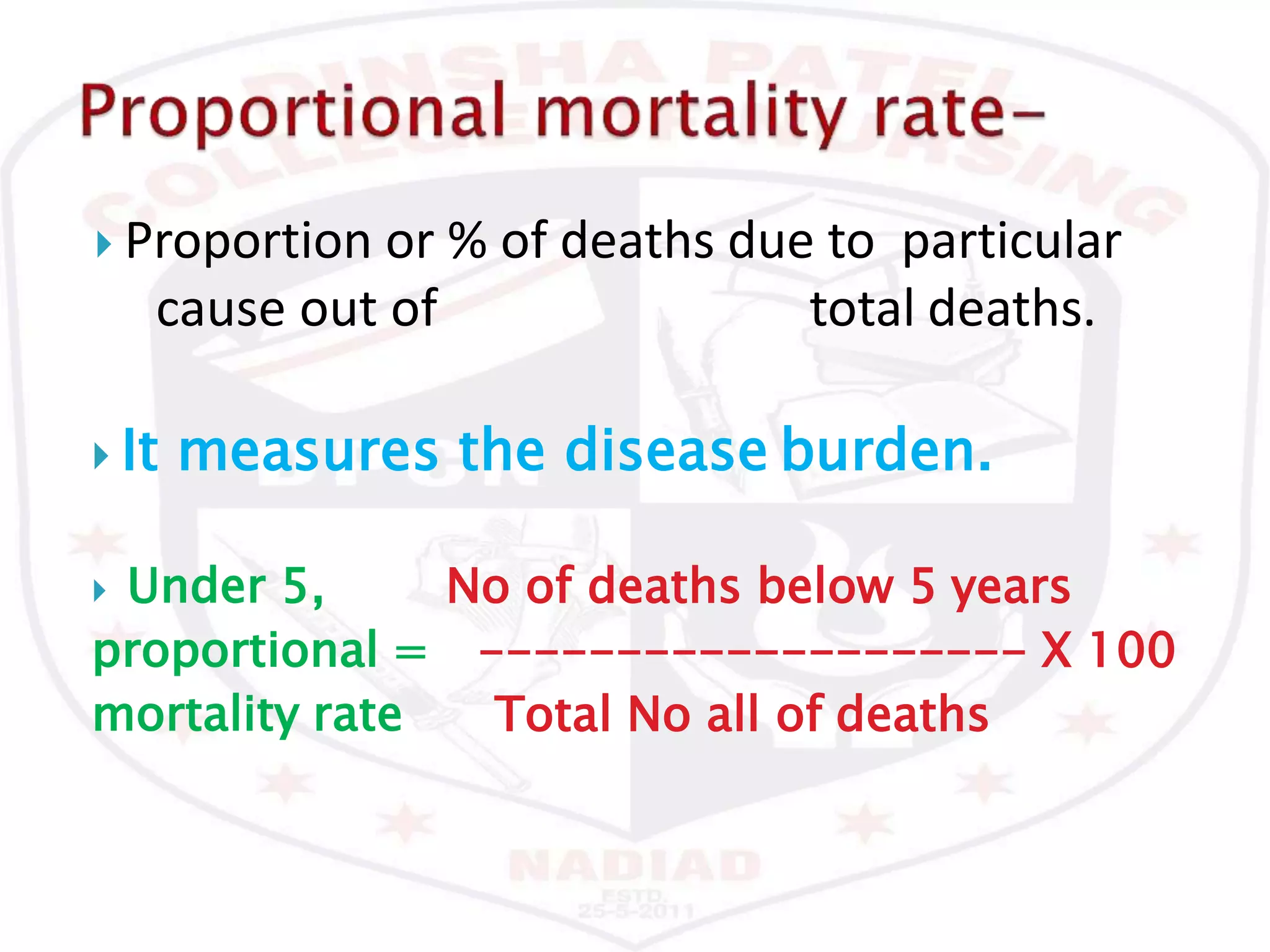
 Proportion or % of deaths due to particular
cause out of total deaths.
 It measures the disease burden.
 Under 5,
proportional =
mortality rate
No of deaths below 5 years
-------------------- X 100
Total No all of deaths
 Percentage of the treated patients remaining
alive at the end of 5 years treatment.
 Yard stick for assessing the standard of
therapy in cancer.

Sur
vival
Rate
pts alive at the end of 5 yrs
= ---------------------- X 100
Total No of pts treated
 CDR can not be useful for comparison.
 Death rate need to be standardized
for comparisons.
 Standardization can be done by-
:adjusting death rate age wise,
:also can be done sex/race wise

Mesurement epidemiology

  • 1.
    PRESENTED BY, MR. KAILASHNAGAR ASSIST. PROF. DEPT. OF COMMUNITY HEALTH NSG. DINSHA PATEL COLLEGE OF NURSING, NADIAD
  • 2.
     Mortality.  Morbidity. Disability.  Presence & absence or distribution of..  Medical needs.  Utilization of health services.  Demographic variables.
  • 3.
  • 4.
     Measures theoccurrence of an event or disease in a given population during a given period (one Year). (Birth rate, growth rate, accident rate)  Usually expressed per 100 or per1000 population.  It has a time dimension, whereas a PROPORTION does not.
  • 5.
     A fractionis made up of 2 numbers.  The top number is called the NUMERATOR  and the bottom number is called the DENOMINATOR.  In the fraction ¾ the 3 is the numerator and the 4 is the denominator.
  • 6.
    No of deathin one year •  Death rate= -------------------- X 1000 • Total mid year population •Numerator Denominator. Time specification Multiplier • (Numerator is part of denominator )
  • 7.
     The valueobtained by dividing one quantity by another- X/Y.  Male to female ratio.  A ratio often compares two rates, death rates for women and men at a given age.
  • 8.
     Ratio alsoexpresses relation of size between the two quantities.  Numerator is not part of Denominator.  Expressed as X / Y. Doctor : Population ratio. Male : Female ratio. WBC : RBC ratio
  • 9.
     A part/shareor number considered in comparative relation to a whole.  "the proportion of greenhouse gases in the atmosphere is rising”  Usually expressed as a percentage %
  • 10.
     This isalso relation /magnitude between two quantities, And numerator is always part of denominator.  And expressed as percentage -Proportion of female students . -Proportion of anemic mothers (60% mothers are anemic)
  • 12.
    Incidence Occurrence of newcases • Prevalence Existence of all new & old cases.
  • 13.
     Prevalence:- howmany people in a population currently have the disease (Photograph)  Incidence:- how many people are diagnosed each year (Film)
  • 14.
  • 15.
  • 16.
    • The rateat which acute disease is spreading -- used during epidemics & expressed in %. Attack rate • % of exposed persons developing disease after primary case exposure Secondary attack rate
  • 17.
    •Prevalence at any givenpoint of time. • 4% TB cases on 1st April Point prevalence •Prevalence at a given period of time. •Period will be 1year. Period prevalence
  • 18.
     Longer durationof the disease.  Prolongation of life, with treatment.  If incidence increases.  Immigration of new cases.  Better reporting of cases. 
  • 19.
  • 20.
     Shorter durationof diseases.  Improved cure rate.  Incidence decreases.  Emigration of new cases.  Under reporting of cases.
  • 21.
    Improved cure rate. Shortduration of disease. Incidence decreases
  • 23.
     Crude DeathRate.  Specific death rate.  Case fatality rate.  Proportional mortality rate.  Survival rate.  Standardized death rate.
  • 24.
     Number ofdeaths from all causes, per 1000 estimated mid year population in one year in a given place. No deaths during one year CDR = X 1000 Mid year population
  • 25.
     Cause Specificdeath ratelike disease death rate, Road accident…  Age specific-IMR, Child Mortality rate  Sex specific death rate – MMR/female  Period specific death rate–Death in May
  • 26.
     Percentage ofparticular cases dying during particular disease epidemic.  Killing power of disease particularly acute diseases No of deaths due to cholera  CFR= ----------------------- X 100 Total No of cholera cases
  • 27.
     Proportion or% of deaths due to particular cause out of total deaths.  It measures the disease burden.  Under 5, proportional = mortality rate No of deaths below 5 years -------------------- X 100 Total No all of deaths
  • 28.
     Percentage ofthe treated patients remaining alive at the end of 5 years treatment.  Yard stick for assessing the standard of therapy in cancer.  Sur vival Rate pts alive at the end of 5 yrs = ---------------------- X 100 Total No of pts treated
  • 29.
     CDR cannot be useful for comparison.  Death rate need to be standardized for comparisons.  Standardization can be done by- :adjusting death rate age wise, :also can be done sex/race wise