MS. JYOTI CHAND
M.SC NURSING 2ND YR
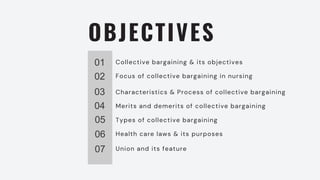
OBJECTIVES
01
02
03
04
05
06
07
Collective bargaining & its objectives
Focus of collective bargaining in nursing
Characteristics & Process of collective bargaining
Merits and demerits of collective bargaining
Types of collective bargaining
Health care laws & its purposes
Union and its feature
INTRODUCTION
In India, the concept of collective bargaining as trade unions was
conceived in the 20th century and attained its significance after
1962.
The term "collective" in the collective negotiations applies to
employers and employees, as they come together and put a joint
effort to establish mutually agreeable terms and conditions for
employment. The phrase "collective bargaining" was coined by
Sydney, Beatrice, and Webb, while Great Britain is known as the
"home of collective bargaining."
DEFINITION
 Collective bargaining is a process of negotiation that involves a set of procedures by which
employee representatives and employer representatives negotiate to obtain a signed
agreement that describes conditions of employment, especially wages, hours, and benefits.
 The National Association of Manufacturers (USA) defined collective bargaining as a
process by which management and labour may explore each other's problems and
viewpoints to develop a framework of employment relations for their mutual benefit.
OBJECTIVES
 To reach an agreement on issues related to employment, status, administrative matters
such as working conditions and safety, wages, salary, autonomy, staffing, benefits, cadre,
promotions, etc.
 To maintain employee-employer relation bilaterally
 To protect the interests of employees through a joint effort
 To negotiate voluntarily to gain mutual benefits and loss by both sides
 To resolve the differences between employees and management through negotiation.
Focus of Collective Bargaining in Nursing
The focus of collective bargaining in nursing is as follows:
 Union recognition and scope of the
agreement
 Management rights
 Union security
 Strikes and lockouts
 Activities and responsibilities
 Career, wages, salary structure
 Working conditions
 Job rights and seniority
 Discipline
 Promotions
 Grievances handling
 Health and safety.
Characteristics of Collective Bargaining
It is a two-way
process where the
employees' and
employers'
representatives
negotiate directly.
01
Bipartite process
02 03 04
Both the parties in the
collective negotiations
should maintain
balance.
Equality
Both negotiate freely
to go bargaining
Voluntarily
negotiation
It is a legal process to
regulate specific
employment-related
issues at the national
and organizational
levels.
Formal process
It is an ongoing and
flexible activity.
01
Flexible
06 07 08
It aims to improve the
employer- employee
relationship in the
organization to
resolve specific
conflicts.
Improvement
It takes place between
the representatives of
employees and
employers
Representation
Collective bargaining
is progressive and
continues to change
over a period and
grows and expands
the way of agreement
Dynamic
05
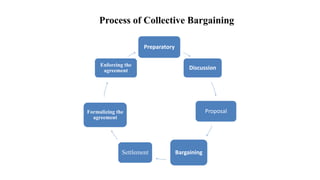
Process of Collective Bargaining
Preparatory
Discussion
Proposal
Bargaining
Settlement
Formalizing the
agreement
Enforcing the
agreement
Process of Collective Bargaining
1. Preparatory phase: During the preliminary period, identify negotiation teams. The
negotiation teams must be representatives of both the parties. The parties should have the
knowledge and skills to discuss and negotiate. The team must identify the exact problem,
gather relevant information related to the topic, and examine the situation and issues for
negotiation before the discussion.
2. Discussion phase: Set an appropriate time and make a conducive environment for
negotiation. Have discussions. Maintain mutual trust and understanding. Both parties must
have good listening skills, ask questions, observe, and summarize.
Process of Collective Bargaining
3. Proposal phase: The proposal phase starts with the initial opening of statements. Both
parties discuss and brainstorm to decide possible options to resolve issues.
4. Bargaining phase: During the bargaining phase, both parties try to solve problems.
5. Settlement phase: During the settlement phase, both parties have a consensus to agree on
a joint decision and negotiated change.
CONT…
6. Formalizing the agreement: After agreeing upon, draft a formal document of agreement.
It should be simple, clear, and concise. Both parties sign the final deal and abide by its terms
and conditions.
7. Enforcing the agreement: To have the deal valid and meaning, enforce or implement it
immediately.
Merits
 It provides an opportunity to negotiate regarding professional and
employment issues.
 It promotes employees' democracy and their participation with
management.
 It helps in maintaining a harmonious relationship between the employee
and the employer.
 It emphasizes on the interests and benefits of employees and management.
 It eliminates unnecessary expenditure and avoids bitterness among
employees and management.
Demerits
 The collective bargaining process may not be always fair.
 Power and politics often influence the decision.
 The immediate consequence of collective bargaining if not fulfilled is strike or
lockout.
Types of Collective Bargaining
Collective bargaining consists of four types, which are listed below:
1. Distributive or conjunctive bargaining: It is a type of negotiation that takes up
economic issues for discussion, such as wages, salaries, and bonuses. It is more competitive
in which one party gains and other party loses.
2. Integrative or cooperative bargaining: In an integrative type of negotiation, both parties
may gain, or at least neither party loses. It tends to be more cooperative.
3. Productive bargaining: In this type, the management has control over the employee-
employer relationship. Substantial benefits are measured based on productivity standards.
4. Composite bargaining: A kind of negotiation wherein both parties agree on wages with
equity.
HEALTH-CARE LAWS
The health-care laws are rules applied to patients,
health-care providers, payers, and vendors of health-
care organizations. These laws are concerning with
the health of the individuals and population at large.
Health-care laws are in the form of statutory
requirements, contract laws, medical malpractice,
medical laws, administrative laws, regulatory laws,
public health laws, and consent. These are related to
practice, client, and health-care providers.
CUS
Purposes
Health-care laws help to achieve the following:
 Establish and meet the health policy and its goals
 Safeguard health issues of the public at large
 Provide occupation safety and health at work
 Protect people from infectious diseases
 Create and establish a health system structure
 Establish a health institution, its mandate, duties, and responsibilities
 Enforce and maintain health-care practice standards
Health-care Laws in India
In India, there are various health-care laws that relate to the following:
Commissioning of the hospitals, e.g. Society Registration Act (1960)
Qualification, practice, and conduct of health professionals, e.g. Medical Council Act (1956), the Indian
Nursing Council Act (1947)
Storage and sale of drugs and safety and efficacy of medications, e.g. Drug and Cosmetic Act, 1945
(Amendment, 1982)
Biomedical Research, e.g. Breeding of and Experiments on Animals (Amendment) Rules (2005)
Management of Patients, e.g. Prenatal Diagnostic Techniques (PNDT) Act (1994), Medical Termination
of Pregnancy (MTP) Act (1997)
Medico legal aspect, e.g. Consumer Protection Act (1986)
Safety of patients, public, and staff, e.g. Biomedical Waste Management Handling Rules (1998 and
2000), Environment Protection Act (1986)
EMPLOYEE UNIONS
• Employee associations and unions are part of human resource administration. Unions and
associations are nothing but the organizations of employees formed to promote and protect
their interests through collective action.
• Trade union is the employee's association formulated to achieve specific purposes to
advance and protect the interests of its members. Webb, Sidney, and Beatrice viewed it as a
wage earners' association formed to maintain and improve the working conditions of its
employees. Trade union is a formal association to protect the interests of its members
through collective actions.
Features of Unions
The five main features of unions are as follows.
 It is an association of employees.
 It is relatively permanent.
 It secures certain economic and social benefits to members.
 Its focus is on bargaining, joint, coordinated action and collective
 It regulates the relationship between employees and management.
Objectives of Unions
 To bargain for wages and salaries
 To insist on the compensation for the work per the nature of the job
 To see the minimum payments paid to the employees
 To ensure that deserving employees get due promotions
 To ensure adequate retirement benefit provisions to meet employee's financial needs for
the rest of the life
 To fight for the provision of proper working place, weekend holidays, sick leaves, free
medical aid, etc.
Objectives of Unions
 To negotiate to improve the social conditions within the services and to improve the human
relations within the organization
 To fight against improper implementation of personnel policies in respect of recruitment,
selection, promotions, transfers, training, etc.
 To work as a guide, consulting authority, and negotiating machinery in overcoming the
personal problems of members.
 To safeguard the organizational health through various methods evolved for grievance
redressing and techniques adopted to reduce absenteeism, turnover, and improve employee
relations.
Purposes
 To solve the problems of the employees
 To secure better wages and working conditions
 To enhancement of self-respect and dignity
• To fulfil social needs and stability of employment and other issues during service
CONCLUSION
Collective bargaining is a negotiating process between the representatives of employers and
employees to regulate working conditions and other issues. It is bipartite, flexible, and a
formal ongoing process where both parties negotiate freely to resolve specific conflicts. The
process is to undergo various phases before reaching the agreement and enforcement of
arbitration. It may be of distributive, integrative, productive, or composite type based on its
outcome.
THANK YOU!!!!

Collective bargaining.pptx.

  • 1.
    MS. JYOTI CHAND M.SCNURSING 2ND YR
  • 2.
    OBJECTIVES 01 02 03 04 05 06 07 Collective bargaining &its objectives Focus of collective bargaining in nursing Characteristics & Process of collective bargaining Merits and demerits of collective bargaining Types of collective bargaining Health care laws & its purposes Union and its feature
  • 3.
    INTRODUCTION In India, theconcept of collective bargaining as trade unions was conceived in the 20th century and attained its significance after 1962. The term "collective" in the collective negotiations applies to employers and employees, as they come together and put a joint effort to establish mutually agreeable terms and conditions for employment. The phrase "collective bargaining" was coined by Sydney, Beatrice, and Webb, while Great Britain is known as the "home of collective bargaining."
  • 4.
    DEFINITION  Collective bargainingis a process of negotiation that involves a set of procedures by which employee representatives and employer representatives negotiate to obtain a signed agreement that describes conditions of employment, especially wages, hours, and benefits.  The National Association of Manufacturers (USA) defined collective bargaining as a process by which management and labour may explore each other's problems and viewpoints to develop a framework of employment relations for their mutual benefit.
  • 5.
    OBJECTIVES  To reachan agreement on issues related to employment, status, administrative matters such as working conditions and safety, wages, salary, autonomy, staffing, benefits, cadre, promotions, etc.  To maintain employee-employer relation bilaterally  To protect the interests of employees through a joint effort  To negotiate voluntarily to gain mutual benefits and loss by both sides  To resolve the differences between employees and management through negotiation.
  • 6.
    Focus of CollectiveBargaining in Nursing The focus of collective bargaining in nursing is as follows:  Union recognition and scope of the agreement  Management rights  Union security  Strikes and lockouts  Activities and responsibilities  Career, wages, salary structure  Working conditions  Job rights and seniority  Discipline  Promotions  Grievances handling  Health and safety.
  • 7.
  • 8.
    It is atwo-way process where the employees' and employers' representatives negotiate directly. 01 Bipartite process 02 03 04 Both the parties in the collective negotiations should maintain balance. Equality Both negotiate freely to go bargaining Voluntarily negotiation It is a legal process to regulate specific employment-related issues at the national and organizational levels. Formal process
  • 9.
    It is anongoing and flexible activity. 01 Flexible 06 07 08 It aims to improve the employer- employee relationship in the organization to resolve specific conflicts. Improvement It takes place between the representatives of employees and employers Representation Collective bargaining is progressive and continues to change over a period and grows and expands the way of agreement Dynamic 05
  • 10.
    Process of CollectiveBargaining Preparatory Discussion Proposal Bargaining Settlement Formalizing the agreement Enforcing the agreement
  • 11.
    Process of CollectiveBargaining 1. Preparatory phase: During the preliminary period, identify negotiation teams. The negotiation teams must be representatives of both the parties. The parties should have the knowledge and skills to discuss and negotiate. The team must identify the exact problem, gather relevant information related to the topic, and examine the situation and issues for negotiation before the discussion. 2. Discussion phase: Set an appropriate time and make a conducive environment for negotiation. Have discussions. Maintain mutual trust and understanding. Both parties must have good listening skills, ask questions, observe, and summarize.
  • 12.
    Process of CollectiveBargaining 3. Proposal phase: The proposal phase starts with the initial opening of statements. Both parties discuss and brainstorm to decide possible options to resolve issues. 4. Bargaining phase: During the bargaining phase, both parties try to solve problems. 5. Settlement phase: During the settlement phase, both parties have a consensus to agree on a joint decision and negotiated change.
  • 13.
    CONT… 6. Formalizing theagreement: After agreeing upon, draft a formal document of agreement. It should be simple, clear, and concise. Both parties sign the final deal and abide by its terms and conditions. 7. Enforcing the agreement: To have the deal valid and meaning, enforce or implement it immediately.
  • 14.
    Merits  It providesan opportunity to negotiate regarding professional and employment issues.  It promotes employees' democracy and their participation with management.  It helps in maintaining a harmonious relationship between the employee and the employer.  It emphasizes on the interests and benefits of employees and management.  It eliminates unnecessary expenditure and avoids bitterness among employees and management.
  • 15.
    Demerits  The collectivebargaining process may not be always fair.  Power and politics often influence the decision.  The immediate consequence of collective bargaining if not fulfilled is strike or lockout.
  • 16.
    Types of CollectiveBargaining Collective bargaining consists of four types, which are listed below: 1. Distributive or conjunctive bargaining: It is a type of negotiation that takes up economic issues for discussion, such as wages, salaries, and bonuses. It is more competitive in which one party gains and other party loses. 2. Integrative or cooperative bargaining: In an integrative type of negotiation, both parties may gain, or at least neither party loses. It tends to be more cooperative. 3. Productive bargaining: In this type, the management has control over the employee- employer relationship. Substantial benefits are measured based on productivity standards. 4. Composite bargaining: A kind of negotiation wherein both parties agree on wages with equity.
  • 17.
    HEALTH-CARE LAWS The health-carelaws are rules applied to patients, health-care providers, payers, and vendors of health- care organizations. These laws are concerning with the health of the individuals and population at large. Health-care laws are in the form of statutory requirements, contract laws, medical malpractice, medical laws, administrative laws, regulatory laws, public health laws, and consent. These are related to practice, client, and health-care providers. CUS
  • 18.
    Purposes Health-care laws helpto achieve the following:  Establish and meet the health policy and its goals  Safeguard health issues of the public at large  Provide occupation safety and health at work  Protect people from infectious diseases  Create and establish a health system structure  Establish a health institution, its mandate, duties, and responsibilities  Enforce and maintain health-care practice standards
  • 19.
    Health-care Laws inIndia In India, there are various health-care laws that relate to the following: Commissioning of the hospitals, e.g. Society Registration Act (1960) Qualification, practice, and conduct of health professionals, e.g. Medical Council Act (1956), the Indian Nursing Council Act (1947) Storage and sale of drugs and safety and efficacy of medications, e.g. Drug and Cosmetic Act, 1945 (Amendment, 1982) Biomedical Research, e.g. Breeding of and Experiments on Animals (Amendment) Rules (2005) Management of Patients, e.g. Prenatal Diagnostic Techniques (PNDT) Act (1994), Medical Termination of Pregnancy (MTP) Act (1997) Medico legal aspect, e.g. Consumer Protection Act (1986) Safety of patients, public, and staff, e.g. Biomedical Waste Management Handling Rules (1998 and 2000), Environment Protection Act (1986)
  • 20.
    EMPLOYEE UNIONS • Employeeassociations and unions are part of human resource administration. Unions and associations are nothing but the organizations of employees formed to promote and protect their interests through collective action. • Trade union is the employee's association formulated to achieve specific purposes to advance and protect the interests of its members. Webb, Sidney, and Beatrice viewed it as a wage earners' association formed to maintain and improve the working conditions of its employees. Trade union is a formal association to protect the interests of its members through collective actions.
  • 21.
    Features of Unions Thefive main features of unions are as follows.  It is an association of employees.  It is relatively permanent.  It secures certain economic and social benefits to members.  Its focus is on bargaining, joint, coordinated action and collective  It regulates the relationship between employees and management.
  • 22.
    Objectives of Unions To bargain for wages and salaries  To insist on the compensation for the work per the nature of the job  To see the minimum payments paid to the employees  To ensure that deserving employees get due promotions  To ensure adequate retirement benefit provisions to meet employee's financial needs for the rest of the life  To fight for the provision of proper working place, weekend holidays, sick leaves, free medical aid, etc.
  • 23.
    Objectives of Unions To negotiate to improve the social conditions within the services and to improve the human relations within the organization  To fight against improper implementation of personnel policies in respect of recruitment, selection, promotions, transfers, training, etc.  To work as a guide, consulting authority, and negotiating machinery in overcoming the personal problems of members.  To safeguard the organizational health through various methods evolved for grievance redressing and techniques adopted to reduce absenteeism, turnover, and improve employee relations.
  • 24.
    Purposes  To solvethe problems of the employees  To secure better wages and working conditions  To enhancement of self-respect and dignity • To fulfil social needs and stability of employment and other issues during service
  • 25.
    CONCLUSION Collective bargaining isa negotiating process between the representatives of employers and employees to regulate working conditions and other issues. It is bipartite, flexible, and a formal ongoing process where both parties negotiate freely to resolve specific conflicts. The process is to undergo various phases before reaching the agreement and enforcement of arbitration. It may be of distributive, integrative, productive, or composite type based on its outcome.
  • 26.

Editor's Notes

  • #11 Both the parties will create a team and identify a problem and collect information r/t problem. Discussion: both the parties will decide time and palace of bargaining as well as they will reach in a mutual trust & understanding. Proposal: open the problem as well as give opinion to solve the problem. SETTELEMENT- problem is solved n both the parties accepted the decision.
  • #12 Both the parties will create a team and identify a problem and collect information r/t problem. Discussion: both the parties will decide time and palace of bargaining as well as they will reach in a mutual trust & understanding.
  • #13 Proposal: open the problem as well as give opinion to solve the problem. SETTELEMENT- problem is solved n both the parties accepted the decision.
  • #17 My gain is ur loss n ur gain is my loss