Public health
surveillance
Dr. Manisha Mandal
Junior Resident
CCM, A.I.I.M.S.
1
Bubonic plaque
Public health authorities boarded the ships from port to prevent
people with bubonic plaque like illness from disembarking
2
Definition
• Public health surveillance is the
continuous, systematic collection, analysis
and interpretation of health-related data
needed for the planning, implementation,
and evaluation of public health practice.
WHO | Public health surveillance [Internet]. WHO. [cited 2016 Nov 4]. Available
from: http://www.who.int/topics/public_health_surveillance/en/
Adapted from: Thacker SB, Birkhead GS. Surveillance. In: Gregg, MB, ed. Field
epidemiology. Oxford, England: Oxford University Press; 2008.
3
Public health core sciences
4
Uses
Immediate detection
of:
• Epidemics
• New health
problems
• Changes in health
practices
• Changes in
distribution of
population at risk
Periodic
dissemination
for
• Estimating health
problem magnitude
• Assessing control
activities
• Setting research
priorities
• Determining risk factors
• Facilitating planning
• Monitoring changes in
health practices
Stored
information for
• Describing natural
history of diseases
• Validating use of
preliminary data
5
6
7
8
SURVEILLANCE TYPES AND
DEFINITION
9
Definitions
1. Indicator: a measurable factor that allows decision makers
to estimate objectively the size of a health problem and
monitor the processes, the products, or the effects of an
intervention on the population
• immunization indicators
2. Active surveillance: a system employing staff members to
regularly contact heath care providers or the population to
seek information about health conditions.
• most accurate and timely information
• expensive
• eg: Measles , Tetanus , Poliomyelitis
10
Definitions
3. Passive surveillance: a system by which a health jurisdiction
receives reports submitted from hospitals, clinics, public health
units, or other sources.
• relatively inexpensive strategy to cover large areas
• depends on people in different institutions to provide data
• data quality and timeliness are difficult to control.
• eg : Diptheria , Hepatitis B , Mumps
4. Routine health information system: a passive system in which
regular reports about diseases and programs are completed by
public health staff members, hospitals, and clinics.
11
Definitions
5. Health information and management system: a passive
system by which routine reports about financial, logistic, and
other processes involved in the administration of the public
health and clinical systems can be used for surveillance.
6. Categorical surveillance: an active or passive system that
focuses on one or more diseases or behaviors of interest to an
intervention program.
• useful for program managers
• inefficient at the district or local level
• eg. HIV, T.b., S.T.D.
12
Definitions
7. Integrated surveillance:
a combination of active and passive systems using a single
infrastructure that gathers information about multiple diseases
or behaviors of interest to several intervention programs
• Eg: a health facility–based system may gather information on
multiple infectious diseases and injuries
 duplication and inefficiency
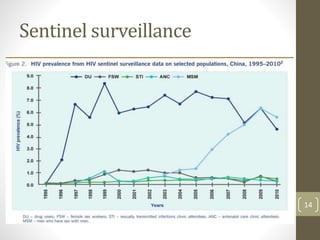
8. Sentinel surveillance:
• missing data
• When data about disease cannot be completed with help of passive
surveillance
• eg: Hib, HIV 13
Sentinel surveillance
14
Definitions
9. Syndromic surveillance: an active or passive system that uses
case definitions that are based entirely on clinical features
without any clinical or laboratory diagnosis
• number of cases of diarrhea rather than cases of cholera
• "rash illness" rather than measles
Inexpensive
Fast
Often the first kind of surveillance begun in a developing country
 lack of specificity
15
16
Syndromic surveillance
17
Overview of Syndromic Surveillance What is Syndromic Surveillance? [Internet]. [cited 2016 Nov 7]. Available from:
http://www.cdc.gov/Mmwr/preview/mmwrhtml/su5301a3.htm
Overview | NSSP | CDC [Internet]. [cited 2016 Nov 7]. Available from: http://www.cdc.gov/nssp/overview.html
Syndromic surveillance
18
Definitions
10. Behavioral risk factor surveillance system (BRFSS):
an active system of repeated surveys that measure behaviors
that are known to cause disease or injury
• Eg: tobacco or alcohol use, unprotected sex, or lack of physical
exercise
• provide a direct measure of their effect in the population
before the anticipated health effects are expected
• provide timely measures of program effectiveness for both
communicable and non-communicable disease interventions.
19
BRFSS
• Premier system of health-related telephone surveys that
collect state data about U.S. residents
• regarding their health-related risk behaviors, chronic health
conditions, and use of preventive services
20CDC - BRFSS - Survey Data & Documentation [Internet]. [cited 2016 Nov 7].
Available from: http://www.cdc.gov/brfss/data_documentation/index.htm
21
BRFSS
22
Other Surveillance types
• Environmental public health surveillance
• Injury surveillance
• Surveillance for biologic terrorism
• Chronic disease surveillance system
23
Objectives and action plan
Objective Action Data System
-Detect
epidemics
Epidemic
response
Early warning
information
Active
surveillance
-Monitor
intervention
programs
Program
monitoring
Program
indicators
Health
information
-Monitor impact
of policy change
Health policy Health
indicators
Health
information
-Monitor health
system
Resource
allocation
Administrative
data
Health
information and
management
24
ATTRIBUTES OF SURVEILLANCE
25
Attributes
1. Completeness :
• Essential in highly transmissible and severe infectious
disease
• To interrupt transmission
2. Representativeness :
• To know the target intervention
• Affected by variation in reporting
3. Predictive value :
• affected by criteria used
• laboratory services
26
Attributes
4. Timeliness :
• to detect outbreaks, monitoring within hours or days
• for chronic diseases, long term over period of years
5. Acceptability
6. Simplicity
7. Flexibility
• change in criteria
8. Stability
9. Interoperability : ability to compare or share information
across multiple surveillance systems
10. Cost 27
ELEMENTS OF SURVEILLANCE
28
Develop case definitions
Establish goals
Acquire tools and clearance for collection,
analysis, and dissemination
Select personnel, data collection
Data analysis
Evaluate surveillance activities
Elements in establishing and maintaining a
surveillance system
29
Case definitions
30
Case definitions
• Objective definition for
• Time period
• Place
• Person
• Categorizing into “susceptible” or “ confirmed “
• Sensitivity V/s Specificity
 Outbreaks
 Self reported, syndromic
approach
 Non epidemic periods
 Laboratory confirmed
31
Data collection
• Reported diseases or syndromes
• Electronic health records (e.g., hospital discharge data)
• Vital records (e.g., birth and death certificates)
• Registries (e.g., cancer, immunization)
• Surveys (e.g., National Health and Nutrition Examination
Survey [NHANES])
32
Global infectious disease surveillance
framework
33
Integrated Disease Surveillance
(IDS) Programme
• Ensures availability of guidelines for integrated disease
surveillance and response
• provides necessary technical support for strengthening
national communicable disease surveillance systems
• through implementation of the Regional Strategy for
Integrated Disease Surveillance and the International health
Regulations.
Integrated Disease Surveillance - WHO | Regional Office for Africa [Internet]. [cited
2016 Nov 6]. Available from: http://www.afro.who.int/en/integrated-disease-
surveillance/
34
Integrated Disease Surveillance
(IDS) Programme
• establishes links with –
National Centres of Excellence (CoE)
Regional and global networks for disease surveillance
35
International health
regulations
Binding international legal
agreement involving 196 countries
across the globe, including all the
Member States of WHO
AIM: prevent, protect against, control and provide a public health response to the
international spread of disease in ways that are commensurate with and restricted
to public health risks, and which avoid unnecessary interference with international
traffic and trade.
36
IDSP
• Launched by Hon’ble Union Minister of Health & Family
Welfare November 2004 for a period upto March 2010
• The project was restructured and extended up to March 2012
• The project continues in the 12th Five year plan as
Programme
• A Central Surveillance Unit (CSU) at Delhi
• State Surveillance Units (SSU) at all State/UT head quarters
and District Surveillance Units (DSU) at all Districts in the
country
37
IDSP
• Data is collected on epidemic prone diseases on weekly basis
(Monday–Sunday)
• The information is collected on three specified reporting
formats, namely “S” (suspected cases), “P” (presumptive
cases) and “L” (laboratory confirmed cases)
• filled by Health Workers, Clinicians and Laboratory staff
• weekly data gives information on the disease trends and
seasonality of diseases.
• Whenever there is a rising trend of illnesses in any area, it is
investigated by the Rapid Response Teams (RRT) to diagnose
and control the outbreak
38
National notifiable diseases
39
Analysis and evaluation
Source: Centers for Disease Control and Prevention (CDC). National Notifiable Diseases Surveillance System and
Supplemental Pertussis Surveillance System and 1922-1949, passive reports to the US Public Health Service. Atlanta, GA:
US Department of Health and Human Services, CDC. Available at: http://www.cdc.gov/pertussis/images/incidence-
graph.jpg.
40
41
References
• Oxford textbook of public health surveillance
• WHO | Public health surveillance [Internet]. WHO. [cited 2016 Nov
4]. Available from:
http://www.who.int/topics/public_health_surveillance/en/
• Integrated Disease Surveillance - WHO | Regional Office for Africa
[Internet]. [cited 2016 Nov 6]. Available from:
http://www.afro.who.int/en/integrated-disease-surveillance/
• Nsubuga P, White ME, Thacker SB, Anderson MA, Blount SB, Broome
CV, et al. Public Health Surveillance: A Tool for Targeting and
Monitoring Interventions. In: Jamison DT, Breman JG, Measham AR,
Alleyne G, Claeson M, Evans DB, et al., editors. Disease Control
Priorities in Developing Countries [Internet]. 2nd ed. Washington
(DC): World Bank; 2006 [cited 2016 Nov 4]. Available from:
http://www.ncbi.nlm.nih.gov/books/NBK11770/ 42
References
• Introduction to Public Health Surveillance|Public Health 101
Series|CDC [Internet]. [cited 2016 Nov 6]. Available from:
http://www.cdc.gov/publichealth101/surveillance.html
• CDC - BRFSS - Survey Data & Documentation [Internet]. [cited 2016
Nov 7]. Available from:
http://www.cdc.gov/brfss/data_documentation/index.htm
• Overview of Syndromic Surveillance What is Syndromic
Surveillance? [Internet]. [cited 2016 Nov 7]. Available from:
http://www.cdc.gov/Mmwr/preview/mmwrhtml/su5301a3.htm
• Overview | NSSP | CDC [Internet]. [cited 2016 Nov 7]. Available
from: http://www.cdc.gov/nssp/overview.html
• WHO | Sentinel Surveillance [Internet]. WHO. [cited 2016 Oct 19].
Available from:
http://www.who.int/immunization/monitoring_surveillance/burden
/vpd/surveillance_type/sentinel/en/ 43

Surveillance

  • 1.
    Public health surveillance Dr. ManishaMandal Junior Resident CCM, A.I.I.M.S. 1
  • 2.
    Bubonic plaque Public healthauthorities boarded the ships from port to prevent people with bubonic plaque like illness from disembarking 2
  • 3.
    Definition • Public healthsurveillance is the continuous, systematic collection, analysis and interpretation of health-related data needed for the planning, implementation, and evaluation of public health practice. WHO | Public health surveillance [Internet]. WHO. [cited 2016 Nov 4]. Available from: http://www.who.int/topics/public_health_surveillance/en/ Adapted from: Thacker SB, Birkhead GS. Surveillance. In: Gregg, MB, ed. Field epidemiology. Oxford, England: Oxford University Press; 2008. 3
  • 4.
  • 5.
    Uses Immediate detection of: • Epidemics •New health problems • Changes in health practices • Changes in distribution of population at risk Periodic dissemination for • Estimating health problem magnitude • Assessing control activities • Setting research priorities • Determining risk factors • Facilitating planning • Monitoring changes in health practices Stored information for • Describing natural history of diseases • Validating use of preliminary data 5
  • 6.
  • 7.
  • 8.
  • 9.
  • 10.
    Definitions 1. Indicator: ameasurable factor that allows decision makers to estimate objectively the size of a health problem and monitor the processes, the products, or the effects of an intervention on the population • immunization indicators 2. Active surveillance: a system employing staff members to regularly contact heath care providers or the population to seek information about health conditions. • most accurate and timely information • expensive • eg: Measles , Tetanus , Poliomyelitis 10
  • 11.
    Definitions 3. Passive surveillance:a system by which a health jurisdiction receives reports submitted from hospitals, clinics, public health units, or other sources. • relatively inexpensive strategy to cover large areas • depends on people in different institutions to provide data • data quality and timeliness are difficult to control. • eg : Diptheria , Hepatitis B , Mumps 4. Routine health information system: a passive system in which regular reports about diseases and programs are completed by public health staff members, hospitals, and clinics. 11
  • 12.
    Definitions 5. Health informationand management system: a passive system by which routine reports about financial, logistic, and other processes involved in the administration of the public health and clinical systems can be used for surveillance. 6. Categorical surveillance: an active or passive system that focuses on one or more diseases or behaviors of interest to an intervention program. • useful for program managers • inefficient at the district or local level • eg. HIV, T.b., S.T.D. 12
  • 13.
    Definitions 7. Integrated surveillance: acombination of active and passive systems using a single infrastructure that gathers information about multiple diseases or behaviors of interest to several intervention programs • Eg: a health facility–based system may gather information on multiple infectious diseases and injuries  duplication and inefficiency 8. Sentinel surveillance: • missing data • When data about disease cannot be completed with help of passive surveillance • eg: Hib, HIV 13
  • 14.
  • 15.
    Definitions 9. Syndromic surveillance:an active or passive system that uses case definitions that are based entirely on clinical features without any clinical or laboratory diagnosis • number of cases of diarrhea rather than cases of cholera • "rash illness" rather than measles Inexpensive Fast Often the first kind of surveillance begun in a developing country  lack of specificity 15
  • 16.
  • 17.
    Syndromic surveillance 17 Overview ofSyndromic Surveillance What is Syndromic Surveillance? [Internet]. [cited 2016 Nov 7]. Available from: http://www.cdc.gov/Mmwr/preview/mmwrhtml/su5301a3.htm Overview | NSSP | CDC [Internet]. [cited 2016 Nov 7]. Available from: http://www.cdc.gov/nssp/overview.html
  • 18.
  • 19.
    Definitions 10. Behavioral riskfactor surveillance system (BRFSS): an active system of repeated surveys that measure behaviors that are known to cause disease or injury • Eg: tobacco or alcohol use, unprotected sex, or lack of physical exercise • provide a direct measure of their effect in the population before the anticipated health effects are expected • provide timely measures of program effectiveness for both communicable and non-communicable disease interventions. 19
  • 20.
    BRFSS • Premier systemof health-related telephone surveys that collect state data about U.S. residents • regarding their health-related risk behaviors, chronic health conditions, and use of preventive services 20CDC - BRFSS - Survey Data & Documentation [Internet]. [cited 2016 Nov 7]. Available from: http://www.cdc.gov/brfss/data_documentation/index.htm
  • 21.
  • 22.
  • 23.
    Other Surveillance types •Environmental public health surveillance • Injury surveillance • Surveillance for biologic terrorism • Chronic disease surveillance system 23
  • 24.
    Objectives and actionplan Objective Action Data System -Detect epidemics Epidemic response Early warning information Active surveillance -Monitor intervention programs Program monitoring Program indicators Health information -Monitor impact of policy change Health policy Health indicators Health information -Monitor health system Resource allocation Administrative data Health information and management 24
  • 25.
  • 26.
    Attributes 1. Completeness : •Essential in highly transmissible and severe infectious disease • To interrupt transmission 2. Representativeness : • To know the target intervention • Affected by variation in reporting 3. Predictive value : • affected by criteria used • laboratory services 26
  • 27.
    Attributes 4. Timeliness : •to detect outbreaks, monitoring within hours or days • for chronic diseases, long term over period of years 5. Acceptability 6. Simplicity 7. Flexibility • change in criteria 8. Stability 9. Interoperability : ability to compare or share information across multiple surveillance systems 10. Cost 27
  • 28.
  • 29.
    Develop case definitions Establishgoals Acquire tools and clearance for collection, analysis, and dissemination Select personnel, data collection Data analysis Evaluate surveillance activities Elements in establishing and maintaining a surveillance system 29
  • 30.
  • 31.
    Case definitions • Objectivedefinition for • Time period • Place • Person • Categorizing into “susceptible” or “ confirmed “ • Sensitivity V/s Specificity  Outbreaks  Self reported, syndromic approach  Non epidemic periods  Laboratory confirmed 31
  • 32.
    Data collection • Reporteddiseases or syndromes • Electronic health records (e.g., hospital discharge data) • Vital records (e.g., birth and death certificates) • Registries (e.g., cancer, immunization) • Surveys (e.g., National Health and Nutrition Examination Survey [NHANES]) 32
  • 33.
    Global infectious diseasesurveillance framework 33
  • 34.
    Integrated Disease Surveillance (IDS)Programme • Ensures availability of guidelines for integrated disease surveillance and response • provides necessary technical support for strengthening national communicable disease surveillance systems • through implementation of the Regional Strategy for Integrated Disease Surveillance and the International health Regulations. Integrated Disease Surveillance - WHO | Regional Office for Africa [Internet]. [cited 2016 Nov 6]. Available from: http://www.afro.who.int/en/integrated-disease- surveillance/ 34
  • 35.
    Integrated Disease Surveillance (IDS)Programme • establishes links with – National Centres of Excellence (CoE) Regional and global networks for disease surveillance 35
  • 36.
    International health regulations Binding internationallegal agreement involving 196 countries across the globe, including all the Member States of WHO AIM: prevent, protect against, control and provide a public health response to the international spread of disease in ways that are commensurate with and restricted to public health risks, and which avoid unnecessary interference with international traffic and trade. 36
  • 37.
    IDSP • Launched byHon’ble Union Minister of Health & Family Welfare November 2004 for a period upto March 2010 • The project was restructured and extended up to March 2012 • The project continues in the 12th Five year plan as Programme • A Central Surveillance Unit (CSU) at Delhi • State Surveillance Units (SSU) at all State/UT head quarters and District Surveillance Units (DSU) at all Districts in the country 37
  • 38.
    IDSP • Data iscollected on epidemic prone diseases on weekly basis (Monday–Sunday) • The information is collected on three specified reporting formats, namely “S” (suspected cases), “P” (presumptive cases) and “L” (laboratory confirmed cases) • filled by Health Workers, Clinicians and Laboratory staff • weekly data gives information on the disease trends and seasonality of diseases. • Whenever there is a rising trend of illnesses in any area, it is investigated by the Rapid Response Teams (RRT) to diagnose and control the outbreak 38
  • 39.
  • 40.
    Analysis and evaluation Source:Centers for Disease Control and Prevention (CDC). National Notifiable Diseases Surveillance System and Supplemental Pertussis Surveillance System and 1922-1949, passive reports to the US Public Health Service. Atlanta, GA: US Department of Health and Human Services, CDC. Available at: http://www.cdc.gov/pertussis/images/incidence- graph.jpg. 40
  • 41.
  • 42.
    References • Oxford textbookof public health surveillance • WHO | Public health surveillance [Internet]. WHO. [cited 2016 Nov 4]. Available from: http://www.who.int/topics/public_health_surveillance/en/ • Integrated Disease Surveillance - WHO | Regional Office for Africa [Internet]. [cited 2016 Nov 6]. Available from: http://www.afro.who.int/en/integrated-disease-surveillance/ • Nsubuga P, White ME, Thacker SB, Anderson MA, Blount SB, Broome CV, et al. Public Health Surveillance: A Tool for Targeting and Monitoring Interventions. In: Jamison DT, Breman JG, Measham AR, Alleyne G, Claeson M, Evans DB, et al., editors. Disease Control Priorities in Developing Countries [Internet]. 2nd ed. Washington (DC): World Bank; 2006 [cited 2016 Nov 4]. Available from: http://www.ncbi.nlm.nih.gov/books/NBK11770/ 42
  • 43.
    References • Introduction toPublic Health Surveillance|Public Health 101 Series|CDC [Internet]. [cited 2016 Nov 6]. Available from: http://www.cdc.gov/publichealth101/surveillance.html • CDC - BRFSS - Survey Data & Documentation [Internet]. [cited 2016 Nov 7]. Available from: http://www.cdc.gov/brfss/data_documentation/index.htm • Overview of Syndromic Surveillance What is Syndromic Surveillance? [Internet]. [cited 2016 Nov 7]. Available from: http://www.cdc.gov/Mmwr/preview/mmwrhtml/su5301a3.htm • Overview | NSSP | CDC [Internet]. [cited 2016 Nov 7]. Available from: http://www.cdc.gov/nssp/overview.html • WHO | Sentinel Surveillance [Internet]. WHO. [cited 2016 Oct 19]. Available from: http://www.who.int/immunization/monitoring_surveillance/burden /vpd/surveillance_type/sentinel/en/ 43

Editor's Notes

  • #2  good after noon everynoon . I am dr. manisha presenting seminar on …....... Types and uses in public health
  • #3 Historically the first use of surveillence system system in public health happenned in time of bububonic. In repubic of venice where patients suffering from plaque where not allowed to enteras it was thoughtto be entry port of dedly disease
  • #14 It should be willing to participate.criteria It serves a relatively large population that has easy access to it. It has medical staff sufficiently specialized to diagnoze, treat and report cases of the disease under surveillance. It has a high-quality diagnostic laboratory.  
  • #20 STEPS MOSULE OF who FOR NON COMMUNICABLE DISEASE , monitor, questionnaire , measurements and laboratory reports
  • #30 Explain abt goals